At DataWeave, data security isn’t just about compliance—it’s about enabling peace of mind and better decision-making for our customers. Our customers rely on us not just for competitive and market intelligence but also for the seamless integration of critical data sources into their decision-making frameworks. To achieve this, we have built a security-first infrastructure that ensures organizations can confidently leverage both external and internal data without compromising privacy or protection.
Secure Data Integration: The Foundation of Smarter Decisions
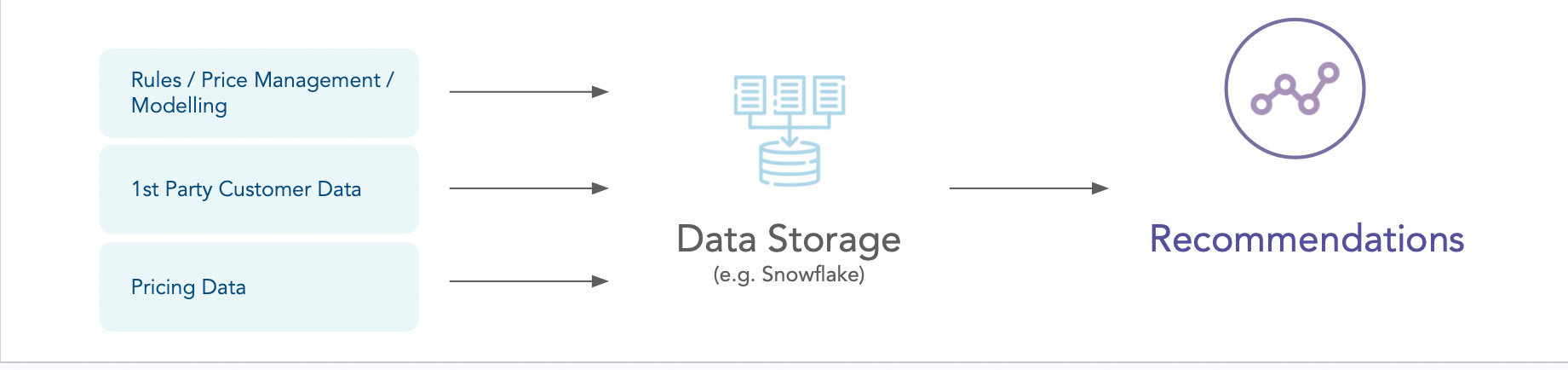
Effective decision-making in today’s digital commerce landscape depends on combining multiple data sources—including first-party customer data, pricing intelligence, and business rules—into a unified framework. However, without the right security measures in place, businesses often struggle to operationalize this data effectively.
At DataWeave, we eliminate this challenge by offering:
Integration with Leading Data Storage Solutions: Our platform seamlessly connects with data lakes and warehouses like AWS S3 and Snowflake, ensuring that businesses can easily ingest and analyze our data in real time.
Support for Sandboxed Environments & Data Clean Rooms: Organizations can securely merge internal and external datasets without compromising confidentiality, unlocking deeper insights for pricing and business strategies.
Automated Data Ingestion & Management: We simplify the process of integrating first-party data alongside competitive insights, allowing customers to focus on execution rather than infrastructure management.
Our Purpose-Built Security Framework
Handling millions of data points daily demands a security framework that is not only robust but also scalable and adaptable to evolving threats. DataWeave’s multi-tenant architecture ensures seamless data security without compromising operational efficiency.
Multi-Tenant Architecture: Our system allows multiple customers to share the same application infrastructure while maintaining complete data isolation and security.
Tenants share infrastructure and computing resources but remain logically isolated.
Application-level controls ensure privacy while maximizing cost efficiency.
Centralized updates, maintenance, and easy scalability for new tenants.
End-to-End Encryption & Access Controls: Every piece of data is encrypted both in transit and at rest. Role-based access controls (RBAC) restrict visibility to only authorized personnel, ensuring minimal risk of unauthorized data access.
Active Monitoring & Automated Compliance Management: We leverage automated access controls that adjust permissions dynamically as organizational roles evolve, ensuring that compliance is continuously maintained.
Certifications That Inspire Confidence
Data security is at the core of everything we do. Our compliance with the highest industry standards ensures that businesses can trust us with their sensitive data.
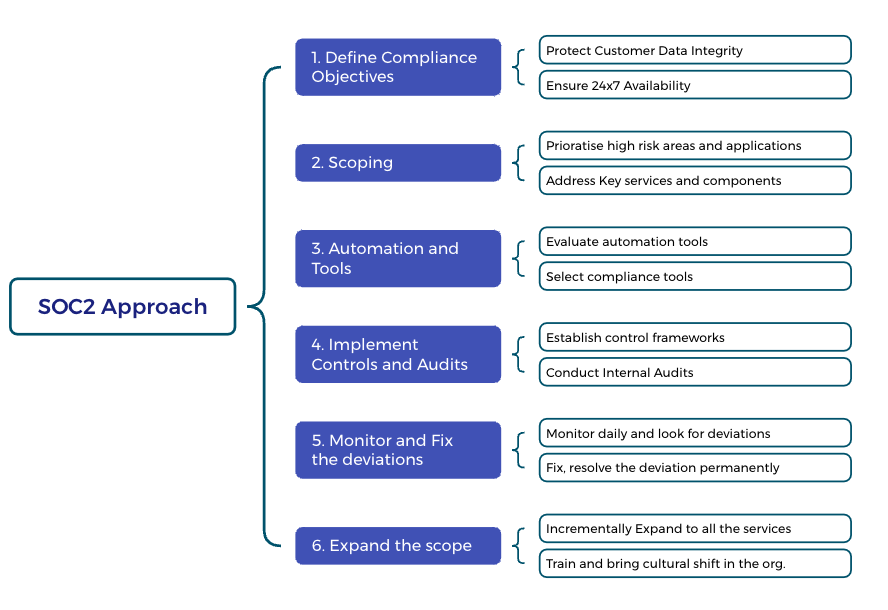
SOC 2 Type II Certification: DataWeave’s SOC 2 compliance is a testament to our commitment to stringent security protocols. This certification guarantees that we adhere to strict standards in data protection, availability, and confidentiality.
We implement a phased approach to security improvement:
Prioritizing Critical Systems: To maximize impact, we prioritized systems that had the highest data security relevance and expanded the coverage thereafter. By addressing these priority areas, we were able to make meaningful security improvements early in the process.
Automating Monitoring and Compliance: Partnering with Sprinto streamlined the compliance journey by automating key processes. This included real-time monitoring of our cloud environments, automated generation of audit-ready evidence, and integration with critical systems like AWS, Bitbucket, and Jira. These enhancements ensured efficient management of compliance requirements while reducing the burden on our teams.
Fostering a Culture of Shared Responsibility: We conducted organization-wide training sessions to embed compliance as a shared responsibility across all teams. By educating employees on the importance of security practices and providing them with the tools to manage compliance autonomously, we established a security-first mindset throughout the company.
This systematic method allowed us to deliver immediate improvements while aligning long-term practices with industry’s best standards.
What This Means for Our Customers
By combining robust security with seamless data integration, DataWeave empowers businesses to:
Optimize Price Management & Modelling: With secure access to real-time data, organizations can make informed pricing decisions that enhance profitability and market competitiveness.
Run Advanced Simulations & Testing: Reliable, secure data enables businesses to model various pricing and assortment strategies before implementation, reducing risks and maximizing returns.
Uncompromised Data Security: SOC 2 Type II compliance ensures stringent protocols to protect your data at every stage.
Simplified Vendor Processes: Verified security certifications reduce friction during due diligence and onboarding, making it easier to partner with us.
Aligned Standards: Our adherence to industry benchmarks reflects our commitment to meeting your expectations as a trusted technology partner.
Scalable Operations: Expand across regions while maintaining full confidence in data privacy and security.
Secure Collaboration: Share insights across teams with tools designed to protect sensitive information.
Our customers are increasingly looking to integrate their internal datasets with the external competitive intelligence provided by DataWeave. This can be a complex and risky process without the right security measures in place. We remove these roadblocks by providing a secure, scalable infrastructure designed to help businesses unify data without security concerns.
By ensuring seamless compatibility with key data storage platforms, such as Snowflake and AWS S3, we enable organizations to consolidate valuable first-party data with timely market insights. This integration empowers businesses to refine their pricing, assortment, and digital shelf strategies, thereby driving superior customer experiences—without the headaches of data security risks.
Security remains a top priority in everything we do. Our SOC 2 Type II-certified framework enforces rigorous encryption, access controls, and real-time compliance monitoring. We take on the burden of data security so our customers can focus on innovation and growth.
With DataWeave, businesses can confidently leverage secure data-driven decision-making to unlock new opportunities, optimize operations, and scale without compromise.
Black Friday and Cyber Monday are major retail events in Canada, with 43% and 29% of the population making purchases during these sales respectively, according to a YouGov report. Consumer electronics continue to lead the Canadian retail market during these events, with 55% of surveyed shoppers choosing to buy tech products on Black Friday. Household appliances come in second, with 25% of shoppers opting for these items, while 18% prefer to shop for furniture deals.
These statistics highlight the importance of delivering value during the Thanksgiving sales week. Retailers must cater to shoppers’ expectations with competitive pricing, attractive deals, and a seamless shopping experience. So, what unique offerings did Canadian retailers present to shoppers this season?
To understand the pricing and discount dynamics during BFCM 2024 in Canada, DataWeave analyzed discounts across leading consumer electronics and home & furniture retailers. Using our AI-powered pricing intelligence platform, we analyzed 37,108 SKUs across these categories for major retailers including Amazon, Walmart, Best Buy, Home Depot, and Canadian Tire from the 10th to 29th November. We focused on the top 500 products ranked for each search keyword on each retail site, using targeted terms aligned with categories like “sofa” and “wearables”.
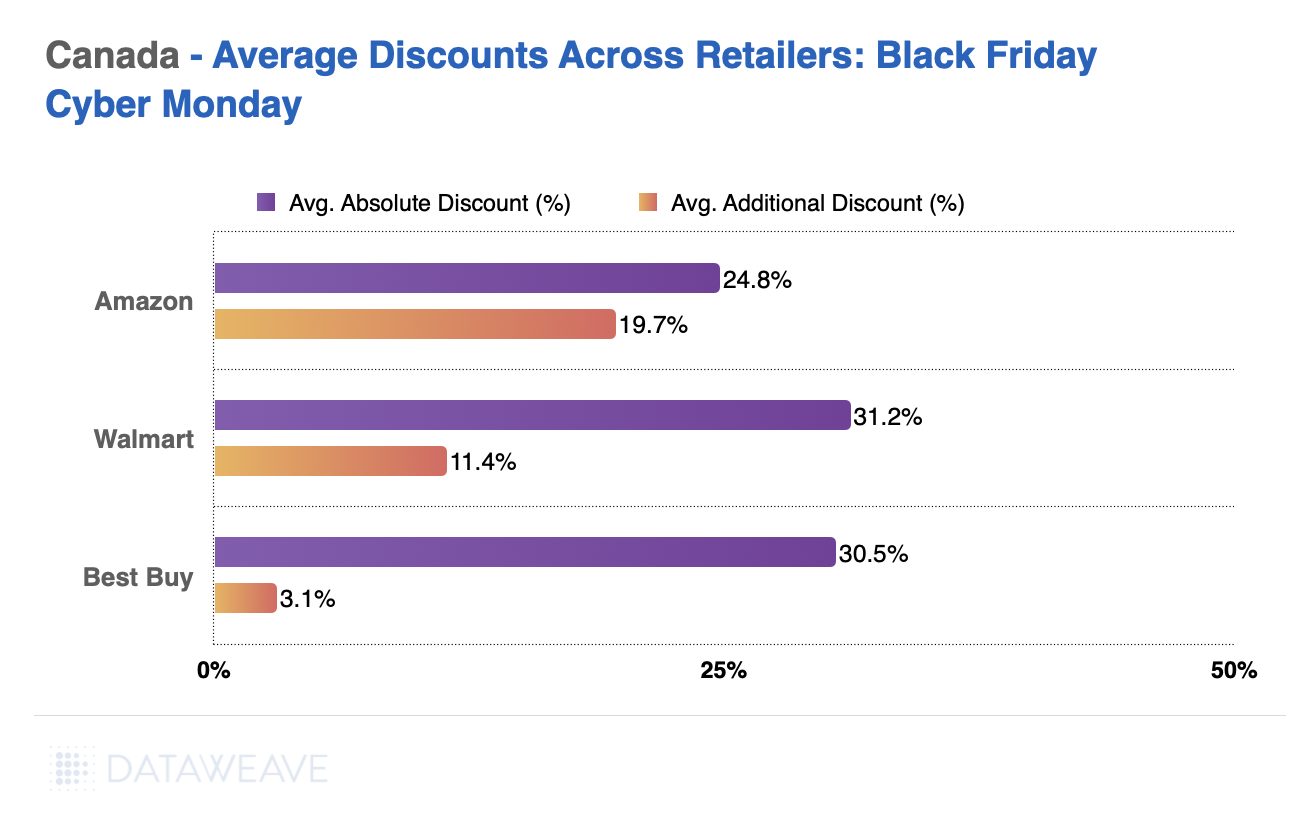
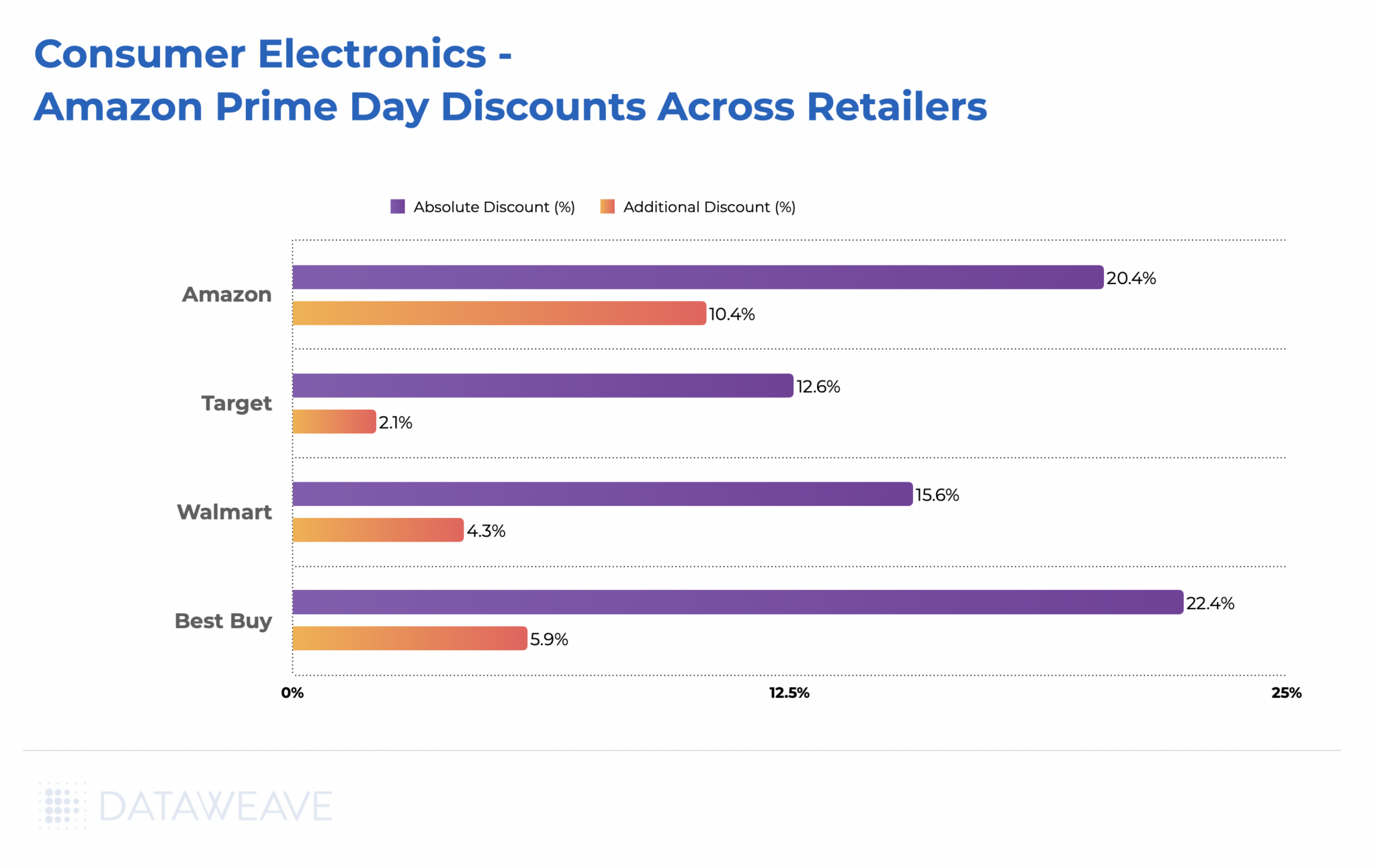
In the following insights, the Absolute Discount represents the reduction of the selling price compared to the Manufacturer’s Suggested Retail Price (MSRP). The Additional Discount reflects how much lower the selling price is during Black Friday compared to its price a week before the sale. This metric reveals the actual or effective value of the sale event, beyond the standard discounts typically offered.
Consumer electronics saw robust participation from major retailers, with Amazon, Best Buy, and Walmart leading the charge. Here’s how they stacked up in terms of discounts:
Best Buy emerged as the frontrunner in absolute discounts at 31.2%, while Amazon impressed with a notable 19.7% additional discount, indicating a strong Black Friday-specific markdown strategy.
Walmart offered steady competition, particularly in audio and video products, which reached an average absolute discount of 37.2%. However, it’s average additional discount was only 3.1%, indicating muted BFCM-specific price reductions in this category.
Subcategory Insights
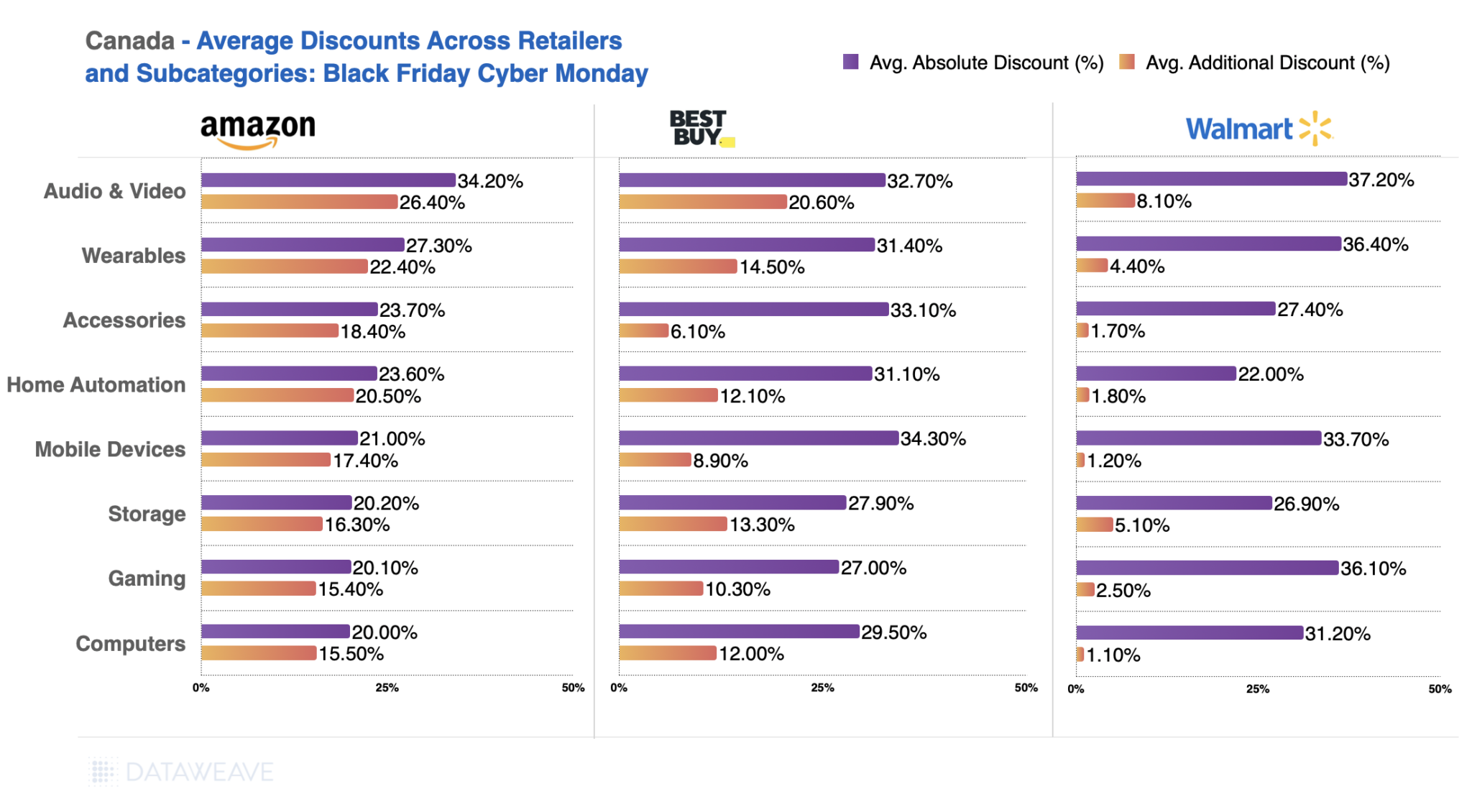
Diving deeper into consumer electronics subcategories, we observed varied discounting strategies.
Audio & Video stood out as the most discounted subcategory, with Walmart leading at 37.2%.
In Wearables, Walmart again took the top spot with 36.4%, while Amazon offered higher additional discounts (22.4%).
Discounting for computers and gaming was less aggressive, highlighting strategic pricing to maintain profitability in these high-demand segments.
Brand Performance
Brand-level data highlighted how key players used Black Friday to drive visibility and sales.
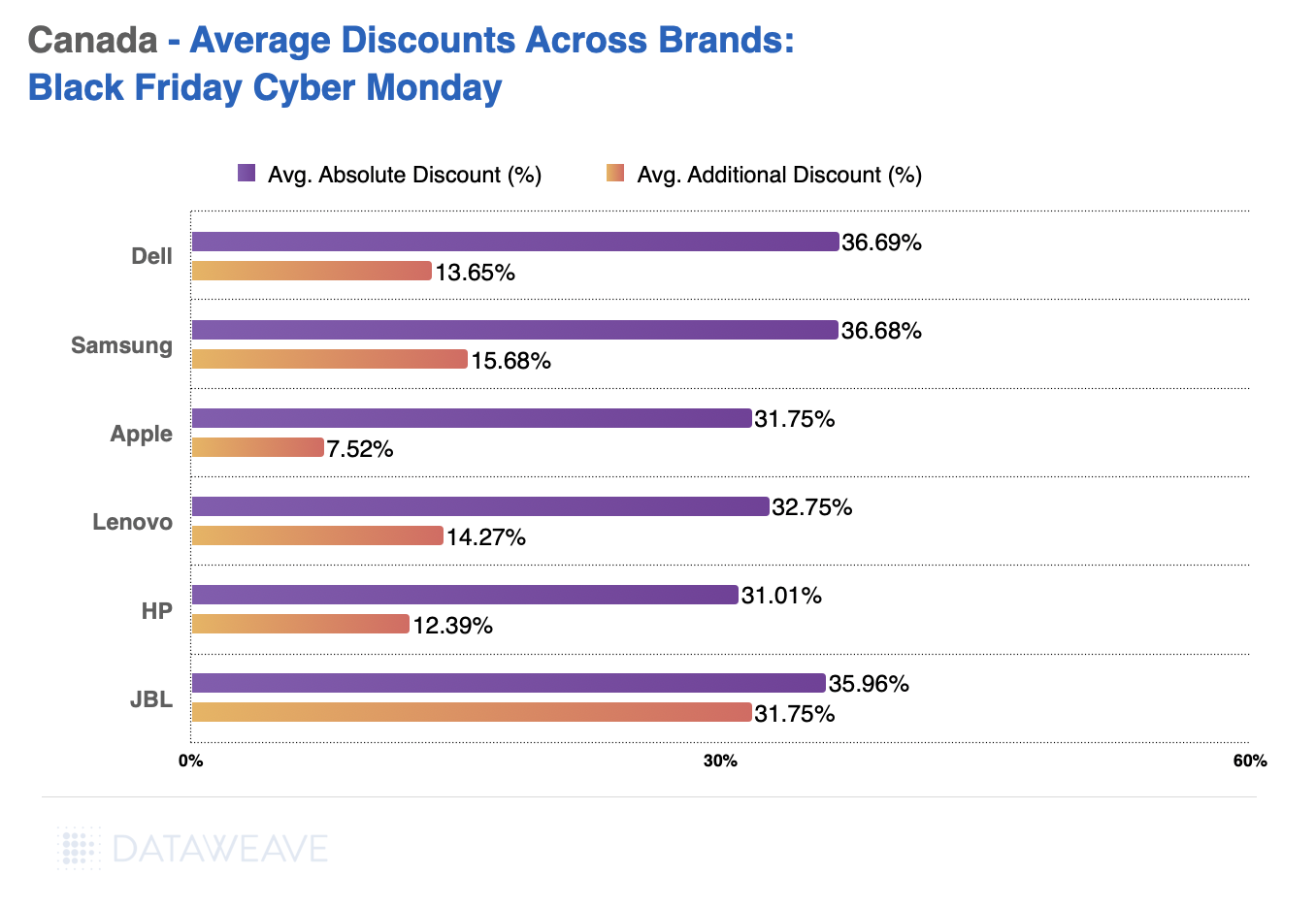
Dell led in average absolute discounts (36.7%) followed by Samsung at 36.68%
Audio brand JBL offered significant absolute discounts at 35.9%.
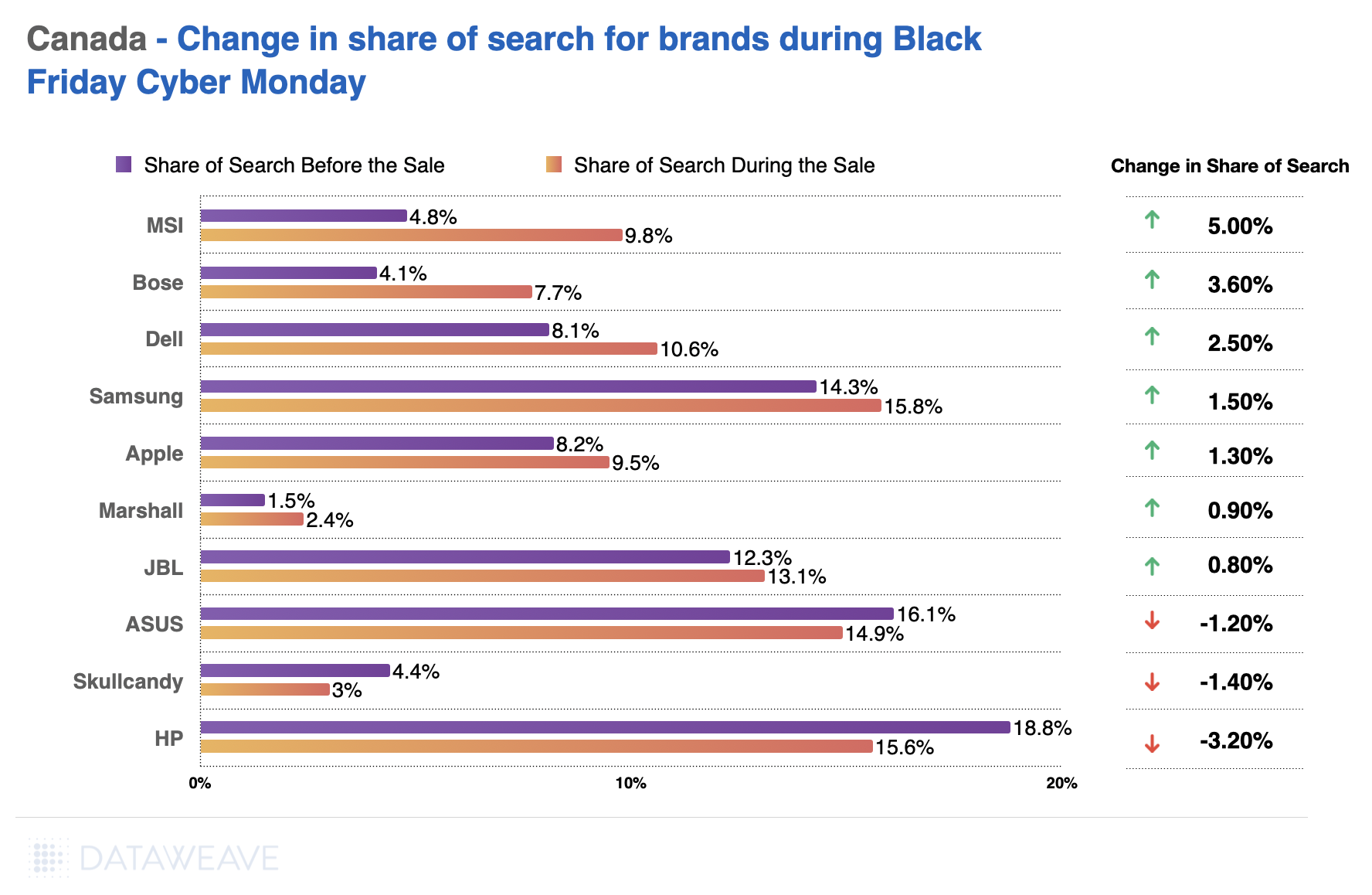
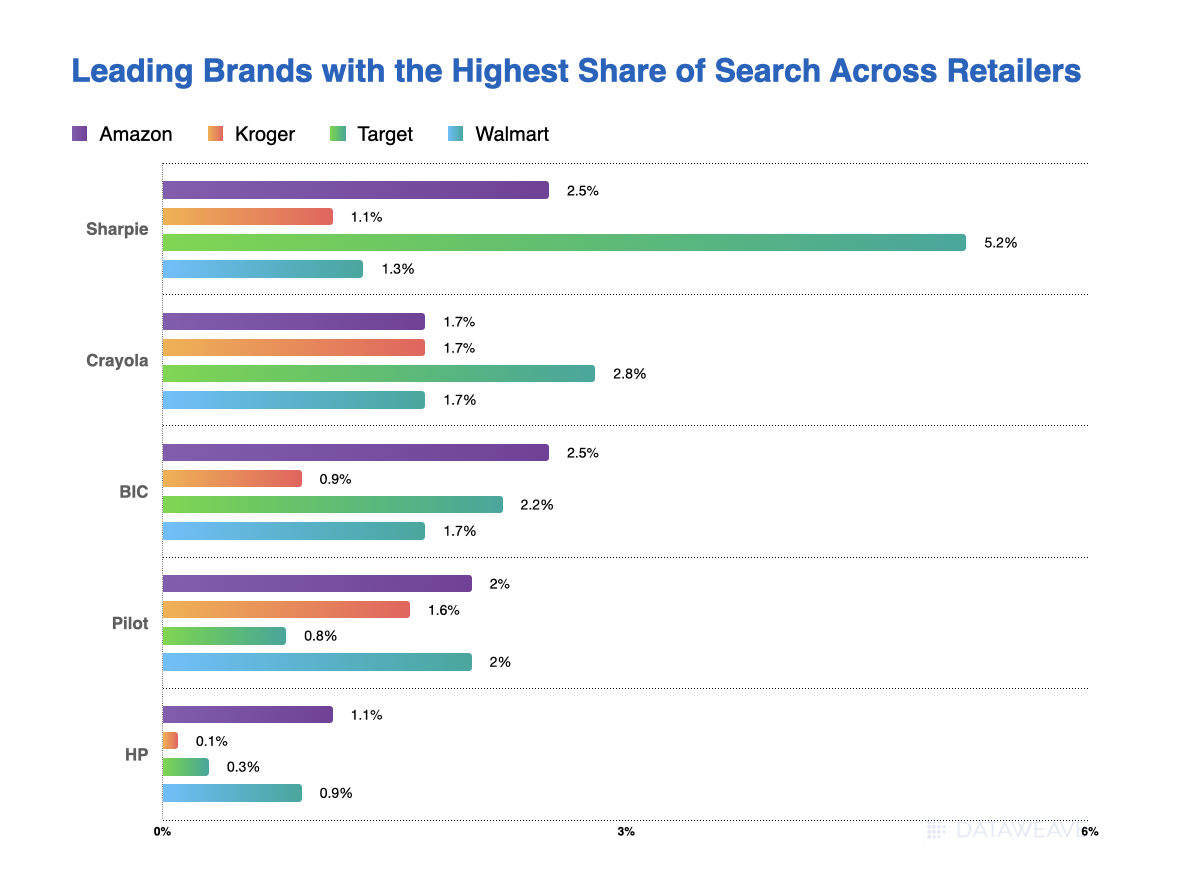
Apple and Lenovo offered comparatively fewer discounts but maintained strong visibility, as seen in their increase in the Share of Search during the sale period.
MSI (laptop brand) and Bose (audio and earphone brand) experienced significant increases in visibility, with Share of Search increases of 5% and 3.6%, respectively.
Notably, HP faced a decline (-3.2%) in the Share of Search, suggesting missed opportunities to align promotions with consumer interest.
Home & Furniture
Retailers in Focus
The home and furniture category saw competitive discounting, with Walmart, Canadian Tire, and Home Depot vying for consumer attention.
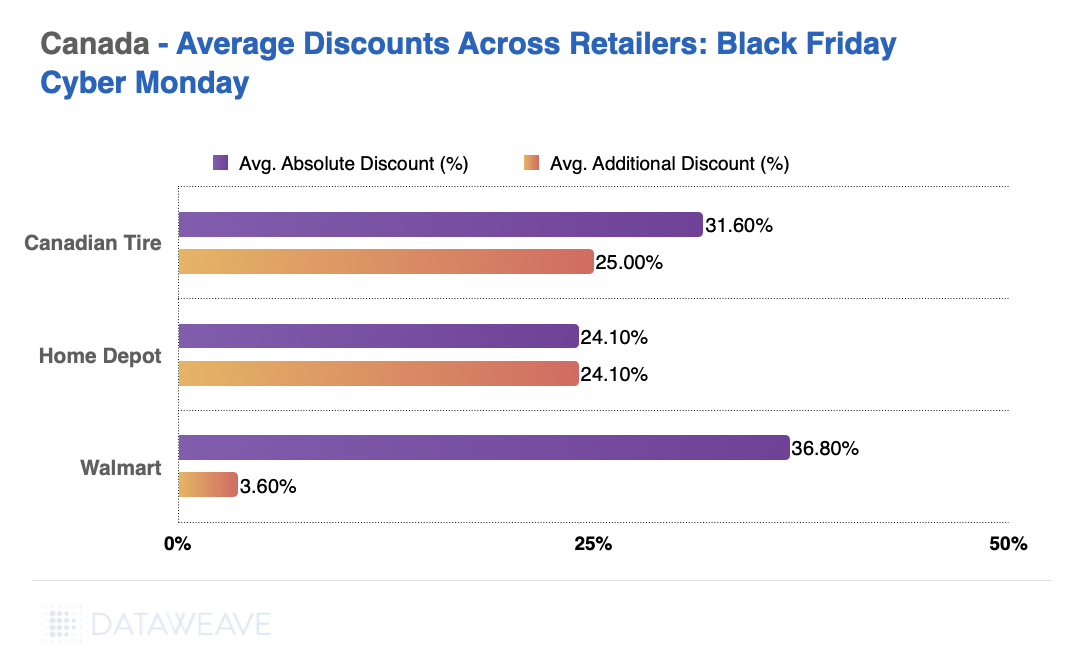
Walmart took the lead with the highest absolute discounts at 36.8%. The retailer’s additional discounts were more conservative at 3.6%. This is similar to their discount levels in Consumer Electronics.
Canadian Tire offered stiff competition, providing 31.6% absolute discounts and 25% additional discounts.
Home Depot matched its absolute and additional discounts, maintaining consistency at 24.1%.
Subcategory Insights
Home and furniture subcategories revealed targeted discount strategies.
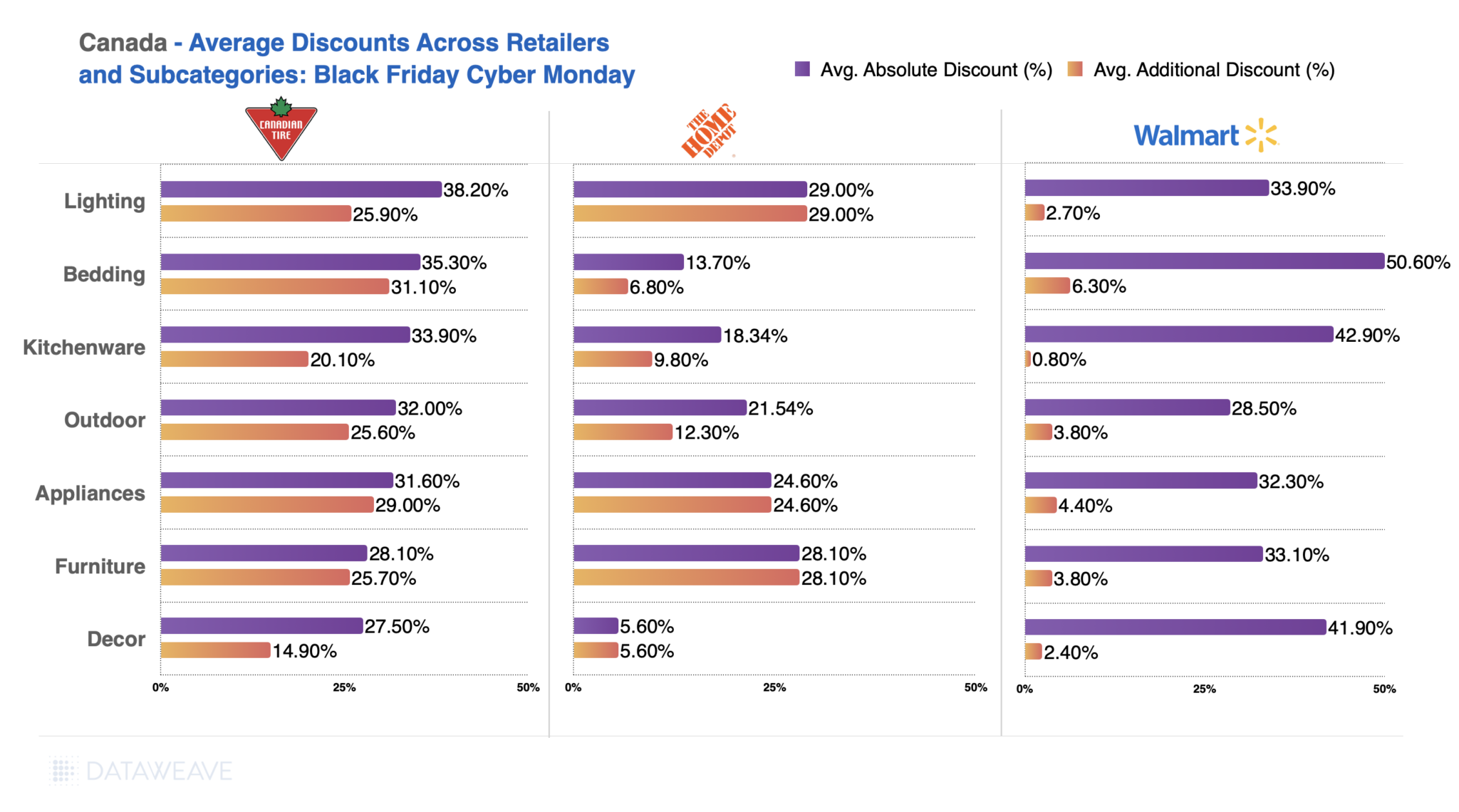
Bedding emerged as the most discounted subcategory at Walmart (50.6%) and Canadian Tire (35.3%).
Kitchenware saw competitive pricing, with Walmart leading at 42.9%, followed by Canadian Tire at 33.9%.
Canadian Tire focused on lighting, offering the highest absolute discounts in this subcategory (38.2%)
Brand Performance
Brand-level analysis revealed stark contrasts in discounting approaches.
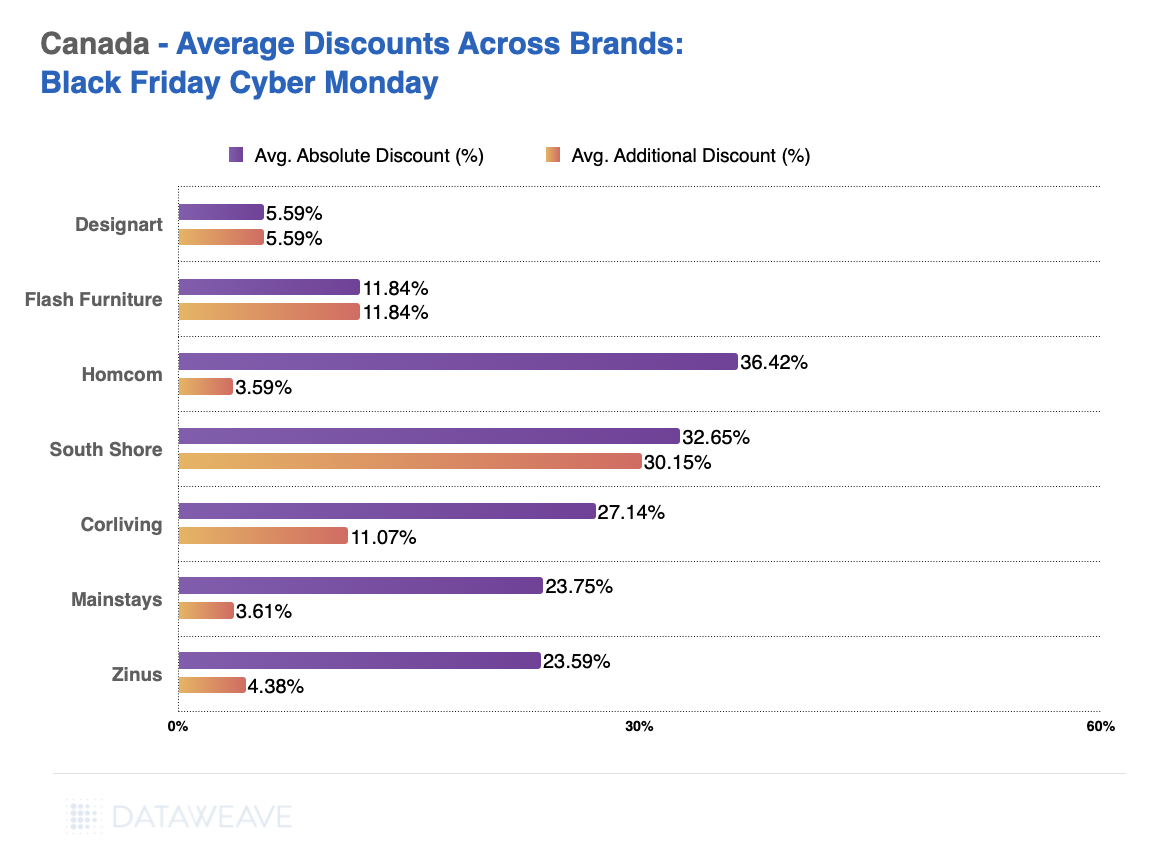
Furniture brands Homcom led in absolute discounts (36.4%), while South Shore stood out with the highest additional discounts (30.2%).
Value-oriented brands like furnishings brand Mainstays and mattress and bedding brand Zinus offered more modest discounts, focusing on consistent affordability.
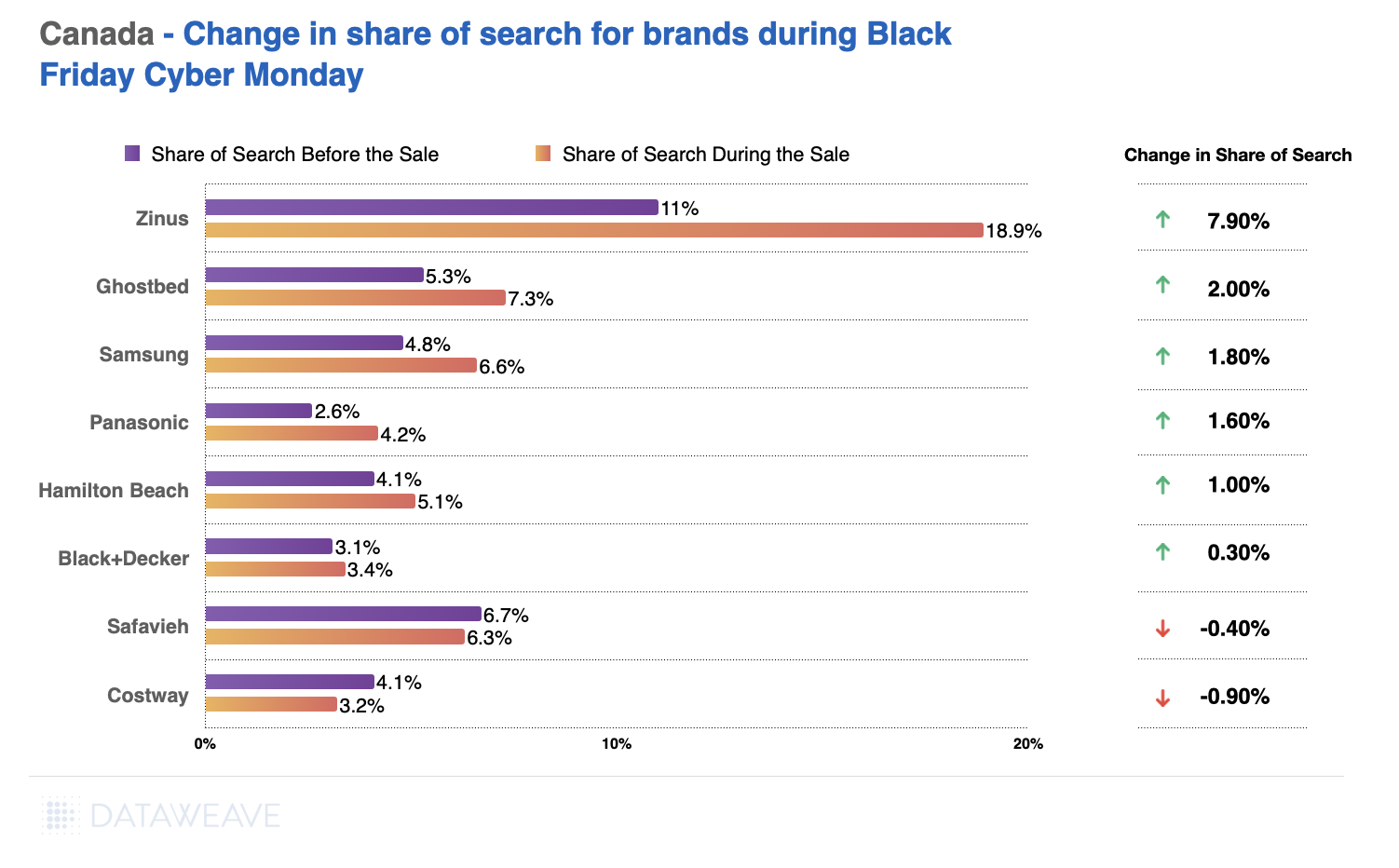
Zinus (mattresses and sofa brand) experienced a significant 7.9% increase in the Share of Search, driven by aggressive promotions.
Home furnishings brands like Costway and Safavieh faced declines, reflecting the importance of aligning promotional strategies with consumer expectations.
Insights for Retailers and Brands
This Black Friday, Canadian retailers effectively balanced deep discounts with category-specific strategies to maximize sales. However, the fluctuating Share of Search highlights the critical need for brands to align promotions with consumer interest.
For brands and retailers looking to stay ahead of the competition, DataWeave’s pricing intelligence platform offers unparalleled insights to refine discounting strategies and boost visibility. Contact us to learn how we can help you stay competitive in this dynamic retail landscape.
Americans spent a whopping total of $10.8 billion online this Black Friday. As Thanksgiving Week 2024 wraps up, one thing is clear: the consumer electronics category continues to dominate seasonal shopping trends. Fueled by a blend of enticing deals and high consumer demand, the sector delivered competitive discounts across subcategories like wearables, gaming, and mobile devices.
At DataWeave, we analyzed discounting trends in the U.S. consumer electronics market during this year’s sales events. Using our AI-powered pricing intelligence platform, we tracked pricing and promotions for 22383 SKUs across Amazon, Walmart, Target, and Best Buy from November 10 to 29. We focused on the top 500 products ranked for each search keyword on each retail site, using targeted terms aligned with categories like “gaming” and “apple.” Here’s what we uncovered.
Retailers Battle It Out with Competitive Discounts
Discount trends reveal clear leaders in terms of markdowns:
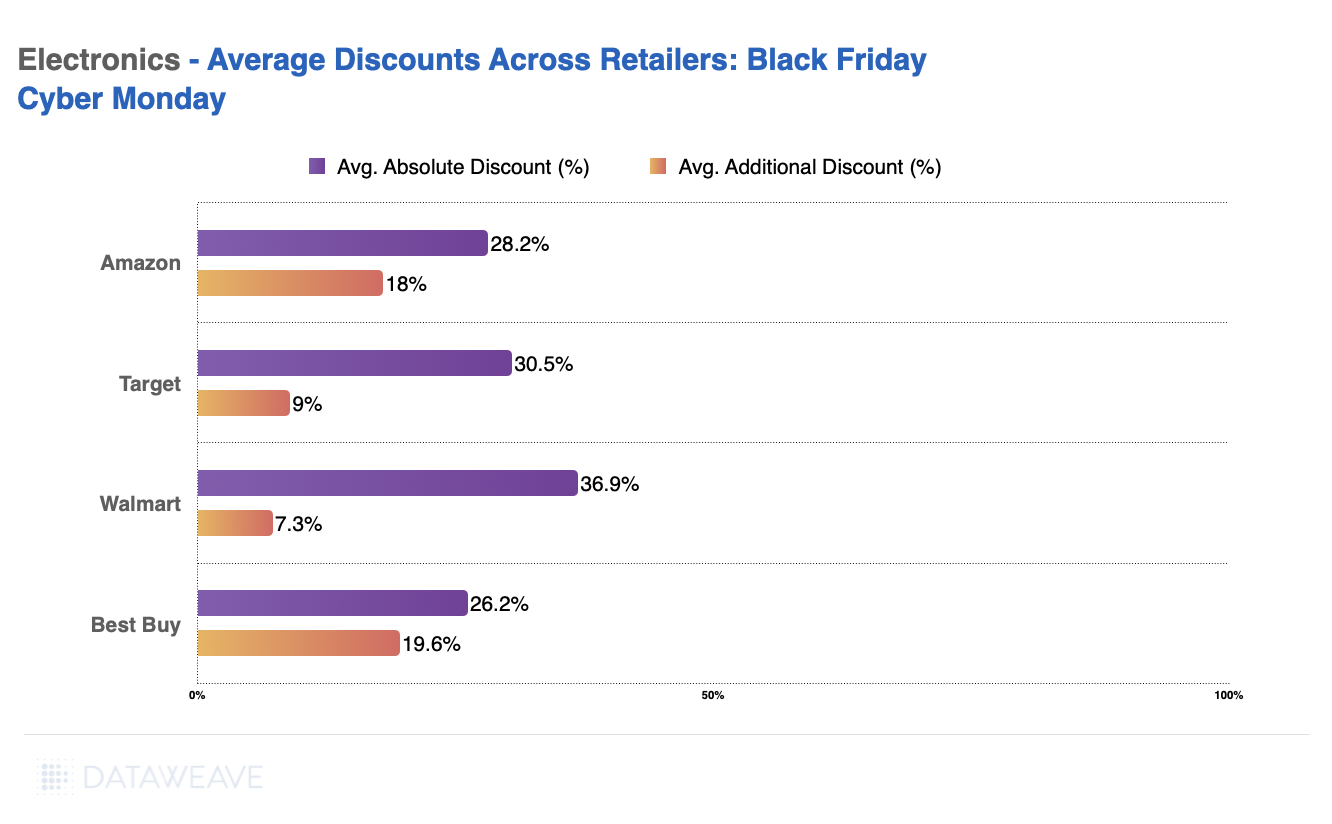
Walmart offered the deepest average absolute discounts at 36.9%.
Amazon and Target followed closely, highlighting a diverse range of deals designed to appeal to budget-conscious shoppers
Best Buy, the specialist consumer electronics retailer, offers the lowest discounts this Black Friday at 26.2%.
Note: The Absolute Discount represents the reduction of the selling price compared to the Manufacturer’s Suggested Retail Price (MSRP). The Additional Discount reflects how much lower the selling price is during Black Friday compared to its price a week before the sale. This metric reveals the actual or effective value of the sale event, beyond the standard discounts typically offered.
Subcategory Spotlight: Where the Best Deals Happened
From audio & video to wearables, each retailer carved out competitive advantages across subcategories.
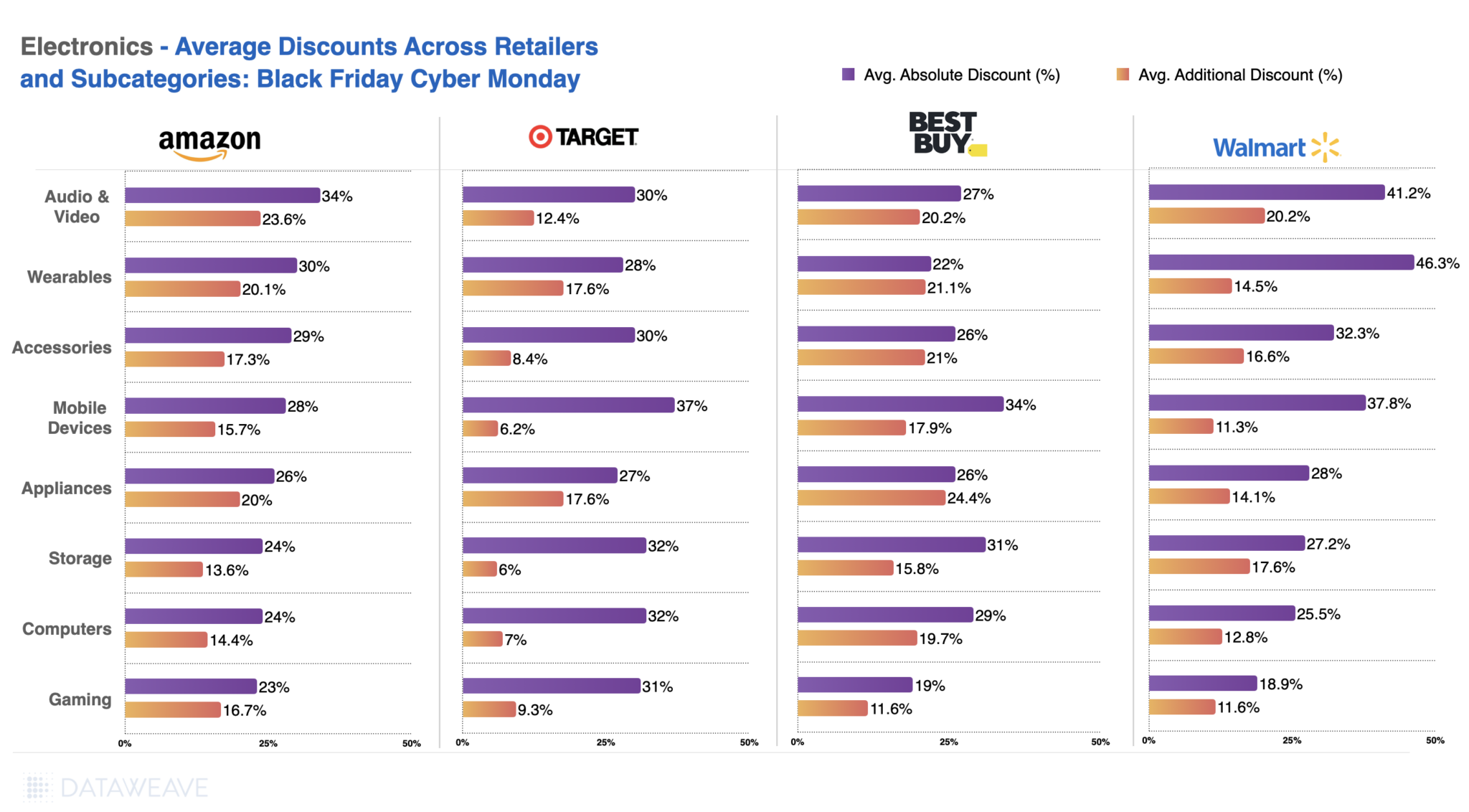
Both Amazon and Walmart offered high discounts in audio & video and wearables, but Walmart led, with discounts up to 46.3%.
Best Buy, meanwhile, offered high absolute discounts on Mobile Devices(34%) and Storage (31%), followed by high discounts on wearables and Audio & Video.
Amazon maintained a balanced approach, excelling in audio & video and mobile devices.
Brand-Level Insights: HP and Samsung Dominate
The biggest winners this year were brands that strategically leveraged Black Friday discounts to boost visibility and sales:
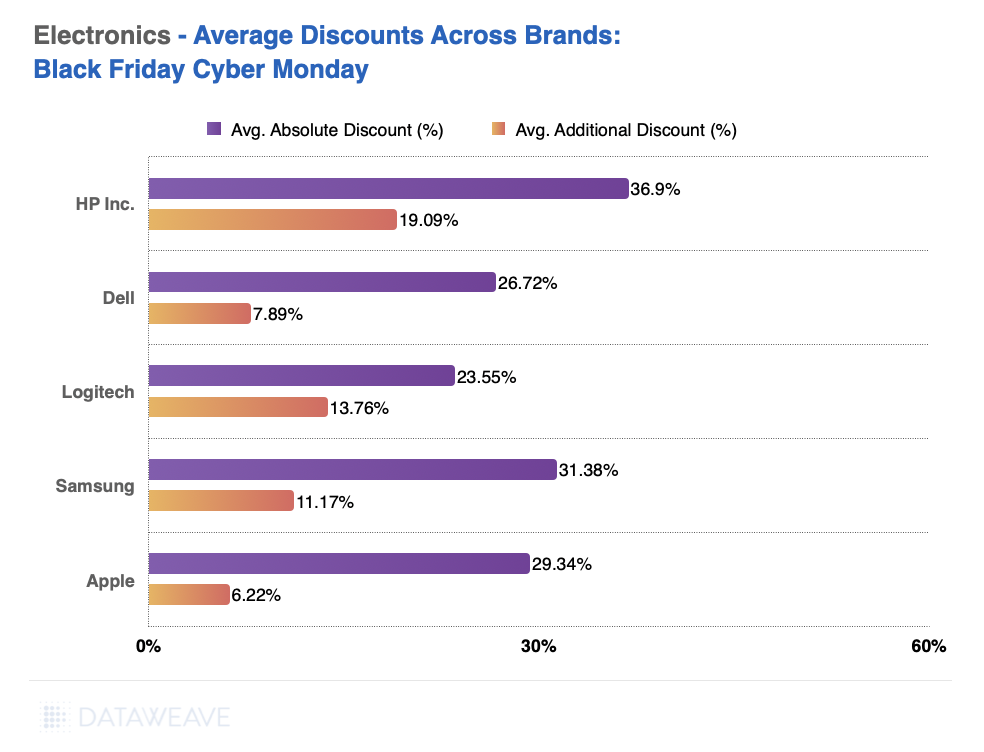
HP took the top spot with average discounts of 36.9%, followed by Samsung at 31.4%.
Despite its premium reputation, Apple offered an average discount of 29.3%, signaling a shift in strategy to attract deal hunters.
Share of Search: Shifting Consumer Attention
Search trends reveal how discounts shaped brand visibility:
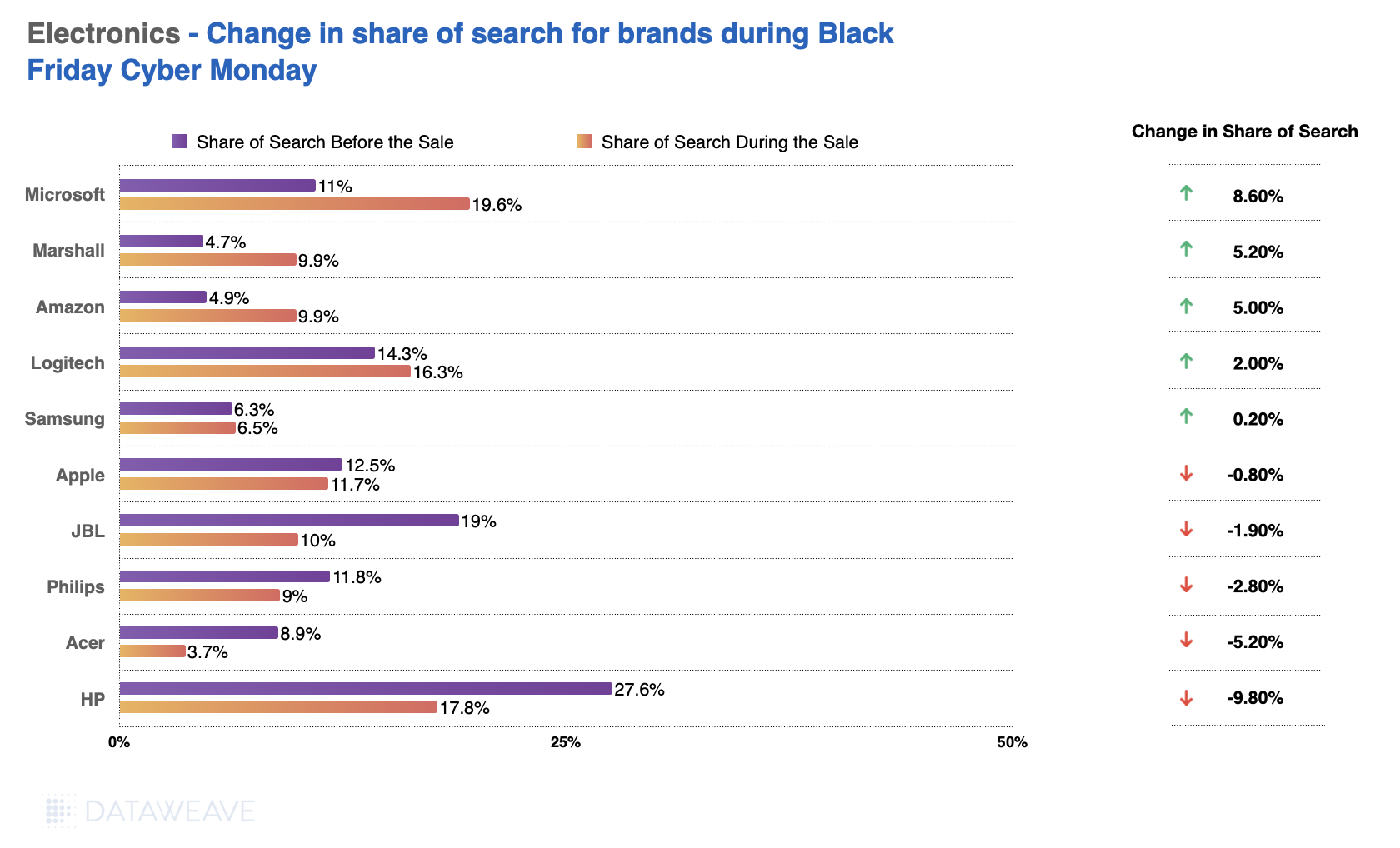
Microsoft saw the largest spike in share of search (+8.6%), thanks to aggressive pricing on gaming consoles and accessories.
Marshall and Amazon also saw significant gains in visibility.
Surprisingly, HP experienced a sharp decline (-9.8%), indicating missed opportunities despite steep discounts.
In the previous analysis, we focused on the top 500 products within each subcategory for each retailer, showcasing the discount strategies for their highlighted or featured items. However, to identify which retailer offered the lowest or highest prices for the same set of products, it’s necessary to match items across retailers. For this, we analyzed a separate dataset of 340 matched products across retailers to compare their pricing during Black Friday. This approach provides a clearer picture of price leadership and competitiveness across categories.
Here are the key takeaways from this analysis.
Category-Level Highlights
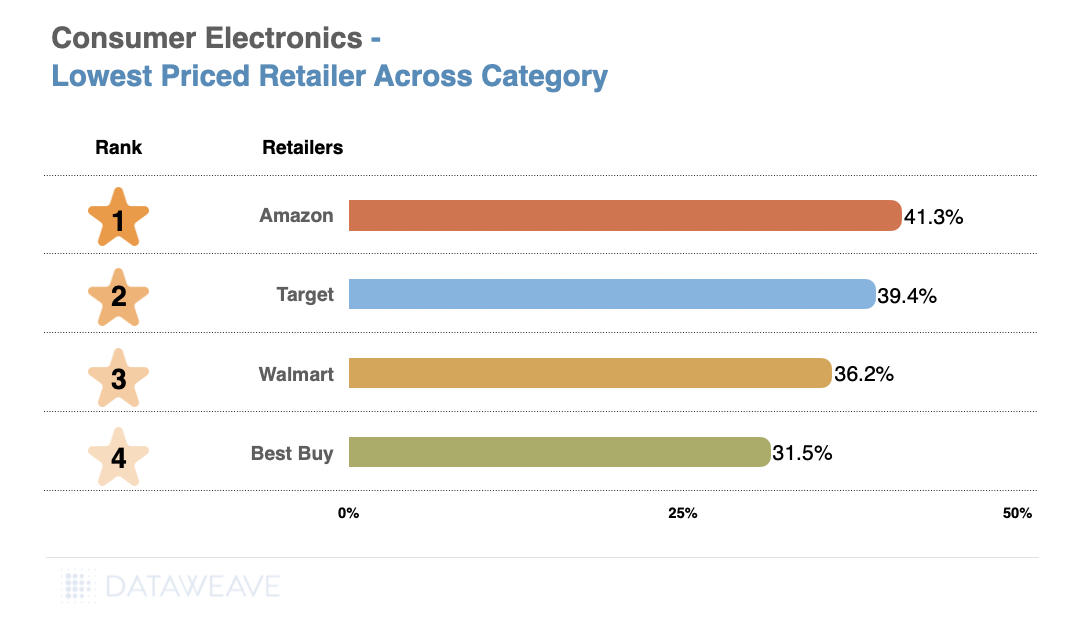
Amazon leads with the highest average discount (41.35%), offering the most value to consumers. It is followed by Target (39.37%) and Walmart (36.15%).
Best Buy, the specialist consumer electronics retailer, ranks last with an average discount of 31.53%, emphasizing a less aggressive pricing strategy compared to competitors.
Subcategory Highlights
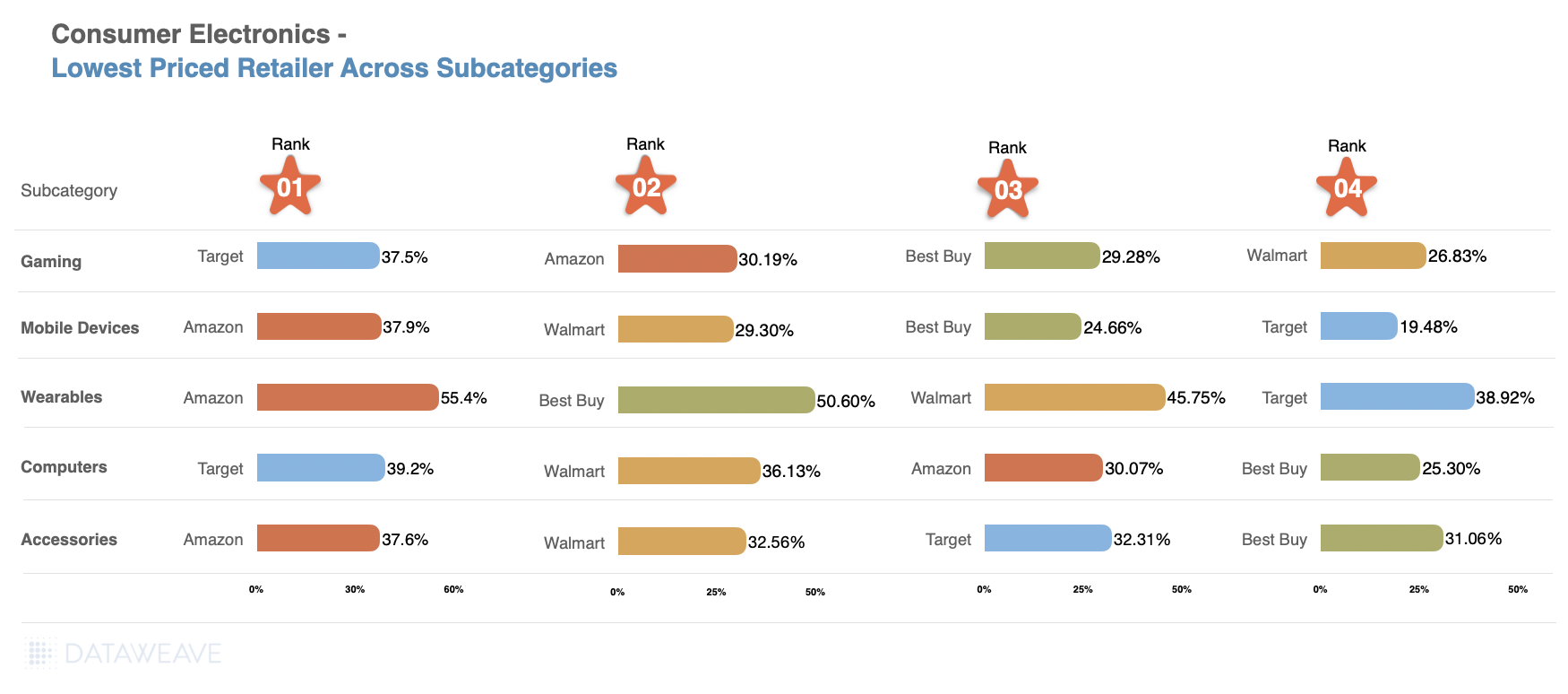
Wearables: Amazon offers the steepest discounts (55.40%), followed by Best Buy (50.60%) and Walmart (45.75%).
Mobile Devices: Amazon also leads (37.94%), with Walmart (29.30%) in second place and Target trailing at 19.48%.
Gaming: Target takes the lead (37.47%), with Amazon and Best Buy offering similar discounts around 30%.
Computers: Target again emerges as the leader (39.18%), narrowly surpassing Walmart (36.13%).
Brand Highlights
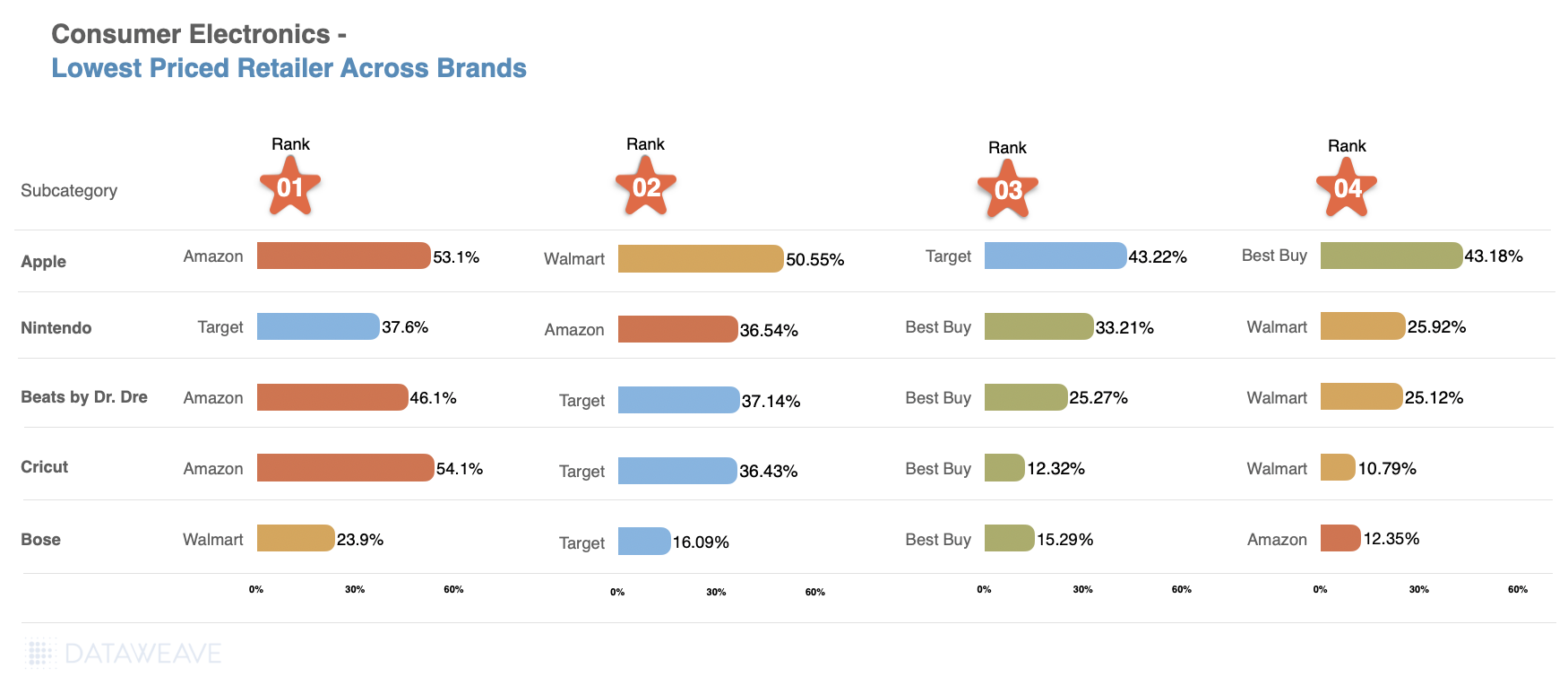
Apple: Amazon dominates with 53.06%, closely followed by Walmart (50.55%), while Target and Best Buy hover around 43%.
Nintendo: Target edges out Amazon (37.62% vs. 36.54%), with Best Buy (33.21%) and Walmart (25.92%) trailing.
Beats by Dr. Dre: Amazon leads (46.07%), with Target (37.14%) as the runner-up. Best Buy and Walmart offer comparatively modest discounts around 25%.
Bose: Walmart emerges as the value leader (23.90%), surpassing Target (16.09%) and Best Buy (15.29%).
Cricut: Amazon sets a high benchmark (54.13%), with Target far behind (36.43%) for this viral portable printer brand. Best Buy (12.32%) and Walmart (10.79%) offer significantly lower discounts.
What This Means for Retailers and Brands
Retailers looking to stay competitive should focus on strategic discounting and enhanced brand visibility. Brands must align with consumer expectations by:
Leveraging platforms like DataWeave to analyze discount trends.
Optimizing pricing and assortment strategies for seasonal demand.
For more insights into consumer electronics pricing, contact DataWeave to discover how our AI-powered solutions can drive success in today’s fast-paced market. Stay tuned for more category-specific analyses in the coming weeks!
As the holiday shopping season kicked off, savvy shoppers embraced the spirit of the season, drawn by enticing deals. The apparel category is forecasted as the second highest earning category (Source: Statista), expected to generate revenues up to $43.9 billion, closely following consumer electronics. To understand the pricing strategies of top retailers amidst the sale season, DataWeave analyzed the pricing trends for the Apparel category this Black Friday.
We leveraged our AI-powered data platform to analyze the discounting across key retailers. Our analysis focused on the Apparel category, examining how Amazon, Walmart, Target, Saks Fifth Avenue, Nordstrom, Bloomingdales, Neiman Marcus and Macy’s differentiated themselves through their discounts.
For this analysis, we tracked the average discounts of apparel products among leading US retailers during the Thanksgiving weekend sale, including Black Friday. Our sample was chosen to encompass the top 500 ranked products in each product subcategory across during the sale.
Subcategories reported on: Footwear, Kid’s Clothing, Men’s Clothing, Women’s Clothing, Activewear, Plus Size Clothing, Accessories
Timeline of analysis: 10 to 29 November 2024
We focused on the top 500 products ranked for each search keyword on each retail site, using targeted terms aligned with categories like “athleisure” and “plus size clothing”. Our methodology distinguished between standard discounts and Black Friday-specific ‘additional discounts’ or price reductions during the sale compared to the week before, to reveal true consumer value.
Key Findings
This year’s fashion discounts were unprecedented. Let’s take a look.
Retailer Level Insights
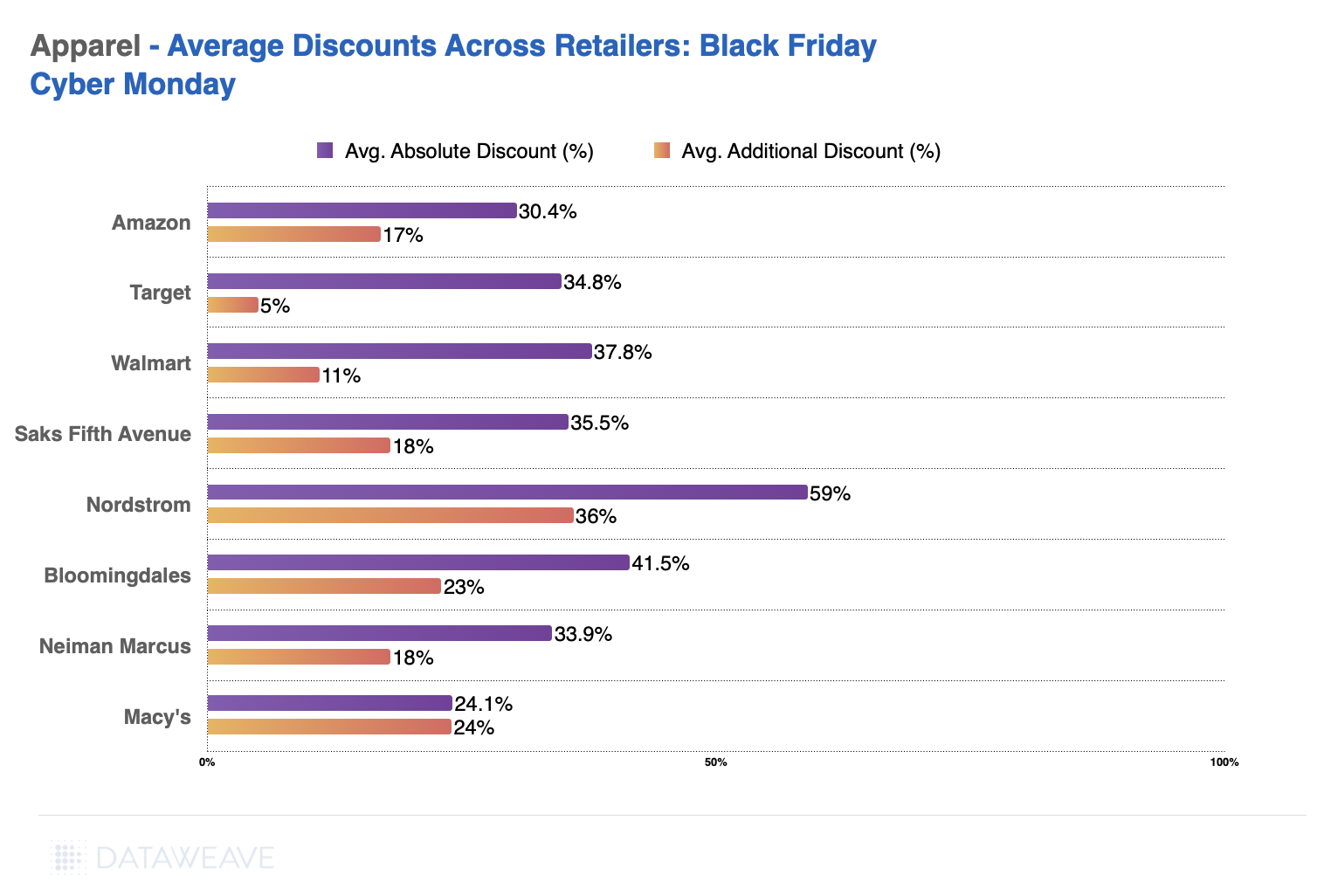
Nordstrom leads with the highest average absolute discount at 59%, followed by Saks Fifth Avenue at 35.5% and Bloomingdale’s at 41.5%. Macy’s shows the lowest average discount at 24.1%, while Amazon has an average discount of 30.4%.
Amazon ranks lower in both average absolute and additional discounts compared to competitors, indicating a more conservative discounting strategy.
Subcategory Analysis
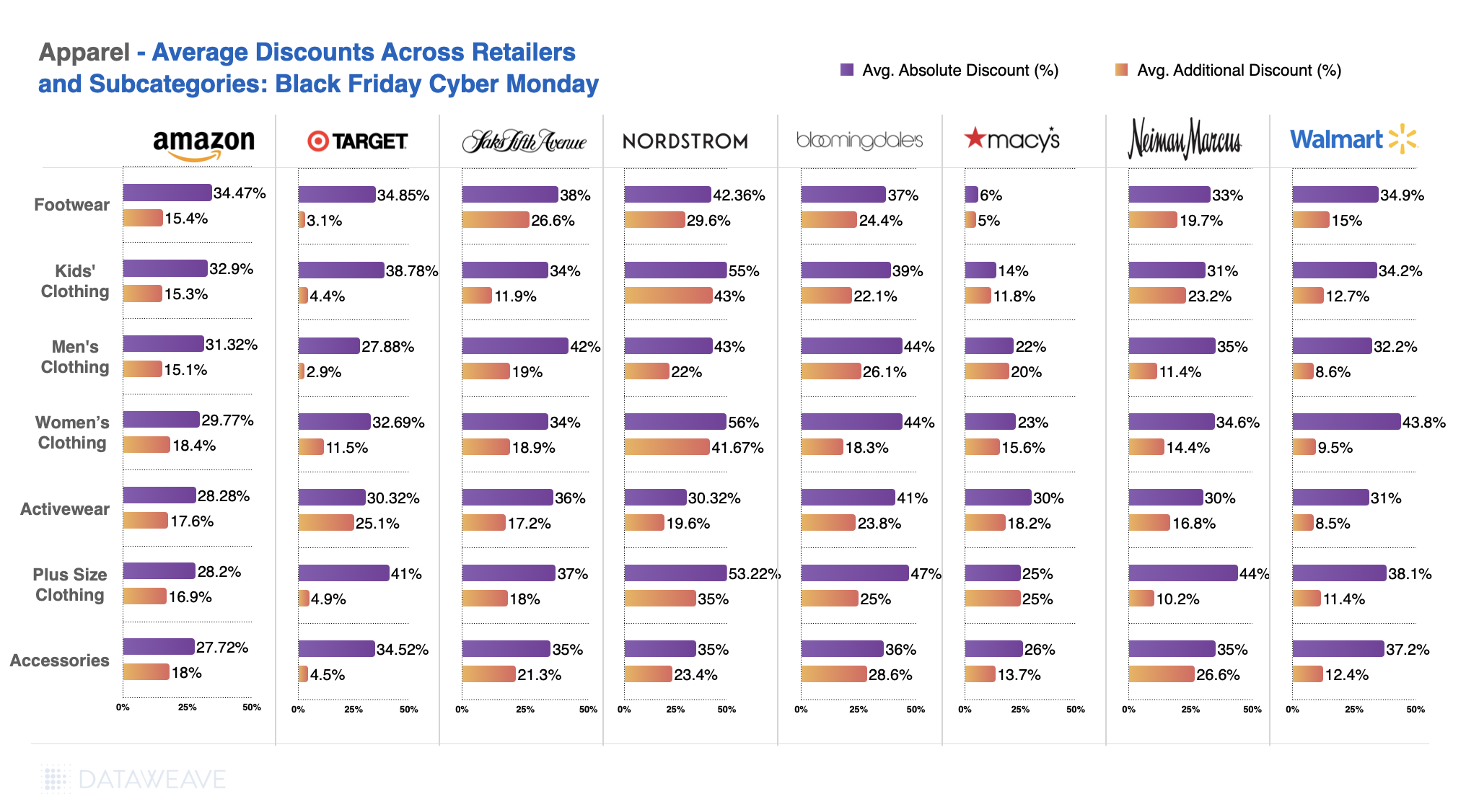
Kids’ Clothing saw the deep discounts (up to 55% at Nordstrom), reflecting growing pressure on family budgets and heightened competition to attract budget-conscious parents.
Plus-Size Clothing emerged as a major focus, with Nordstrom leading at 53.22% average absolute discounts, signaling that retailers are increasingly prioritizing size inclusivity and appealing to a broader consumer base.
Footwear experienced robust discounting, particularly at Bloomingdale’s with 37% average absolute discounts, showing a competitive approach to attract customers looking for seasonal footwear deals.
Activewear displayed substantial discounts, with Walmart offering up to 41% on average, aligning with the trend of consumers looking for practical and comfortable attire during the winter season.
Brand Level Insights
Apparel brands, meanwhile, also offer telling insights.
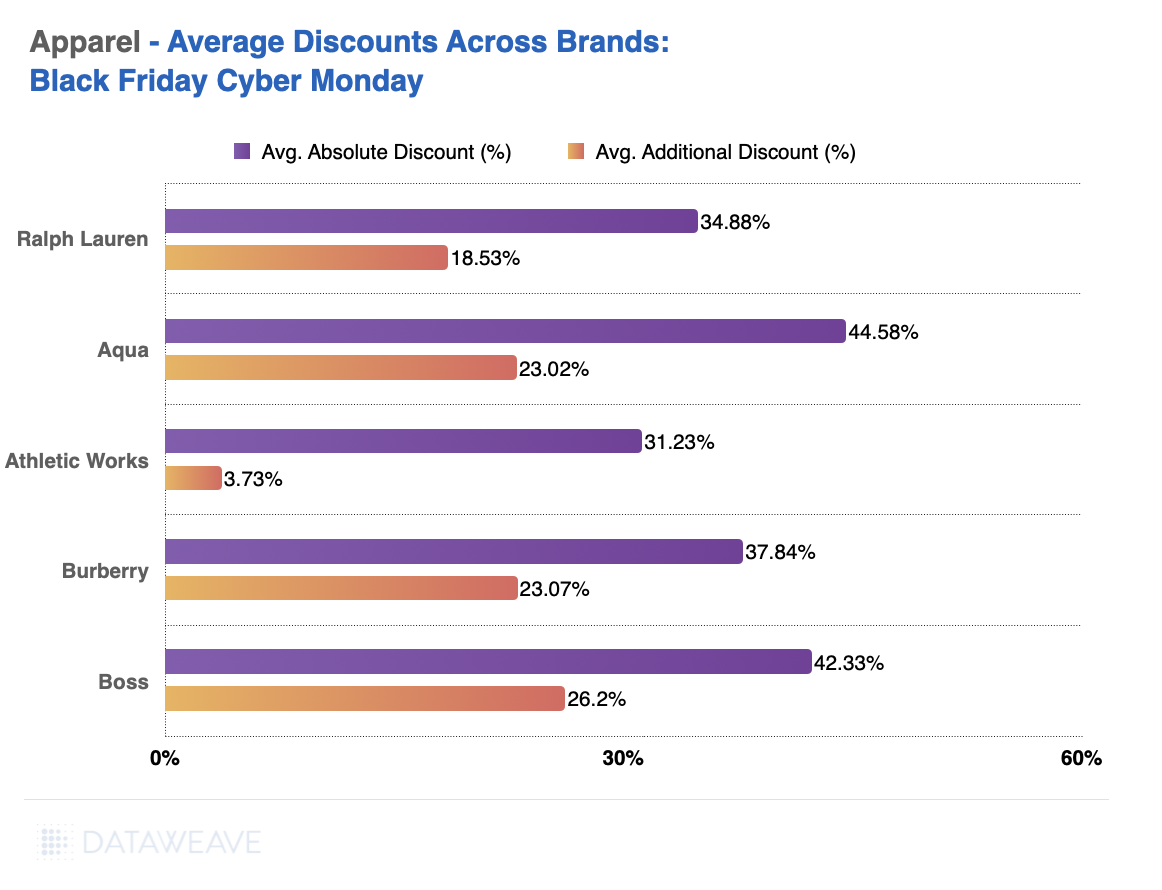
Top Discounting Brands: Aqua leads with an average absolute discount of 44.58%, followed by Boss at 42.33% and Burberry at 37.84%.
Lowest Discounts: Athletic Works shows the lowest average absolute discount at 31.23%, with a minimal additional discount of 3.73%.
Competitive Advantage: Brands like Ralph Lauren and Boss show strong discounts, indicating aggressive marketing during the sale.
Share of Search Insights
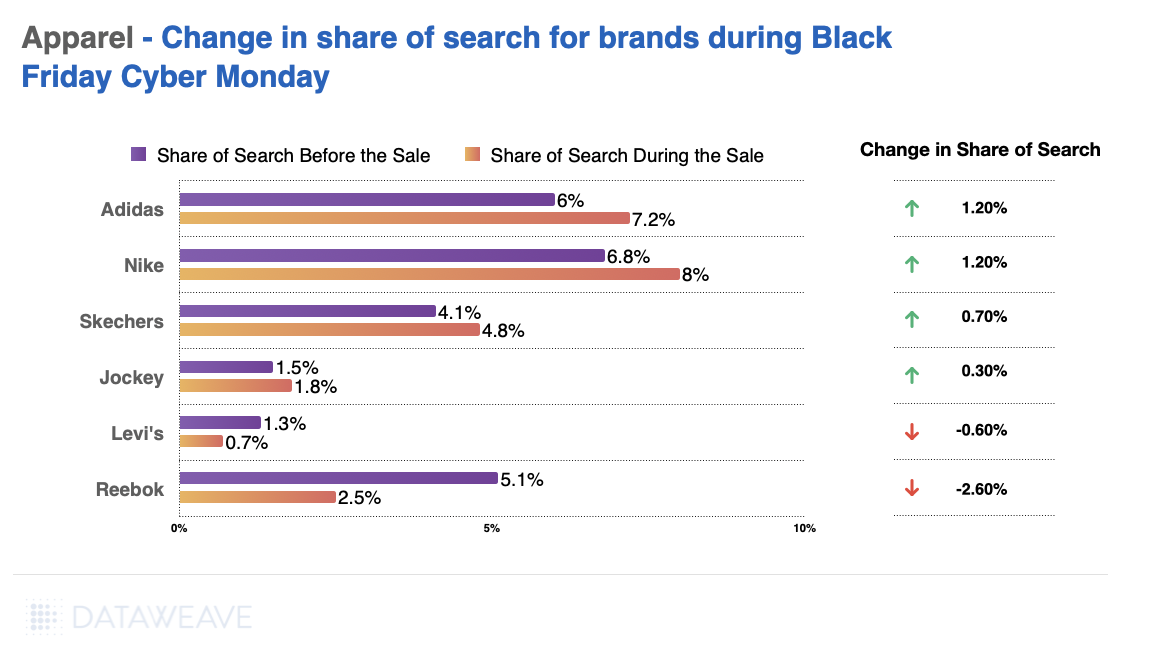
Top Gainers: Adidas and Nike each saw an increase of 1.20% in their share of search during Black Friday/Cyber Monday, highlighting their strong brand presence and consumer interest.
Top Losers: Reebok experienced a sharp decline, losing 2.60% in its share of search, while Levi’s also dropped by 0.60%.
Search Trends: The data suggests a strong consumer preference for activewear brands like Nike and Adidas and a decline in interest for traditional apparel brands like Levi’s.
Who Offered Most Value This Black Friday
In the previous analysis, we focused on the top 500 products within each subcategory for each retailer, showcasing the discount strategies for their highlighted or featured items. However, to identify which retailer offered the lowest or highest prices for the same set of products, it’s necessary to match items across retailers. For this, we analyzed a separate dataset of 418 matched products across Apparel specific retailers to compare their pricing during Black Friday. This approach provides a clearer picture of price leadership and competitiveness across categories.
Here are the key takeaways from this analysis.
Category-Level Analysis
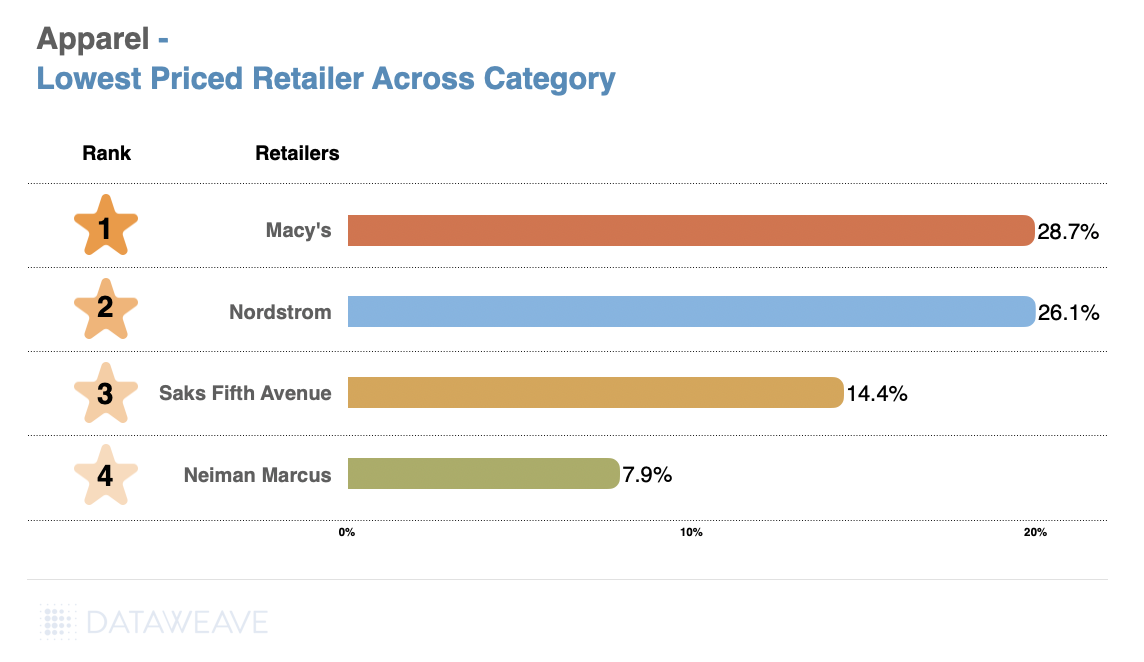
At the overall category level, Macy’s emerged as the lowest-priced retailer, offering the highest average discount of 28.72%, followed closely by Nordstrom (26.06%). The steep decline in average discounts from Saks Fifth Avenue (14.42%) and Neiman Marcus (7.93%) highlights a clear gap in discounting strategies.
Macy’s and Nordstrom are aggressively competitive on pricing in the overall apparel category, likely capturing consumer attention with substantial discounts.
Saks Fifth Avenue and Neiman Marcus may rely more on brand perception and luxury positioning rather than heavy discounting.
Subcategory-Level Analysis
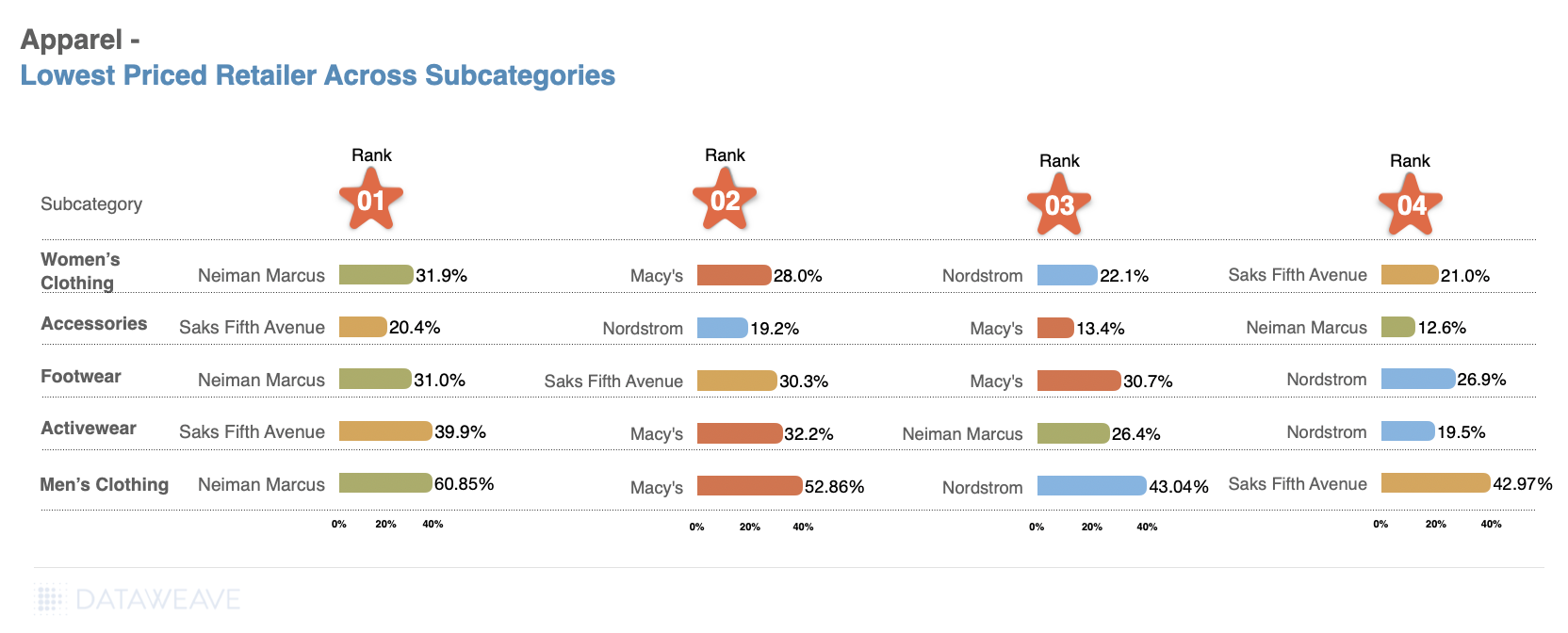
Neiman Marcus tops the ranking with an impressive 60.85% average discount, outperforming Macy’s (52.86%) and Nordstrom (43.04%) for Men’s Clothing. We see a similar trend with Neiman Marcus offering more value across Women’s Clothing as well, compared to other retailers.
The competition in footwear was intense, with Neiman Marcus narrowly securing the top spot at 31.03%, slightly ahead of Saks Fifth Avenue (30.28%) and Macy’s (30.07%).
Saks Fifth Avenue led by a significant margin in the Activewear category, offering 39.89% average discounts, indicating a strong push in this growing segment.
Macy’s followed at 32.16% in Activewear, while Neiman Marcus and Nordstrom had comparatively lower discounts of 26.40% and 19.52%, respectively.
Brand-Level Analysis
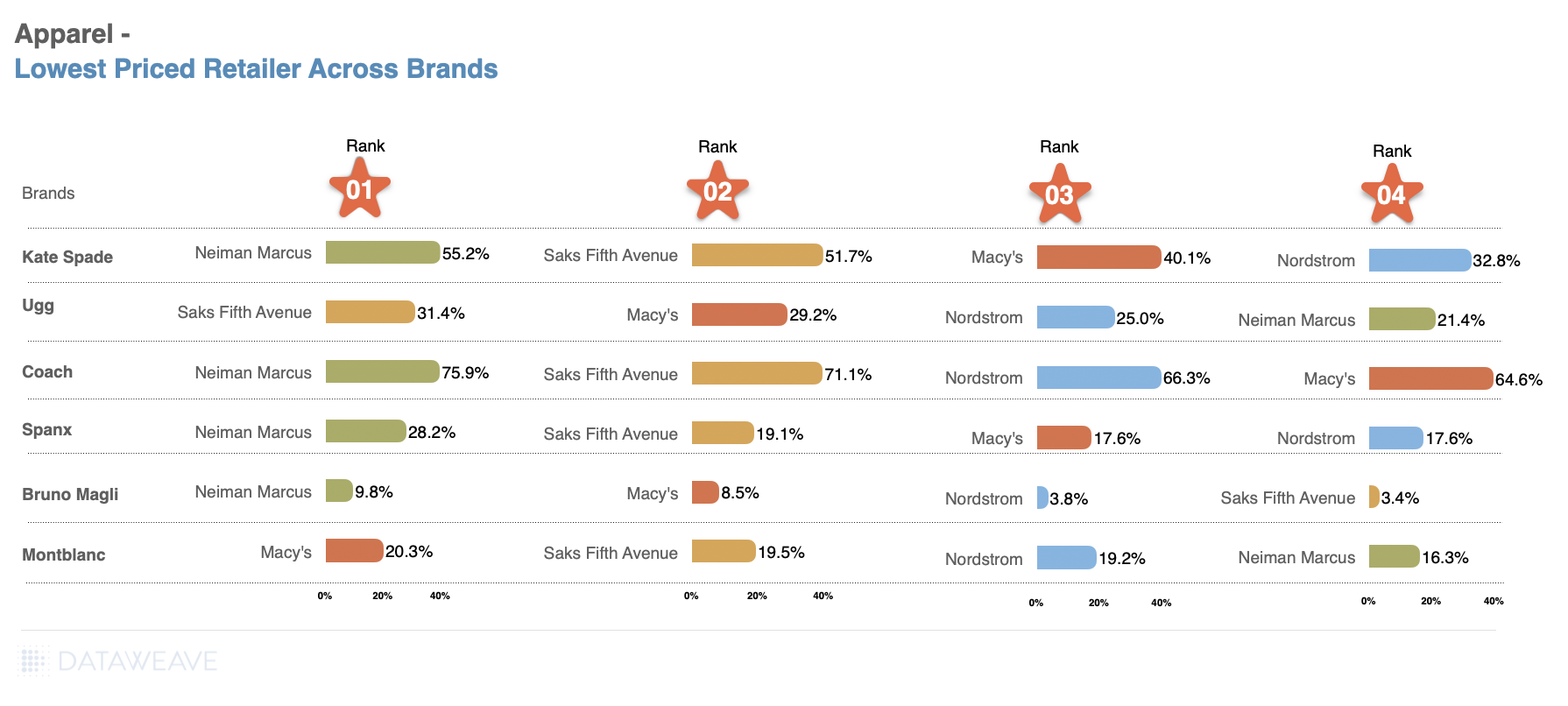
Kate Spade New York: Neiman Marcus leads with the highest discount of 55.23%, reflecting strong price leadership in premium fashion, closely followed by Saks Fifth Avenue at 51.66%.
Coach: Neiman Marcus dominates with a significant 75.85% discount, showcasing an aggressive promotional strategy for this luxury brand.
Spanx: While Neiman Marcus leads with 28.22%, discounts across other retailers like Saks Fifth Avenue, Macy’s, and Nordstrom are clustered within a competitive range of 17–19%.
Montblanc: Macy’s takes the lead with 20.32%, signaling its competitiveness even in high-end accessories, with Saks Fifth Avenue and Nordstrom closely behind.
Ugg: Saks Fifth Avenue leads with 31.42%, focusing on maintaining price leadership for this popular brand, while other retailers remain competitive with discounts around 25–30%.
What’s Next
To win over price-conscious shoppers, retailers need to stay competitive and consistently offer the lowest prices.
For a deeper dive into the world of competitive pricing intelligence and to explore how our solutions can benefit apparel retailers and brands, reach out to us today!
Stay tuned to our blog for more insights on different categories this Black Friday and Cyber Monday.
As shoppers flocked online and to stores during Black Friday and Cyber Monday, the grocery category stood out as a key battleground for retailers. With inflation affecting consumer spending, discounted groceries have become a critical driver for both shopper savings and retailer competitiveness.
In fact, according to the NRF, one of the top shopping destinations during Thanksgiving weekend were department stores (42%), online (42%),and grocery stores and supermarkets (40%). Clearly, consumers are looking to stock up in bulk on their groceries to maximize their savings.
To understand the pricing dynamics in the grocery category, DataWeave analyzed grocery discounts across leading grocers, uncovering significant trends that shaped consumer choices during this holiday shopping period.
Our research encompassed retailers like Amazon, Target, and Walmart, examining their discounting strategies across subcategories, alongside trends in share of search for leading CPG companies.
Key Grocery Market Stats for Black Friday-Cyber Monday 2024
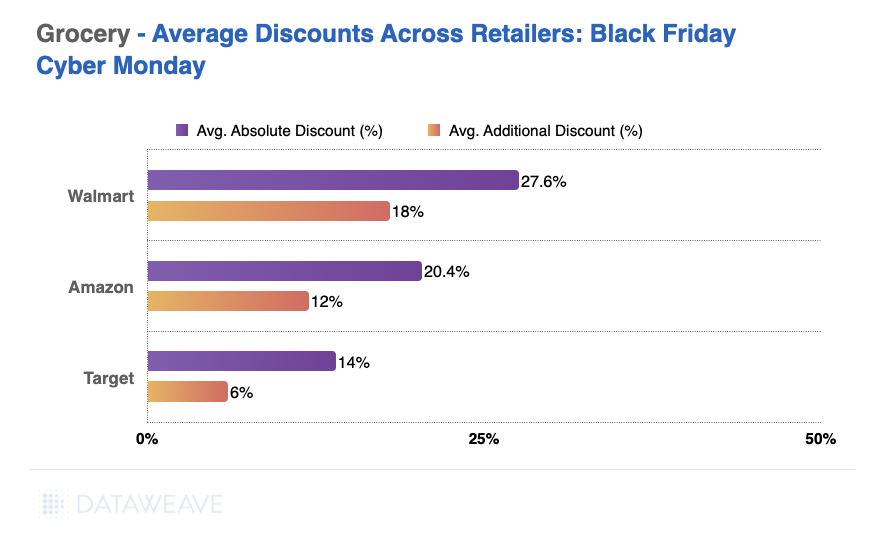
Retailer Discounts: Walmart offered the highest average absolute discount at 27.6%, followed by Amazon at 20.4% and Target at 14.0%
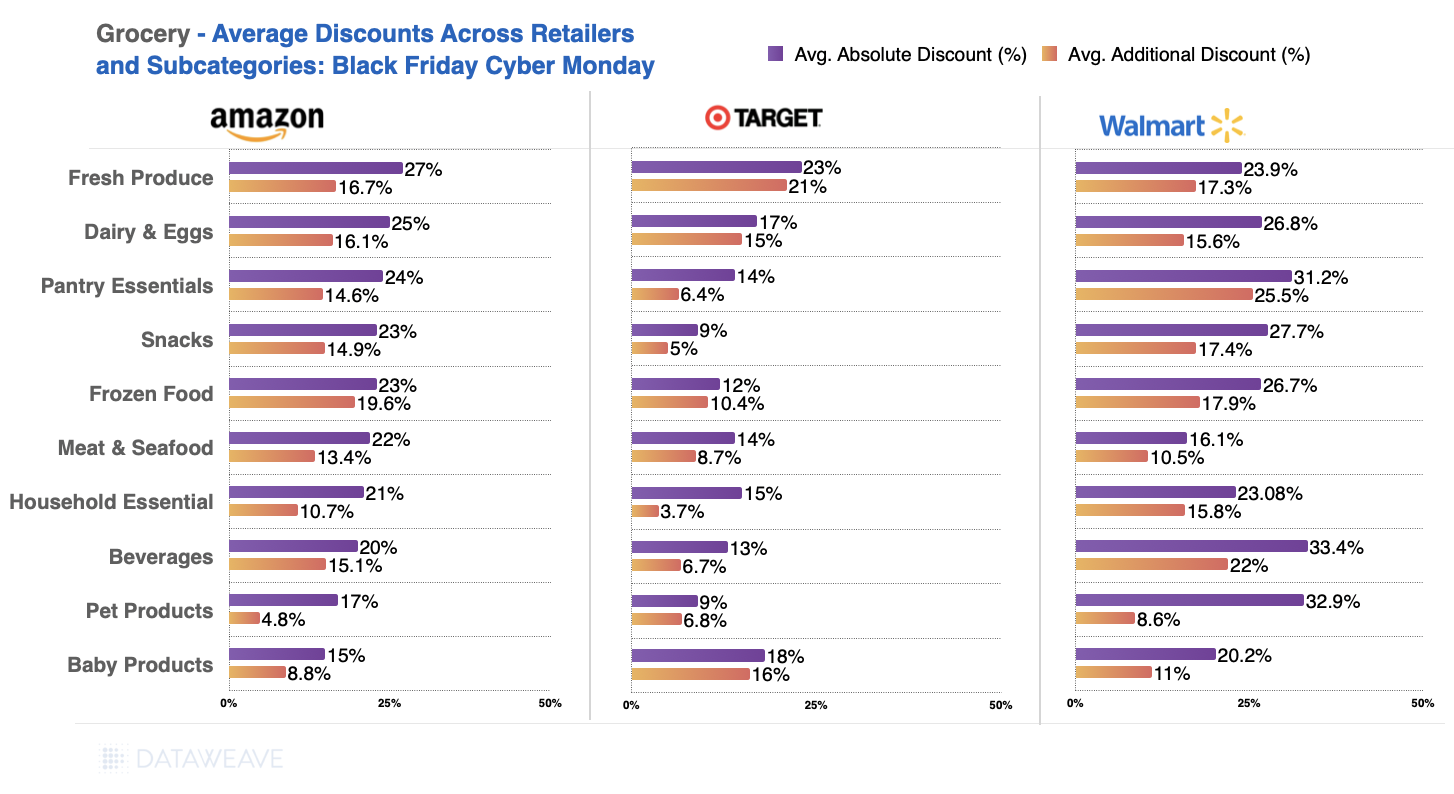
Subcategory Insights: Beverages Category at Walmart saw the deepest discounts, with an average of 33.4%
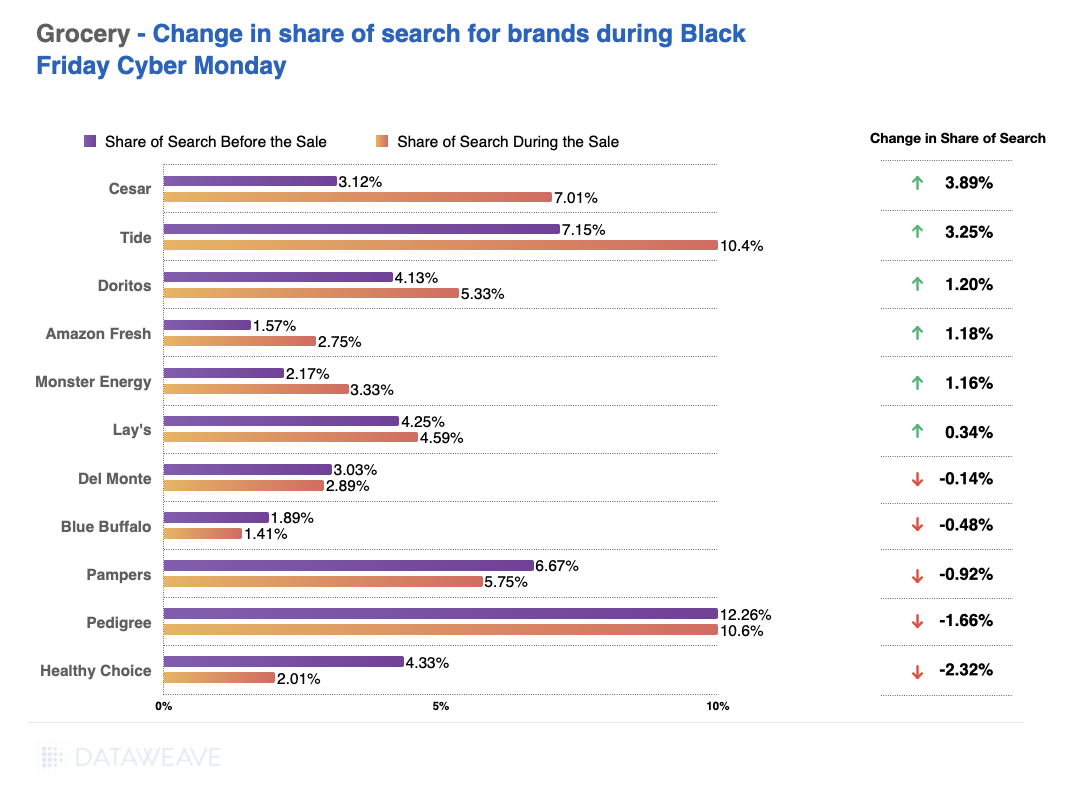
Top Gaining Brands: Cesar experienced the largest increase in share of search during the sales period (+3.89%)
This blog will dive deeper into grocery discount trends and brand-level strategies, offering insights for retailers looking to stay competitive in the grocery sector.
Our Methodology
For this analysis, we tracked the average discounts offered by major U.S. grocery retailers during the Thanksgiving weekend, including Black Friday and Cyber Monday. We focused on key subcategories within the grocery segment, capturing trends in discounting strategies.
In the following insights, the Absolute Discount represents the reduction of the selling price compared to the Manufacturer’s Suggested Retail Price (MSRP). The Additional Discount reflects how much lower the selling price is during Black Friday compared to its price a week before the sale. This metric reveals the actual or effective value of the sale event, beyond the standard discounts typically offered.
Key Findings
Retailer-Level Insights
Walmart emerged as the leader in grocery discounting, offering the highest average absolute (27.6%) and additional (18%) discounts.
Amazon adopted a mid-tier discounting strategy, with average absolute discounts of 20.4%.
Target, while more conservative, maintained competitiveness in select subcategories like baby products.
Subcategory Insights
Pantry Essentials saw Walmart leading with an average discount of 31.2%, appealing to budget-conscious consumers stocking up for the holidays.
Fresh Produce showed consistent discounting across retailers, with Amazon slightly ahead at 27%.
Beverages stood out for significant discounting at Walmart, with an impressive 33.4% average discount.
Brand-Level Insights
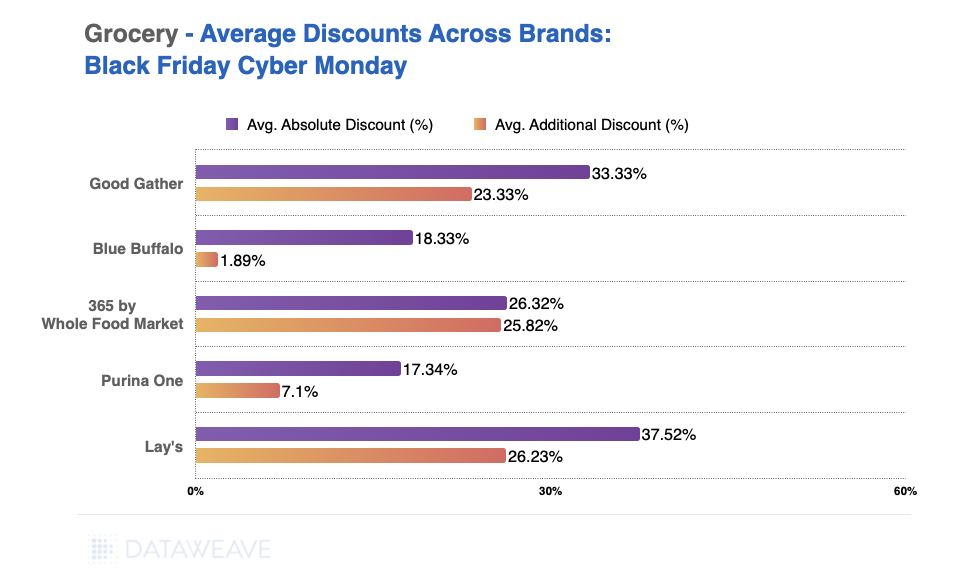
Lay’s led in absolute discounts (37.52%) and additional discounts (26.23%) showcasing aggressive pricing in the snacks subcategory.
Good & Gather maintained its competitive edge with strong discounts, appealing to price-conscious consumers seeking value.
Brands like Blue Buffalo (pet food brand) offered significant absolute discounts, but with a low additional discount of just 2%, the overall impact of the sale event on effective value was limited.
Share of Search Insights
Cesar (dog food brand), Tide (laundry staple) and Doritos saw significant gains in share of search, reflecting successful promotional strategies.
Brands like Pampers (baby diapers brand), Healthy Choice, (frozen foods brand) and Pedigree (pet food brand) experienced a decline, indicating less effective engagement during the sale period.
Who offered the lowest prices?
In the previous analysis, we focused on the top 500 products within each subcategory for each retailer, showcasing the discount strategies for their highlighted or featured items. However, to identify which retailer offered the lowest or highest prices for the same set of products, it’s necessary to match items across retailers. For this, we analyzed a separate dataset of 1433 matched products across retailers to compare their pricing during Black Friday. This approach provides a clearer picture of price leadership and competitiveness across categories.
Here are the key takeaways from this analysis.
Category-Level Analysis
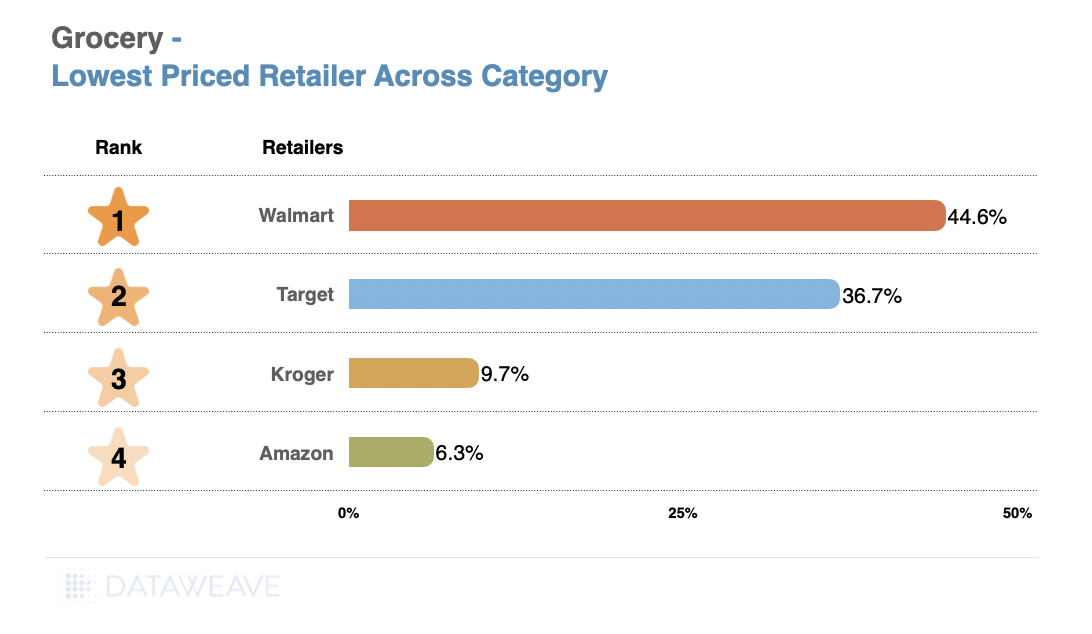
Walmart is the lowest priced retailer overall for the grocery category, with an impressive average discount of 44.60%. This significant discount advantage makes Walmart a leading option for value-seeking consumers.
Target follows with strong discounts of 36.73%, indicating solid pricing in comparison but less aggressive than Walmart.
Interestingly, Amazon was the most expensive in Grocery, with an average discount of only 6.3%.
Subcategory-Level Analysis
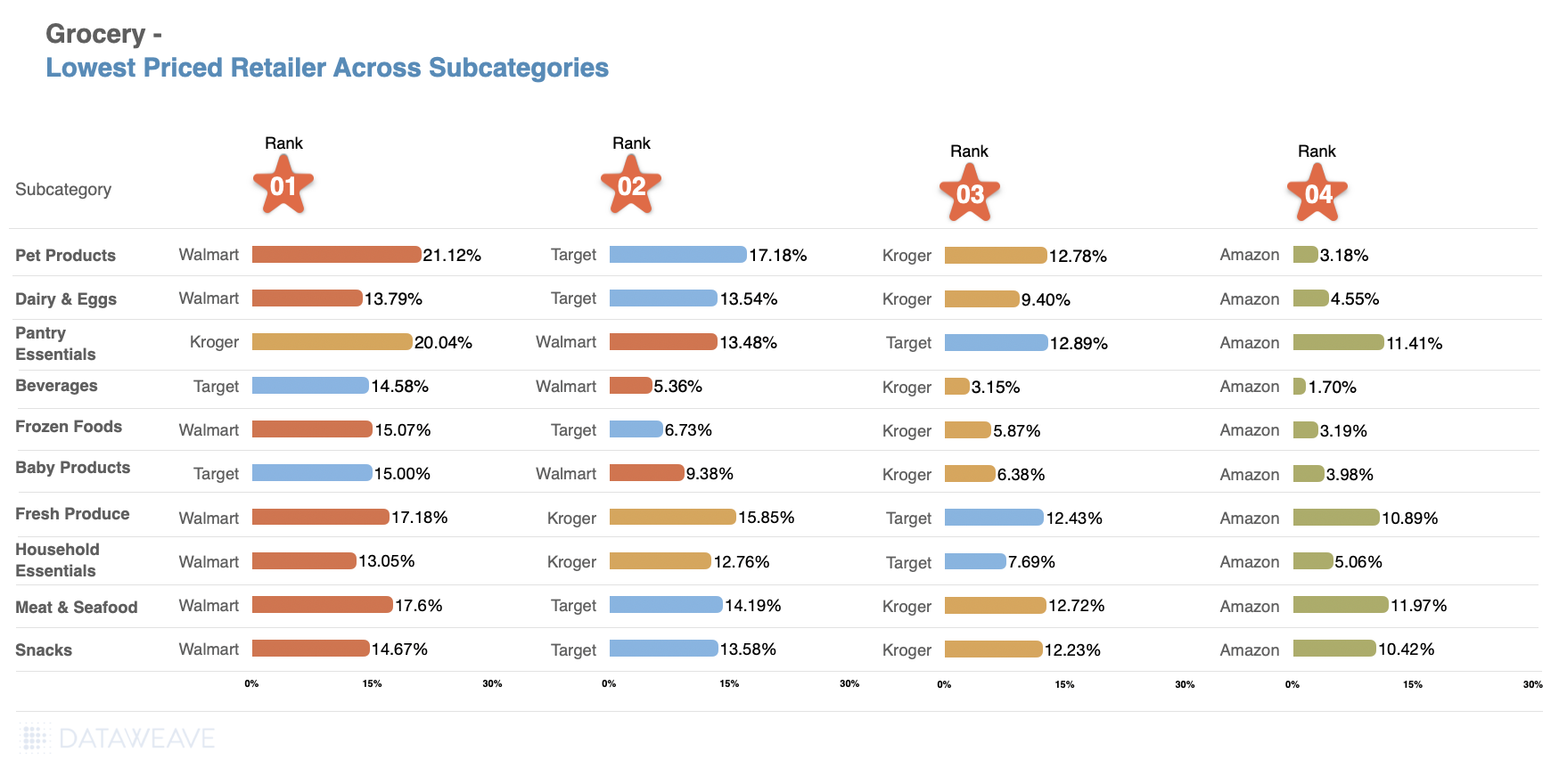
Walmart leads in various subcategories such as Pet Products (21.12%), Dairy & Eggs (13.79%), Household Essentials (13.05%), Frozen Foods (15.07%), and Meat & Seafood (17.60%), showcasing its extensive value across the board.
Target excels in Beverages (14.58%) and Baby Products (15.00%) with competitive discounts, standing out in these specific subcategories.
Kroger provides notable value in Pantry Essentials (20.04%) and Fresh Produce (15.85%), although its overall average discount is lower than Walmart’s.
Amazon consistently ranks lower in terms of average discounts across most subcategories, highlighting it as less competitive for consumers seeking the lowest prices.
Brand-Level Analysis
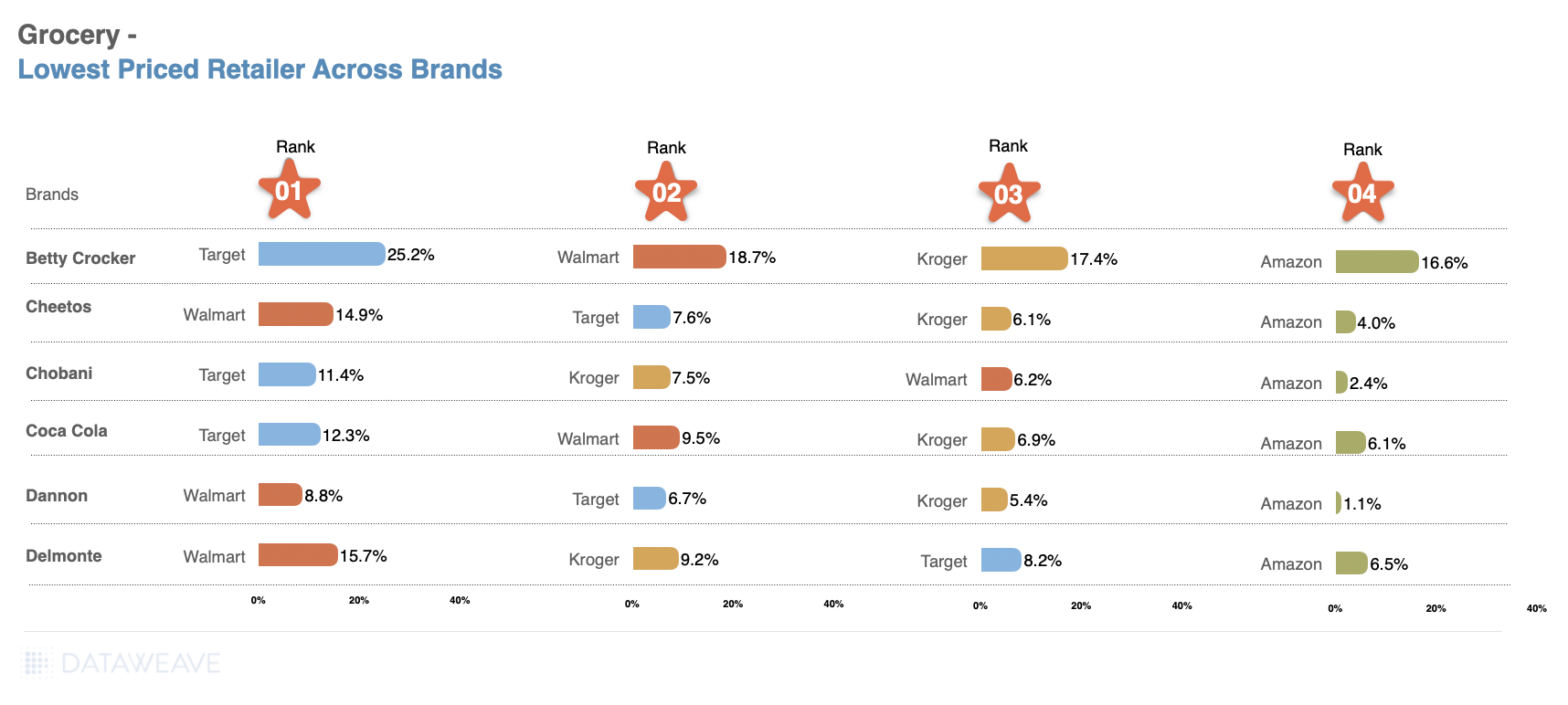
Walmart also holds the top position for several key brands like Cheetos (14.92%) and Dannon (8.81%), making it the best option for consumers looking for budget-friendly choices across popular brands.
Target takes the lead for brands like Betty Crocker (25.20%) and Chobani (11.37%), showing that it can offer value for specific products.
Kroger maintains strong discounts for brands such as Delmonte (9.19%), but it does not outpace Walmart in the overall grocery brand comparison.
Amazon generally lags behind in average discounts for most brands, with Dannon (1.12%) and Chobani (2.43%) showing significantly lower discounts.
Walmart is the lowest priced retailer in the grocery category and provides substantial value across a wide range of subcategories and popular brands. This ties in with Walmart’s ELDP pricing strategy. The retailer leads in overall average discounts and maintains its position as the go-to for price-conscious consumers. Target offers strong value in certain subcategories and brands but falls short of Walmart’s broad value based pricing advantages.
What’s Next
For grocery retailers, competitive pricing and targeted promotions are critical to driving sales during key shopping events. As consumers continue to prioritize value, staying ahead in the discounting game can significantly impact market share.
For detailed insights into grocery discounting strategies and to explore how DataWeave’s solutions can help retailers optimize their pricing, contact us today!
Stay tuned to our blog for further analyses of other categories during Black Friday and Cyber Monday.
The Home & Furniture category continues to thrive, propelled by consumer interest in creating personalized and functional living spaces. In 2023, the U.S. furniture and home furnishings market was valued at approximately $641.7 billion in 2023 and is estimated to grow at a CAGR of 5.1% from 2024 to 2032. Black Friday and Cyber Monday play a crucial role in fueling this growth, offering consumers a mix of premium and affordable options across subcategories.
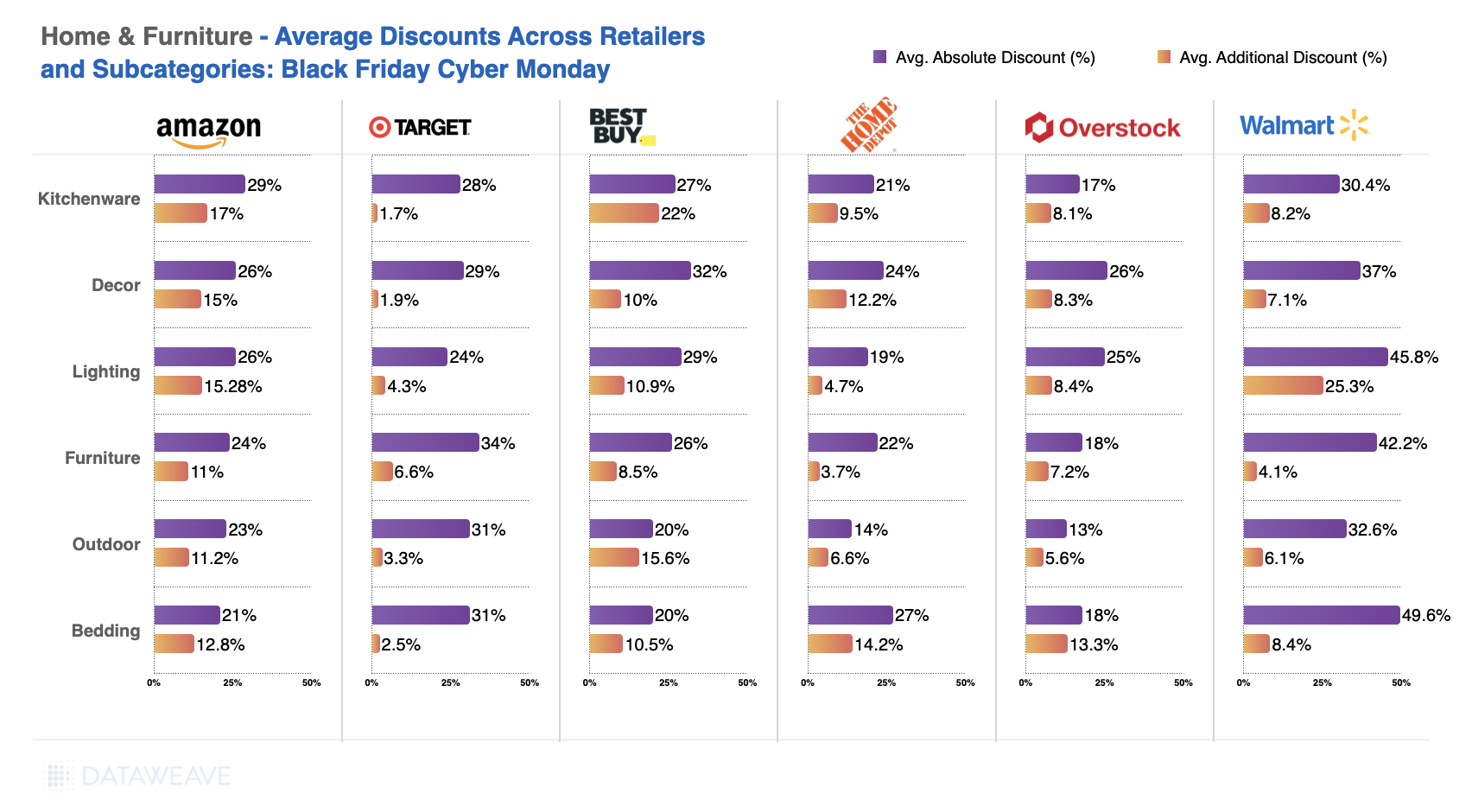
To better understand market trends and discount strategies this Black Friday, at DataWeave we tracked over 18,149 SKUs across major home & furniture retailers, including Amazon, Walmart, Target, Best Buy, Home Depot, and Overstock, from November 10 to 29, 2024. Using our AI-powered pricing intelligence platform, we focused on the top 500 products in subcategories like kitchenware, furniture, decor, lighting, outdoor items, and bedding.
In our analysis, the Absolute Discount represents the reduction of the selling price compared to the Manufacturer’s Suggested Retail Price (MSRP). The Additional Discount reflects how much lower the selling price is during Black Friday compared to its price a week before the Black Friday sale. This metric reveals the actual or effective value of the sale event, beyond the standard discounts typically offered.
Also check out our insights on discounts and pricing for the health & beauty category this Black Friday.
Retailer Performance: Who Led the Discount Race?
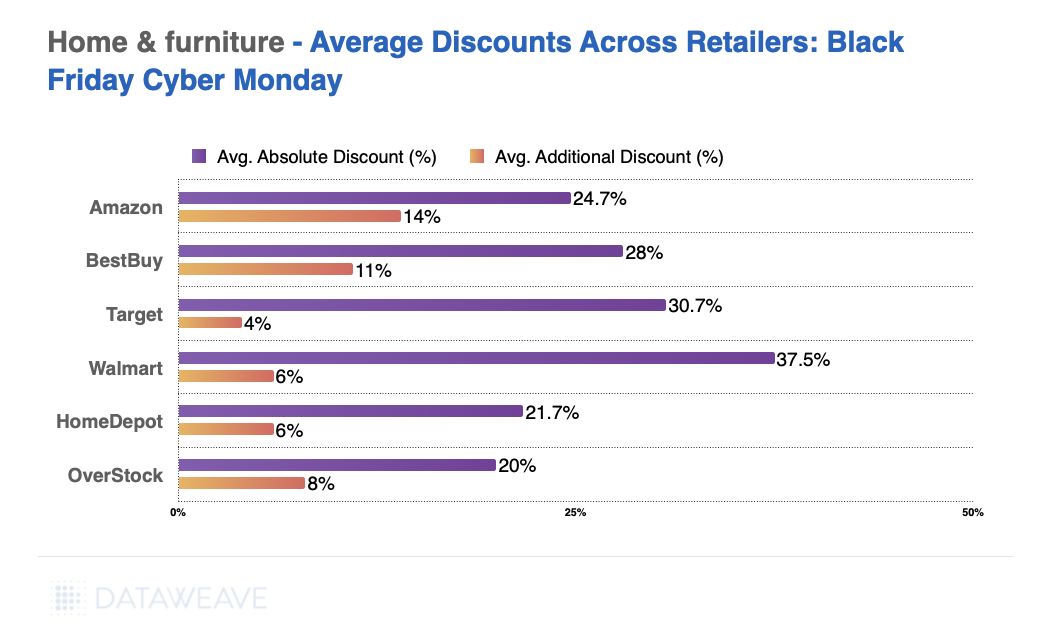
Retailers showed varying discount strategies for Home & Furniture products. Walmart emerged as the leader in absolute discounts (37.5%) while Amazon offered the highest additional discount of 14%. Best Buy maintained competitive pricing across all subcategories, while Overstock and Home Depot offered relatively modest discounts.
Subcategories in Focus
Breaking down the discounts by subcategory provides deeper insights into consumer priorities and retailer strategies:
Kitchenware saw strong competition, with Walmart (30.40% absolute discounts) and Amazon (29% absolute discounts) dominating.
Lighting became a discount hotspot, with Walmart offering up to 45.8% in absolute discounts and 25.3% additional markdowns.
Furniture remained a core focus for Target, delivering an impressive 34% average absolute discount.
Bedding stood out at Walmart, where discounts peaked at 49.6%.
Brand Spotlight: Who Stood Out?
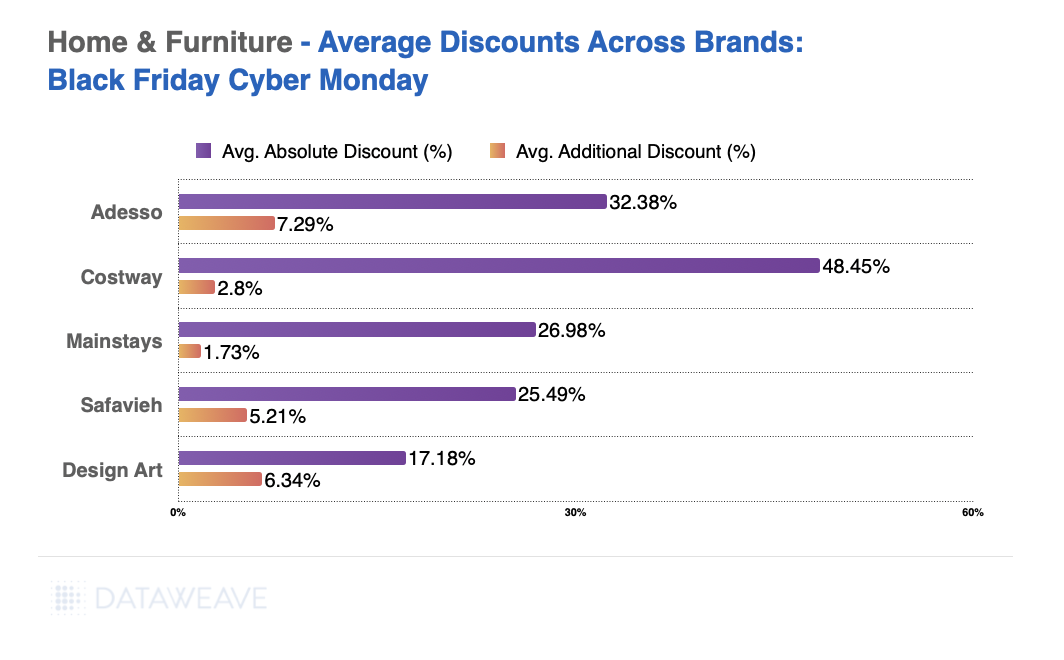
Among top-performing brands, furniture brand Costway offered the highest discounts, with an average of 48.4%. Meanwhile, Adesso (lighting solutions), Mainstays and Safavieh (both home furnishings brands) balanced discounts and premium appeal.
Search Visibility: The Winners and Losers
Share of search dynamics revealed significant shifts in brand visibility during Black Friday:
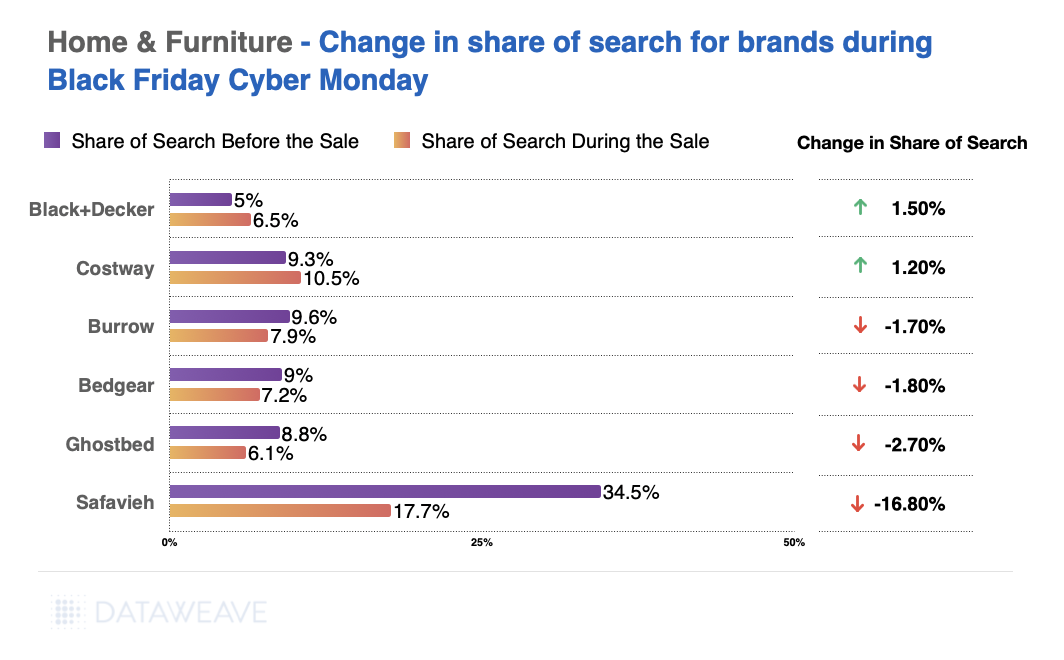
Furniture brand Costway (+1.2%) and home improvement player Black+Decker (+1.5%) gained visibility.
On the flip side, premium brands like Safavieh known for rugs and home furnishings (-16.8%) and furniture brand Burrow ( -1.7%) saw declines.
Who Offers the Lowest Prices?
In the previous analysis, we focused on the top 500 products within each subcategory for each retailer, showcasing the discount strategies for their highlighted or featured items. However, to identify which retailer offered the lowest or highest prices for the same set of products, it’s necessary to match items across retailers. For this, we analyzed a separate dataset of 735 matched products across Home & Furniture specific retailers to compare their pricing during Black Friday. This approach provides a clearer picture of price leadership and competitiveness across categories.
Here are the key takeaways from this analysis.
Category-Level Highlights
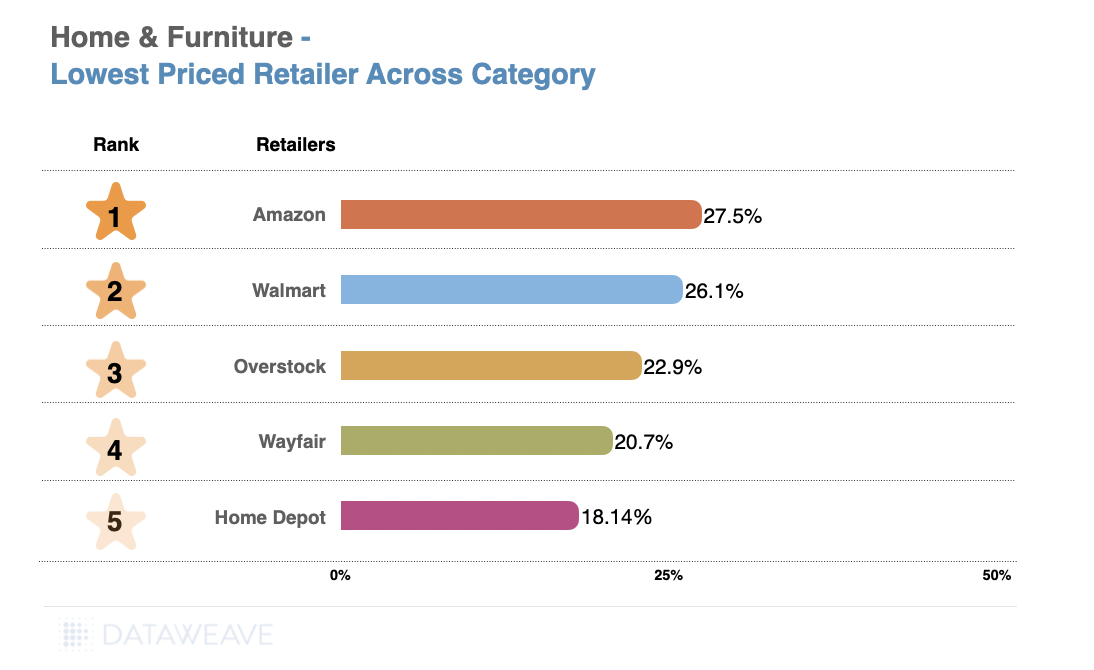
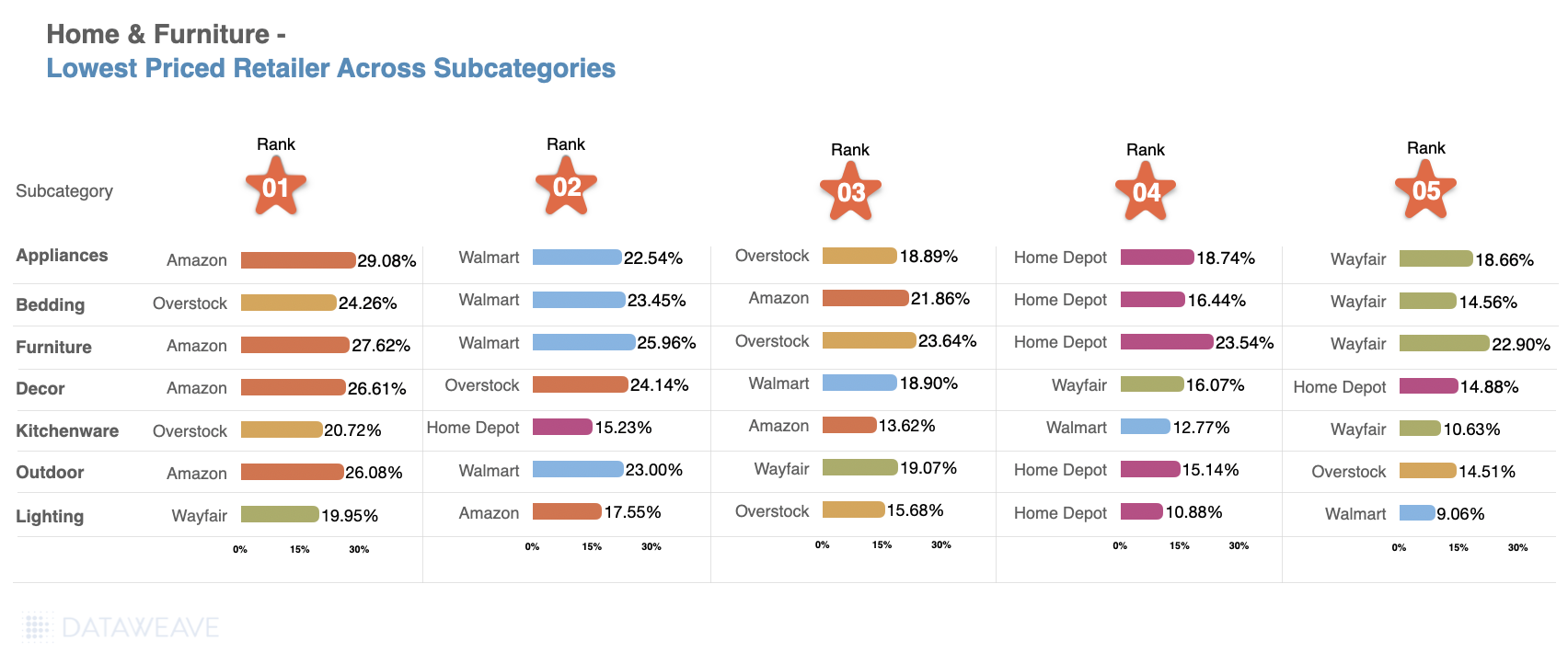
Amazon emerges as the lowest-priced retailer across Home & Furniture categories, with the highest average discount of 27.50%, closely followed by Walmart (26.09%).
Overstock and Wayfair trail with average discounts of 22.93% and 20.71%, respectively, while Home Depot offers the least aggressive pricing at 18.14%. This is notable, as all 3 players are known specialists in the category.
Subcategory Highlights
Amazon stands out as the leader in multiple subcategories, including Appliances, Furniture, Decor, and Outdoor, offering competitive average discounts of around 26-29%.
Overstock leads in Bedding and Kitchenware, with strong average discounts of 24.26% and 20.72%, respectively.
Wayfair is notable for Lighting, with an average discount of 19.95%, and is also competitive in Outdoor and Furniture categories.
Walmart consistently ranks high in several subcategories like Appliances and Bedding, providing solid discounts of around 22-23%.
What’s Next
For home & furniture retailers, driving maximum value during mega sale events like Black Friday involves offering bundles and sets to meet customer demands and trend expectations. Gaining insights into competitor discounts and pricing can help furniture retailers get an edge amid this environment.
Want to know how DataWeave’s intelligence platform can empower your business during peak sales events? Contact us to discover more about competitive insights, price intelligence, and data-driven decision-making. Stay tuned to our blog to see more coverage on Black Friday 2024.
The U.S. health and beauty retail sector shows remarkable resilience amid economic uncertainties, with the skincare market projected to hit $21.83 billion in 2024. Black Friday data reinforces this trend, with health and beauty products seeing a 14.6% surge in web traffic compared to last year.
At DataWeave, we conducted an in-depth analysis of Black Friday discounting trends in the U.S. health and beauty sector. DataWeave’s AI-powered pricing intelligence platform was used to monitor pricing and discounts across Sephora, Ulta Beauty, Walmart, Target, and Amazon during Black Friday 2024. The study covered 19985 SKUs from November 10-29. We focused on the top 500 products ranked for each search keyword on each retail site, using targeted terms aligned with categories like “skincare” and “fragrance”.
The results? Beauty leads across categories in discount depth this year, with some retailers offering significant markdowns.
The Beauty Boom: More Than Just Looking Good
If there’s one thing the pandemic taught us, it’s that self-care isn’t just a luxury – it’s a necessity. This Black Friday proved that beauty has become an indispensable part of consumers’ lives, with retailers offering unprecedented discounts and crafting strategic promotions to capture the growing demand.
The Absolute Discount represents the reduction of the selling price compared to the Manufacturer’s Suggested Retail Price (MSRP). The Additional Discount reflects how much lower the selling price is during Black Friday compared to its price a week before the sale. This metric reveals the actual or effective value of the sale event, beyond the standard discounts typically offered.
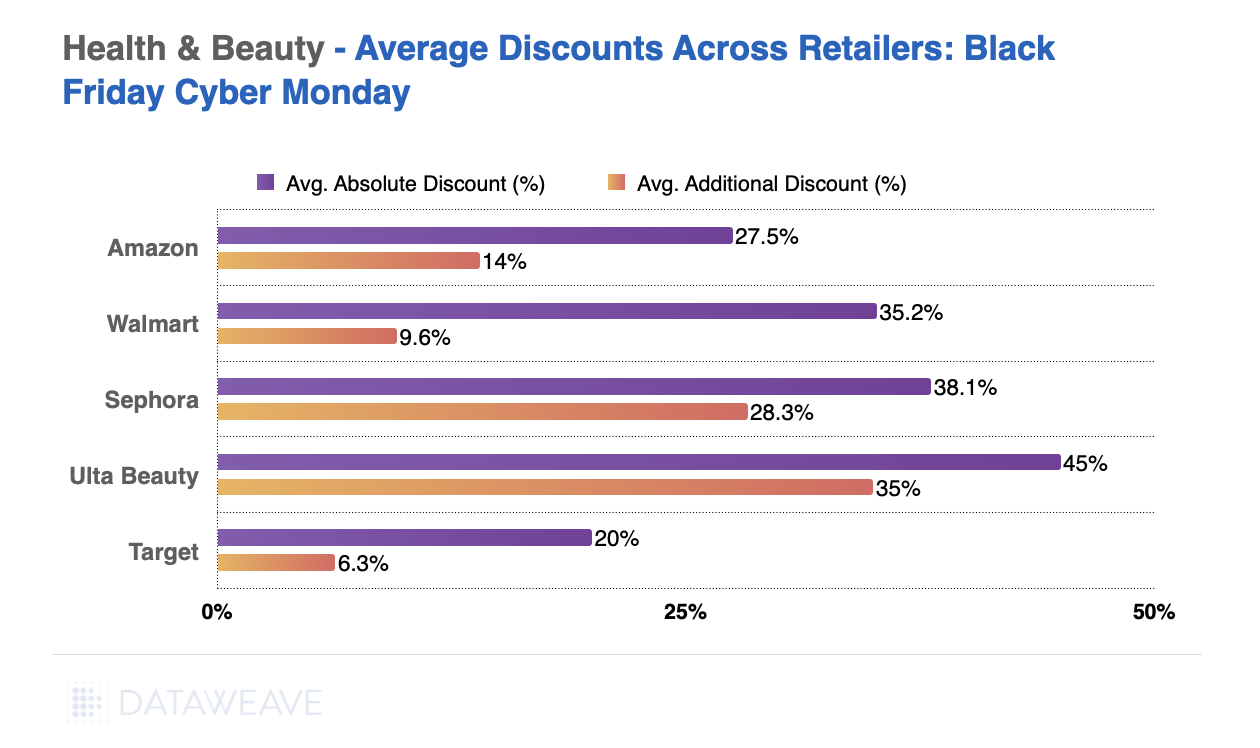
Ulta Beauty led with 45% average discounts, followed by Sephora at 38.1% and Walmart at 35.2%. In terms of additional Black Friday discounts, Ulta maintained dominance at 35%, with Sephora following at 28%.
Hair care emerged as the standout category, with Ulta Beauty offering up to 56% discounts, reflecting sustained demand for at-home beauty routines. Skincare saw fierce competition, with Sephora emphasizing premium discounts (37%) while Walmart focused on value pricing (32.5%).
Fragrance and Makeup attracted consumers with targeted promotions from Walmart and Ulta Beauty, signaling strong demand for gifting items.
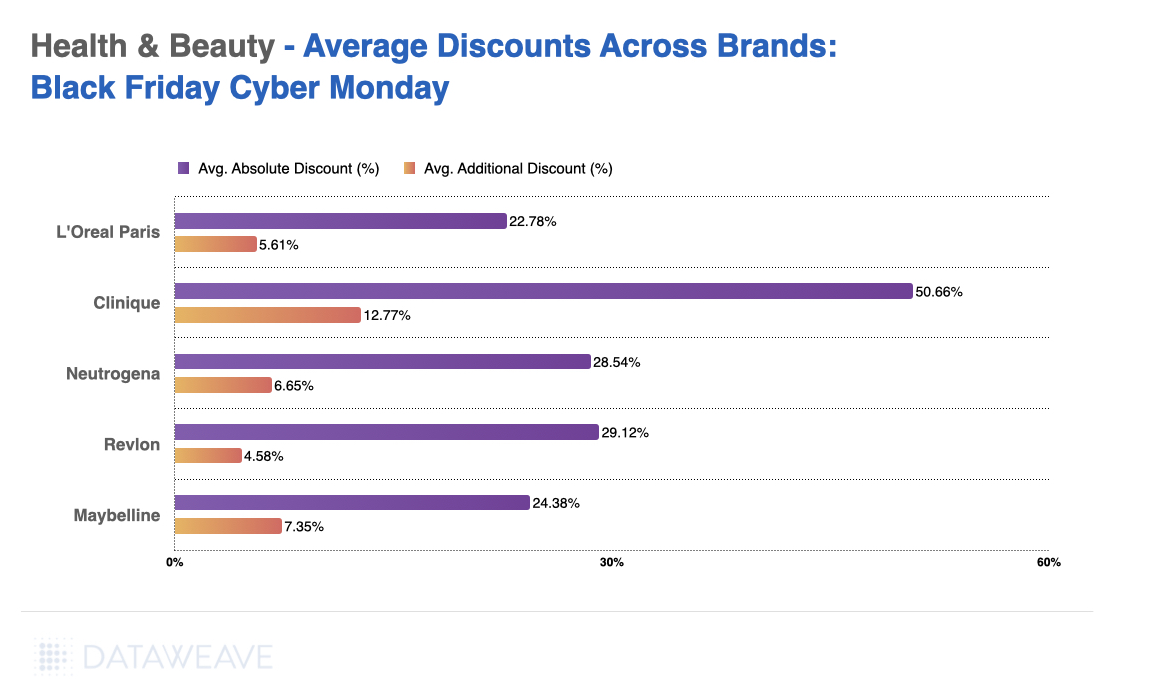
Major beauty brands echoed the sentiment. Premium skincare brand Clinique leads with 50.6% average discounts. Meanwhile, drugstore staples like Revlon (29.1%) and Maybelline (24.4%) balanced accessibility and affordability, driving mass-market appeal. Popular beauty and makeup brand L’Oreal Paris also offered a modest 22.8% average discount, reinforcing its position as a value-oriented brand.
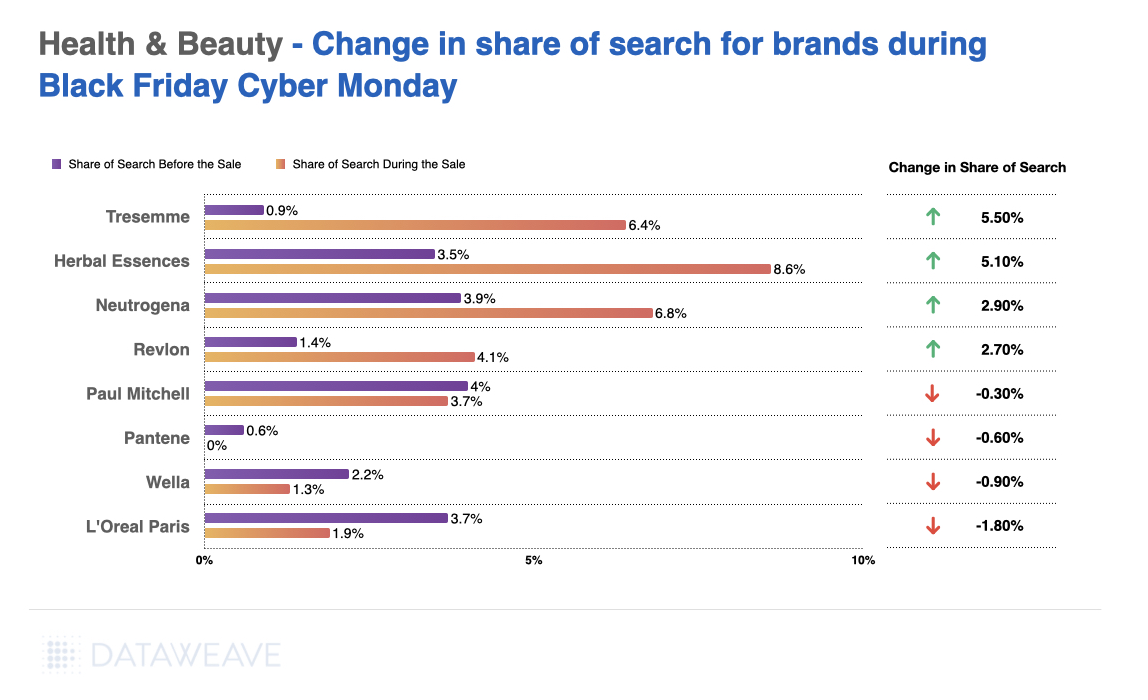
The more interesting story? The massive shift in brand visibility, as our share of search rankings denote:
Shampoo and hair care brand Tresemmé saw an unexpected 5.5% jump in the share of search results
Beauty brand Herbal Essences gained 5.1% in share of search well
Declines in share of search were noted for brands like L’Oreal Paris (-1.8%) and Pantene (-0.6%), indicating missed opportunities in promotional visibility.
Insight: What’s driving this beauty boom? TikTok and social media continue to fuel beauty purchases, with viral products driving significant search and sales spikes. Plus, the “skinification” of hair care has turned basic shampoo shopping into a full-blown beauty ritual.
Who Offered the Lowest Prices?
In the previous analysis, we focused on the top 500 products within each subcategory for each retailer, showcasing the discount strategies for their highlighted or featured items. However, to identify which retailer offered the lowest or highest prices for the same set of products, it’s necessary to match items across retailers. For this, we analyzed a separate dataset of 1133 matched products across Health & Beauty specific retailers to compare their pricing during Black Friday. This approach provides a clearer picture of price leadership and competitiveness across categories.
Here are the key takeaways from this analysis.
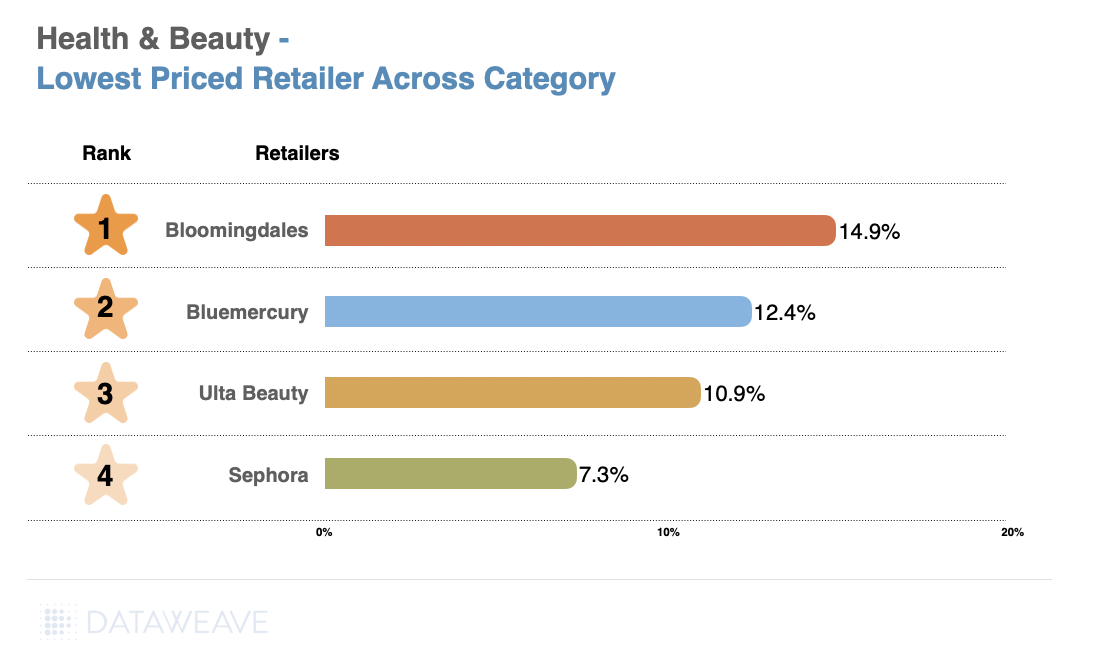
Bloomingdale’s emerges as the overall leader, offering the highest average discount of 14.87%, closely followed by Bluemercury (12.41%).
Ulta Beauty ranks third (10.94%), demonstrating competitiveness across key subcategories, while Sephora trails with the lowest average discount (7.33%), reflecting a more premium positioning.
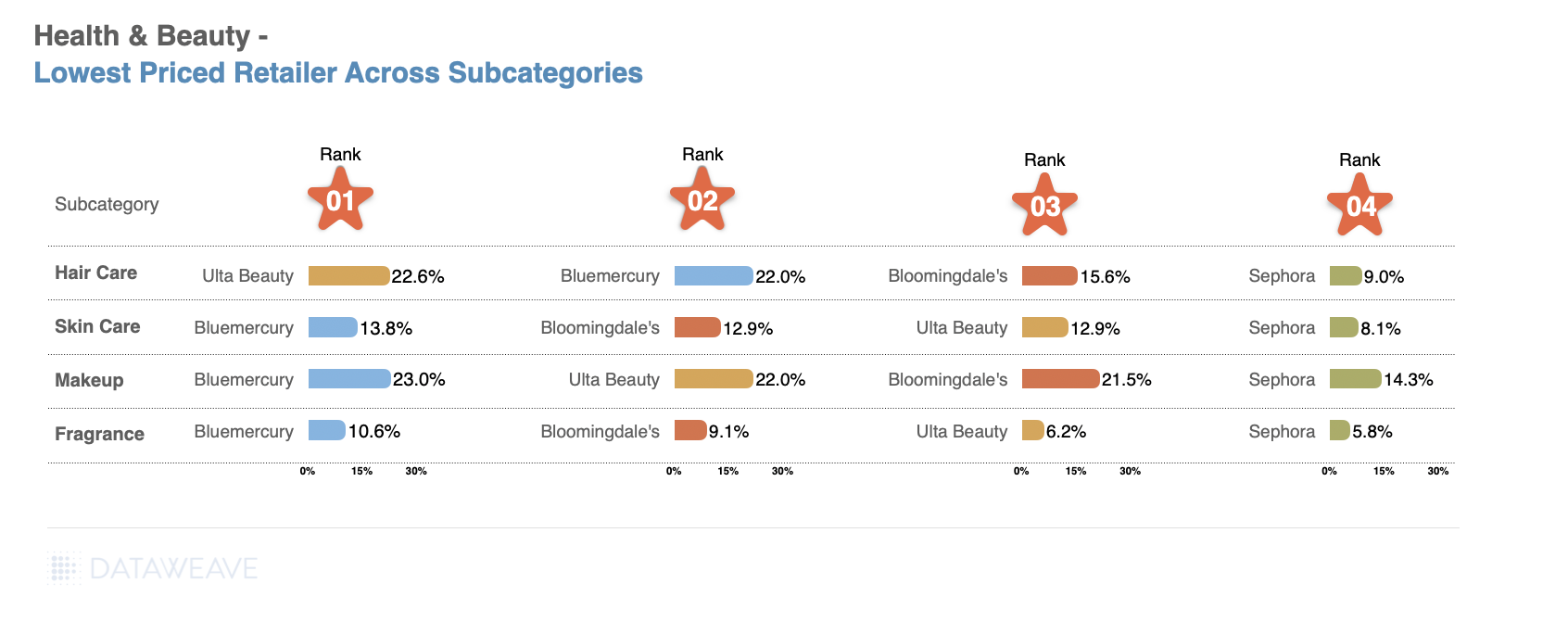
Ulta Beauty leads in Hair Care with the highest discount (22.62%), while Bluemercury dominates in Skin Care (13.81%), Makeup (22.98%), and Fragrance (10.6%).
Sephora consistently offers the lowest discounts across all subcategories, reflecting their premium positioning.
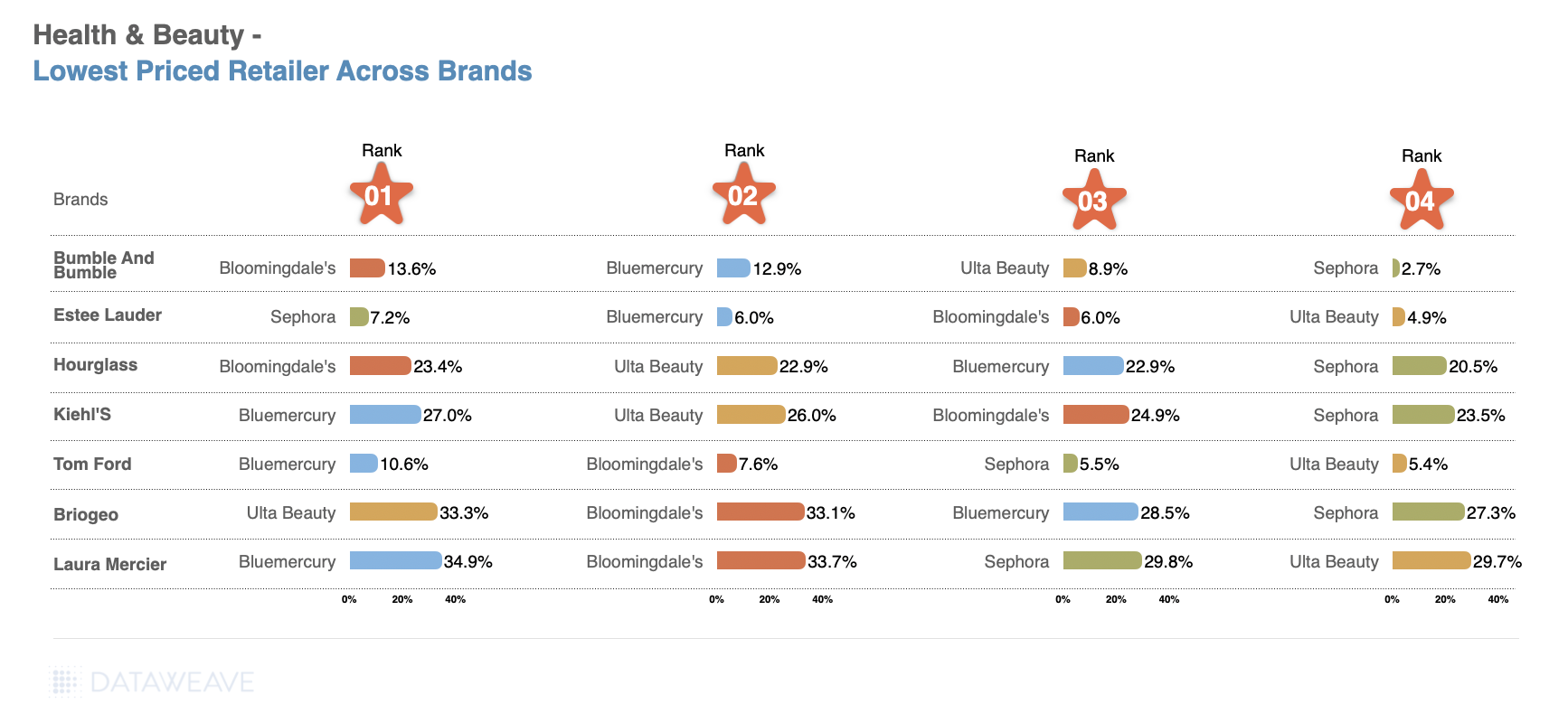
Bluemercury offers the lowest prices for luxury brands like Kiehl (27.02%) and Laura Mercier (34.87%), with Bloomingdale’s closely trailing.
Bloomingdale’s leads for Bumble and Bumble (13.59%) and Hourglass (23.41%), showcasing strong promotional efforts.
Sephora maintains a more restrained discount strategy, with notable leadership only for Estée Lauder (7.18%).
Ulta Beauty shines in offering the steepest discount for Briogeo (33.26%), emphasizing competitiveness in key brands.
What’s Next for Holiday Discounting?
For retailers, the message is clear: traditional holiday playbooks need a serious update. For shoppers, it means unprecedented opportunities to score deals in categories that traditionally held firm on pricing.
Want to stay ahead of retail trends and optimize your holiday shopping strategy? DataWeave’s commerce intelligence platform helps brands and retailers strategically navigate these shifts. Contact us to learn more about how we can help you make data-driven decisions in this rapidly evolving retail landscape.
Stay tuned to our blog for forthcoming analyses on pricing and discounting trends across a spectrum of shopping categories, as we continue to unravel the intricacies of consumer behavior and market dynamics.
Black Friday, once confined to a single weekend, has evolved into a shopping season that now stretches well before Thanksgiving. With inflation hovering around 3% and consumer confidence showing signs of recovery, retailers are adapting their promotional calendars to capture early-bird shoppers and maintain a competitive edge.
Major retailers, including Amazon, Walmart, Target, and Best Buy, have capitalized on this trend by launching promotions weeks in advance, signaling the traditional holiday rush is now a month-long event. At DataWeave, we put these deals under a microscope.
Our Methodology
Using DataWeave’s advanced, AI-powered pricing intelligence platform, we tracked early Black Friday deals across Consumer Electronics, Home & Furniture, Health & Beauty, and Apparel categories. We monitored dedicated Black Friday deal pages on Amazon, Walmart, Target, Best Buy, Nordstrom, Neiman Marcus, and Sephora to gather and analyze discount data a week prior to Black Friday weekend.
Who’s Offering the Best Deals Across Categories?
Our pre- Black Friday analysis reveals a clear pattern of premium brands offering deeper discounts across categories ahead of the holiday. Here are some key findings around retail players:
Walmart emerges as the most aggressive discounter across categories, leading in Health & Beauty (57.07%), Apparel (48.97%), and Consumer Electronics (43.35%).
Amazon maintains consistent but lower discounts (28-29%) across categories, suggesting potential deeper cuts ahead.
Best Buy and Sephora, both category specialists, play it conservative compared to mass retail players.
Let’s look at each category more closely to get a detailed snapshot of the deals this Thanksgiving week:
Health & Beauty
Our analysis reveals that it’s not electronics, but the health & beauty category that leads with the widest discount range pre Black Friday, making it the category to watch out for.
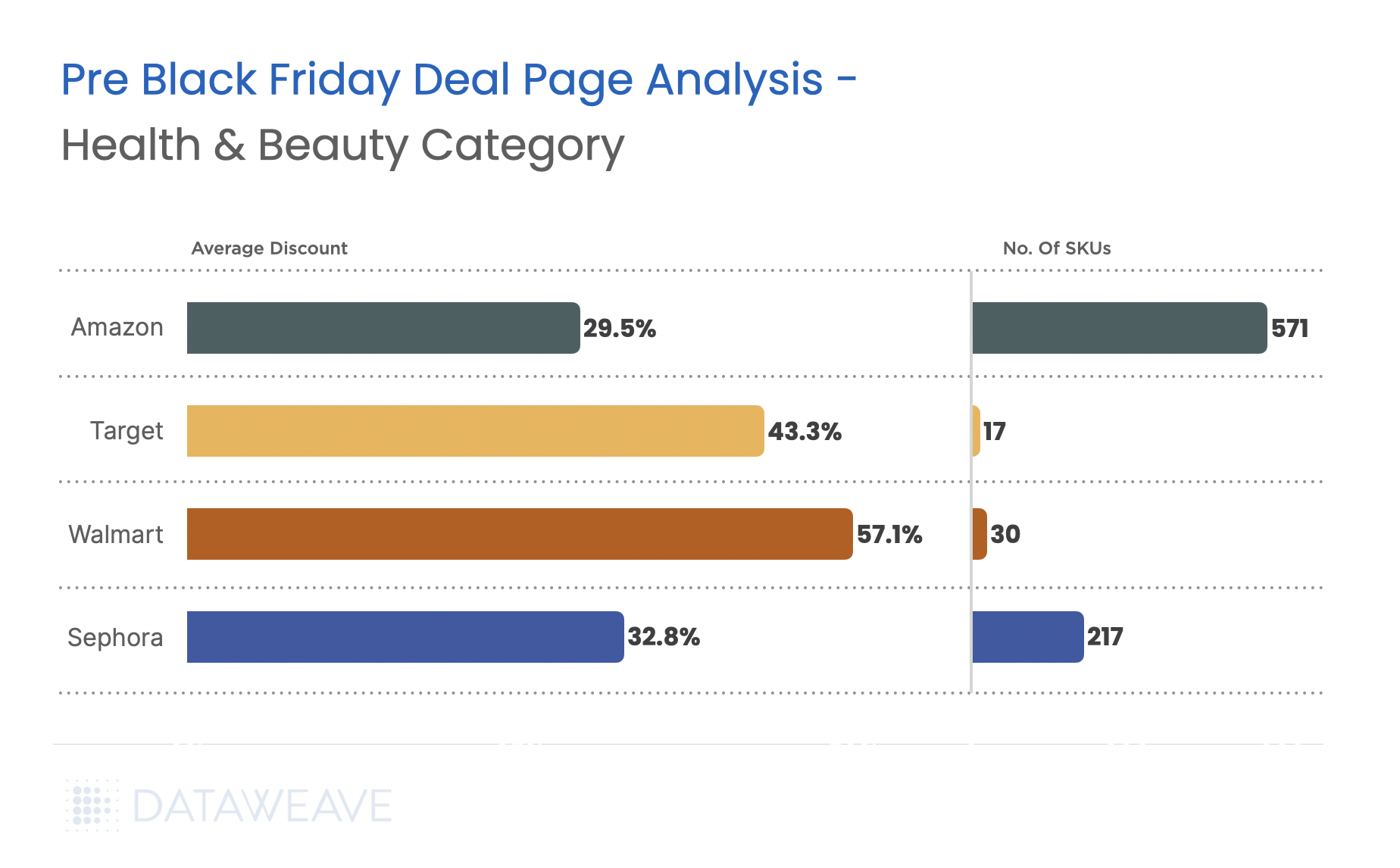
Walmart takes the lead with an aggressive 57.1% average discount in this category, capitalizing on its value-oriented reputation.
Beauty specialist Sephora holds modest beauty discounts (32.81%) compared to other retailers.
Amazon offers the broadest range of SKUs (571) in the category.
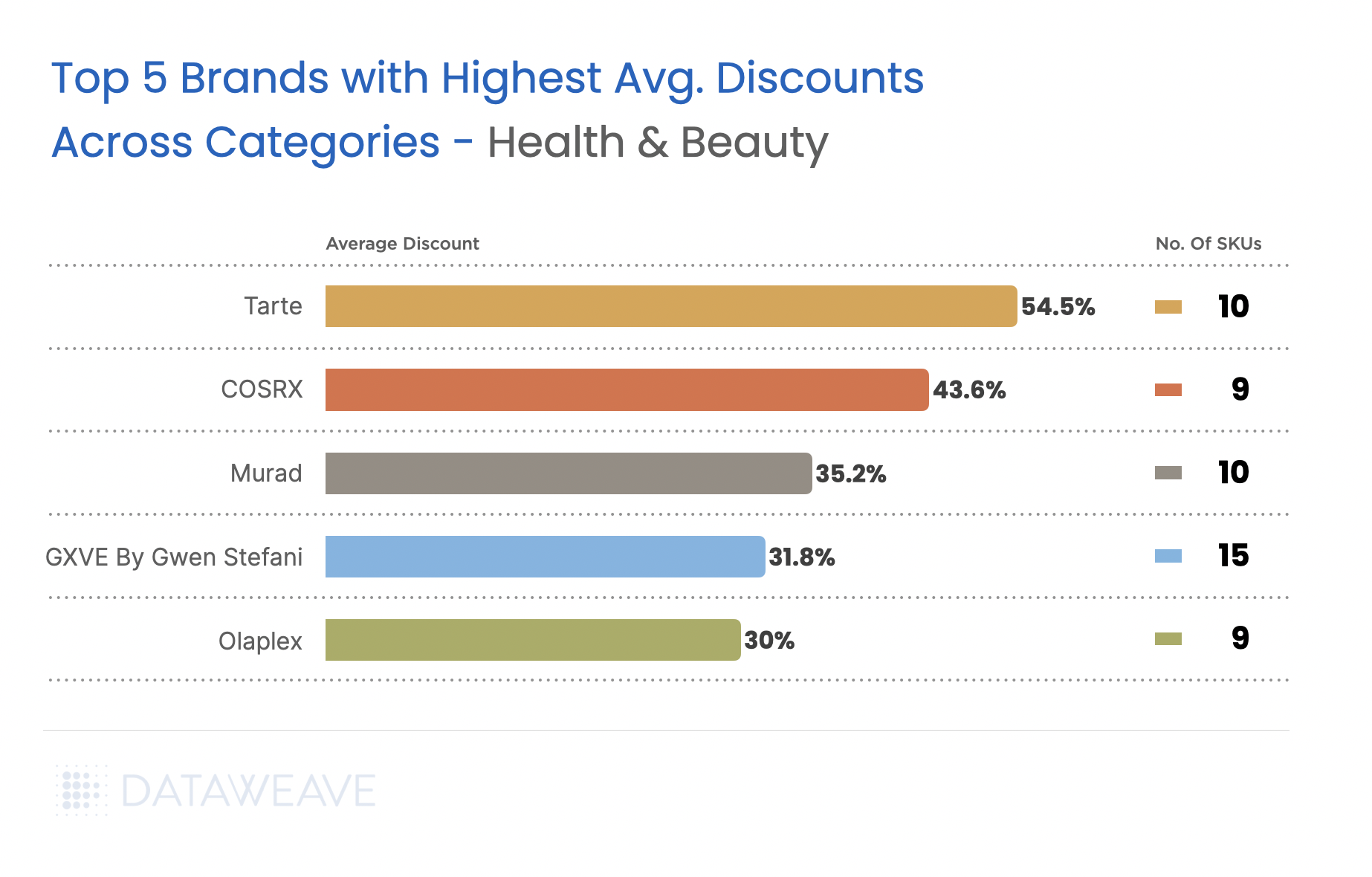
Among the health & beauty brands we analyzed, cosmetics brand Tarte and viral K-Beauty skincare brand COSRX stand out with discounts above 40%, appealing to cost-conscious beauty enthusiasts.
Consumer Electronics
Our pre- Black Friday analysis reveals interesting insights about consumer electronics deals this season.
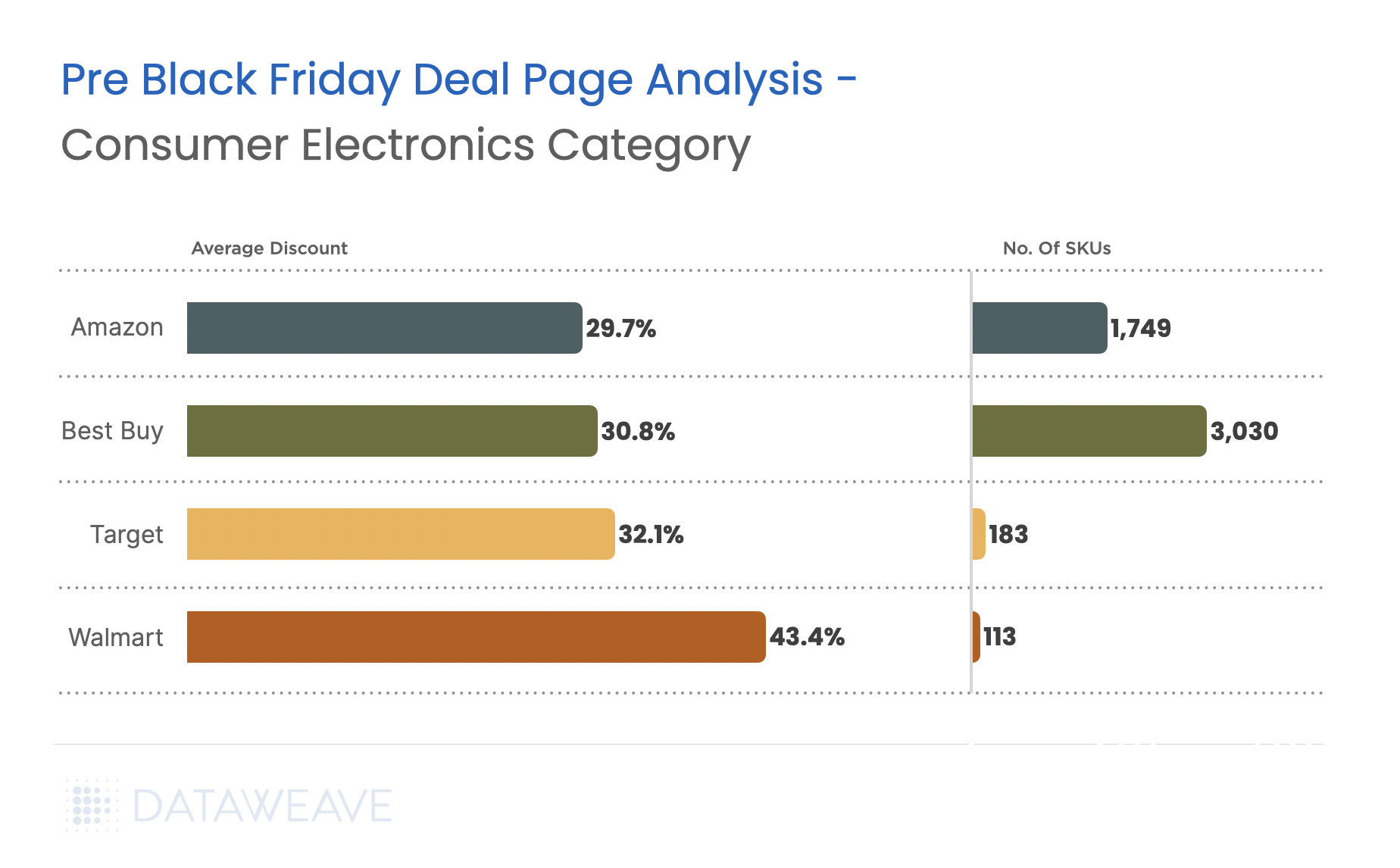
Walmart, once again, emerges as the frontrunner in the category with 43.4% average discounts.
Best Buy plays it conservative in electronics (30.75%), despite being a category specialist, but offers the most extensive SKU coverage (3030).
Amazon’s consistent 29.7% discount across 1,749 SKUs suggests they’re probably holding back their best deals for Prime members during Black Friday.
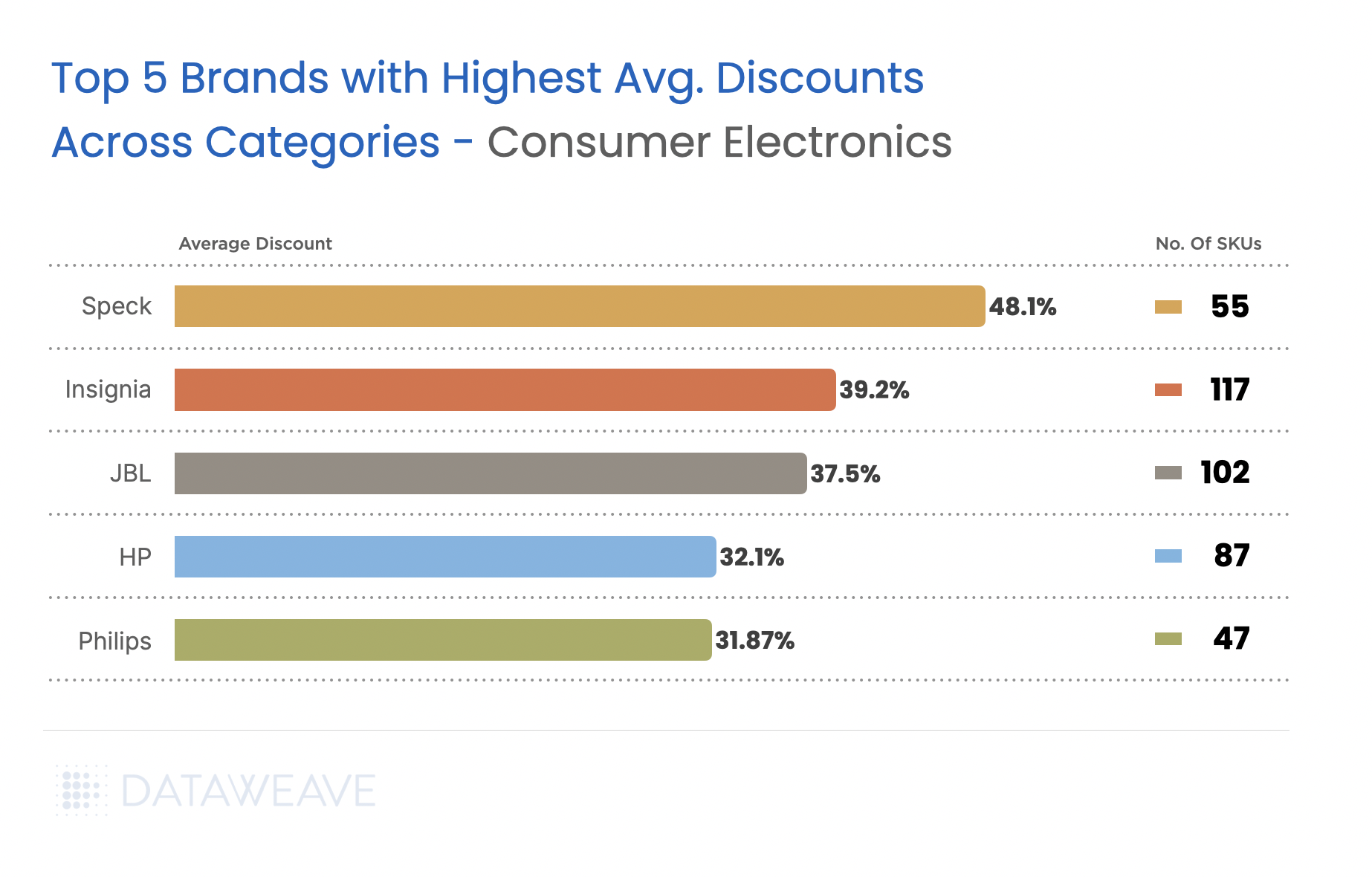
Brand-specific data for the category reveals significant deals on Speck (48.07%) and smart TV brand Insignia (39.22%), making accessories and mid-tier electronics attractive for early shoppers. Core computing (HP at 32.14%) and electronics brands maintain more conservative discounts. It remains to be seen if this changes on Black Friday or Cyber Monday.
Apparel
Our analysis of the apparel category reveals several highlights:
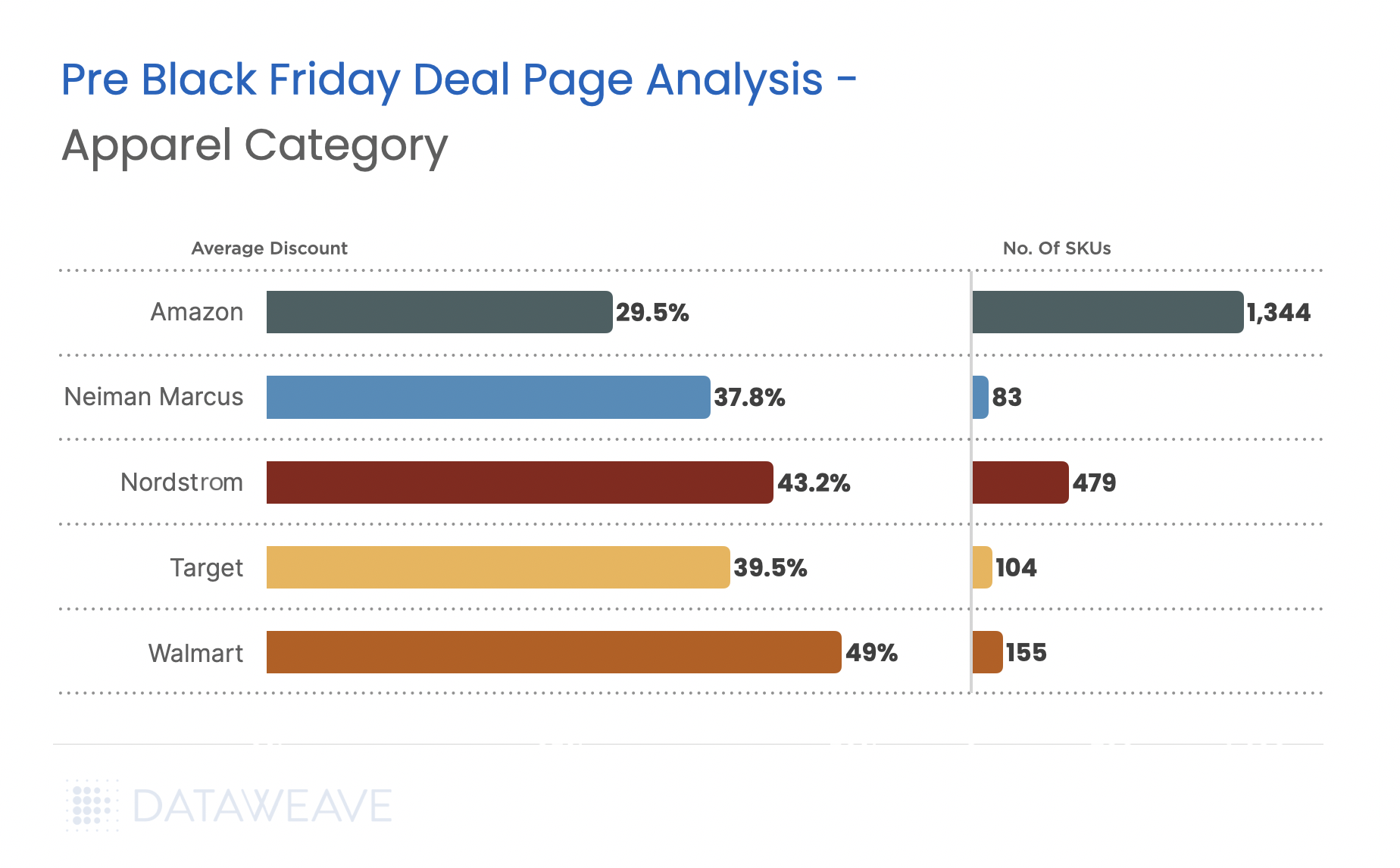
In the apparel category too, Walmart dominates with an impressive 49% average discount, effectively targeting price-sensitive shoppers in the fashion segment.
Nordstrom and Neiman Marcus, both known for apparel, offer significant discounts at 43.2% and 37.8% respectively.
Amazon’s expansive SKU coverage (1344) is countered by a modest 29.5% discount, showing its focus on variety over depth of discounts.
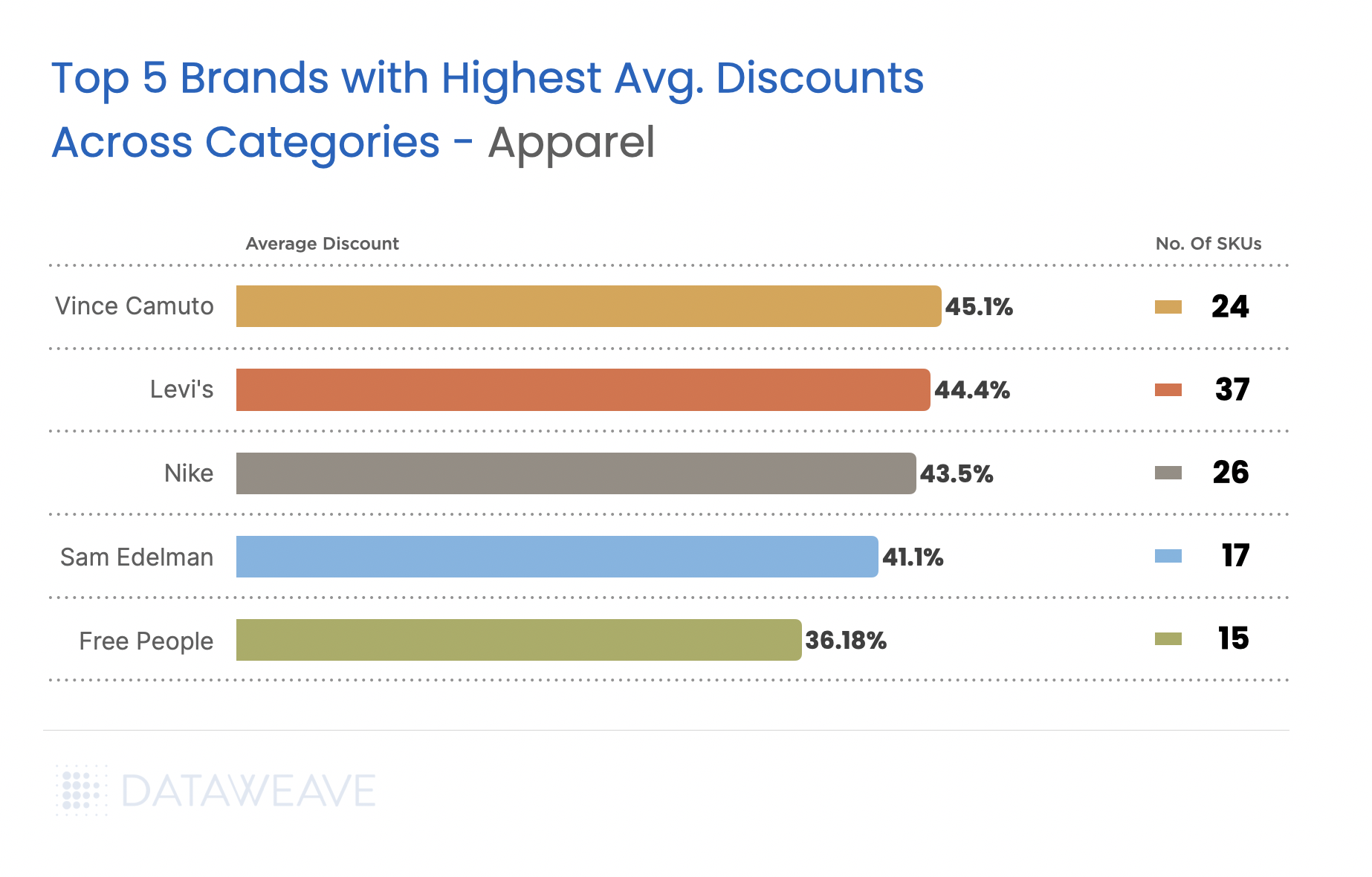
Premium fashion brands dominate the highest discounts this Black Friday in the apparel category. Vince Camuto leads with over 45.1% average discount. Notably, Levi and Nike’s aggressive 44.43% and 43.50% discounts suggests significant inventory positions or intent to capture market share.
Home & Furniture
Our analysis reveals an interesting trend across the category.
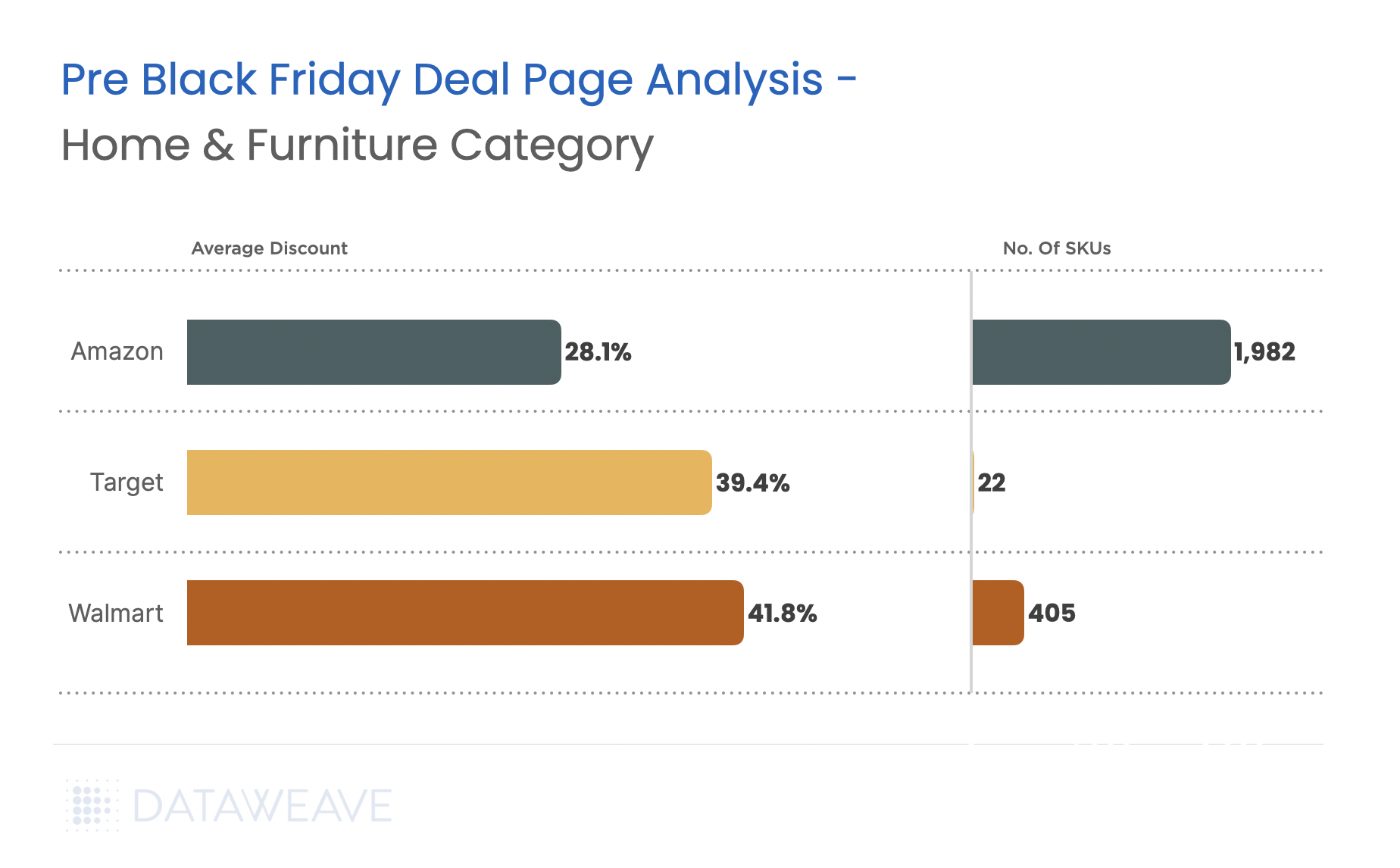
In the home & furniture category too, Walmart leads at 41.8% average discounts. Target follows closely, but with significantly lesser SKUs on offer.
Amazon’s 28.1% discount, though the lowest among major players, spans a substantial 1,982 SKUs, reinforcing its position as a marketplace for diverse needs.
Top 3 Products With the Highest Discounts Across Retailers
To provide a clearer picture of the early Black Friday landscape, we analyzed the top 3 products with the most substantial discounts in consumer electronics and health & beauty categories. These insights highlight how retailers are leveraging strategic discounts on high-value items to attract early shoppers.
Top Discounted Products in Consumer Electronics
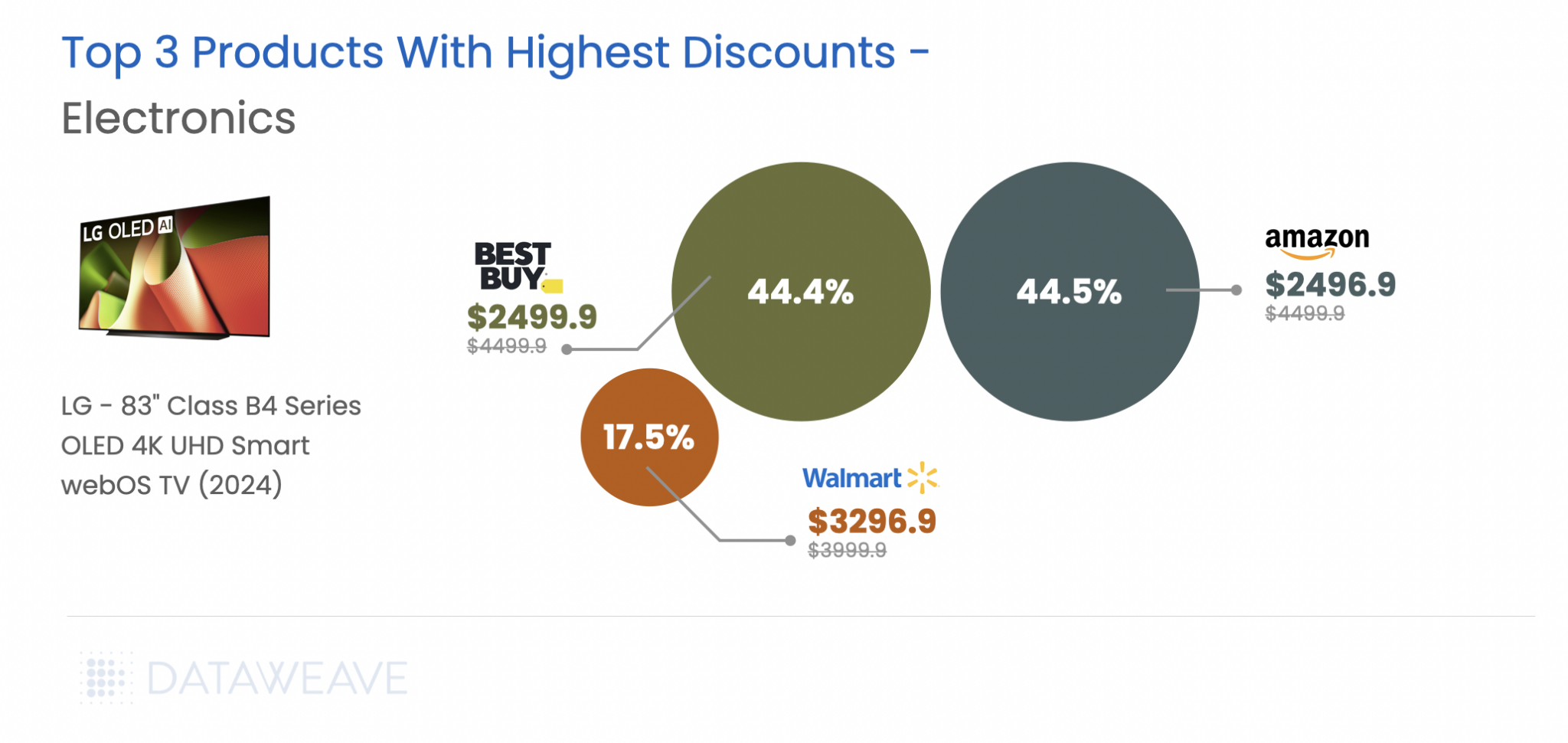
Premium TVs dominate the discount scene, with LG’s 83″ OLED offering up to 44.5% off on Amazon, closely followed by a 44.4% discount on Best Buy, showcasing aggressive competition. The same product has much lower discounting on Walmart, but notably, the product is retailed at $3999.9, at least $1000 less than other retailers, highlighting Walmart’s commitment to offering lowest prices.
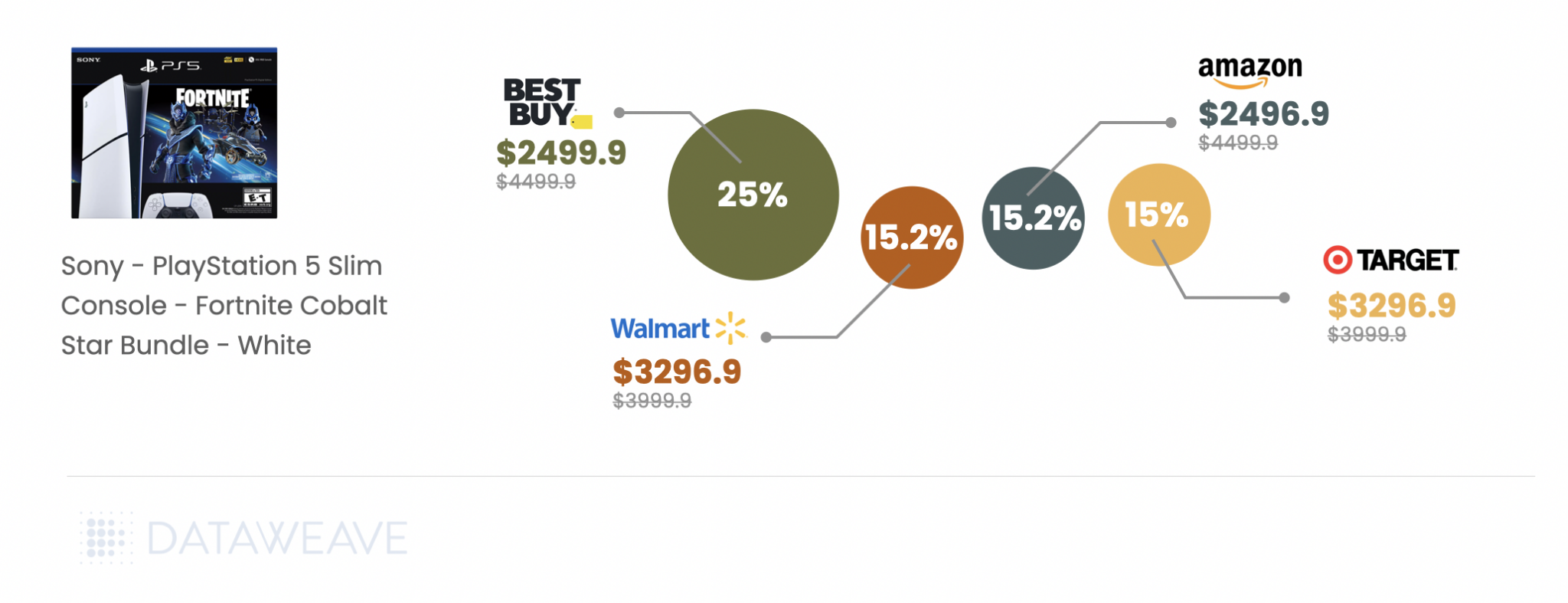
Gaming consoles, like the PlayStation 5 Slim Bundle, show moderate discounts (ranging from 15% on Walmart and Target to 25% at Best Buy), appealing to tech-savvy shoppers.
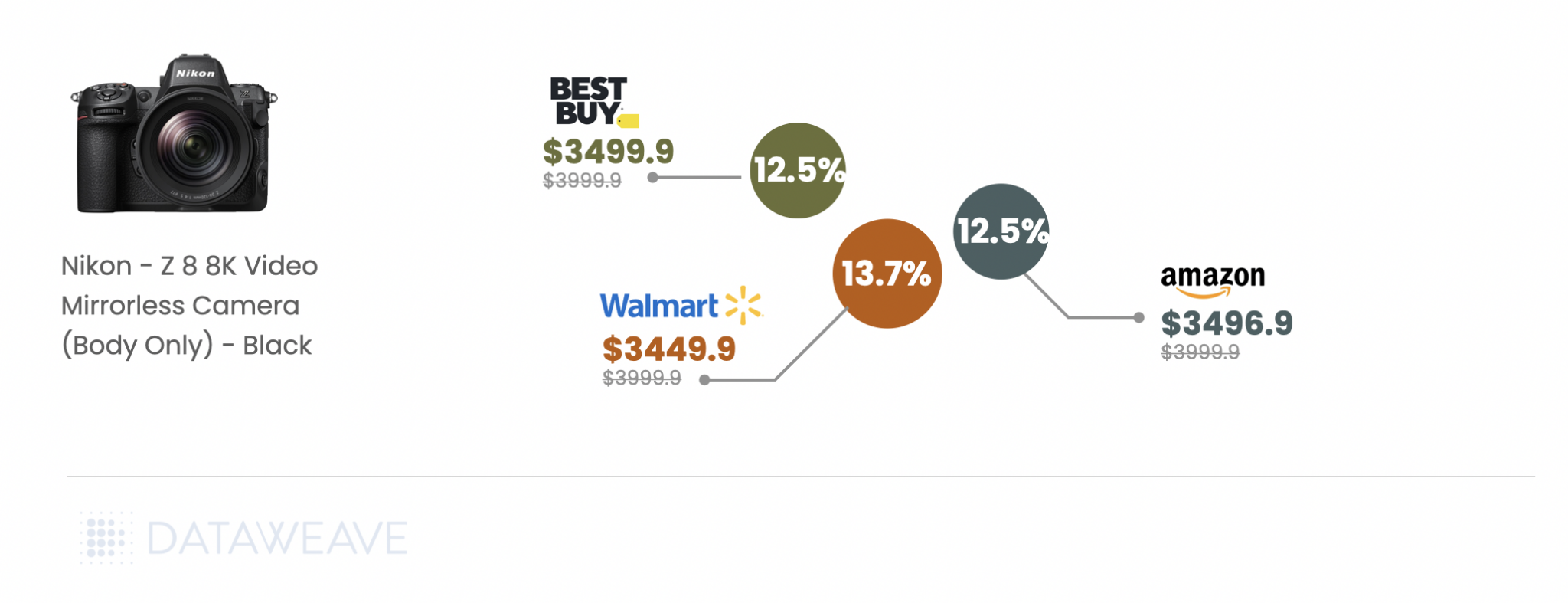
Notable competition is evident in price matching across major retailers, particularly in TVs and high-value electronics like the Nikon Z 8 camera, where Walmart offers the deepest discount at 13.75%, edging past Amazon and Best Buy.
Top Discounted Products in Health & Beauty
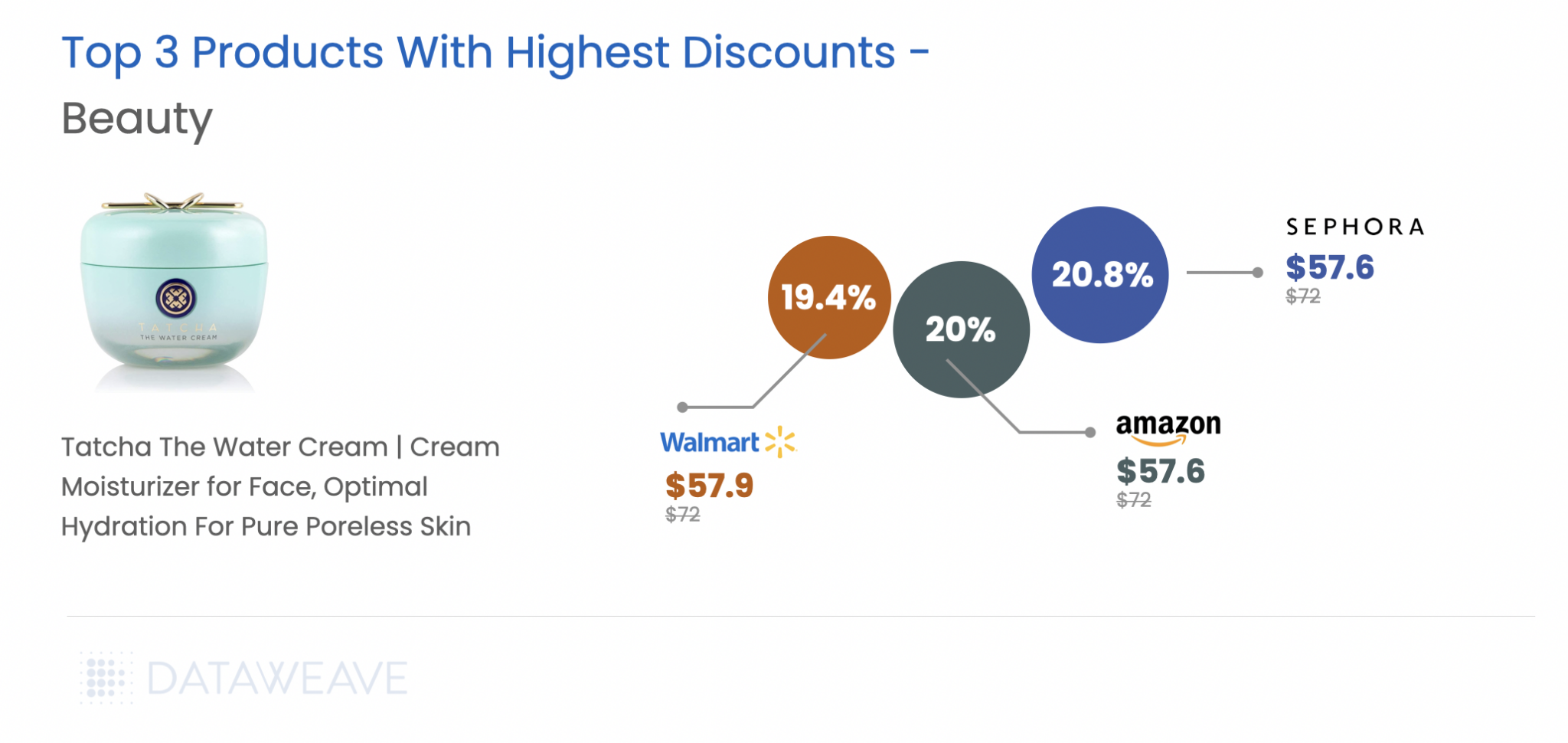
Viral skincare staples like Tatcha’s Water Cream show tight discounting consistency, with Walmart offering 19.47% off compared to Amazon’s 20% and Sephora’s 20.83%.
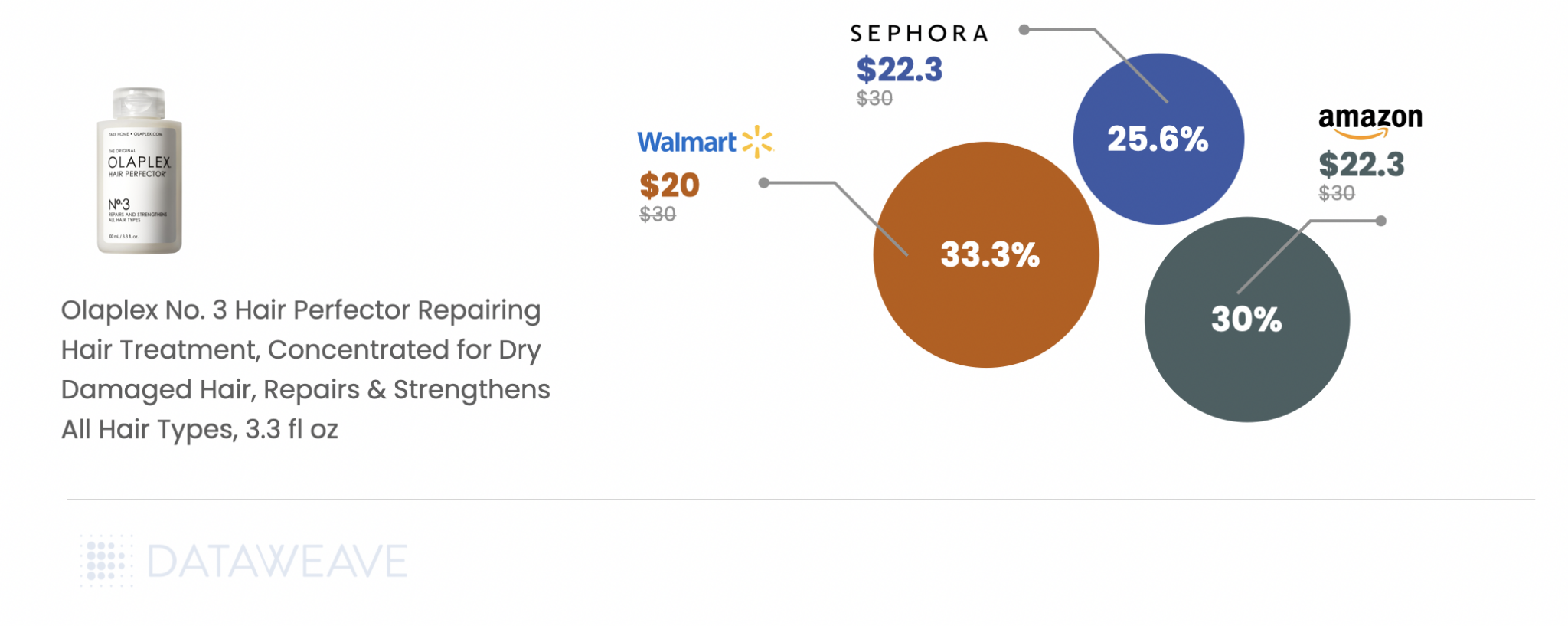
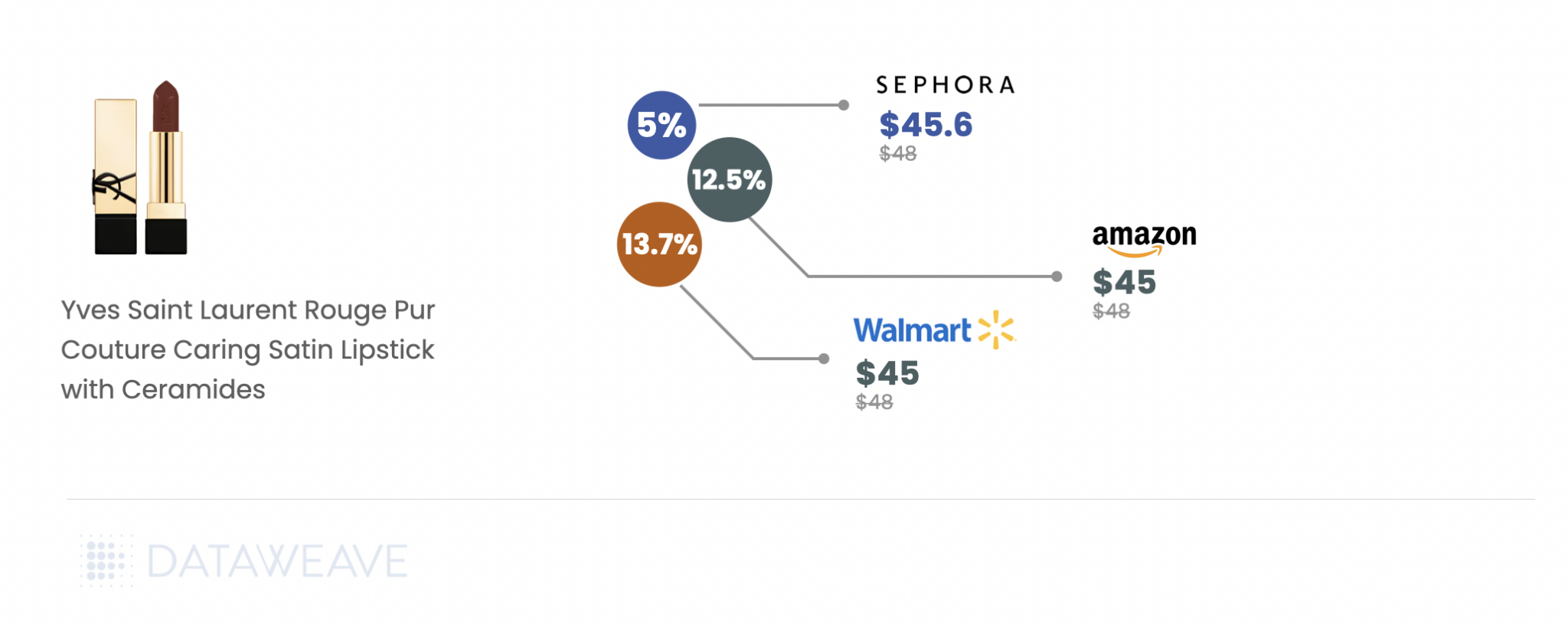
Trending haircare brand Olaplex displays greater disparity, with Walmart leading with a 33.33% discount, surpassing Amazon and Sephora. Luxury brand, Yves Saint Laurent’s Satin Lipstick is one of the highest discounted items across retailers.
Looking Ahead
Our analysis suggests that while some early deals offer genuine value, particularly in premium beauty and high-end electronics, many retailers might be holding their best discounts for Black Friday.
For shoppers, the key is being selective: jump on premium brand discounts now (since they’re likely to remain the same though the weekend), but wait on mid-range electronics and home goods where better deals are likely to emerge on Black Friday or Cyber Monday.
For retailers, the imperative is clear: dynamic pricing intelligence is crucial for maintaining a competitive edge while protecting margins. Competitive insights will be critical as the holiday season progresses to balance market share against profitability.
Stay tuned for our Black Friday Cyber Monday analysis next week, where we’ll track how these early discounts compare to the main event’s deals!
In online retail, success hinges on more than just offering quality products at competitive prices. As eCommerce catalogs expand and consumer expectations soar, businesses face an increasingly complex challenge: How do you effectively organize, categorize, and present your vast product assortments in a way that enhances discoverability and drives sales?
Having complete and correct product catalog data is key. Effective product attribute tagging—a crucial yet frequently undervalued capability—helps in achieving this accuracy and completeness in product catalog data. While traditional methods of tagging product attributes have long struggled with issues of scalability, consistency, accuracy, and speed, a new thinking and fundamentally new ways of addressing these challenges are getting established. These follow from the revolution brought in Large Language Models but they fashion themselves as Small Language Models (SLM) or more precisely as Domain Specific Language Models. These can be potentially considered foundational models as they solve a wide variety of downstream tasks albeit within specific domains. They are a lot more efficient and do a much better job in those tasks compared to an LLM. .
Retail Domain Language Models (RLMs) have the potential to transform the eCommerce customer journey. As always, it’s never a binary choice. In fact, LLMs can be a great starting point since they provide an enhanced semantic understanding of the world at large: they can be used to mine structured information (e.g., product attributes and values) out of unstructured data (e.g., product descriptions), create baseline domain knowledge (e.g, manufacturer-brand mappings), augment information (e.g., image to prompt), and create first cut training datasets.
Powered by cutting-edge Generative AI and RLMs, next-generation attribute tagging solutions are transforming how online retailers manage their product catalog data, optimize their assortment, and deliver superior shopping experiences. As a new paradigm in search emerges – based more on intent and outcome, powered by natural language queries and GenAI based Search Agents – the capability to create complete catalog information and rich semantics becomes increasingly critical.
In this post, we’ll explore the crucial role of attribute tagging in eCommerce, delve into the limitations of conventional tagging methods, and unveil how DataWeave’s innovative AI-driven approach is helping businesses stay ahead in the competitive digital marketplace.
Why Product Attribute Tagging is Important in eCommerce
As the eCommerce landscape continues to evolve, the importance of attribute tagging will only grow, making it a pertinent focus for forward-thinking online retailers. By investing in robust attribute tagging systems, businesses can gain a competitive edge through improved product comparisons, more accurate matching, understanding intent, and enhanced customer search experiences.
Taxonomy Comparison and Assortment Gap Analysis
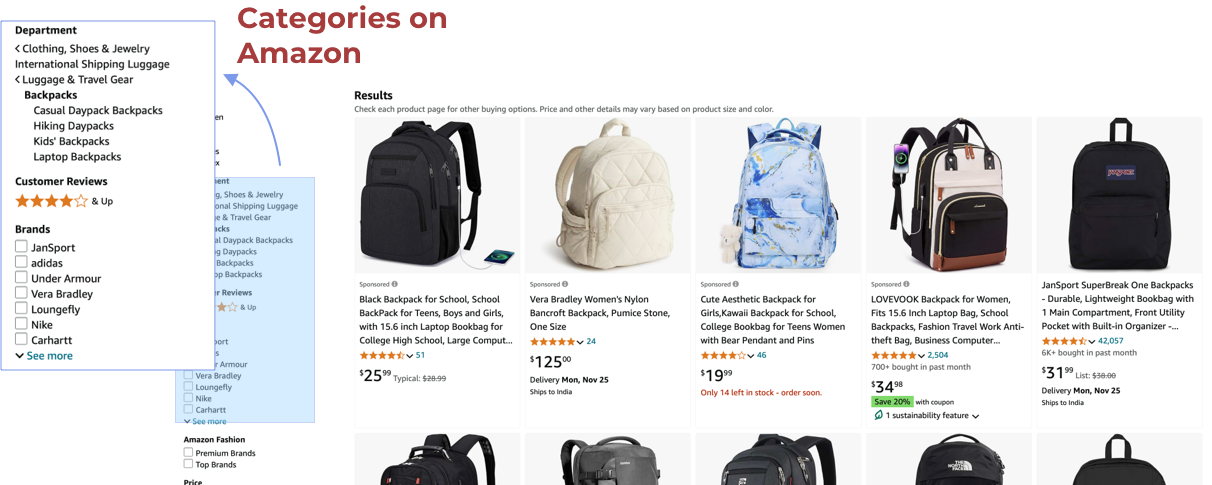
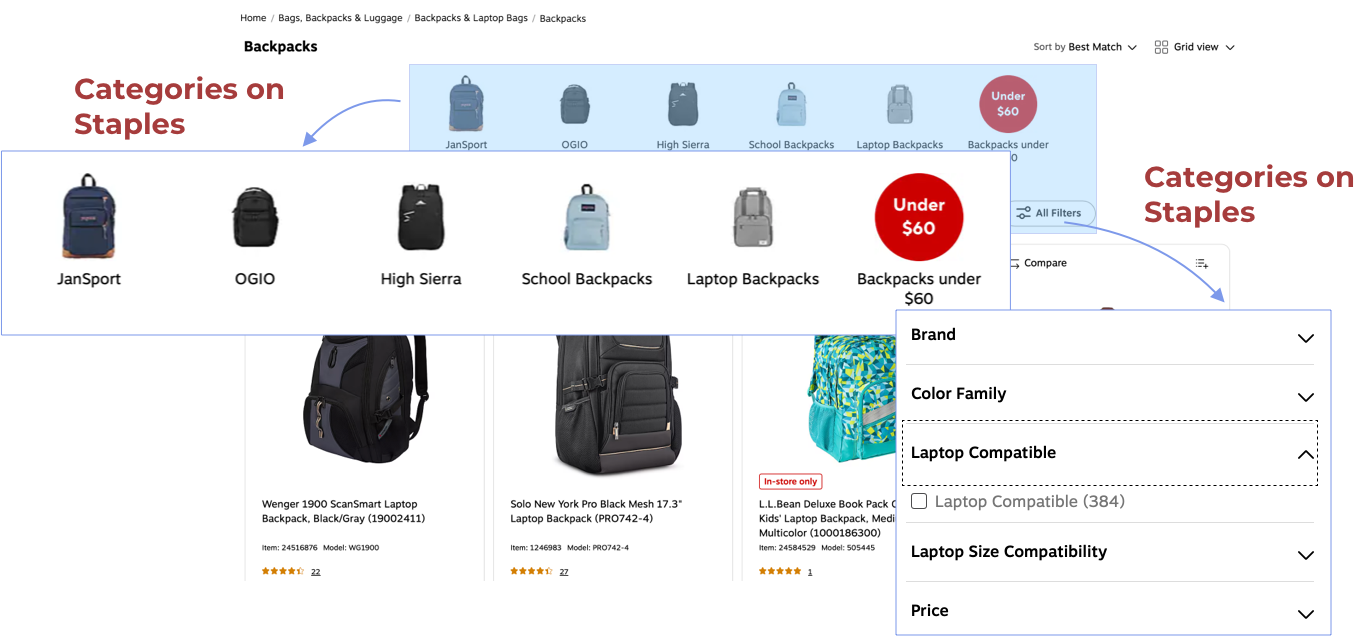
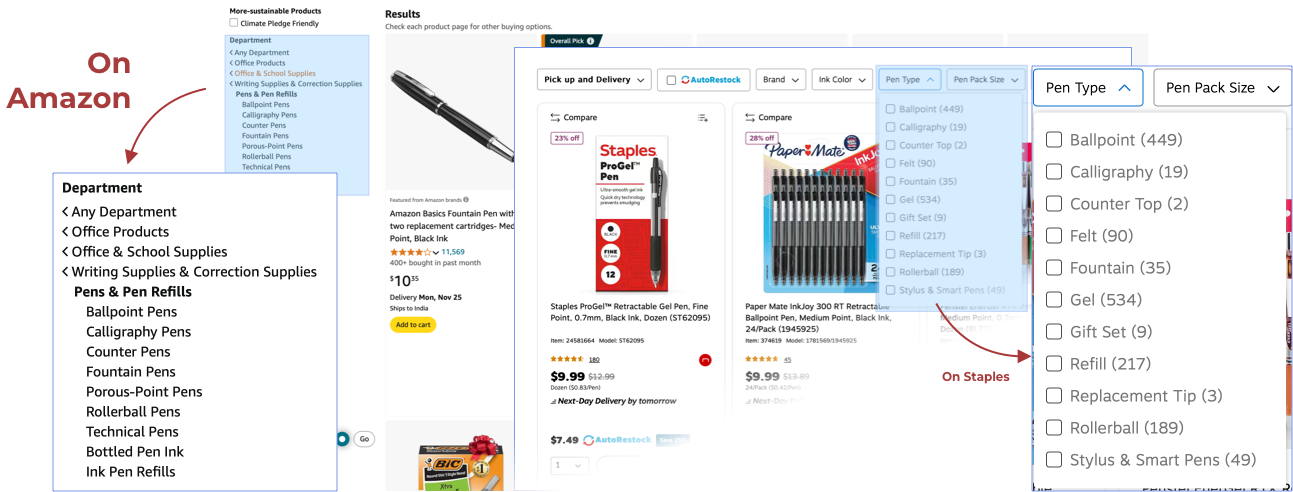
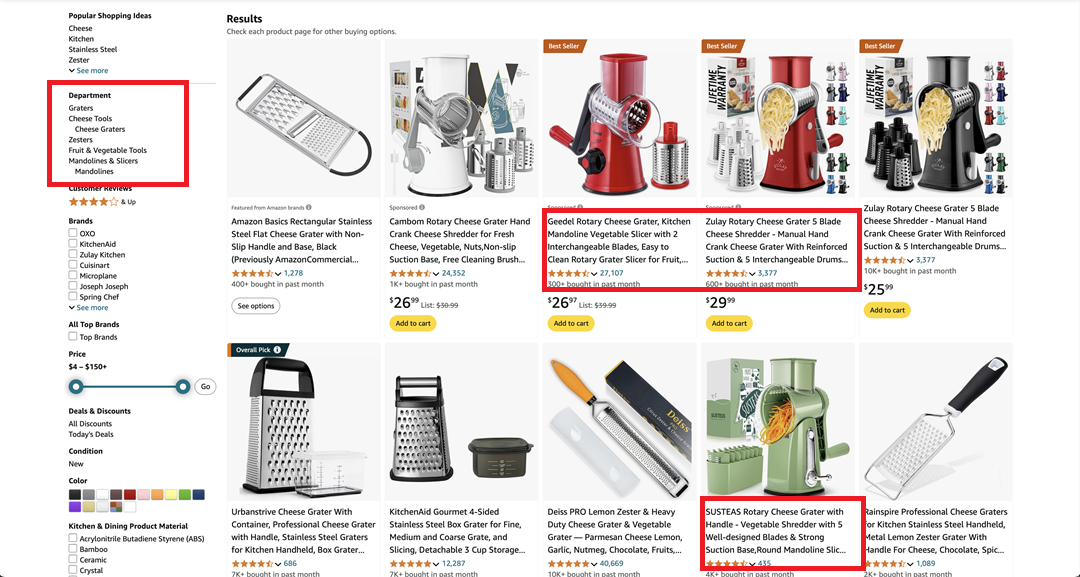
Products are categorized and organized differently on different retail websites. Comparing taxonomies helps in understanding focus categories and potential gaps in assortment breadth in relation to one’s competitors: missing product categories, sizes, variants or brands. It also gives insights into the navigation patterns and information architecture of one’s competitors. This can help in making search and navigation experience more efficient by fine tuning product descriptions to include more attributes and/or adding additional relevant filters to category listing pages.
For instance, check out the different Backpack categories on Amazon and Staples in the images below.
Or look at the nomenclature of categories for “Pens” on Amazon (left side of the image) and Staples (right side of the image) in the image below.
Assortment Depth Analysis
Another big challenge in eCommerce is the lack of standardization in retailer taxonomy. This inconsistency makes it difficult to compare the depth of product assortments across different platforms effectively. For instance, to categorize smartphones,
Retailer A might organize it under “Electronics > Mobile Phones > Smartphones”
Retailer B could use “Technology > Phones & Accessories > Cell Phones”
Retailer C might opt for “Consumer Electronics > Smartphones & Tablets”
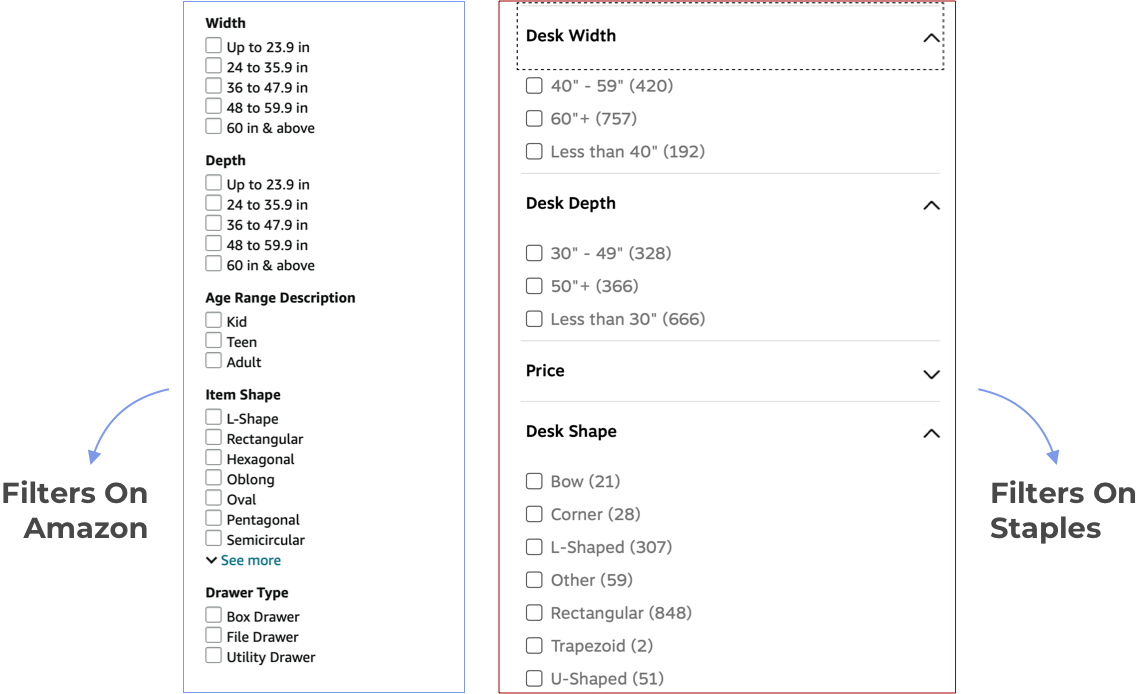
Inconsistent nomenclature and grouping create a significant hurdle for businesses trying to gain a competitive edge through assortment analysis. The challenge is exacerbated if you want to do an in-depth assortment depth analysis for one or more product attributes. For instance, look at the image below to get an idea of the several attribute variations for “Desks” on Amazon and Staples.
Custom categorization through attribute tagging is essential for conducting granular assortment comparisons, allowing companies to accurately assess their product offerings against those of competitors.
Enhancing Product Matching Capabilities
Accurate product matching across different websites is fundamental for competitive pricing intelligence, especially when matching similar and substitute products. Attribute tagging and extraction play a crucial role in this process by narrowing down potential matches more effectively, enabling matching for both exact and similar products, and tagging attributes such as brand, model, color, size, and technical specifications.
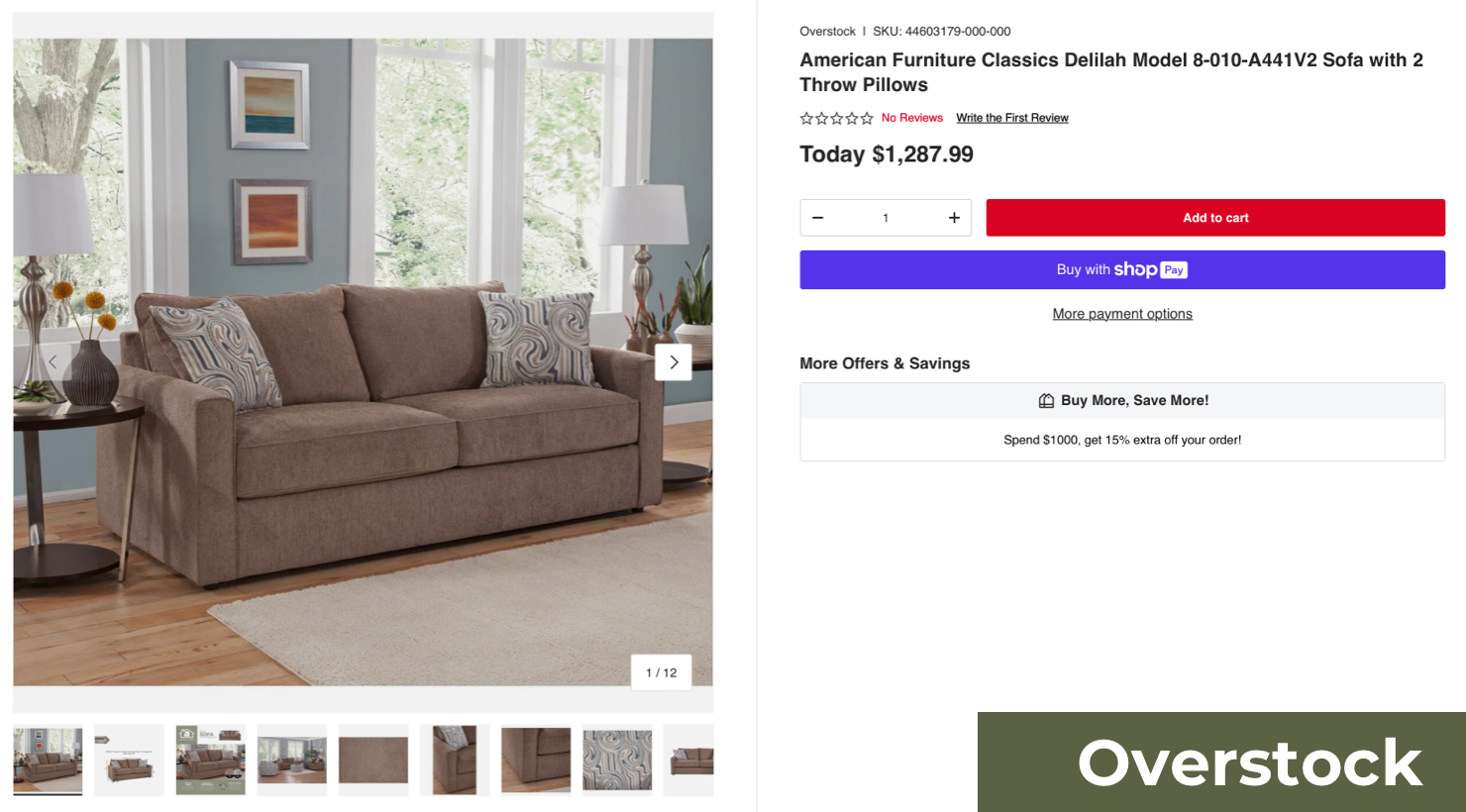
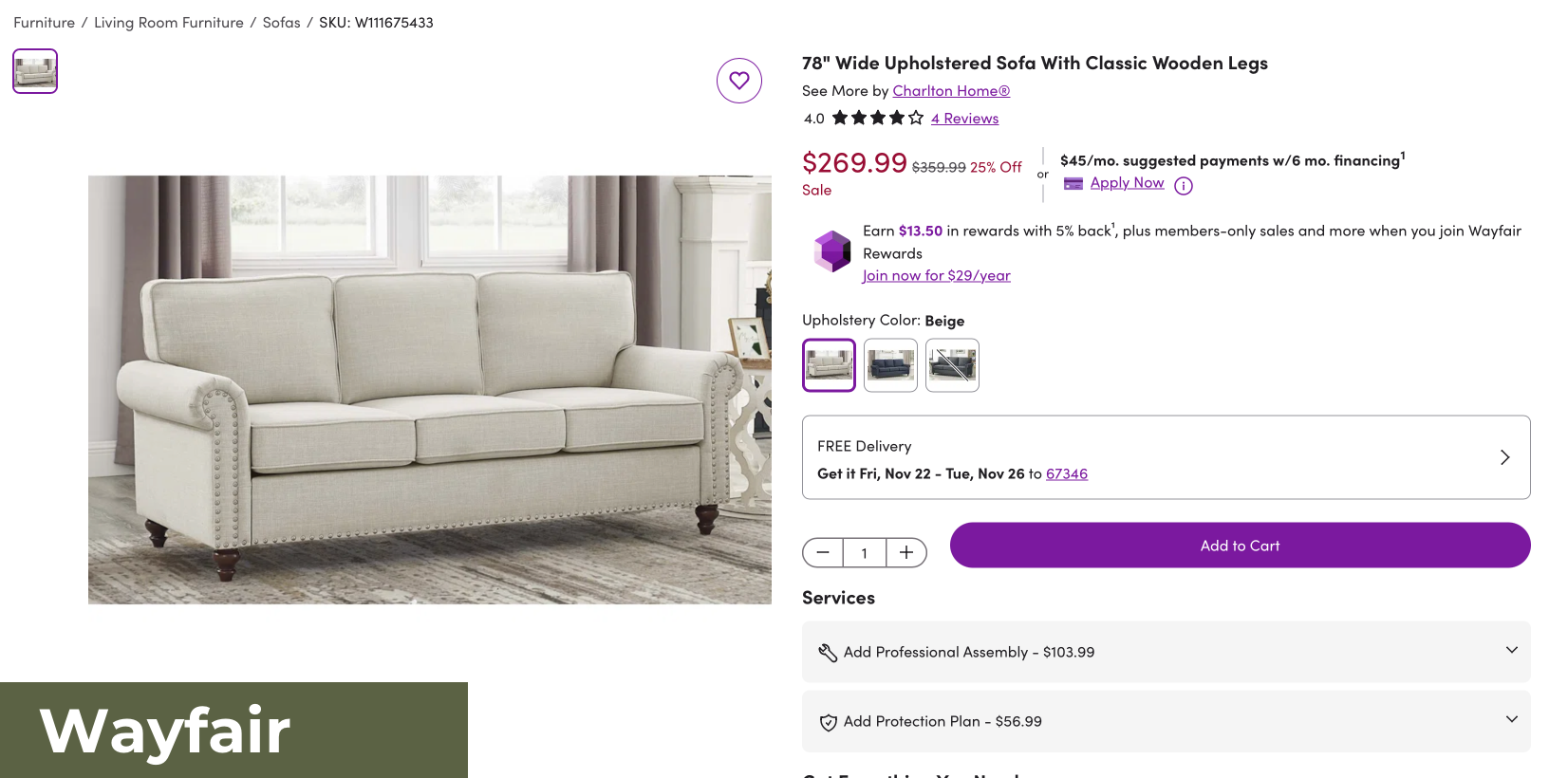
For instance, when choosing to match similar products in the Sofa category for 2-3 seater sofas from Wayfair and Overstock, tagging attributes like brand, color, size, and more is a must for accurate comparisons.
Taking a granular approach not only improves pricing strategies but also helps identify gaps in product offerings and opportunities for expansion.
Fix Content Gaps and improve Product Detail Page (PDP) Content
Attribute tagging plays a vital role in enhancing PDP content by ensuring adherence to brand integrity standards and content compliance guidelines across retail platforms. Tagging attributes allows for benchmarking against competitor content, identifying catalog gaps, and enriching listings with precise details.
This strategic tagging process can highlight missing or incomplete information, enabling targeted optimizations or even complete rewrites of PDP content to improve discoverability and drive conversions. With accurate attribute tagging, businesses can ensure each product page is fully optimized to capture consumer attention and meet retail standards.
Elevating the Search Experience
In today’s online retail marketplace, a superior search experience can be the difference between a sale and a lost customer. Through in-depth attribute tagging, vendors can enable more accurate filtering to improve search result relevance and facilitate easier product discovery for consumers.
By integrating rich product attributes extracted by AI into an in-house search platform, retailers can empower customers with refined and user-friendly search functionality. Enhanced search capabilities not only boost customer satisfaction but also increase the likelihood of conversions by helping shoppers find exactly what they’re looking for more quickly and with minimal effort.
Pitfalls of Conventional Product Tagging Methods
Traditional methods of attribute tagging, such as manual and rule-based systems, have been significantly enhanced by the advent of machine learning. While these approaches may have sufficed in the past, they are increasingly proving inadequate in the face of today’s dynamic and expansive online marketplaces.
Scalability
As eCommerce catalogs expand to include thousands or even millions of products, the limitations of machine learning and rule-based tagging become glaringly apparent. As new product categories emerge, these systems struggle to keep pace, often requiring extensive revisions to existing tagging structures.
Inconsistencies and Errors
Not only is reliance on an entirely human-driven tagging process expensive, but it also introduces a significant margin for error. While machine learning can automate the tagging process, it’s not without its limitations. Errors can occur, particularly when dealing with large and diverse product catalogs.
As inventories grow more complex to handle diverse product ranges, the likelihood of conflicting or erroneous rules increases. These inconsistencies can result in poor search functionality, inaccurate product matching, and ultimately, a frustrating experience for customers, drawing away the benefits of tagging in the first place.
Speed
When product information changes or new attributes need to be added, manually updating tags across a large catalog is a time-consuming process. Slow tagging processes make it difficult for businesses to quickly adapt to emerging market trends causing significant delays in listing new products, potentially missing crucial market opportunities.
How DataWeave’s Advanced AI Capabilities Revolutionize Product Tagging
Advanced solutions leveraging RLMs and Generative AI offer promising alternatives capable of overcoming these challenges and unlocking new levels of efficiency and accuracy in product tagging.
DataWeave automates product tagging to address many of the pitfalls of other conventional methods. We offer a powerful suite of capabilities that empower businesses to take their product tagging to new heights of accuracy and scalability with our unparalleled expertise.
Our sophisticated AI system brings an advanced level of intelligence to the tagging process.
RLMs for Enhanced Semantic Understanding
Semantic Understanding of Product Descriptions
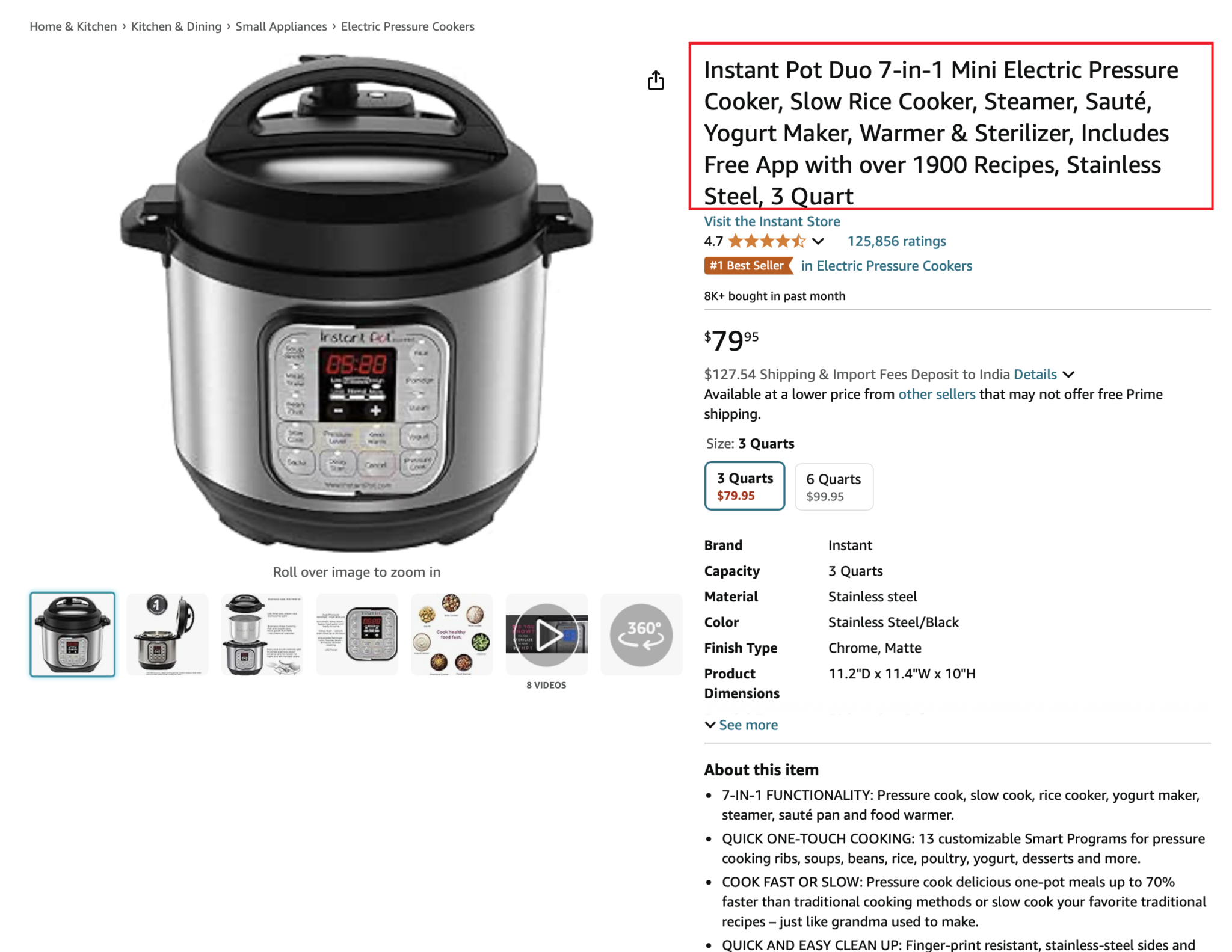
RLMs analyze the meaning and context of product descriptions rather than relying on keyword matching. Example: “Smartphone with a 6.5-inch display” and “Phone with a 6.5-inch screen” are semantically similar, though phrased differently.
Attribute Extraction
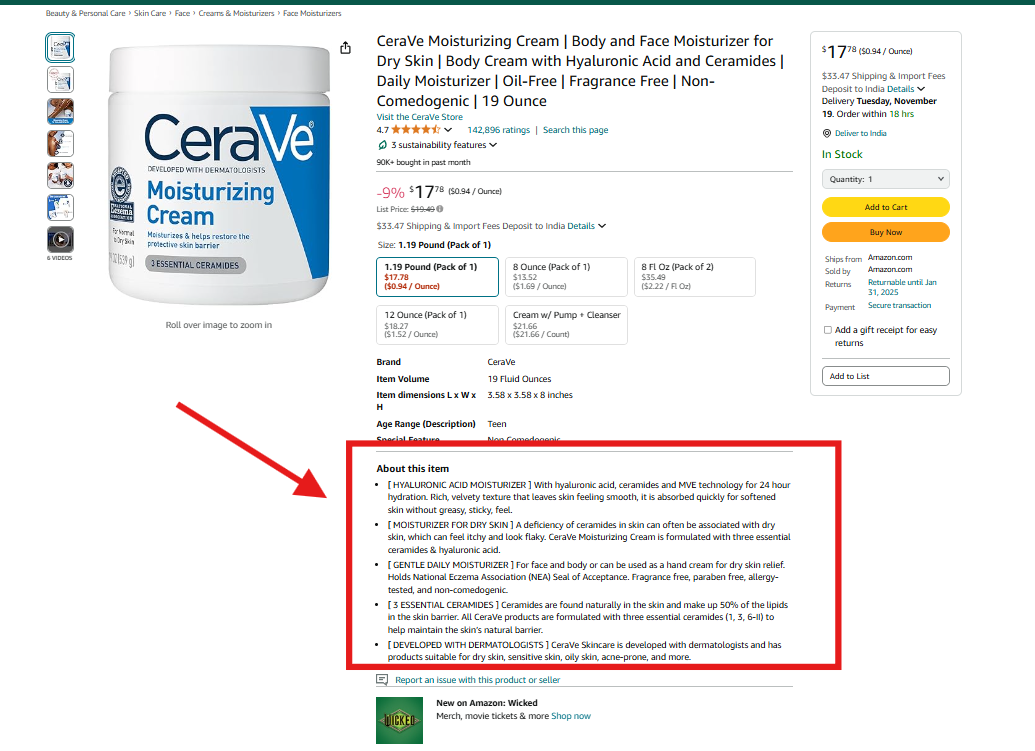
RLMs can identify important product attributes (e.g., brand, size, color, model) even from noisy or unstructured data. Example: Extracting “Apple” as a brand, “128GB” as storage, and “Pink” as the color from a mixed description.
Identifying Implicit Relationships
RLMs find implicit relationships between products that traditional rule-based systems miss. Example: Recognizing that “iPhone 12 Pro” and “Apple iPhone 12” are part of the same product family.
Synonym Recognition in Product Descriptions
Synonym Matching with Context
RLMs identify when different words or phrases describe the same product. Examples: “Sneakers” = “Running Shoes”, “Memory” = “RAM” (in electronics) Even subtle differences in wording, like “rose gold” vs “pink” are interpreted correctly.
Overcoming Brand-Specific Terminology
Some brands use their own terminologies (e.g., “Retina Display” for Apple). RLMs can map proprietary terms to more generic ones (e.g., Retina Display = High-Resolution Display).
Dealing with Ambiguities
RLMs analyze surrounding text to resolve ambiguities in product descriptions. Example: Resolving “charger” to mean a “phone charger” when matched with mobile phones.
Contextual Understanding for Improved Accuracy and Precision
By leveraging advanced natural language processing (NLP), DataWeave’s AI can process and understand the context of lengthy product descriptions and customer reviews, minimizing errors that often arise at human touch points. The solution processes and interprets information to extract key information to dramatically improve the overall accuracy of product tags.
It excels at grasping the subtle differences between similar products, sizes, colors and identifying and tagging minute differences between items, ensuring that each product is uniquely and accurately represented in a retailer’s catalog.
This has a major impact on product and similarity-based matching that can even help optimize similar and substitute product matching to enhance consumer search. At the same time, our AI can understand that the same term might have different meanings in various product categories, adapting its tagging approach based on the specific context of each item.
This deep comprehension ensures that even nuanced product attributes are accurately captured and tagged for easy discoverability by consumers.
Case Study: Niche Jewelry Attributes
DataWeave’s advanced AI can assist in labeling the subtle attributes of jewelry by analyzing product images and generating prompts to describe the image. In this example, our AI identifies the unique shapes and materials of each item in the prompts.
The RLM can then extract key attributes from the prompt to generate tags. This assists in accurate product matching for searches as well as enhanced product recommendations based on similarities.
This multi-model approach provides the flexibility to adapt as product catalogs expand while remaining consistent with tagging to yield more robust results for consumers.
Unparalleled Scalability
DataWeave can rapidly scale tagging for new categories. The solution is built to handle the demands of even the largest eCommerce catalogs enabling:
Effortless management of extensive product catalogs: We can process and tag millions of products without compromising on speed or accuracy, allowing businesses to scale without limitations.
Automated bulk tagging: New product lines or entire categories can be tagged automatically, significantly reducing the time and resources required for catalog expansion.
Normalizing Size and Color in Fashion
Style, color, and size are the core attributes in the fashion and apparel categories. Style attributes, which include design, appearance, and overall aesthetics, can be highly specific to individual product categories.
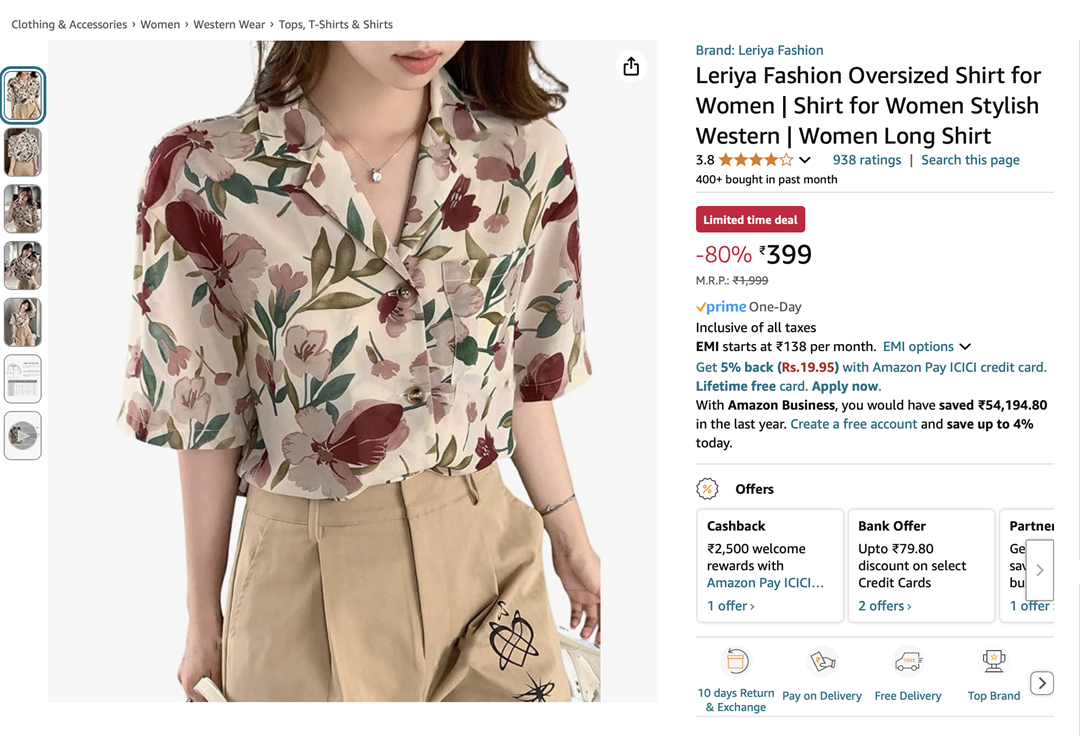
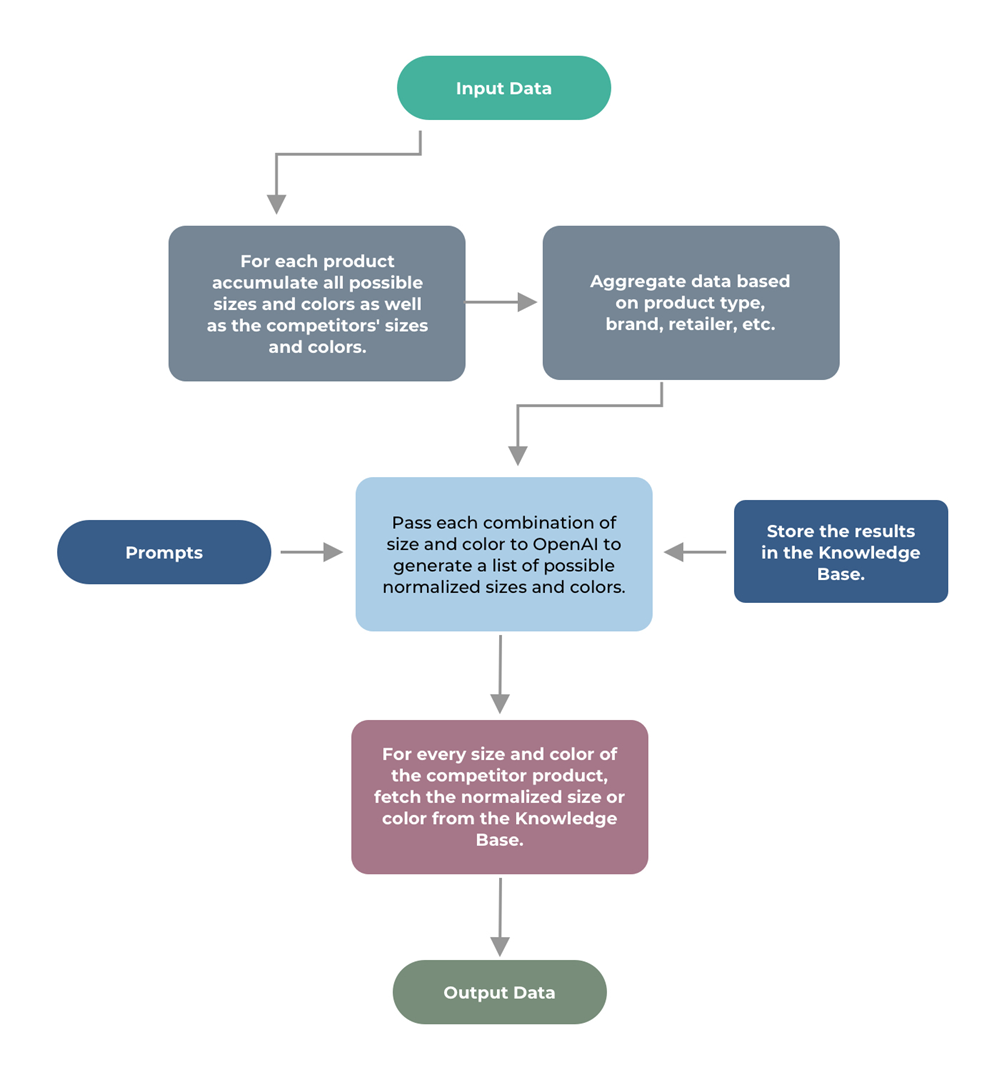
Our product matching engine can easily handle color and sizing complexity via our AI-driven approach combined with human verification. By leveraging advanced technology to identify and normalize identical and similar products from competitors, you can optimize your pricing strategy and product assortment to remain competitive. Using Generative AI in normalizing color and size in fashion is key to powering competitive pricing intelligence at DataWeave.
Continuous Adaptation and Learning
Our solution evolves with your business, improving continuously through feedback and customization for retailers’ specific product categories. The system can be fine-tuned to understand and apply specialized tagging for niche or industry-specific product categories. This ensures that tags remain relevant and accurate across diverse catalogs and as trends emerge.
The AI in our platform also continuously learns from user interactions and feedback, refining its tagging algorithms to improve accuracy over time.
Stay Ahead of the Competition With Accurate Attribute Tagging
In the current landscape, the ability to accurately and consistently tag product attributes is no longer a luxury—it’s essential for staying competitive. With advancements in Generative AI, companies like DataWeave are revolutionizing the way product tagging is handled, ensuring that every item in a retailer’s catalog is presented with precision and depth. As shoppers demand a more intuitive, seamless experience, next-generation tagging solutions are empowering businesses to meet these expectations head-on.
DataWeave’s innovative approach to attribute tagging is more than just a technical improvement; it’s a strategic advantage in an increasingly competitive market. By leveraging AI to scale and automate tagging processes, online retailers can keep pace with expansive product assortments, manage content more effectively, and adapt swiftly to changes in consumer behavior. In doing so, they can maintain a competitive edge.
When egg prices surged 70% during the 2023 avian flu outbreak, grocery retailers faced a critical dilemma: maintain margins and risk losing customers, or absorb costs and watch profits evaporate. Similarly, rising olive oil and chocolate prices also had domino effects, cascading down from retailers to consumers. In each of these scenarios, those with sophisticated pricing intelligence systems adapted swiftly, finding the sweet spot between competitiveness and profitability. Others weren’t so fortunate.
This scenario continues to play out daily across thousands of products in the grocery sector. From breakfast cereals to fresh produce to bottled water, retailers must orchestrate pricing across a variety of categories – each with its own competitive dynamics, margin requirements, and price sensitivity patterns.
The Evolution of Grocery Pricing Intelligence
Imagine these scenarios in the grocery industry:
Milk prices spike during a supply shortage.
Your competitor drops egg prices by 20%.
Fresh produce costs fluctuate with an unseasonable frost.
For grocery retailers, these aren’t occasional challenges—they’re Tuesday. Reacting to each pricing crisis as it comes isn’t just exhausting—it’s a recipe for shrinking margins and missed opportunities.
Think of it this way: If you’re constantly playing defense with your pricing strategy, you’re already two steps behind. Commoditized items like milk and eggs face intense price competition, while seasonal products and fresh produce demand constant attention. Simply matching competitor prices or adjusting for cost changes isn’t enough anymore. What’s needed is a proactive approach that anticipates market shifts before they happen and turns pricing challenges into competitive advantages. This is where price management comes in.
Price management has transformed from simple competitor checks into a strategic power play that can make or break a retailer’s market position. Weekly manual adjustments have given way to a long-term strategic view, driven by data analytics and market intelligence. Here are the basics of how price management in grocery retail works today.
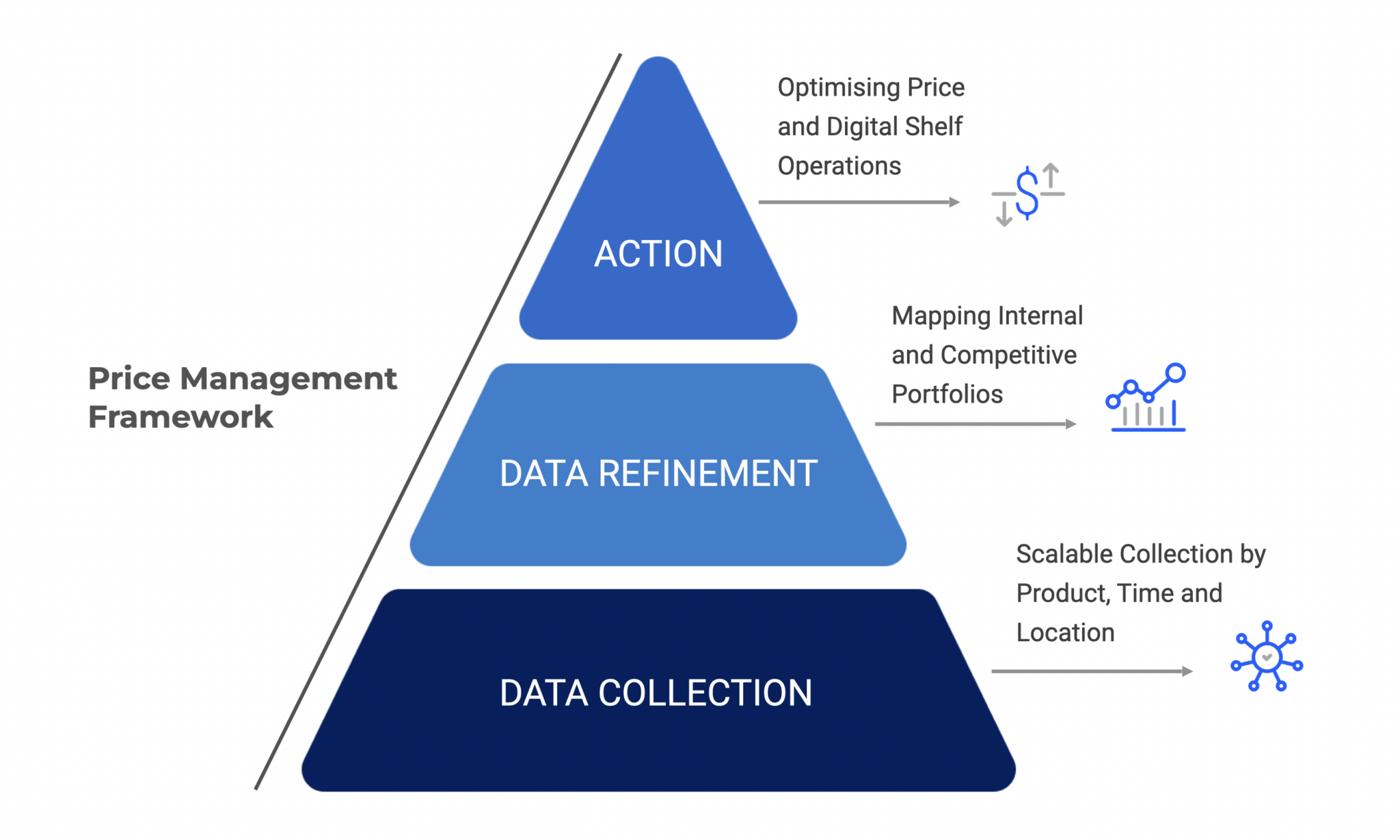
Three Pillars of Grocery Price Management
1. Smart Data Collection: Building Your Foundation
The journey begins with comprehensive data collection and storage across your entire product ecosystem. This means:
Complete Coverage Of All SKUs Across All Stores: Tracking prices for all SKUs across all stores, with particular attention to high-velocity items and volatile categories.
Dynamic Monitoring: Tracking prices across different time frequencies as grocery prices are highly volatile for different categories. So daily tracking for volatile items like dairy and produce, and weekly for more stable categories may be needed.
Competitive Intelligence: Gathering data not just on prices, but on promotions, pack sizes, and private label alternatives.
Infrastructure to Support Large Volumes of Data: Partnering with external data and analytics providers to bridge the gap when retailers struggle with the scale of digital infrastructure these data sets require.
2. Intelligent Data Refinement: Making Sense of the Numbers
Raw data alone isn’t enough—it needs context and structure to become actionable intelligence. This is called Data Refinement—the process of establishing meaningful relationships within the data to facilitate the extraction of valuable insights. This refinement stage is closely tied to the data collection strategy, as the quality and depth of the insights derived depend on the accuracy and coverage of the collected data.
Data refinement includes several key processes:
Advanced Product Matching
Picture this: You’re tracking a competitor’s pricing on organic apples. Simple, right? Not quite. Yes, Universal Product Codes (UPCs) and Price Lookup Codes (PLUs) are present in Grocery to standardize product identification across different retailers—unlike the fashion industry’s endless style variations. Still, product matching isn’t as straightforward as scanning barcodes.
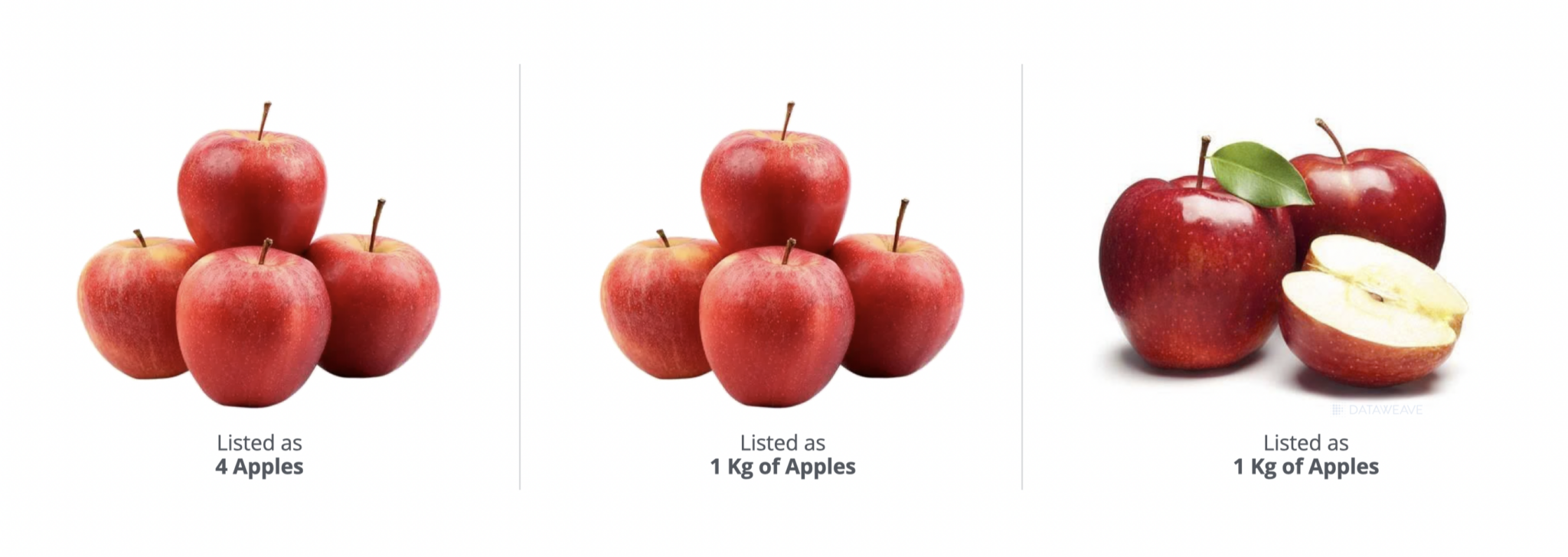
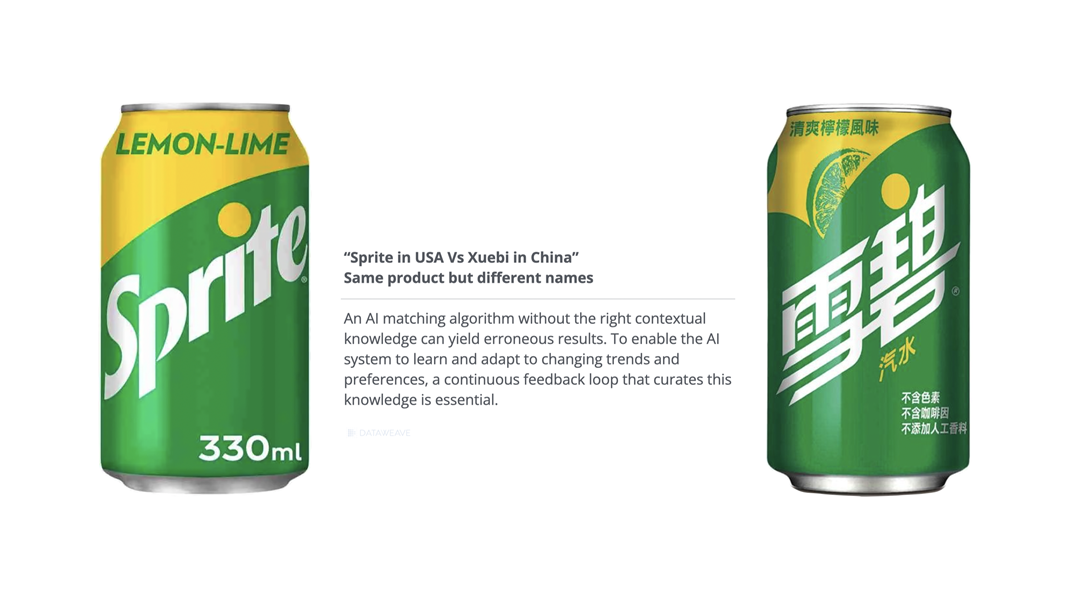
Here’s the catch: many retailer websites don’t display them. Then there’s the private label puzzle—your “Store’s Best” organic apples need to match against competitors’ house brands, each with their own unique UPC. Throw in different sizes (4 Apples vs. 1Kg of Apples), regional product names (fancy naming for plain old arugula), and international brand variations (like the name for Sprite in the USA and China), and you’ve got yourself a complex matching challenge that would make conventional pricing intelligence providers sweat.
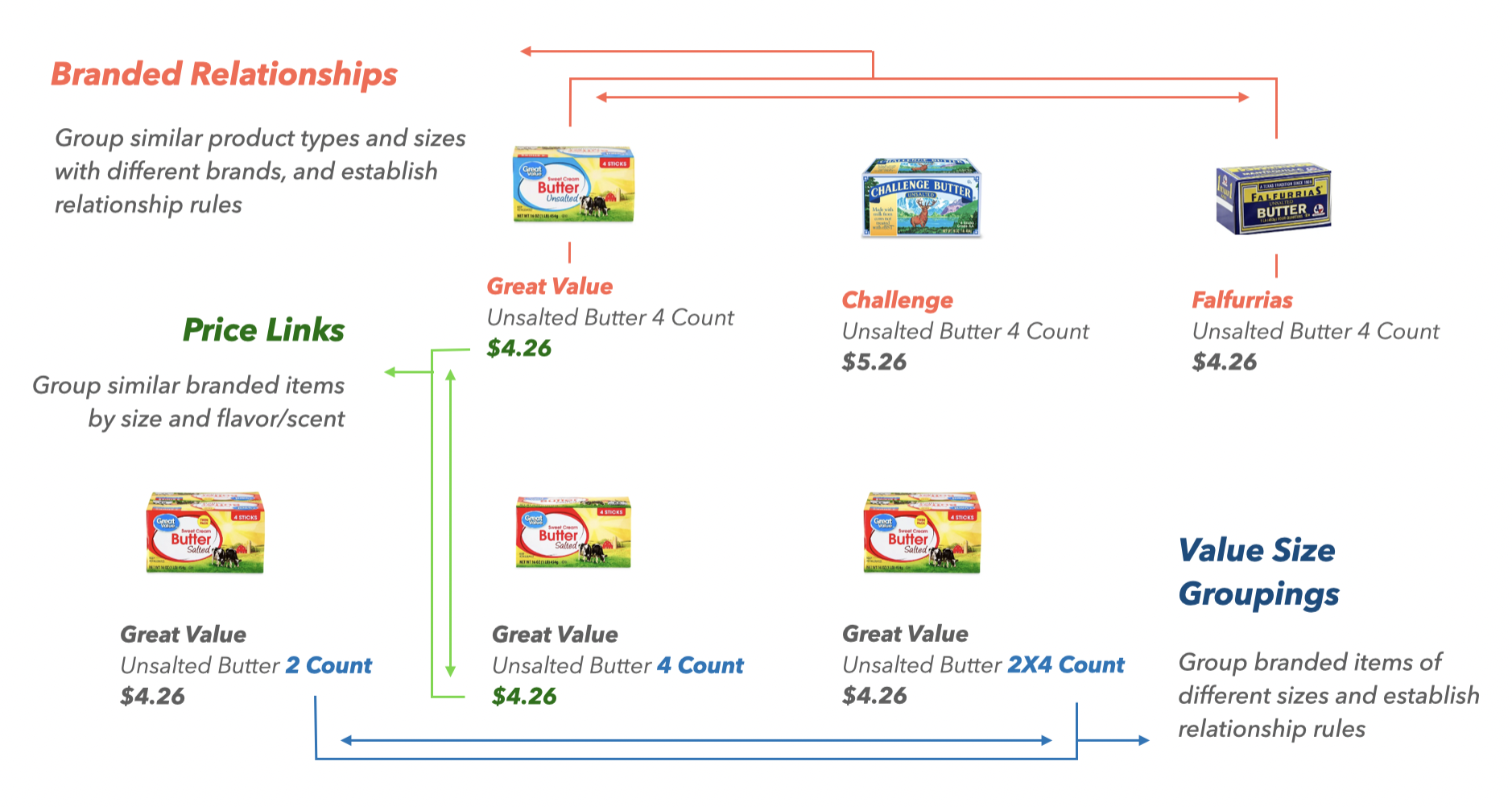
Custom Product Relationships for Consistent Pricing and Competitive Positioning
Think like a shopper browsing the dairy aisle. You regularly buy your family’s favorite organic yogurt, the 24oz tub. But today, you notice the larger 32oz size is on sale – except the 24oz isn’t. As you stand there, confused, you wonder: Is the sale only for the bigger size? Did I miss a promotion? Should I buy the 32oz even though it’s more than I need?
For shoppers, this inconsistent pricing across product variations creates a frustrating experience. Establishing clear relationships between related items in your catalog is essential for maintaining consistent pricing and a coherent competitive strategy.
Start by linking products based on attributes like size, brand, and packaging. That way, when you adjust the price of the 32oz yogurt, the 24oz version automatically updates too – no more scrambling to ensure uniform pricing across your assortment. Similarly, products of the same brand but with flavor variations should be connected to keep pricing consistent.
Taking this one step further, mapping your competitors’ exact and similar products is crucial for comprehensive competitive intelligence. Distinguishing between premium and private label tiers, national brands, and regional players gives you a holistic view of the landscape. With this understanding, you can hone your pricing strategies to maintain a clear, compelling position across your entire category lineup.
Consistent pricing, whether across your own product variations or against competitors, provides clarity and accuracy in your overall competitive positioning. By establishing these logical connections, you avoid the customer confusion of seemingly random, inconsistent discounts – and ensure your pricing strategies work in harmony, not disarray.
The Role of AI and Data Sciences in Data Refinement
On the surface, linking products based on attributes like size, brand, and packaging seems like a no-brainer. But developing and maintaining the systems to accurately and automatically identify these connections? That’s a whole different animal.
Think about it – you’re not just dealing with text-based product titles and UPCs. There are images, videos, regional variations, private labels, and a whole host of other data types and industry nuances to account for.
Luckily, DataWeave is one of the few companies that’s truly cracked the code. Our multimodal AI models are trained to process all those diverse data formats – from granular product specs to zany regional produce names. And it’s not just about technology; we also harness the power of human intelligence.
See, in the grocery world, category managers are the real decision makers. They know their shelves inside and out and can spot those tricky connections in product matching, especially when they are not UPC-based. That’s why DataWeave built in a Human-in-the-Loop (HITL) process, where their AI systems continuously learn from expert feedback. It’s a feedback loop that allows our customers to pitch in and keep product relationships accurate, reliable, and always adapting to new market realities.
So while product mapping may seem straightforward on the surface, the reality is it takes some serious horsepower to do it right. Thankfully, DataWeave has both the technical chops and the grocery industry know-how to make it happen. Because when it comes to pricing intelligence, getting those product connections right is half the battle.
3. Strategic Implementation: Turning Insights into Action
The true value of pricing intelligence (PI) is realized through its strategic application. Although many view PI as a technical function, its strategic significance is increasing, particularly in the context of recent economic pressures like inflation. Here’s why:
Tactical vs Strategic Use of Data: From Standard Reporting to Competitive Analysis
Pricing intelligence has come a long way from the days of simply reacting to daily price changes. These days, it’s not just about firefighting—it’s about driving long-term strategy.
You can use pricing data to make quick, tactical adjustments, like matching a competitor’s sudden price drop on milk. Or, you can leverage that same data to predict market trends, optimize your product lineup, and shape your overall pricing strategy. Retailers who take that strategic view can get out ahead of the curve, anticipating shifts instead of just chasing them.
DataWeave supports both of these approaches. Our Standard Reporting tools give pricing managers the nitty-gritty details they need—current practices, historical patterns, and operational KPIs. It’s all the insights you’d expect for making those tactical, day-to-day tweaks.
In addition, DataWeave offers something more powerful: Competitive analysis. This is where pricing intelligence becomes a true strategic weapon. By providing a high-level view of market positioning, competitor moves, and untapped opportunities, competitive analysis empowers leadership to make proactive, big-picture decisions.
Armed with this broader perspective, retailers can start taking a more surgical approach. Maybe you need to adjust pricing zones to better meet customer demands. Or rethink your overall strategies to stay ahead of the competition, not just keep pace. It’s the difference between constantly putting out fires and systematically fortifying your entire pricing fortress.
Beyond Pricing: Comprehensive Data for Broader Insights
Pricing intelligence is just the tip of the iceberg. When you really start to refine and harness your data, the possibilities for grocery retailers expand far beyond simple price comparisons. Think about it – all that information you’re collecting on products, markets, and consumer behavior? That’s a goldmine waiting to be tapped. Sure, you can use it to keep a pulse on competitor pricing. But why stop there?
What if you could leverage that data to optimize your product assortment, making sure you’re stocking the right mix to meet customer demands? Or tap into predictive analytics to get a glimpse of future market shifts, so you can get out ahead of the curve? How about using it to streamline your supply chain, identify availability inefficiencies, and get products to shelves faster?
Sure, pricing intelligence will always be mission-critical. But when you couple it with these other data-driven insights, that’s when grocery retailing gets really interesting. It’s about evolving from a price-matching robot to a true strategic visionary, armed with the intelligence to take your business to new heights.
Looking Ahead: The Future of Grocery Pricing Intelligence
The grocery pricing landscape continues to evolve, driven by:
Integration of AI and machine learning for predictive pricing
Enhanced focus on omnichannel pricing consistency
Growing importance of personalization in pricing strategies
Pricing intelligence isn’t just about having data—it’s about having the right data and knowing how to use it strategically. Success requires a comprehensive approach that combines robust data collection, sophisticated analysis, and strategic implementation.
By embracing modern pricing intelligence tools and strategies, grocery retailers can navigate market volatility, maintain competitive positioning, and drive sustainable growth. The key lies in building a pricing ecosystem that’s both sophisticated enough to handle complex data and flexible enough to adapt to changing market conditions.
Ready to transform your pricing strategy? Check out our grocery price tracker to get month-on-month updates on grocery prices in the real world. Contact us to learn how our advanced pricing intelligence solutions can help your business stay ahead in the competitive grocery market.
Today, the first name that comes to anybody’s mind when they hear about online shopping is Amazon. In the US alone, Amazon accounted for over 37.6 percent of total online retail sales in 2023 with the second place Walmart not even managing to win double-digit numbers on the same scale.
With such a phenomenal market share, it is not surprising that any retail brand would want to have their products listed on Amazon for sale. However, as enticing as the potential exposure could be, the overwhelming presence of brands selling similar products on Amazon is so huge that getting fair visibility for your products may require some heavy-lifting support.
Will the Same SEO You Use for Google Work with Amazon?
Unfortunately, no, as Google and Amazon have different objectives when it comes to search rankings on their respective customer platforms. Google makes the lion’s share of its revenue from search advertising, whereas Amazon makes money when customers buy products listed on its platform by sellers.
Relying on traditional search engine optimization (SEO) techniques may not get the desired results as they are more optimized for search engines like Google. Amazon embraces its unique DNA when it comes to product display rankings on its search option.
How Does SEO Work in Amazon?
Over the years, Amazon amassed data about shopping experiences that billions of customers globally had on its platform. With this data, they developed their custom search algorithm named A9. Contrary to the gazillion objectives that Google has for its intelligent search algorithms, Amazon has tasked A9 with just a simple straightforward target—when a customer keys in a search query, provide the best choice of products that they will most probably purchase, as search results.
A9 works to fulfill the mission of guiding shoppers to the right product without worrying about semantics, context, intent, mind mapping, etc. of the search query in contrast to what Google does. As with Google search, Amazon does have paid advertising and sponsored results options such as Amazon PPC, Headline ads, etc. but their SEO algorithms are aware of how to support and boost search rankings of genuine products and brands that have taken an effort to follow best practices in Amazon SEO as well as have a great offering with attractive prices.
As additional knowledge, Amazon also has clear guidelines on what it prioritizes for search rankings. Known in the SEO world as Amazon ranking signals, these are core factors that influence how a product is ranked for search queries. Some of the top Amazon ranking signals that carry heavy influence on search rankings include on-page signals, off-page signals, sales rank, best sellers rank, etc.
What Brands Need to Strategize to Master the Amazon SEO Algorithms
From a broad perspective, we can classify the actions brands need to take in this regard in 3 core stages:
Pre-Optimization
This deals with getting first-hand knowledge about both customers who are likely to purchase your product and the competitors who are vying for sales from these very same customers. Filtering your target customer or audience is essential to ensure that you get the most ROI from marketing initiatives and that sales cycles are accelerated. For example, if your product is a premium scented candle, there is no point in wasting advertising dollars trying to win attention from customers who are not likely to ever spend on luxury home décor items.
Knowing how your competitors are performing on Amazon search, the keywords, and SEO strategies they have adapted is critical to ensure that you stay one step ahead.
Product Listing Page Optimization
This includes strategies that a brand can adopt so that its product description page gets the much-needed content optimizations to sync with Amazon’s A9 algorithm. It has a mix of keyword-integrated content, relevant images, descriptions in easy-to-understand language, localized content flavors to resonate with target buyers, etc. For example, a kitchen tool like a grater might be used for different kinds of food preparation techniques in different regions of the same country.
The brand must ensure that the description adequately localizes the linguistic or usage preference representation of the target audience. If the grater is used for grating coconut shells to extract the fibrous pulp in the Midlands and for grating ginger skin in the Far East, both use cases should be part of the product description if the target customers are from both regions.
Sales Optimization
This deals with options that have more sales strategies integrated into their core. For example, blogs on popular websites with the Amazon purchase link embedded in the content, collaboration with social media influencers, paid advertising on Amazon itself as well as on search engines, video ads, banner and display ads, etc.
The key intent here is to drive organic and inorganic traffic to the Amazon product listing page and ultimately win sales.
How Can Your Products Rank High in Amazon Search Results? Top 10 Tactics
Now that you have a clear understanding of the strategies that help in mastering Amazon’s ranking algorithms, here are some great tips to help achieve higher search rankings for your products on Amazon search:
1. Target Relevant Keywords
You need to figure out the best keywords that match what customers put as queries into the Amazon search bar. Your brand needs to clearly understand customer behavior when they arrive on Amazon to search for a product or category of products. The best place to begin looking for the same would be on competitor pages on Amazon. The keywords that helped them rank well on Amazon can help you as well. Manually investigating such a large pool of competitors is nearly impossible but with the right tools, you can easily embrace capabilities to know which keywords can help you in mimicking the success of your competitors.
2. Focus on Product Titles
Every single part of the content in your brand’s Amazon storefront or product page needs dedicated focus. Beginning with the product titles, effort needs to be made to ensure that they include the brand name, key product category or features, and other relevant keyword information.
In other words, product titles must be optimized for searchability. This searchability for product titles needs to be optimized for both mobile and desktop screens.
3. Create Product Descriptions that Resonate with the Audience
For product descriptions on your Amazon webpage, you need to figure out the optimal quality levels needed for the intended audience. Effective content can help achieve better search ranking visibility and convince the incoming traffic of shoppers to make a purchase. It is important to periodically review and modify your page content to suit the interests of visitors from both web and mobile devices.
Leveraging solutions like DataWeave can help with regular content audits to ensure you are putting out the best product content that will delight shoppers and deliver on sales conversion targets.
4. Use High-Quality Media Assets like Images and Videos
Promoting your product doesn’t have to be restricted to just textual content in Amazon product description sections. You can use other multimedia assets of high quality. These include images, videos, brochure images, etc. Every content asset must aim to educate shoppers on why your product should be their number one choice. For example, look at this detailed product description for the viral K-Beauty product COSRX Mucin Essence.
Moreover, images can help attract more attention span from visitors, thereby increasing the probability of purchases.
5. Strengthen the Backend Keywords As Well
Amazon also supports hidden backend keywords that sellers add to their product listings. They help add more relevance to products similar to meta descriptions and titles in traditional SEO for search engines like Google. A typical backend keyword may comprise synonyms, misspelled keywords, textual variations, etc. However, knowing how to pick the right ones is crucial. By analyzing your keyword rankings against competitors and higher-ranking product results in search, the platform can help you consistently optimize your content backend to help grow visibility.
6. Focus on Reviews and Ratings
Reviews and ratings on product pages are key insights that help customers with their purchasing decisions. So, it is natural for brands to keep a close eye on how their products are faring in this regard. Reviews and ratings are a direct indication of the trustworthiness of your product. When previous buyers rate you high and leave favorable reviews on your product, it will directly promote trust and help you secure a better rapport with new customers.
This upfront advantage can help boost sales conversions better. Leveraging solutions like DataWeave can help you understand the sentiments that customers have for your products by intelligently analyzing reviews and ratings.
7. Implement Competitive Pricing Strategies
The goal of most customers when shopping online is to get their desired product at the most affordable prices. The eCommerce price wars every year are growing in scale today and getting your product pricing right is crucial for sales. However, there is a need to gain comprehensive insights into how your competitors are pricing their offerings and how the market responds to specific price ranges. Solutions like DataWeave help your brand access specific insights into pricing. By analyzing competitor pricing, you can create a winning price model that is sustainable for your brand and favorable for target customers.
8. Track Share of Search
Content and other SEO activities will help improve your search rankings on Amazon. However, it is equally important to know how well your products are performing periodically against your competitors for the same set of specific keyword searches. You need to understand the share of search that your products are achieving to formulate improvement strategies. DataWeave’s Digital Shelf Analytics solution provides share of search insights helping you uncover deep knowledge on your discoverability on Amazon (and other marketplaces) for your vital search keywords.
9. Ensure Stock Availability
To achieve better ranking results, brands need to ensure that the relevant products matching the search keywords are available for quick delivery at the desired ZIP codes where users are more likely to search and order them. Out-of-stock items seldom show up high on search results. Certain products, especially if they’re popular, can get stocked out frequently in certain locations. Keeping a close eye on your stock availability across the map can help minimize these scenarios.
10. Optimize Your Brand Presence
While optimizing content and other key areas within the Amazon webpage for your product is critical, there are other avenues to help boost search rankings. One such option includes registering in the Amazon Brand Registry, which provides more beneficial features like protection against counterfeits and ensuring that your brand page is optimized according to Amazon storefront standards.
The Bottom Line
Winning the top spot in Amazon search ranking is crucial for brands that aim to capitalize on online sales revenue to grow their business. Knowing your workaround for Amazon’s proprietary SEO frameworks and algorithms is the first step to succeeding. The key element of success is your ability to gain granular insights into the areas we covered in this blog post such as competitor prices, sentiments of customers, market preferences, and content optimization requirements.
This is where DataWeave’s Digital Shelf Analytics solution becomes the biggest asset for your eCommerce business. Contact us to explore how we can empower your business to build the most visible and discoverable Amazon storefront that guarantees higher search rankings and ultimately increased sales. Talk to us for a demo today.
Fashion is as dynamic a market as any—and more competitive than most others. Consumer trends and customer needs are always evolving, making it challenging for fashion and apparel brands to keep up.
Despite the inherent difficulties fashion and apparel sellers face, this industry is one of the largest grossing markets in the world, estimated at $1.79 trillion in 2024. Global revenue for apparel is expected to grow at an annual rate of about 3.3% over the next four years. That means companies in this space stand to make significant revenue if they can competitively price their products, keep up with the competition, and win customer loyalty with consistent product availability.
There are three main categories in fashion and apparel. These include:
Apparel and clothing (i.e., shirts, pants, dresses, and other apparel)
Footwear (i.e., sneakers, sandals, heels, and other products)
Accessories (i.e., bags, belts, watches, and so on)
If you look at all of these product types across all sorts of retailers, there is a massive amount of overlapping data based on product attributes like style and size that are difficult to normalize.
Fashion Attributes
Style, color, and size are the main attribute categories in fashion and apparel. Style attributes include things like design, look, and overall aesthetics of the product. They’re very dependent on the actual product category of fashion as well. A shirt might have a slim fit attribute associated with it, whereas a belt might have a length. All these different attributes are usually labeled within a product listing and affect the consumer’s decision-making process:
Color (red, blue, sea green, etc.)
Pattern (solid, striped, checked, floral, etc.)
Material (cotton, polyester, leather, denim, silk, etc.)
Fit (regular, slim, relaxed, oversized, tailored, etc.)
Type (casual, formal, sporty, vintage, streetwear)
Color Complexity in Fashion
Color is perhaps the most visually distinctive attribute in fashion, yet it presents unique challenges for retailers. This is because color naming can vary across retailers and marketplaces. There are several major differences in color convention:
A single color can be labeled differently across brands (e.g., “navy,” “midnight blue,” “deep blue”)
Seasonal color names (e.g., “summer sage” vs. “forest green”)
Marketing-driven names (e.g., “sunset coral” vs. “pale orange”)
Size: The Other Critical Dimension
Size in fashion refers to the dimensions or measurements that determine how fashion products fit. Depending on whether the product is a clothing item, shoes, or a hat, there will be different sizing options. Types of sizes include:
Standard sizes (XS, S, M, L, XL, XXL, XXL)
Custom sizes (based on brand, retailer, country, etc.)
A single type of product may have different sizing labels. For instance, one pants listing may use traditional S, M, L, XL sizing, while another pants listing may use 24, 25, or 26, to refer to the waist measurement.
Size is a dynamic attribute that changes based on current trends. For example, there has recently been a significant shift towards inclusive sizing. Size inclusivity refers to the practice of selling apparel in a wide range of sizes to accommodate people of all body types. Consumers are more aware of this trend and are demanding a broader range of sizing offerings from the brands they shop from.
In the US market, in particular, some 67% of American women wear a size 14 or above and may be interested in purchasing plus-size clothing. There is a growing demand in the plus-size market for more options and a wider selection. Many brands are considering expanding their sizes to accommodate more shoppers and tap into this growing revenue channel.
Pricing Based on Size and Color
Many fashion products are priced differently based on size and color. Let’s take a look at an example of what this can look like.
A popular beauty brand (see image) is known for its viral lip tint. While most of the color variants are priced at $9.90 on Amazon, a specific colorway option, featuring less pigmented options, is priced at $9.57. This price differential is driven by both material costs and market demand.
Different colorways (any of a range of combinations of colors in which a style or design is available) of the same product often command different prices also. This is based on:
Dye costs (some colors require more expensive processes)
Seasonal demand (traditional colors vs. trend colors)
Exclusivity (limited edition colors)
An example of price variations by size is a women’s shirt that is being sold on Amazon as shown below. For this product, there are no style attributes to choose from. The only parameter the shopper has to select is the size they’d like to purchase. They can choose from S to XL. On the top, we can see that the product in size S is ₹389. Below, the size XL version of this same shirt is ₹399. This price increase is correlated to the change in size.
So why are these same products priced differently? In an analysis of One Six, a plus-size clothing brand, several reasons for this difference in plus-size clothing were determined.
Extra material is needed, hence an increase in production costs
Extra stitching costs, hence an increase in production costs
Production of plus-size clothing often means acquiring specialized machinery
Smaller scale production runs for plus-size clothing means these initiatives often don’t benefit from cost savings
Some sizes are sold more than others, meaning that in-demand sizes for certain apparel can affect pricing as well. Brands want to be able to charge as much as possible for their listing without risking losing a sale to a competitor.
The Competitive Pricing Challenge: Normalizing Product Attributes Across Competitors in Apparel and Fashion
There are hundreds of possible attribute permutations for every single apparel product. Some retailers may only sell core sizes and basic colors; some may sell a mix of sizes for multiple style types. Most retailers also sell multiple color variants for all styles they have on catalog. Other retailers may only sell a single, in-demand size of the product. Also, when other retailers are selling the product, it’s unlikely that their naming conventions, color options, style options, and sizing match yours one-for-one.
In one analysis, it was found that there were 800+ unique values for heel sizes and 1000+ unique values for shirts and tops at a single retailer! If you’re looking to compare prices, the effort involved in setting up and managing lookup tables to identify discrepancies when one retailer uses European sizes and another uses USA sizes, for example, is simply too onerous to contemplate doing. Colors only add to the complexity – as similar colors may have new names in different regions and locations as well!
Even if you managed to find all the discrepancies between product attributes, you would still need to update them any time a competitor changed a convention.
Still, monitoring your competitors and strategically pricing your listings is essential to maintain and grow market share. So what do you do? You can’t simply eyeball your competitor’s website to check their pricing and naming conventions. Instead, you need advanced algorithms to scan the entire marketplace, identify individual products being sold, and normalize their data and attributes for analysis.
Getting Color and Size Level Pricing Intelligence
With DataWeave, size and color are just two of several dimensions of a product instead of an impossible big data problem for teams. Our product matching engine can easily handle color and sizing complexity via our AI-driven approach combined with human verification.
This works by using AI built on more than 10 years of product catalog data across thousands of retail websites. It matches common identifiers, like UPC, SKU code, and other attributes for harmonization before employing a large language model (LLM) prompts to normalize color variations and sizing to a single standard.
For example, if a competitor has the smallest size listed as Sm but has your smallest listing identified as S, DataWeave can match those two attributes using AI. Similar classification can be performed on color as well.
Complex LLM prompts are pre-established so that this process is fast and efficient, taking minutes rather than weeks of manual effort.
Harmonizing products along with their color and sizing data across different retailers for further analysis has several benefits. Most importantly, product matching helps teams conduct better competitive analysis, allowing them to stay informed about market trends, competitors’ offerings, and how those competitors are pricing various permutations of the same product. It helps ensure that you’re offering the most competitive assortment of sizing in several colors to win more market share as well. Overall, it’s easier for teams to gain insights and exploit their findings when all the data is clean and available at their fingertips.
Product Matching Size and Color in Apparel and Fashion
Color and size are crucial attributes for retailers and brands in the apparel and fashion industry. It adds a level of complexity that can’t be overstated. While it’s a necessity to win consumers (more colors and sizes will mean a wider potential reach), the more permutations you add to your listing, the more complicated it will be to track it against your competition. However, This challenge is worth undertaking as long as you have the right solutions at your disposal.
With a strategy backed by advanced technology to discover identical and similar products across the competitive landscape and normalize their color and sizing attributes, you can ensure that you are competitively pricing your products and offering the best assortment possible. Employing DataWeave’s AI technology to find competitor listings, match products across variants, and track pricing regularly is the way to go.
Interested in learning more about DataWeave? Click here to get in touch!
Fuel retailers today operate in a highly competitive and volatile market. Consumer behavior is increasingly driven by price sensitivity, particularly in industries like fuel where small changes in price can significantly influence where consumers choose to fill up. The stakes are even higher when you consider the razor-thin margins many fuel retailers work with, making every cent count.
For years, retailers have relied on third-party apps and services to provide them with location-based competitive fuel price data. These services collect pricing data based on customer transactions. While these platforms offer a convenient way for consumers to find cheaper fuel prices, their value to retailers is limited. The data they provide is often riddled with inaccuracies, lags, and incomplete coverage, leaving retailers vulnerable to missed pricing opportunities.
In this rapidly shifting landscape, retailers need data that is not only accurate but also real-time. Solving this involves directly tapping into retailers’ own data sources (first-party or 1P data) —such as websites and apps. This is believed to be the most comprehensive and reliable source of fuel price data in the market.
To validate this hypothesis, we conducted a comprehensive analysis comparing first-party and third-party (3P) fuel price data. Our analysis compared pricing (at the same time of the day) across more than 40 gas stations—including major players like Circle K, Costco, Speedway, and Wawa. The data was captured several times a day for over a week.
Accurate Pricing Matters More Than Ever
Our analysis revealed that nearly a quarter (24.4%) of the fuel pricing data provided by third-party sources was inaccurate when compared to first-party data. On average, these inaccuracies amounted to a price difference of 10.9%.
Such discrepancies, though seemingly minor, can significantly affect consumer behavior. Inaccurate prices could drive customers to competitors who are listed with lower prices—even if the real difference is negligible. For fuel retailers, this leads to lost revenue, missed opportunities, and reduced market share.
The implications are clear: relying on third-party competitive data alone puts retailers at risk. With inaccurate data, retailers may fail to adjust their prices in time to respond to market changes, losing customers to competitors.
The Core Challenges of Third-Party Data
Third-party data comes with inherent limitations. The way this data is collected presents significant challenges for fuel retailers looking to optimize pricing strategies. Here are the main issues:
Inconsistent Data Frequency: Third-party pricing data is often gathered through customer card transactions. As a result, pricing data updates only when and where transactions occur. This can lead to irregular data availability, particularly in stations with lower transaction volumes. For instance, in rural areas or during off-peak hours, fewer transactions lead to fewer updates. Retailers are left with outdated data, making it difficult to keep pace with real-time price fluctuations.
Limited Geographic Coverage: Regions with lower transaction volumes are particularly affected by data gaps. While urban centers may enjoy more frequent updates, rural and less-frequented stations often suffer from a lack of data. This limited geographic coverage creates blind spots, making it impossible for retailers in these regions to stay competitive.
Potential Data Inaccuracies Across Fuel Types: Our analysis showed that inaccuracies in third-party pricing data were most pronounced for Unleaded fuel, with errors occurring nearly 80% of the time. While Diesel prices fared slightly better, inaccuracies were still frequent. This inconsistency across fuel types further complicates the challenge for retailers relying on third-party data.
Leveraging First-Party Data
At DataWeave, our Fuel Pricing Intelligence solution leverages real-time 1P data directly from fuel retailers’ websites and mobile apps, ensuring that retailers always have access to the most up-to-the-minute and accurate pricing information.
Here’s why first-party data stands out:
Real-Time Updates: Our solution provides near-instantaneous updates across more than 30,000 ZIP codes, ensuring that retailers always have the most up-to-date pricing information. This real-time accuracy is essential for making dynamic pricing adjustments in a highly competitive market.
Wide Geographic Coverage: DataWeave’s first-party solution captures data across a broad geographic range, ensuring no blind spots in coverage. Retailers in rural or less-frequented areas benefit from the same level of insight as their urban counterparts, giving them the ability to optimize pricing in real-time.
Complementary to Existing Solutions: For retailers already using third-party data, DataWeave’s first-party solution can complement and enhance their current systems. By filling in data gaps and providing more frequent updates, our solution ensures that retailers are never left in the dark when it comes to competitive pricing.
Retailer-Wise Variances
Among the retailers analyzed, we found that some were more affected by third-party data inaccuracies than others. Speedway and Wawa, for instance, experienced inaccuracies in up to 28% of third-party price data. In contrast, Circle K exhibited fewer discrepancies, but even they were not immune to the challenges posed by third-party data.
For their competition, relying on third-party data alone presents a significant risk. By switching to first-party data sources, or complementing their existing third-party data with DataWeave’s first-party solution, retailers can ensure they stay competitive in the eyes of price-sensitive consumers.
In an industry as price-sensitive as fuel retail, accurate data is a strategic asset. Leveraging first-party data allows fuel retailers to:
Maximize Revenue: By using real-time, accurate data, retailers can avoid under- or over-pricing their fuel, ensuring they capitalize on high-demand periods while minimizing losses during low-demand times.
Enhance Margins: First-party data provides the precision needed to fine-tune margins, ensuring profitability even in fiercely competitive markets.
Boost Customer Retention: Competitive pricing fosters customer loyalty. With better data, retailers can maintain customer trust and retention, even during volatile market shifts.
Shift into High Gear with DataWeave
As the fuel retail industry becomes increasingly competitive, the need for accurate, real-time pricing data has never been more important. DataWeave’s Fuel Pricing Intelligence solution empowers retailers with the insights they need to stay ahead of the competition, optimize pricing strategies, and boost profitability.
With first-party data, fuel retailers can eliminate the blind spots and inaccuracies associated with third-party sources. This shift toward data-driven pricing strategies ensures that every price adjustment is backed by real-time insights, giving retailers the edge they need to succeed.
Brands are investing millions of dollars in digital retail media to make their products stand out amid unrelenting competition.
The ad spend on digital retail media worldwide was estimated at USD 114.4 billion in 2022, and the current projections indicate that it will grow to USD 176 billion by 2028. This amounts to a 54% increase in just six years.
The current surge in digital retail media advertising has led brands to find an effective way to monitor the efficacy of their ad spend. While Share of Search has long been used to measure brand visibility effectively, the metrics often missed tracking ads on retail sites.
DataWeave’s Share of Media solution helps solve this problem.
What is the Share of Media?
At DataWeave, Share of Media is a metric used to measure a brand’s presence in sponsored listings and banner ads on eCommerce platforms. It captures how often a brand appears in paid promotions compared to competitors, offering insights into advertising visibility and effectiveness.
These days most marketplaces seamlessly blend banner ads and sponsored listings into organic search results. Let’s take a closer look.
Banner Advertising
Banner advertising strategically places creative banners across websites—often at the top, bottom, or sides. Some eCommerce platforms also integrate these banners into product search listings.
What makes banner ads so special is the unique ability to allow marketers to use various types of media in a single ad, such as images, auto-play videos, and animations. Brands can also present curated collections of products. This flexibility provides marketers with creative opportunities to differentiate from competitors, capture customer interest, and encourage conversions.
Sponsored Listings
Sponsored listings are paid placements within search engine results or eCommerce platforms. They are usually marked as ‘sponsored’ or ‘ad,’ and they often appear at the top of search results and alongside organic product listing results.
Unlike organic search results, sponsored listings are prioritized based on the advertiser’s bid amount and relevance to users’ search queries.
Sponsored listings offer a strategic advantage by enabling businesses to connect directly with consumers who are actively searching for their products. This targeted approach ensures that marketing efforts are focused on individuals with high intent of making a purchase, maximizing the potential return on investment.
The Power of Banner Ads and Sponsored Listings
Banner ads and sponsored listings are great choices for boosting customer engagement and product sales. Here are four key advantages they offer:
Enhanced Visibility: Digital retail media strategically places your brand where it will stand out—outshining competitors and grabbing the attention of high-purchase-intent consumers.
Precision in Reach: These ads target specific keywords or categories, allowing for highly focused advertising based on demographics and search intent.
Minimal Conversion Friction: Smooth transitions from ads to a brand’s native store or product listing on the marketplace keep conversion friction to a minimum.
Brand Awareness and Recall: Consistent exposure to your brand through banner ads and sponsored product listings can leave lasting impressions and build brand recognition.
The bottom line is that it’s increasingly important for brands to monitor their Share of Media.
How to Monitor Your Brand’s Share of Media
DataWeave’s Digital Shelf Analytics (DSA) platform extends beyond the traditional Share of Search metrics and provides robust support for monitoring the Share of Media.
DataWeave monitors the Share of Media in two ways: keywords and product categories. Users can view Share of Media insights through aggregated views, trend charts, and detailed tables. The views are designed to show brand visibility and the overall competitive landscape. For example, the screenshot below, taken from DataWeave’s dashboard, showcases the Share of Media across keywords, categories, and retailers.
Share of Media by Keyword
The Share of Media metric captures a brand’s advertising presence within search listings for a designated keyword. This provides a comprehensive view of a brand’s visibility and promotional efforts across retail platforms, helping brands validate and gauge the effectiveness of their ad spend.
For example, the screenshot below shows the trend of manufacturer’s Share of Media by keyword—‘baby food.’
Share of Media by Category
The Share of Media metric measures the presence of brands’ banner ads and sponsored listings across product categories on retail sites. This helps brands see which product categories require more investment, making it easier for them to spend their ad budget wisely.
The screenshot below illustrates manufacturers’ Share of Media by category across retailers.
Share of Media: An Essential Ecommerce Metric
As retail media continues to evolve, our analytics must follow—after all, knowledge is a competitive advantage. In the dynamic world of eCommerce, where competition is fierce and consumer attention is scarce, understanding your share of media is crucial.
Analyzing the Share of Media can give brands a competitive edge. By regularly monitoring and analyzing this metric, you can make data-driven decisions to improve your brand’s visibility, attract more customers, and ultimately drive sales growth. With a deeper understanding of their target audience and market dynamics, brands can refine promotional efforts to drive more effective results and optimize return on ad spend (ROAS).
For more information on how Digital Shelf Analytics can enhance your brand’s digital shelf presence, request a demo or contact us at contact@dataweave.com.
Your budget-conscious customers are hunting for value and won’t hesitate to switch brands or shop at other retailers.
In saturated and fiercely competitive markets, how can you retain customers? And better yet, how can you attract more customers and grow your market share? One thing you can do as a brand or retailer is to set the right prices for your products.
Competitive or competition-based pricing can help you get there.
So what exactly is competitive pricing? Let’s dive into this strategy, its advantages and disadvantages, and how it can be used to stay ahead of the competition.
What is Competitive Pricing?
Competitive or competition-based pricing is a strategy where brands and retailers set product prices based on what their competitors charge. This method focuses entirely on the market landscape and sets aside the cost of production or consumer demand.
It is a good pricing model for businesses operating in saturated markets, such as consumer packaged goods (CPGs) or retail.
Competitive Pricing Models
Competitive pricing isn’t a one-size-fits-all strategy. The approach includes various pricing models that can be customized to fit your business goals and market positioning.
Here’s a closer look at five of the most common competition-based pricing models:
Price Skimming
If you have a new product entering the market, you can initially set a high price. Price skimming allows you to maximize margins when competition is minimal.
This strategy taps into early adopters’ willingness to pay a premium for new project categories. As competitors enter the market, you can gradually reduce the price to maintain competitiveness.
Premium Pricing
Premium pricing lets you position your product as high-quality or luxurious goods.
When you charge more than your competitors, you’re not just selling a product—you’re selling status and an experience. This strategy is effective when your offering is of superior quality or has unique features that justify a higher price point.
Price Matching
Price matching—also known as parity pricing—is a defensive pricing tactic.
By consistently matching your competitors’ prices, you can retain customers who might otherwise, be tempted to switch to an alternative.
This approach signals your customers that they don’t need to look elsewhere for what they need and can feel comfortable remaining loyal to your brand.
Penetration Pricing
Penetration pricing is when you set a low price for a new product to gain market share quickly. The opposite of price skimming, this strategy can be particularly effective in price-sensitive or highly competitive industries.
By attracting customers early, you can also deter some competitors from entering the market. This bold move can establish your product as a market leader from the get-go.
Loss Leader Pricing
Loss leader pricing is a strategic sacrifice that can lead to greater gains in the long run.
By offering a product at a low price—sometimes even below cost—you can attract new customers to your brand and strengthen your current customers’ loyalty.
Eventually, you can cross-sell other higher-margin products to your loyal customer base to cover the loss from your loss leader pricing and increase sales of other more profitable products.
Key Advantages of Competitive Pricing
Although it’s not the only pricing strategy available, competitive pricing has some significant advantages.
It is Responsive
Agility is synonymous with profit in industries where consumer preferences and market conditions shift rapidly.
Competitive pricing allows you to adapt quickly—if a competitor lowers their prices, you can respond promptly to maintain your positioning.
It is Simple to Execute and Manage
Competitive pricing is straightforward, unlike cost-based pricing, which requires complex calculations and spans various factors and facets.
By closely monitoring competitors’ prices and adjusting your prices accordingly, you can implement this pricing strategy with relative ease and speed.
It Can Be Combined with Other Pricing Strategies
Competitive pricing is not a standalone strategy—it’s a versatile approach that can easily be combined with other pricing strategies. For example, say you want to use competitive pricing without losing money on a product. In this case, you could use cost-plus pricing to determine a base price that you won’t go below, then use competitive pricing as long as the price stays above your base price.
Key Disadvantages of Competitive Pricing
While competition-based pricing has its advantages, it’s not without its pitfalls. Here are some potential disadvantages of competitive pricing.
It De-emphasizes Consumer Demand
If you focus solely on what competitors are charging, you could overlook consumer demand.
For example, you could underprice items that consumers could be willing to purchase for more. Or, you might overprice items that consumers perceive as low-value, which can reduce sales.
You Risk Price Wars
If you and your competition undercut each other for customer acquisition and loyalty, you will eventually erode profit margins and harm the industry’s overall profitability. It’s a slippery slope where everyone loses in the end.
There’s Potential for Complacency
When you base your prices on beating those of competitors, you might neglect to differentiate your offerings through innovation and product improvements. Over time, this can weaken your brand’s position and lead to a loss of market share. Staying competitive means more than just matching prices—it means continuously evolving and adding value for the consumer.
4 Tips for a Successful Competitive Pricing Strategy in Retail
Here are four competition-based pricing tips for retailers:
Retailer Tip #1. Know Where to Position Your Products in the Market
For competitive pricing to work, you must understand your optimal product positioning in the overall market. To gain this understanding, you must regularly compare your offerings and prices with those of your key competitors, especially for high-demand products.
Then, you can decide which competition-based pricing model is suitable for you.
Retailer Tip #2. Price Dynamically
Dynamic pricing is a tactic with which you automatically adjust prices on your chosen variables, such as market conditions, competitor actions, or consumer demand.
When it comes to competitive pricing, a dynamic pricing system can track your competitors’ price changes and update yours in lockstep.
Price-monitoring tools like DataWeave allow you to stay ahead of the game with seasonal and historical pricing trend data.
Retailer Tip #3. Combine Competitive Pricing with Other Pricing Strategies
Competitive pricing can be powerful, but it doesn’t have to stand alone. You can enhance its benefits with complementary marketing tactics.
To illustrate, you can bundle products to offer greater value than what your competitors are offering. You can also leverage loyalty programs to offer exclusive discounts or rewards so customers keep returning, even when your competitors offer them lower prices.
Retailer Tip #4. Stay in Tune with Consumer Demand
Competition-based pricing aligns you with your competitor, but don’t lose sight of what your customers want. Routinely test your pricing strategy against consumer behavior to ensure that your prices reflect the actual value of your offerings.
5 Tips for a Successful Competitive Pricing Strategy for Consumer Brands
If you’re thinking about how to create a competitive pricing strategy for your brand, consider these five tips:
Brand Tip #1. Identify Competing Products for Accurate Comparisons
The first step in competitive pricing is to know the value of what you’re selling and how it compares to that of your competitors’ products. This extends to private-label products, similar but not identical products, and use-case products.
Product matching ensures your pricing decisions are based on accurate like-for-like comparisons, allowing you to compete effectively.
Brand Tip #2. Understand Your Product’s Relative Value
Knowing how your product competes on value is key to setting the right price. If your product offers higher value, price it higher; if it offers less, price it accordingly. This ensures your pricing strategy reflects your product’s market placement.
Brand Tip #3. Consider Brand Perception
Even if your product is virtually the same as a competitor’s, your brand’s perceived value may be different, which plays a crucial role in pricing.
If your brand is perceived as premium, you can justify higher prices. Conversely, if customers perceive you as a value brand, your pricing should reflect affordability.
Brand Tip #4. Leverage Value-Based Differentiation
When your prices are similar to competitors’, you must differentiate your products by expressing your product value through branding, packaging, quality, or something else entirely.
This differentiation will compel consumers to choose your product over other similarly priced options.
Brand Tip #5. Stay Vigilant with Price Monitoring
Your competitors will update their pricing repeatedly, and you will, too.
It can be difficult and time-consuming to monitor your competitive pricing, so you’ll need a system like DataWeave to monitor competitors’ pricing and manage dynamic pricing changes.
This vigilance ensures your brand remains competitive and relevant in real time.
4 Essential Capabilities You Need to Implement Successful Competition-Based Pricing
You’ll need four key capabilities to implement a competitive pricing strategy effectively.
AI-Driven Product Matching
Product matching means you’ll compare many products (sometimes tens or hundreds) with varying details across multiple platforms. Accurate product matching at that scale requires AI.
For instance, AI can identify similar smartphones to yours by analyzing features like screen size and processor type. DataWeave’s AI product matches start with 80–90% matching accuracy, and then human oversight can fine-tune the data for near-perfect matches.
You can make informed pricing decisions once you know which competing products to base your prices on.
Accurate and Comprehensive Data
A successful competition-based pricing strategy depends on high-quality, comprehensive product and pricing data from many retailers and eCommerce marketplaces.
By tracking prices on large online platforms and niche eCommerce sites across certain regions, you’ll gain a more comprehensive market view, which enables you to make quick and confident price changes.
Normalized Measurement Units
Accurate price comparisons are dependent on normalized unit measurements.
For example, comparing laundry detergent sold in liters to laundry detergent sold in ounces requires converting either or both products to a common base like price-per-liter or price-per-ounce.
This normalization ensures accurate pricing analysis.
Timely Actionable Insights
Timely and actionable pricing insights empower you to make informed pricing decisions.
With top-tier competitive pricing intelligence systems, you get customized alerts, intuitive dashboards, and detailed reports to help your team quickly act on insights.
In Conclusion
Competitive pricing or competition-based pricing is a powerful strategy for businesses navigating crowded markets, but you must balance competitive pricing with your brand’s unique value proposition.
Competitive pricing should complement innovation and customer-centric strategies, not replace them. To learn more, talk to us today!
In retail, competition is fierce, and in its ever-evolving landscape, consumer expectations are higher than ever.
For years, our AI-driven solutions have been the foundation that empowers businesses to sharpen their competitive pricing and optimize digital shelf performance. But in today’s world, evolution is constant—so is innovation. We now find ourselves at the frontier of a new era in AI. With the dawn of Generative AI and the rise of Large Language Models (LLMs), the possibilities for eCommerce companies are expanding at an unprecedented pace.
These technologies aren’t just a step forward; they’re a leap—propelling our capabilities to new heights. The insights are deeper, the recommendations more precise, and the competitive and market intelligence we provide is sharper than ever. This synergy between our legacy of AI expertise and the advancements of today positions DataWeave to deliver even greater value, thus helping businesses thrive in a fast-paced, data-driven world.
This article marks the beginning of a series where we will take you through these transformative AI capabilities, each designed to give retailers and brands a competitive edge.
In this first piece, we’ll offer a snapshot of how DataWeave aggregates and analyzes billions of publicly available data points to help businesses stay agile, informed, and ahead of the curve. These fall into four broad categories:
Product Matching
Attribute Tagging
Content Analysis
Promo Banner Analysis
Other Specialized Use Cases
Product Matching
Dynamic pricing is an indispensable tool for eCommerce stores to remain competitive. A blessing—and a curse—of online shopping is that users can compare prices of similar products in a few clicks, with most shoppers gravitating toward the lowest price. Consequently, retailers can lose sales over minor discrepancies of $1–2 or even less.
All major eCommerce platforms compare product prices—especially their top selling products—across competing players and adjust prices to match or undercut competitors. A typical product undergoes 20.4 price changes annually, or roughly once every 18 days. Amazon takes it to the extreme, changing prices approximately every 10 minutes. It helps them maintain a healthy price perception among their consumers.
However, accurate product matching at scale is a prerequisite for the above, and that poses significant challenges. There is no standardized approach to product cataloging, so even identical products bear different product titles, descriptions, and attributes. Information is often incomplete, noisy, or ambiguous. Image data contains even more variability—the same product can be styled using different backgrounds, lighting, orientations, and quality; images can have multiple overlapping objects of interest or extraneous objects, and at times the images and the text on a single page might belong to completely different products!
DataWeave leverages advanced technologies, including computer vision, natural language processing (NLP), and deep learning, to achieve highly accurate product matching. Our pricing intelligence solution accurately matches products across hundreds of websites and automatically tracks competitor pricing data.
Here’s how it works:
Text Preprocessing
It identifies relevant text features essential for accurate comparison.
Metadata Parsing: Extracts product titles, descriptions, attributes (e.g., color, size), and other structured data elements from Product Description Pages (PDP) that can help in accurately identifying and classifying products.
Attribute-Value Normalization: Normalize attributes names (e.g. RAM vs Memory) and their values (e.g., 16 giga bytes vs 16 gigs vs 16 GB); brand names (e.g., Benetton vs UCB vs United Colors of Benetton); mapping category hierarchies a standard taxonomy.
Noise Removal: Removes stop words and other elements with no descriptive value; this focuses keyword extraction on meaningful terms that contribute to product identification.
Image Preprocessing
Image processing algorithms use feature extraction to define visual attributes. For example, when comparing images of a red T-shirt, the algorithm might extract features such as “crew neck,” “red,” or “striped.”
Image hashing techniques create a unique representation (or “hash”) of an image, allowing for efficient comparison and matching of product images. This process transforms an image into a concise string or sequence of numbers that captures its essential features even if the image has been resized, rotated, or edited.
Before we perform these activities there is a need to preprocess images to prepare them for downstream operations. These include object detection to identify objects of interest, background removal, face/skin detection and removal, pose estimation and correction, and so forth.
Embeddings
We have built a hybrid or a multimodal product-matching engine that uses image features, text features, and domain heuristics. For every product we process we create and store multiple text and image embeddings in a vector database. These include a combination of basic feature vectors (e.g. tf-idf based, colour histograms, share vectors) to more advanced deep learning algorithms-based embeddings (e.g., BERT, CLIP) to the latest LLM-based embeddings.
Classification
Classification algorithms enhance product attribute tagging by designating match types. For example, the product might be identified as an “exact match”, “variant”, “similar”, or “substitute.” The algorithm can also identify identical product combinations or “baskets” of items typically purchased together.
What is the Business Impact of Product Matching?
Pricing Intelligence: Businesses can strategically adjust pricing to remain competitive while maintaining profitability. High-accuracy price comparisons help businesses analyze their competitive price position, identify opportunities to improve pricing, and reclaim market share from competitors.
Similarity-Based Matching: Products are matched based on a range of similarity features, such as product type, color, price range, specific features, etc., leading to more accurate matches.
Counterfeit Detection: Businesses can identify counterfeit or unauthorized versions of branded products by comparing them against authentic product listings. This helps safeguard brand identity and enables brands to take legal action against counterfeiters.
Attribute Tagging
Attribute tagging involves assigning standardized tags for product attributes, such as brand, model, size, color, or material. These naming conventions form the basis for accurate product matching. Tagging detailed attributes, such as specifications, features, and dimensions, helps match products that meet similar criteria. For example, tags like “collar” or “pockets” for apparel ensure high-fidelity product matches for hard-to-distinguish items with minor stylistic variations.
Including tags for synonyms, variants, and long-tail keywords (e.g., “denim” and “jeans”) improves the matching process by recognizing different terms used for similar products. Metadata tags categorize similar items according to SKU numbers, manufacturer details, and other identifiers.
Altogether, these capabilities provide high-quality product matches and valuable metadata for retailers to classify their products and compare their product assortment to competitors.
User-Generated Content (UGC) Analysis
Customer reviews and ratings are rich sources of information, enabling brands to gauge consumer sentiment and identify shortcomings regarding product quality or service delivery. However, while informative, reviews constitute unstructured “noisy” data that is actionable only if parsed correctly.
Here’s where DataWeave’s UGC analysis capability steps in.
Feature Extractor: Automatically pulls specific product attributes mentioned in the review (e.g., “battery life,” “design” and “comfort”)
Feature Opinion Pair: Pairs each product attribute with a corresponding sentiment from the review (e.g., “battery life” is “excellent,” “design” is “modern,” and “comfort” is “poor”)
Calculate Sentiment: Calculates an overall sentiment score for each product attribute
The final output combines the information extracted from each of these features, which looks something like this:
Battery life is excellent
Design is modern
Not satisfied with the comfort
The algorithm also recognizes spammy reviews and distinguishes subjective reviews (i.e., those fueled by emotion) from objective ones.
Promo Banner Analysis
Our image processing tool can interpret promotional banners and extract information regarding product highlights, discounts, and special offers. This provides insights into pricing strategies and promotional tactics used by other online stores.
For example, if a competitor offers a 20% discount on a popular product, you can match or exceed this discount to attract more customers.
The banner reader identifies successful promotional trends and patterns from competitors, such as the timing of discounts, frequently promoted product categories or brands, and the duration of sales events. Ecommerce stores can use this information to optimize their promotion strategies, ensuring they launch compelling and timely offers.
Other Specialized Use Cases
While these generalized AI tools are highly useful in various industries, we’ve created other category—and attribute-specific capabilities for specialty goods (e.g., those requiring certifications or approval by federal agencies) and food items. These use cases help our customers adhere to compliance requirements.
Certification Mark Detector
This detector lets retailers match items based on official certification marks. These marks represent compliance with industry standards, safety regulations, and quality benchmarks.
Example:
USDA Organic: Certification for organic food production and handling
ISO 9001: Quality Management System Certification
By detecting these certification marks, the system can accurately match products with their certified counterparts. By identifying which competitor products are certified, retailers can identify products that may benefit from certification.
Nutrition Fact Table Reader
Product attributes alone are insufficient for comparing food items. Differences in nutrition content can influence product category (e.g., “health food” versus regular food items), price point, and consumer choice. DataWeave’s nutrition fact table reader scans nutrition information on packaging, capturing details such as calorie count, macronutrient distribution (proteins, fats, carbohydrates), vitamins, and minerals.
The solution ensures items with similar nutritional profiles are correctly identified and grouped based on specific dietary requirements or preferences. This helps with price comparisons and enables eCommerce stores to maintain a reliable database of product information and build trust among health-conscious consumers.
Building Next-Generation Competitive and Market Intelligence
Moving forward, breakthroughs in generative AI and LLMs have fueled substantial innovation, which has enabled us to introduce powerful new capabilities for our customers.
These include:
Building Enhanced Products, Solutions, and Capabilities: Generative AI and LLMs can significantly elevate the performance of existing solutions by improving the accuracy, relevance, and depth of insights. By leveraging these advanced AI technologies, DataWeave can enhance its product offerings, such as pricing intelligence, product matching, and sentiment analysis. These tools will become more intuitive, allowing for real-time updates and deeper contextual understanding. Additionally, AI can help create entirely new solutions tailored to specific use cases, such as automating competitive analysis or identifying emerging market trends. This positions DataWeave to remain at the forefront of innovation, offering cutting-edge solutions that meet the evolving needs of retailers and brands.
Reducing Turnaround Time (TAT) to Go-to-Market Faster: Generative AI and LLMs streamline data processing and analysis workflows, enabling faster decision-making. By automating tasks like data aggregation, sentiment analysis, and report generation, AI dramatically reduces the time required to derive actionable insights. This efficiency means that businesses can respond to market changes more swiftly, adjusting pricing or promotional strategies in near real-time. Faster insights translate into reduced turnaround times for product development, testing, and launch cycles, allowing DataWeave to bring new solutions to market quickly and give clients a competitive advantage.
Improving Data Quality to Achieve Higher Performance Metrics: AI-driven technologies are exceptionally skilled at cleaning, organizing, and structuring large datasets. Generative AI and LLMs can refine the data input process, reducing errors and ensuring more accurate, high-quality data across all touchpoints. Improved data quality enhances the precision of insights drawn from it, leading to higher performance metrics like better product matching, more accurate price comparisons, and more effective consumer sentiment analysis. With higher-quality data, businesses can make smarter, more informed decisions, resulting in improved revenue, market share, and customer satisfaction.
Augmenting Human Bandwidth with AI to Enhance Productivity: Generative AI and LLMs serve as powerful tools that augment human capabilities by automating routine, time-consuming tasks such as data entry, classification, and preliminary analysis. This allows human teams to focus on more strategic, high-value activities like interpreting insights, building relationships with clients, and developing new business strategies. By offloading these repetitive tasks to AI, human productivity is significantly enhanced. Employees can achieve more in less time, increasing overall efficiency and enabling teams to scale their operations without needing a proportional increase in human resources.
In our ongoing series, we will dive deep into each of these capabilities, exploring how DataWeave leverages cutting-edge AI technologies like Generative AI and LLMs to solve complex challenges for retailers and brands.
With pricing making headlines more frequently than ever, now is the perfect moment for retailers to take a step back and rethink their holiday strategy. The heightened focus on pricing—driven by economic uncertainties, inflationary pressures, and fluctuating supply chain dynamics—presents a unique opportunity for retailers to not only meet customer expectations but to exceed them by rebuilding trust. In today’s climate, where consumer confidence is often fragile, the perception of fair pricing can be a significant differentiator. This is especially true during the holiday season when shoppers are more budget-conscious, and every dollar counts.
Rather than focusing on the price of individual items, consumers are increasingly concerned with the total amount they spend at checkout. This means the overall basket cost, rather than the price tag on a single product, holds greater sway in determining whether a customer feels they’ve gotten a good deal. Retailers who can maintain steady, predictable basket pricing—despite external pressures such as supply chain disruptions or increased competition—will stand out as reliable and customer-centric.
Pricing Strategy for the Holiday Season
Your pricing strategy sets the tone for fostering and maintaining customer trust during the busy holiday season. From establishing initial prices to managing markdowns, having a stable, well-thought-out plan is crucial to balancing profitability with customer satisfaction. Below are several guiding principles to help you navigate this critical time frame:
Anchor Your Prices Early on Key Holiday Items
Identify the products that are likely to drive traffic and sales during the holiday period and set your prices strategically early on. Use these prices as a ceiling that you won’t exceed, allowing customers to trust that they’re getting consistent value. By establishing this anchor price, you create a sense of stability in an otherwise fluctuating market, helping your customers feel confident that they won’t face price hikes on essential holiday items.
Prepare for Competitive Moves
The holiday season is notorious for aggressive pricing tactics by competitors, so you’ll need to remain agile. Be prepared to make strategic price reductions when necessary, but ensure you stay below your anchored price to avoid eroding trust. Monitoring competitors closely and adjusting your strategy without undermining your overall value proposition will be key to maintaining a competitive edge.
To accomplish this, having reliable and timely competitor pricing data is essential. A sophisticated pricing intelligence platform like DataWeave’s can get the job done, which is equipped to handle the scale and speed demanded during the fast-paced holiday season.
Collaborate with Vendors on Promotions
Strong vendor relationships are crucial during the holiday season. By working closely with your suppliers, you can develop compelling promotions that not only attract customers but also ensure you have adequate inventory levels to support any reduced pricing strategies. Vendors may offer additional incentives or discounts during this period, and leveraging those to provide deeper savings can help retailers pass along better deals to customers without sacrificing margin.
Pre-Holiday Markdowns
Pre-holiday markdowns are an essential tool to clear out older inventory and make room for newer, more seasonal items. Get ahead of these markdowns by tracking trends and data from previous years. This will allow you to anticipate demand and address any overstocking issues early, ensuring that your shelves are stocked with the right products at the right time.
Post-Holiday Markdowns
Once the holiday rush subsides, differentiating between products is crucial. For “In and Out” items, which are seasonal or limited-time offers, your goal should be to clear through inventory as quickly as possible to free up valuable shelf space for upcoming product cycles. For products that are part of your regular planogram, the focus should shift to adjusting inventory levels back down to non-holiday norms, ensuring you’re not left with excess stock that could tie up cash flow in the slower months ahead.
Manage Markdowns at the Store/Item Level
Not all stores or products will move at the same pace, so it’s essential to manage markdowns on a granular level. Each store has different inventory turnover rates, and customer demand may vary from one location to another. Tailoring markdown strategies to the specific needs of individual stores and products allows for greater flexibility and ensures you’re maximizing sell-through while minimizing excess stock.
Managing the Rest of the Assortment
While holiday-specific items will undoubtedly capture much of the attention from customers due to the increased volume and seasonal demand, it’s essential to remember that the rest of the customer’s basket—comprised of non-holiday items—plays a pivotal role in their overall shopping experience. Retailers often focus heavily on optimizing prices for holiday items, but maintaining a consistent and customer-friendly pricing strategy across the entire assortment is equally important. Neglecting non-holiday items can erode trust and diminish the effectiveness of the overall holiday pricing strategy. Customers shop holistically, and their perception of your brand is shaped by the totality of their shopping experience, not just individual product categories.
While holiday promotions may attract traffic, it’s the consistency and transparency of your broader pricing strategy that will strengthen trust and encourage repeat business. After all, the holiday season is not just about winning a single transaction—it’s about building relationships that extend well into the new year.
A few critical factors to consider for your non-holiday assortment:
The holiday season is a delicate time when customers are highly sensitive to pricing. Sudden, unexpected price hikes, especially on everyday, non-seasonal items, can quickly erode the trust you’ve worked hard to build. Customers may forgive small fluctuations, but if they perceive a retailer is taking advantage of holiday demand or inflationary pressures to unnecessarily raise prices, that goodwill can evaporate. By maintaining steady pricing, you reinforce the idea that your brand prioritizes fairness over opportunism, especially in a period marked by heightened scrutiny around pricing practices.
Evaluate Price Gaps Between Product Tiers
A key element of pricing strategy that retailers should focus on is maintaining appropriate price gaps between product tiers, such as private label and national brands. Ensuring that the price difference between these tiers remains clear and consistent helps reinforce a value proposition for both types of customers: those who seek premium national brands and those who are value-oriented and gravitate toward private label options. If the price gap becomes too narrow, customers may be confused about the differentiation between products, leading to dissatisfaction or lost sales.
Ensure Accurate Value Sizing
One of the most effective ways to gain customer trust is through clear, transparent pricing, particularly when it comes to value sizing. Misleading unit pricing, whether intentional or accidental, can quickly frustrate customers, making them feel that they are being deceived. Ensure that unit pricing is visible, logical, and consistent across all product categories, allowing customers to make informed choices without feeling overwhelmed or misled. By offering transparency in this area, you can foster a sense of fairness and accountability, further building your reputation as a customer-first retailer.
Maintain Price Links Across Your Assortments
Consistency in pricing across various categories and product lines is crucial to managing customer expectations. Pricing disparities between similar products or across different stores in your chain can create confusion and frustration, leading to negative perceptions of your brand. Customers expect a seamless shopping experience, and this includes consistency in pricing, no matter what they buy or where they buy it. Establishing and maintaining price links within your assortment will ensure that your broader pricing strategy remains aligned with customer expectations, reinforcing reliability.
Trust is Your Greatest Currency
In a retail environment where customers are constantly bombarded with news about inflation, price hikes, and economic instability, trust is your greatest asset. Negative perceptions surrounding pricing, whether it’s from the media or personal experiences, can make customers wary and hesitant. By committing to a stable, transparent, and fair pricing strategy—not just for holiday items but across the entire assortment—you can differentiate yourself in the market and foster long-term loyalty. Stability and consistency in your pricing model allow customers to feel confident that they’re getting good value every time they shop with you, regardless of external economic pressures.
It’s important to prioritize the customer relationship above all else, even if that means sacrificing some immediate short-term gains. Retailers who opt for quick wins through aggressive price changes may see a temporary boost in profits but risk damaging long-term customer loyalty. On the other hand, by focusing on providing a consistent and fair experience, you position your brand as a reliable choice, one that customers will return to not just during the holidays but throughout the entire year.
In a season where every retailer is vying for the same holiday dollar, your approach to pricing must stand out by emphasizing trust, loyalty, and customer satisfaction. Pricing transparency and fairness are key differentiators, especially in an environment where many retailers will be tempted to capitalize on increased demand by raising prices or reducing promotions. Instead, leading with trust and focusing on stability will allow you to rise above the noise and deliver a superior customer experience.
In Summary: Stability Wins
This holiday season, the winning strategy isn’t about pushing for the highest possible margins or taking advantage of seasonal demand spikes. It’s about the bigger picture—building lasting customer relationships that extend well beyond the holidays. By prioritizing consistency in your pricing, maintaining transparency across your assortment, and leading with trust, you’ll not only achieve success during the holiday period but also set the stage for long-term customer loyalty.
In short, stability wins. Prioritize the customer experience, remain consistent in your approach, and lead with trust. Doing so will ensure that your customers not only choose you during the holidays but continue to choose you long into the future.
As summer winds down, families across the US have been gearing up for the annual back-to-school shopping season. The back-to-school season has always been a significant event in the retail calendar, but its importance has grown in recent years. With inflation still impacting many households, parents and guardians are more discerning than ever about their purchases, seeking the best value for their money.
The National Retail Federation has forecasted that this season could see one of the highest levels of spending in recent years, reaching up to $86.6 billion. As shoppers eagerly stock up on back-to-school and back-to-college essentials, it’s crucial for retailers and brands to refine their pricing strategies in order to capture a larger share of the market.
To understand how retailers are responding to the back-to-school rush this season, our proprietary analysis delves into pricing trends, discount strategies, and brand visibility across major US retailers, including Amazon, Walmart, Kroger, and Target. By examining 1000 exactly matching products in popular back-to-school categories, our analysis provides valuable insights into the pricing strategies adopted by leading retailers and brands this year.
Price Changes: A Tale of Moderation
The most notable trend in our analysis is the much smaller annual price increases this year, in contrast to last year’s sharp price hikes. This shift is a reaction to growing consumer frustration about rising prices. After enduring persistent inflation and steep price growth, which peaked last year, consumers have become increasingly frustrated. As a result, retailers have had to scale back and implement more moderate price increases this year.
Kroger led the pack with the highest price increases, showing a 5.3% increase this year, which follows a staggering 19.9% rise last year. Walmart’s dramatic price increase of 14.9% is now followed by a muted 3.1% hike. Amazon and Target demonstrated a similar pattern of slowing price hikes, with increases of 2.3% and 2.7% respectively in the latest period. This trend indicates that retailers are still adjusting to increased costs but are also mindful of maintaining customer loyalty in a competitive market.
When examining specific product categories, we observe diverse pricing trends. Electronics and apparel saw the largest price increases between 2022 and 2023, likely due to supply chain disruptions and volatile demand. However, the pace of these increases slowed in 2024, indicating a gradual return to more stable market conditions. Notably, backpacks remain an outlier, with prices continuing to rise sharply by 22%.
Interestingly, some categories, such as office organization and planners, experienced a price decline in 2024. This could signal an oversupply or shifting consumer preferences, presenting potential opportunities for both retailers and shoppers.
Brand Visibility: The Search for Prominence
In the digital age, a brand’s visibility in online searches can significantly impact its success during the back-to-school season. Our analysis of the share of search across major retailers provides valuable insights into brand prominence and marketing effectiveness.
Sharpie and Crayola emerged as the strongest performers overall, with particularly high visibility on Target. This suggests strong consumer recognition and demand for these traditional school supply brands. BIC showed strength on Amazon and Target but lagged on Kroger, while Pilot maintained a more balanced presence across most retailers.
The variation in brand visibility across retailers also hints at potential partnerships or targeted marketing strategies. For instance, Sharpie’s notably high visibility on Target (5.16% share of search) could indicate a specific partnership.
Talk to us to get more insights on the most prominent brands broken down by specific product categories.
Navigating the 2024 Back-to-School Landscape
As we look ahead to the 2024 back-to-school shopping season, several key takeaways emerge for retailers and brands:
Price sensitivity remains high, but the rate of increase is moderating. Retailers should carefully balance the need to cover costs with maintaining competitive pricing.
Strategic discounting can be a powerful tool, especially for lesser-known brands looking to gain market share. However, established brands would need to rely more on quality, visibility, and brand loyalty.
Online visibility is crucial. Brands should invest in strong SEO and retail media strategies, tailored to different retail platforms.
Category-specific strategies are essential. What works for backpacks may not work for writing instruments, so a nuanced approach is key.
Retailers and brands should be prepared for potential shifts in consumer behavior, such as increased demand for value-priced items or changes in category preferences.
By staying attuned to these trends and remaining flexible in their strategies, businesses can position themselves for success in the competitive back-to-school retail landscape of 2024. As always, the key lies in understanding and responding to consumer needs while maintaining a keen eye on market dynamics.
Stay tuned to our blog to know more about how retailers can stay aware of changing pricing trends. Reach out to us today to learn more.
As a leader with over 20 years of experience leading pricing strategy at a major US grocery chain, I deeply understand the complexities pricing teams face when trying to derive, quantify, and execute corporate pricing initiatives.
Providing insights into the competitive marketplace in order to ensure the overall success of directed pricing strategies is more than simple reporting.
That’s what many teams get wrong.
Reporting is a post-mortem, which is a valuable exercise, but not one that will help you achieve your pricing goals all by itself. After all, your pricing goals can change due to a number of reasons: macroeconomic challenges, regional competition, corporate objectives, along with several other factors.
Pricing teams need a well-defined process to devise and implement their pricing strategies. This process needs to holistically examine your product base to provide robust price management. It also needs to be backed up by technology powered by the latest advancements because you can be sure your competition is already thinking that way.
Let’s break down an effective and modern price management process for retailers.
Data Collection
The first aspect of any effective price management framework for retailers is a clearly defined product data collection. You need to understand your collection in terms of who to collect pricing data from, what data to collect, where to collect it from, and how often.
The who: Consists of both primary competition and others you’d like to keep tabs on
The what: Can range from targeted single items like Key Value Items (KVIs) or total portfolio
Where: Can range from targeted locations within your market or the total competitive network
How often: To be able to support your price management process and for reporting purposes, determining a cadence is essential.
Data is power and the more data you can acquire, the more insights you’ll gain. Make sure that your collection data is well thought out ahead of time. Leaning on a price management framework built for retailers that can aggregate all your data into representative prices can help.
For example, if you have multiple competitive stores in a single market, flattening pricing data into a defined representative price will help speed up your analysis. Don’t get confined to a single store when a comprehensive assortment view across your target markets will provide a more accurate understanding.
Data Refinement
Competitive Matched Items
Next, you need to examine your competitive-matched items. These are the products that you want to be priced in direct response to your competitors’ pricing. The goal is to remain closely aligned with their prices so as not to lose market share while simultaneously achieving your corporate strategies.
Your price management system needs to help you manage your overlapping items. Trying to do so manually will be inefficient and is almost impossible to execute across 100% of your product catalog.
The mapping needs to go beyond exact UPC / PLU matches to encompass other match criteria. It needs to be able to incorporate any number of derivatives, including competitor-specific item codes like Amazon’s ASINs or Target’s DPCIs. This will help you overcome the challenge of mapping exact items to a competitor when the competitor’s site doesn’t showcase a UPC. It will also help you map your own private-label items to your competitor’s private-label counterparts.
A good price management framework will also help you match the same items but with dissimilar sizes (e.g., Cheerios 18 OZ vs. Cheerios 20 OZ), either by letting you match directly within acceptable tolerances or by enabling you to compare prices on a per-unit basis.
We need to leverage GenAI to help facilitate matches beyond UPC / PLU exact matches, such as Exact Item with no Competitor Code, Exact Item with Competitive Specific Codes, Similarity Matching on Private Label, Similarity Matching on Size all need to leverage it.
If you’re playing in a vertical that doesn’t always have a unifying code (restaurants, apparel, etc.) you’ll need to leverage the latest GenAI tools to map items together for price management. The variables are simply too numerous and complex to do manually.
Unmatched Items and Internal Portfolio
Not every product will be included in your competitive-matched items collection. Competitive matches in your internal portfolio offer a proxy for building clear and concise price management strategies that are in line with your corporate initiatives.
However, your unmatched items still need to be factored into your price strategy. If you only manage your competitively priced items, you won’t have a holistic viewpoint of your total product catalog and pricing. It’s critical to ensure that internal portfolio items are effectively mapped and grouped in order to extend overall price management.
Here are three things you need to consider when managing the pricing of your internal product portfolio. A smart price management framework is your best bet for achieving these results:
Value Size Groupings Value size groupings allow for the same branded items of different sizes to be priced accordingly to ensure price parity. You don’t want to sell a private label gallon of milk for $4.00 while the half gallon is at $1.75, for example. You need certain mechanisms in place to alert you when price parity is off. This is especially true when some of your items are competitively matched, and others are not.
Relationships between Brands Relationships between brands are also critical to ensure price parity. There should be well-defined relationships between like-sized products that are from different brands. This will ensure that your private label program is priced ‘at a value’ compared with their national branded counterparts. You need to maintain the balance between different private label tiers along with different national brand tiers.
Price Links Price Links are also critical to keeping up to date from a consumer perspective. Your customers expect that certain items should be priced together and will be put off if they are not. For example, if you sell an item in different sizes or flavors and scents, their prices should be logically linked.
For your internal portfolio, there may be items that don’t have a competitive match or simply don’t fall into one of your internal portfolio groupings. These are unique items to your banner and should be considered margin drivers for your brand.
Leveraging Data for Action
Now that you have a complete line of sight into both competitively matched items and internal mappings, you can move to fully leveraging your data. Figuring out how to utilize these competitive insights to understand where your price positioning is compared with your competition can be a challenge without a playbook. An effective price management framework will help guide you to the best insights and help you understand how it relates to your corporate strategy.
If you don’t have a well-defined corporate pricing strategy (competitive or margin) or you need to update it to be more modern, the data sets provided by a price management framework can help you ascertain where you are in your pricing journey. They can also help you identify options for where you want to go.
Here are some other ways a price management framework can help you improve your pricing strategy:
Utilize Competitive Data Get competitive insights, identify competitive price zones, and understand your competitors’ pricing philosophy. Figure out if they’re using strategies like:
High-Low
Everyday Low Price (EDLP)
Cost Plus
Unravel Competitor Strategy See if you can unlock what your competition has planned for pricing strategy and promotions. Try relating what you see in corporate filings and tie back to what you see in your competitive data sets.
Assortment Analysis Try looking at the data not only from a pricing perspective but also from a competitive assortment, promotion, and supply chain perspective.
Proactive Alerts Establish alerts for your internal portfolio to ensure that you don’t exceed your tolerance based on price moves.
Leveraging a Price Management Framework Designed for Retailers
A price management system designed specifically for you as a retailer is a game changer. An effective one can be configured specifically for the price owners, whether you have a dedicated team for this function or the price is owned by the category management team.
For category managers, standard reporting offers a clear view of pricing performance and trends. Beyond that, competitive intelligence becomes crucial—using data from various sources like collected pricing data, market filings, social media insights, etc. to provide the senior leadership team with a deeper understanding of competitor strategies and actions. This empowers informed decision-making at the highest levels.
With these price management insights, retailers can gain a holistic view of the competitive marketplace, uncover gaps and opportunities, and scale their business more effectively. As someone with experience on the retailer’s side of the market, I know first-hand how valuable these insights can be.
We’d love to talk with you if you’re interested in learning more about DataWeave’s AI-powered price intelligence solution for retailers. Click here to schedule an introductory conversation.
As the retail landscape continues to evolve, events like Amazon Prime Day have become more than just shopping extravaganzas—they’ve transformed into strategic battlegrounds where retailers assert their market positions and brand identities. Prime Day 2024 was no exception, serving as a crucial moment for retailers to showcase their pricing prowess, customer loyalty programs, and category expertise.
In an era where consumer expectations for deals are at an all-time high, the impact of Prime Day extends far beyond Amazon’s ecosystem. Retailers like Walmart, known for its “everyday low prices,” Target with its emphasis on style and value, and Best Buy, the electronics specialist, have all adapted their strategies to compete. These companies didn’t just react to Prime Day; they proactively launched their own pre-emptive sales events, with Target Circle Week, Walmart July Deals and more, effectively extending the shopping bonanza and challenging Amazon’s dominance.
For Prime Day, we analyzed over 47,000 SKUs across major retailers and product categories to publish insights on Amazon’s pricing strategies as well as the performance of leading consumer brands. Here, we go further to delve into the discounts offered (or not offered) by Amazon’s competitors during Prime Day. Our analysis reveals that some retailers chose to compete on price during the sale for certain categories, while others did not.
Below, we highlight our findings for each product category. The Absolute Discount is the total discount offered by each retailer during Prime Day compared to the MSRP. These are the discounts consumers are familiar with, displayed on retail websites prominently during sale events. The Additional Discount, on the other hand, is the reduction in price during Prime Day compared to the week prior to the sale, revealing the level of price markdowns by the retailer specific to a sale event.
Consumer Electronics
In the Consumer Electronics category, Best Buy stood out as a strong competitor, offering an Additional Discount of 5.9%—the highest among all competitors analyzed. This is unsurprising, as Best Buy is well-known for its focus on consumer electronics and is likely aiming to reinforce its reputation for offering attractive deals in order to maintain its strong consumer perception in the category.
Walmart was a close second with a 4.3% Additional Discount while Target reduced its prices by only 2% during the sale.
Apparel
In the Apparel category, Walmart’s Additional Discount was 3.1%, demonstrating its willingness to be priced competitively on a small portion of its assortment during the sale, without compromising much on margins.
Target, on the other hand, opted out of competing with Amazon on price during the sale, choosing instead to maintain its Absolute Discount level of around 11%.
Home & Furniture
The Home & Furniture category showcased diverse strategies from retailers. Specialty furniture retailers such as Overstock and Home Depot provided Additional Discounts of 3.9% and 2.5%, respectively, compared to Amazon’s 6.9%. This indicates a clear intent to maintain market share and remain top-of-mind for consumers despite Amazon’s competitive pricing.
Although Target didn’t significantly lower its prices during the sale, its Absolute Discount remains substantial at 18.9%. This suggests that Target’s markdowns were already steep before the event, which could explain the lack of further reductions during the sale.
Health & Beauty
The Health & Beauty category saw minimal participation from Amazon’s competitors, with the exception of Sephora, which reduced prices by 3.7% during Prime Day.
Ulta Beauty chose not to adjust its prices, likely reflecting its strategy to uphold a premium brand image. Walmart, on the other hand, offered a modest Additional Discount of 2% on select items. Given Walmart’s generally affordable product range, its total discount remained relatively low, around 3.5%.
In Conclusion
During Prime Day, Walmart was the only major retailer that made an effort to compete, albeit modestly. Target, on the other hand, largely chose not to offer any additional markdowns. However, several category-specific retailers, such as Best Buy in Consumer Electronics, Overstock and Home Depot in Furniture, and Sephora in Health & Beauty, aimed to retain market share by providing notable discounts.
What this means for consumers is that even on Amazon’s Prime Day, it’s not a bad idea to compshop to identify the best deal.
For retailers, the key takeaway is the importance of quickly analyzing competitor pricing and making agile, data-driven decisions to improve both revenues and margins. By utilizing advanced pricing intelligence solutions like DataWeave, retailers can optimize their discount strategies, better navigate pricing complexities, and drive revenue growth — all while staying prepared for major shopping events and beyond.