Blog

  • Alibaba’s Singles Day Sale: Decoding the World’s Biggest Shopping Festival

    Alibaba’s Singles Day Sale: Decoding the World’s Biggest Shopping Festival

    $17.5 million every 60 seconds.

    That’s the volume of sales Alibaba generated on 11.11, or Singles Day. This mammoth event, decisively the world’s biggest shopping day, dwarfed last years’ Black Friday and Cyber Monday combined.

    This year, the anticipation around Singles Day was all-pervasive, and the sale was widely expected to break all records, as more than 60,000 global brands queued up to participate. By the end of the day, sales topped $25.3 billion, while shattering last year’s record by lunchtime.

    It’s an astonishing feat of retailing, eight years in the making. When Alibaba first started 11.11 in 2009, they set out strategically to try and convert shopping into a sport, infusing it with a strong element of entertainment. “Retail as entertainment” is a unique central theme for 11.11 and this year Alibaba leveraged its media and eCommerce platforms in concert to create an entirely immersive experience for viewers and consumers alike.

    From a technology perspective, the “See Now, Buy Now” fashion show and the pre-sale gala seamlessly merged offline and online shopping so viewers tuning in to both shows can watch them while simultaneously shopping via their phones or saving the items for a later date.

    The eCommerce giant also collaborated with roughly 50 shopping malls in China to set up pop-up shops, eventually extending its shopper reach to span 12 cities.

    Of course, attractive discounts on its eCommerce platforms were on offer as well.

    Deciphering Taobao.com

    At DataWeave, we have been analyzing the major sale events of several eCommerce companies from around the world. During Singles Day, when we trained our data aggregation and analysis platform on Taobao.com (Alibaba’s B2C eCommerce arm), and its competitors JD.com and Amazon.ch, our technology platform and analysts had to overcome two primary challenges:

    1. All text on these websites were in Chinese

    All information — names of products, brands, and categories — were displayed in Chinese. However, our technology platform is truly language agnostic, capable of processing data drawn from websites featuring all international languages. Several of our customers have benefited strategically from this unique capability.

    2.  Discounted prices were embedded in images on Taobao.com
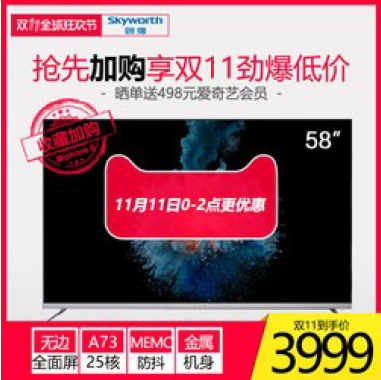
    While it’s normal for sale prices to be represented in text on a website (relatively easy to capture by our advanced data aggregation system), Taobao chose to display these prices as part of its product images — like the one shown in the adjacent image.

    However, our technology stack comprises of an AI-powered, state-of-the-art image processing and analytics platform, which quickly extracted the selling prices embedded in the images at very high accuracy.

    We analyzed the Top 150 ranked products of over 20 product types , spread across Electronics, Men’s Fashion, and Women’s Fashion, representing over 25,000 products in total, each day, between 8.11 and 12.11.

    In the following infographic, we analyze the absolute discounts offered by Taobao on 11.11, compared to 8.11 (based on pricing information extracted from the product images using our image analytics platform), together with an insight into the level of premium products included in their mix for each product type, between the two days of comparison.

    Unexpectedly, we noticed that each day, ALL the products in the Top 150 ranks differed from the previous day — a highly unique insight into Taobao’s unique assortment strategy.
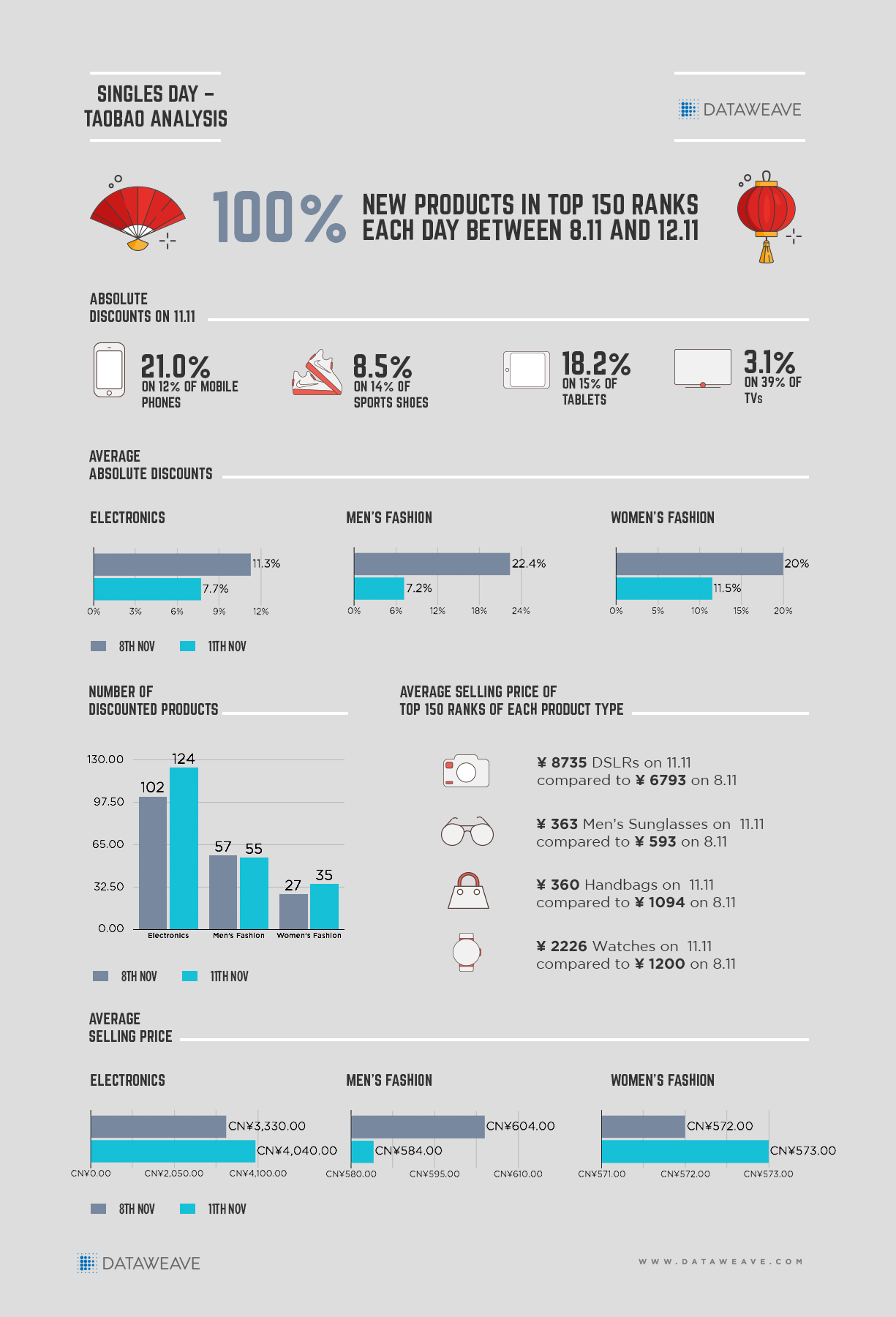
    Counter-intuitively, absolute discounts across all categories were considerably higher on 8.11 than on 11.11, even if it were for a marginally fewer number of products. The number of discounted Electronics products on sale rose on 11.11 compared to 8.11 (124 versus 102 respectively), while there was little movement in the number of discounted Men’s Fashion(55 versus 57) and Women’s Fashion (35 verses 27) products.

    Taobao targeted the mobile phone and tablets segment with aggressive discounts (21.0 percent and 18.2 percent respectively), compared to the average Electronics discount level of 7.7 percent.

    Interestingly, the average selling price drifted up for Electronics on 11.11 compared to 8.11 (¥4040 versus ¥3330). Men’s Fashion dropped to ¥584 from ¥604 while prices for Women’s Fashion was stable.

    It’s clear that even with all the fanfare, Singles Day didn’t produce the level of discounts that one might have expected, indicating that purchases were driven as much by the hype surrounding the event as anything else.

    How did Alibaba’s Competitors Fare?

    While Taobao was widely expected to offer discounts during Alibaba’s major sale event, we looked at how its competitors JD.com and Amazon.ch reacted to Taobao’s strategy.

    As over 80 percent of top-ranked products were consistently present in the Top 150 ranks of each product type on these websites, we analyzed the additional discounts offered during 11.11, compared to prices on 8.11.
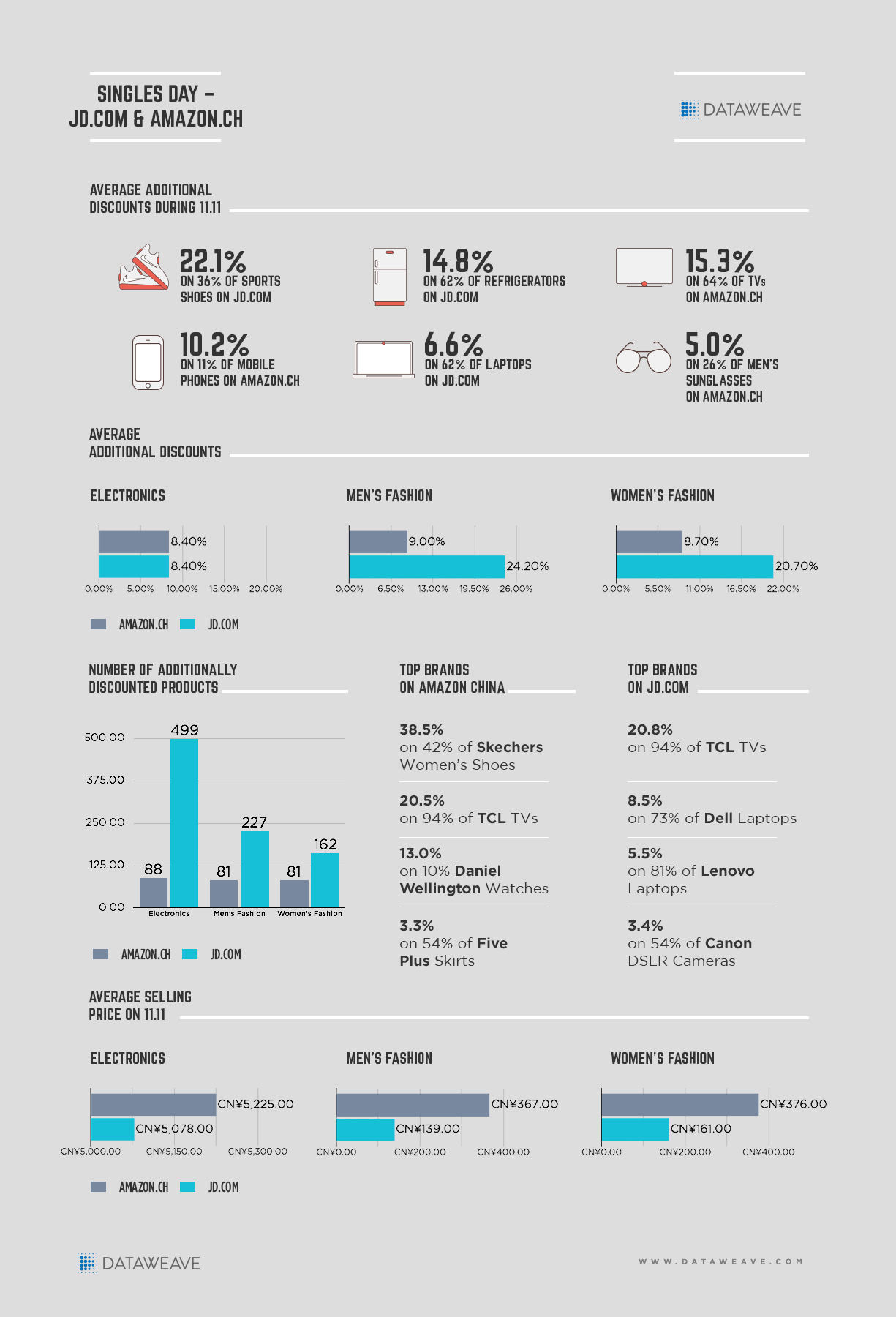
    Broadly speaking, both Amazon.ch and JD.com appear to have elected not to go head to head with Taobao on specific segments. JD.com’s discount strategy was spearheaded by Sports Shoes (22.1 percent) and Refrigerators (14.8 percent) while Amazon.ch featured TVs (15.3 percent) and Mobile Phones (10.2 percent).

    The average additional discounts offered by Amazon.ch and JD.com in Electronics (8.4 percent) was slightly above Taobao’s overall absolute discount (7.7 percent). TCL was aggressive with its pricing on both websites, offering over 20% discount on almost its entire assortment.

    Surprisingly, JD.com swamped Amazon.ch’s number of additionally discounted products, across all three featured categories although this may be partially explained by Amazon.ch electing to adopt a significantly more premium price position in both Men’s and Women’s Fashions compared to JD.com, while remaining roughly line ball on Electronics.

    Jack Ma’s “New Retail”

    Interestingly, JD.com wasn’t far behind Taobao in terms of sales, clocking up $20 billion in revenue, and sparking an interesting public debate between the two eCommerce giants extolling their respective performances.

    Singles Day is one of the pillars of Jack Ma’s vision of a “New Retail” represented by the merging of entertainment and consumption. Ma’s vision sees the boundary between offline and online commerce disappearing as the focus shifts dramatically to fulfilling the personalized needs of individual customers.

    Hence, Alibaba’s Global Shopping Festival should be understood as not just a one-day event that produces massive revenue, but as a demonstrable tour de force of Alibaba’s vision for the future of retail. One thing is certain — as competition heats up between Chinese retailers, we can be prepared for another Singles Day shoot-out sale next year that one-ups the staggering sales volumes this year.

    If you’re intrigued by DataWeave’s technology, check out our website to learn more about how we provide Competitive Intelligence as a Service to retailers and consumer brands globally.
     

  • Under the Microscope: Lazada’s 11.11 Online Revolution Sale

    Under the Microscope: Lazada’s 11.11 Online Revolution Sale

    Lazada’s signature event, Online Revolution, is a month-long sale extravaganza that commenced with a Mega Sale on 11 November, and culminates in an End-Of-Year sale on 12 December. The shopping event is held across six southeast Asian countries — Singapore, Malaysia, Thailand, Indonesia, the Philippines and Vietnam — making it the region’s biggest retail event.

    Lazada Group’s chief executive officer Maximilian Bittner observed, “We aim to provide Southeast Asia’s rapidly growing middle-class the access to a wide range of products with deals and discounts that were previously available only abroad or in the capital cities.”

    On 11.11, the first Mega Sale, shoppers took advantage of great deals, ordering 6.5 million items (nearly doubling last year’s tally), resulting in sales of US$123m, annihilating last year’s takings by a whopping 191 percent.

    At DataWeave, our proprietary data aggregation and analysis platform enabled us to seamlessly analyze and compare Lazada’s discounts during 11.11 with those of its competitors. We focussed specifically on two markets — Singapore and Indonesia. While the sale itself is Lazada’s, we looked at its immediate competitors as well, to study how competitively they position themselves during Lazada’s sale.

    For our analysis, we aggregated pricing information on the Top 500 ranked products of over 20 product types on each website, spread across Electronics and Fashion, covering over 120,000 products in total.

    11.11 — Singapore

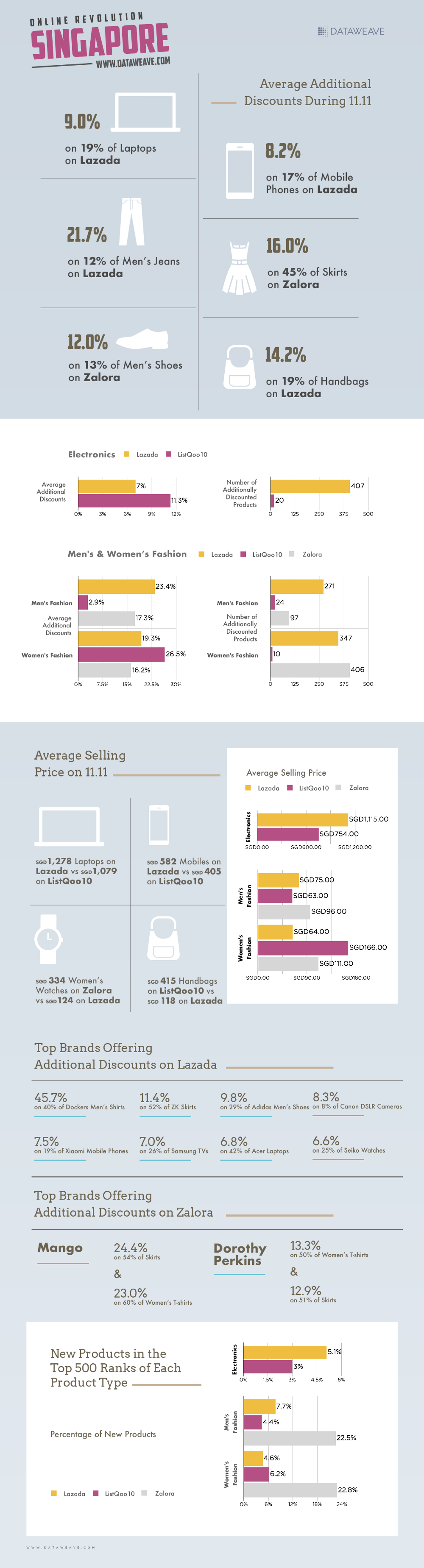
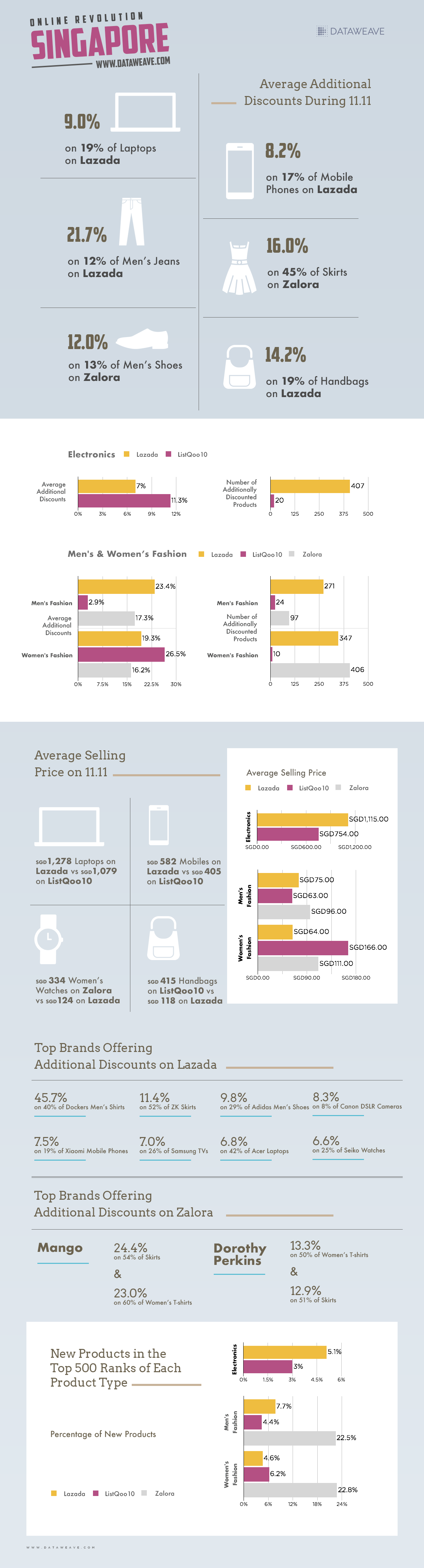
    In our analysis, we scrutinized the additional discounts offered by Lazada, ListQoo10, and Zalora during the sale period, compared to prices leading up to the sale. As today’s shoppers often encounter deep discounts on several products even on normal days, our analysis of additional discounts offered during the sale more accurately reflects the true value of the sale event to shoppers.

    In the following infographic, all prices are in Singapore Dollars, and additional discounts are the percentage reduction in price on 11.11 compared to 10.11.

    Lazada’s discounting strategy was more focused on Fashion rather than Electronics. However, Lazada didn’t have it all its own way with Zalora providing comparably high discounts, enabling it to compete effectively, especially in Women’s Fashion (16.2 percent on 406 products).

    Zalora actually exceeded Lazada in the number of additionally discounted products on offer (Zalora 406, Lazada 347). ListQoo10 did not match either Lazada or Zalora’s level of discounting.

    While Lazada held a more premium, high-value product mix in Electronics compared to ListQoo10, it chose to target the more affordable segment in Fashion, with both ListQoo10 and Zalora displaying a higher average selling price in each category.

    Interestingly, Lazada refreshed very few of its Top 500 products during the sale, limiting new options to choose from for its shoppers. On the other hand, Zalora refreshed 22.5 and 22.8 percent of its products in men’s and women’s fashion respectively.

    11.11 — Indonesia

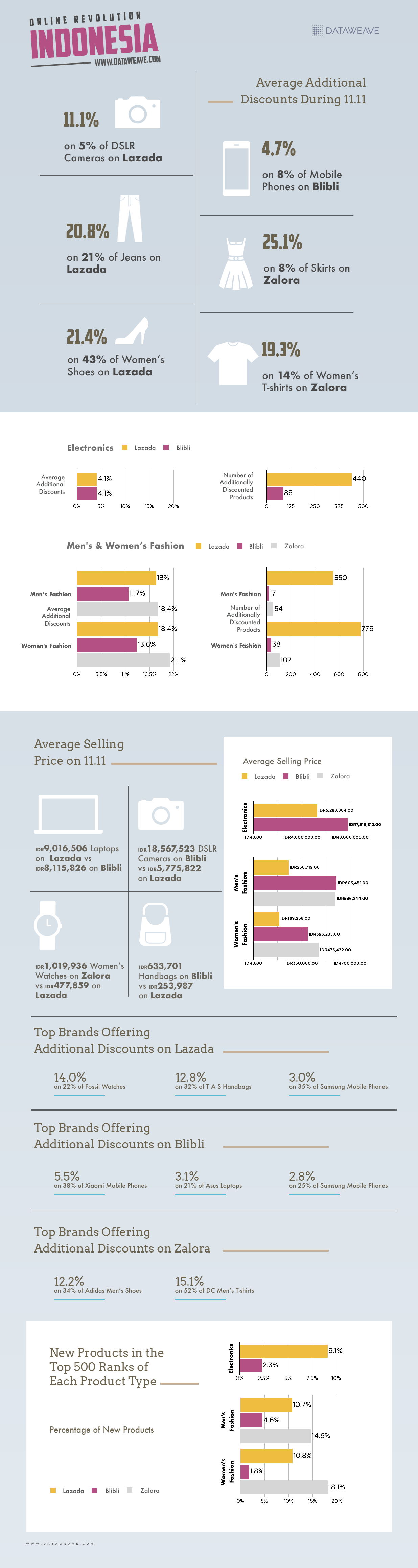
    Using a similar methodology to our Singapore analysis, we analyzed Lazada’s promotions against Blibli and Zalora, three of the top eCommerce websites in the region. In the following infographic, all currencies are in Indonesian Rupiah.

    As with its Singapore strategy, Lazada targeted Fashion as the lead category for discounts in Indonesia. It offered steep discounts in both Men’s and Women’s Fashion (around 18 percent in each) across a large number of products (550 and 776 respectively). While Zalora matched and occasionally exceeded the discounts offered by Lazada, it did so across a significantly smaller range of additionally discounted products.

    Surprisingly, Electronics were de-emphasised in Indonesia (4.1 percent compared to 9 percent in Singapore).

    Compared to the market leaders Lazada and Zalora, Blibli struggled to be competitive from both an absolute discount level and a product assortment perspective.

    Like in Singapore, Lazada looked to be targeting the affordable value end of the product mix spectrum across all categories, and introduced very few new products in its Top 500 ranks.

    Zalora had a healthier churn rate of 14.6 percent and 18.1 percent in Men’s and Women’s Fashion, compared to Lazada’s 9.1 percent (Electronics), 10.7 percent (Men’s Fashion) and 10.8 percent (Women’s Fashion).

    It’s Not Just About Discounts

    Lazada’s ‘Fashion First’ targeting strategy creates an effective tie-in to its broader model of surfing the convergence wave between entertainment and eCommerce, something unique to southeast Asia.

    Together with sumptuously attractive discounts, major sale events in South East Asia are fast becoming characterized by entertainment. By launching Southeast Asia’s first star-studded eCommerce TV show, Lazada continues to be the region’s eCommerce innovator, following in the footsteps of its pioneering parent company, Alibaba.

    While time will tell how effective Lazada’s strategy ultimately proves to be, together with Alibaba, it has set up a fascinating and uniquely Asian retail sale model. No doubt another milestone will be set on 12.12 when the Online Revolution Mega Sale returns with even greater deals. At DataWeave, we’ll be sure to analyze that sale as well and bring you all its highlights.

  • Black Friday Sales Season: How US Retailers Are Gearing Up

    Black Friday Sales Season: How US Retailers Are Gearing Up

    In today’s rapidly evolving online and mobile worlds, few things encapsulate the competitive nature of the online retail battlefield like the Black Friday sales season. With this year’s Black Friday and Cyber Monday sale events just around the corner, 2017 promises another titanic tussle between contenders.

    The holiday shopping season commences on Black Friday, November 24, and continues through much of December. Anticipating the sales season, many retailers are already offering discounts on several key categories and anchor products, providing a sneak peek into what we can expect towards the end of the month.

    While traditionally, Black Friday sales were dominated by brick and mortar retail stores, with the odd shopper stampede not unheard of, retail dynamics have changed in the recent past. Online sales now consume a larger proportion of Black Friday spending, and for the first time, consumers are expected to spend more online in the 2017 holiday season than in-store.

    In anticipation of this mammoth sale event, we at DataWeave trained our proprietary data aggregation and analysis platform on several major US retailers to understand the competitive market environment before the sales kick off.

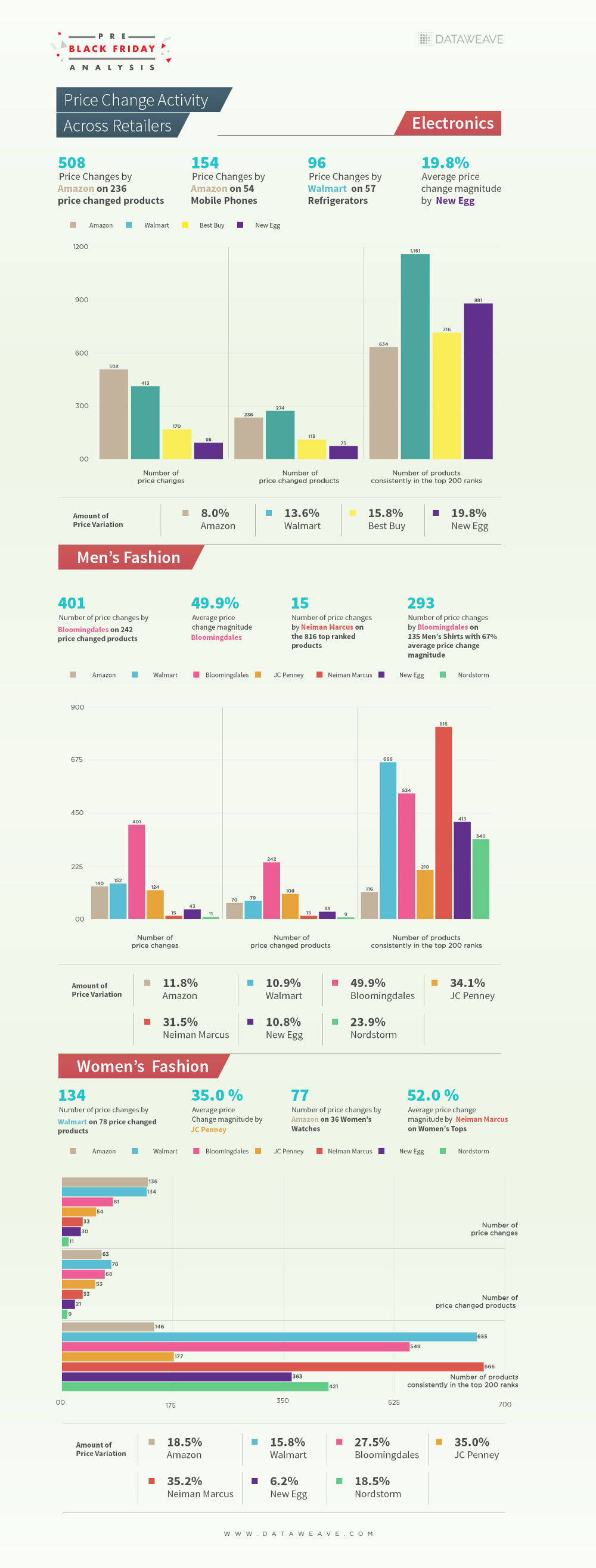
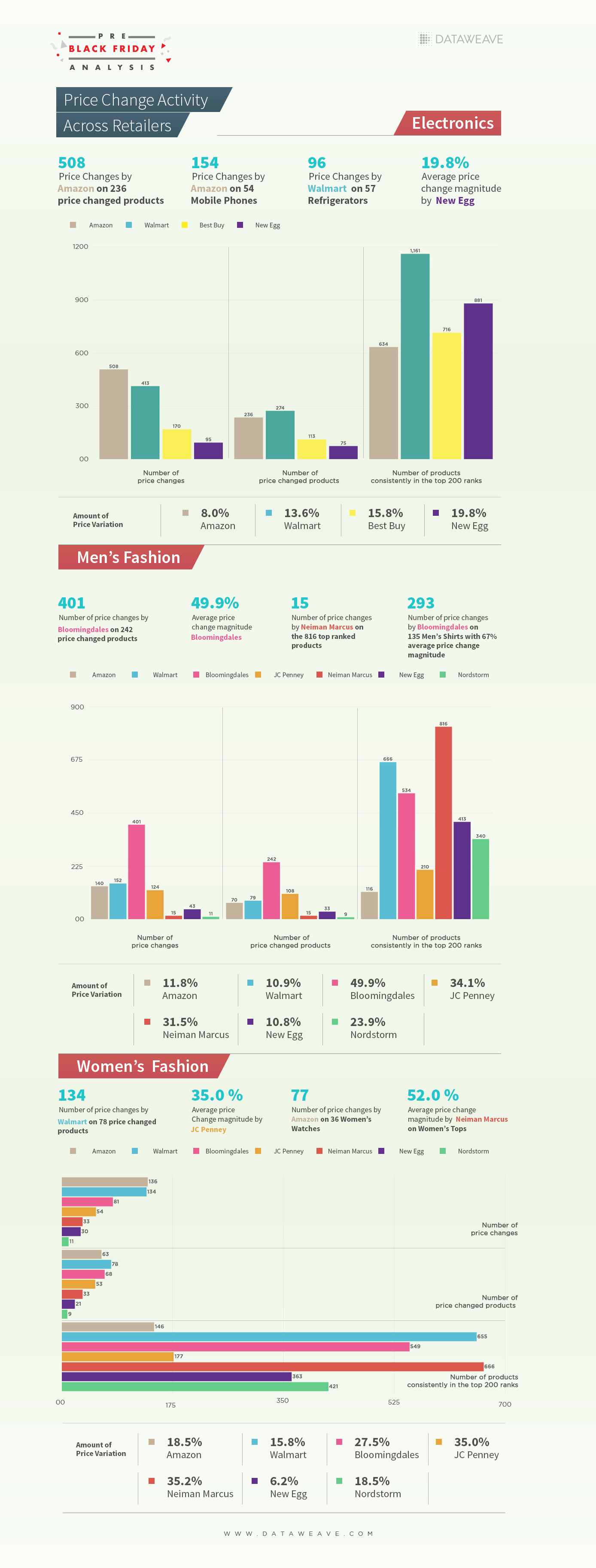
    Between the 15th and 29th of October, we tracked the prices of the top 200 ranked products each day in the Electronics and Fashion categories across several major retailers. For Electronics, we analyzed Amazon, Walmart, Best Buy, and New Egg, while Amazon, Walmart, Bloomingdales, Nordstrom, Neiman Marcus, New Egg, and JC Penney provided our insights into the pivotal Fashion category. Product types analyzed include mobile phones, tablets, televisions, wearables techs, digital cameras, DSLRs, irons, USB drives, and refrigerators in Electronics, and T-shirts, shirts, shoes, jeans, sunglasses, watches, skirts, and handbags in Fashion.

    Automated Competitive Pricing Is the New Norm

    With the accelerated evolution of online commerce, retailers have increasingly harnessed the power of competitive data to drive changes on the go to their pricing, product assortment, and promotional strategy. During sale events, however, these numbers spike significantly. Amazon famously made 80 million price changes each day during 2014’s Christmas Season sale. Similarly, even on normal days some retailers have adopted the tactics of changing their product pricing more frequently than others, in their quest to stay competitive and build their desired price perception amongst shoppers.

    In our analysis of price changes, we considered the set of products that ranked consistently in the Top 200 from the 20th to the 25th of October. We identified the number of price changes together with the number of products affected by price changes that were implemented by the retailers.

    As anticipated, Amazon led the way with 508 price changes on 236 products in the Electronics category during the period compared to Walmart’s 413. By comparison, New Egg’s 95 price changes trailed the field by a significant margin and illustrate the tactical advantage Amazon’s dynamic pricing technology confers. However, the price variation (8.0%) of Amazon’s was also the lowest of the four retailers included in the study, showing that Amazon makes short, sharp tweaks to its pricing at a higher frequency than its competitors.

    By comparison, the Fashion category demonstrated a much lower level of price changes than Electronics, albeit with significantly higher price variations. Walmart leads the pack, adopting an order of magnitude greater number of price changes across a significantly larger number of products compared to the majority of its competitors.

    Product Mix Suited to Target Market Segments

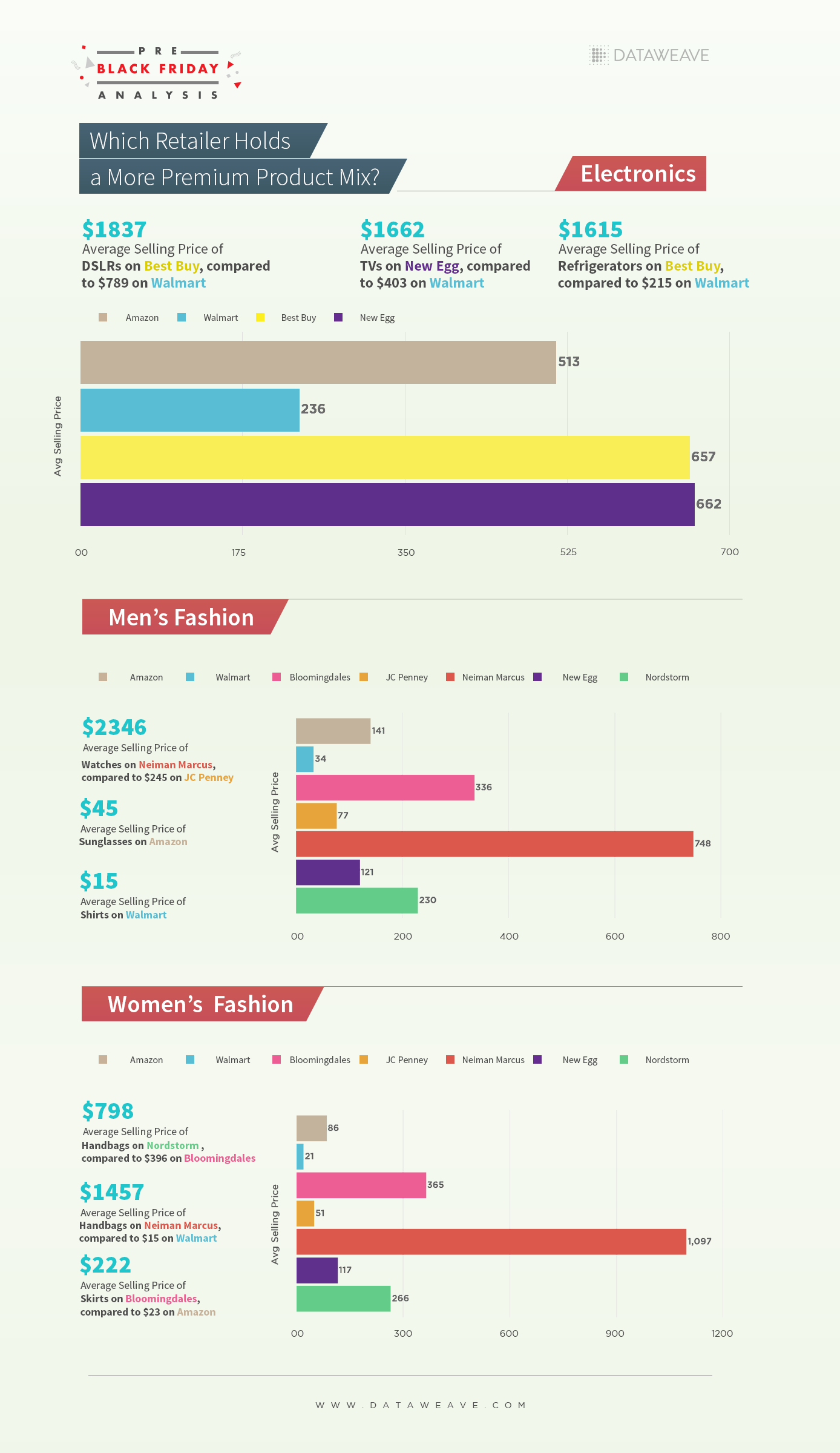
    While competitive pricing is one strategy for attracting new customers and retaining existing ones, the selection of products featured in a retailer’s inventory is just as important. Ensuring a disciplined product assortment, which caters exclusively to a retailer’s target market segments is key. While some retailers such as Walmart choose to house a more affordable range of products, Neiman Marcus and Bloomingdales target the more premium segment of shoppers.

    It is clear from the data that Walmart has aligned its pricing strategy to support its affordability pitch to its shopper base, while Neiman Marcus and Nordstrom use pricing to juggle the demands of a more premium inventory with perceptions of price competitiveness.

    Product Movement In The Top 200

    Much of a retailer’s sales performance comes down to how effectively it maintains the optimal mix of reassuring bestsellers complemented by attractive new arrivals. Sound product assortment clearly provides shoppers with a variety of options each time they visit the retailer’s website. To achieve this balance, retailers typically employ their own, unique algorithm that ranks products in their listings based on several factors, including price range, discount offered, review ratings, popularity and promotions by brands.

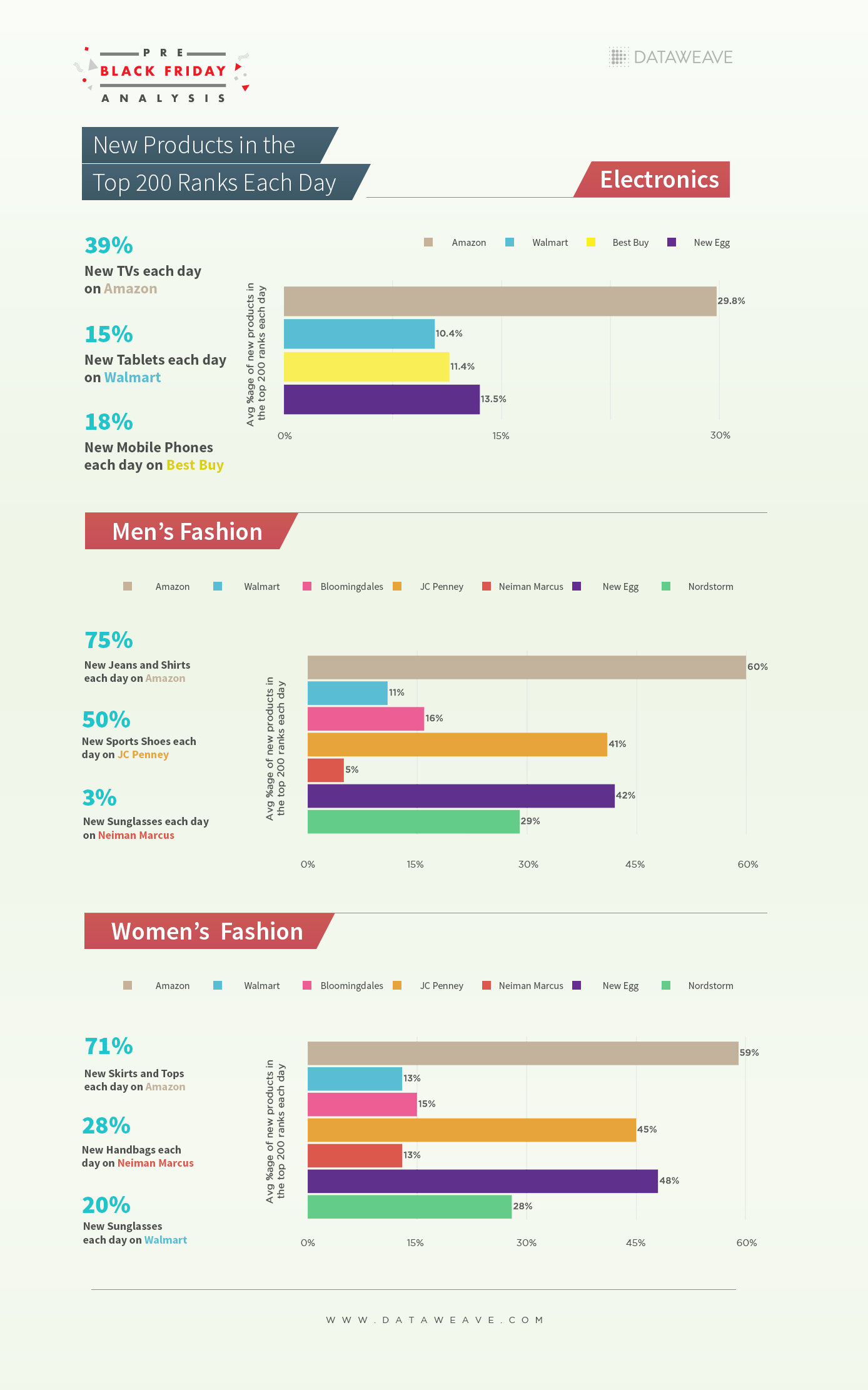
    To study this, we evaluated the average percentage of products that were replaced in the Top 200 ranks for each product type of each website.

    Amazon has clearly adopted a strategy of offering new options to its shoppers each day, with an average of 60% new products in the Top 200 ranks of the Fashion category. Contrast that with Walmart which appears to be more conservative in its approach to churning its Top 200 products. In the case of Neiman Marcus however, the reason for the lower volume of product pricing movements in its Top 200 ranks may be due to the relatively high value of its premium product assortment, which imposes the internal constraints of having a smaller pool of new products to choose from.

    Online-First, This Black Friday Sale Season

    Amazon continues to demonstrate its dominance as a pacesetter in US retail, largely due to its progressive online pricing and merchandising strategies. These embrace the power of big data in its approach to online retail.

    Research shows online is consistently outperforming in-store along critical customer satisfaction dimensions spanning: product quality, selection and/or variety, availability of hard-to-find and unique products, ease of searching and delivery options.

    According to global consultancy Deloitte, for the first time ever, American shoppers will purchase more online than they buy offline in the 2017 holiday shopping season — 51 percent, up from 47 percent in 2016. With Black Friday looming in the next few weeks, it will be interesting to see how US retailers push to seize a larger piece of this growing pie.

    Check out our website to learn more about how DataWeave provides Competitive Intelligence as a Service to retailers and consumer brands globally.
  • Our Analysis of Diwali Season Sales

    Our Analysis of Diwali Season Sales

    As the battle of the Indian eCommerce heavyweights continues to accelerate, we have witnessed three separate sale events compressed into the last four weeks of this festive season. Flipkart has come out with all guns blazing following its multi-billion-dollar funding round, leaving Amazon with little choice but to follow suit with its own aggressive promotions. At this stage of a highly competitive eCommerce cycle, market share is a prize worth its weight in gold and neither Flipkart nor Amazon are prepared to blink first.

    At DataWeave, our proprietary data aggregation and analysis platform enables us to seamlessly analyze these sale events, focusing on multiple dimensions, including website, category, sub-category, brand, prices, discounts, and more. Over the past six weeks, we have been consistently monitoring the prices of the top 200 ranked products spread over sub-categories spanning electronics, fashion, and furniture. In total, we amassed data on over 65,000 products during this period.

    The first of these pivotal sale events was held between the 20th and 24th September, which we earlier analyzed in detail. Another major sale soon followed, contested by Amazon, Flipkart and Myntra for varying periods between the 4th and 9th of October. Lastly, was the Diwali season sale held by Amazon, Flipkart, and Myntra between the 14th and 18th of October, joined by Jabong between the 12th and 15th of October.

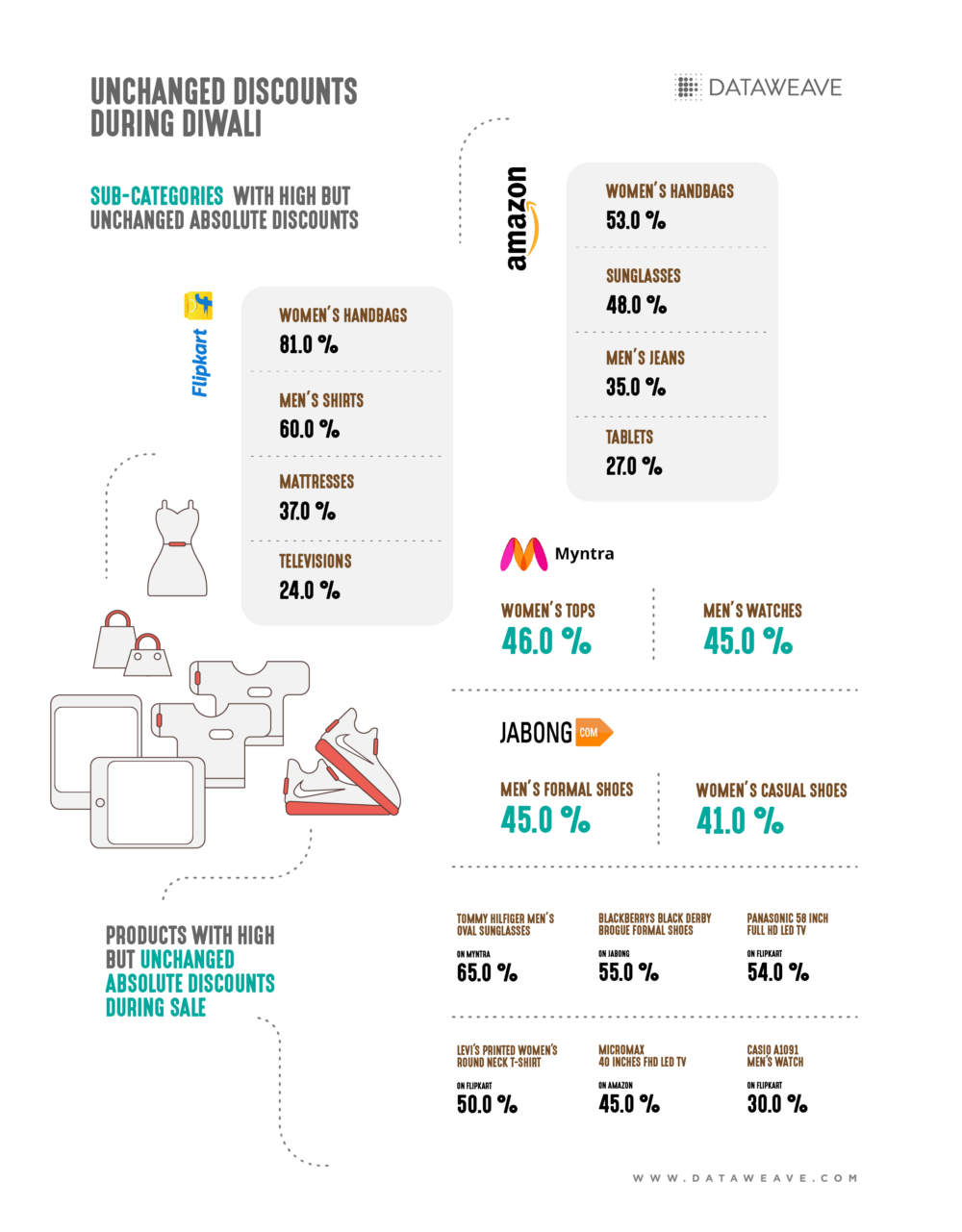
    In analyzing these significant sale events for all eCommerce websites, we observed an extensive range of products enjoying high absolute discounts, but with no additional discounts during the sale, i.e. prices remained unchanged between the day before the sale and the first day of the sale. The following infographic highlights some of the sub-categories and products where this phenomenon was more pronounced during the recently concluded Diwali season sale. Here, discount percentages are average absolute discounts of products with unchanged discounts during the sale.

    Having identified the aggressive use of high but unchanged absolute discounts amongst eCommerce heavyweights during the sale, we focused our analysis on the additional discounts offered during the sale, to more accurately reflect the value these sale events deliver to Indian consumers.

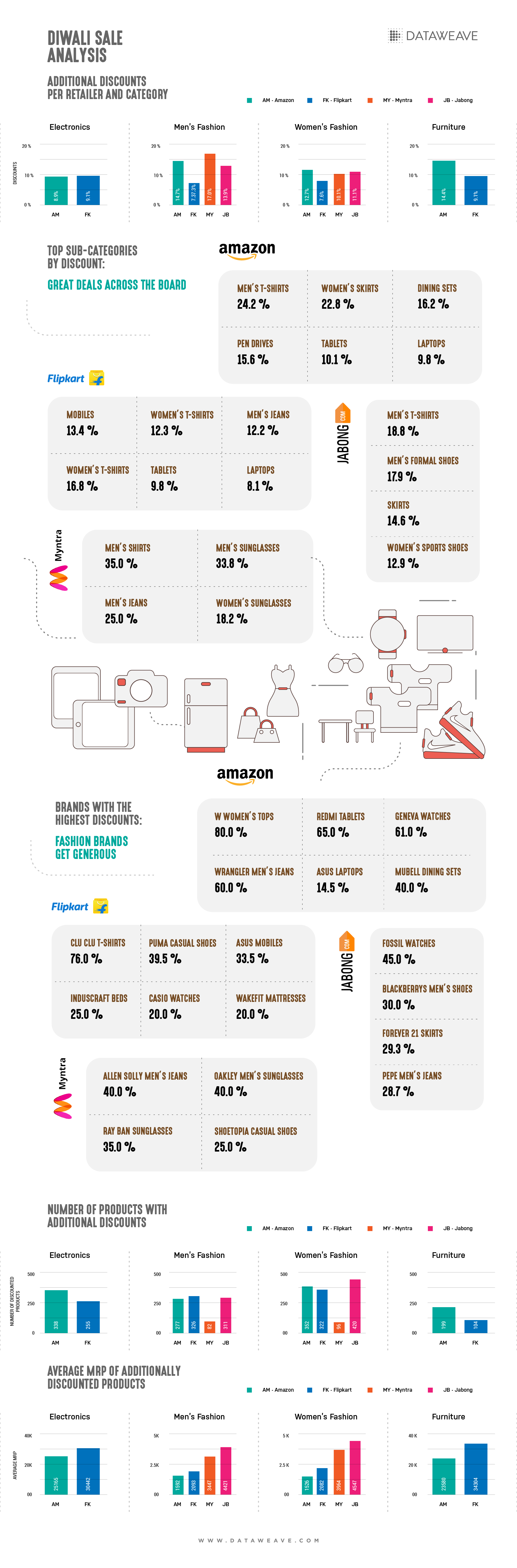
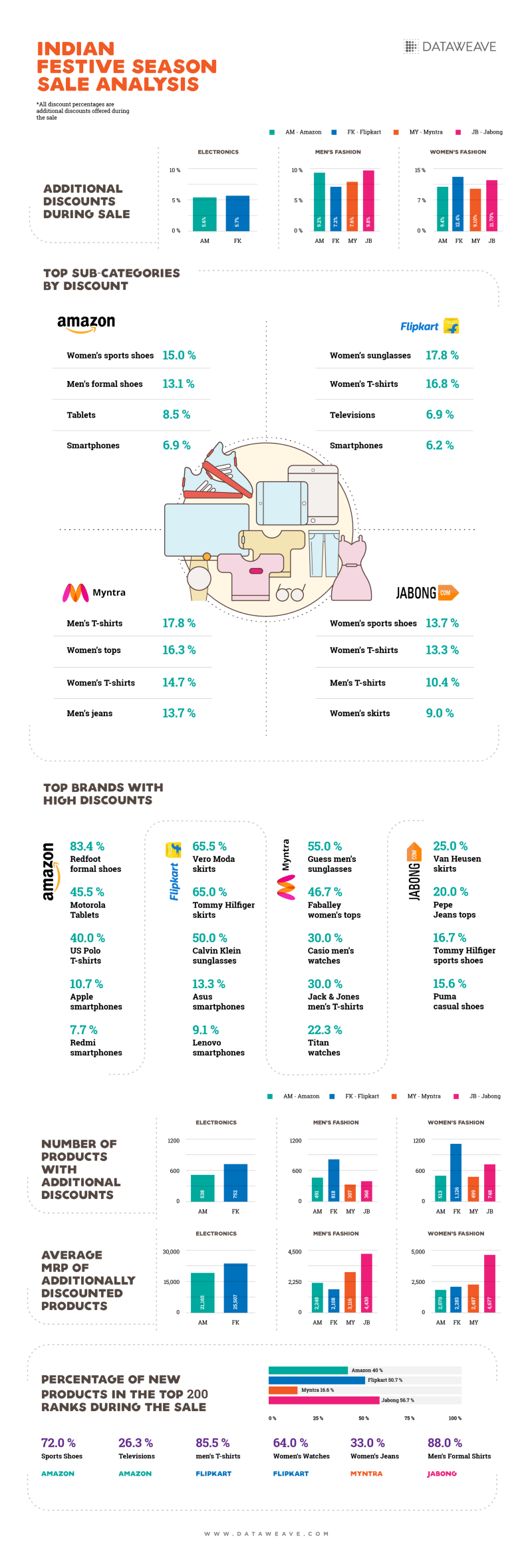
    Several categories, sub-categories and brands emerged as enjoying substantial additional discounts. The following infographic details our analysis:

    Amazon and Flipkart continue to stand toe to toe on discounts in Electronics, although Amazon offered discounts across a greater number of products. Flipkart adopted a more premium brand assortment in the Electronics category with an average MRP of INR 30,442 for additionally discounted products.

    What stands out in our analysis is Amazon’s consistently aggressive discounting in fashion compared to Flipkart. As anticipated, Jabong and Myntra continued to offer attractive discounts in a large number of fashion products, seeking to maintain their grip in their niche. Furniture, too, is a category where Amazon out-discounted Flipkart, albeit through a less premium assortment mix (average MRP of INR 23,580 compared to Flipkart’s INR 34,304).

    Several big brands elected to dig deep into their pockets during the sales to offer very high discounts. These included attractive discounts from Redmi, Asus, and Acer in Electronics, and W, Wrangler, Levi’s, Puma, Fossil, and Ray Ban in Fashion.

    Which Sale Delivered Greater Value For Consumers?

    Since DataWeave has extensive data on both the pre-Diwali sale (held between 4th and 9th of October), and the Diwali season sale (held between 12th and 18th October), we compared prices to identify which of the sale events offered more attractive discounts across categories, sub-categories and products.

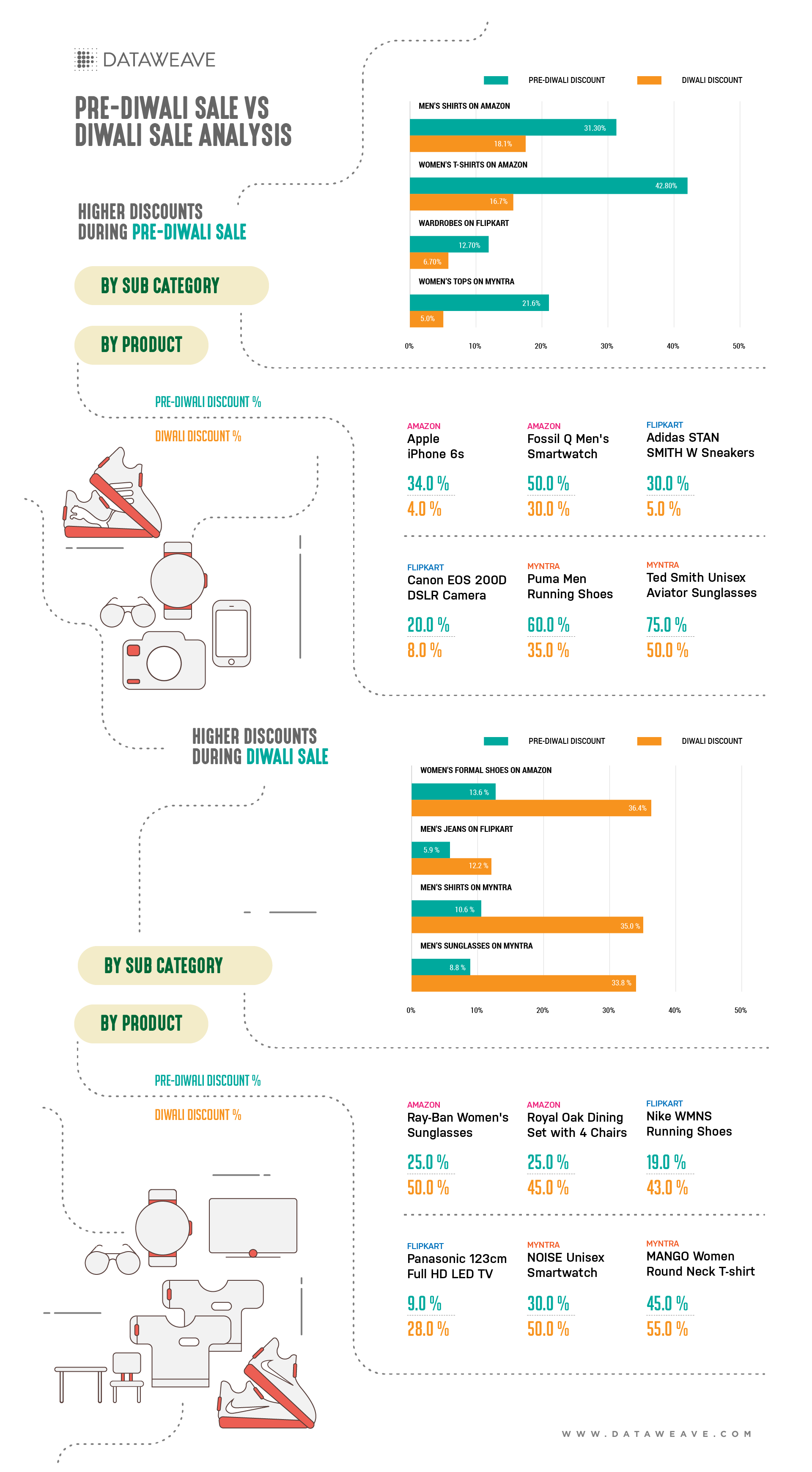
    While the discount levels were generally consistent across most sub-categories, only varying by a few percentage points, we identified several sub-categories and products that displayed a large variation in the absolute level of discount offered.

    As the infographic above shows, Amazon identified women’s formal shoes as a key category in its discounting strategy, which saw its level of discounting triple during the Diwali sale. By comparison, Flipkart doubled its discount in men’s jeans, and Myntra tripled its discounts on Men’s shirts and sunglasses.

    Similarly, during the Diwali sale Amazon, Flipkart and Myntra all offered selected products with an aggressive 40% to 50% discount level.

    Interestingly, Amazon, Flipkart and Myntra all elected to reduce the level of discounts offered on specific products as well. One of the biggest discount moves was Amazon’s reduction on iPhone 6s from 34% to only 4%. Flipkart recorded a similar price move on Adidas originals Stan Smith sneakers (30% to 5%) and Canon EOS 200D DSLR cameras (20% to 8%).

    Market Share Reigns Supreme

    Based on our analysis of the festive season sales, Flipkart’s aggressive approach powered by its multi-billion-dollar funding round enabled it to stave off Amazon’s discounting strategy in the annual eCommerce festive season sales this year, increasing its lead over Amazon India in a market where the total sales is believed to have surged by up to 40 percent over 2016’s sales.

    Based on several reports, Flipkart’s share of total festive season sales appears to have increased from 45 percent in 2016 to 50 percent this year, capturing much of the market up for grabs from a now relegated Snapdeal. Amazon’s market share during a festive sales period that stretched over a month is estimated to have remained steady at 35 percent, though the company reported it saw a 50 percent share in other metrics such as order volume and active customers.

    The key question for both industry analysts and consumers alike is, how much deeper are retailers willing to go in their quest to capture market share at the expense of operating margins?

    If you’re interested in DataWeave’s data aggregation and analysis platform, and how we provide Competitive Intelligence as a Service to retailers and brands, visit our website!

  • Top 5 Drivers of Successful eCommerce | DataWeave

    Top 5 Drivers of Successful eCommerce | DataWeave

    Retail has undergone a dramatic transformation over the last decade. Once dominant retailers are today being given a run for their money amid a gradual decline in mall traffic and sharply growing consumer preference for shopping online.

    Surfing this online retail wave is Internet behemoth Amazon, which is raking in 43% of all new eCommerce dollars, leaving other retailers floundering in its wake.

    As it unfolded, this transformation has unleashed changes across many areas of retail, a phenomenon that’s been well documented by industry commentators in the media. Some of these shifts include:

    Customer preferences: Customers today are spoilt for choice, both in terms of being able to quickly and easily compare product prices across websites, as well as consistently driving the demand for new and unique products from retailers.

    Hyper-personalization: With shoppers increasingly relying on mobile apps, highly personalized shopping experiences are becoming the new normal.

    Delivery: e-Retailers are competing on faster home deliveries, stretching themselves to guarantee same day delivery, or even (as in the case of hyper-local grocery retailers) within a few hours. Drones, anyone?

    Payment Modes: Even the more tactical aspects of retail, like payment modes, have been forced to evolve. Starting with cash-on-delivery, this trend quickly spread to embrace card payments and digital wallets. These initiatives have posed significant technological and security challenges for retailers.

    As with a forced move in chess, traditional retailers have had to evolve and embrace changes like the ones listed above, in order to survive the incredibly cutthroat world of modern retail. Similar challenges exist for up-and-coming eCommerce companies as well.

    However, many pundits and retailers alike often forget that doing even simple, time-tested things correctly can go a long way in forging an effective competitive position, helping win both market share and customer affections. While digital transformation has altered how these strategies were routinely executed, the fundamentals remain as relevant today as they ever were.

    1. Smarter Pricing

    With 80 percent of first-time shoppers comparing products prior to buying, the need for an eCommerce website to offer competitive pricing has become a mandatory cost-of-entry capability. While dynamic pricing poses a challenge for e-retailers to stay competitive, it also presents them with an opportunity to track their competitors’ pricing and exploit that information to optimize their own pricing.

    However, e-retailers today are frequently forced to perform millions of price-changes every day in the eternal quest to either offer the lowest price or entrench a calculated premium price perception among shoppers.

    For instance, as far back as Christmas season 2014, Amazon is estimated to have made a total of 80 million price changes per day. Similarly, today’s hyper-local grocery retailers offer differentiated and targeted prices for shoppers living in specific zip codes.

    To achieve price controls on this level of scale demands sophisticated automated tracking of competitor pricing to facilitate timely, data-driven dynamic pricing decisions. This has, today, become a table stakes requirement.

    2. Variety and Depth of Product Range

    If customers cannot find what they are looking for on a website, all other aspects of how an eCommerce operator optimizes their retail strategy falls by the wayside.

    A website’s success remains dependent largely on it being able to cater effectively to the needs, wants and desires of its target audience. Simply put, a website offering a mammoth product range may still end up failing compared to a small niche website with a limited but highly targeted assortment that understands closely its customer’s sweet spot.

    However, with millions of products on offer online all day every day, gathering and harvesting deep insights into a competitor’s assortment mix can appear daunting. Include dynamically changing product assortments and different product taxonomies into the standard research mix, and many who lack access to automated competitive intelligence systems find themselves struggling to find the expertise required to gather and summarize this information in an actionable form.

    3. Customer Centricity

    Today, customers demand to be heard. As competitive pricing becomes an expected cost of doing business, retailers will need to place greater support resources and more effective processes to resolve customer problems and complaints in a timely fashion at the heart of their customer service model.

    Following the online social revolution, 9 out of 10 retail customers now expect a consistent response across all social media channels.

    Successful companies like Zappos, Best Buy and Amazon have been quick to understand this significant shift in customer preferences. These retailers have demonstrated their willingness to go the extra mile by establishing a robust, scalable omni-channel support structure.

    The level of this commitment can be seen in Amazon’s recent vision statement announcement, “Amazon today boasts of one of the most responsive omni-channel customer support and Zappos takes pride in sending a personalized response to customer queries. We seek to become Earth’s most customer centric company.” This aggressive customer centric sentiment drives a stake in the ground for all competing eCommerce companies’ to match via their customer service strategy.

    4. Superior Customer Experience

    While bricks and mortar retail stores continue to attract customers by enabling shoppers to touch, feel and test items before they purchase, online and omni-channel retailers have channelized their efforts into increasingly refining their web user experience.

    Several studies reveal it takes only a couple of seconds for a website visitor to decide whether to stay on or leave a website. Aspects such as visual design, ease of use, content attractiveness, website loading time and pervasive calls to action (CTA) are a few of the key user experience parameters that influence visitors to stay on a website.

    eCommerce sites such as Zara, Graze, Asos, and Amazon offer attractively organized and clutter-free designs, which are visually engaging and easy to navigate. While these design elements help them keep their customers engaged, it’s their disciplined focus on content that stimulates visitor conversions.

    Detailed product descriptions and high-quality images are helping these eCommerce sites educate their customers about their products while simultaneously boosting their website’s SEO ranking, helping it attract and engage still more online visitors.

    Complementing the online retailing revolution are substantial efforts by omni-channel retailers to optimize O2O (online to offline) strategies designed to bring together the best of both worlds — the discoverability of online, with the touch-and-feel of an offline environment.

    5. Optimized Promotional Strategies

    With so many options for a shopper to choose from in an increasingly cluttered and competitive online retailing environment, attracting new customers and entrenching customer loyalty is an ongoing challenge. Strategic online promotions are emerging as an effective technique in solving the customer recruitment and retention dilemma. Online promotions if executed effectively are doing wonders for generating inbound website traffic.

    However, for online promotions to be effective, it is critical for e-retailers to understand their competitor’s strategy if they are going to be able to sustain their competitiveness. Key questions to answer in this context are, what brands are they promoting more than others? For how long? At what frequency?

    Keeping a keen eye on and reacting to competitors’ promotions is a key aspect to designing effective online promotions. Being able to exploit this competitive intelligence not only boosts their own sales volumes but erodes that of their competitors as well.

    Competitive Intelligence As A Service

    Having understood the far-reaching impact of these evergreen drivers of eCommerce success, we at DataWeave work with omni-channel and online retailers to provide Competitive Intelligence as a Service and help them evaluate and optimize their strategic approach across the eCommerce landscape.

    If you’re interested in DataWeave’s solutions and would like to learn more about how we help retailers and brands optimize their retail strategies, visit our website!

  • Festive Season Sale: Who’s Winning the Great Indian eCommerce Battle?

    Festive Season Sale: Who’s Winning the Great Indian eCommerce Battle?

    In the lead up to October’s Diwali celebrations, almost all major Indian e-retailers had announced mammoth sale events for last week. Resuming the epic battle of India’s online shopping carts during festival seasons, Flipkart, together with Jabong and Myntra, kicked off their five-day-long “Big Billion Days” sales on September 20, while Amazon India‘s “Great Indian Festival” launched the next day.

    The stakes were high as Amazon and Flipkart are more evenly matched this year than ever before, making predicting an eventual winner of these dueling discounters a lot tougher than in previous years.

    At DataWeave, our proprietary data aggregation and analysis platform enabled us to easily assess which e-retailer offered better deals and discounts. Over the last two weeks, we have been consistently monitoring the prices of the top 200 ranked products in Amazon, Flipkart, Myntra, and Jabong, across several sub-categories of Electronics, Men’s Fashion, and Women’s Fashion, encompassing over 35,000 products in total.

    Divergent Discount Strategies

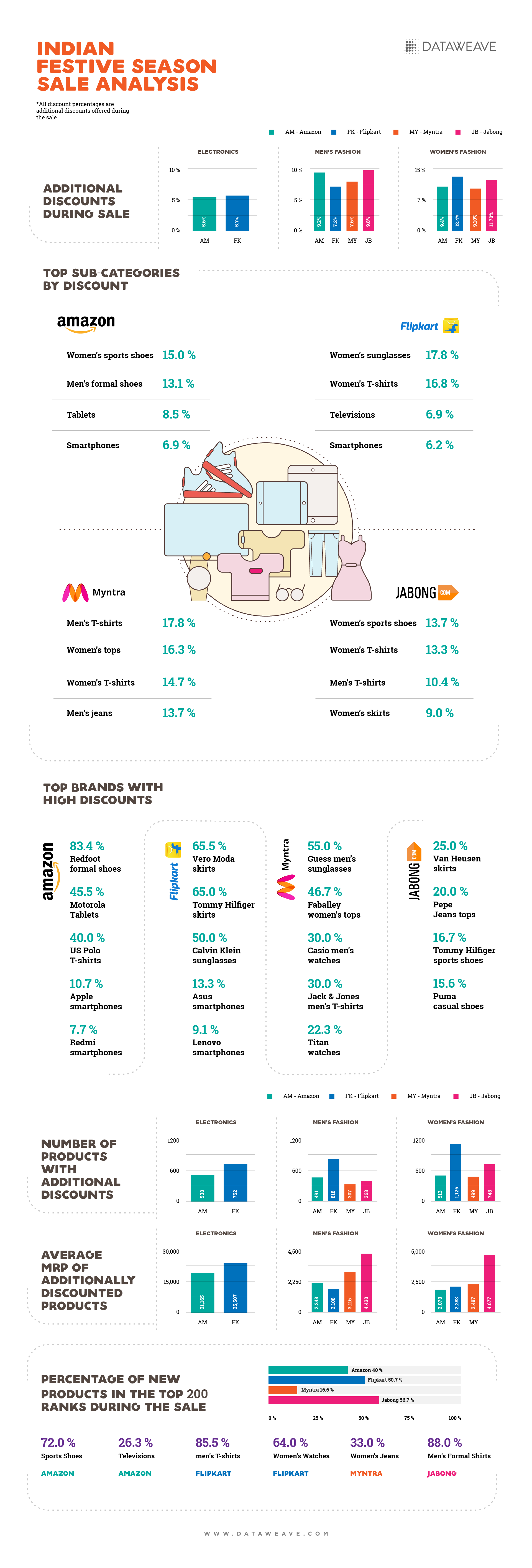
    In our analysis, we bring focus to the additional discounts offered by competing e-retailers during the sale, compared to prices before the sale. This is key, as today’s shoppers often encounter deep discounts on several products even on normal days, which could potentially dampen the value suggested by the large discounts advertised during the sale.

    Based on our analysis, Flipkart clearly adopted a more aggressive pricing strategy this year, establishing a lead over Amazon in average discount percentage for Electronics and Women’s Fashion. Moreover, Flipkart launched additional discounts on a larger number of products across categories. Amazon, though, offered 6.9 percent additional discounts on smartphones compared to Flipkart (6.2 percent), led by 10.7 percent discount on Apple and 7.7 percent discount on Redmi smartphones.

    Flipkart has already reported a doubling of revenue from the sale (which includes sales volumes of Myntra and Jabong) compared to last year, and claimed it accounted for 70 percent of eCommerce sales during these five days — beating Amazon by a considerable margin. Amazon, for its part, reported a “2.5X growth in smartphone sales, 4X increase in large appliances and 7X in fashion sales.”

    The difference in discounting strategies between Amazon and Flipkart is starkly illustrated by their respective highest discounts. Flipkart led the way with a 65.5 percent discount on Vero Moda skirts, a 65 percent discount on Tommy Hilfiger skirts, and 50 percent off Calvin Klein sunglasses.

    By contrast, Amazon’s greatest discounts were an 83.4 percent discount on Redfoot formal shoes, 45.5 percent on Motorola Tablets, a 40 percent on US Polo T-shirts, and a 25.1 percent discount on Puma sports shoes.

    Also, Flipkart hosted a more premium range of products in its assortment compared to Amazon, evidenced by a higher average MRP for its discounted products. Surprisingly, Amazon’s spread of discounted products has the least average MRP in Electronics and Women’s Fashion, compared to all other competitors.

    New Products Break Through the Top 200

    What’s fascinating in this battle of the e-retail giants is the correlation we uncovered between prices and rank. During the sale, as prices dropped on hundreds of products across the board, newer products successfully broke through into the Top 200 ranks for each sub-category. New products in the top 200 ranks had higher discount levels than the ones they replaced.

    This trend was especially pronounced in fashion, where we observed an almost complete overhaul of products filling the Top 200 during the sale period, led by sports shoes in Amazon, Men’s shirts in Flipkart, and Men’s formal shirts in Jabong.

    What About Pre-Sale Prices?

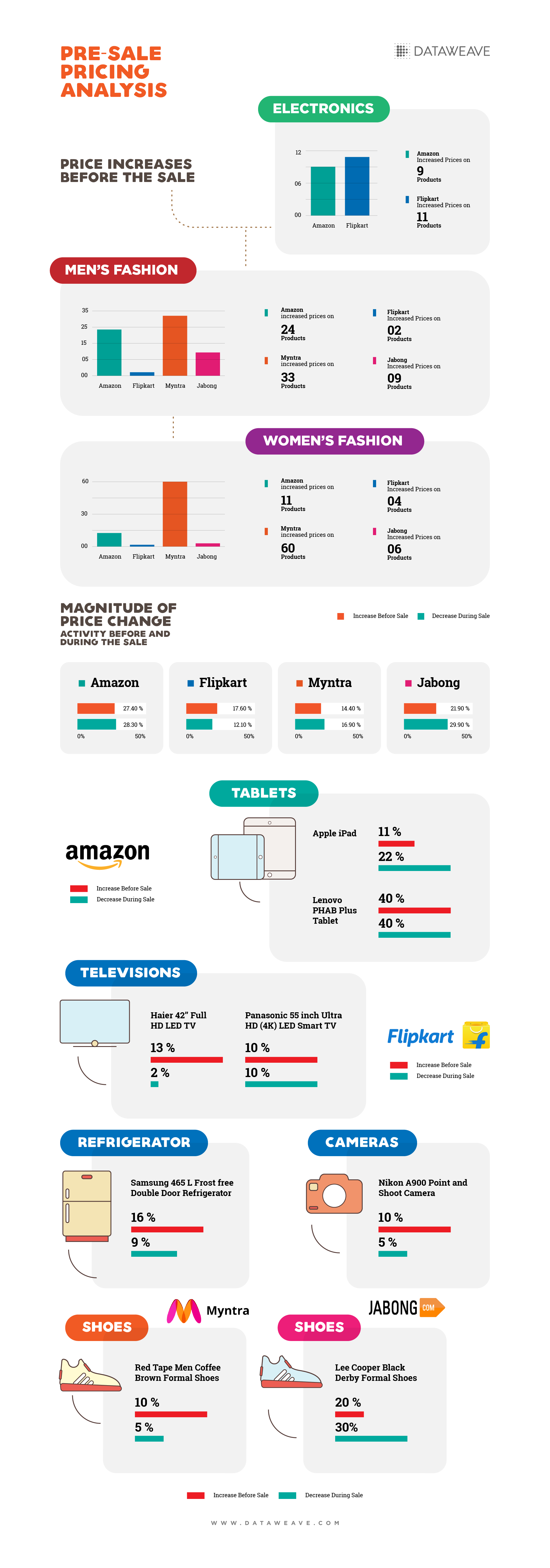
    Another angle we explored was whether (like most of us suspect) e-retailers increase their prices before a sale, only to reduce them during the sale, so they can advertise higher discounts. We observed that all e-retailers did increase their prices for an albeit small set of products before the sale.

    While the number of products where the prices increased for each website prior to the sales is small, it is interesting to observe that certain brands choose to perform the oldest trick in the retail book even today — raising prices to accentuate the degree of discount during the sale period, something shoppers need to keep an eye out for.

    A Sign of Things to Come?

    Based on our analysis, Flipkart has recognized the threat from Amazon and has approached this year’s “Big Billion Days” sale aggressively. It has dug deep into its freshly funded pockets, and offered better discounts for a larger set of products across most categories, in its attempt to lock down a greater market share in the burgeoning Indian eCommerce space.

    Amazon, though, has continued to maintain a firm grip on the Indian consumer, having achieved tremendous growth in specific categories during the sale.

    What’ll be interesting now is to see how these pricing strategies impact company revenues and margins, and how this will shape the soon-to-follow Diwali sales in mid-October.

    If you’re intrigued by DataWeave’s data aggregation and analysis technology, and would like to learn more about how we help retailers and brands build and maintain a competitive edge, please visit our website.


  • Analysis of Target’s Discount Strategy

    Analysis of Target’s Discount Strategy

    Earlier this year, we witnessed Amazon and Walmart going head to head in a CPG goods price war of fluctuating intensity that soon rippled out to embrace the entire grocery industry.

    This further intensified with Amazon’s takeover of Whole Foods and the Whole Foods’ subsequent announcement hinting at significant discounts toward the end of August.

    (Read Also: Amazon’s Whole Foods Pricing Strategy Revealed)

    Soon, Target announced it was lowering prices on literally “thousands of items.” As Mark Tritton, Target executive vice president and the chief merchandising officer put it, “We want our guests to feel a sense of satisfaction every time they shop at Target.”

    To drive home the seriousness of their intent, Target nominated grocery staples such as cereal, paper towels, milk, eggs, baby formula, razors and bath tissue and vowed to, “eliminate more than two-thirds of their price.”

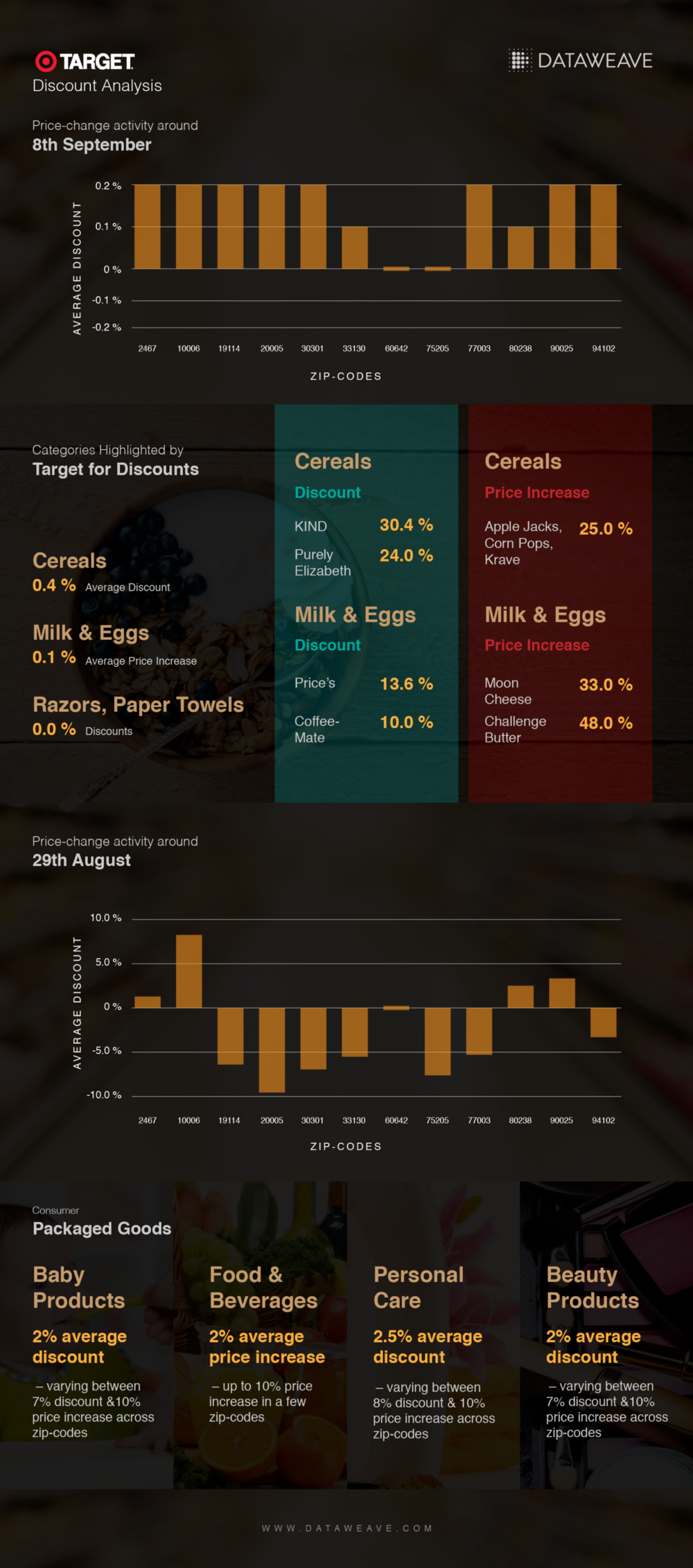
    At DataWeave, we focused our proprietary data aggregation and analysis platform on Target’s reported price reduction. Our team acquired data on the prices of over 160,000 products listed by Target across 12 zip-codes selected at random. The platform then took two snapshots. Firstly, between 23rd August and 30th August which included the Whole Foods’ price reduction (to study any possible reactions on price) and, secondly, between the 6th September and 13th September, which included Target’s discount strategy announcement.

    Of the categories Target identified as priorities for its discount strategy, only baby products, cereals, and Milk & Eggs displayed significant price drops. This price discounting effect varies, however, across brands in each category. In cereals, while KIND (30.4%) and Purely Elizabeth (24%) displayed high discounts, Apple Jacks, Corn Pops, and Krave more surprisingly increased their prices by up to 25% each.

    Similarly, in the Milk & Eggs category, Price’s (13.6%) and Coffee-Mate (10%) exemplified hefty discounts, while Moon Cheese and Challenge Butter increased their prices by 33% and 48% respectively in the same time period. By comparison, Razors and Paper Towels showed no price changes whatsoever across the review period.

    Interestingly, we observed greater price-change activity coinciding with the time of the Whole Foods’ announcement (between 23rd and 30th of August) than the later time period. Once again, however, no definite price discounting pattern emerged from the study, indeed the team found discount rates fluctuated significantly across categories.

    Looking across the spectrum of CPG categories pricing, we saw significant, sustained variation across both categories and zip-codes.

    Beauty products showed a 2 percent discount on average although this varied by zip-code, fluctuating between a 7 percent discount and an actual 10 percent price increase. F&B showed a 2 percent price increase, which jumped to 10 percent in some zip-codes. Personal care displayed a 2.5 percent increase on average, varying anywhere between an 8 percent discount and a 10 percent price increase. Baby products surprisingly recorded a 4 percent price increase on average during the study.

    So, What Does This All Mean?

    Based on our analysis, Target’s pricing strategy appears to be a combination of very closely concentrated discounting, complemented by selective price increases. Is discounting more a perception than a reality at this stage of the CPG cycle?

    Aggressive price discounting has never been a decisive factor in successfully building Target’s consumer franchise. However, given the current trading environment and the continued pressure applied by competitive omni-channel strategies, which has seen a host of new entrants elbowing their way into the market, we anticipate price will continue to play a prominent role in retailing.

    We suspect, based on evidence we gathered, that price discounts are more a highly targeted weapon in the fight for market share than a broadsword slashing of prices across the board. As Target’s CEO Brian Cornell noted during an earnings call, the company experienced “a meaningful increase in the percent of our business done at regular price and a meaningful decline in the percent on promotion.”

    If you’re interested in DataWeave’s data aggregation and analysis technology, and would like to learn more about how we help retailers and brands build and maintain a competitive edge, visit our website.

  • Amazon’s Whole Foods Pricing Strategy Analysis | DataWeave

    Amazon’s Whole Foods Pricing Strategy Analysis | DataWeave

    Amazon.com, America’s retail behemoth, dominated headlines in August when it completed its acquisition of Whole Foods in early August 2017. Having officially taken control of the up-market grocer, which focuses on premium quality produce, market observers and consumers alike are eagerly awaiting Amazon’s pricing strategy analysis.

    At the heart of Amazon.com’s seemingly unstoppable growth trajectory is the company’s ability to understand consumers, complemented by deep insights into buying cycles and purchase decisions and preferences. It also helps that Amazon.com boasts one of the planet’s mightiest marketing and publicity machines.

    Is Amazon.com About To Launch A Grocery Price War?

    Reports of Amazon.com dropping Whole Foods prices by up to 43 percent quickly made splashes across the news media. Given Jeff Bezos has been quoted in the past as saying, “your margin is our opportunity”, an aggressive promotional campaign to achieve dominance for its new Whole Foods acquisition was anticipated by some commentators.

    These sentiments ignited fears of a profit-sapping price war, immediately hit stock prices in the cutthroat grocery industry, which survives on famously thin margins. Memories of Amazon.com’s impact on US department store profitability quickly surfaced with analysts pointing to Walmart’s revenue/market share plunge from 26 percent in 2005 to just 11 percent in 2016 when the sector came under sustained pressure from Amazon.com.

    How Deep Are Amazon.com’s Price Cuts Really?

    At DataWeave, a Competitive Intelligence as a Service provider for retailers and brands, we put Amazon.com’s actual Whole Foods discounts under the microscope. The resulting careful analysis of price discounts revealed quite a different story to the one initially featured in the media. Scrutiny by our proprietary data aggregation and analysis platform showed the drop in retail grocery prices was minimal to almost negligible, depending on the category.

    In delivering near-real-time competitive insights to retailers and brands, we acquire and compile large volumes of data from the Web on an ongoing basis. A key differentiator is our ability to aggregate data down to a zip-code level.

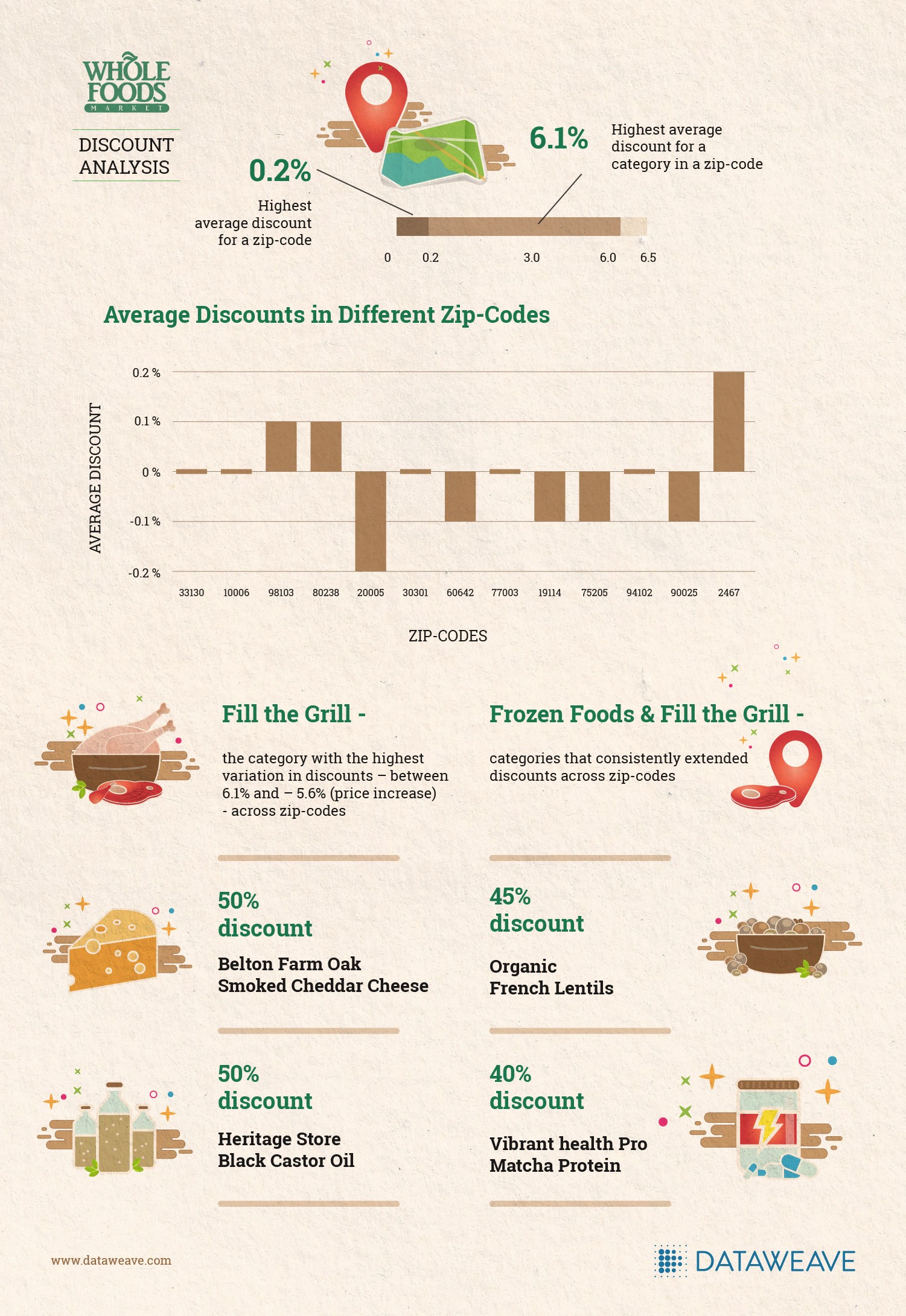
    Our analysis of Amazon.com’s reported drop in prices was based on data acquired for 13 zip-codes distributed across the country and selected at random. Our platform compared market prices by zip code valid between 23rd August and 30th August.

    Each zip code indicated the overall average discount offered varied between 0.20 percent and -0.20 percent. When the discounts at a category-level were separated out, the discounts available to customers per category varied between -6.8 percent (an actual price increase) and 6.1 percent.

    Moving on to the “Fill the Grill” category, discounts again were modest, varying between -5.6 percent (another price increase) and 6.1 percent across the zip codes analyzed.

    This aligns with Amazon.com’s recognized preference for basing its strategy on competing on breadth and depth of product assortment rather than pure pricing discounts at the checkout.

    Some Sunshine For Foodies

    There was some good news for shoppers looking for higher discounts. Amongst those products attracting a higher discount were:

    • Belton Farm Oak Smoked Cheddar Cheese: 50 percent
    • Beemster Premium Dutch Cheese: 50 percent
    • Heritage Store Black Castor Oil: 50 percent
    • Organic French Lentils: 45 percent
    • Vibrant Health Pro Matcha Protein: 40 percent
    • Hass Avocado: 50 percent (confined to one zip-code).

    Final Word

    Amazon.com’s marketing engine is renowned for skillfully nurturing consumer price perceptions of the giant retail website as being the lowest priced retailer. We kept a keen eye on Amazon’s pricing these past weeks, and unearthed a carefully conceived and executed Whole Foods pricing campaign, which is yet another example of their market shaping expertise at work.

    If you’re intrigued by DataWeave’s technology and would like to learn more about how we help retailers and brands build and maintain a competitive edge, please visit our website!

  • The Role of Competitive Intelligence in Modern Retail

    The Role of Competitive Intelligence in Modern Retail

    When retailers today look to compete in the cutthroat world of online commerce, they face several challenges unique to the nature of modern retail. It is now significantly harder for retailers to benchmark their pricing, assortment, and promotions against their competition, as the online world is highly dynamic and significantly more complex than before.

    Trends like the growing adoption of mobile shopping apps, the rising influence of customer reviews in buying behavior, hyperlocal e-commerce websites differentiating themselves by fulfilling deliveries in a matter of hours — the list goes on — have only added to this complexity.

    However, this complexity also presents an opportunity for retailers to incorporate layers of external competitive information into their merchandising strategies to deliver more value to customers and personalize their experience.

    Vipul Mathur, Chief Branding and Merchandising Officer at Aditya Birla Online Fashion, recently published an article highlighting some of the areas in which Competitive Intelligence providers like DataWeave can strategically influence modern merchandising.

    “The consumer is often driven by the aesthetics of a product, more so in the fashion and lifestyle industries than others. Hence, the choices of buyers are hard to interpret. However, innovative modern technologies are helping us understand these decisions,” says Vipul.

    He provides an example of how using AI-based tools (like DataWeave’s) to unearth the sentiments behind thousands of online reviews can help retailers better channel and message their online promotions.

    “Deciphering the consumers’ comments and converting them into tangible insights is incredible proof of the refinement possible with data analysis tools. It’s like knowing that consumers are delighted by the quality of the soles of a pair of Adidas running shoes. Using this, marketing communication can be modified to highlight this specific product feature,” explains Vipul.

    And it’s not just merchandising. This data can percolate across multiple functions in retail, enabling greater efficiency in operations. “If we have data on the best-selling styles across websites, including other attributes like pricing, region/locality (through pin-code mapping), and possibly even rate of sales, it’s up to our supply-chain systems to ensure that the supply is in accordance with demand.”

    DataWeave’s Retail Intelligence offers global retailers and e-commerce websites with these benefits and more. Our AI-powered technology platform aggregates and analyzes vast volumes of online competitive data and presents them in an easily consumable and actionable form, aiding quick, data-driven merchandising decisions.

    “DataWeave, our partner, has helped us refine our merchandising decisions, saving cost and creating value,” sums up Vipul.

    Read the entire article here, and if you’re intrigued by what DataWeave can do for retail businesses and wish to learn more, visit our website!


  • Video: Using Product Images to Achieve Over 90% Accuracy in Matching E-Commerce Products

    Video: Using Product Images to Achieve Over 90% Accuracy in Matching E-Commerce Products

    Matching images is hard!

    Images, intrinsically, are complex forms of information, with varying backgrounds, orientations, and noise. Developing a reliable system that achieves human-like accuracy in identifying, interpreting, and comparing images, without investing in expensive resources, is no mean task.

    For DataWeave, however, the ability to accurately match images is fundamental to the value we provide to retailers and consumer brands.

    Why Match Images?

    Our customers rely on us for timely and actionable insights on their competitors’ pricing, assortment, promotions, etc. compared to their own. To enable this, we need to identify and match products across multiple websites, at very large scale.

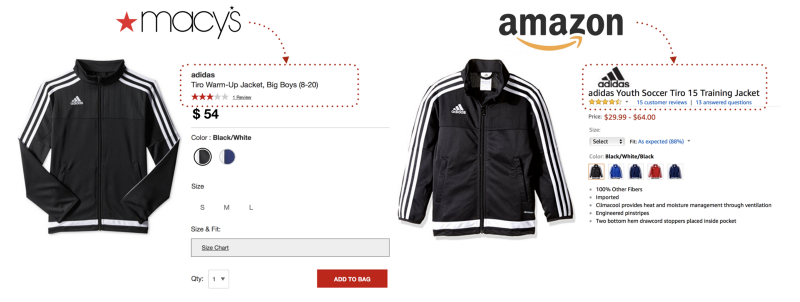
    One might hope to easily match products using just the product titles and descriptions on websites. However, therein lies the rub. Text-based fields are typically unstructured, and lack consistency or standardization across websites (especially for fashion products). In the following example, the same Adidas jacket is listed as “Tiro Warm-Up Jacket, Big Boys (8–20)” on Macy’s and “Youth Soccer Tiro 15 Training Jacket” on Amazon.

    Hence, instead of using text-based information, we considered using deep-learning techniques to match the images of products listed on e-commerce websites. This, though, requires massive GPU resources and training data fed into the deep-learning model — an expensive proposition.

    The solution we arrived upon, was to complement our image-matching system with the text-based information available in product titles and descriptions. Analyzing this combination of both text- and image-based information enabled us to efficiently match products at greater than 90% accuracy.

    How We Did It

    A couple of weeks ago, I gave a talk at Fifth Elephant, one of India’s renowned data science conferences. In the talk, I demonstrated DataWeave’s innovation of augmenting the NLP capabilities of Solr (a popular text search engine) with deep-learning features to match images with high accuracy.

    Check out the video of the presentation for a detailed account of the system we built:

    Human-Aided Machine Intelligence

    All products matched with the seed product are tagged with a corresponding confidence score. When this score crosses a certain threshold, it’s presumed to be a direct match. The ones that are part of a lower range of confidence scores are quickly examined manually for possible direct matches.

    The outcome, therefore, is that our technology narrows down the consideration set of possible product matches from a theoretical upper limit of millions of products, to only a few tens of products, which are then manually checked. This unique approach has two distinct advantages:

    • The human-in-the-loop enables us to achieve greater than 90% accuracy in matching millions of products — a key differentiator.
    • Information on all manually matched products is continually fed to the deep-learning model, which is used as training data, further enhancing the accuracy of the product matching mechanism. As a result, both our accuracy and delivery time keep improving with time.

    As the world of online commerce continues to evolve and becomes more competitive, retailers and consumer brands need the ability to make quick proactive and reactive decisions, if they are to stay competitive. By building an automated self-improving system that matches products quickly and accurately, DataWeave enables just that.

    Find out more about how retailers and consumer brands use DataWeave to better understand their competitive environment, optimize customer experience, and drive profitable growth.

  • Was Amazon’s Prime Day Sale Really That Big a Deal?

    Was Amazon’s Prime Day Sale Really That Big a Deal?

    Hint: Only in some product categories

    Amazon’s Prime Day sale, the first-of-its-kind in India, made a conspicuous splash across the media a couple of weeks ago, with several stories of the sale’s dramatic success doing the rounds. For 30 hours spread over 10th and 11th of July, the online retail giant rolled out deals as frequently as every five minutes, exclusively for Amazon Prime subscribers. And online shoppers lapped it up.

    According to Amazon India, more customers signed up for Prime on the day of the sale and in the week leading up to it, than on any other month since Prime’s launch in India last year. To boot, Prime subscribers shopped three-times more during the sale compared to other days.

    The discounts offered on several products were quite frequently in the range of 60–70% and beyond, with some products reaching absurd discount levels of up to 85%. However, for a retailer as competitively priced as Amazon, what’s interesting to explore is how much additional discount was offered during the sale. After all, even on normal days, Amazon discounts aggressively on its top 20% selling SKUs, in order to reinforce the commonly held perception that the company is the lowest priced retailer around.

    More Than Meets the Eye

    At DataWeave, our AI-based technology platform aggregates and analyzes publicly accessible data on the Web, at large scale, to deliver insights on competitors to retailers and consumer brands. We collected pricing and discount information for the Electronics and Fashion categories on Amazon during the sale, and compared it to numbers from before the sale. Thus, we evaluated just how much additional value Prime subscribers could’ve potentially drawn from this sale.

    We performed a similar analysis on Flipkart as well, to examine how competing e-commerce websites react to big-ticket sale events.

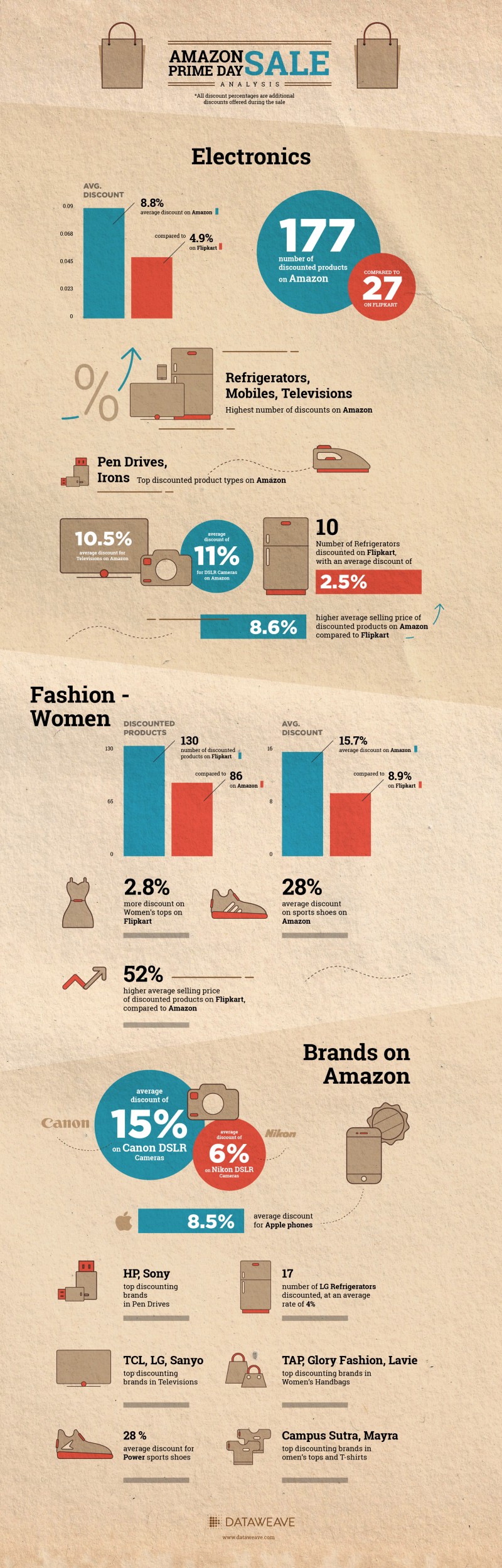
    The infographic below lists out some of the more interesting bits of our analysis.

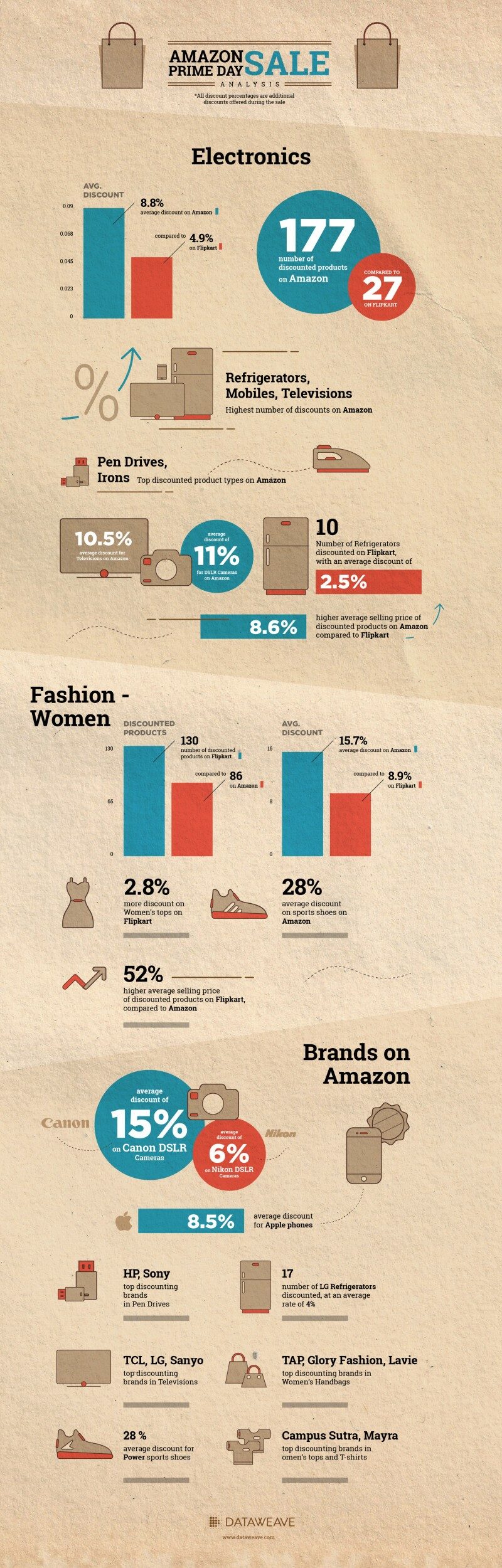
    Unsurprisingly, Amazon strengthened its grip in the electronics category by offering, on average, 3.9% higher discount than Flipkart, even with a higher-value assortment mix. Subsequently, Amazon reported a 5X increase in sales of smartphones and an 8X increase in sales of televisions during Prime Day.

    While Apple discounted its phones by 8.5% during the sale, Sanyo was among the top discounting brands (10%) in Televisions, with the company reporting a 4X jump in television sales. TCL offered 20% additional discount, the highest for televisions.

    What stands out from this analysis, though, is that Flipkart beat Amazon on price definitively in the fashion for women category, by extending 6.8% more discount than Amazon on a significantly higher-value assortment mix.

    It’s not uncommon to see e-commerce companies lowering their prices across the board to take advantage of the hype surrounding a competing e-commerce website’s promotional activity. Clearly, it’s a good idea for shoppers to always compare prices across websites before buying any product online.

    The New Age of Retail

    That shoppers today can easily compare products and prices across different e-commerce websites has brought about greater competition among online retailers. With the consequent margin pressure, comes the need for retailers to be able to react to price changes by their competitors in near-real-time.

    And it’s no mean task. Amazon has been found to effect over 80 million price changes a day during holiday season, and retailer-driven sale events like the Prime Day Sale are here to stay. Consequently, retailers look to Competitive Intelligence providers like DataWeave for easily consumable competitive information that enables them to react effectively and compete profitably.

    DataWeave’s AI-powered technology platform aggregates, compiles, and presents millions of data points to provide e-commerce companies with actionable competitive insights. With our solutions, retailers can effect profitable price changes, implement high-value assortment expansion, and proactively monitor and respond to promotional campaigns by competitors.

    Find what we do interesting? Visit our website to find out more about how modern retailers benefit from using DataWeave’s Competitive Intelligence as a Service.

  • Implement a Machine-Learning Product Classification System

    Implement a Machine-Learning Product Classification System

    For online retailers, price competitiveness and a broad assortment of products are key to acquiring new customers, and driving customer retention. To achieve these, they need timely, in-depth information on the pricing and product assortment of competing retailers. However, in the dynamic world of online retail, price changes occur frequently, and products are constantly added, removed, and running out of stock, which impede easy access to harnessing competitive information.

    At DataWeave, we address this challenge by providing retailers with competitive pricing and assortment intelligence, i.e. information on their pricing and assortment, in comparison to their competition’s.

    The Need for Product Classification

    On acquiring online product and pricing data across websites using our proprietary data acquisition platform, we are tasked with representing this information in an easily consumable form. For example, retailers need product and pricing information along multiple dimensions, such as — the product categories, types, etc. in which they are the most and least price competitive, or the strengths and weaknesses of their assortment for each category, product type, etc.

    Therefore, there is a need to classify the products in our database in an automated manner. However, this process can be quite complex, since in online retail, every website has its own hierarchy of classifying products. For example, while “Electronics” may be a top-level category on one website, another may have “Home Electronics”, “Computers and Accessories”, etc. as top-level categories. Some websites may even have overlaps between categories, such as “Kitchen and Furniture” and “Kitchen and Home Appliances”.

    Addressing this lack of standardization in online retail categories is one of the fundamental building blocks of delivering information that is easily consumable and actionable.

    We, therefore, built a machine-learning product classification system that can predict a normalized category name for a product, given an unstructured textual representation. For example:

    • Input: “Men’s Wool Blend Sweater Charcoal Twist and Navy and Cream Small”
    • Output: “Clothing”
    • Input: “Nisi 58 mm Ultra Violet UV Filter”
    • Output: “Cameras and Accessories”

    To classify categories, we first created a set of categories that was inclusive of variations in product titles found across different websites. Then, we moved on to building a classifier based on supervised learning.

    What is Supervised Learning?

    Supervised learning is a type of machine learning in which we “train” a product classification system by providing it with labelled data. To classify products, we can use product information, along with the associated category as label, to train a machine learning model. This model “learns” how to classify new, but similar products into the categories we train it with.

    To understand how product information can be used to train the model, we identified what data points about products we can use, and the challenges associated with using it.

    For example, this is what a product’s record looks like in our database:

    {
    “title”: “Apple MacBook Pro Retina Display 13.3” 128 GB SSD 8 GB RAM”,
    “website”: “Amazon”,
    “meta”: “Electronics > Computer and Accessories > Laptops > Macbooks”,
    “price”: “83000”
    }

    Here, “title” is unstructured text for a product. The hierarchical classification of the product on the given website is shown by “meta”.

    This product’s “title” can be represented in a structured format as:

    {
    “Brand”: “Apple”,
    “Screen Size”: “13.3 inches”,
    “Screen Type”: “Retina Display”,
    “RAM”: “8 GB”,
    “Storage”: “128 GB SSD”
    }

    In this structured object, “Brand”, “Screen Size”, “Screen Type” and so on are referred to as “attributes”. Their associated items are referred to as “values”.

    Challenges of Working with Text

    Lack of uniformity in product titles across websites –

    In the example shown above, the given structured object is only one way of structuring the given unstructured text (title). The product title would likely change for every website it’s represented on. What’s worse, some websites lack any form of structured representation. Also, attributes and values may have different representations on different websites — ‘RAM’ may be referred to as ‘Memory’.

    Absence of complete product information –

    Not all websites provide complete product information in the title. Even when structured information is provided, the level of detail may vary across websites.

    Since these challenges are substantial, we chose to use unstructured titles of products as training inputs for supervised learning.

    Pre-processing and Vectorisation of Training Data

    Pre-processing of titles can be done as follows:

    • Lowercasing
    • Removing special characters
    • Removing stop words (like ‘and’, ‘by’, ‘for’, etc.)
    • Generating unigram and bigram tokens
    • We represented the title as a vector using the Bag of Words model, with unigram and bigram tokens.

    The Algorithm

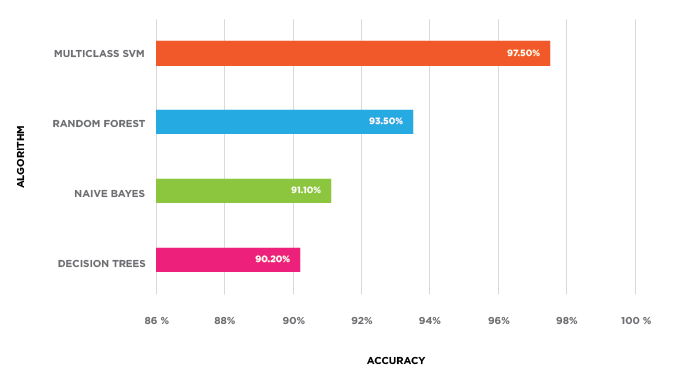
    We used Support Vector Machine (SVM) and compared the results with Naive Bayes Classifiers, Decision Trees and Random Forest.

    Training Data Generation

    The total number of product data we’ve acquired runs into the hundreds of millions, and every category has a different number of products. For example, we may have 40 million products in “Clothing” category but only 2 million products in the “Sports and Fitness” category. We used a stratified sampling technique to ensure that we got a subset of the data that captures the maximum variation in the entire data.

    For each category, we included data from most websites that contained products of that category. Within each website, we included data from all subcategories and product types. The size of the data-set we used is about 10 million, sourced from 40 websites. We then divided our labelled data-set into two parts: training data-set and testing data-set.

    Evaluating the Model

    After training with the training dataset, we tested this machine-learning classification system using the testing dataset to find the accuracy of the model.

    Clearly, SVM generated the best accuracy compared to the other classifiers.

    Performance Statistics

    • System Specifications: 8-Core system (Intel(R) Xeon(R) CPU E3–1231 v3 @ 3.40GHz) with 32 GB RAM
    • Training Time: 90 minutes (approximately)
    • Prediction Time: Approximately 6 minutes to classify 1 million product titles. This is equivalent to about 3000 titles per second.

    Example Inputs and Outputs from the SVM Model (with Decision Values)

    • Input: “Washing Machine Top Load”

    Output: {“Home Appliances”: 1.45, “Home and Living”: 0.60, “Tools and Hardware”: 0.54}

    • Input: “Nisi 58 mm Ultra Violet UV Filter”

    Output: {“Cameras and Accessories”: 1.46, “Eyewear”: 1.14, “Home and Living”: 1.12}

    • Input: “NETGEAR AirCard AC778AT Around Town Mobile Internet — Mobile hot”

    Output: {“Computers and Accessories”: 0.82, “Books”: 0.61, “Toys”: 0.27}

    • Input: “Nike Sports Tee”

    Output: {“Sports and Fitness”: 1.63, “Footwear”: 0.63, “Toys and Baby Products”: 0.59}

    Largely, most of the outputs were accurate, which is no mean feat. Some incorrect outputs were those of fairly similar categories. For example, “Home and Living” was predicted for products that should have ideally been part of “Home Appliances”. Other incorrect predictions occurred when the input was ambiguous.

    There were also scenarios where the output decision values of the top two categories were quite close (as shown in the third example above), especially when the input was vague. In the last example above, the product should have been classified as “Clothing”, but got classified as “Sports and Fitness” instead, which is not entirely incorrect.

    Delivering Value with Competitive Intelligence

    The category classifier elucidated in this article is only the first element of a universal product organization system that we’ve built at DataWeave. The output of our category classification system is used by other in-house machine-learning and heuristic-based systems to generate more detailed product categories, types, subcategories, attributes, and the like.

    Our universal product organization system is the backbone of the Competitive Pricing and Assortment Intelligence solutions we provide to online retailers, which enable them to evaluate their pricing and assortment against competitors along multiple dimensions, helping them compete effectively in the cutthroat eCommerce space.

    Click here to find out more about DataWeave’s solutions and how modern retailers harness the power of data to drive revenue and margins.

  • Advantage Flipkart: The Motives Behind Acquiring eBay India

    Advantage Flipkart: The Motives Behind Acquiring eBay India

    Flipkart recently acquired eBay’s India business in an announcement that made a huge splash across the country. With Flipkart already having acquired Myntra and Jabong, and talks of a Snapdeal acquisition picking up steam, this level of consolidation comes clearly as a direct response to internet behemoth Amazon’s aggressive expansion strategies in India.

    With this acquisition play, Flipkart stands to gain primarily on two fronts.

    eBay’s Seller Network

    Firstly, eBay has built a strong network of authorized and highly-rated global sellers, something that Flipkart can leverage to drive increased sales and market share.

    Per Flipkart’s announcement to the press — “Flipkart and eBay have signed an exclusive cross-border trade agreement, as a result of which customers of Flipkart will gain access to the wide array of global inventory on eBay, while eBay’s customers will have access to unique Indian inventory provided by Flipkart sellers. Thus, sellers on Flipkart will now have an opportunity to expand their sales globally.”

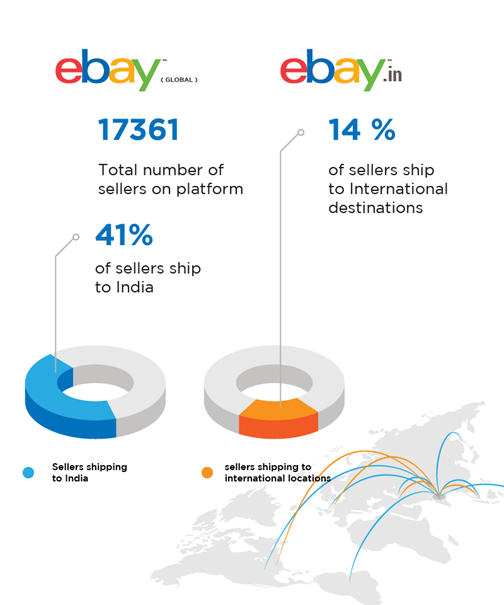
    At DataWeave, we ran our proprietary data aggregation and analysis algorithms over eBay’s websites and unearthed some interesting numbers about their seller network.

    eBay.com has a global network of 17,361 sellers, 41% of whom ship to India. Therefore, this acquisition opens the door for Flipkart to gain access to over 7000 global eBay.com sellers who ship to India — a huge boost to the range of products Flipkart can host on its platform.

    Additionally, a sizable chunk — 14% — of eBay.in sellers ship to international destinations. This provides Flipkart with opportunities to expand its reach globally.

    The other, rather lesser known advantage that Flipkart stands to gain from this acquisition is in the refurbished and pre-owned goods space.

    The Emergence of Refurbished and Pre-Owned Goods

    The market for refurbished and pre-owned products is estimated to be between $15 billion and $20 billion globally, with exponential growth forecast for the near future.

    Part of the reason for growth in this segment is it yields higher returns on investment for retailers. While a retailer typically earns 3–5% margin by selling a new smartphone, refurbished smartphones fetch 7–8% margin, and pre-owned smartphones 9–10%.

    The Hidden Advantage

    eBay has established itself over the years as a reliable source of refurbished and pre-owned products, with impressive levels of authentication and warranties. We did a quick analysis of eBay.in, Flipkart, and Amazon to identify their relative strengths in this space.

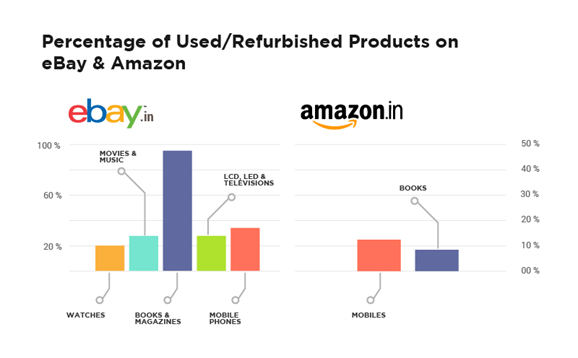
    Unsurprisingly, Flipkart has close to zero refurbished or pre-owned products hosted on their website. With Amazon, 12% of mobile phones and 9% of Books on their website are refurbished or pre-owned, the largest selling categories in this space.

    eBay.in, though, has a significant share of these products across categories — 95% of books & magazines, 36% of mobile phones, and 28% of televisions — a substantial portion of eBay’s business.

    With this acquisition, Flipkart can now take a gigantic step into the relatively more profitable and exponentially growing refurbished and pre-owned products space. It will also be a strong competitive differentiator for the company as they go head to head with Amazon in India.

    While the refurbished and pre-owned goods space poses a series of advantages for retailers, it sits well with consumer preferences as well, drawing more shoppers, and retaining existing ones.

    Influence of Shopping Behavior on Product Assortment

    Refurbished and pre-owned products provide consumers with attractive alternatives, both in terms of price and variety. Shoppers today explore and research new, pre-owned and refurbished products, all at the same time, and compare prices across e-commerce websites before deciding on a purchase.

    As a result, comprehensive product assortments across price ranges and attributes drive higher engagements, traffic and improve customer conversion and retention rates, as they cater to a more diverse set of consumers.

    For modern retailers, this reinforces the importance of investing in tools that enable to them to identify high-value gaps in their assortment and plug them. To achieve this, they need up-to-date, accurate data, at scale, on the assortments of their competitors.

    DataWeave’s Assortment Intelligence solution is designed to give retailers near-real-time insights on competing retailers’ product mix and suggests product additions to retailer catalogs.

    Click here to know more about how Assortment Intelligence can help your retail business manage assortment efficiently and profitably.

     

  • Baahubali 2: Dissecting 75,000 Tweets to Uncover Audience Sentiments

    Baahubali 2: Dissecting 75,000 Tweets to Uncover Audience Sentiments

    Why did Katappa kill Baahubali?

    Two years ago, not many would have foreseen this sentence capturing the imagination of the country like it has. Demolishing all regional barriers, the movie has grossed over INR 500 crores across the world in only its first three days.

    While the first movie received lavish praise for its ambition, technical values, and story, the sequel, bogged by bloated expectations, has polarized the critics fraternity. Some critics compare the movie’s computer graphics favorably to Hollywood productions like Lord of the Rings. Others find the movie lacking in pacing and plot.

    The masses, however, have reportedly lapped the movie up. Social media channels are brimming with opinions, and if one is to attempt finding out the aggregate views of audiences, Twitter is a good place to start.

    At DataWeave, we ran our proprietary, AI-powered ‘Sentiment Analysis’ algorithm over all tweets about Baahubali 2 the first three days of its release, and observed some interesting insights.

    Twitterati Reactions to Baahubali 2

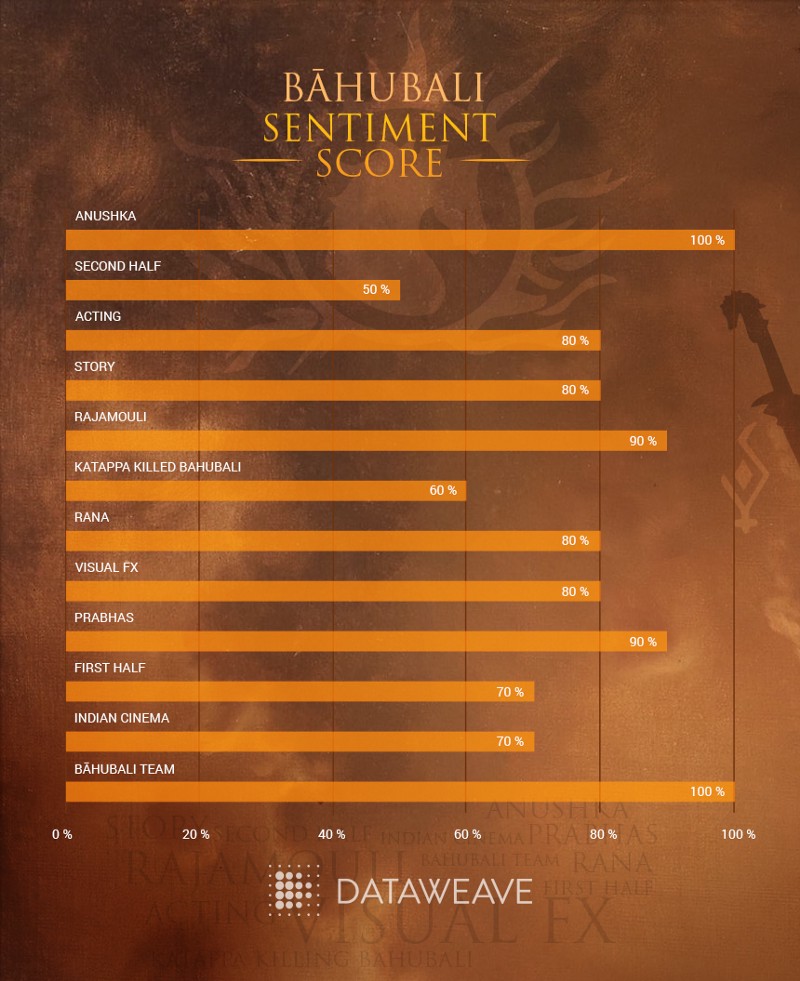
    Overall, the Twitterati’s views on the movie were overwhelmingly positive. We analysed over 75,000 tweets and identified the sentiments expressed on several facets of the movie, such as, Visuals, Acting, Prabhas, etc. The following graphic indicates how the movie fared in some of these categories.

    The Baahubali team, Anushka (actor), Rajamouli (director), and Prabhas (actor), are all perceived as huge positive influences on the movie. Rajamouli, specifically, met with almost universal approval for his dedication and execution. Several viewers cheered the movie on as a triumph of Indian cinema, one which has redefined the cinema landscape of the country. There was considerable praise for the story, Rana (actor), and acting performances, as well.

    The not-so-positive sentiments were reserved for the reason behind Katappa killing Baahubali (no spoilers!), the visuals, and the second half of the movie. Many viewers found the second half to be slow, with unrealistic visuals and action sequences. For example, one of the tweets read:

    “First half was good, but the second half is beyond Rajnikanth movies: humans uprooting trees!”

    While these insights seem simple enough to understand, the technology to filter inevitably chaotic online content and extract meaningful information is incredibly complex.

    Unearthing Meaning from Chaos

    At DataWeave, we provide enterprises with Competitive Intelligence as a Service by aggregating and analyzing millions of unstructured data points on the web, across multiple sources. This enables businesses to better understand their competitive environment and make data-driven decisions to grow their business.

    One of our solutions — Sentiment Analysis — helps brands study customer preferences at a product attribute level by analyzing customer reviews. We used the same technology to analyze the reaction of audiences globally to Baahubali 2. After data acquisition, this process consists of three steps –

    Step 1: Features Extraction

    To identify the “features” that reviewers are talking about, we first understand the syntactical structure of the tweets and separate words into nouns, verbs, adjectives, etc. This needs to account for complexities like synonyms, spelling errors, paraphrases, noise, etc. Our AI-based technology platform then uses various advanced techniques to generate a list of “uni-features” and “compound features” (more than one word for a feature).

    Step 2: Identifying Feature-Opinion Pairs

    Next, we identify the relationship between the feature and the opinion. One of the reasons this is challenging with twitter is, most of the time, twitter users treat grammar with utter disdain. Case in point:

    “I saw the movie visuals awesome bad climax felt director unnecessarily dragged the second half”

    In this case, the feature-opinion pairs are visuals: awesome, climax: bad, second half: unnecessarily dragged. Clearly, something as simple as attributing the nearest opinion-word to the feature is not good enough. Here again, we use advanced AI-based techniques to accurately classify feature-opinion pairs.

    We classified close to 1000 opinion words and matched them to each feature. The infographic below shows groups of similar words that the AI algorithm clustered into a single feature, and the top positive and negative sentiments expressed by the Twitterati for each feature.

    While our technology can associate words with similar meaning, such as, ‘part after interval’ and ‘second half’, it can also identify spelling errors by identifying and grouping ‘Rajamouli’ and ‘Raajamouli’ as a single feature.

    Adjectives like ‘magnificent’ and ‘creative’ were used to describe the Baahubali team positively, while words like ‘boring’, ‘disappointed’, and ‘tiring’ were used to describe the second half of the movie negatively.

    Step 3: Sentiment Calculation

    Lastly, we calculate the sentiment score, which is determined by the strength of the opinion-word, number of retweets and the time of tweet. A weighted average is normalized and we generate a score on a scale of 0% to 100%.

    A Peephole into the Consumer’s Mind

    As more and more people express their views and opinions in the online world, there is more of an opportunity to use these data points to drive business strategies.

    Consumer-focused brands use DataWeave’s Sentiment Analysis solution as a key element of their product strategy, by reinforcing attributes with positive sentiments in reviews, and improving or eliminating attributes with negative sentiments in reviews.

    Click here to find out more about the benefits of using DataWeave’s Sentiment Analysis!


  • How to Survive the Loss of Brick & Mortar Retail Stores

    How to Survive the Loss of Brick & Mortar Retail Stores

    For years, the consumer electronics chain Radioshack has endeavored to stay alive in our ever-changing world. Despite their efforts, they have filed for bankruptcy for the second time, in as many years. As of now, the company is closing 200 of their 1,500 stores, slightly more than 13% of their locations

    This one-time retail “giant” isn’t alone on the path of reduction in force. Macy’s has announced that they will close 63 stores, and Sears will lock their doors for the final time on 150 of their stores this fiscal year.

    Brands too are feeling the heat. Ralph Lauren recently announced the closure of an unspecified number of stores (including its Polo store on Fifth Avenue, New York City), and a reduction in its workforce.

    The internet is impacting brick and mortar sales the way that Sears Roebuck and Montgomery Ward catalog mail order sales impacted the general store at the turn of the last century.

    Online Retail Plays the Spoiler

    The disruption of the retail industry following the onset of e-commerce is largely due to the change in shopping behavior. Shoppers today can sit at home and compare multiple retailers before making a purchase. This has a significant impact on consumer expectations and how retailers do business today.

    Smartphone apps make comparing prices, and downloading coupons simple. So, we now see e-retailers compete tooth-and-nail on price, and even willing to take the “loss leader” route to drive adoption. Consequently, consumers expect rock bottom prices. Many brick-and-mortar retailers like Walmart have responded by simply matching online prices.

    While there are tens of thousands of e-commerce companies in the world today, this disruption is led primarily by the behemoth of global retail — Amazon.


    The Torchbearer of Modern Retail

    Amazon’s retail business strategy rests on three pillars: price perception, broad assortments, and customer experience.

    Price has long been the primary driving factor in retail. Therefore, there is need to optimize price efficiently to drive revenue and margins. What Amazon has smartly done is to drive the perception among shoppers that the company is always the lowest priced, even though it’s untrue. They do this by ensuring they are the lowest priced in the top 20% selling SKUs by volume. The resulting perception among consumers is a key differentiator.

    Also, to deliver superior customer experience compared to competing retailers, Amazon ensures high quality of online catalogs, provides a wide selection of products, and offers fast shipping to a broad coverage area, at no additional cost.

    When you factor in the Amazon Prime service, consumers have become spoiled with receiving their purchases within 48 hours. Sunday deliveries, and scheduling within the hour means buyers are in the driving seat.

    Some of Amazon’s competitors are following suit. Mega box stores like Costco, in an endeavor to meet their customers’ desire for options, are partnering with Google Express to provide fast delivery of household items, apparel, electronics, pantry staples such as bread and cereal, and more.

    The message is clear — today’s brick-and-mortar retailers need to have an omni-channel approach to retail, and an online presence if they are to stay competitive and relevant. However, this move has its fair share of obstacles –

    The Challenge of Moving Online

    Brick-and-mortar retailers moving online are confronted with several questions that carry more weight today than they used to in the past:

    • How do I deliver a high-quality shopping experience?
    • How can I drive price perception among shoppers?
    • What products do I promote and when?
    • What product assortment do I build to drive sales and retention?
    • How do I manage my logistics to reduce shipping cost and time?

    Traditional retailers looked largely at only internal data — like POS data, product sell-through rates, inventory, etc. to answer these questions. Today, it is mission-critical for retailers to absorb and utilize external competitive data as well — and here lies the problem. When you are benchmarking yourself against the competition online, it is that much harder, as it’s more dynamic and significantly more complex than before.

    For example, Forbes estimated that through Christmas season in 2014, Amazon made a total of 80 million price changes per day to stay competitive. These are extraordinary numbers, and reflect how dynamic online retail is, and its contrast to traditional retail.

    Retailers today have no choice but to automate as much as possible, so they can make quick, timely merchandising decisions and keep pace with modern e-retail. Retail technology providers like DataWeave have stepped in to meet this demand.

    DataWeave’s Retail Intelligence

    At DataWeave, we enable retailers gain a competitive advantage in the online world by providing Competitive Intelligence as a Service. We do this by harnessing public information on the competition, structuring it, and presenting it in a form that is easily consumable and actionable, enabling easy, automated decision-making.

    Our AI-based technology platform facilitates smarter pricing decisions by providing retailers with price change (increase and decrease) opportunities as they occur. Retailers can also plug gaps in their product portfolio by identifying opportunities to expand their assortments. In addition, they can benchmark their shipping speed and cost against competition, to enhance customer experience. And there’s more where these come from!

    Click here to find out more about how we can help modern retailers stay competitive in the online world.


  • Dissonance in Online MRP Prices Across Retailers | DataWeave

    Dissonance in Online MRP Prices Across Retailers | DataWeave

    We all know, online shopping offers a lot of benefits to shoppers. Apart from the convenience it offers access to a wide-assortment base and, of course, discounts are an added benefit. Often we see, retailers claiming large discounts on products.

    Many-a-time, the percentage discount that is mentioned drives price perception. Customers when comparing prices across stores view larger percentage discounts as a better deal. However, this is not necessarily the case. To present this case, let us look into how discounts are calculated:

    Percentage discounts are a function of the MRP / MSRP and the Selling Price. The MRP / MSRP is set by the manufacturer and the selling price is more often than not determined by the retailer.

    Selling price of products being different across retailers is a well-known fact. When the MRP of the same products tend to vary across retailers, it gets confusing for a customer, which in turn leads to a brand equity dilution of the brand or manufacturer.

    To analyse how deep this discord is, we decided to dive deeper into its working dynamics. Amongst all the data that we aggregate at DataWeave, analysing discounts of the same product across retailers gives us the ability to discern pricing strategies of retailers. We used this dataset to monitor and analyse MRPs.

    What we found

    1. We analysed MRPs of around 400 brands across 10 categories. Around 44% of products in these brands have no variance in MRPs across retailers

    2. This also means there is a variance in 56% of products

    3. Products in the ‘Mobile Phones and Tablets’ category have the most price variance; 65% of the products have price variance

    4. Fashion and Fashion accessories have the least price variance; around 20%

    5. Brands having the most variance:

    6. Brands having the least variance:

    What are the implications of the above insights?

    1. Brands & manufacturers need to be aware of how their brand products are being represented and sold online
    2. Consumers shopping online need to look at end prices, and not focus on the discount percentage, before making a purchase-decision on a particular store

    This article was previously published on Yourstory

    DataWeaves Brand Intelligence provides consumer brands with the ability to track their products, pricing, discoverability vis-a-vis their competitors across e-commerce platforms.

  • DataWeave Wins 2016 BI Software Awards From FinancesOnline

    DataWeave Wins 2016 BI Software Awards From FinancesOnline

    After a thorough assessment of our product FinancesOnline, a well-known software review platform and SaaS leads generation source, awarded DataWeave Retail Intelligence with two of their prestigious industry awards. According to FinancesOnline, our specialized competitive intelligence product is a rare tool that handles different languages with ease, and it allows businesses to improve the margin of their products and be more competitive.


    Currently, DataWeave Retail Intelligence holds two of the platform’s prominent awards: the 2016 Great User Experience Award given to products which facilitate complex operations and allow users to navigate an easy and familiar interface; and the 2016 Expert’s Choice Award, confirming that DataWeave employs a variety of unique mechanisms to produce valuable competitors’ insights, compares and measures metrics that matter to every online store. Both awards were given for the platform’s business intelligence software reviews category.


    According to their DataWeave review here the experts believe DataWeave genuinely focused on making businesses more competitive instead of simply listing data that may not be actionable by the company. They were particularly fond of the advanced identification of weak and strong points, actionable insights, and assortment intelligence, but mentioned as well the positive aspects of combining internal analytics with market data the way DataWeave does it. They praised our efforts to surpass traditional functionality gaps arising from language and location restrictions, and seem to firmly believe that out well-planned integrations make DataWeave usable for all type of analysis. Continuing with this tempo, FinancesOnline’s B2B professional foresee DataWeave performing successfully in many areas other than retail.


  • Smart Practices for Pricing Products

    Smart Practices for Pricing Products

    Top pricing strategies for online retailers

    “When it comes to retail markets, law of one price is no law at all” — Hal Varian

    Hal Varian, in his seminal paper “A Model of Sales”, further remarks that most retail markets are instead characterized by a rather large degree of price dispersion.

    Do you know how much your products are worth? How low are you willing to price an item to compete with another ecommerce retailer?

    Today, online retail has become increasingly competitive. If you are priced higher than your competitors, you may end up losing customers who are sensitive to prices. With the advent of highly competitive pricing tools, winning the online pricing war is an uphill task. Having a differentiated competitive strategy is critical to your e-commerce success.

    We bring to you a list of smart practices that we have seen being played out across online retailers in 10 countries that we actively monitor and analyze.

    Analyzing Competitor Prices And Stock Availability

    Product pricing is one of the largest driver of profitability. So you know who your main competitors are, but do you know how they are priced? Compare prices and stock availability of products that are popular across all your competitors and do the same for products that are popular at your store. If you know that certain products are “not in stock”, you know you need not discount. Look at products that are popular across competition and know your price position. Try for an opportunity to increase prices without losing your price position. However, for products popular on your store, you may want to stay competitive.

    Knowing Price Variations

    You get the right price, and then it’s not right anymore. That’s the story of online retail. But when you are equipped with the knowledge of price variations on popular marketplaces, it gives you an idea of where the market is heading. This, in turn, will help you adjust your prices to get the consumers. For instance, Amazon changed prices of more than 50% of their products in Hair Care category more than once in a week including ~20% of the products at least 4 times in the same week.

    Product Bundling

    A marketer of a successful product may bundle a new or less successful product with its stronger product to edge its way into a new market. This allows you to charge a unique, competitive price that can’t be copied by others. If you realize that you may not be able to compete on direct discounts, bundle products together and offer them at a lower price. You can either bundle in multiples of the same product or pack different products together. One of the more famous examples of this is Microsoft’s bundling of various software applications. In the onsite retail space, for example, on a particular day we noticed ~400+ combo offers from SnapDeal in the camera & accessories category whereas PayTM has ~200+ combo offers and Amazon has ~3000+ combo offers in the same category. Similarly, in hair care category we observed significant variance in combo offers across marketplaces (~900+ by Amazon, ~250+ by PayTM and ~100 by SnapDeal on a specific day). We also noticed that marketplaces have varied number of products sold in packs across different brands (~2500 in Amazon, ~800+ in PayTM and ~500 in Snapdeal on a specific day).

    Shipping Fees & Delivery Time

    Free shipping attracts customers to e-commerce platforms like a moth to a flame. Monitor shipping fees across competition for products you are interested in. There will be cases where your competitor is pricing a product at a lower price than you, but does not offer free shipping. That is your signal to promote your platform.

    Price Match Guarantees

    Price match is an easy way for customers to save money on their day-to-day purchases. During Black Friday sales in the US, a lot of popular stores go for the price match guarantee feature to drive sales. It’s a smart trick to let your customers show you the lowest price and then match them accordingly.

    No Discounts On Unique Products

    No matter how much you dress it up, cutting prices hurts. It might be unavoidable, but you can get rid of discounts on unique products. When you analyze gaps and strengths of your catalog and realize that there are products that are available only on your store, why would you need to provide discounts? So, for instance, it seems that only Flipkart is carrying Icon LaserJet Pro Black Toner currently and it is being sold at 75% discount. Unless the objective is to get rid of the inventory, this product could be priced higher. Another example is, Nikon Coolpix S1100PJ Point & Shoot Camera is out of stock with most of the key marketplaces. Hence if anyone gets this replenished, this should not be discounted. Similarly, unique brands in hair care category, say LeModish, is sold primarily on PayTM. So, PayTM could look at reducing discount for this brand.

    Don’t Price Above Market Rate

    Some retailers price products above the market rate (MRP / MSRP) so that they can show substantial discounts. But your customers are smart and research well. If they realize that this is not really ‘low price’, you may end up losing them.

    Dynamic Pricing

    This is one trend you should definitely follow. Constantly monitor competitor prices and drop or increase prices whenever you see an opportunity. This process is highly tech-driven, so ensure that you work with a vendor who provides the same or you have the in-house capability to do this in a sustained and scalable manner.

    There are multiple product strategies that have to be considered, including cross-border commerce and highly spread out markets like SEA where there exists a lot more C2C marketplaces. However, as with many things in ecommerce, one size does not fit all. Combine the powers of your service and price to drive your bottom line and emerge as an undisputed leader in the retail space.

    Note: This article has been previously published on Inc42 and on Indian Retailer.

    DataWeave Retail Intelligence provides competitive intelligence solution to retailers. DataWeave’s solution is both language and geography agnostic and is built for significant scale

  • Introducing the new PriceWeave

    Introducing the new PriceWeave

    PriceWeave provides Competive Intelligence for eRetailers, brands, and manufacturers. Competitive Intelligence helps businesses understand their competition better, take timely decisions, and increase sales. Our retail pricing intelligence tool serves the following major purposes:

    Compare: PriceWeave lets you access products from across any number of sources and organize them for a straightforward apples-to-apples comparison.

    Monitor: Our intuitive dashboards help you monitor prices, assortments, products, brands, and deals across competition on a daily basis.

    Discover: Discover gaps in your product catalog. Discover products that are unique to you. Discover new brands and categories your competitors have introduced. Find new competitors.

    Analyze: Get customized alerts and reports on anything that you want to track. Access historical pricing data to understand pricing strategies. Visualize data across facets at different levels of granularity.

    If you are an eRetailer, PriceWeave powers your sales, marketing, and analytics team with actionable data–for both day to day operations, as well as long term strategy. With retail pricing intelligence, an eRetailer can:

    • understand pricing opportunitiesand implement an effective pricing strategy
    • get pricing variation for the products you are tracking across competition
    • get apples-to-apples product comparison and historical pricing data
    • optimize assortment planningthrough assortment intelligence
    • continuously monitor product assortment width and depth
    • understand gaps in your (and your competition’s) product catalog
    • manage featured products and promotions
    • develop overall sales and marketing strategy
    • big picture as well multi-dimensional faceted views: price bands, discount bands, categories, brands, and features

    If you are a brand or a manufacturer who sell your products through retailers, PriceWeave helps you as well. A Brand (or a Manufacturer) can:

    • ensure brand equity
    • monitor MOP violations and discover unauthorized resellers
    • increase market penetration
    • track retailer assortment across competing brand products.
    • discover new retailers — new distribution channels
    • increase engagement with retailers as well as customers
    • get regular reports on availability, pricing, offers, and discounts

    In short, PriceWeave is a product that gives you all the data and tools to help you gain and sustain an edge over your competition.

    For a demo of the product do reach out to us at (contact@dataweave.com). You can sign up for a free evaluation at dataweave.com.

  • Benefits of Competitive Marketing Intelligence | DataWeave

    Benefits of Competitive Marketing Intelligence | DataWeave

    In the aggressive business of online retail every detail you know about your competitor gives you an edge over them. To help you stay ahead of your competition we have designed a series of blog posts that familiarize you with competitive intelligence and equip you to get maximum mileage out of competitive intelligence tools. This is the first post of the series.

    Let’s begin at the beginning.

    What is Competitive Intelligence?

    Competitive intelligence (CI) is the gathering of publicly-available information about an enterprise’s competitors and the use of that information to gain a business advantage.

    Competitive marketing intelligence helps managers and executives to make data-driven decisions both in the short term, as well as formulate medium to long term strategy.

    Why is Competitive Intelligence important?

    Competitive marketing intelligence is critical because it helps businesses stay ahead of the competition by:

    1. Augmenting one’s experience and instincts with hard data and analyses on a regular basis
    2. Delivering reasonable assessments of one’s own business vis-a-vis competitors’ businesses
    3. Identifying and alerting new business opportunities as well as threats
    4. Helping shape short term and long term strategies to grow and consolidate one’s business

    How does Competitive Intelligence help achieve the core objectives of retail business?

    Retail is a particularly competitive sector. Given the volume of transactions that happen in the retail sector, even a slight improvement in metrics has a huge impact. Thus, competitive Intelligence has a direct effect on the bottom line. It helps in the following ways:

    > Improve margins

    This is a result of optimized pricing of products. Knowing the competitors pricing goes a long way in pricing your products right and improving margins. With Competitive Intelligence on your side, you can take pricing decisions backed by data.

    > Reduce customer acquisition costs

    By improving your assortment mix more users looking for products that your site offers become your users. This helps reduce customer acquisition costs. This also helps in retaining existing customers

    > Optimize marketing spend

    Competitive Intelligence brings more clarity and sharper objectives for the marketing team. You get good indicators which products/categories your competitors are promoting, and which new brands/categories they have introduced. This helps streamline and optimize your market spend.

    This is where DataWeave comes in. DataWeave provides Competitive Intelligence for retailers, brands, and manufacturers. DataWeave is built on top of huge amounts of product data to provide features such as: pricing opportunities (and changes), assortment intelligence, gaps in catalogs, reporting and analytics, and tracking promotions, and product launches.

    DataWeave is powered by distributed data crawling and processing engines that enables serving millions of data points around products data refreshed on a daily basis. This data is presented through dashboards, notifications, and reports. PriceWeave brings the ability to use BigData in compelling ways to retailers.

    DataWeave lets you track any number of products across any categories against your competitors. If you wish to try this out, just book a free discovery call with us.

    In the next few posts, we will dig deeper into DataWeave and introduce its major features. We will also talk about how each of these features help you in improving your business metrics.