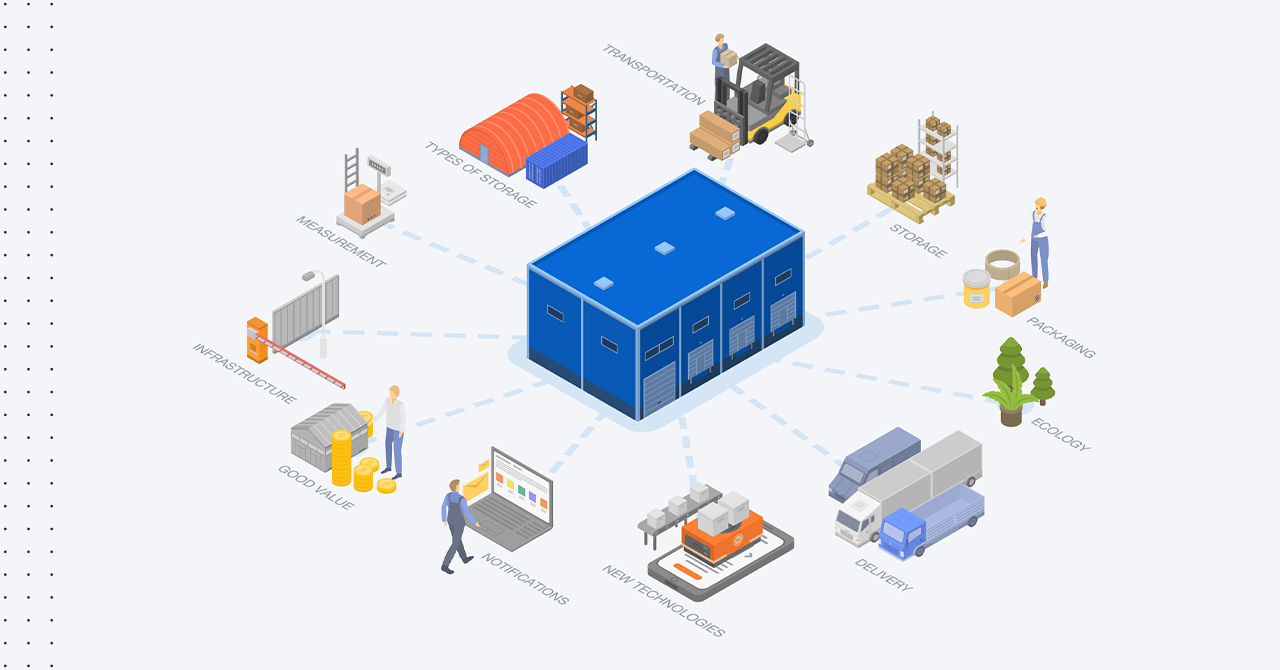
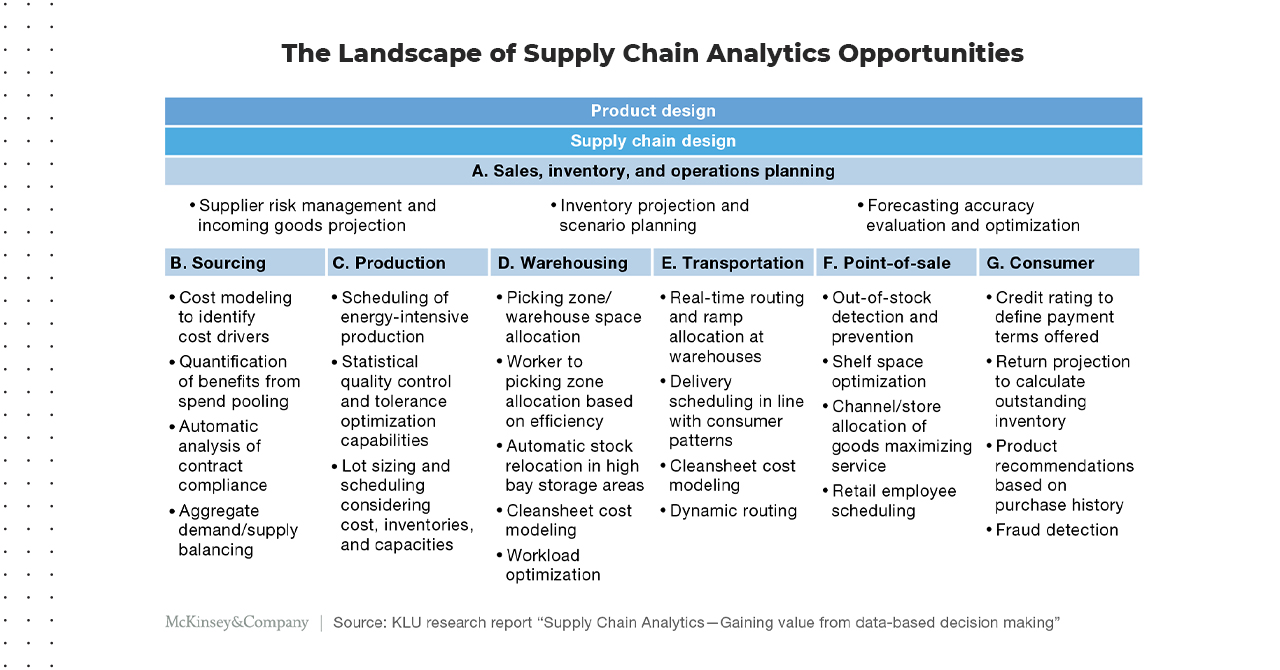
To make faster, seamless deliveries possible, brands need to tighten their supply chain. The pandemic has put a lot of stress on the global supply chain. The supply shock that began in China in February and the demand shock that followed as the global economy shut down uncovered weaknesses in production strategies and supply chains. Temporary trade restrictions and shortages of pharmaceuticals, critical medical supplies, and other products, further added to the problem.
As a consequence of all this, brands have to reduce or even eliminate their dependence on sources that are perceived as risky and rethink their use of lean manufacturing strategies that involve minimizing the amount of inventory held in their global supply chains. In the post-pandemic world, the supply chain will take center stage, and managing it efficiently with technical support is going to be what gives one brand an upper hand over the others.
1. Micro fulfillment is emerging as the need of the hour
Emerging Micro Fulfillment
Retailers are now faced with unprecedented omnichannel fulfillment complexities. Not only do customers expect faster order fulfillment and delivery, but they’re also opting to ‘buy online and pick up in-store (BOPIS)’ or ‘click-and-collect’. Amazon has spent billions of dollars on building its shipping infrastructure, including its existing operating 175+ fulfillment centers across the world and investing nearly $1.5 Bn to build an air hub in the US. Walmart, on the other hand, is relying on its existing footprint across 5000+ US stores to help deliver online orders faster.
All this is hinting towards micro-fulfillment emerging as a strategy retailers are using to make the fulfillment process more efficient and their supply chain more ready — from receiving an online order to packing it and offering last-mile delivery. This approach will certainly work towards imparting speed to localized, in-store pick-up and combine it with the efficiency of large, automated warehouses. Delivery speed and costs are more important than ever to retain customers and foster brand loyalty. In fact, this will become a big differentiator for grocery e-commerce as the number of people making online grocery purchases has increased drastically the world over and a recent report indicated that in the US, 46% of people use online delivery more now than before the COVID crisis, and 40% use online pickup more.
2. Use big data to tie-in loose nodes
Supply chain management is held at the heart of every successful e-commerce company. Supply Chain efficiency always ensures that the right product reaches the right place at the right time. It ensures cost reduction and enhancement of cash utilization. That is why it is important to stay alert and tie-in all loose ends in the supply chain architecture. Big data can come in handy here and it is that quantitative method and structure that can be used to improve decision-making for all activities across the supply chain. While the role of big data is extremely exhaustive and full-pronged across the entire supply chain design, it is important to understand it in theory in a simplified way so that brands can incorporate it to make their backend operations seamless.
Big data is all about real-time analytics and it primarily does two very important things in making supply chain management easy
It expands the dataset for analysis beyond the traditional internal data held on Enterprise Resource Planning (ERP) and supply chain management (SCM) systems.
Big data apply powerful statistical methods to both new and existing data sources. This helps give structure to new insights. This in turn allows forecasting and helps improve supply chain decision-making capabilities for your brand, all the way from the improvement of front-line operations, to strategic choices such as the selection of the right supply chain operating models.
3. Improve ROI by introducing automation to the mix
Introducing Automation to Improve ROI
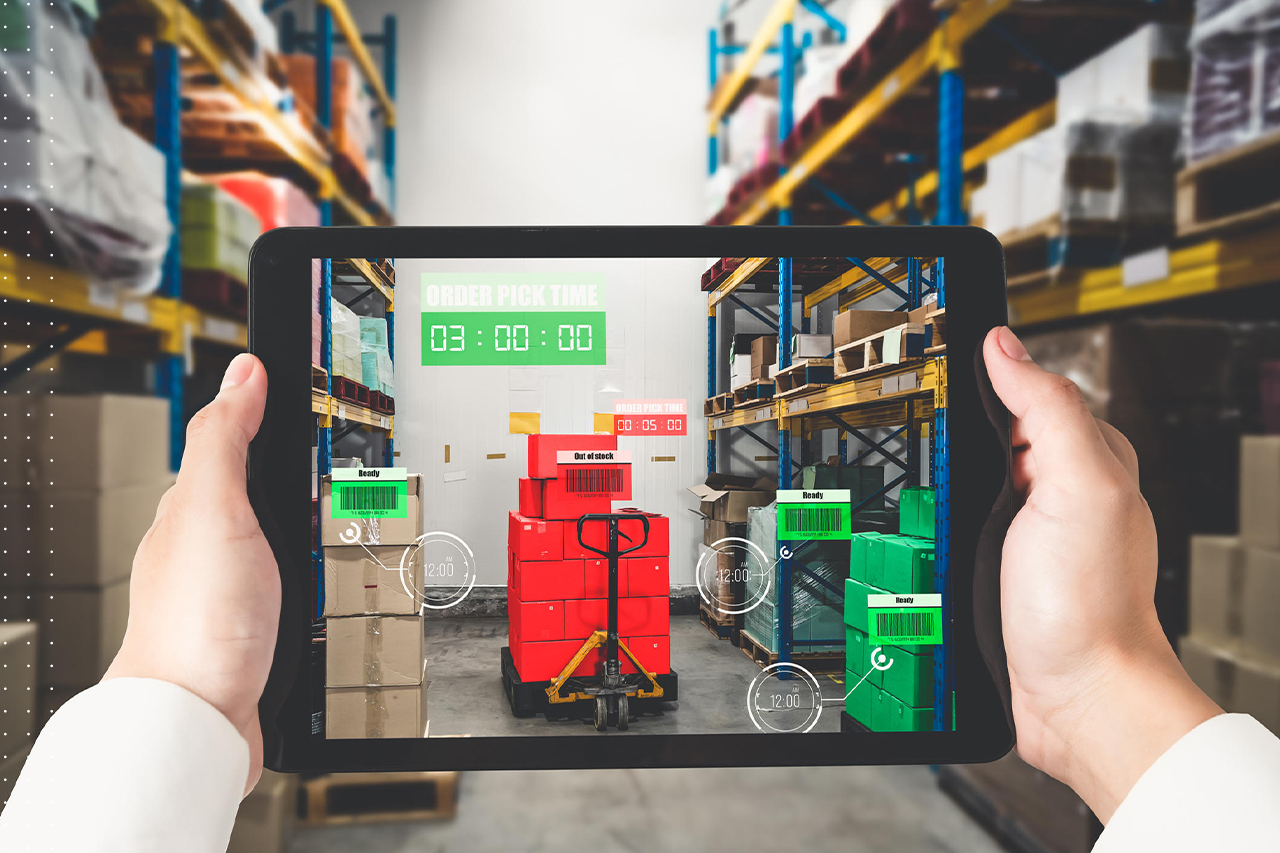
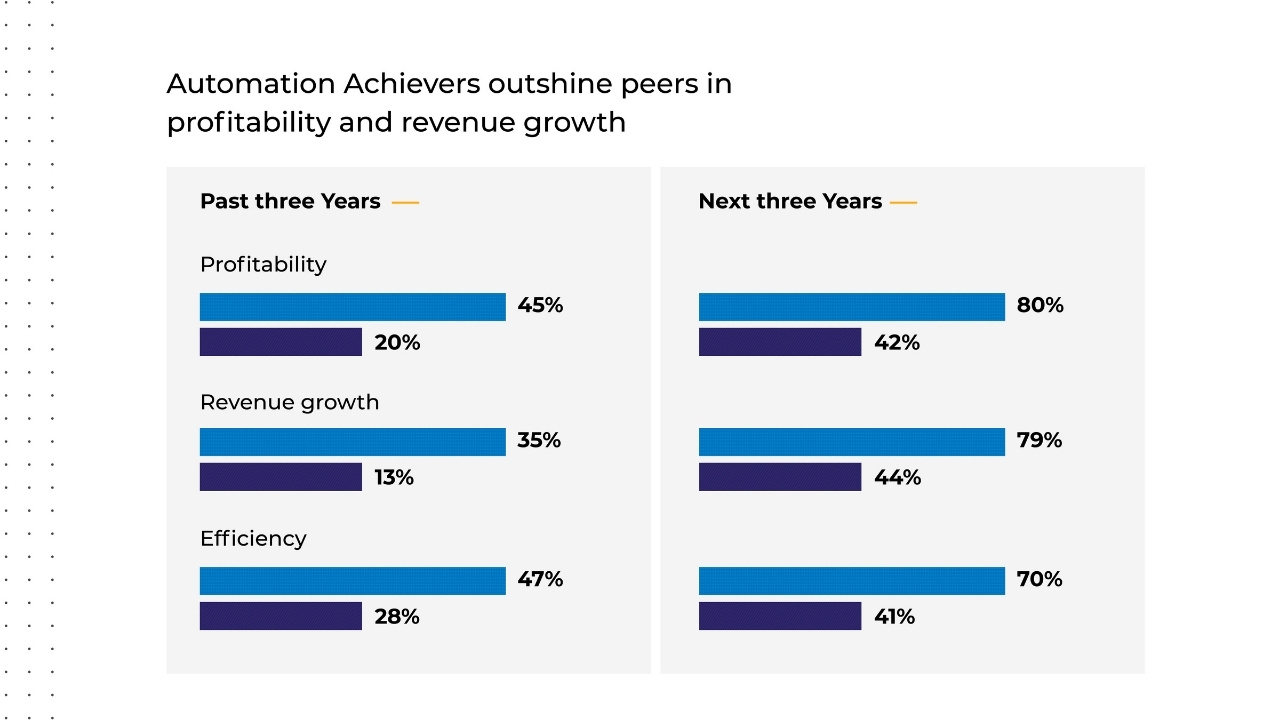
Introducing automation will help take care of tasks usually done manually, such as placing orders, processing changes, data entry, and much more. This frees up time and cuts down on human errors leading to error-free, faster processes. Adidas for instance has been able to reduce 60% of its operational supply chain costs just by switching to end-to-end automation. The largest sportswear manufacturer used automation across 400 factories by bringing in standardized, reusable processes to deliver the best results in a cost-effective way across the supply chain, marketing, finance, retail, and eCommerce. On the supply chain part, with automation, the brand was able to globally attend to supply chain service desk management, vendor onboarding, PO change management, Contract form approval, product data verification, and other such tasks in real-time. This highly successful initiative helped the brand save a lot of time, it earlier lost in manually attending to internal processes and reduced the time to market for Adidas by two-thirds. Moreover, automating systems helps cut down slacks and in return allows the supply chain to stay agile and alert for any unforeseen situations. This readiness further boosts the framework towards growth.
4. Eye the future and introduce robotics
Robotics is the next big thing in Future
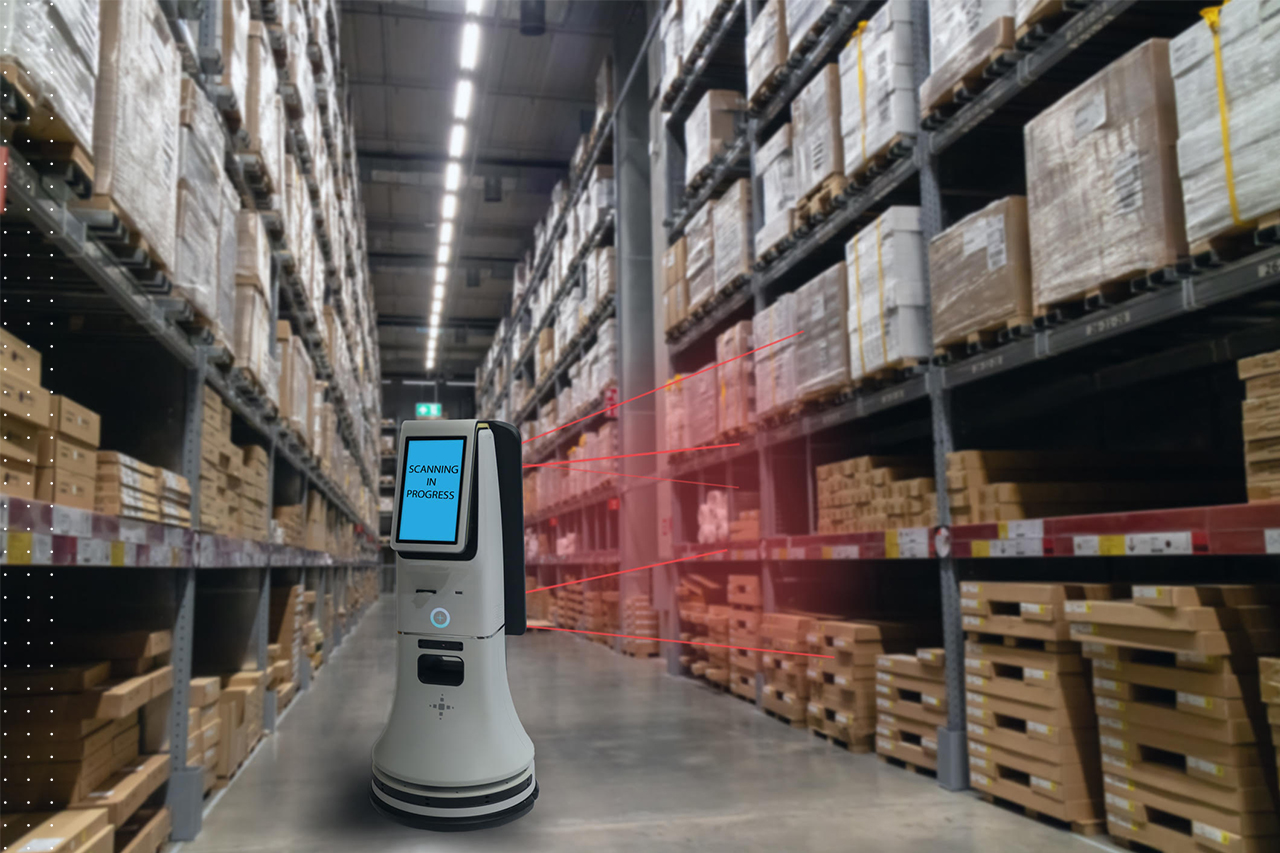
Autonomous technology is not the next big thing of the future but is the most important thing at present defining the face of the supply chain. Autonomous robots are expected to see strong growth over the next five years. In fact, according to the Boston Consulting Group (BCG),the global robotics market is estimated to reach USD 87 Billion by 2025. It is believed that more than half of this will be allocated for the retail market. In fact, it is not uncommon to find giant beetle-like robots moving around busily with vertical shelves stacked on them inside Amazon’s warehouse in southern New Jersey, US. Tesco for instance uses Radio Frequency Identification (RFID) robots who are used to scan inventories for entire stores in just an hour (as against seven hours for a store employee) with far fewer errors.
Even though every word of this sounds too futuristic to be believable, this is the reality for now and retailers are beginning to realize that innovation must set in holistically and extend far beyond just the warehouse or supply chain.Autonomous mobile robots (AMRs) are fast becoming commonplace in warehouses, helping warehouse workers to fulfill orders quickly and efficiently. There are a few different types of robots that companies are considering, and each has its own unique set of advantages. AMRs in totality enable workers to be more productive due to constant collaboration and promote agility, cutting down on slacks and errors.
A cohesive and well-defined supply chain where you can leave enough room for tweaks in the future owing to evolving trends will surely help you gain an edge over your competitors through the entire lifecycle of your product. Getting a grip over the supply chain is necessary now as, by 2025, many supply chains may shift from global flows of goods and services to national, regional, and local networks of buyers and suppliers. So, integrating the supply chain keeping an eye on the global and local is the real deal!
The explosive growth of online shopping has forced brands to re-examine their e-commerce processes to stay competitive and profitable. In particular, out-of-stocks are a common, costly retail challenge, as product shortages frustrate online shoppers – and even prompt them to leave brands.
According to McKinsey & Company, forty-eight percent of consumers switched to a different brand in 2020 because those products were in stock. Among these consumers, seventy-three percent plan to keep using the new brands, linking product availability gaps to the erosion of sales and loyalty. Conversely, brands with effective inventory planning and replenishment can keep items in stock, drive sales and improve the customer experience.
Retailers like Walmart, collaborating with these brands to meet customer demand, are still facing inventory challenges but, as noted in 2021 Q3 earnings, inventory was up almost twelve percent year-over-year as they worked to stay ahead of increased holiday demand. They have also adjusted in-store operations to accommodate ever-growing e-commerce demands, especially within grocery-centric categories, as digital grocery buyers now amount to more than half the U.S. population.
Maximizing Conversions with Category Insights
Walmart’s dot-com strategy is paying off in spades, considering they surpassed Amazon as the leading U.S. grocery e-commerce retailer in 2020 and grew another forty-one percent in Q3, 2021. Our team has been actively tracking digital shelf analytic KPIs on Walmart.com to identify inventory and promotional performance improvement opportunities at a category level to support brands in capitalizing on these digital growth opportunities.
The latest analysis is summarized below, reviewing average category availability and discount trends occurring each week of the month, from May to August 2021, at a category level. A recent report found the 29th of each month to be the busiest day for online sales because consumers often get paid at the end of the month, which made DataWeave analysts wonder:
Which categories are maximizing their growth potential on Walmart.com and where are the greatest opportunities for improvement during periods of increased demand?
How do increased demand periods (like payday) impact category online availability?
Are category promotions offered at the right times throughout the month to best support demand?
When Seasonal Demand for Groceries and Payday Merge
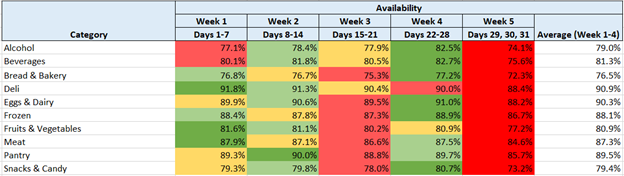
Across all Walmart.com food categories tracked, Week 5 – where payday commonly falls for most consumers, had the lowest average product availability, while Week 4 had the highest average product availability for all categories except Deli and Fruits and Vegetables. These findings may inspire Walmart’s brand partners to rethink their inventory and assortment planning, replenishment and even pricing efforts to maintain a healthy stock closer toward the end of the month to match higher demand.
The categories with the greatest difference in average availability during Week 5 versus the rest of the month were Snacks & Candy, Beverages and Alcohol, indicating consumers consistently made these types of purchases closest to payday, when income was highest throughout the month. Seasonality is a secondary factor that influenced demand for these items given events like Memorial Day, Fourth of July, Summer Break, and Back-to-School shopping all took place during our analysis. Additionally, most holidays overlapped payday, which also furthered Week 5 demand.
Source: DataWeave Digital Shelf Analytics for Brands – Category average availability percentages from May to August 2021 between Week 1 (the 1st to the 7th day of the month) and Week 5 (the 29th, 30th and 31st day of the month).
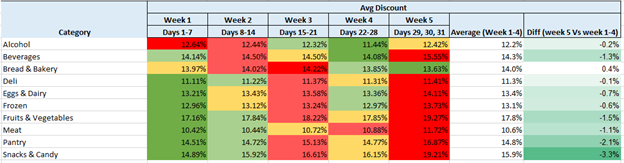
Coupling availability with discounts allows us to consider whether consumers buy more in Week 5 due to high discounts or increased purchasing power, or both. In reviewing the average category discounts offered within the same grocery-centric categories analyzed above, we found almost every grocery category showed a higher discount in Week 5 compared to the rest of the month, except for Bread & Bakery and Alcohol.
Source: DataWeave Digital Shelf Analytics for Brands – Category average discount percentages from May to August 2021 between Week 1 (the 1st to the 7th day of the month) and Week 5 (the 29th, 30th and 31st day of the month).
Regarding Alcohol, during Week 4, when average availability was the highest, the average discounts offered were the lowest. This can indicate inventory was primed for payday shoppers (and the holidays of course). Bread & Bakery offers the greatest average discounts when inventory levels are lowest on average, indicating Week 3 is a great time to stock up, while Week 4 might be a great time to buy the freshest inventory.
The greatest average discounts in Week 5 were in Snacks & Candy, Pantry and Fruits & Vegetables. Deeper discounts for Snacks & Candy in Week 5 may have helped brands compete for consumers’ disposable income despite being a discretionary category. Pantry brands’ discounts may have reflected a need to compete for shoppers’ attention. During this period, consumers were out of the house more and less likely to use these grocery staples compared to earlier lockdown periods and cooler months.
Making Specialty Categories and Health a Priority for Online Shoppers
Interestingly, the only two categories where inventory was higher in Week 5 versus all other weeks each month were ‘Special Diets’ foods and ‘Summer Flavors’, although ‘Special Diets’ foods consistently maintained the lowest level of average availability each week across all food categories analyzed. This consistent lack of inventory could indicate a great opportunity for brands to increase inventory for dietary products sold on Walmart.com.
Source: DataWeave Digital Shelf Analytics for Brands – Category average availability percentages from May to August 2021 between Week 1 (the 1st to the 7th day of the month) and Week 5 (the 29th, 30th and 31st day of the month).
The average availability for ‘Summer Flavors’ foods verifies brands are maintaining a solid replenishment strategy for these seasonal items, and a high likelihood consumers will happily find what they need to plan their Summer gatherings on Walmart.com. One alarming factor we found was the change in average discounts offered during Week 5 versus Weeks 1 through 4, indicating promotions surrounding payday may be driving sales volume versus organic demand.
Source: DataWeave Digital Shelf Analytics for Brands – Category average discount percentages from May to August 2021 between Week 1 (the 1st to the 7th day of the month) and Week 5 (the 29th, 30th and 31st day of the month).
Digital Growth Opportunity in Meal Kits and Kids’ Meals
Two categories primed for growth, according to Statista, are meal kits and kids’ food and beverages. Their research indicates retail sales for kids’ food has grown steadily year-over-year since 2013, and a recent report also indicates meal kit sales are expected to more than double 2017 sales in 2022, reaching $11.6 billion in the U.S., spurred by pandemic-induced demand. A concerning find in our research indicates both categories, ‘Easy Meal Solutions’ and ‘Kid Friendly Foods’ on Walmart.com, showed great volatility when it comes to in-stock availability. For example, in Week 1, ‘Easy Meal Solutions’ had an average availability nearly half the average of the rest of the month (around nineteen percent versus nearly thirty-eight percent), and in Week 5, payday week, ‘Kid Friendly Foods’ saw the biggest drop in average availability compared to Weeks 1 through 4 (over sixty-seven percent versus seventy-five percent) indicating supply may not be keeping up with the heightened demand.
Source: DataWeave Digital Shelf Analytics for Brands – Category average availability percentages from May to August 2021 between Week 1 (the 1st to the 7th day of the month) and Week 5 (the 29th, 30th and 31st day of the month).
The heightened average discounts offered during Week 5 for ‘Baby’ and ‘Pets’ items indicate two categories consumers will most likely stock up on during payday.
Source: DataWeave Digital Shelf Analytics for Brands – Category average discount percentages from May to August 2021 between Week 1 (the 1st to the 7th day of the month) and Week 5 (the 29th, 30th and 31st day of the month).
Back to School Stock-Outs
U.S. retail sales unexpectedly increased in August, likely boosted by back-to-school shopping and child tax credit payments. Meanwhile, product shortages and other supply chain issues slowed 2021’s back-to-school sales, possibly affecting school supplies’ and clothing availability on Walmart.com. According to our analysis, the average product availability in Walmart.com’s school supplies category fell from over sixty-two percent during Weeks 1 through 4 to nearly forty-two percent in Week 5.
Warmer weather, seasonal events, reduced lockdowns, and vaccination efforts led more Americans to resume in-person socializing, giving reason to update their spring and summer wardrobes. In July, Forbes shared that three-quarters of shoppers are purchasing apparel, accessories and shoes the most. On average, only around sixty-three percent of clothing items were available on Walmart.com during Weeks 1 through 4. However, in Week 5, that figure plummeted to just over thirty-eight percent, the most significant drop among all categories.
Source: DataWeave Digital Shelf Analytics for Brands – Category average availability percentages from May to August 2021 between Week 1 (the 1st to the 7th day of the month) and Week 5 (the 29th, 30th and 31st day of the month).
Demand for new fashion remained high throughout this period, seemingly fueled organically, as only moderate additional discounts took place in Week 5, and although the average discount on school supplies was only around twenty-seven percent during Weeks 1 through 4, it surged to just over forty-seven percent in Week 5. Generous additional discounts in Week 5 may have inspired online shoppers to shift spending from clothing to school supplies in late July and August ahead of students’ return to the classroom.
Source: DataWeave Digital Shelf Analytics for Brands – Category average discount percentages from May to August 2021 between Week 1 (the 1st to the 7th day of the month) and Week 5 (the 29th, 30th and 31st day of the month).
Prioritizing Product Availability with Digital Advertising Strategies
Seventy-eight percent of B2C marketers increased their 2021 digital advertising spend to fuel online product discoverability (Share of Search), and sales and market share, but out-of-stock experiences simultaneously surged 172% this year from pre-pandemic levels. Paying for ads that drive traffic to your out-of-stock products can be as detrimental to your brand as a bad user experience. Our review of the ‘Featured Products’ sold on Walmart.com show consistent, low-levels of product availability each week throughout the months reviewed.
Source: DataWeave Digital Shelf Analytics for Brands – Category average availability percentages from May to August 2021 between Week 1 (the 1st to the 7th day of the month) and Week 5 (the 29th, 30th and 31st day of the month).
Additionally, the average discount offered on these products tended to be higher than most other categories reviewed, indicating brands participating in the featured product section of the website were not only investing in digital ads, but also doubling down with promotional activity as well.
Source: DataWeave Digital Shelf Analytics for Brands – Category average discount percentages from May to August 2021 between Week 1 (the 1st to the 7th day of the month) and Week 5 (the 29th, 30th and 31st day of the month).
How Brands can Replenish Their Digital Shelf
It is well known just how important it is to have products available during the right time of day, week, month, or season to improve customer satisfaction rates, but with your e-commerce store open 24/7 and omnichannel fulfillment strategies in place, it drastically changes the way in which strategic execution is prioritized for a retailer to reduce basket abandonment and for brands to build loyalty.
Our greatest takeaway from this analysis is realizing how crucial it is for brands to proactively track product availability and competitive pricing insights to stay ahead of the curve and achieve their digital growth goals. Early visibility to stock replenishment could help brands align with heightened cyclical and seasonal demand to avoid out-of-stocks and grow e-commerce sales.
This is why more leading brands now rely on our Digital Shelf Analytics solutions, including Pricing and Availability insights, to keep eCommerce planning agile, to maximize online conversions, and ultimately maintain shopper satisfaction and loyalty.
As eCommerce grows in complexity, brands need new ways to grow sales and market share. Right now, brands face urgent market pressures like out-of-stocks, an influx of new competition and rising inflation, all of which erode profitability. As online marketplaces mature, more brands need to make daily changes to their digital marketing strategies in response to these market pressures, shifts in demand, and competitive trends.
eMarketer forecasts 2021 U.S. eCommerce will rise nearly 18% year-over-year (vs. 6.3% for brick-and-mortar), led by apparel and accessories, furniture, food and beverage, and health and personal care. The eCommerce industry is also undergoing fundamental changes with newer entities emerging and traditional business models evolving to adapt to the changed environment. For example, sales for delivery intermediaries such as Doordash, Instacart, Shipt, and Uber have gone from $8.8 billion in 2019 to an estimated $35.3 billion by the end of 2021. Similarly, many brands have established or are building out a Direct to Consumer (D2C) model so they can fully own and control their customer’s experiences.
In response, DataWeave has launched the next generation of our Digital Shelf Analytics suite to help brands across retail categories directly address today’s costly market risks to drive eCommerce growth and gain a competitive advantage.
“Our new enhancements help brands improve online search rank visibility and quantify the impact of digital investments – especially in time for the busy holiday season.” ~ Karthik Bettadapura, CEO and co-founder, DataWeave
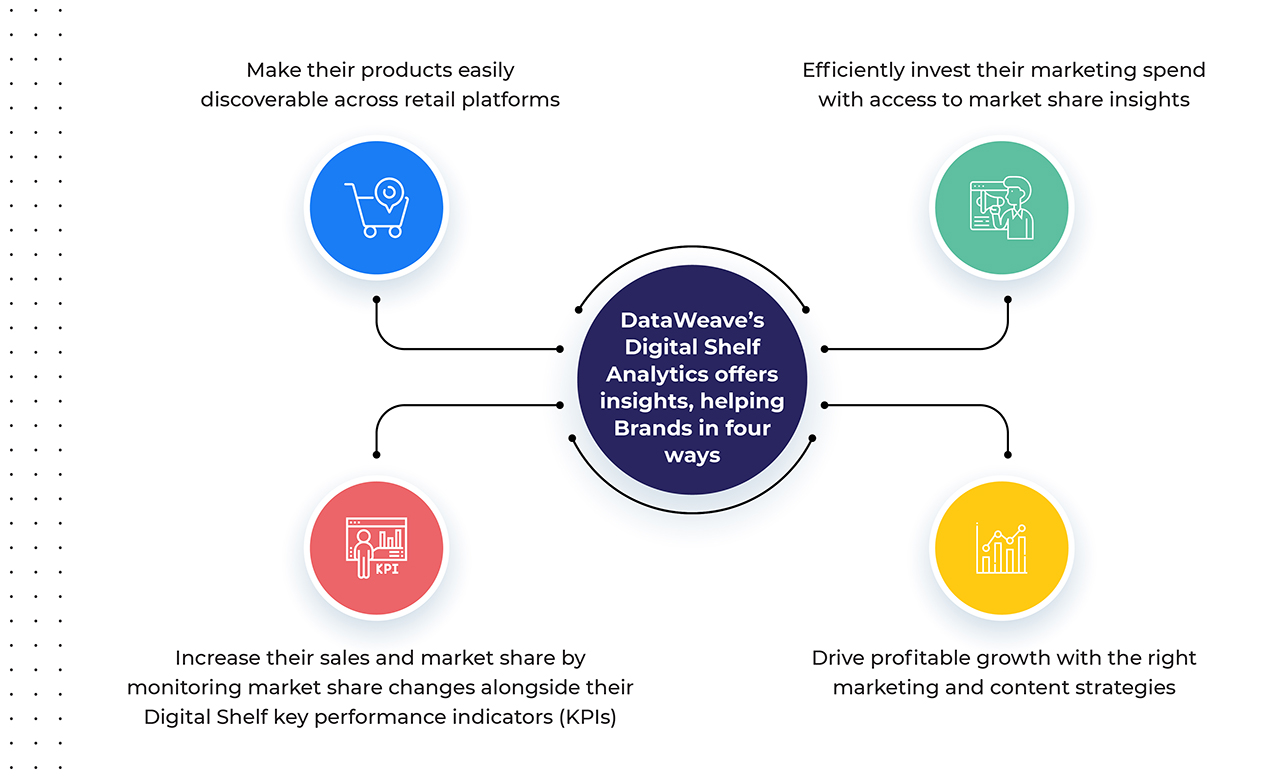
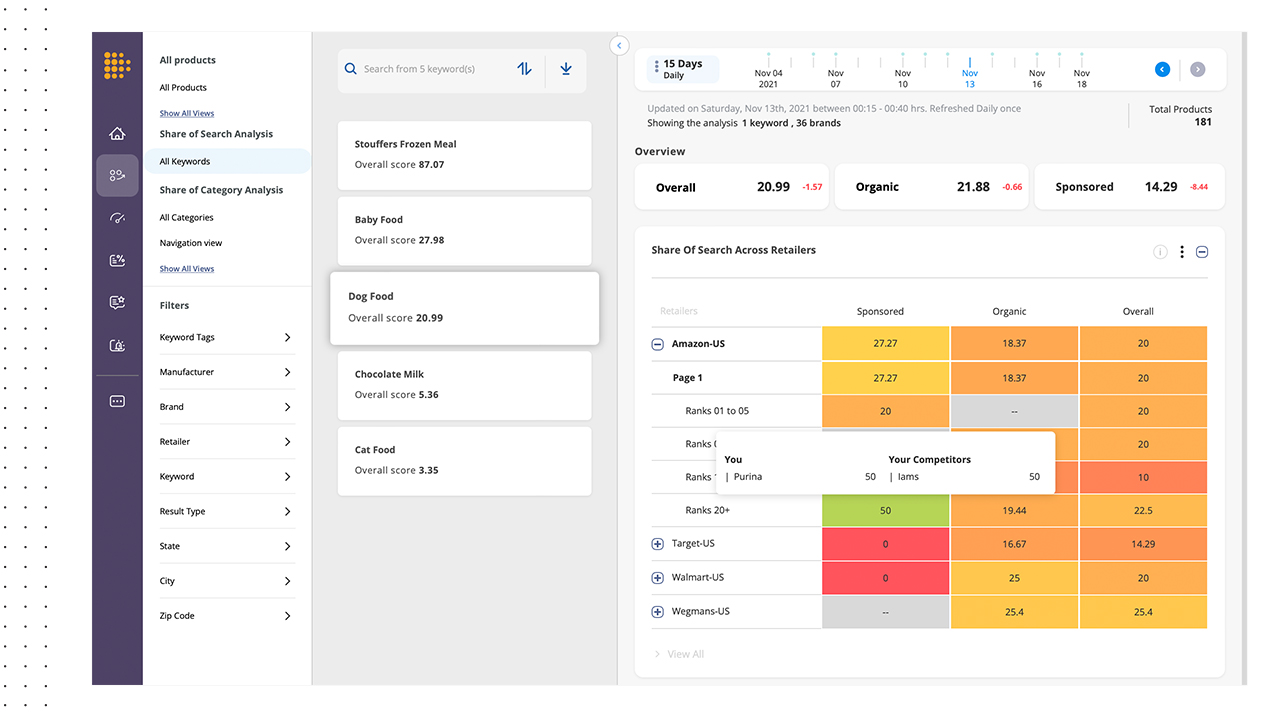
The latest product enhancements provide brands access to tailored dashboard views that track KPI achievements and trigger actionable alerts to improve online search rank visibility, protect product availability and optimize share of search 24/7. Dataweave’s Digital Shelf Analytics platform works seamlessly across all forms of eCommerce platforms and models – marketplaces, D2C websites and delivery intermediaries.
Dashboard for Multiple Functions
While all brands share a common objective of increasing sales and market share, their internal teams are often challenged to communicate and collaborate, given differing needs for competitive and performance data across varying job functions. As a result, teams face pressure to quickly grasp market trends and identify what’s holding their brands back.
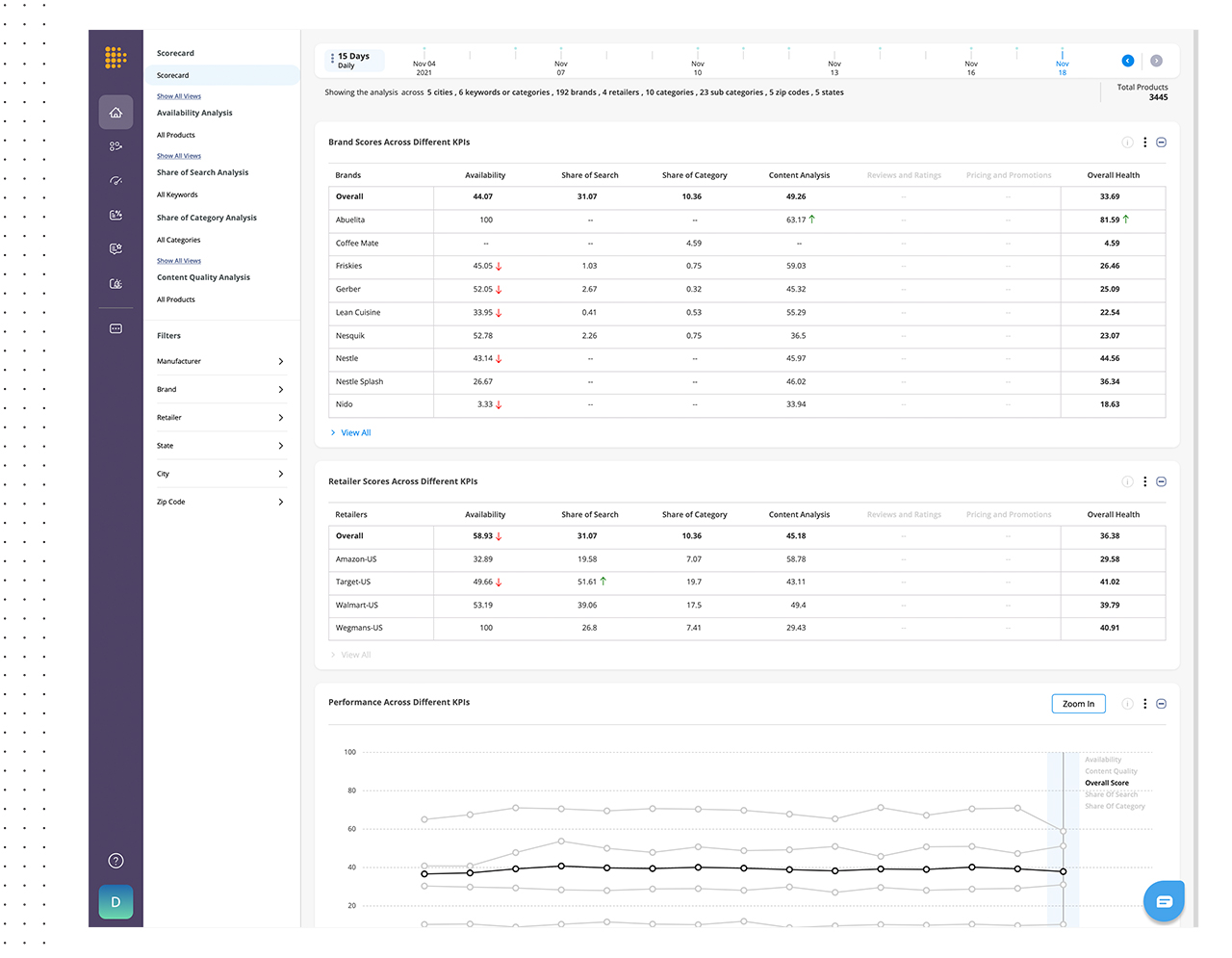
In response, DataWeave now offers executive-level and customized scorecard views, tailored to each user’s job function, with the ability to measure and assess marketplace changes across a growing list of online retail channels for metrics that matter most to each user. This enhancement enables data democratization and internal alignment to support goal achievement, such as boosting share of category and content effectiveness. The KPIs show aggregated trends, plus granular reasons that help to explain why and where brands can improve.
Brands gain versatile insights serving users from executives to analysts and brand and customer managers.
Prioritized, Actionable Insights
As brands digitize more of their eCommerce and digital marketing processes, they accumulate an abundance of data to analyze to uncover actionable insights. This deluge of data makes it a challenge for brands to know exactly where to begin, create a strategy and determine the right KPIs to set to measure goal accomplishment.
DataWeave’s Digital Shelf Analytics tool enables brands to effectively build a competitive online growth strategy. To boost online discoverability (Share of Search), brands can define their own product taxonomies across billions of data points aggregated across thousands of retailer websites. They can also create customized KPIs that track progress toward goal accomplishment, with the added capability of seeing recommended courses of action to take via email alerts when brands need to adjust their eCommerce plans for agility.
“Brands need an integrated view of how to improve their discoverability and share of search by considering all touchpoints in the digital commerce ecosystem.” ~ Karthik Bettadapura, CEO and co-founder, DataWeave
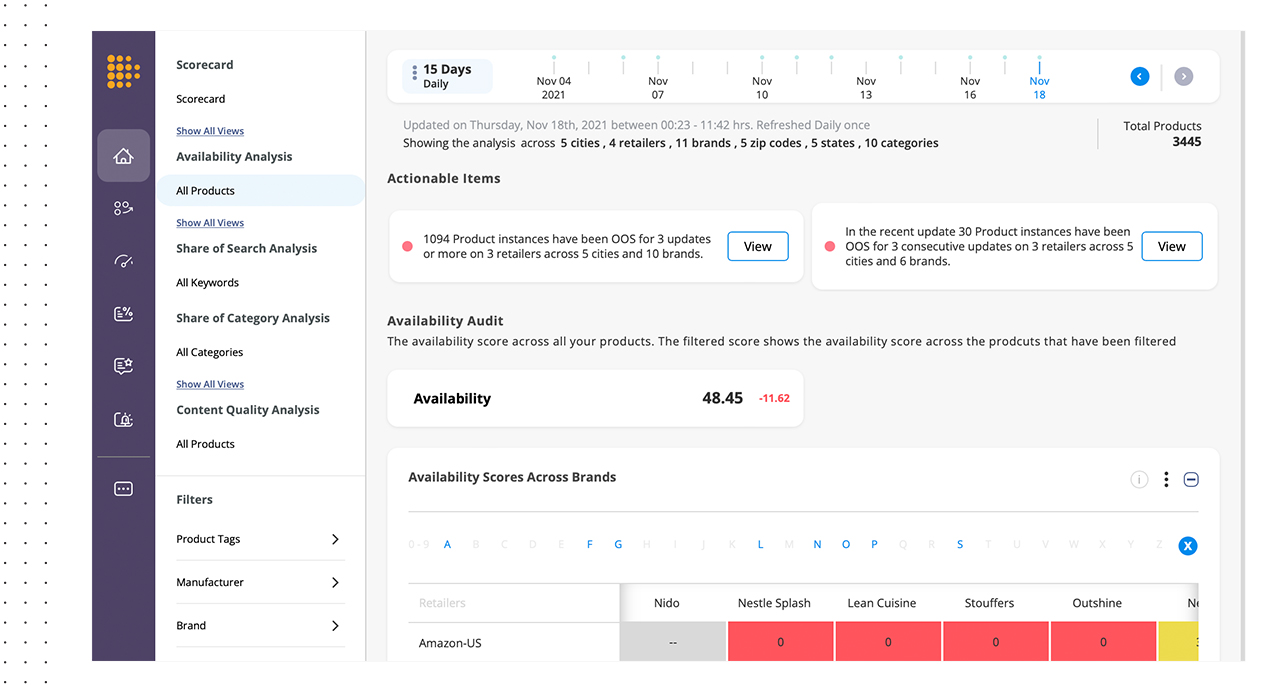
Of vital importance, amid today’s global supply chain challenges, brands gain detailed analysis on product inventory and availability, as well as specific insights and alerts that prompt them to solve out-of-stocks faster, which Deloitte reports is a growing concern of consumers (75% are worried about out-of-stocks) this holiday season.
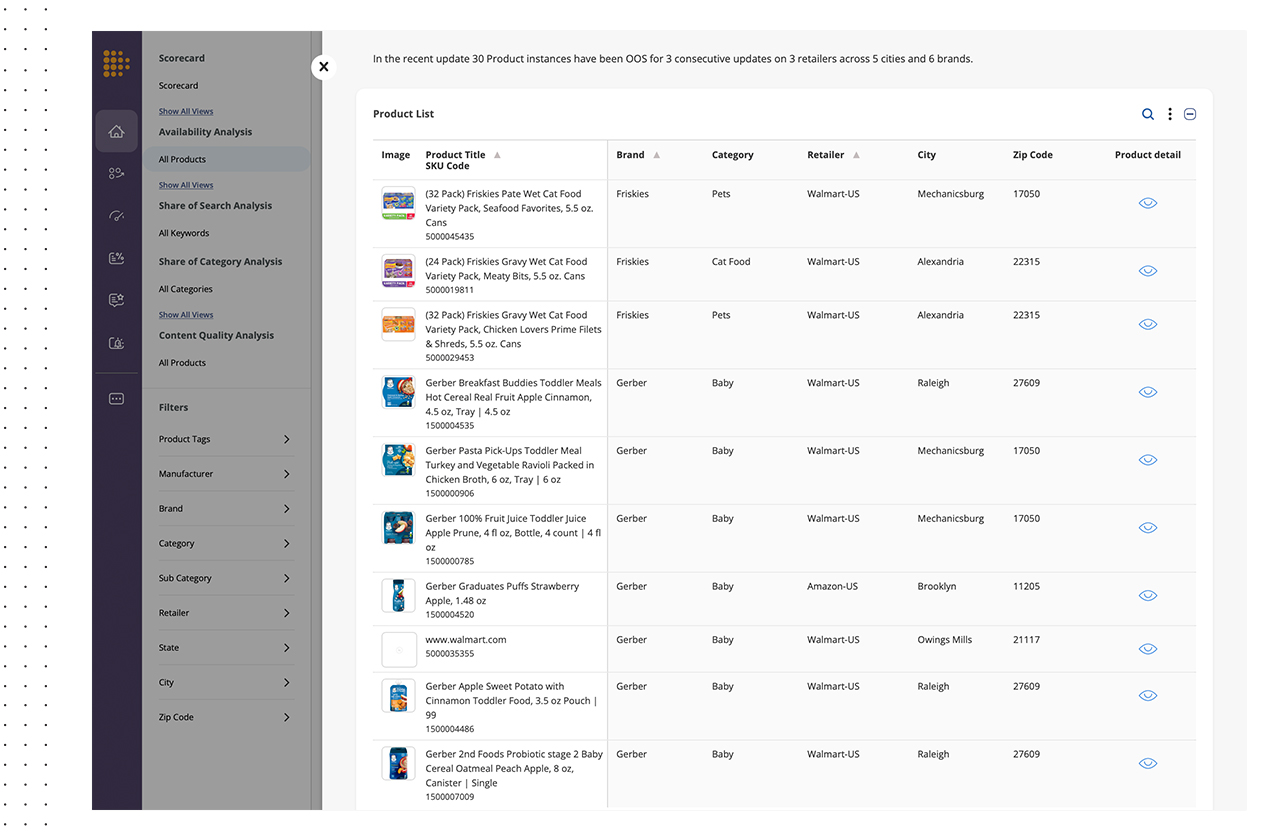
User and system generated alerts provide clarity to actionable steps to improving eCommerce effectiveness.You also have visibility to store-level product availability, and are alerted to recurring out-of-stock experiences.
Scalable Insights – From Bird’s Eye to Granular Views
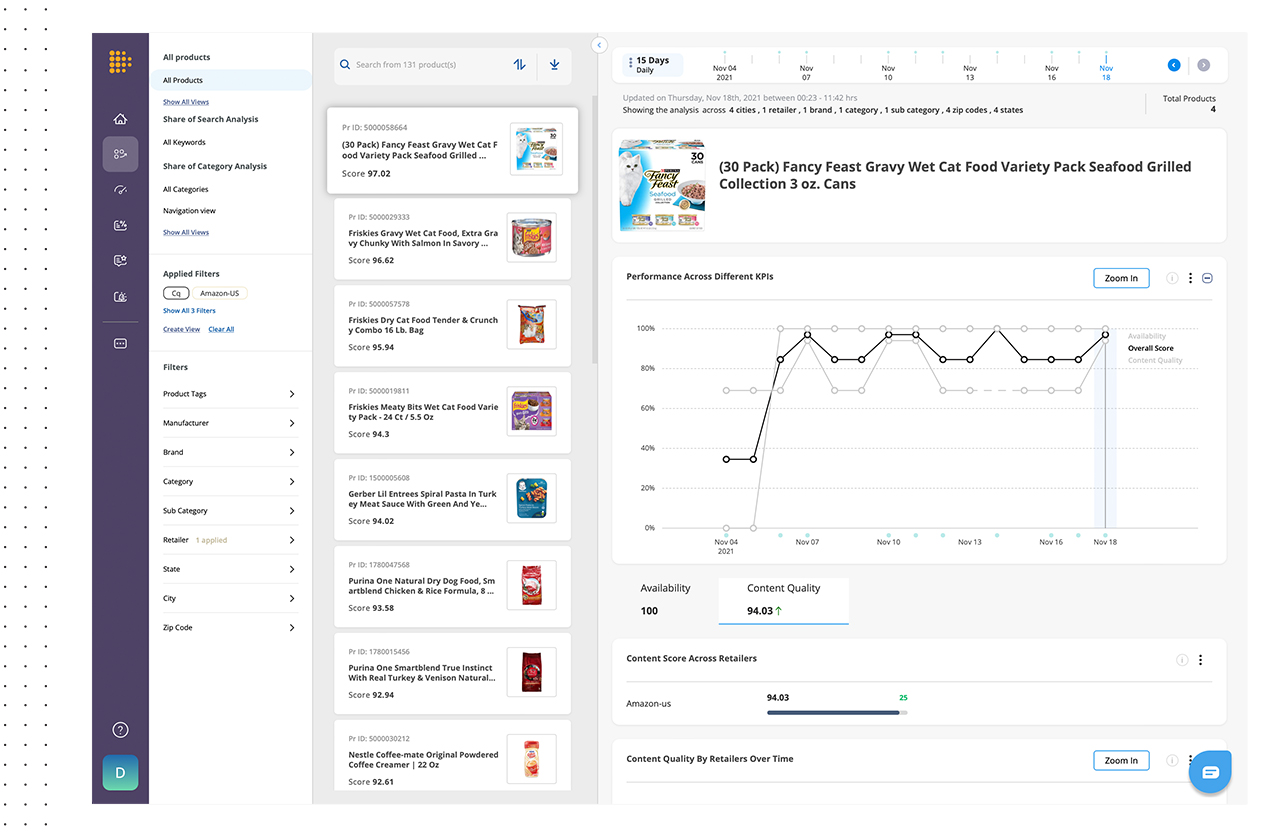
DataWeave’s Digital Shelf Analytics allows brands to achieve data accuracy at scale, including reliable insights from a top-down and bottom-up perspective. For example, you can see a granular view of one SKUs product content alongside availability, or you can monitor a group of SKUs, say your best selling ones, at a higher level view with the ability to drill down into more detail.
Brands can access flexible insights, ranging from strategic overviews to finer details explaining performance results.
Many brands struggle with an inability to scale from a hyper-local eCommerce strategy to a global strategy. Most tools available on the market solve for one or the other, addressing opportunities at either a store-level basis or top-down basis – but not both.
According to research by Boston Consulting Group and Google, advanced analytics and AI can drive more than 10% of sales growth for consumer packaged goods (CPG) companies, of which 5% comes directly from marketing. With DataWeave’s advanced analytics, AI and scalable insights, brands can set and follow global strategies while executing changes at a hyper-local level, using root-cause analysis to drill deeper into problems to find out why they are occurring.
As more brands embrace eCommerce and many retailers localize their online assortment strategies, the need for analytical flexibility and granular visibility to insights becomes increasingly important. Google reports that search terms “near me” and “where to buy” have increased by more than 200% among mobile users in the last few years, as consumers seek to buy online locally.
e-Retailers are now fine-tuning merchandising and promotional strategies at a hyper-local level based on differences seen in consumer’s localized search preferences, and DataWeave’s Digital Shelf Analytics solution provides brands visibility to retailer execution changes in near real-time.
Competitive Benchmarking
Brand leaders cannot make sound decisions without considering external factors in the competitive landscape, including rival brands’ pricing, promotion, content, availability, ratings and reviews, and retailer assortment. Dataweave’s Digital Shelf Analytics solution allows you to monitor share of search, search rankings and compare content (assessing attributes like number of images, presence of video, image resolution, etc.) across all competitors, which helps brands make more informed marketing decisions.
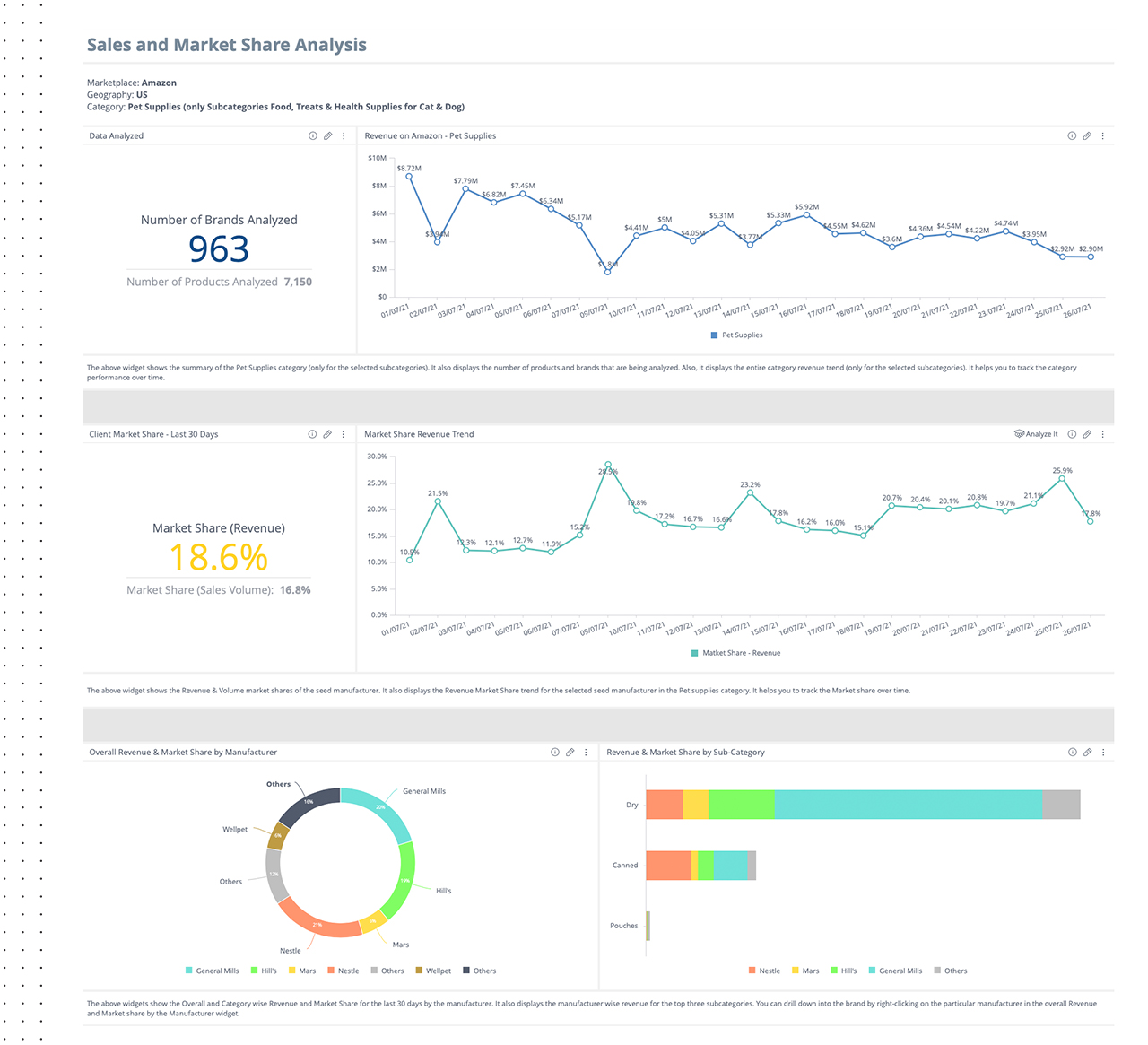
Brands are also provided visibility into competitive insights at a granular level, allowing them to make actionable changes to their strategies to stay ahead of competitors’ moves. A new module called ‘Sales and Share’ now enables brands to benchmark sales performance alongside rivals’ and measure market share changes over time to evaluate and improve competitive positioning.
Monitor competitive activity, spot emerging threats and immediately see how your performance compares to all rivals’, targeting ways to outmaneuver the competition.
Sales & Market Share Estimates Correlated with Digital Shelf KPIs
In a brick-and-mortar world, brands often use point of sale (POS) based measurement solutions from third party providers, such as Nielsen, to estimate market share. In the digital world, it is extremely difficult to get such estimates given the number of ways online orders are fulfilled by retailers and obtained by consumers. Dataweave’s Digital Shelf Analytics solution now provides sales and market share estimates via customer defined taxonomy, for large retailers like Amazon. Competitive sales and market share estimates can also be obtained at a SKU level so brands can easily benchmark their performance results.
Additionally, sales and market share data can also be correlated with digital shelf KPIs. This gives an easy way for brands to check the effect of changes made to attributes, such as content and/or product availability, and how the changes impact sales and market share. Similarly, brands can see how modified search efforts, both organic and sponsored, correspond to changes in sales and market share estimates.
Take Your Digital Shelf Growth to the Next Level
The importance of accessing flexible, actionable insights and responding in real-time is growing exponentially as online is poised to account for an increasing proportion of brands’ total sales. With 24/7 digital shelf accessibility among consumers comes 24/7 visibility and the responsibility for brands to address sales and digital marketing opportunities in real-time to attract and serve online shoppers around the clock.
Brands are turning to data analytics to address these new business opportunities, enhance customer satisfaction and loyalty, drive growth and gain a competitive advantage. Companies that adopt data-driven marketing strategies are six times more likely to be profitable year-over-year, and DataWeave is here to help your organization adopt these practices. To capitalize on the global online shopping boom, brands must invest in a digital shelf analytics solution now to effectively build their growth strategies and track measurable KPIs.
DataWeave’s next-gen Digital Shelf Analytics enhancements now further a brand’s ability to monitor, analyze, and determine systems that enable faster and smarter decision-making and sales performance optimization. The results delight consumers by helping them find products they’re searching for, which boosts brand trust.
Connect with us to learn how we can scale with your brand’s analytical needs. No project or region is too big or small, and we can start where you want and scale up to help you stay agile and competitive.
Content is the reigning king for e-commerce & plays a big role in driving sales and conversions. And, consumer-centric content that drives traffic is vital for e-commerce sales. Unlike offline retail where the sales staff on the ground is always available to answer customer queries, online that is not the case. When shopping online, customers rely on audio & visual product content to give them the information they need in order to make purchase decisions. Understanding that your product speaks to your customers directly on online channels is critical – so optimizing your product content to represent your brand in the best light is very important.
Here are the Top 4 ways to optimize content & drive ROI.
1. Focus on your customer & set a brand tone
Who is your customer? And what type of product is your brand selling? The golden rule togetting the right content for your brand is to answer these two questions right. For instance, if you’re selling furniture and focusing on a family audience then using flowery language will not help your cause. You need to share factual, product-specific content, calling out furniture specs from color, fabric, size, and so on.
Take for instance ProFlowers – a US-based flower retailer who created an entire Florapedia® – an in-depth flower guide. This content helped their customers learn more about the various flowers & discover new flowers they never knew of when making purchase decisions. To drive e-commerce sales, ProFlowers set the brand tone using educational content. On the other hand, if you are selling clothing or lingerie, you need to be extremely specific about the details of each product. Let’s look at reputed outdoor clothing brand Jack Wolfskin – they use high-quality images for content optimization and showcase real instances and moods in which the clothing can be worn or what they can be paired with. This is a good way to allow customers to picture themselves owning the item, as well as research their unique qualities.
Educational, visual-heavy, or fun & quirky – pick your content style based on your brand tone.
2. Use videos as a powerful content optimization tool
Videos empower content and hook your customers in. In a report, Cisco had earlier projected that by the year 2022, videos will be responsible for 82% of all consumer internet traffic. For e-commerce, video content can not only deliver a message but is easily shareable across all platforms. Videos not only possess the power to captivate people for extended amounts of time, but according to research, if a video is embedded on your website, you’re 53 times more likely to rank on the first page of Google.
Videos work as a descriptive medium to give more details about your product. Further, explanatory videos relieve consumer fears regarding the quality of the product by allowing viewers to visually experience its usages and benefits. MAC for instance uses a host of make-up tutorials and other video content on their website.
Videos bring brand storytelling to life and keep visitors informed. In the case of the videos created by MAC, they are not only informative and engaging, but they also help the brand answer common shopper questions with live examples. Customers who land upon the MAC website can watch videos relevant to the products they want to shop for, understand the product details and then decide if the product is for them. Thus, brands using videos can create a better customer experience by giving the visitors an immersive brand exposure online, just like they could have got offline.
3. Focus on making your product page consumer-centric
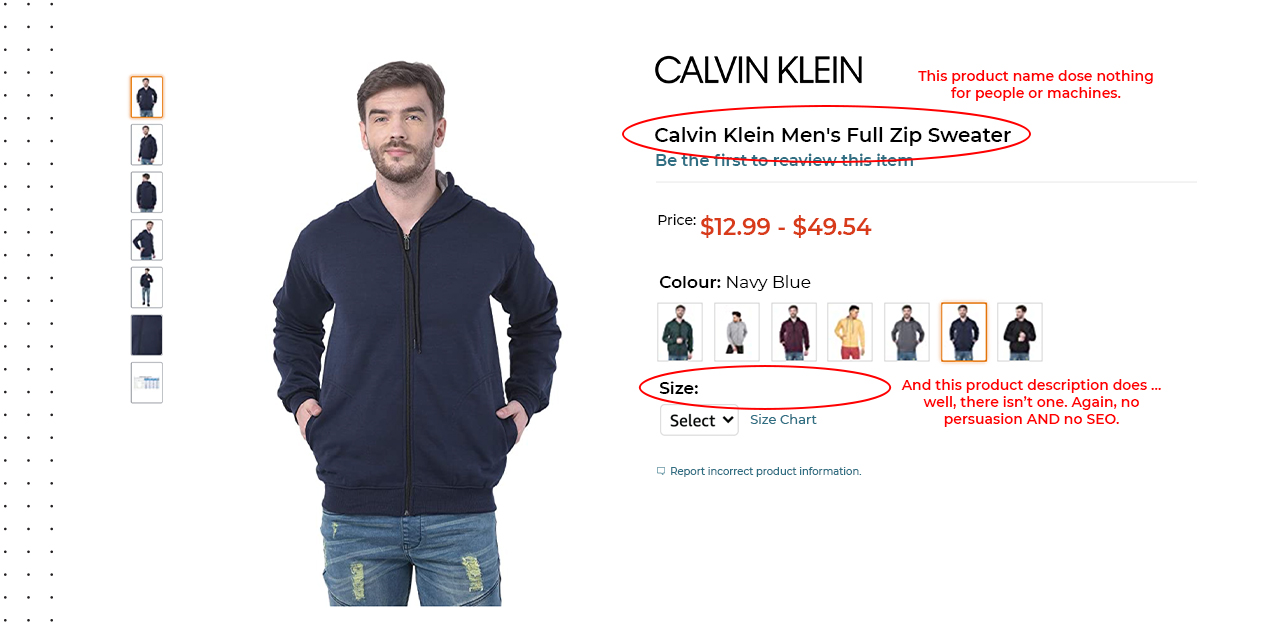
A product page can be highly discoverable if it aligns with the best practices & standard e-commerce algorithms put in place by popular marketplaces and e-commerce channels. This is because the organic product ranking algorithms vary across channels and are composed of direct and indirect factors used to match a consumer’s popular search queries to products they are most likely to purchase. For better content optimization that ensures visibility, start by mapping platform-specific content standards. Then follow the SEO trends and tweak your product titles and description, to give your brand content a boost.
Love Hair Product
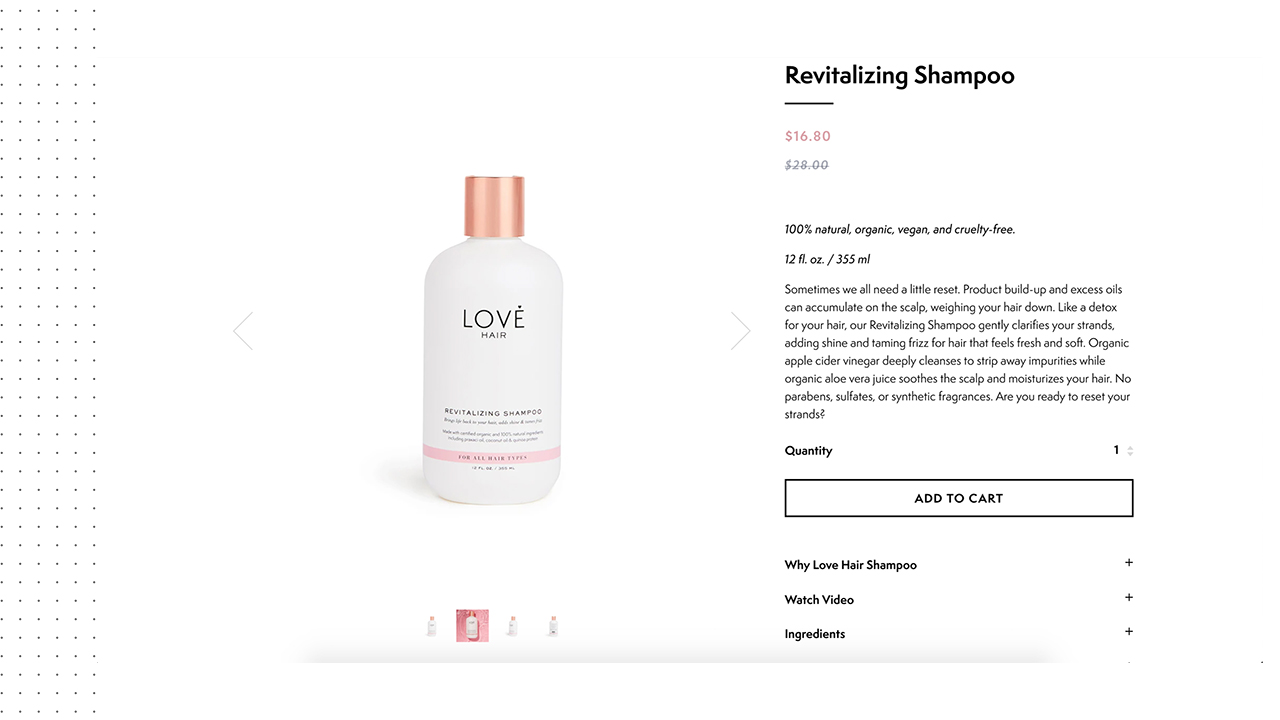
Take for instance the LOVE Hair product pages – the product titles are crafted using product features and benefits like revitalizing, nourishing, volumizing. Consumers searching for shampoos normally type in these attributes to look for shampoos that may suit their requirements – so using attributes as a hook in the product title is a great idea to make the product more discoverable against that keyword or attribute.
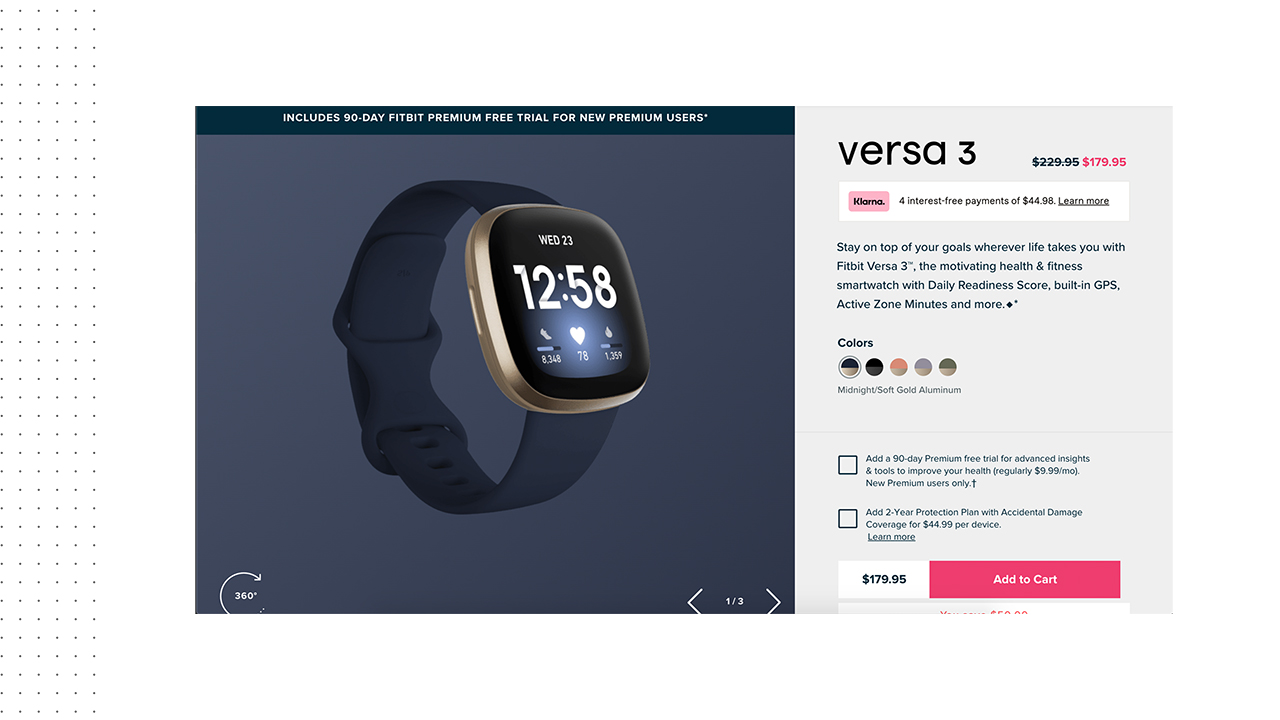
Next, keeping these standards as a backbone, fine-tune the product details you are putting out on the page. Your product features are the reasons why your consumer will buy your brand as compared to your competitors, so your descriptions should be crisp, easy to read, highlighting all the product features & facts that help them make that purchase decision. Let’s look at the Fitbit product page…
Fitbit Product Page
4. Optimize content based on devices
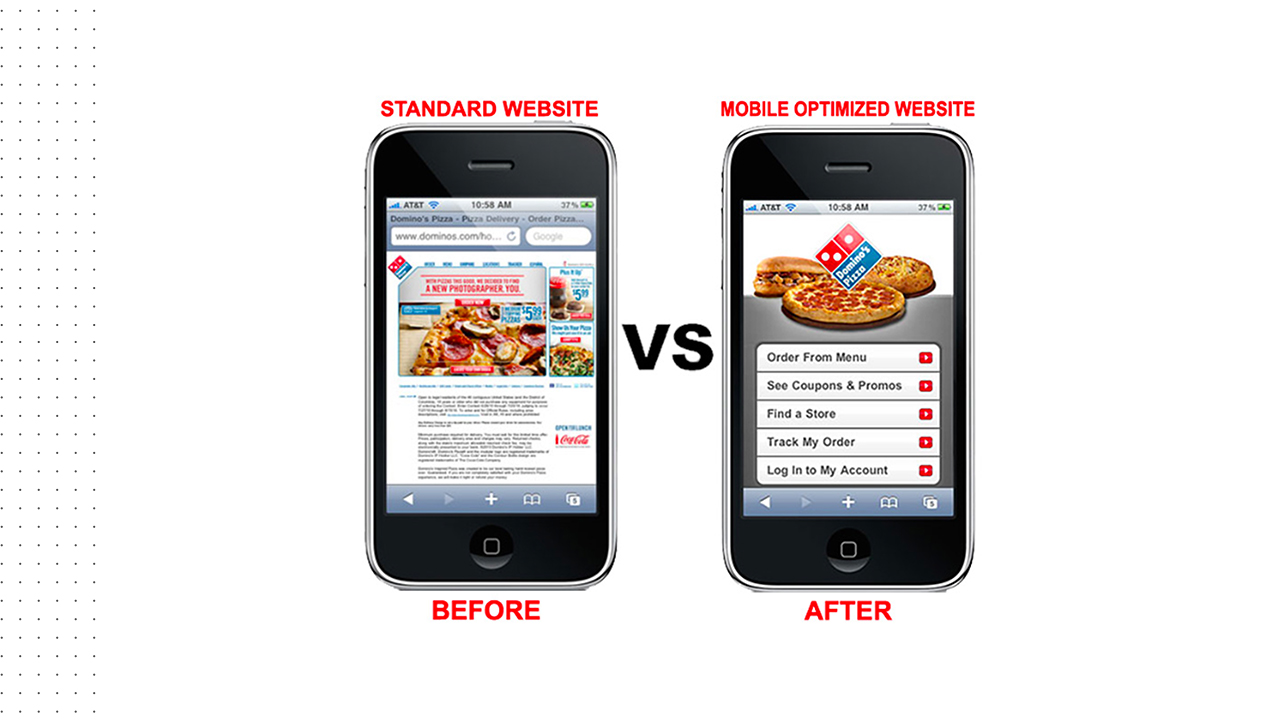
With mobile commerce reaching the tipping point in the e-commerce sales funnel, you cannot ignoreattending to content optimization for hand-held devices. Many times, buyers on the go use mobile devices to conduct their research and your success lies in being able to entice them with a perfectly optimized e-commerce page even on their mobile device. Here are a few tips to keep in mind:
Keep their reading experience in mind. Use shorter titles, and bite-sized product information so key points are upfront and visible on a tinier screen
Be concise with your content presentation
Video content should not autoplay on mobile. The less invasive your content, the better
Keep video & image file sizes small so that page load time is quick
E-Commerce Product Page
A perfectly balanced e-commerce product page is even more vital in the new normal, given that COVID has accelerated e-commerce, globally. So, whether you are selling furniture, books, clothes, or health juices, with the right focus on product content, you can convert shoppers into customers more easily and increase your sales & revenue. Feel free to take inspiration from some of the examples above to apply some of these strategies to your online store.
Building the right product page with the right content is not enough. You will also need to keep rehashing your product pages with reviews, offers, and other such relevant nodes to deliver the right punch. After all, delivering the right customer experience starts with a product page done right.
Want to see first-hand how DataWeave can help brands with content optimization? Sign up for a demo with our Digital Shelf experts to know more.
The exponential growth of eCommerce has forever changed holiday shopping as we know it. What was once led by the launch of Cyber Monday in 2005, has since expanded to ‘Cyber Five’ in 2018, now spans beyond an eight-week period, and is collectively the busiest digital shopping period of the year. Most retail websites have launched a ‘Thanksgiving Comes Early’ sales event for a mosaic of products, causing one to wonder how this ‘early start’ to holiday shopping will impact the traditional promotional cadence consumers have grown to expect to see launch closer to the holidays. Given today’s environmental challenges, threats of scarcity are also encouraging consumers to buy early, which could also impact traffic on the shopping days that have traditionally seen the highest sales volume from digital shoppers.
In the current environment, the onus will be on consumers to keep a watch for their categories of interest and buy them as and when they appear on sale in their favorite store, because there is no guarantee of sustained availability. Of course, they might return and buy at a different store if a better deal comes up, but there’s a time cost for the dollars saved. More broadly, there has been enough noise made about deals and discounts to keep consumer interest and curiosity going.
The early promotional start and heightened demand has influenced our team to get a jump start on our 2021 Black Friday analysis to look deeper at trends seen pre-Black Friday 2021 versus 2020. With this assessment, we can track how promotional prices and product availability rates may have changed throughout the event leading in to 2021 Cyber Five, and compare it to last year’s activity to understand how 2021 holiday sales may be impacted.
We reviewed popular holiday categories like apparel, electronics, and toys (for kids and pets), to have a broad sense of notable trends seen consistently throughout various, applicable marketplaces. What we found is a consistent decline in product availability over the last six months and as compared to last year, alongside an increase in prices.
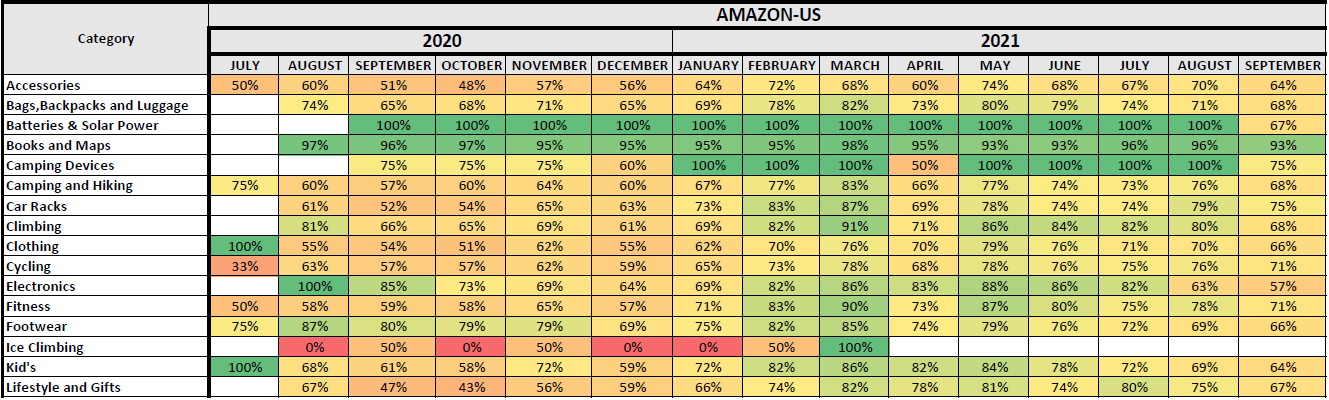
We first analyzed availability changes for popular categories on Amazon, noted in the chart below, to understand how inventory may have changed throughout the year, and also compared to 2020. With the exception of batteries and solar power goods and books and maps, there appears to be consistency in greater product availability in 2021 versus 2020, but a slow decline in availability throughout 2021, leading into the holiday season.
Source: DataWeave Commerce Intelligence – Product Availability in-stock percentage from July 2020 through September 2021 for a sample size of 1000+ products on Amazon.com
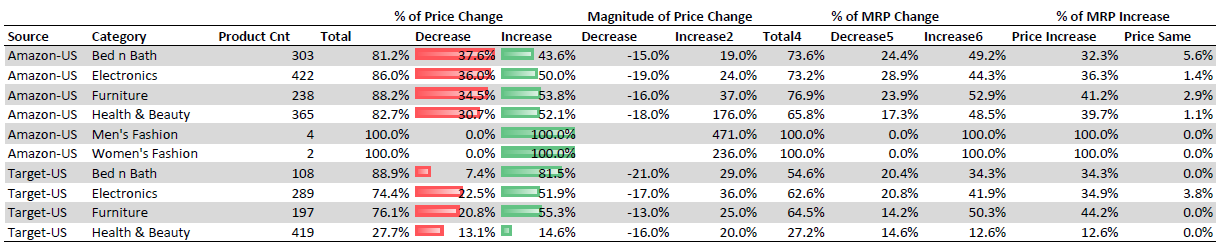
When it came to our pricing analysis, we reviewed select categories on Amazon and Target.com, and found around fifty percent of products on both websites to have seen a price increase year-over-year, while only thirty-seven percent and sixteen percent of products saw a price decrease on Amazon and Target.com, respectively. We also see an increase in the manufacturer’s retail price (MRP) in 2021 versus 2020 for a very high proportion of products (forty-eight percent of products on Amazon and thirty-five percent of products on Target.com), but the discount percentages have remained the same.
Source: DataWeave Commerce Intelligence – Pricing Intelligence: MRP and promotional pricing for 1000+ products on Amazon and Target.com were analyzed from November 13th – 15th, 2021 versus Pre-Black Friday November 24th & 25th 2020
This indicates 2021 discounts may appear to be greater than or equivalent to 2020, but in reality, consumers will end up paying higher prices than they would have for the same items in 2020. The remainder of this article highlights our key findings found within each key category reviewed – Electronics, Apparel and Toys.
Electronics Category Analysis
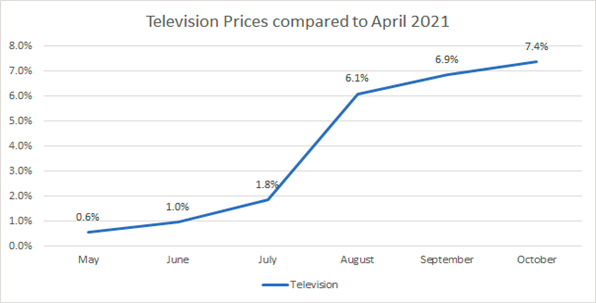
The television category showcases a great example of how pricing fluctuations impact holiday promotional cadences. Based on our analysis, we found the average television price to have increased around seven percent from April to October 2021, as seen below and as noted within our analysis conducted with NerdWallet.
Source: DataWeave Commerce Intelligence – Pricing Intelligence: The change in average price captured for televisions sold on Amazon from May 2021 through October 2021.
In fact, on Amazon and Target.com, we see around eighty-four percent of the SKUs listed show both an MRP and promotional price increase in 2021 versus 2020 during pre-Black Friday times. One specific example found on Amazon is noted below for Samsung TV model QN65LS03TAFXZA, a 65 inch QLED TV that was priced at $1697 during this analysis at a fifteen percent discount from MRP, but was priced last year at $1497 without a discount from MRP. In essence, even though the TV offers a greater discount this year, it is actually more expensive than it was in 2020 at this same time of year.
Source: DataWeave Commerce Intelligence – Pricing Intelligence: MRP and promotional pricing analysis on Amazon.com comparing prices from November 13th – 15th, 2021 versus Pre-Black Friday November 24th & 25th 2020
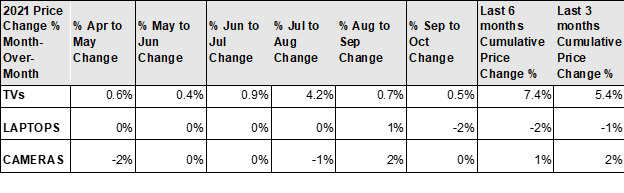
Unlike TVs, the price of laptops has experienced a decrease over time based on our analysis conducted during the same timeframe, indicating these are a great buy for consumers this holiday season versus promotional offers seen in 2020.
Source: DataWeave Commerce Intelligence – Pricing Intelligence: The month-over-month change in average price captured for televisions sold on Amazon from April 2021 through September 2021.
Overall, our prediction is that within the electronics category, promotions during Cyber Five may be equivalent to last year’s offers, however, supply will be limited and the total spend versus last year will be greater to the consumer outside of Doorbuster deals offered on select models.
Apparel Category Analysis
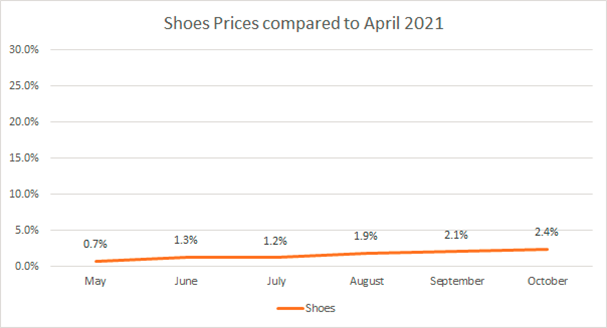
The Luxury market is seeing a Roaring 20s-like feeling this season given the Covid-induced changes in work and lifestyle and higher disposable income. Therefore, our prediction is that prices for these goods are likely to remain flat, or offer very little discounts this season both due to supply constraints as well as higher demand. For example, our analysis on shoe pricing changes shows relative stability from April to October 2021.
Source: DataWeave Commerce Intelligence – Pricing Intelligence: The change in average price captured for shoes sold on Amazon from May 2021 through October 2021.
Given heightened demand and the Global shipping crisis, we anticipate luxury apparel categories to face out-of-stock challenges this holiday season, and therefore we also anticipate seeing less promotional activity for these items as well during Cyber Five 2021. To dive deeper into the severity of the impact, we looked at availability for clothing, accessories, and footwear categories from August 2020 until present to verify our thesis.
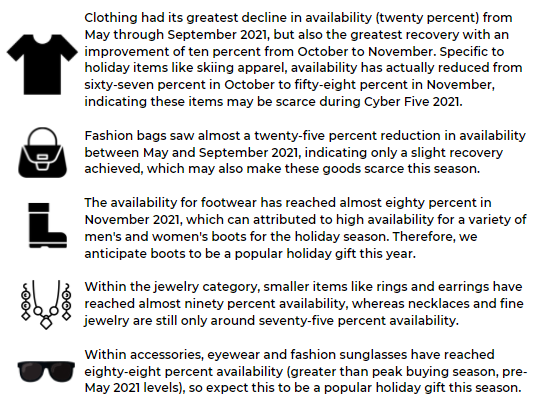
Focusing only on clothing, accessories, and footwear, these categories followed the same downward trending pattern regarding product availability decreases this year with a decline from June (seventy-six percent versus eighty-six percent in May 2021) to September 2021 (the lowest rate seen at sixty-eight percent availability), followed by a partial recovery in October and November (achieving seventy-seven percent availability).
Source: DataWeave’s Commerce Intelligence – Product Availability: 10k SKUs tracked across 11 retailers US websites (Farfetch, Brownsfashion, NetAPorter, EndClothing, 24s, Selfridges, Ssense, Harrods, Luisaviaroma, MyTheresa, MrPorter) tracked daily stock status in apparel categories; Availability is calculated as percent of instances when product is in stock against all instances tracked.
Not all recoveries were the same however, and given this, we predict accessories to have the lowest availability rate and greatest risk of facing out of stocks heading into Cyber Five. From May through November 2021, accessories availability continued to decline significantly from month to month, beginning at eighty-three percent in May and ending at seventy-four percent in November. Given this continued decline and with Black Friday right around the corner, we don’t anticipate inventory levels to increase enough to meet the increased holiday demand.
Source: DataWeave’s Commerce Intelligence – Product Availability: 10k SKUs tracked across 11 retailers US websites (Farfetch, Brownsfashion, NetAPorter, EndClothing, 24s, Selfridges, Ssense, Harrods, Luisaviaroma, MyTheresa, MrPorter) tracked daily stock status in apparel categories; Availability is calculated as percent of instances when product is in stock against all instances tracked.
Toys & Games Category Analysis
As noted by DigitalCommerce360, we also anticipate toys to be one of the greatest impacted categories this holiday season given the continued decline in overall availability for these items on Amazon.com, as one great example. Within our category analysis, we saw a steady decline in availability from March 2021 through June (eighty percent to sixty-one percent), followed by a period of stability from June through August (approximately sixty percent), followed by another decline from September through October, finally reaching the lowest availability of fifty-six percent (down twenty-four percent from March 2021).
Source: DataWeave’s Commerce Intelligence – Product Availability – hundreds of Toys & Games SKUs tracked on Amazon.com on a weekly basis from March 2021-October 2021
The biggest sub-category within the toys department on Amazon, Sports and Outdoor Play, followed the same trend as Toys and Games overall through June 2021, also reaching its lowest availability of fifty-six percent. Instead of continuing along that pattern, Sports and Outdoor Play started on a recovery path, ending at a relatively high availability level of sixty-seven percent in October, which is only five percent lower than its highest availability (seventy-two percent in March 2021). Games and Accessories, the second largest sub-category in Toys and Games, had a continuous decline starting with eighty-nine percent in March 2021, reaching its lowest availability of fifty-four percent in October.
Source: DataWeave’s Commerce Intelligence – Product Availability – hundreds of Toys & Games SKUs tracked on Amazon.com on a weekly basis from March 2021-October 2021
The sub-category Tricycles, Scooters and Wagons interestingly had its highest availability from July to September 2021 (around eighty percent), unlike other sub-categories which as a whole, had their lowest availability during the same timeframe. From September through October, there was a significant decline (fourteen percent), reaching its lowest availability of sixty-seven percent. The sub-category Babies & Toddlers started on a continuous decline from its highest availability of eighty percent in April to its lowest availability of fifty-six percent in October.
Source: DataWeave’s Commerce Intelligence – Product Availability – hundreds of Toys & Games SKUs tracked on Amazon.com on a weekly basis from March 2021-October 2021
*Please reach out to our Retail Analytics experts for access to sub-category details available within the above analysis on the Toys and Games category on Amazon.com.
Pet Toys Category Analysis
When it comes to in demand holiday toys, you can’t forget about the needs for gifts for our furry friends and family. We also tracked sub-categories such as dog, cat, and bird toys, following the same methodology as tracked within Toys and Games to track pet toy availability changes.
Source: DataWeave’s Commerce Intelligence – Product Availability – hundreds of Pet Toys SKUs tracked on Amazon.com on a weekly basis from March 2021-October 2021
Dog toys, the biggest sub-category out of the three pet toys analyzed, had high availability – ninety percent in March 2021, but started to decline reaching a low of sixty-five percent in October. There was a period of stability from April to August (averaging seventy-seven percent), followed by a significant decline of over thirteen percent in from September to October. Cat toys, the second largest sub-category, also had its highest availability in March (eighty-nine percent) followed by a steady decline to sixty-six percent in June, a recovery from July to August (achieving seventy-three percent), followed by another decline during September and October, reaching its lowest availability of sixty-three percent (down twenty-six percent from eighty-one percent in March). Interestingly, dog toys which has a product count eight times greater than cat toys, had higher availability than cat toys during each of the months considered during the analysis.
Source: DataWeave’s Commerce Intelligence – Product Availability – hundreds of Pet Toys SKUs tracked on Amazon.com on a weekly basis from March 2021-October 2021
In Conclusion
If we consider discounts and availability to be a good indicator of sales for the 2021 holiday season, with the Global shipping crisis looming over this year’s event, we expect retailers to have trouble keeping their inventory well stocked, which might affect growth rates. That being said, while discounts may be muted and popular items may come on very limited sales given constraints, we believe digital sales on Black Friday will see the highest year-over-year growth to date, given a number of supporting factors: scarcity threats increasing demand and the reason to buy, and consumers waiting to see if holiday offers surpass those see in the early start promotions, followed by the sudden rush to buy on Black Friday so as not to risk a given product being out of stock beyond this time period.
We also anticipate seeing a continued decline in product availability day-to-day as we progress throughout Cyber Five 2021. Given the analysis conducted on 2020 trends, (we tracked nearly a one percent decline in availability on Black Friday 2020 vs. Thanksgiving Day, followed by a two percent decline on Cyber Monday), our data indicates products went out-of-stock at a faster rate then also.
Ultimately only the digital-savvy retailers and brands will thrive during these opportune times, while others will continue to be in catch-up mode. Access to real-time marketplace insights can enable a first-to-market strategy, while having access to historical patterns can also help react faster to commonly seen future market factors, such as another pandemic or Global shipping crisis. These types of insights also support day-to-day operations, enabling retailers and brands to accelerate eCommerce growth, determine systems to distinguish their online strategies, discover efficiencies and drive profitable growth in an intensifying competitive environment.
Continue to follow us in the coming weeks to see the insights we track through Cyber Five 2021, and be sure to reach out to our Retail Analytics experts for access to more details regarding the above analysis.
Customers expect personalization. Unless they have a seamless experience on your online channels, they’ll leave for a different retailer. Retail analytics can solve these problems for merchants looking to increase customer satisfaction and sales. It provides insights into inventory, sales, customers, and other essential aspects crucial for decision-making. Retail analytics also encompasses several granular fields to create a broad picture of a retail business’s health and sales, along with improvement areas.
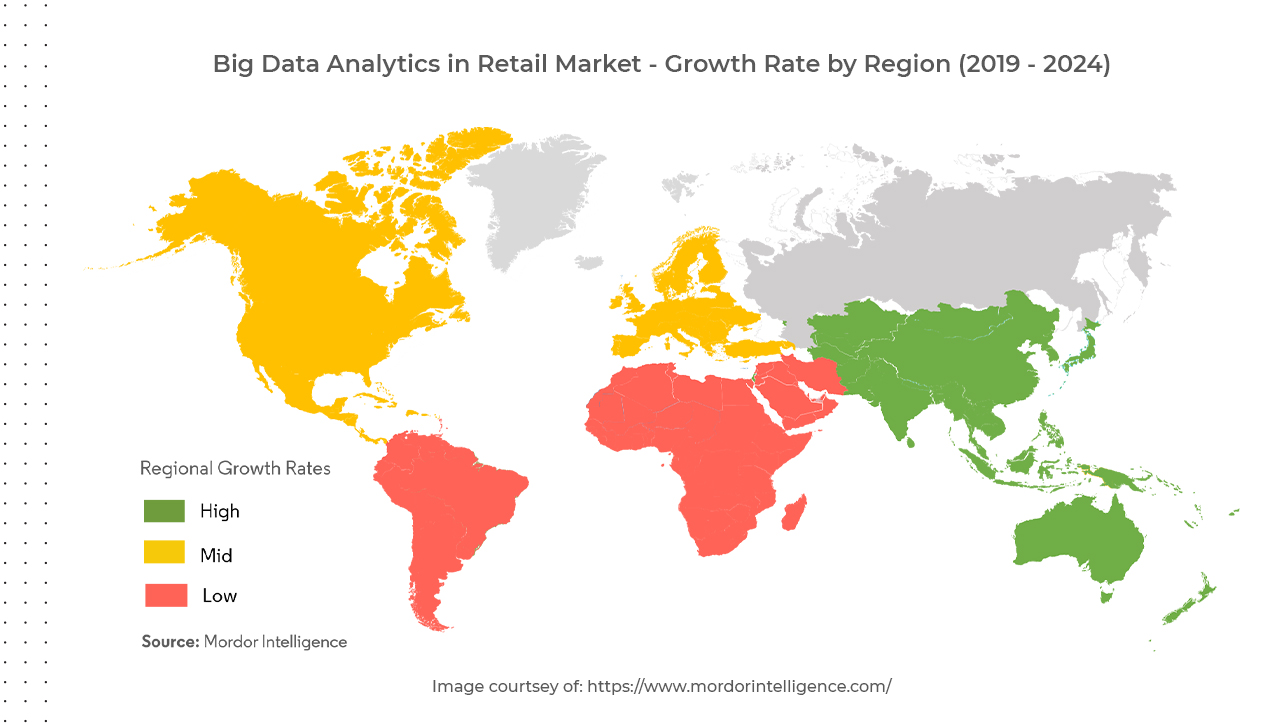
Big data analytics in the retail market
Big data analytics in the retail market is expected to reach USD 13.26 billion by the end of 2026, registering a CAGR of 21.20% during the forecast period (2021-2026). The growth of analytics in retail depicts how it can help companies run businesses more efficiently, make data-backed choices, and deliver improved customer service.
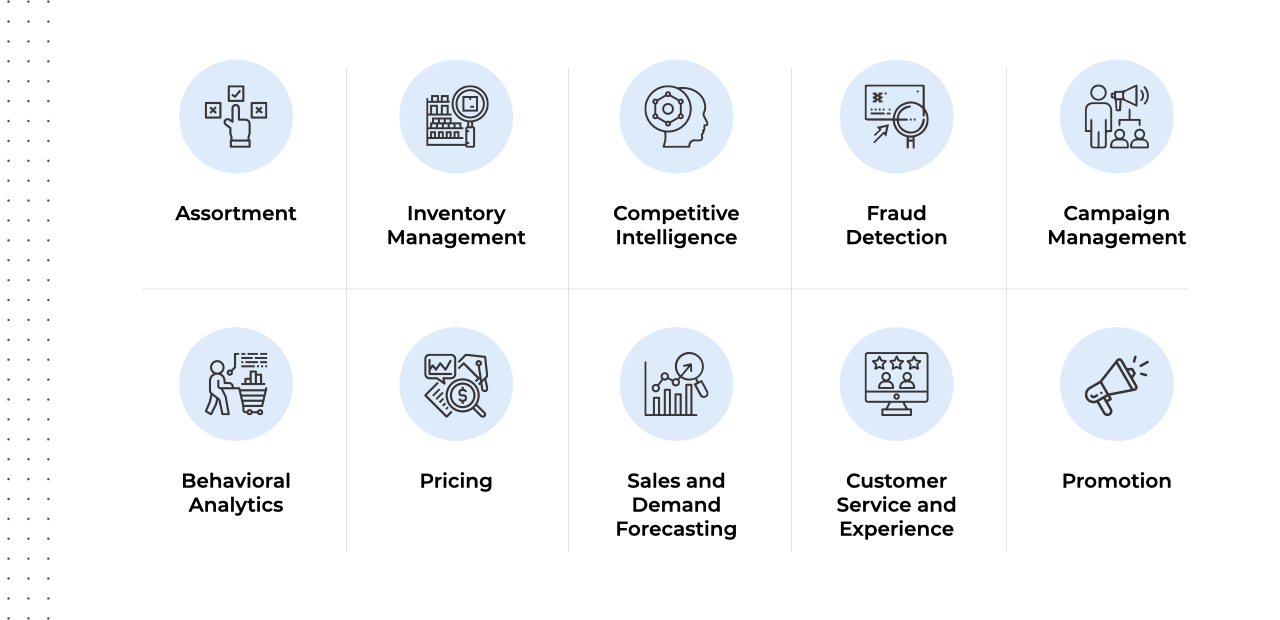
In this blog, we’ll discuss the top 10 analytics that retailers are using to gain a competitive advantage in accurately evaluating business & market performance.
Top 10 of Retail Analytics You Must Know
1. Assortment
Assortment planning allows retailers to choose the right breadth (product categories) and depth (product variation within each category) for their retail or online stores. Assortment management has grown beyond simple performance metrics like total sales or rotation numbers. Instead, retail analytics offers a comprehensive analysis of product merchandise and an estimated number of units at the push of a button. Retailers that effectively apply assortment analytics can enjoy increased gross margins and prevent significant losses from overstocks sold at discounted prices or out-of-stock inventory leading their customers to buy from competitors.
It also helps retailers gain insights into the trendy and discoverable brands and products on all e-commerce websites across the globe. They can boost sales by making sure they have an in-demand product assortment. They can also track pricing information and attributes common across popular products to drive their pricing and promotion strategies.
2. Inventory Management
An inadequately maintained inventory is every retailer’s worst nightmare. It represents a poor indicator of inadequate demand for a product and leads to a loss in sales. Data can help companies answer issues like what to store and what to discard. It’s beneficial to discard or increase offers on products that are not generating sales and keep replenished stocks of popular items.
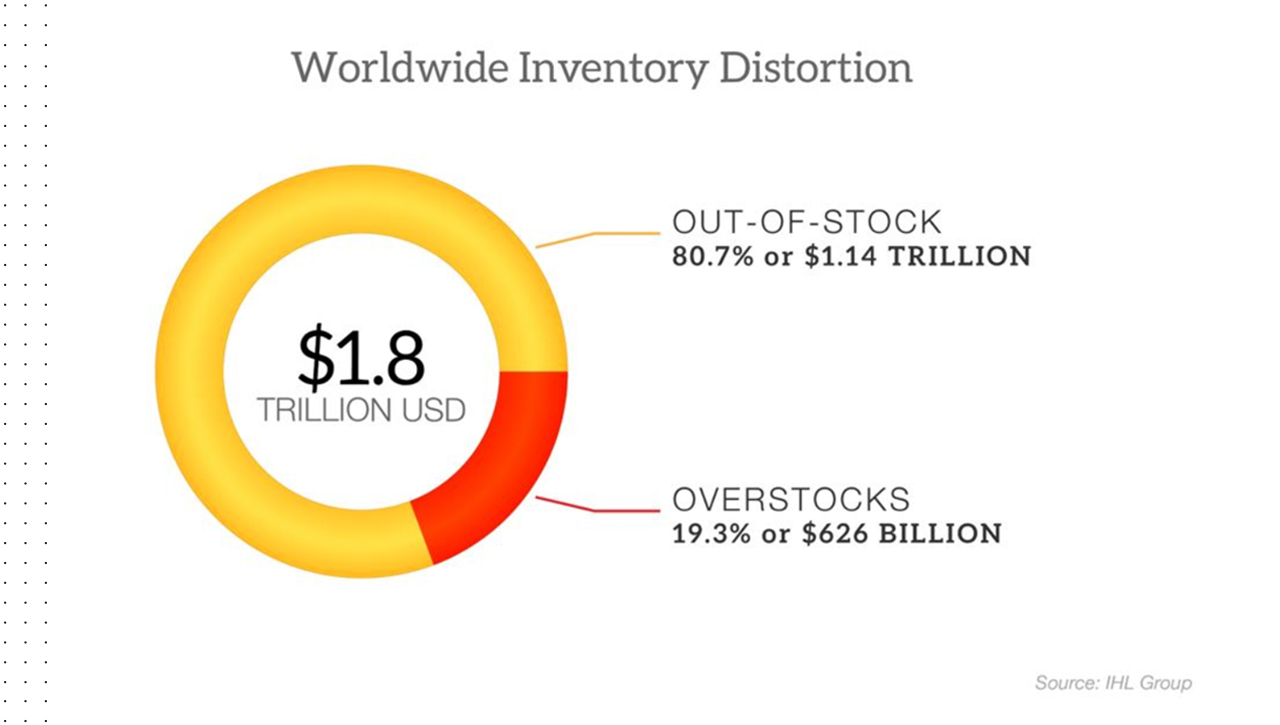
In 2020, the estimated value for out-of-stock items ($1.14 trillion) was double that of overstock items ($626 billion). A similar trend was especially prominent in grocery stores, where out-of-stock items were worth five times more than overstock items.
Unavailability of high-selling products can lead to reduced sales, ultimately generating incorrect data for future forecasting and producing skewed demand and supply insights. Retailers can now use analytics to identify which products are in demand, which are moving slowly, and which ones contribute to dead stock. They can know in real-time if a high-demand product is unavailable at a specific location and take action to increase the stock. Retailers can use this historical data to predict what to stock, at what place, time, and cost to maintain and optimize revenue. It helps satisfy consumer needs, prevents loss of sales, reduces inventory cost, and streamlines the complete supply chain.
3. Competitive Intelligence
Market intelligence & Competitive Insights
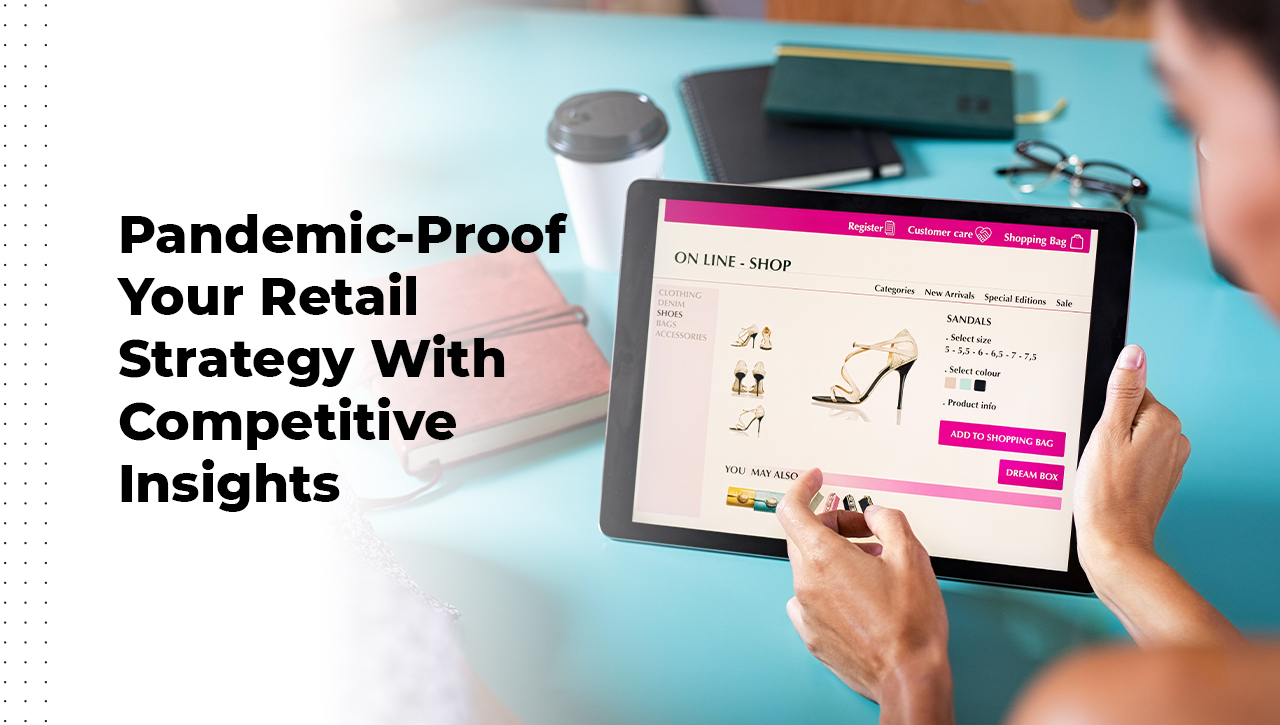
The ability to accurately predict trends after the global pandemic and with an unknown economic future is becoming the cornerstone for successful retailers. Smart retailers know how important it is to Pandemic-Proof their retail strategy with Market Intelligence & Competitive Insights
With 90% of Fortune 500 companies using competitive intelligence, it’s an essential tool to gain an advantage over industry competitors. Competitive Intelligence allows you to gather and analyze information about your competitors and understand the market–providing valuable insights that you can apply to your own business. A more strategic competitor analysis will explain brand affinities and provide insights on what to keep in stock and when to start promotions. Customer movement data will also give you access to where your customers are shopping.
4. Fraud Detection
Fraud Detection
Retailers have been in a constant struggle with fraud detection and prevention since time immemorial. Fraudulent products lead to substantial financial losses and damage the reputation of both brands and retailers. Every $1 of fraud now costs U.S. retail and eCommerce merchants $3.60, a 15% growth since the pre-Covid study in 2019, which was $3.13. Retail Analytics acts as a guardian against fraudsters by constantly monitoring, identifying, and flagging fraud products and sellers.
5. Campaign Management
Some of the challenges of the retail industry are that it’s seasonal, promotion-based, highly competitive, and fast-moving. In today’s competitive marketplace, consumers compare prices and expect personalized shopping experiences. Campaign management allows marketing teams to plan, track, and analyze marketing strategies for promoting products and attracting audiences. Retail analytics can help businesses predict consumer behavior, improve decision-making across the company, and determine the ROI of their marketing efforts.
According to Invesp, 64% of marketing executives “strongly agree” that data-driven marketing is crucial in the economy. Retail analytics can help businesses analyze their data to learn about their customers with target precision. With predictive analysis, retailers can design campaigns that encourage consumers to interact with the brand, move down the sales funnel, and ultimately convert.
6. Behavioral Analytics
Retail firms often look to improve customer conversion rates, personalize marketing campaigns to increase revenue, predict and avoid customer churn, and lower customer acquisition costs. Data-driven insights on customer shopping behaviors can help companies tackle these challenges. However, several interaction points like social media, mobile, e-commerce sites, stores, and more, cause a substantial increase in the complexity and diversity of data to accumulate and analyze.
Insider Intelligence forecasts that m-eCommerce volume will rise at 25.5% (CAGR) until 2024, hitting $488 billion in sales, or 44% of all e-commerce transactions.
Data can provide valuable insights, for example, recognizing your high-value customers, their motives behind the purchase, their buying patterns, behaviors, and which are the best channels to market to them and when. Having these detailed insights increases the probability of customer acquisition and perhaps drives their loyalty towards you.
7. Pricing
Competitive pricing in retail
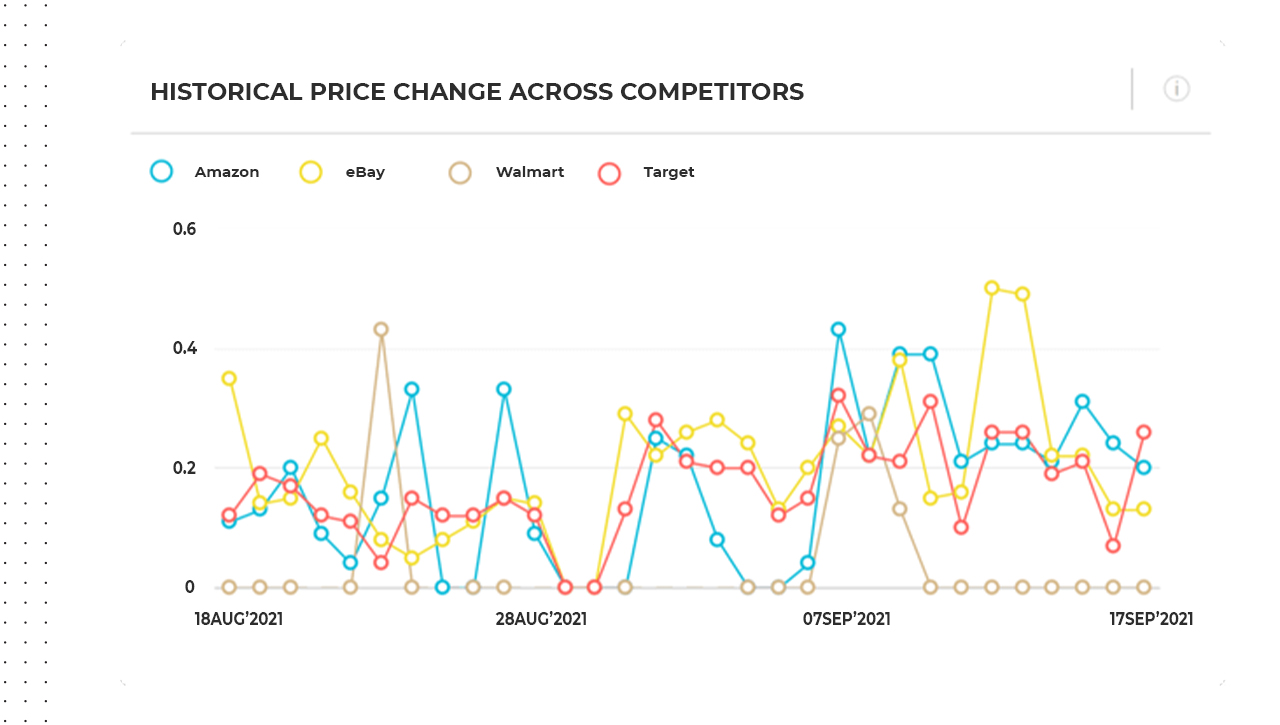
Market trends fluctuate at an unprecedented pace, and pricing has become as competitive as it’s ever been. The only way to keep up with competitive pricing in retail is to use retail analytics that enables retailers to drive more revenue & margin by pricing products competitively.
A report from Inside Big Data found companies experience anywhere from 0.5% up to 17.1% in margin loss purely because of pricing errors. Pricing analytics provides companies with the tools and methods to perceive better, interpret and predict pricing that matches consumer behavior. Appropriate pricing power comes from understanding what your consumers want, which offers they respond to, how and where they shop, and how much they will pay for your products.
In 2021, the price optimization segment is anticipated to own the largest share of the overall retail analytics market. Retailers can identify gaps and set alerts to track changes across crucial SKUs or products with pricing analytics. Knowing your customer’s price perception will increase sales and also allow you to design promotions that’ll attract customers. Pricing analytics also accounts for factors like demographics, weather forecasting, inventory levels, real-time sales data, product movement, purchase history, and much more to arrive at an excellent price.
8. Sales and Demand Forecasting
Sales and demand forecasting allow retailers to plan for levels of granularity—monthly, weekly, daily, or even hourly—and use the insights in their marketing campaigns and business decisions. The benefits of a granular forecast are apparent since retailers don’t have to bank on historical data of previous clients and customers to predict revenues. Retailers can plan their strategies and promotions that suit their customer’s demands.
With sales and demand forecasting, retailers can also consider the most recent, historical, and real-time data to predict potential future revenue. Sales and demand analytics can predict buying patterns and market trends based on socioeconomic and demographic conditions.
9. Customer Service and Experience
With the development of eCommerce, more and more customers prefer to browse and interact with the product before purchasing online. They look for better deals and discounts across stores and platforms. 3 out of 5 consumers say retail’s investment in technology is improving their online and in-store shopping experiences. To enhance merchandising and marketing strategies, retailers can gather data on customer buying journeys to understand their in-store and online experiences.
Retailers can run test campaigns to know the impact on sales and use historical data to predict consumers’ needs based on their demographics, buying patterns, and interests. Retail analytics help retailers to bring more efficiency in promotions and drive impulsive purchases and cross-selling.
10. Promotion
Analyze Competitors’ Promotions
Promotions are potent sales drivers and need to be cleverly targeted towards specific customers with precise deals to generate outstanding sales. Retail analytics allows companies to study their customers and competitors to a vastly elevated level.
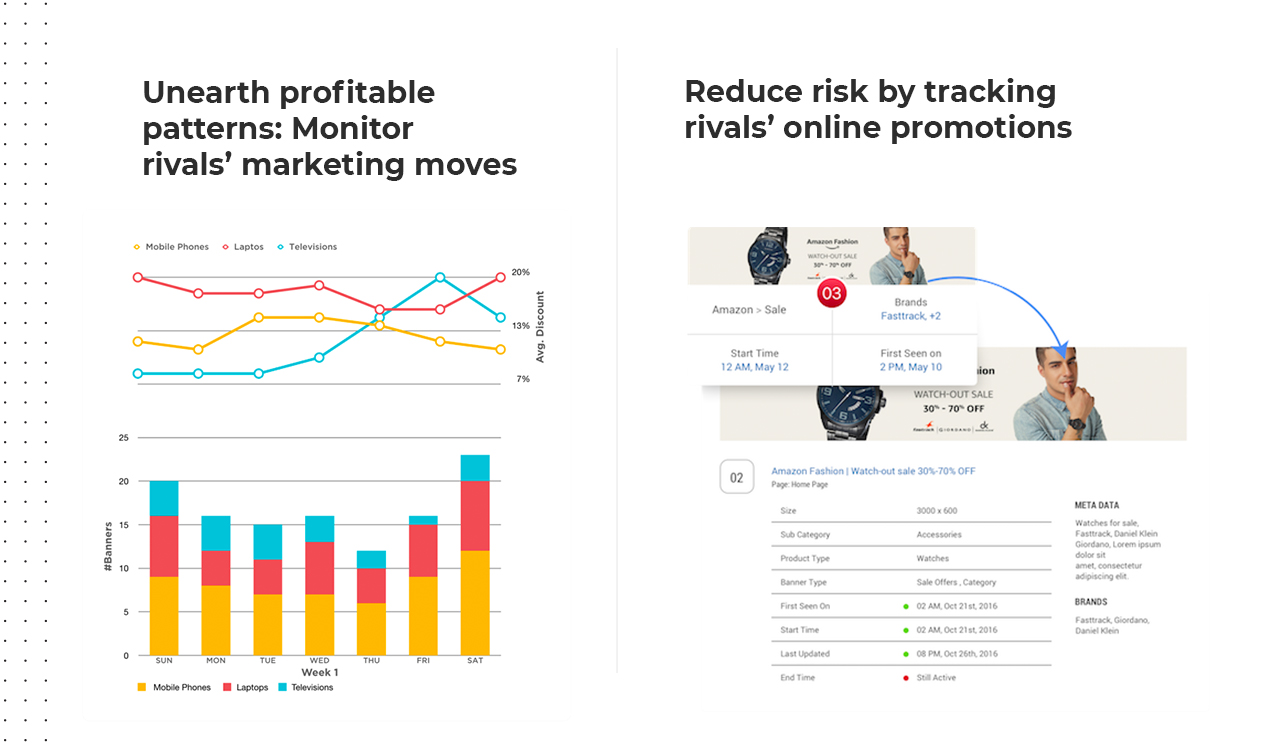
To be an industry leader, retail companies not only have to understand their customers, but they must also analyze competitors’ promotions to improve their marketing strategies. Analyzing your competitor’s promotional banners, ads, and marketing campaigns are no more associated with imitation.
With data analytics and AI, retailers can watch their competitors’ commercialization strategies. It can uncover vital information about their target audience, sales volume fluctuations, popular seasonal product types, product attributes of popular items, and significant industry trends. Knowing exactly which products and brands are popular among your competitor’s campaigns can help retailers improve their promotional strategies.
Conclusion
The benefits of retail analytics are spread across various verticals, from merchandising, assortment, inventory management, and marketing to reducing losses. The need for analytics has become even more apparent considering the growing eCommerce platforms, changing customer buying journeys, and the complexity of the industry. Understanding which products sell best among which customers will help retailers to deliver an optimized shopping experience.
Want to drive profitable growth by making smarter pricing, promotions, and product merchandising decisions using real-time retail insights? DataWeave’s AI-powered Competitive Intelligence can help! Reach out to our Retail Analytics experts to know more.
Counterfeits pose a dangerous threat to any retail brand. Since every single sale is a pivotal branding opportunity, especially for young, burgeoning eCommerce brands, an online marketplace flooded with counterfeits can be particularly dangerous. One in five customers will boycott a brand after mistakenly purchasing a counterfeit product, and that’s not the kind of ratio that any retailer –– from the smallest Direct-to-Consumer (DTC) site to the behemoths like Amazon –– can afford to ignore.
In the age of online reviews, it’s especially dangerous to have counterfeits floating around. Customers that have a bad experience with a counterfeit can take to the internet to disparage your brand without ever actually interacting with your company or trying your product. That’s why consistent and thorough content audits are paramount to ensuring your brand’s authentic products are highly discoverable, and brand protection and governance processes are in place to safeguard brand integrity across all applicable eCommerce websites.
The Holiday Counterfeit Boom
The holidays are a time when customers search for gifts for their friends and family, which means exploring brands outside of their usual fare. Many consumers will be exposed to your brand’s Digital Shelf for the first time over the holiday season, creating an opportunity for brand growth. But if you don’t have eCommerce brand protection initiatives in place, the holidays can be detrimental to brand positioning, customer trust, and your bottom line.
As consumers boost their online spending and web traffic increases over the holidays, so does the likelihood of them purchasing counterfeit goods online. eMarketer predicts that retail eCommerce sales will comprise almost 20 percent of total holiday retail sales this year. As such, there will also be a surge in counterfeit inventory. So, this is an ideal time to invest in a brand protection solution to help you stay ahead of unauthorized sellers entering the marketplace.
Brand Integrity Helps Suppliers Save
Implementing a solution to mitigate the risks of counterfeit products should be at the top of every retailer’s “To-Do” list this year. However, for many retailers, this means manually reviewing numerous websites and third-party marketplaces for violations. Not only is manually reviewing content, images, and seller authenticity a time-consuming process, but it also leaves a lot of room for human error – making it possible for counterfeits to slip through the cracks and into the hands of unsuspecting customers. Not to mention your time should be spent fulfilling orders and increasing customer satisfaction during the high-traffic holiday season, not distracted by monitoring counterfeits.
Fortunately, that’s not the only way to identify counterfeits and protect your brand online. An effective content auditing tool can help you monitor, detect, and determine systems to identify and act on identified violations, saving time and labor hours normally spent on manual auditing processes. Content audit software also often contains helpful features to help you run your business more strategically by monitoring online hygiene factors like product titles and description. It works across all online channels by highlighting content gaps, which can then be remedied to improve product visibility and conversions. Through online content optimization, you can save money (in unnecessary labor costs), improve your Share of Search, and increase sales and share, with a modest up-front investment.
Brand Value Protection Boosts Consumer Confidence
Brand image protection doesn’t just protect retailers, it also protects customers from unintentionally buying dangerous counterfeit goods. Counterfeiting has skyrocketed during the pandemic. The International Chamber of Commerce reports that, by 2022, counterfeit goods will be a $4.2 trillion industry, and global damage from counterfeit goods is projected to exceed $323 billion. Studies show one in four customers has unknowingly purchased a counterfeit item online.
As counterfeits increase in number, so does the risk of counterfeit consumption by unwitting consumers. Counterfeit goods are as dangerous as they are ubiquitous. Customs and Border Patrol has found ingredients such as cadmium, arsenic, lead, and cyanide inside of counterfeit cosmetics. Consumers are aware of these risks. So, as a retailer, you need to be able to reassure customers that they can trust the authenticity of the goods they are purchasing at your online store.
A counterfeit detection tool can help you identify fakes and image replicas across multiple online marketplaces, so you can get fake products delisted. Automated counterfeit solutions can increase customer satisfaction in their purchasing experience, since they know they’re getting an authentic product right off the bat. This type of online brand protection creates increased brand loyalty over time, as well as more positive first-time product interactions.
Making a Measurable Impact: A Counterfeit Detection Case Study
Classic Accessories is a leading manufacturer of high-quality furnishings and accessories. The company’s investment in a counterfeit detection tool paid off in spades for their organization. After noticing a surge in counterfeit versions of their goods being sold via online, global marketplaces, they decided they needed to change their manual counterfeit and image violation detection process to an automated one to proactively respond to concerned activity in a timely manner.
Their goal was to achieve streamlined, actionable insights across all retail websites to account for varied violation submission processes, and to reduce the timespan in which insights were generated, ultimately eliminating the need to conduct daily, manual audits. They partnered with DataWeave, who built out a fully customized program to automate Classic Accessories’ content inventory management process, and identified SKU-level violations by matching names and images in diverse online marketplaces.
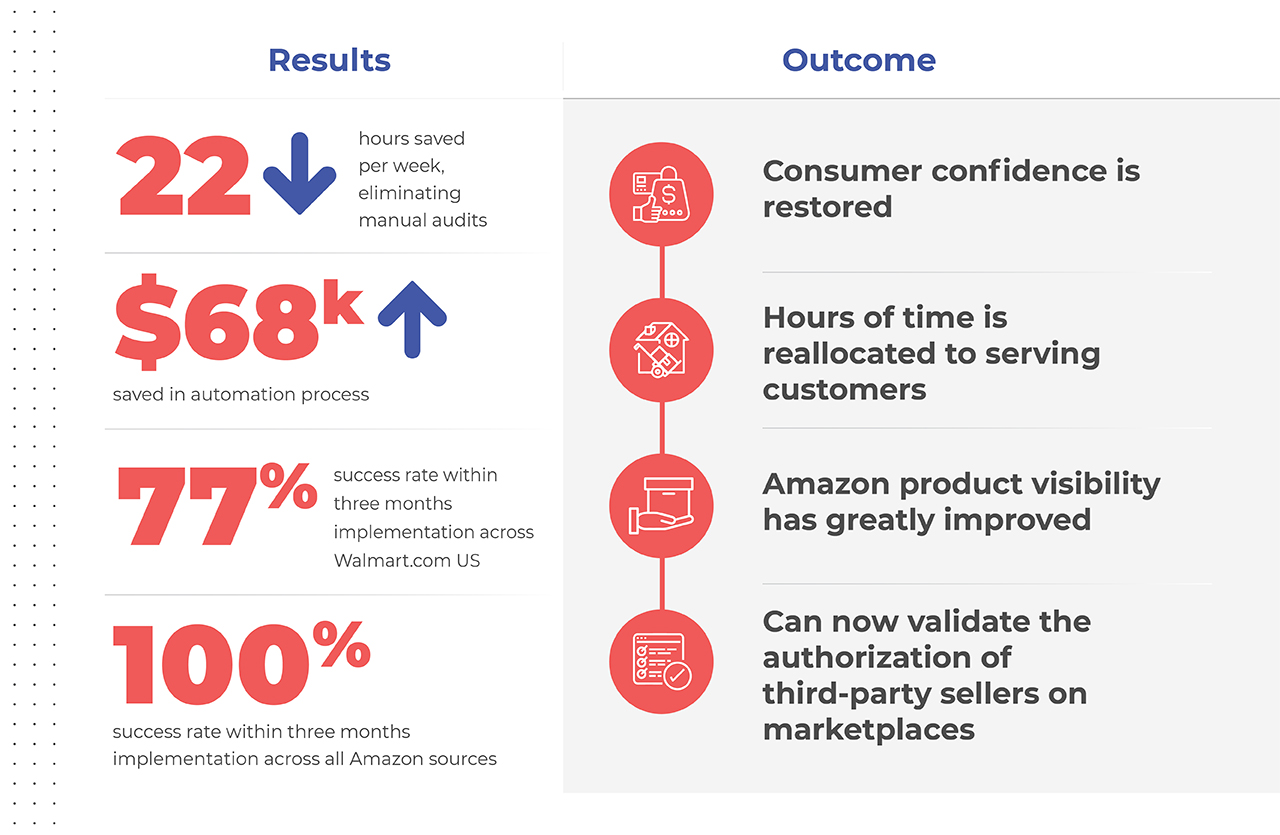
During the first three months of onboarding, Classic Accessories was able to detect more than 25,000 violations, submitting notices to each marketplace, and even achieved a 100% removal rate across all Amazon sources. Additionally, they also achieved their goal of saving time (22 hours per week) in automation processes, translating to a $68,000 savings opportunity in labor costs.
Closing Thoughts
Prioritizing your online brand protection strategy is imperative to growing your online presence and achieving customer satisfaction and brand loyalty. Fortunately, there are options like DataWeave’s brand protection tool available to help curate your online content, provide consistency across online channels, and improve consumer confidence by addressing and removing counterfeit violations. Implementing the right solution can help find counterfeit products in real-time to keep your brand safe –– and your reputation intact –– throughout the 2021 holiday season. The right brand protection software will provide both Brand Protection and Content Audits, so your brand is optimized from every possible angle for truly competitive results.
As per recent research conducted by Deloitte, approximately 81% of consumers use reviews to make purchase decisions. Reviews work like social testimonials. They are credible recommendations, as a vote of confidence from an existing customer. And when satisfied customers express themselves through the right words, automatically your product gets a boost.
In case you’re thinking, ‘who has time to read through each and every review?’ Put a pause to your thought, because more than 70% of people regularly or occasionally read online reviews, and 19% of US shoppers trust online reviews as much as a personal recommendation. Online reviews matter and for brands that are selling online, this is becoming a big deciding ground, contributing to sales.
Let’s go a little deeper and take a look at why good Ratings and Reviews are important for your eCommerce sales.
1. Use your customer’s voice as a marketing tool!
Reviews have emerged as a new and effective product promotional tool that never fails to attract the right audience. Even standalone, reviews or word-of-mouth from real users have always been the hook for consumers, so using reviews in your marketing amps up the impact. And the best part is, that it is absolutely free and user-generated!
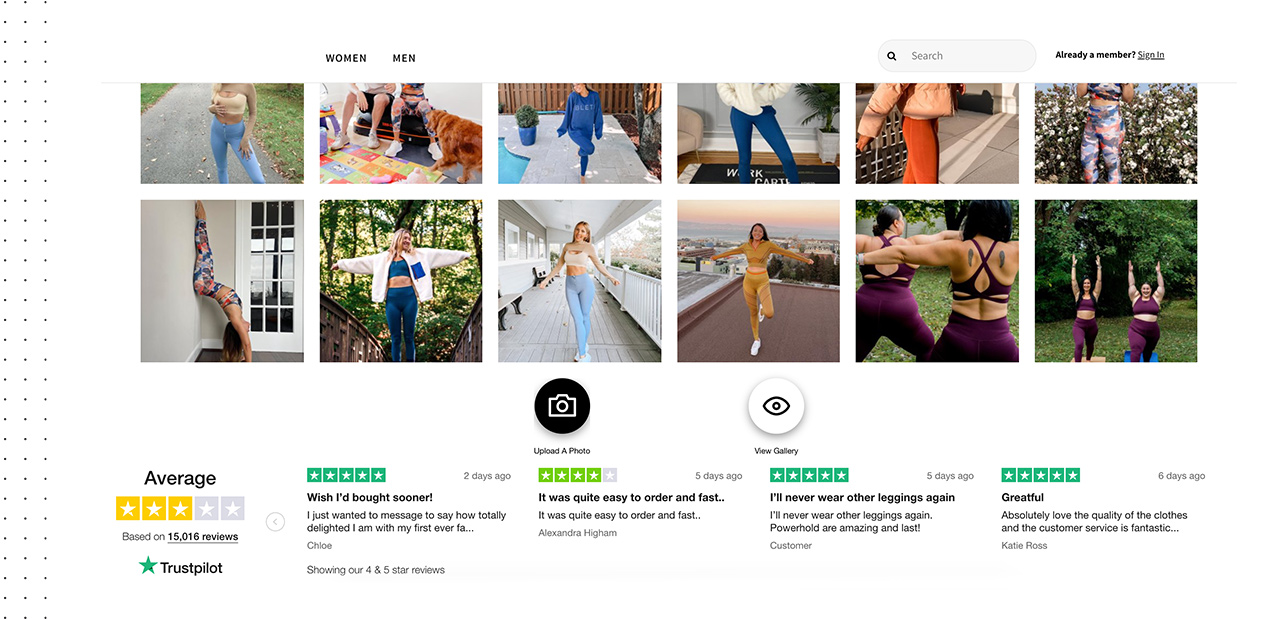
Here’s how Fabletics in the UK is using reviews for marketing – they’ve brought these customer testimonials right onto their website homepage! These attention-grabbing reviews showcase the voice of their existing customers and serve as the main influence for future customers that visit their website and want to know more about their brand offerings.
Fabletics website
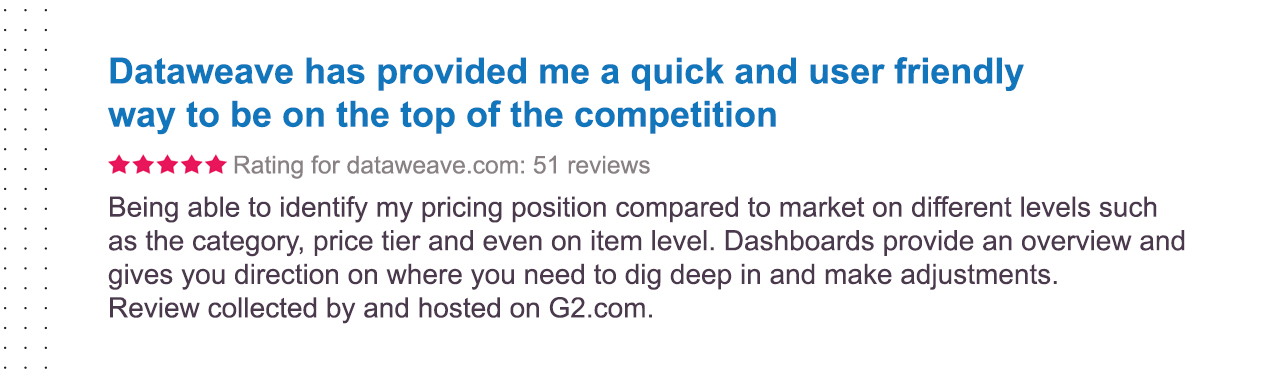
Using reviews in Search ads is another really impactful way to amplify your customer’s voice and confidence in your brand. Here’s a sample of how we at DataWeave could use our fantastic G2 reviews to build out a Search ad.
G2 Review
2. Use Reviews & Ratings to influence buying decisions
Product page from Suja website
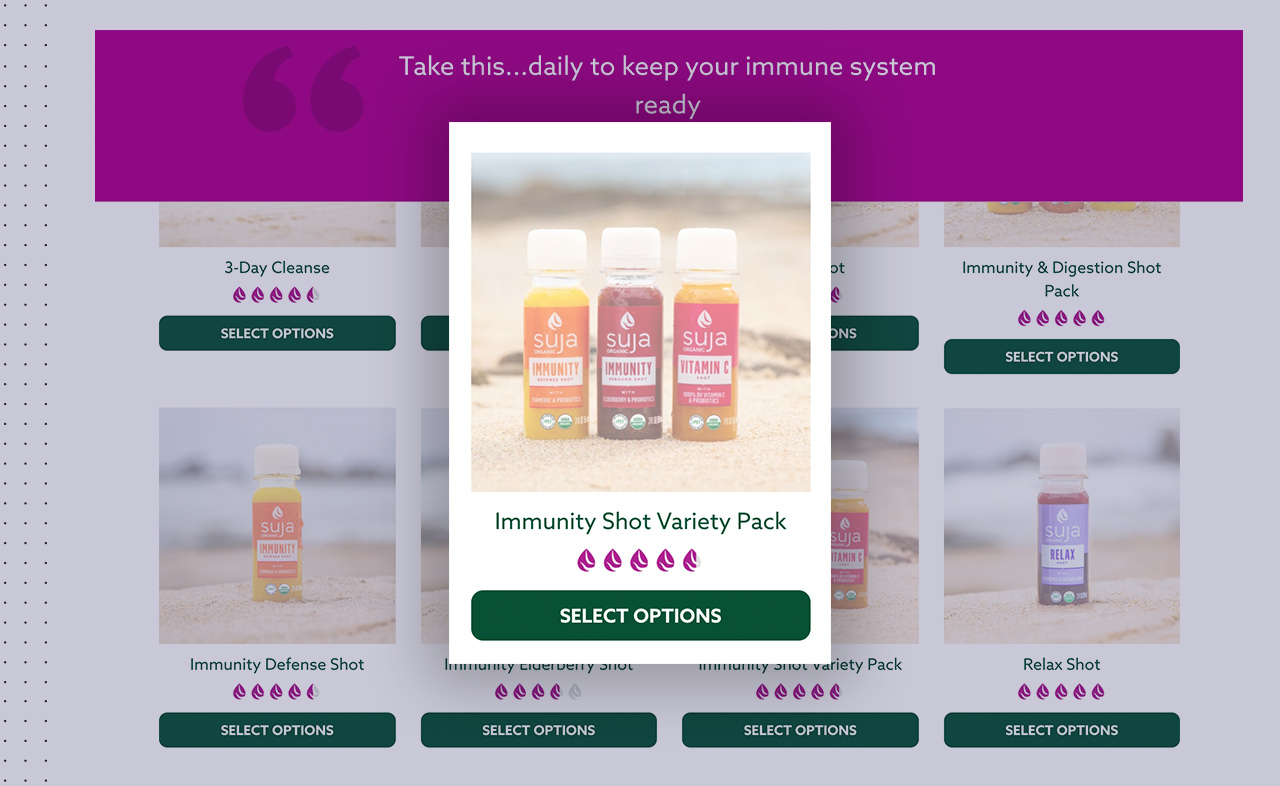
Display your reviews upfront. Help consumers make their purchase decision easier. Take for instance Suja, a cold-pressed juice brand. Suja converts user ratings and reviews into scores for each of their organic drinks and displays it right below the product, so at one glance users know which products have high reviews and which don’t. This further eases purchase decisions and every customer can decide on the variant right at the product page and then add it to the cart if it meets their expectations.
3. Positive reviews impact your brand’s conversion rate
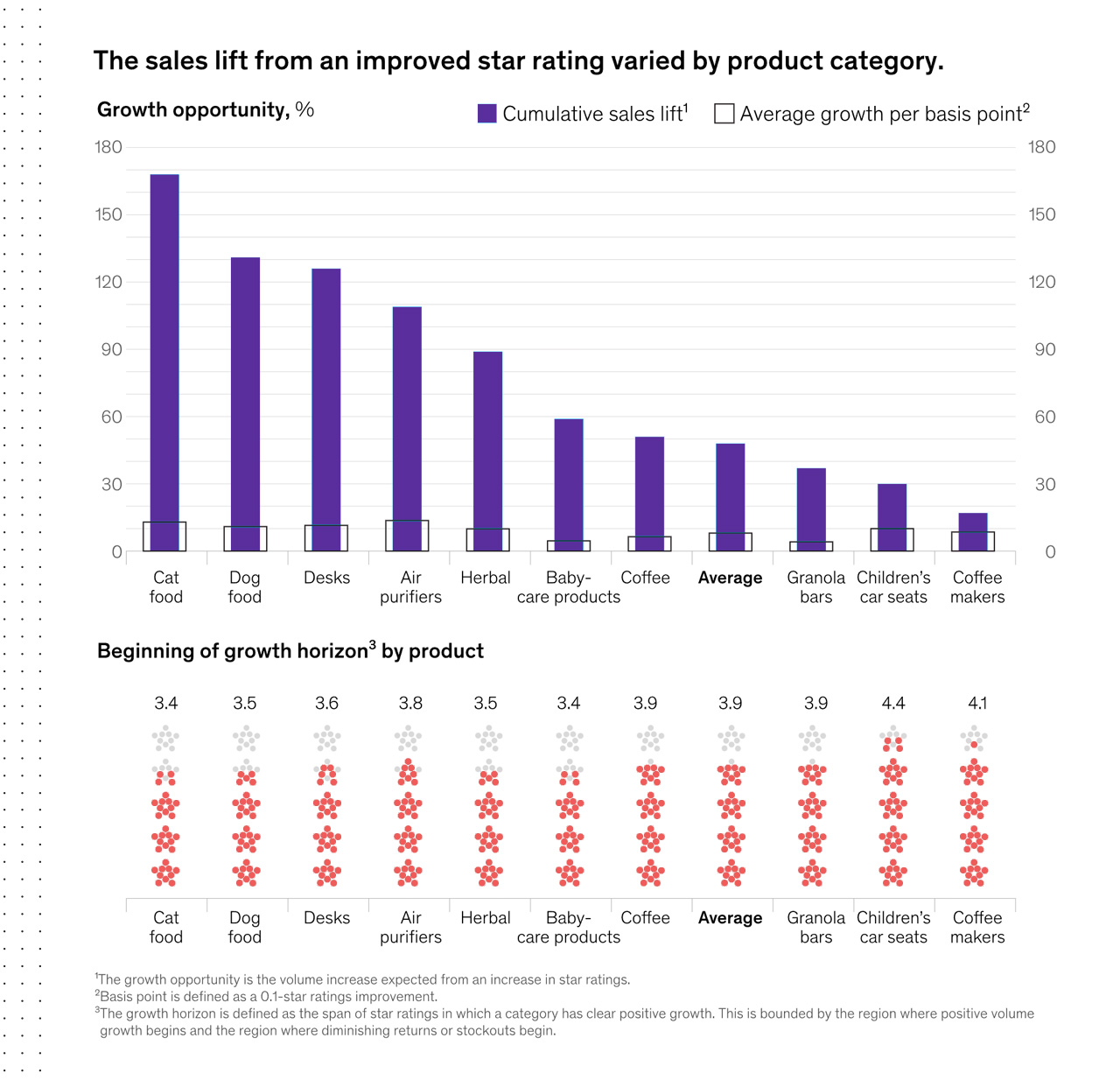
Experts say that 50 or more reviews per product can mean a 4.6% increase in conversion rates. McKinsey has attempted to quantify the relationship between reviews and conversion rates by analyzing reviews and ratings across the 70 highest-selling categories on a major online platform. After tracking hundreds of thousands of individual SKUs over a two-year time span, they found out that the correlation between star ratings and product sales was positive in 55 of the 70 categories they examined. In fact, a jump in rating was also seen to add to the conversion rates growing. Loyalty drives ratings and that, in turn, leads to positive conversions.
Negative or fewer ratings can directly impact sales. We at DataWeave can help Brands adapt to consumer feedback by tracking their reviews and rating.
4. Use honest & transparent reviews to build trust, including negative reviews.
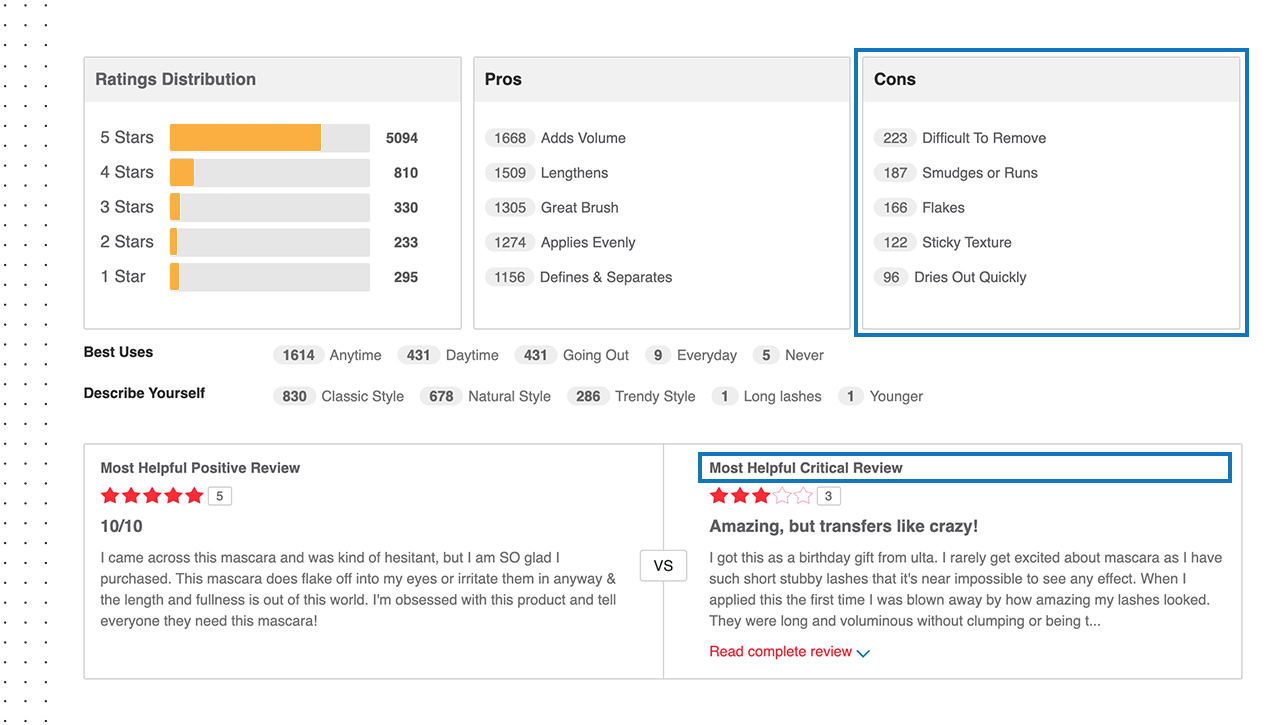
Take for instance this detailed review for a Lancôme mascara on Ulta Beauty. It not only gives the user a ready guide to the product they are eyeing but also makes the brand come out very transparent and believable, courtesy of the cons & negative reviews on display. This helps build a relationship of trust with customers across the board. Various studies have been conducted where consumers said when looking at reviews of businesses, they would trust the company less if there were no negative reviews on display. And they said the probability of every single customer having a four or five-star experience just isn’t believable – this would cause suspicion and has a strong potential of turning them away from making a purchase. Consumers clearly want the real story about a brand or business and not just a rosy picture.
5 Ratings and reviews can boost SEO
Use ratings and reviews to structure the entire listing
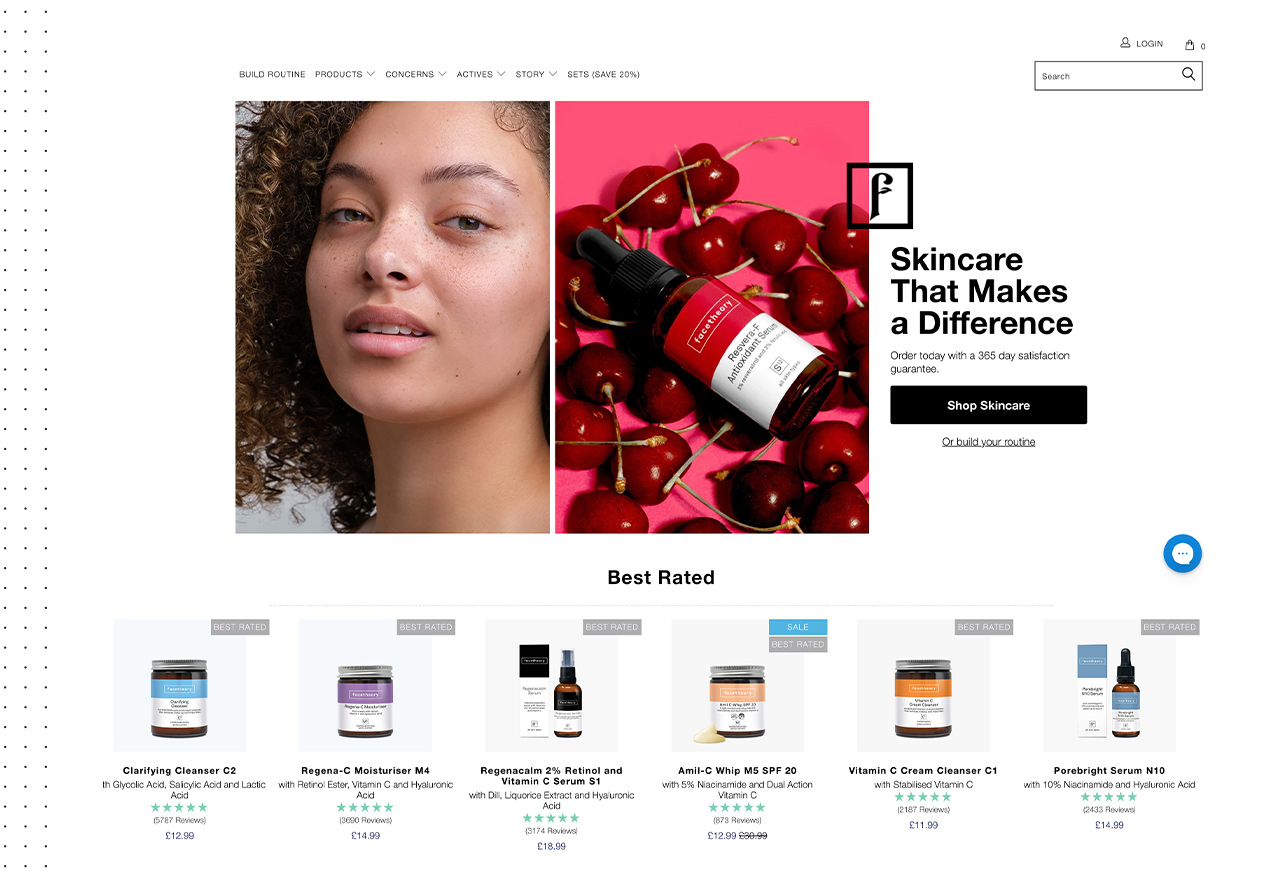
Online reviews are estimated to make up 10% of the criteria Google algorithms use when displaying search results. Every brand understands the importance of putting SEO-optimized content online via blogs & an array of other content marketing activities. Reviews can contribute to that cause too! User-generated content like reviews can work as a ready stream of optimized content, which Google can crawl to rank products higher in search. What is interesting is that buyers when posting a review for products are bound to mention the brand name and use certain words to describe their experience, which subconsciously in most cases become the right keywords! This actually then turns into organically generated authentic, keyword-optimized content. In fact, brands can collect and use rich snippets of reviews on their website or use it for marketing purposes to further optimize listings on Google. Take for Instance Face Theory, they use ratings and reviews to structure the entire listing for their own e-commerce website. This helps them rank higher in search on Google and even on Amazon.
#6 Understand Customer Sentiment via reviews
Consumers use reviews to make purchase decisions. On the flip side, what’s interesting is that brands can also gauge their consumers through reviews or feedbacks they submit. This feedback helps brands align with the ground reality of how consumers really feel about their products. And by synthesizing & breaking down reviews across channels, brands can work towards bringing more innovation and personalization for their customer, just the way they want.
Understand Customer Sentiment via reviews
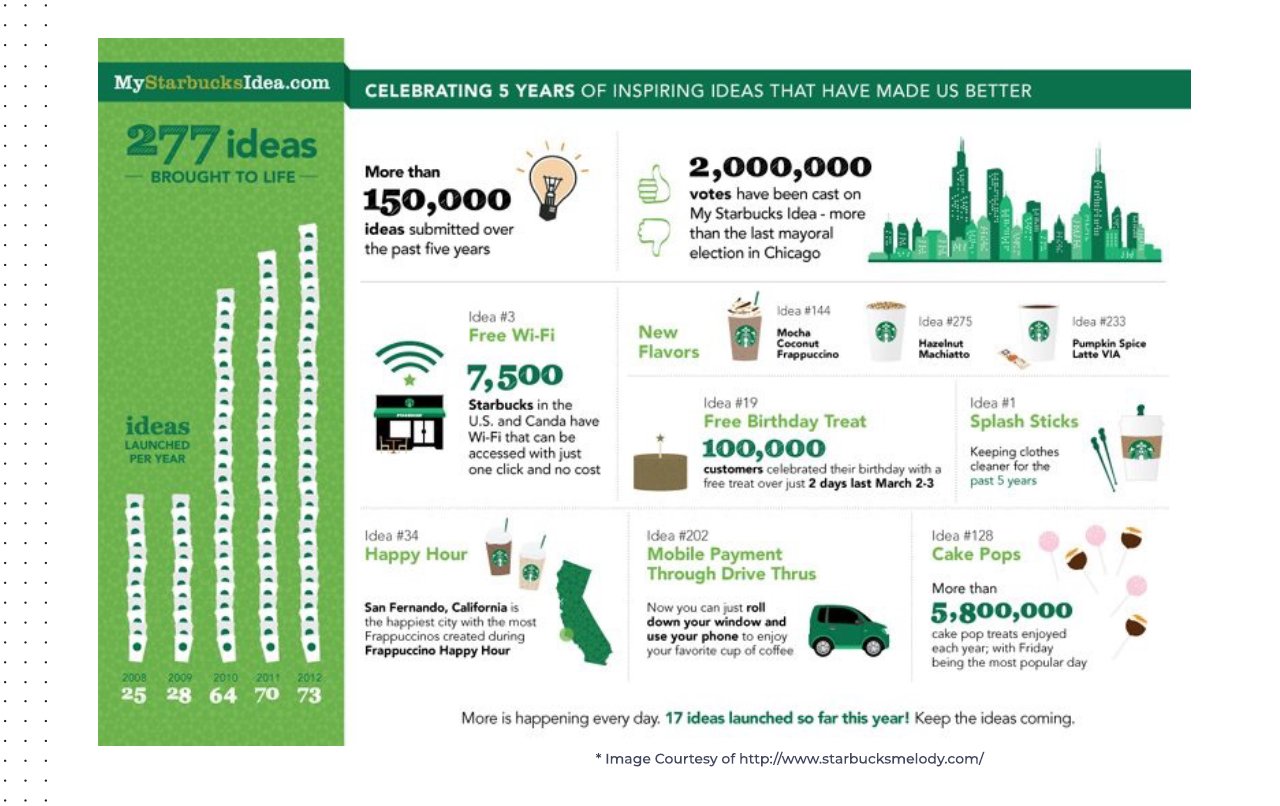
Take, for instance, Starbucks, a leading international coffee chain introduced MyStarbucksIdea in 2008. This was an instant hit and Starbucks customers within just the first five years of operation, shared over 150,000 ideas and recommendations to the brand, and the company put hundreds of them to use. This is a real case of a brand becoming an advocate to customer sentiments to drive its innovations directly from the core of ideas and reviews submitted by discerning customers.
In today’s scenario, brands do not need elaborate programs like MyStarbucksIdea, they can simply ask customers for their ideas, thoughts, and suggestions via online reviews across numerous platforms! The only task from there is on is collecting and analyzing these reviews to glean insights.
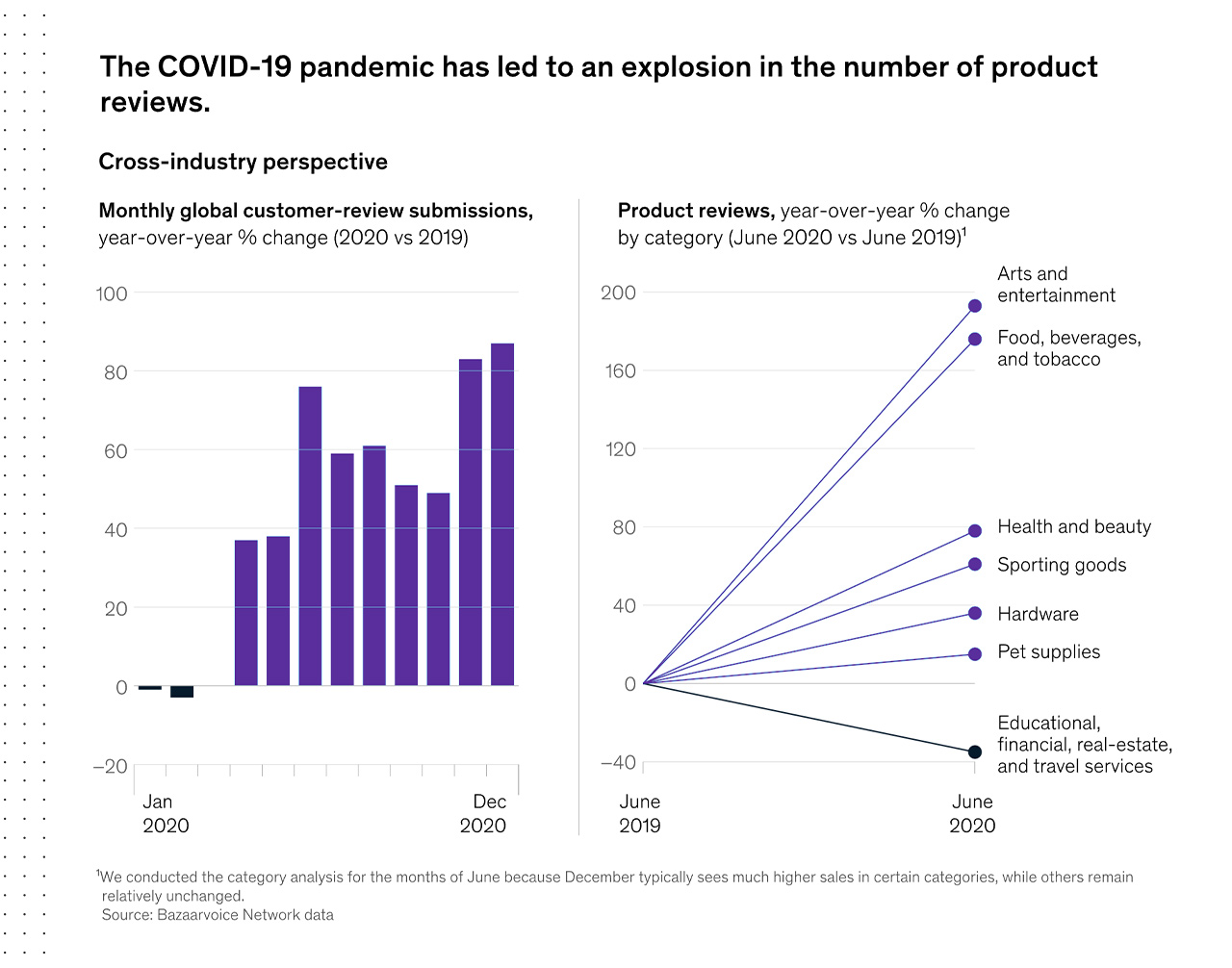
The new normal has led to an explosion of product reviews as more and more people shop online. In the US alone reviews were 40 – 80% higher during the core months of the pandemic in 2020 as compared to 2019.
Reviews matter, and even more so now. Brands need to build it as part of their actionable strategies and incentivize consumers to rate and review products with each purchase.
Need help tracking your online ratings? Or decoding customer sentiment from reviews they’ve left for your products? Sign up for a demo with our team to know how DataWeave can help!
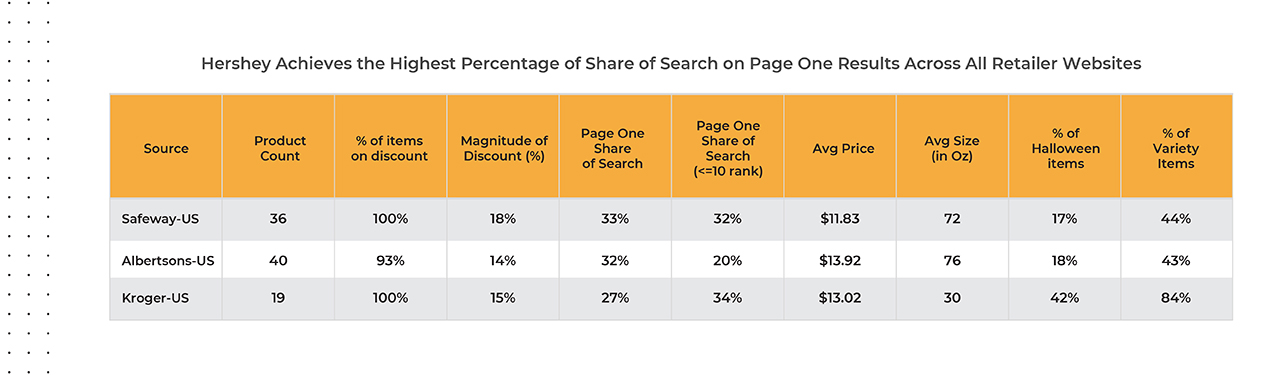
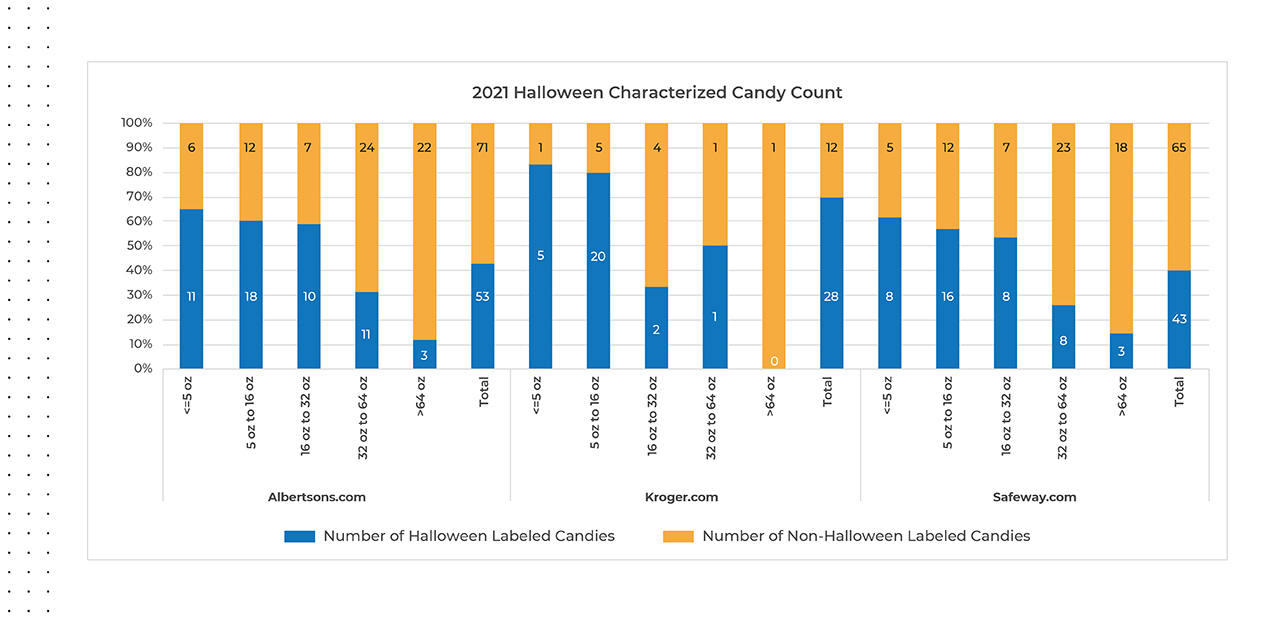
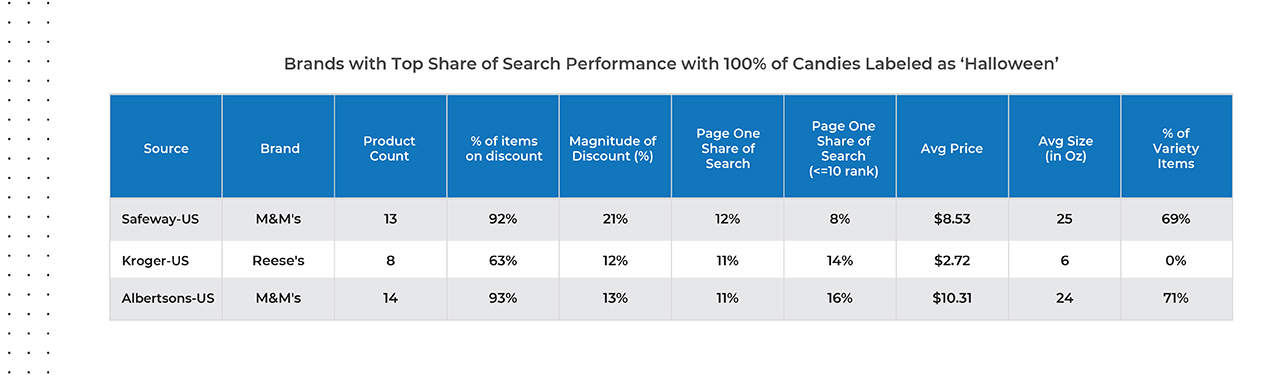
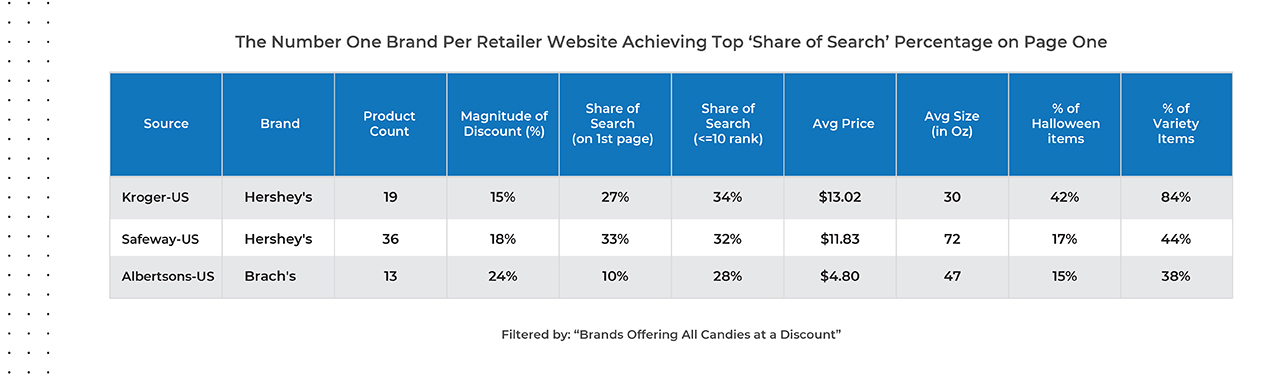
Lessons from Kroger, Albertson’s, and Safeway’s Optimized Online Positioning
As consumers continue their migration to online shopping through and after the pandemic, Halloween shopping is no exception.
If that’s the new paradigm, what clues should retailers and brands be looking for to enhance their sales? With Halloween around the corner, the analyst team at DataWeave wanted to see how successfully grocers are partnering with brands to prepare for the influx of online Halloween shoppers. We tracked insights from September 14 to 24, 2021, using data from Kroger, Albertson’s, and Safeway websites to understand the preparedness of each retailer, their partnered brands, and how their online strategies compare with one another.
There are hundreds of ways for a consumer to search for a brand’s products online and of critical importance, almost 50 percent of traffic across the top 1000 retailers come through search. At the same time, consumers are becoming less brand conscious. This is a significant development, and there are significant ramifications to consumers searching for products using generic category specific keywords without including brand names in the search. Consequently, we can’t sufficiently stress how understanding online channel experiences is critical to successful outcomes. Retailers and brands alike need an integrated view of how to improve their discoverability and share of search by considering all touchpoints in the digital commerce ecosystem.
The Importance of Product Descriptions, Assortment, Sizes, Price Points
With 75 percent of people never scrolling past the first page of a website when searching for the goods they desire, getting products to page one is imperative to a brand’s success. While in-store, festive displays will help drive traffic and availability awareness, the ‘digital shelf’ is a totally different locus of opportunity. Here, brands rely on proper product descriptions, the right assortment, sizes, and competitive price points to stand out among the crowd and modify their positioning, given each retailer’s consumer base and assorted competitive brands.
Optimizing the Digital Shelf and leading Share of Search for page one across all retail websites isn’t achievable overnight, but it is never too early or too late to start, given the 24/7 visibility your products have online. When it comes to Halloween candies, confectionery brands must consider many factors when differentiating their online positioning, such as finding the ‘sweet spot’ for pricing, size, and variety within each product offered, and knowing the right and wrong times to drive promotions. Additional elements to consider when introducing seasonal candies include cannibalization of non-holiday inventory, which can increase spoilage for aged inventory, or if holiday items are successful, could cause an abundance of markdown items to be sold before replacement inventory can be ordered.
To better understand what retailers are doing—or should be doing—to optimize their Halloween holiday sales, we turned to our DataWeave Digital Shelf Analytics data to answer these questions:
Which brands and products are dominating “Share of Search” page one results across all three retailer websites?
How do discounts and promotions vary among candy brands and retailers?
How does each retailer use Halloween-specific and ‘variety’ labeling within the product descriptor to differentiate their holiday season assortment?
What sizes of candy packages is each retailer offering, and how does this play out in online positioning?
Winning Candy Brands
Which Halloween candies are people searching for—and presumably buying? Our data shows that Hershey’s branded candies achieved the greatest page one ‘Share of Search’ results across all three retailers’ websites—Albertson’s, Kroger and Safeway. This was unsurprising, given their total SKU count as well as the brand loyalty Hershey’s steadily maintains throughout the year. There is a high likelihood of consumers buying what they see on page one, so in our analysis, Hershey’s has the best chance of ‘winning’ this holiday season within all three of these retail channels.
That said, looking more specifically at how candy items are labeled and bundled adds another layer of insight to how candy brands are performing at each of these retailers.
Historically speaking, Snickers is almost always within the top five confectionery brands sold during the Halloween season, but with the migration of more consumers shopping online, Mars may be leaving opportunity on the table this year. Our data shows that Snickers had the lowest Share of Search percentage on page one results on Safeway.com and Albertson’s.com for brands carrying 8 or more SKUs each, indicating they will most likely not make the first page results—and therefore may end up as a clearance item after Halloween if relying on online promotional efforts to achieve sales goals.
Source: DataWeave’s Digital Shelf Analytics Solution: Data aggregated from 9/14/21-9/24/21 for Albertson’s.com and Kroger.com, and 9/17-9/24 for Safeway.com; Analysis was conducted reviewing product information for items falling within the ‘Halloween Candy’ listing category
What Size Candy Packages Are Retailers Carrying/Betting On?
For example, Albertsons.com and Safeway.com’s assortment includes 124 SKUs and 108 SKUs respectively with most of those items falling within the 5 to 16-ounce (averaging 25 percent) and 32 to 64-ounce (averaging 29 percent) sizes, Kroger.com is betting on a ‘smaller is better’ strategy, with a majority (63 percent) of their candies sold in the 5 to 16-ounce package size.
The average Hershey candies available through all three retailers happen to be much greater in size and price point, on average, than other top ranked items, and while these larger items appear to mostly be variety packs, a majority are not labeled as ‘Halloween’ candy.
Source: DataWeave’s Digital Shelf Analytics Solution: Data aggregated from 9/14/21-9/24/21 for Albertson’s.com and Kroger.com, and 9/17-9/24 for Safeway.com; Analysis was conducted reviewing product information for items falling within the ‘Halloween Candy’ listing category
How Important Is Halloween-Specific Branding?
Our data shows that Kroger.com included the name ‘Halloween’ within the product description for most (around 80 percent) of the candies sized 16 ounces or smaller, and overall have labeled more than two-thirds of their total candy items sold as ‘Halloween.’ This indicates they are staged well for the peak of the seasonal demand and anticipate their shoppers to buy smaller unit sizes, comparatively speaking.
Source: DataWeave’s Digital Shelf Analytics Solution: Data aggregated from 9/14/21-9/24/21 for Albertson’s.com and Kroger.com, and 9/17-9/24 for Safeway.com; Analysis was conducted reviewing product information for items falling within the ‘Halloween Candy’ listing category
Taking a closer look at all items positioned as ‘Halloween’ across the three retailer websites, Hershey’s brand Reese’s is set for success at Kroger.com for total Share of Search percentage, considering they carry eight Reese’s, non-variety SKUs. Competing in the audience of others leading with variety packs indicates the weight the Reese’s brand carries and also indicates they will also have a great likelihood of success for increased sales this Halloween season.
Mars M&M’s brand came out on top at Safeway.com and Albertsons.com within the ‘Halloween’ labeled SKUs, but a majority (around 70 percent) of these are variety packs that leads with the M&M’s brand versus an M&M’s only bag.
Source: DataWeave’s Digital Shelf Analytics Solution: Data aggregated from 9/14/21-9/24/21 for Albertson’s.com and Kroger.com, and 9/17-9/24 for Safeway.com; Analysis was conducted reviewing product information for items falling within the ‘Halloween Candy’ listing category
How Much (Less) Are People Paying for Halloween Candy?
To determine whether candy promotions are increasing Share of Search, DataWeave measured the average promotional discount these retailers and top candy brands are offering online. When looking only at brands offering discounts on 100% of the SKUs they carry within each retailer, Brach’s brand is performing best on Albertson’s.com, and Hershey products are positioned at the top for Kroger.com and Safeway.com.
Source: DataWeave’s Digital Shelf Analytics Solution: Data aggregated from 9/14/21-9/24/21 for Albertson’s.com and Kroger.com, and 9/17-9/24 for Safeway.com; Analysis was conducted reviewing product information for items falling within the ‘Halloween Candy’ listing category
Do Consumers Search For ‘Variety’ Candy Bags, or One-Product-Only Bags?
DataWeave tagged the word ‘variety’ and found that across all three retailers’ websites, non-variety candy bags take up a greater overall Share of Search than ‘variety’ bags. Either this isn’t an important search word or retailers could try adding ‘variety’ to product descriptions to increase Share of Search.
Source: DataWeave’s Digital Shelf Analytics Solution: Data aggregated from 9/14/21-9/24/21 for Albertson’s.com and Kroger.com, and 9/17-9/24 for Safeway.com; Analysis was conducted reviewing product information for items falling within the ‘Halloween Candy’ listing category
Time to Make a Change
Getting products to page one on retailers’ websites can improve sales by as much as 50 percent, but determining the right levers to pull to get there is no easy feat. Based on our preliminary analysis of Halloween insights, our advice to confectionery brands this Halloween season is to invest now to increase visibility to the fast-changing market, to get orders right and on time, establish effective pricing and promotional plans, and get the right candies in stock, to the right locations. Retailers able to get an end-to-end view of the online competitive landscape will be able to make calculated marketing decisions that stand to help generate growth and profitability.
We are now within the prime Halloween shopping season, given that 55 percent of candy sales usually happen in the last two weeks of October (According to Timothy LeBel, President of U.S. Sales for Mars Wrigley). With online sales still growing as consumers have shifted their comfort level in buying more online, retailers should be looking for ways to optimize their product positioning, increase their Share of Search, to improve the likelihood of consumers ordering their brand’s candy to ply those Trick-or-Treaters knocking on their doors.
About DataWeave
DataWeave is a leading provider of advanced sales optimization solutions for e-commerce businesses, consumer brands and marketplaces. The AI-driven proprietary technology and language-agnostic platform aggregates consumable and actionable Competitive Intelligence across 500+ billion data points globally, in 25+ languages, with insights to performance for more than 400,000 brands across 1,500+ websites tracked across 20+ verticals, to ensure online performance is always optimized.
With online shopping becoming increasingly important for brands, the concept of ‘product visibility’ within this ecosystem has emerged as the most noteworthy path to generate sales & win the Digital Shelf. Research shows that on Amazon, the first 3 products garner 64% of business generated. And post-pandemic, more and more people are now shopping online, which means your ‘digital product visibility’ becomes as critical as your in-store product visibility. What’s more, this digital shopper loves to start their search for products directly at leading marketplaces like Amazon, eBay, and the likes. As per the Shopper-First Retail report released by Salesforce almost 87% of shoppers begin product searches online. So, this is the window that brands have and this is where they need to hold their customer’s attention. But the primary question here is how to appear high up on your customer’s search?
Imagine thepages of an e-commerce marketplace as Digital Shelves and correlate that with the offline space. Will the customer sieve through a rack-full of products to reach for your brand, lying at the back of the shelf? No, they won’t. If they have to buy a personal care item, they will choose the brand that is visible to them at the front of the rack. In a similar vein, when they search for a product online on popular marketplaces, they will quickly click “add to cart” for the ones that come up top in the search.
Algorithms of popular e-commerce marketplaces are usually well-kept secrets, but here are 4 hacks brands can consider to increase product visibility on their Digital Shelf.
1. Optimize what you say about your products
Work on the product listing content
To ensure that your products are visible, you will have to work on the product listing content judiciously. And it’s all about using the right keywords. Here, you will have to tighten the strength of your content to ensure that both your listing text and titles are accurate, and include natural language search keywords that consumers normally use when searching for products. Ignore, jargon or business-heavy words, and think what a real consumer may use to search for a smartwatch – for instance. ‘Bluetooth watch’ or ‘Smart Watch’ or ‘Camera Watch’ etc. The product title below has it all covered. So no matter which of the 3 keywords a customer is searching for, this watch will come up in their search results.
Listing Text and Title enables Product Visibility
This aside, the title should highlight as much as possible about the product and the description should be pointed and readily related to the search one can use to look for it. For instance, in the below image Puracy, has not only used the word shampoo in its title, which normally the consumers will use to search, but has given all the major highlights as a part of the title. The consumer at a glance would get the whole picture inclusive of the quality, fragrance, quantity and the dispenser type.
Product features mentioned in Title ensures greater Product Visibility
Search engines take consumer’s natural language preferences into consideration, so a bad or incomplete product description or title will never help customers see your brand easily on the marketplaces listing. Here’s a listing, which does not work at all.
Bad or incomplete product description is bad for Product Searchability
Let’s look at the above example closely. If the customer is a diehard fan of Calvin Klein and is searching for a Calvin Klein sweater, then this product will definitely show up in their search results, but what if he was looking to buy full sleeve polos or wanted a full sleeve sweater, or a navy blue sweater – even though this product fits the bill completely for all the searches, but it may not show up in his search results only because the right content/ keywords have not been used to describe the product. And that is why it is important to use common keywords in your product content that consumers normally use when searching for your product.
In fact, according to a recent Forrester survey 45% of online shoppers do not complete a purchase if they cannot find what they are looking for, and insufficient product information adds to the cause. If you want to audit your current e-commerce content, DataWeave can help!
2.Improve product ranking through the right reviews
Good Reviews and Ratings boost product page rankings
Marketplace search engines prioritize products with good reviews and ratings and show them higher up in search. This prompts product visibility and assures your brand of organic discoverability. So, it is important to fetch as many honest reviews and ratings for your products, in order to gain marketplace visibility. Research shows that 88% of consumers trust online reviews as much as personal recommendations, and 72% of consumers are inspired to trust a brand based on the positive reviews it receives. Moreover, millennials, trust user-generated content 50% more than other media. Even though bad reviews are part and parcel of any business, a brand’s focus should be on ‘honest’ reviews. Real user-based reviews have the power to generate customer trust. When customers begin to trust your product and in your brand, they are more willing to add that product to their cart and finalize their purchase. Good product reviews will certainly make your Digital Shelf a lot more attractive & boost your product sales. Learn how DataWeave can helps brands monitor & stay on top of their Reviews & Ratings
3. Give importance to pricing and attain the sweet spot with product ranking
The right Product Pricing leads to higher rankings in Searches
Intelligent pricing, which is not too low or too high should be your weapon to make your brand gain ample visibility among its competitors. Moreover, if the cost of your products is ominously dissimilar from other products it is competing with, it is bound to impact your position in search results. To achieve great results, either you can consider your competitors and analyse the pricing to reach a perfect mid-ground or choose a dynamic pricing strategy. This strategy will allow your products to cost less than the competition, marginally.
Amazon is pretty sophisticated in this department and reprices top-selling items 3 or 4 times per day and the same can be repriced up to 12 times daily. Following in line, McKinsey reports that multichannel leaders are also changing the prices on 10 to 20 percent for their online assortment daily.At DataWeave, we can help brands track prices on a daily or even every few hours during sale season, when prices are the most sensitive. Learn more here.
4. Invest in paid advertising to improve your listing
Paid ads on Online Retail sites can boost product visibility and Sales
Investing money in paid promotion at e-commerce marketplaces will help you gain visibility and push your products on top of the first page of your category listing. Today, e-commerce platforms allow you to pay for promoted listings that are displayed near organic search results. In fact, a paid Pay Per Click (PPC) campaign will allow you to build up your sales volume and brand awareness, which will in turn assure your brand of long-term organic search placement.
The idea of sponsored ads is getting well-received all across and Amazon’s accelerating ad revenue growth is a living proof of this. In the fourth quarter of 2020, Amazon’s ad revenue reached $7.95 billion, up 66% over the previous year.
The e-commerce marketplace is expanding and in 2020, retail e-commerce sales worldwide amounted to 4.28 trillion US dollars and e-retail revenues are projected to grow to 5.4 trillion US dollars in 2022. To be able to make the most of this growing market, make sure your brand is winning the Digital Shelf, starting by winning the appropriate ‘Share of Search’. Want to learn how DataWeave can help you win the Digital Shelf? Sign up for a demo with our team to know more.
Traditionally, Quick Service Restaurants (QSRs) such as McDonald’s or Burger King, have been strategically operating on a brick and mortar model. However, according to some studies, an average QSR generates as much as 75% of its sales from online orders.
With the advent of delivery apps such as Uber Eats and Doordash, a significant portion of QSRs’ business has moved to these platforms. The war to top rank on one of these platforms is an even greater feat. With each brand competing for the top listing, it’s much less about the dollars you pay and much more about optimizing your investments.
The relationship between QSR chains and food delivery apps has its advantages and disadvantages. One of the critical grouses QSRs have against food apps is the incremental marketing spend required to participate on the platform and the inability to measure the impact of their investment. What makes matters worse is the limitation in metrics even available to measure the impact – neither the food apps provide them, nor does anyone else.
At DataWeave, we have made it our mission to enable QSRs to not only define measurable metrics to achieve a positive ROI for food app marketing investments, but we also equip QSRs with the tools to track their competitive performance at granular, zip code-based level so that localized strategies can be modified as needed. Below is an example of a 1000+ store chain QSR we partnered with to optimize a pre-existing investment made with a large food aggregator app. Within months of engagement with us, they were able to achieve a 3X increase in sales without adding any additional marketing dollars.
Below are the pain points we identified and solved together:
1. No Defined Metric
Problem – No leading metric to track marketing performance
One of the first issues we realized was that sales was not a good metric for tracking marketing performance as it’s a lagging metric and doesn’t capture the issues that help grow or suppress sales.
Most of the sales are driven by rank in the cuisine category and searches for branded keywords. But, the QSR chain had no way to track these ranks.
In fact, 70%+ sales go to the first five restaurants for the category and keyword
Comparing ranking on food delivery platforms across different categories and times
Solution – Establish ranking as a clear marketing metric
By aggregating data across different food app platforms comprehensively, i.e. across locations, at different times of the day, we established the ranking of the QSR chain in critical categories and for priority keywords, identifying where they under or over-performed relative to the competition. As we did this daily- this became a straightforward metric that helped establish the performance of their marketing campaign.
2. Geographical & Categorical Challenges
Problem: Identifying poor-performing stores and zip codes
We realized it was not a simple exercise to identify well performing stores on food apps since sales depend on many factors such as competition, population of the area, local cuisine preference, etc.
Solution: Zip Code Ranking and Attributes
We tracked the ranking of each store within each Zip Code for keywords and created a list of poor-performing stores. We also extracted attributes such as estimated time of arrival (ETAs), Delivery Fee, Ratings, Reviews, etc., for each of these poor performing stores, to identify the reasons for the poor ranking.
Analysing key metrics at a store level – identifying worst & best performing stores
E.g., We realized 356 of the stores were not populating on first page results, primarily because of poor ratings and High ETAs. After the focused initiative, 278 of these stores started showing on the first page and increased sales by 23%.
3. Sensitivity Analysis Deficiency
Problem: Not clear about the contribution of Rating, ETAs, Fees, etc. on the Ranking
The exact ranking algorithms of these food apps are not publicly shared – so the QSR chain wasn’t clear which variable of rating, ETAs, fees, ad spend, or availability contributed more or less to the overall ranking.
Solution: Sensitivity analysis for measuring contribution
Comprehensive data for multiple zip codes in various timestamps was analyzed to determine which variable contributes most significantly to the rankings and when. We also conducted A/B testing – simultaneously testing two different variables, such as reducing ETAs at one store and improving ad spend at another, calculating which led to greater rank and sales impact.
For example, we realized reducing publicized ETA’s (even by decreasing the delivery radius) contributed much more to improve the rankings than changes to ratings.
4. An Unknown Competitive Landscape
Problem: Tracking competitor performance
For example, we found the QSR chain performed well in key urban centers, but the competition was doing even better, but there wasn’t a good way to track and compare the performance of the competitors.
Solution:
We started tracking the QSR chain and the competition for each of the metrics and started comparing performance.
Analysing competitive performance on key metrics such as ETA, Availability etc
We quickly realized ranking started quickly improving as we gained a slight edge in each metric against the competitors. For example, 5 minutes less ETA adds to higher ranking.
In six months of this exercise with the QSR chain, we improved the average ranking from 24 to 11 for the QSR chain, getting them featured on the first page.
5. Blind Advertising Investment Opportunities
Problem:
The QSR chain was not clear on which banners (Popular near you, National Favorites, etc.) to choose to invest in, and had to depend on the recommendations of the food platforms entirely.
They weren’t even provided a clear view of which position made the banner visible and at what rank among those banners was their promo visible. They were at times the 7th promo in the 6th banner, which has almost zero probability of being discovered by the user – this happened despite paying heavily for the banners.
Solution:
We aggregated data for all banners populated within each zip code and found out the ranking and in which position the QSR chain was visible.
Identifying and analysing right banners for advertising spends
The QSR chain invested in 630 zip code-based banners with guaranteed visibility, but our assessment indicated the banners were only visible in 301 zip codes. After selecting suitable banners for promotions, we improved visibility to 533 zip codes within enhancing the budget.
We are now using the same strategy for refining discounts, offers, promotions, and coupons.
6. Lack of Campaign Performance Monitoring
Problem: Unsure of the long-term impact of marketing spend
In general, increasing marketing spend does give a temporary boost to sales, but the QSR chain’s question was, how can we measure the long-term impact i.e., ranking keywords and the targeted zip codes.
Solution:
We created a simple widget for every marketing campaign which showed the rank for the keywords for selected zip codes before the campaign, during the campaign, and post the campaign, clearly establishing the midterm impact of the campaign. This constant monitoring allowed the QSR to also quickly pivot on their strategy on account of national holidays etc, and act accordingly.
7. Non-Existent ROI Measurement
Problem: Establishing the impact of ranking on sales
Though the QSR chain could track sales that were coming via the food app channel, they had no way of knowing incremental organic volume driven by marketing efforts.
One missing variable here was how much of extra sales could be attributed to improvement of QSR ranking?
Solution:
By combining the sales data with aggregated insights over time, we established for the QSR chain how much increase in sales they could anticipate from an increase in ranking, also knowing which changed variables led to the percentage of change increase.
So, in essence, we were able to tell the QSR chain that for each store how much sales would increase by improving ETAs, rating, ad visibility, availability, etc., enabling precise ROI calculations for each intervention they make for their stores.
Increasing sales by 3x within six months was only the beginning, and the journey of driving marketing efficiency using competitive and channel data has only just begun.
DataWeave for QSRs
DataWeave has been working with global QSR chains, helping them drive their growth on aggregator platforms by enabling them to monitor their key metrics, diagnose improvement areas, recommend action, and measure interventions’ impact. DataWeave’s strategy eliminates the dependence on food apps for accurate data. We aggregate food app data and websites to help you with analysis and the justification of marketing spend and drive 10-15% growth.
DataWeave’s strategy eliminates the dependence on food apps for accurate data. We aggregate food app data and websites to help you with analysis and the justification of marketing spend and drive 10-15% growth.
If you want to know learn how your brand can leverage Dataweave’s data insights and improve sales, then click here to sign up for a demo
The big buzzword of the decade has got to be data. When the untapped potentials of great data were first discovered, experts started calling it the new oil, implying that it is now the most precious resource. And then when the usage of data became more mainstream, where corporations started mining and getting access to piles of data, people started calling it the new soil, insinuating that if all this data isn’t regularly nurtured and optimally used, it would be rendered useless.
But amidst all this hype, all the clutter, and all the buzz around this four-letter word, data is just a bunch of numbers and statistics collected for reference and analysis. Basically, it is just what you, your company, your government, or your country make of it. So how can retailers make the most of it?
Before assessing the use cases, it is paramount to understand the different types of data retailers have access to today. Broadly, it is structured and unstructured. Log files, excel spreadsheets with point-of-sale figures, hierarchies, and inventory data are rich sources of structured data; and information that is derived from in-store sensors, customer reviews, social media posts and hashtags, and even conversations between the store staff and customers serve as unstructured data. While the former sits on well-organized databases for retailers to access, giving them operational robustness, unstructured data gathered from social media and personal interactions helps retailers achieve unprecedented value and gain a competitive advantage. However, the very nature of unstructured data makes the process of obtaining, analyzing and making sense of it rather difficult.
Structuring vs Unstructured
In fact, according to a survey by Deloitte, only 18% of organizations reported being able to take advantage of such data. However, harnessing this data isn’t rocket science (not anymore, at least) as there are a number of tools at a retailer’s disposal today that makes this process convenient and efficient. At DataWeave, we help retailers and brands make sense of unstructured data. Read more about our tech here.
Unstructured data is also qualitative, rather than being quantitative, which in turn makes its use cases more effective, giving businesses a competitive edge. How? Glad you asked!
Customer Behaviour Analytics
What motivates a customer to buy more, or spend more time in a store or online? What is the best time to reach them and where (in an omnichannel world) would they like to be reached? Million-dollar questions, right? Big data gives you insights into this and more, which will then help improve customer acquisition and loyalty.
UK-based home retailer Argos uses data to find out exactly how consumers felt about them. After having embarked on an ambitious project of opening 53 new digital stores a few years back, Argos invested in tools that helped them analyze data received from various social media sites based on the demographics and location to assess the performance of each store and identify rooms for improvement. This helped them understand which stores were perceived more favorably and in which areas, quickly identify issues in-store, action feedback, and find resolutions to increase customer satisfaction.
Want to know customer sentiment against your product? Our Sentiment Analysis solution can help! Access in-depth insights sourced from customer opinions with our constantly evolving algorithm.
DataWeave Sentiment Analysis
Personalization and hyper-personalization
The fact that customers are interacting with retailers on multiple platforms today gives retailers access to a wealth of information about their individual customers that could help them tailor their products, offerings, services and communication to these individuals. According to a study conducted by BCG and commissioned by Google, customers increasingly prefer a shopping experience that’s easy and fast and that helps them make purchase decisions.
Target’s popular pregnancy prediction score based on purchase and purchase volume of about 25 different products in-store, such as unscented lotion, large amounts of calcium, magnesium, and zinc, serves as a great example of how they use this information to then target advertising (e.g sending a booklet of coupons related for baby products) to this cohort of their customers. This algorithm got the international limelight when Target started sending such coupons to the irate father of a teenager who had no idea that his daughter was pregnant. Basically, the retailer knew about the man’s daughter’s pregnancy even before he did!
Operations and supply chain
Amazon Go
A healthy mix of structured and unstructured data is key today in achieving operational excellence. Faster product life cycles and ever-complex operations cause organizations to use big data in retail analytics to understand supply chains and product distribution to reduce costs. Combining that with CRM, ERPs, and other log file data can help in real-time delivery management, improved order picking, and overall supply chain efficiency to reduce costs.
Amazon Go, the checkout-free convenience store by Amazon uses AI-powered cameras, computer vision, and sensors to facilitate grab-and-go systems. Now, the store wholly relies on structured and unstructured data in order to function. The sophisticated automated system makes ordering and restocking highly efficient, given that the cameras can track inventory in real-time. The system knows how many picks-per-hour each stocker is completing and exactly when items go out of stock.
The fact that data enables prediction and forecasts can help cater to a prospective rise in demand by managing the supply chain in advance. For example, if a pharmaceutical company analyzed social media content and determined that people in specific geographical areas were discussing cold and flu symptoms, that could give them a heads-up that demand for products to treat those conditions is on the rise.
Price and cost optimization
Machine learning algorithms are not only designed to learn, but over time they get better at finding the optimal price points for retailers. Retailers can use machine learning models to set prices against sales targets. According to an IBM study, 73 percent of companies surveyed plan to optimize their pricing and promotions through smart automation before the end of 2021.
Automation achievers outshine peers in profitability and revenue growth
Walmart has shrewdly utilized powerful proprietary algorithms to make their offers nearly impossible to beat over the last few years. It still reigns in offering the best price match policy for their customers. This strategy has helped it gain a lot of trust, good publicity, and enabled retention of customers. But how do you optimize what you charge without pricing yourself out? That is where data comes into play. You need real-time monitoring across thousands of stock-keeping units (SKUs) to identify key value categories and items. With proper data analytics in your pocket, you can ask and answer the following important questions: Which items’ prices matter most? Which items have the biggest pull on price perception? What pricing strategies are competitors adopting, and how can you match them? And which items can you afford to reduce in price to win loyalty and boost that very perception?
Every company uses data to achieve its own personal goals and objectives, but what makes one retailer better than the other is how they use both structured and unstructured data to provide a seamless experience and shopping journey to customers in a way that is effortless, non-intrusive, and innovative. So use your structured data and also find a way, use the tools, and leverage the power of technology to structure your unstructured big data. In today’s competitive retail landscape where retailers – both online and offline – are leveraging cutting edge technologies to deliver close-to-perfect products and services, and innovative concepts, it is only the ability to harness all forms of structured and unstructured data that will result in achieving your ever-evolving customer engagement and experience goals.
Want to learn how DataWeave can help make sense of your unstructured data? Sign up for a demo with our team to know more.
Food aggregators have emerged as a critical channel for Quick Service Restaurant (QSR) chains to grow their business – especially post-pandemic. Quick Service Restaurants, QSRs, as we call them, are capitalizing on the opportunity too. For many chains, as high as 50% of their revenue now comes via aggregator channels.
However, most QSR chains are only beginning to leverage data and analytics to drive business on the food aggregator apps.
Currently, QSRs spend vast amounts on marketing on Food apps but are always unsure of the return on their investment. Aggregators share some data, but they have an inherent motive to entice QSRs to buy more advertisements. They cannot share competitive insights as well. Moreover, as QSRs work with several platforms at once, it gets difficult to collate and analyze data from all these platforms together. These issues make leveraging data for QSR chains difficult. At Dataweave, we have collated some insights from our recent experience of working with global QSR chains helping them improve their sales on different food applications using data:
1. Availability
(L) Availability of QSR outlets across aggregator platforms at state, city, and outlet levels.
(R) Availability trends at Lunch and Dinner slots across platforms. Such trends can highlight problem areas that need to be addressed.
The easiest and most impactful fix is to ensure that all your outlets are available on the app at the peak slots, typically lunch and dinner. Availability increase of ~2% at peak times results in order volume increase by ~5%-7%.
The reasons for unavailability range from lack of riders, overwhelming orders at the outlet, or just plain technical glitches. Tracking this metric and actively engaging with your stores and aggregator platforms to resolve any issues should be a daily priority.
2. Monitoring Keyword Ranks
Illustrative chart showing a high correlation between ranking and sales
If you are a Pizza chain but don’t show up among the first five ranks when your target customer is searching for Pizza, the chances of a sale are lower.
What helps is to track the ranking for your brand, and your competitor brands, in different category listings across different keywords.
Your ranking may differ a lot by region, markets, and Zip codes depending on consumer tastes, competitors, and your brand presence, and it’s helpful to track it granularly.
No surprises here – but rank is strongly correlated with your order volumes!
3. Tracking competitors
Illustrative chart showing the rank of key QSR chains on the home page and various categories
One of the tricks to rapidly gain in ranking is to monitor competitors in your category and ensure that you are doing better on each attribute – ranking, rating, ETAs (estimated time of arrival), fees, discounts, etc.
A slight edge across your outlets translates to rapid gain in ranking and order volumes.
4. Choosing suitable banners for promotions
Position of various banners at various zip codes. Important to choose banners that rank higher.
Choosing banners is an essential strategy to gain visibility – but it’s vital to know two factors:
At what rank does the banner you are choosing show up on the App/Website.
At what position does your brand show up in the banner?
If you are on a 5th rank on the 4th banner, your marketing spend is probably going down the drain.
5. A/B Testing
Before starting an effective marketing campaign, it helps to do A/B testing by running two different banners in the same city one week apart to see which yields more impact.
A/B testing can also be a tool to choose banners, discounts, offers, signature images, etc.
6. Sensitivity analysis
Illustrative chart showing that ETAs are highly correlated with sales, whereas ratings do not have much impact.
What has more impact on sales – Ratings or ETAs?
What will be the likely impact on sales of the marketing campaign in New York vs. Denver?
What is the likely impact of competitors’ ad blitz on your sales?
Data can answer these and many more questions, and this sensitivity analysis should be part of the QSR chain’s decision-making
7. Monitoring campaign performance
QSR chains spend millions of dollars of ad budget running campaigns on aggregator platforms combining banner ads, discounts, offers, etc.
It’s a great idea to measure QSRs rank on these aggregator’s platforms before, during, and post the campaign in focus Zip Codes for priority keywords to see if the gain in ranking is temporary or lasts for a while.
The ultimate factors for QSRs to win will remain the quality of food and consistency of the brand’s messaging. Leveraging the power of data can help understand the aggregator platform’s characteristics, competitor’s strengths, weaknesses, & strategy, and consumer behavior trends.
Also, data can help better direct ad dollars and the eCommerce teams’ focus on the right initiatives to drive maximum sales and growth.
DataWeave for QSRs
DataWeave has been working with global QSR chains, helping them drive their growth on aggregator platforms by enabling them to monitor their key metrics, diagnose improvement areas, recommend action, and measure interventions’ impact.
DataWeave’s strategy eliminates the dependence on food apps for accurate data. We directly crawl food aggregators apps and websites and help you with data and analysis to solve the aforementioned issues and drive 10-15% growth.
Soaring e-commerce growth has made retail more crowded, complex and competitive. Now retailers face an urgent need to keep an eye on more rivals with potential substitute products to maximize their own e-commerce growth.
Consider these recent figures, which illustrate online shoppers’ abundance of product choices:
24% year-over-year increase in direct-to-consumer (DTC) brands in the U.S. alone was estimated for 2020 as more brands bypass retailers1
55% of shoppers have purchased private label in the past year and many retailers are investing more in their own brands2
110% average increase in small retailers’ 2020 online holiday sales, as more players launched new e-commerce shops during the pandemic3
39% of U.S. consumers have changed brands, with the level of brand switching doubling in 2020 compared to 2019, especially among Gen Z and Millennial consumers, as loyalty declines4
These statistics prove that in 2021 retailers need to navigate more online players and products. Now retailers need a new approach to stay on top of market trends to keep their e-commerce strategies competitive, profitable and attractive to discerning online shoppers.
Retailers reduce the risk of substitutes with similarity matching
In response to online crowding, more leading retailers are turning to similarity matching. Similarity matching is a type of retail analytics that scour global e-commerce sites to find products that exactly match a specific item as well as products that closely match it. Similarity matching insights have grown in strategic significance because they increase retailers’ visibility into potential substitute products, so they can respond to all rivals’ moves with greater agility and efficiency to stay competitive.
In terms of e-commerce applications, similarity matching helps retailers gather insights on potential substitute products so they can adjust their pricing and assortment strategies accordingly. Retailers can align their pricing with rivals’ pricing moves for similar items to protect their margins and maximize profitability. They can also make informed assortment decisions, including which product mix of bestsellers, unique items and private labels could optimize their online sales performance.
Online shoppers search for productsdifferently across different categories
Consumer behavior plays a role, as online search habits differ across product categories, which influences the type of similarity matching retailers need. For example, categories like fashion, toys, home and kitchen work best with similarity matching based on text and images. In these highly-visual categories, consumers can quickly determine whether a product fits the design and aesthetic they are looking for. As a result, e-commerce product titles, descriptions and product images play a big role in consumers’ purchase decisions.
By contrast, consumer electronics and furniture are categories in which consumers tend to seek specific product attributes, such as a certain level of resolution for their high-definition TV or a couch with particular dimensions so it fits their living room. For these types of products, consumer purchases are driven by product specifications, so similarity matching takes into account their specific needs as well as a degree of tolerance for exact or near-similar attributes across online competitors.
Expect intense e-commerce rivalry in 2021
As more consumers shop online, they are increasingly informed by online product comparison information. A wide variety of product choices means consumers can substitute similar goods with ease, especially if a particular item is out-of-stock. Perceived product differentiation, price sensitivity and private labels can also influence consumers’ purchase decisions.
Across categories, e-commerce growth is outpacing total retail growth. When competition is this fierce, there is an increased risk that numerous and aggressive players will drive down profit margins. Leading retailers are now seizing opportunities to earn consumer loyalty. Using similarity matching helps retailers by offering in-demand products that consumers will actually buy and deliver exceptional online experiences to prevent shoppers from switching to rivals and their comparable products.
Similarity matching lets you stay competitive
As e-commerce traffic and rivalry increase, similarity matching helps retailers stand out and serve online shoppers more effectively.
Retailers gain visibility into their entire competitive landscape to keep their e-commerce strategy responsive to shifts among consumers and rivals. By knowing the full scope of potential substitute products available online, retailers can keep their pricing and assortment strategies in line with rivals’ to reduce their risk of losing sales to rivals, and boost their top line, profitability and cost savings.
The data insights give retailers the flexibility they need to align with online shoppers’ different needs across categories. As a result, retailers can use similarity matching to boost agility and gain a competitive advantage by adapting to online shoppers’ needs, winning their sales and fueling e-commerce growth.DataWeave’s similarity matching capability lets clients
1 US Direct-to-Consumer Ecommerce Sales Will Rise to Nearly $18 Billion in 2020. eMarketer. April 2, 2020.
2 Ochwat, Dan. Shopper study: Private brands purchased because they’re preferred. Store Brands. February 24, 2021 3 Miranda, Leticia. Small businesses who pivoted to e-commerce saw record sales during Black Friday weekend. December 1, 2020. 4 Charm, Tamara, Harrison Gillis, Anne Grimmelt, Grace Hua, Kelsey Robinson and Ramiro Sanchez Caballero. Survey: US consumer sentiment during the coronavirus crisis. McKinsey & Company. March 24, 2021.