Category: Pricing insights

  • Black Friday 2025 Germany: Full Analysis of Discount Trends and Brand Search Visibility Across Key Categories

    Black Friday 2025 Germany: Full Analysis of Discount Trends and Brand Search Visibility Across Key Categories

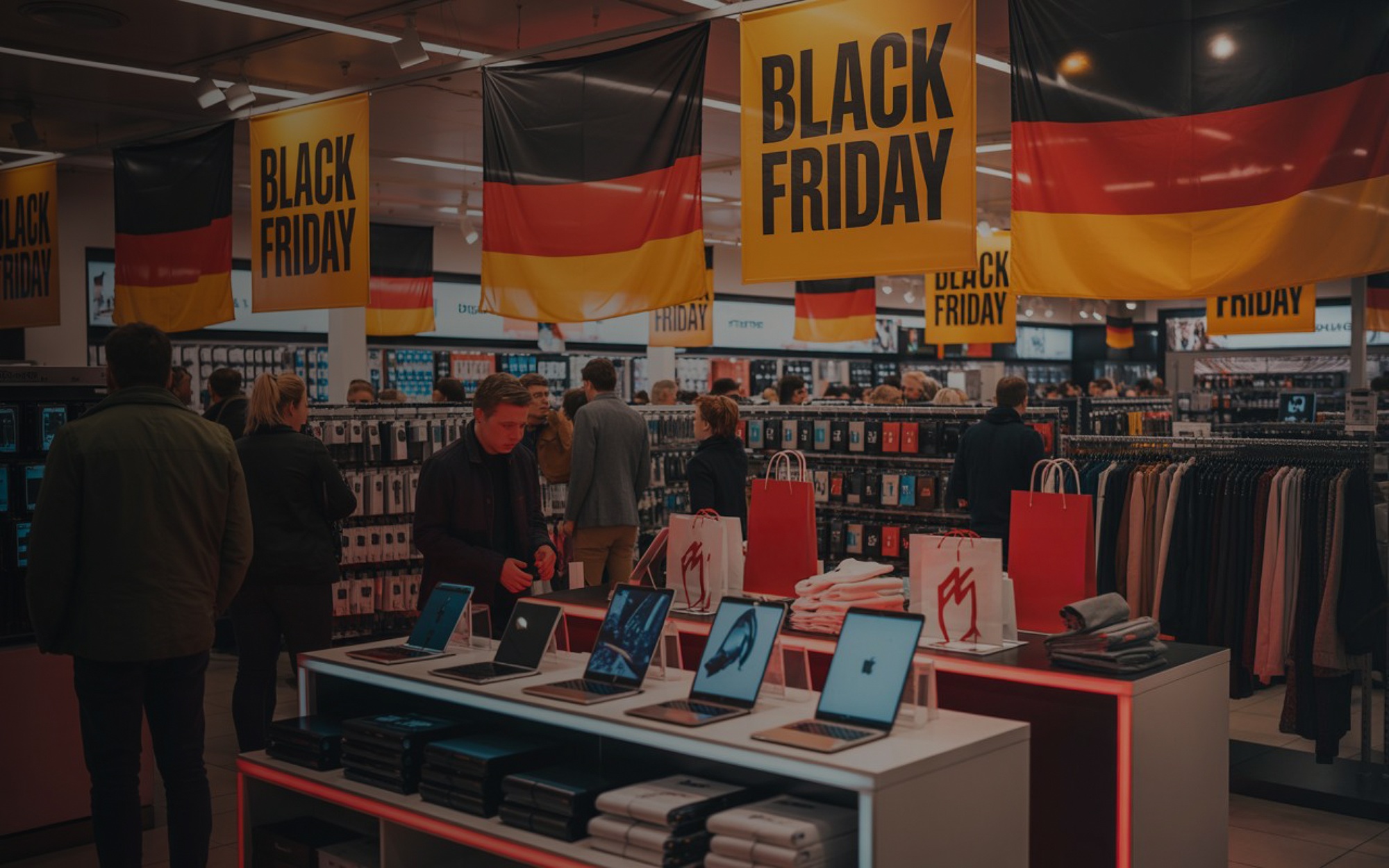
    Black Friday 2025 solidified its position as a major retail event in the German market. German consumers demonstrated an average Black Friday budget of €317, the highest among select European countries.

    The German market, however, exhibited unique consumer behavior patterns during Black Friday 2025. Rather than meticulous planning, 59% of German shoppers allowed deals to inspire their purchases, compared to just 32% who shopped with predetermined lists and budgets. This spontaneous yet budget-conscious approach distinguishes German consumers from other markets, where FOMO-driven purchasing tends to dominate.

    Against this backdrop of rational deal-seeking and regional diversity, how did retailers and brands perform across key categories this Black Friday?

    At DataWeave, we conducted a comprehensive analysis of Black Friday 2025 discounting trends across five major categories in the German market: Consumer Electronics, Home & Furniture, Health & Beauty, Grocery, and Apparel. Our AI-powered pricing intelligence platform monitored over 16,000+ SKUs across leading German retailers like Amazon, Aldi, Douglas, Nutritienda, Carethy, Bofrost, and more, revealing fascinating patterns in how retailers and brands approached this year’s sale season.

    Our Methodology

    For this analysis, DataWeave monitored average discounts across leading German retailers during two distinct periods:

    • Pre-Black Friday: November 6 – November 23, 2025 – capturing early holiday deals and baseline pricing
    • Additional Discounts During Black Friday Week: November 24 – December 1, 2025 – covering Thanksgiving week through Black Friday (November 28) and Cyber Monday (December 1)

    Our sample encompassed the top-ranked products across subcategories on major retail sites. We also analyzed Share of Search data, which measures brand visibility by monitoring which brand names appear in the top 20 search results for critical keywords.

    Black Friday 2025 Germany: The Big Picture

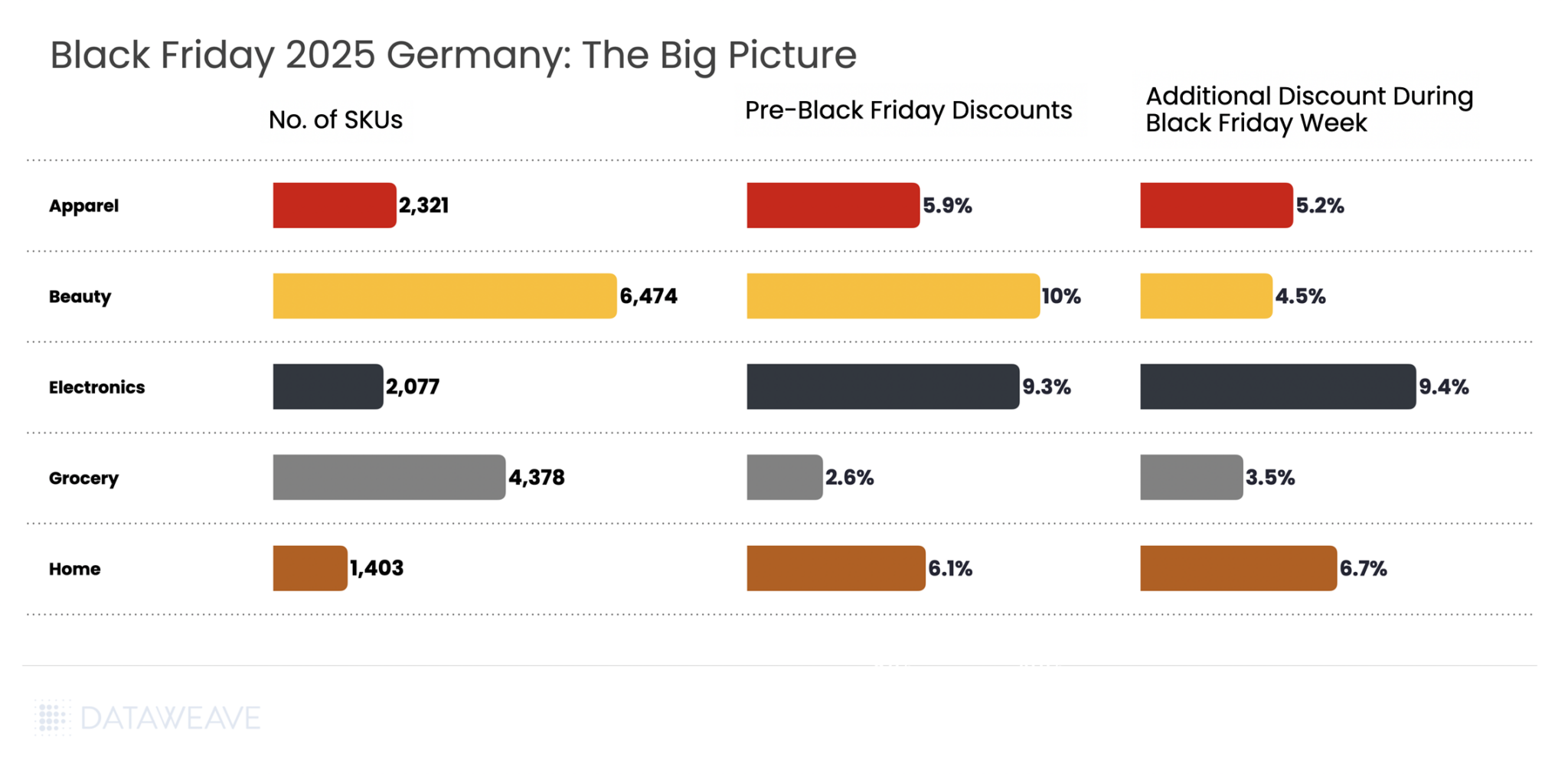
    Our analysis covered 16,653 SKUs across five major categories. Here’s the snapshot of average discounts during the Pre-Black Friday period compared to Black Friday Week:
    Black Friday Discounts across categories - Germany

    Key Insight: The German market presented a notably different discounting pattern compared to other markets. Pre-Black Friday discounts averaged 7% across all categories, with Black Friday Week adding 5.1% on average. Unlike the UK and US markets where retailers front-loaded promotions heavily, German retailers took a more balanced approach, with several categories actually seeing higher discounts during the main Black Friday Week.

    Beauty led pre-sale discounts at 10%, followed by Electronics at 9.3%. Consumer electronics stood out with the highest Black Friday Week discounts at 9.4%, slightly exceeding even the pre-sale period at 9.3%.

    Shopping Behavior Patterns: The relatively modest discount levels reflect the rational, value-oriented approach of German consumers. With the majority of shoppers setting budgets between €100-€299 and prioritizing wish fulfillment over impulse purchases, German retailers focused on strategic discounting rather than aggressive margin erosion.

    Consumer Electronics

    Consumer electronics dominated German Black Friday interest, with 77% of German shoppers most interested in electronics deals, making it the most anticipated category during the sales period. Our analysis of 2,077 SKUs reveals how discounts varied across subcategories and which brands dominated search visibility in this highly competitive category.

    Subcategory Discount Analysis
    Discounts across key consumer electronics categories in Germany - Black Friday 2025

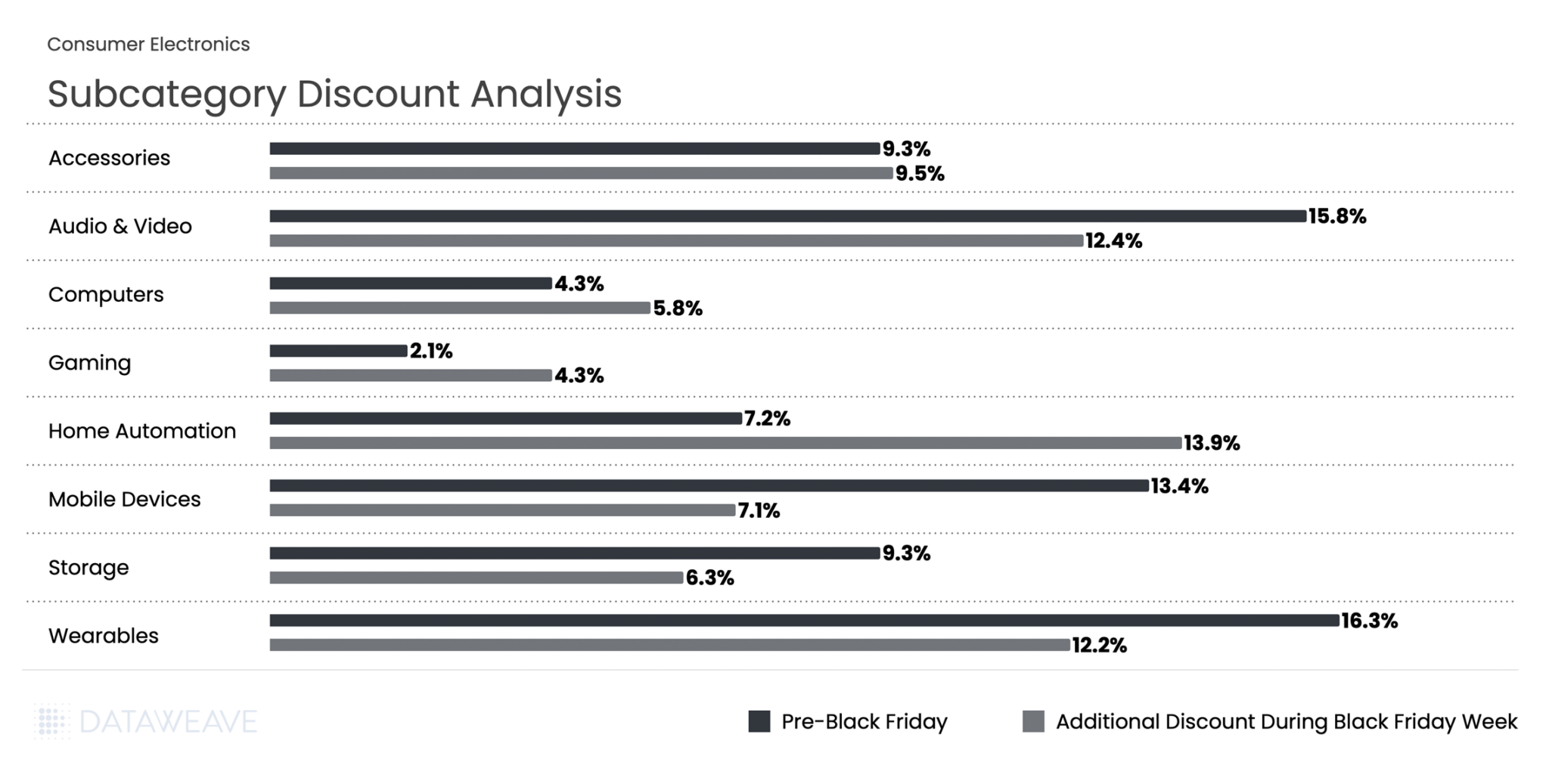
    This was one of the few categories where Black Friday Week discounts matched or exceeded pre-sale levels. Wearables led pre-sale discounting at 16.3%, followed closely by Audio & Video at 15.8%. During Black Friday Week, these categories saw additional discounts of 12.2% and 12.4% respectively.

    The standout performer was Home Automation, which nearly doubled its additional discount from 7.2% to 13.9% during Black Friday Week. Mobile Devices saw additional discounts dropping from 13.4% pre-sale to 7.1% during Black Friday Week. Meanwhile Gaming doubled additional discounting from 2.1% to 4.3%.

    Share of Search: Brand Visibility Trends

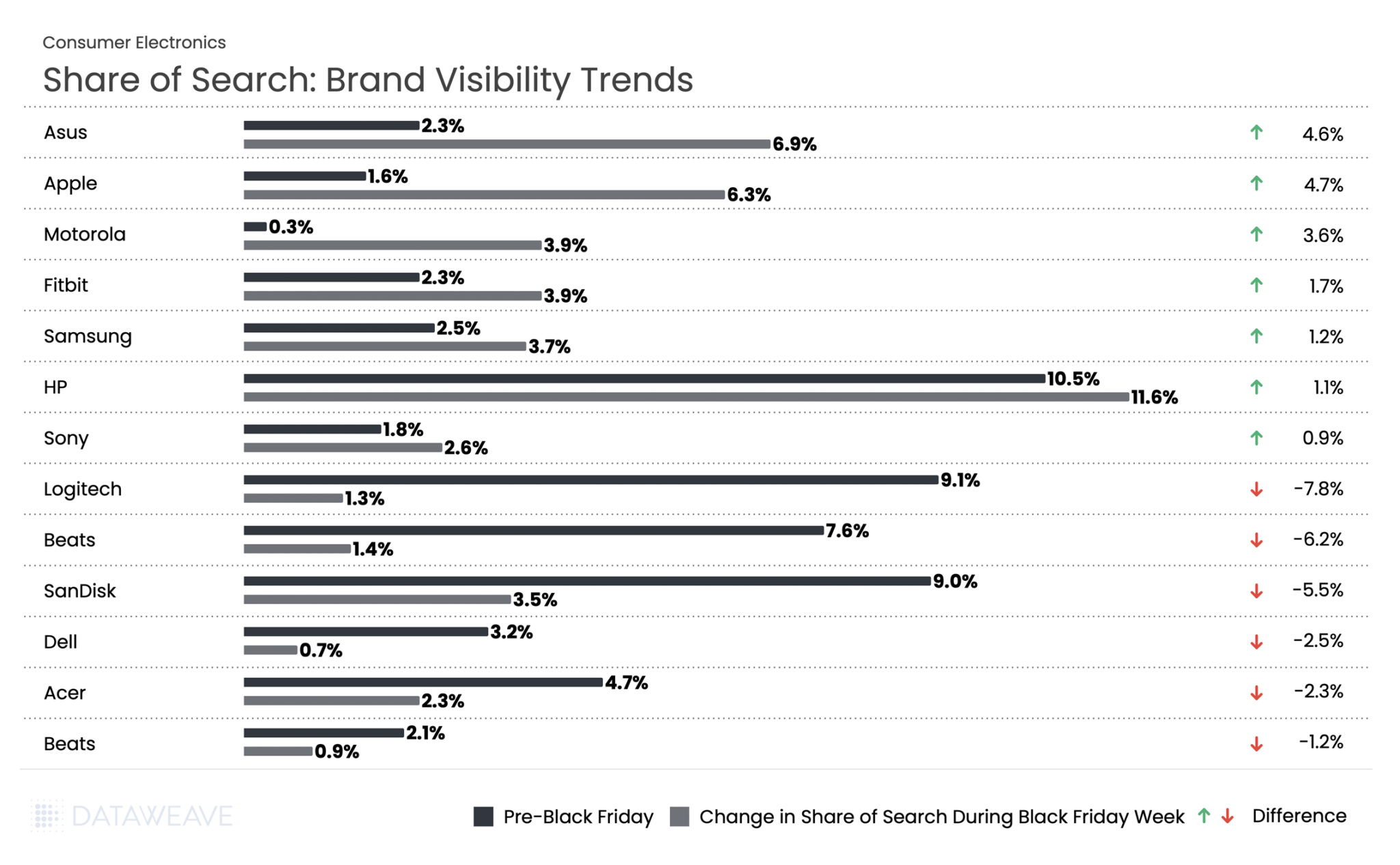
    Our Share of Search analysis reveals significant shifts in brand visibility during Black Friday Week:
    Share of search across electronics brands in Germany - Black Friday

    HP saw the highest share of search across Black Friday at 10.5% pre event and 11.6% during the event. Apple led with a 4.7% increase in visibility, jumping from 1.6% to 6.3%. Asus followed at 4.6%. Motorola surged 3.6 %, while wearables brand Fitbit gained 1.7%.

    In stark contrast, Logitech dropped by 7.8 %, Beats fell 6.2 %, and SanDisk declined 5.5 %. Computer manufacturers Dell and Acer also struggled, falling 2.5 and 2.3 % respectively.

    Home & Furniture

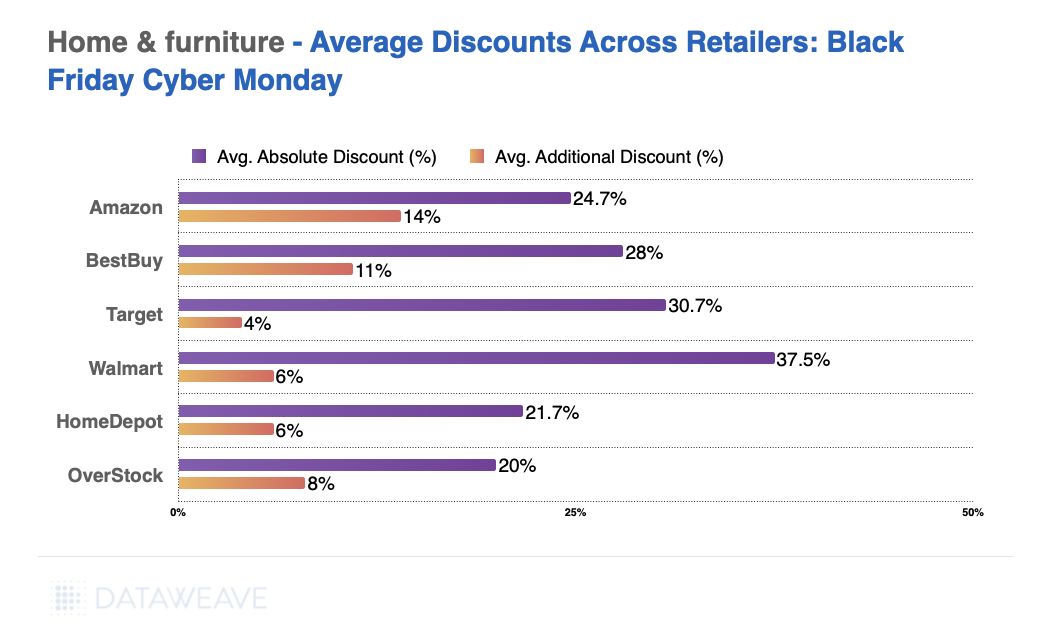
    The Home & Furniture category in Germany showed unique discounting behavior compared to other markets, with additional Black Friday Week discounts (6.7%) actually exceeding Pre-Black Friday levels (6.1%). Our analysis of 1,403 SKUs shows how discounts were distributed across subcategories.

    Subcategory Discount Analysis

    Discounts across key Home and furniture categories in Germany - Black Friday 2025

    Kitchenware led pre-sale discounts at 8.7%. Decor surged from 5% to 7.5%, lighting jumped from 5% to 6.9%, and bedding more than doubled from 3.2% to 6.6%. These substantial increases suggest strategic timing to capture consumer attention during peak shopping days.

    Share of Search: Brand Visibility Trends
    Share of search across home and furniture brands in Germany - Black Friday

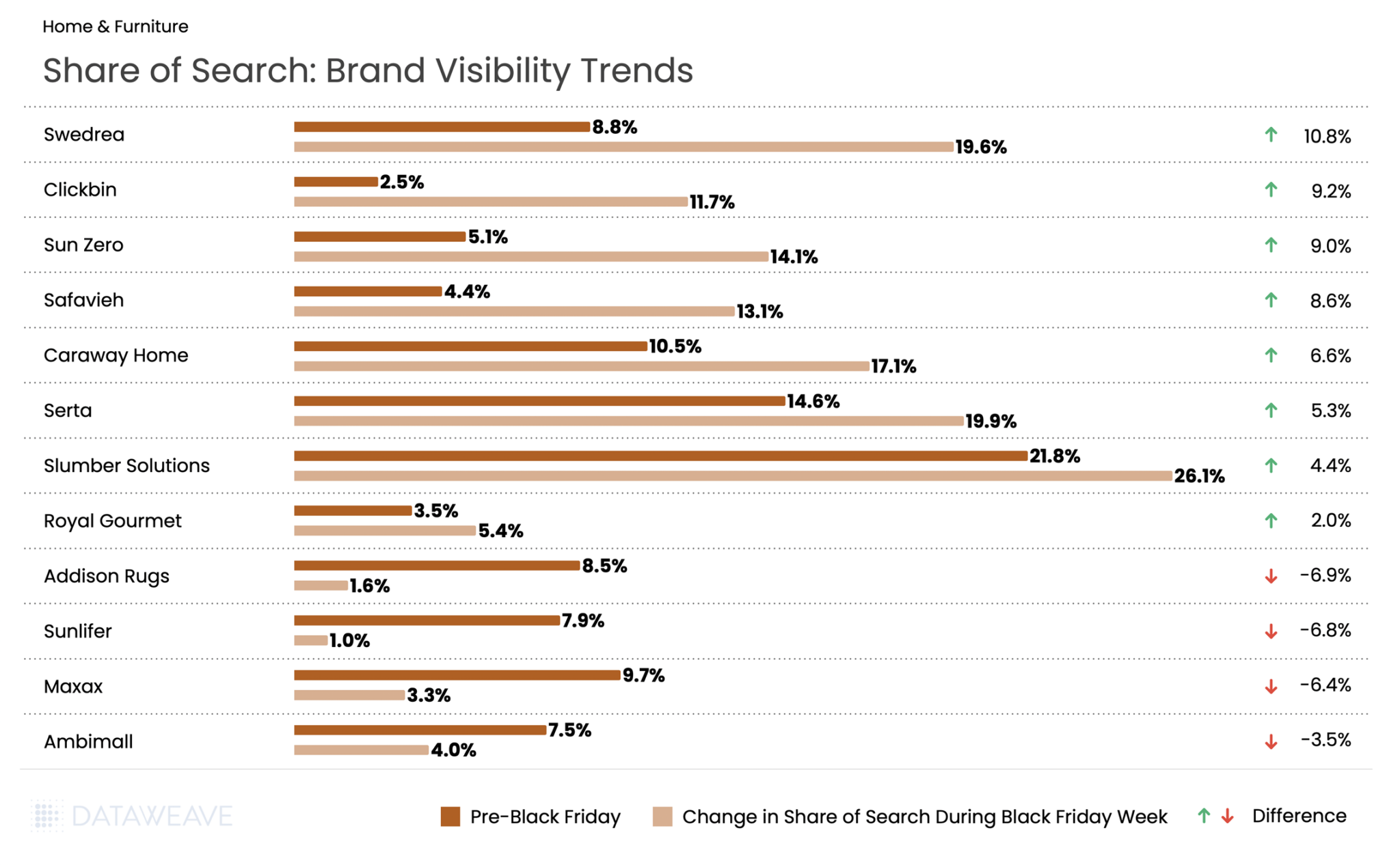
    Mattress brand Slumber Solutions saw the highest share of search at 21.8% pre event and 26.1% during Black Friday week. Meanwhile, another mattress brand Swedrea led all brands with a remarkable 10.8% surge in visibility, jumping from 8.8% to 19.6%. Budget-friendly furniture brand Clickbin gained 9.2%, while window treatment brand Sun Zero increased 9% and home textiles brand Safavieh surged 8.6%.

    Premium and established brands also performed well: Caraway Home (cookware) rose 6.6%, mattress brand Serta gained 5.3%, and Slumber Solutions added 4.4%. Royal Gourmet, specializing in outdoor cooking equipment, gained 2.0%.

    However, several mid-tier brands faced steep declines. Addison Rugs dropped 6.9% from 8.5% to just 1.6%, while Sunlifer fell 6.8 % and Maxax declined 6.4 %.

    Health & Beauty

    Our analysis of 6,474 SKUs reveals subcategory-level insights and dramatic brand visibility shifts that highlight the evolving German beauty landscape.

    Subcategory Discount Analysis
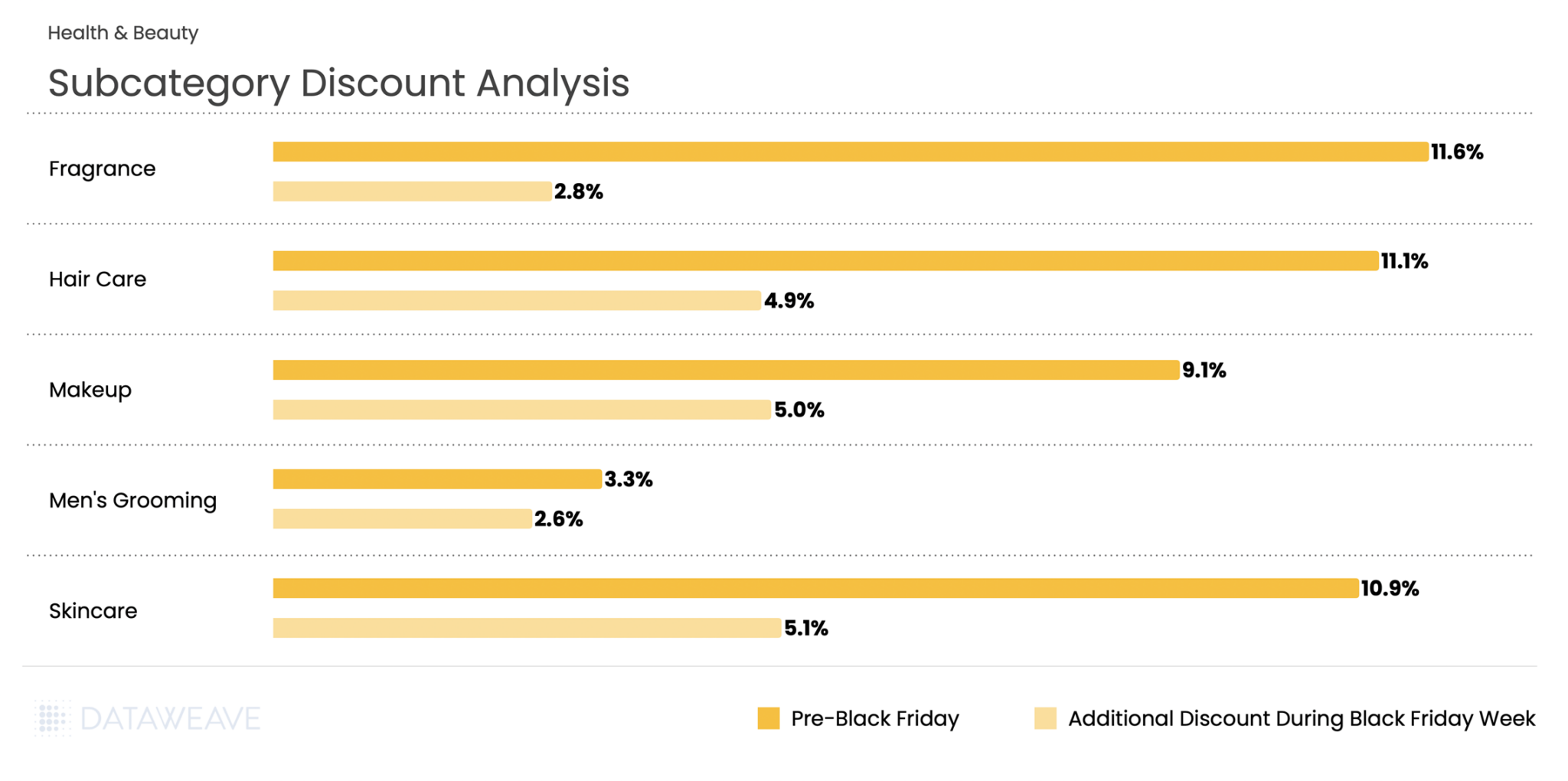
    Discounts across key health and beauty categories in Germany - Black Friday 2025

    Pre-Black Friday discounts averaged 10%, with Black Friday Week adding 4.5% on average. Fragrance led pre-sale discounting at 11.6%, positioning perfumes and colognes as attractive early holiday purchases. However, Fragrance saw the smallest Black Friday Week addition at just 2.8%.

    Hair Care and Skincare both showed strong performance across both periods, with Hair Care at 11.1% pre-sale and 4.9% during Black Friday Week, while Skincare registered 10.9% and 5.1% respectively. Skincare’s 5.1% Black Friday Week discount was the highest in the category.

    Men’s Grooming stood apart with notably lower discounts at 3.3% pre-sale and 2.6% during Black Friday Week, suggesting either tighter margins in this subcategory or strategic positioning at different price points.

    Share of Search: Brand Visibility Trends
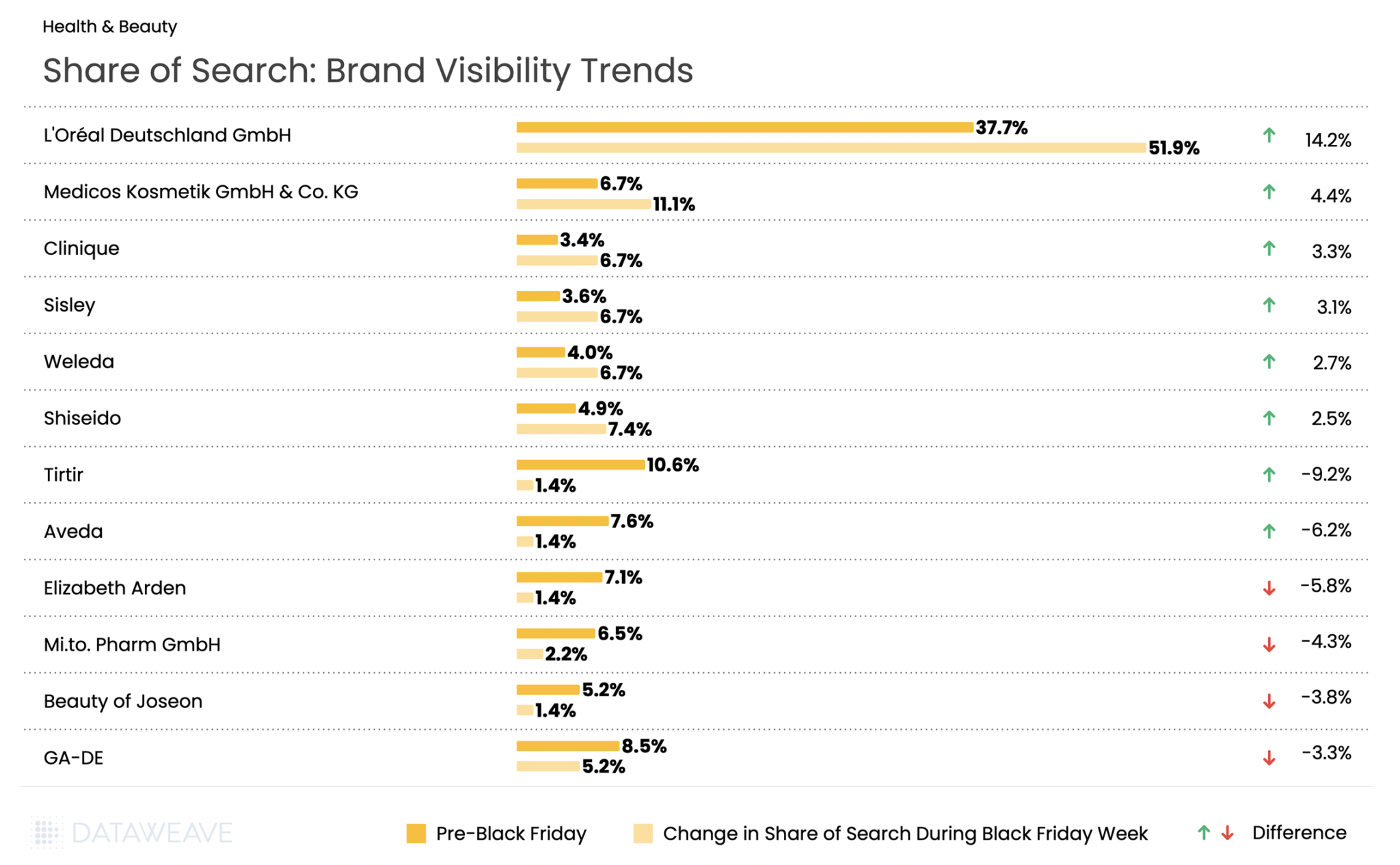
    Share of search across health and beauty brands in Germany - Black Friday

    L’Oréal Deutschland GmbH emerged as the most visible brand, surging from 37.7% to 51.9%, (+14.2). German pharmaceutical cosmetics company Medicos Kosmetik GmbH & Co. KG gained 4.4 %. Clinique gained 3.3 %, and French luxury brand Sisley added 3.1 %, German natural cosmetics brand Weleda rose 2.7 %, and Japanese prestige brand Shiseido gained 2.5 %.

    The flip side? K-beauty brands and some international names faced significant challenges. Viral make-up brand Tirtir experienced the steepest decline visibility, dropping by 9.2 %. Aveda fell 6.2 %, Elizabeth Arden dropped 5.8 %, and Beauty of Joseon declined 3.8 %. German pharmacy brand Mi.to. Pharm GmbH lost 4.3 %, while Israeli makeup brand GA-DE fell 3.3 %.

    The data reveals a clear German preference for European beauty heritage, pharmaceutical-grade cosmetics, and established prestige brands during Black Friday, rather than trendy K-beauty products or mid-tier international brands.

    Grocery

    While Grocery typically sees more modest discounts compared to discretionary categories, the German market showed interesting patterns with Black Friday Week discounts (3.5%) actually exceeding Pre-Black Friday levels (2.6%). Our analysis of 4,378 SKUs shows how German retailers approached promotions across essential and indulgent subcategories.

    Subcategory Discount Analysis
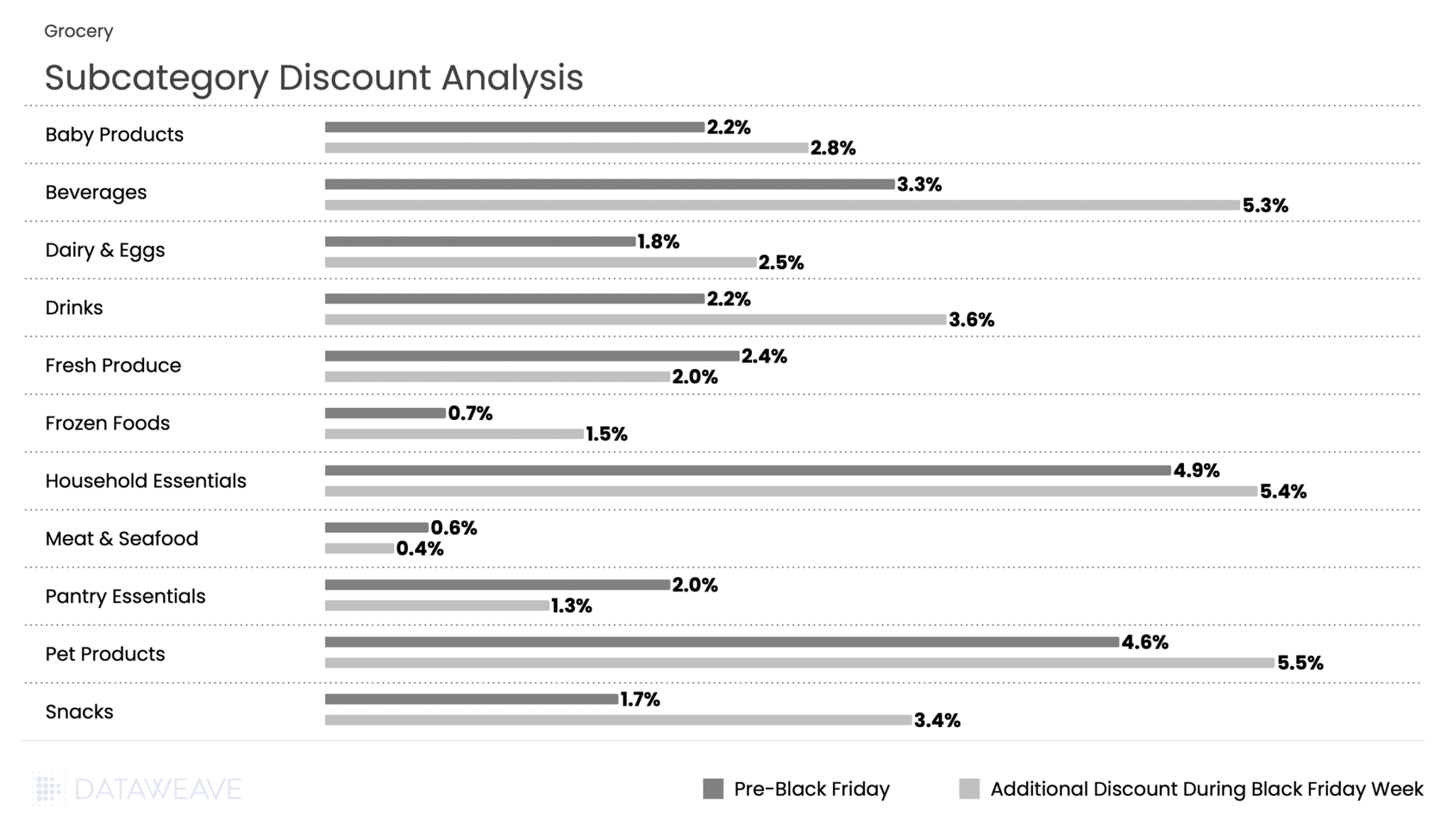
    Discounts across key FMCG categories in Germany - Black Friday 2025

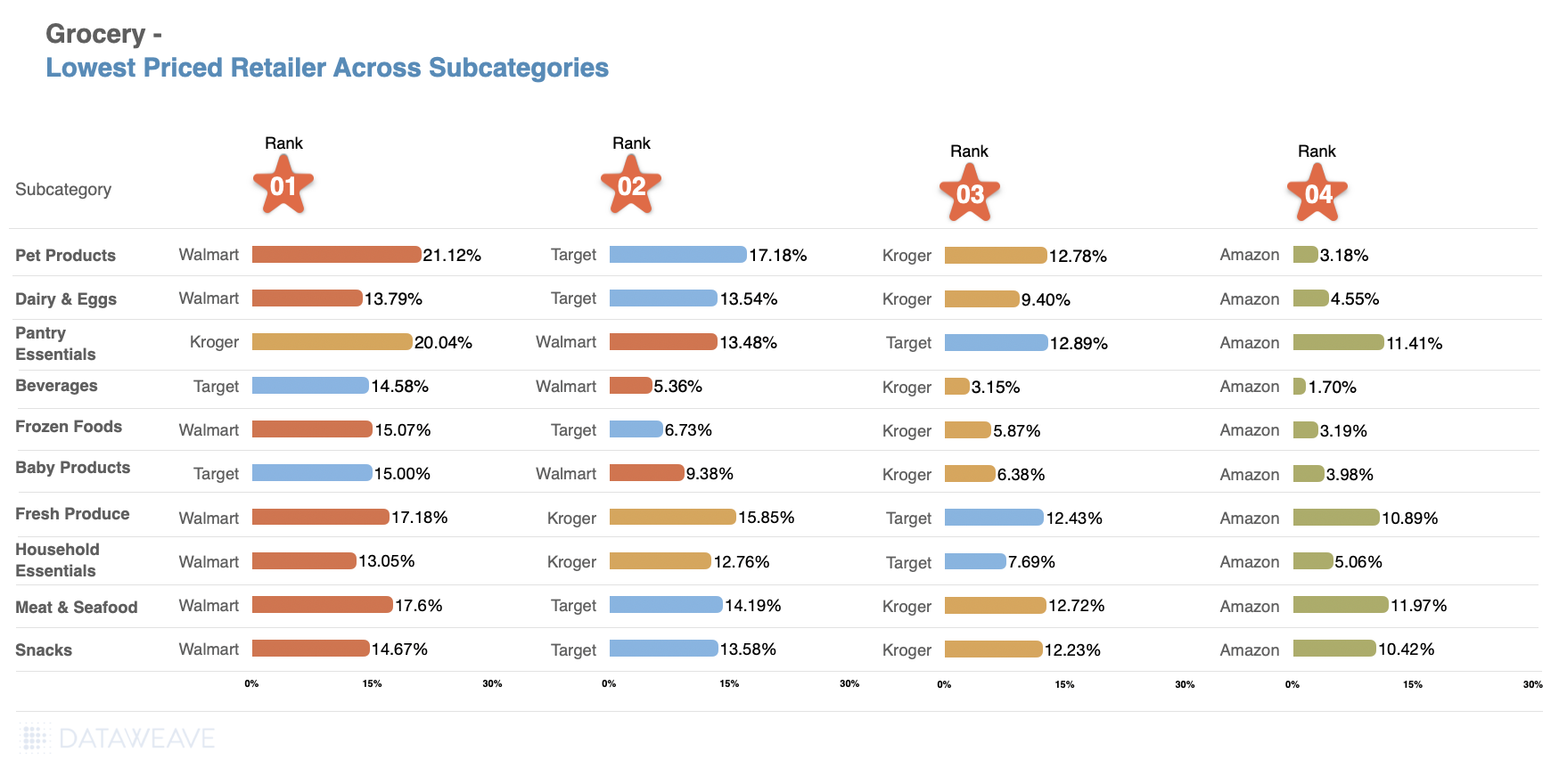
    Pre-Black Friday discounts averaged just 2.6% in grocery. But Black Friday Week saw this surging to 3.5%, an increase that represents the highest proportional jump among all categories.

    Pet Products and Household Essentials led discounting, with Pet Products at 4.6% pre-sale and an additional 5.5% during Black Friday Week. Meanwhile Household Essentials registered 4.9% and 5.4% respectively.

    Beverages showed particularly strong Black Friday Week performance, jumping from 3.3% to 5.3%, while snacks doubled from 1.7% to 3.4%. Fresh categories maintained minimal promotional activity consistent with perishable inventory constraints: Meat & Seafood saw negligible discounts (0.6% pre-sale, 0.4% Black Friday Week), while Fresh Produce actually decreased from 2.4% to 2% during the main event.

    Share of Search: Brand Visibility Trends
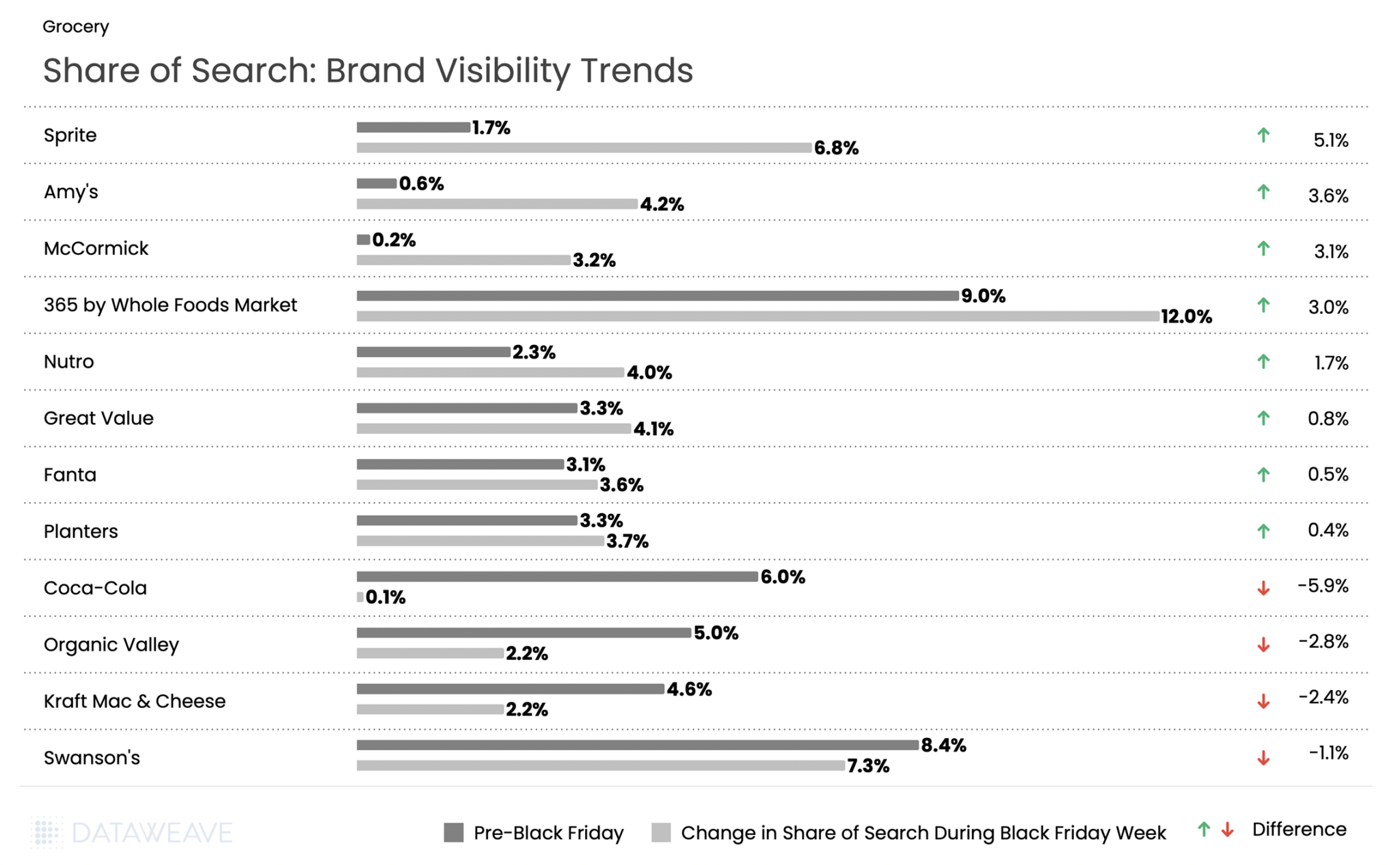
    Share of search across FMCG brands in Germany - Black Friday

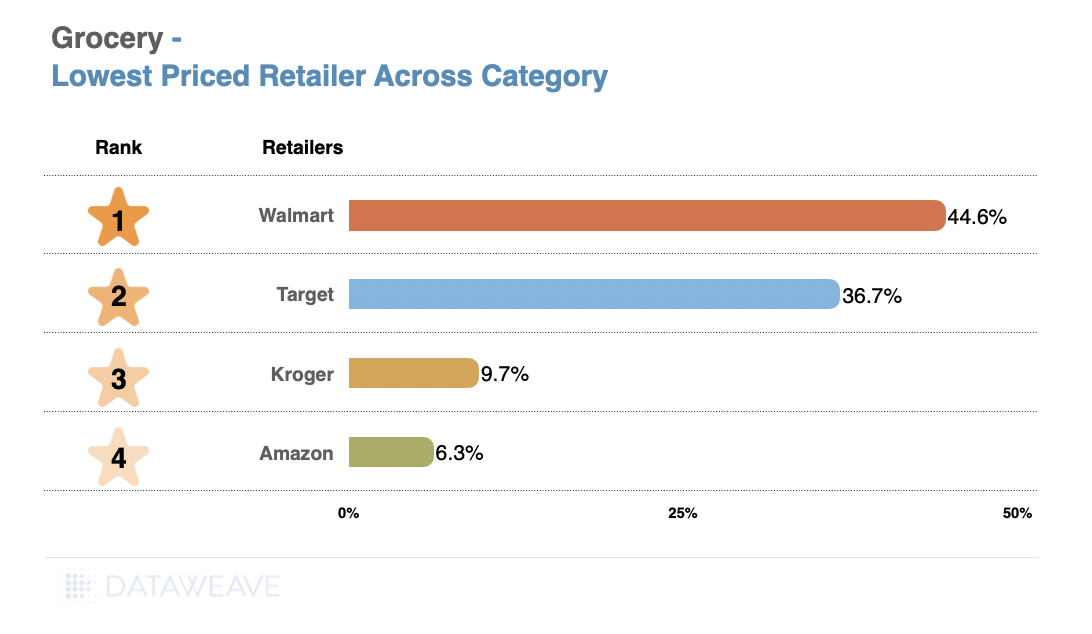
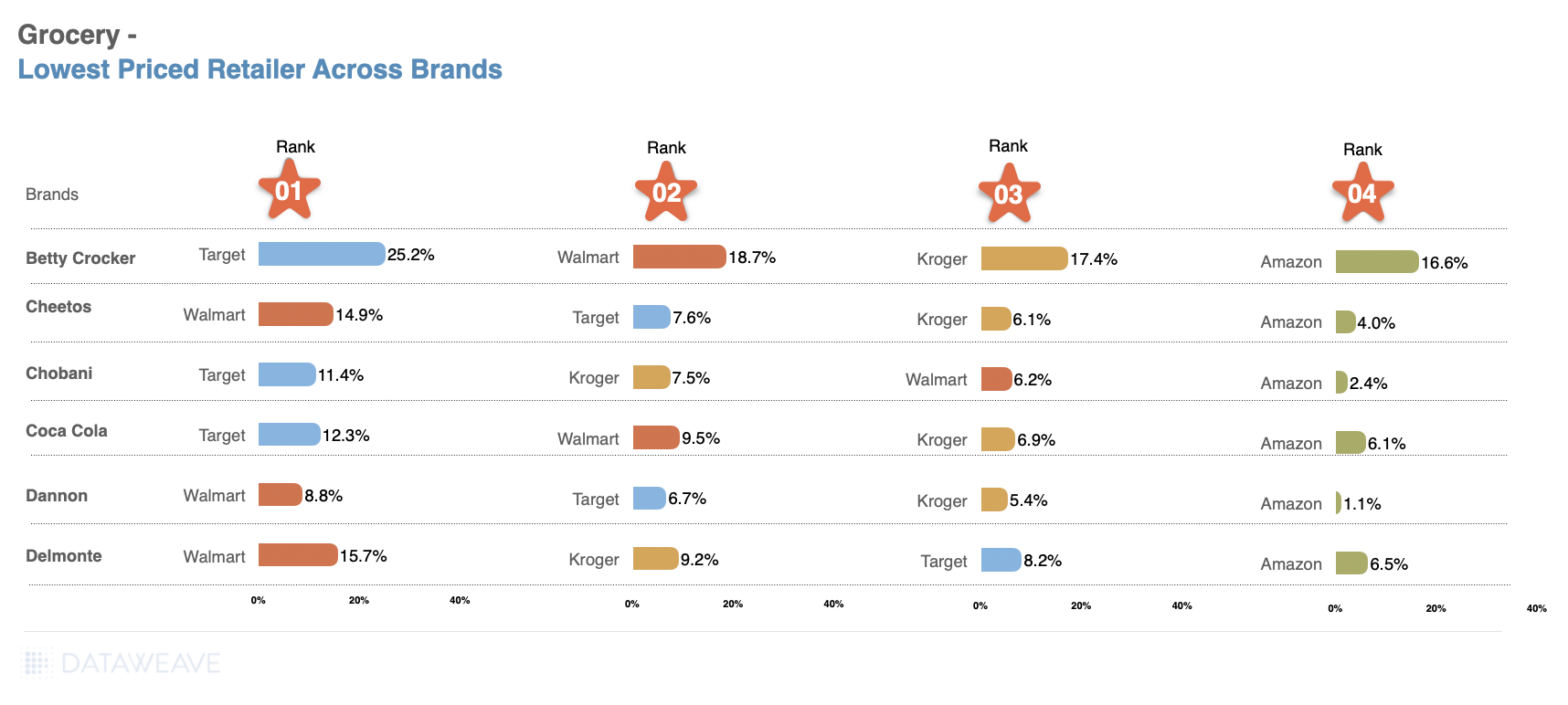
    365 by Whole Foods saw the highest share of search at 9% pre event and 12% during Black Friday week. But Sprite led all brands with a 5.1% surge in share of search. Meanwhile, sister brand Coca-Cola experienced one of the steepest declines in our analysis, with visibility plummeting from 6.0% to just 0.1%. Fanta maintained modest search growth at 0.5 %. This stark divergence between two brands from the same parent company suggests vastly different promotional strategies during Black Friday Week.

    Specialty and organic food brands performed well: Amy’s (organic/natural foods) gained 3.6 %, while spice brand McCormick surged 3.1 %. Pet food brand Nutro gained 1.7 %, while value-oriented Great Value added 0.8 %.

    Snack brand Planters gained 0.4 %. On the decline side, Organic Valley dropped 2.8 %, Kraft Mac & Cheese fell 2.4 %, and Swanson’s declined 1.1 %.

    Apparel

    Apparel in the German market showed modest promotional activity compared to other markets, with Pre-Black Friday discounts averaging 5.9% and Black Friday Week at 5.2%. Our analysis of 2,321 SKUs reveals interesting patterns across fashion segments in the German market.

    Subcategory Discount Analysis
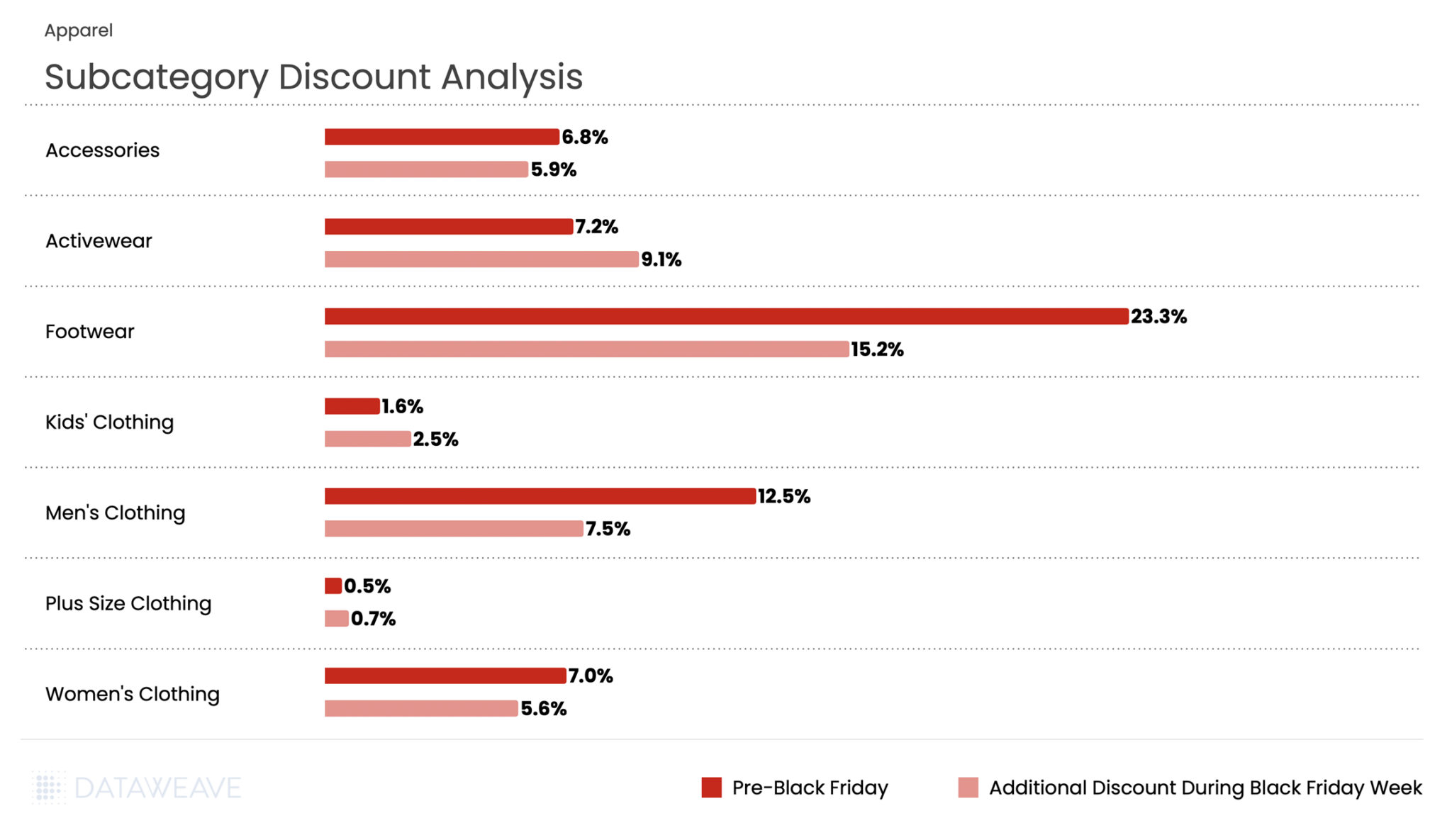
    Discounts across key fashion and apparel categories in Germany - Black Friday 2025

    Footwear dominated discounting in both periods, with an impressive 23.3% pre-sale discount, and 15% additional discount during Black Friday Week. Men’s Clothing followed at 12.5% pre-sale, with additional 7.5% during Black Friday Week.

    Activewear presented a unique pattern, with discounts increasing from 7.2% pre-event to additional 9.1% during Black Friday Week: one of the few subcategories to show higher discounts during the main event. Plus Size Clothing saw minimal promotional activity at 0.5% pre-sale and 0.7% during Black Friday Week, the lowest discounts in the entire category.

    Share of Search: Brand Visibility Trends
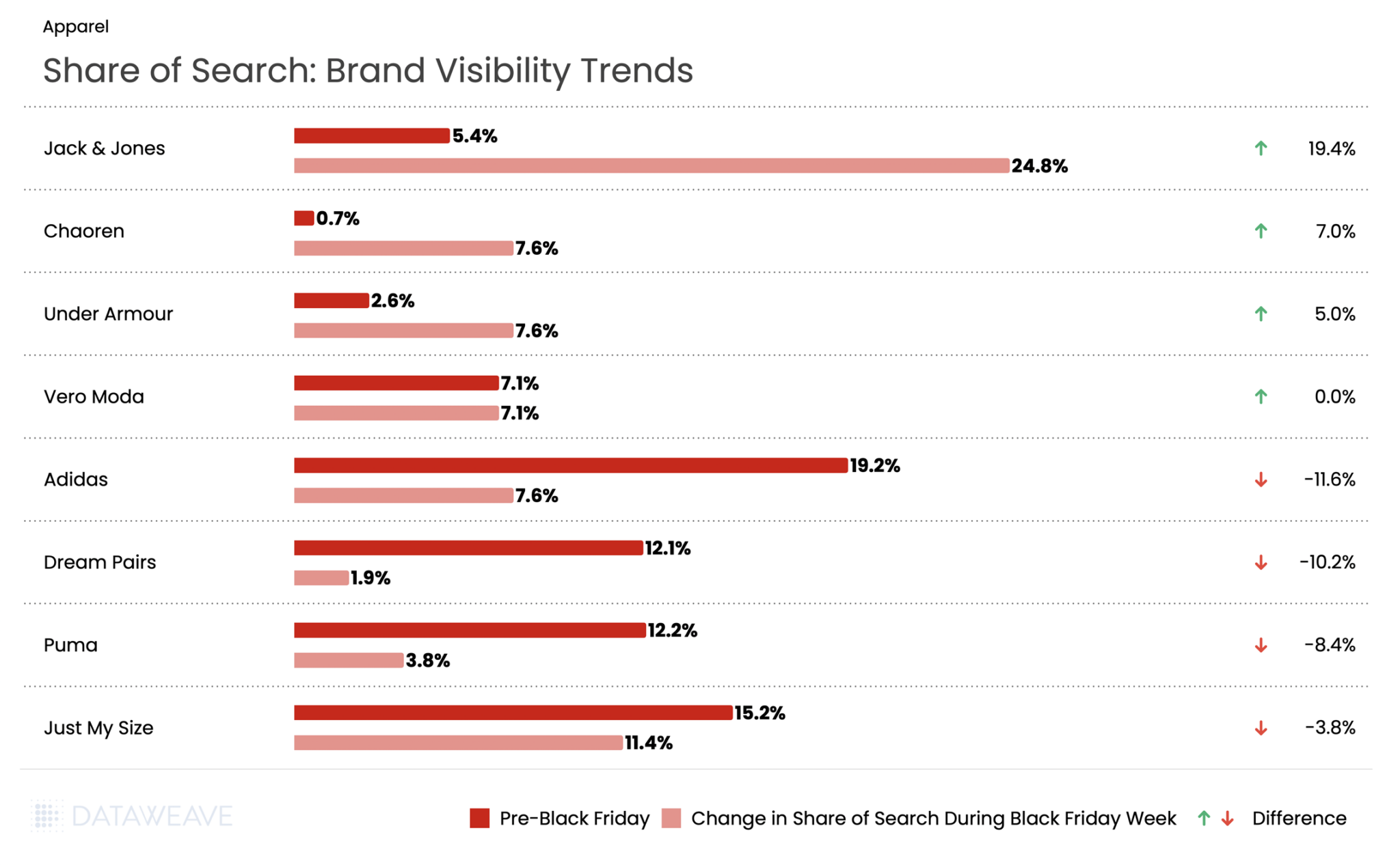
    Share of search across fashion and apparel brands in Germany - Black Friday

    Danish fashion brand Jack & Jones experienced an unprecedented surge with a staggering 19.4% gain in visibility. Sister brand Vero Moda (also owned by Jack & Jones’ parent company Bestseller) maintained flat visibility at 7.1%. Footwear brand Chaoren gained 7%. Meanwhile activewear giant Under Armour rose by 5%.

    However, established sportswear giants suffered dramatic visibility losses. Adidas experienced an 11.6% decline in share of search. Dream Pairs saw visibility drop by 10.2%, Puma fell 8.4%, and plus-size brand Just My Size declined by 3.8 %.


    Want to understand how DataWeave’s pricing intelligence platform can help your business make data-driven decisions during peak sales events? Contact us to learn more about competitive insights, price intelligence, assortment analytics, content analytics, and digital shelf analytics.

    Check out our analysis on Black Friday Pricing and Discount trends in the USA and UK. Follow our blog for more insights on retail pricing trends, brand visibility analysis, and data-driven commerce intelligence.
  • Black Friday 2025 UK: In-Depth Analysis of Discount Strategies and Brand Performance Across Major Categories

    Black Friday 2025 UK: In-Depth Analysis of Discount Strategies and Brand Performance Across Major Categories

    Black Friday 2025 saw British shoppers spend an average of £430 each this year representing a £91 increase from last year and totaling over £10.2 billion across the sales period.

    The 2025 sales event arrived at a pivotal moment for UK retail. Retail sales fell 1.1% in October 2025 as consumers held back spending in anticipation of Black Friday promotions, according to the Office for National Statistics. Over 2 in 5 UK adults participated in Black Friday shopping, with 45% planning to pick up Christmas gifts at a discount, according to a Barclays study.

    Against this backdrop of cautious optimism and strategic consumer behavior, how did retailers and brands perform across key categories this Black Friday? At DataWeave, we conducted a comprehensive analysis of Black Friday 2025 discounting trends across five major categories in the UK market: Consumer Electronics, Home & Furniture, Health & Beauty, Grocery, and Apparel. Our AI-powered pricing intelligence platform monitored over 71K SKUs across leading UK retailers like Costco, Selfridges, Boots, Debenham’s, Carethy, Argos, John Lewis, Amazon, and more, revealing fascinating patterns in how retailers and brands approached this year’s sale season.

    Our Methodology

    For this analysis, DataWeave monitored average discounts across leading UK retailers during two distinct periods:

    • Pre-Black Friday: November 6 – November 23, 2025 – capturing early holiday deals and baseline pricing
    • Additional Discounts During Black Friday Week: November 24 – December 1, 2025 – covering Thanksgiving week through Black Friday (November 28) and Cyber Monday (December 1)

    Our sample encompassed the top-ranked products across subcategories on major retail sites. We also analyzed Share of Search data, which measures brand visibility by monitoring which brand names appear in the top 20 search results for critical keywords.

    Black Friday 2025 UK: The Big Picture

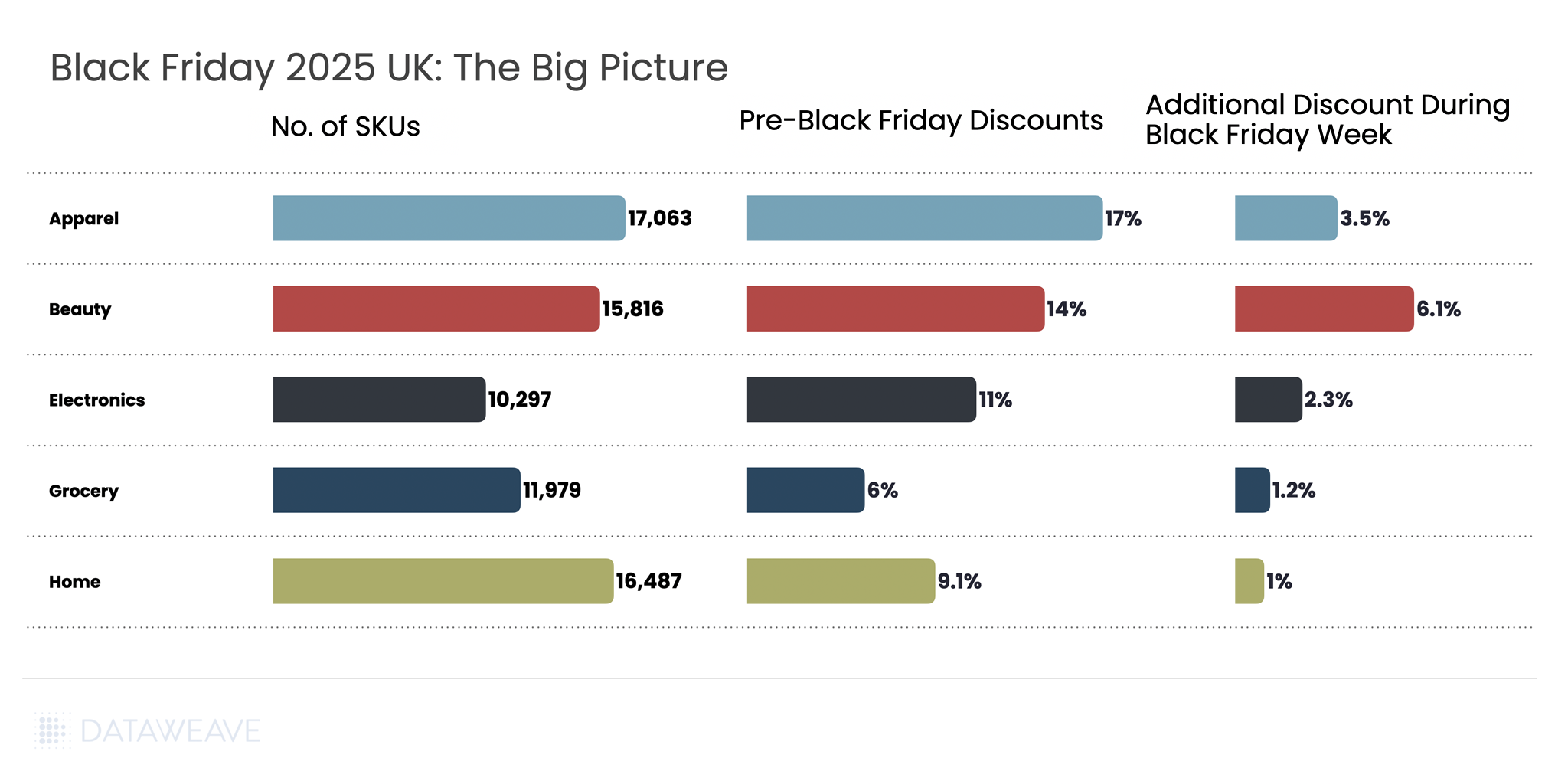
    Our analysis covered 71,642 SKUs across five major categories. Here’s the snapshot of average discounts during the Pre-Black Friday period compared to Black Friday Week:

    Snapshot of Black Friday Discounts across Key Categories in the UK

    Key Insight: Pre-Black Friday discounts were substantial across all categories. This suggests UK retailers front-loaded their promotions to capture early holiday shoppers, with additional discounts during Black Friday Week adding to the baseline discounts already in place. The extended promotional period transformed Black Friday from a single-day event into a month-long campaign, with 60% of UK shoppers beginning their deal searches as early as October.

    Consumer Electronics

    Consumer electronics remains a cornerstone of Black Friday shopping in the UK, with technology accounting for 48% of planned consumer spending during the sales period, according to PwC.

    AI is transforming how consumers shop for electronics, with AI-driven traffic to retail sites expected to rise 410% year-on-year during the 2025 holiday season. Younger shoppers particularly embraced AI tools, with 17% of Gen Z consumers using AI platforms like Chat GPT and Gemini to source and compare deals. Our analysis of 10,297 SKUs reveals how discounts varied across subcategories and which brands dominated search visibility.

    Subcategory Discount Analysis

    Discount analysis for key consumer electronics subcategories this Black Friday in the UK

    Pre-Black Friday discounts averaged 11.1% across subcategories, while Black Friday Week saw an additional 2.3% discount on average. Audio & Video products led the pre-sale discounting at 16.3%, indicating retailers were eager to move inventory early in the season.

    During Black Friday Week, Home Automation saw the highest additional discount at 2.8%. Wearables and Computers both saw solid 2.5% additional discounts, making them attractive categories during the peak shopping period.

    Share of Search: Brand Visibility Trends

    Our Share of Search analysis reveals significant shifts in brand visibility during Black Friday Week:

    Brand visibility for consumer electronics during Black Friday week in the UK

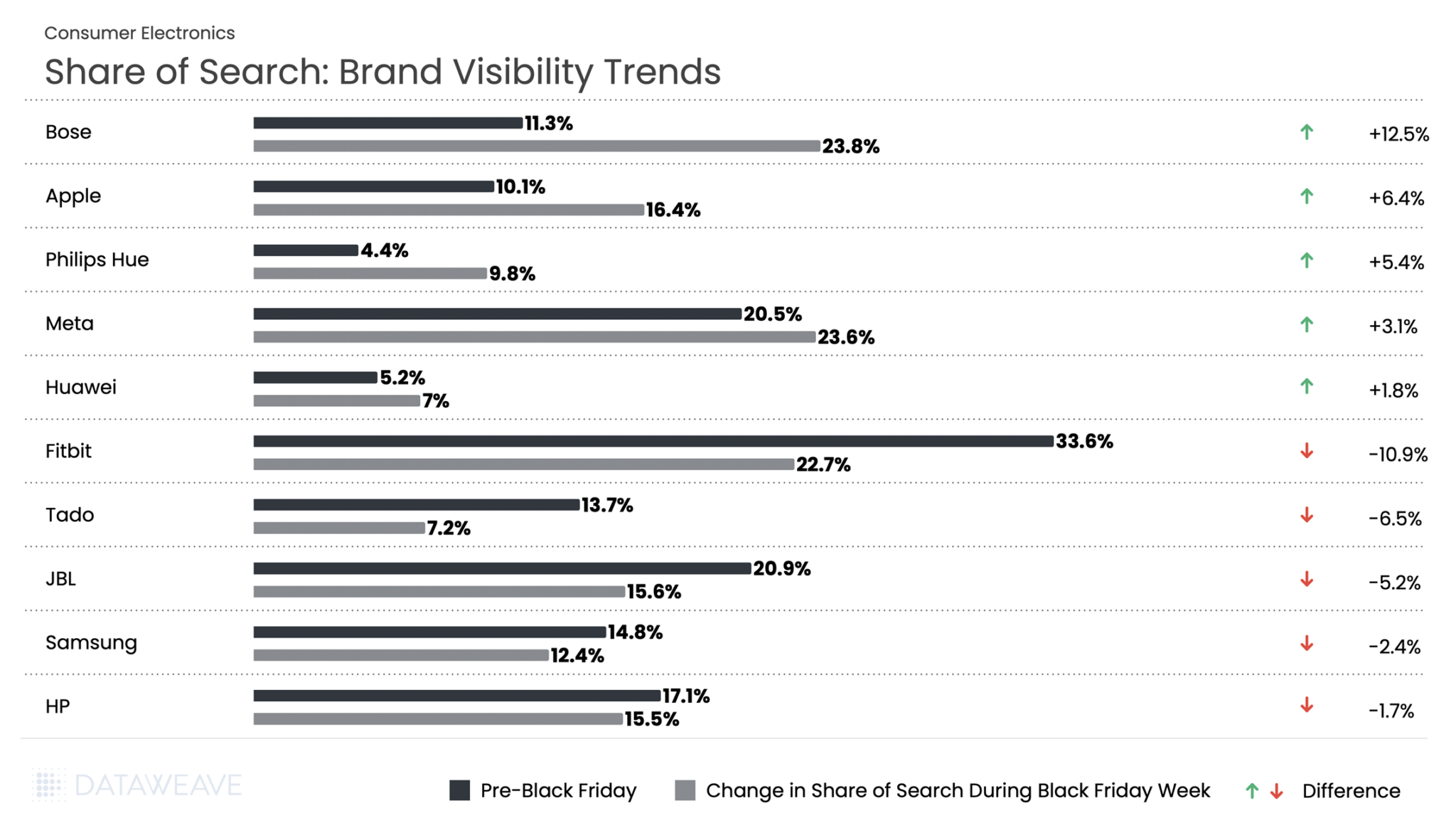
    Bose dominated with its Share of Search more than doubling from 11.3% to 23.8%, a remarkable +12.5% gain. Lighting brand Philips Hue followed, gaining by +5.4% in share of search during Black Friday week. Notably, Meta, with it’s range of wearables, stands out for a +3.1% increase in visibility.

    Apple’s Share of Search jumped from 10.1% to 16.4%, a gain of 6.4%. At the same time, Fitbit’s share dropped nearly 11%, the steepest decline in the entire electronics category. Meanwhile, Samsung and HP also lost on visibility this Black Friday in the UK.

    Home & Furniture

    The Home & Furniture category continues to attract UK consumers during Black Friday, though with a more measured discounting approach compared to other categories. Our analysis of 16,487 SKUs shows how discounts were distributed across subcategories.

    Subcategory Discount Analysis

    Discount analysis for key home & furniture subcategories this Black Friday in the UK

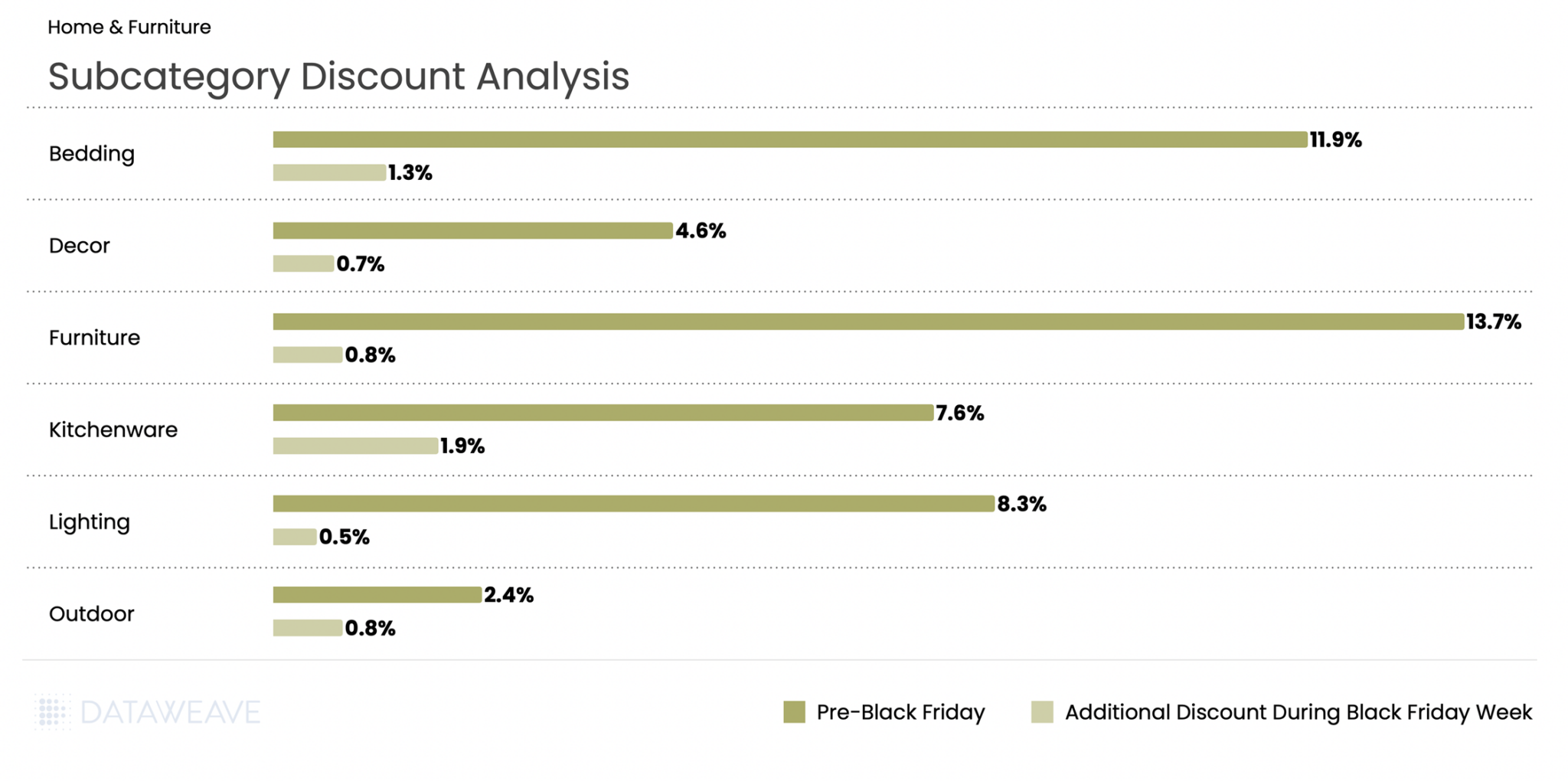
    Home & Furniture saw Pre-Black Friday discounts averaging 9.1%, with Black Friday Week adding just 1% on average, the lowest additional discount among all categories. Furniture led pre-sale discounts at 13.7%, followed by Bedding at 11.9%. This suggests retailers aggressively promoted larger home goods early in the season to capture deal-seekers.

    During Black Friday Week, Kitchenware saw the highest additional discount at 1.9%, making it attractive for holiday cooking and gifting needs. Conversely, Lighting saw minimal additional promotion at just 0.5%.

    Share of Search: Brand Visibility Trends

    Brand visibility for home and furniture during Black Friday week in the UK

    Made.com, the contemporary furniture brand, saw visibility surge during Black Friday with an impressive 8.9% increase. Similarly, emerging mattress brand Vesgantti gained 5.4%. Rug specialist Gooch Oriental also made significant gains with a 4.9% increase.

    On the flip side, British heritage brands faced challenges. Both Laura Ashley and Julian Bowen saw share of search drop 2.2%. Premium mattress maker Vispring also declined 2.1%, while French cookware brand Le Creuset fell 1.9%.

    Health & Beauty

    Health & Beauty has emerged as a growth engine during Black Friday in the UK. The beauty industry is projected to grow 5% annually through 2030 according to a McKinsey survey. The category continues to demonstrate resilience even as consumers show caution in other discretionary categories. Our analysis of 15,816 SKUs reveals fascinating subcategory-level insights and dramatic brand visibility shifts that highlight evolving consumer preferences in the beauty space.

    Subcategory Discount Analysis

    Discount analysis for key health and beauty subcategories this Black Friday in the UK

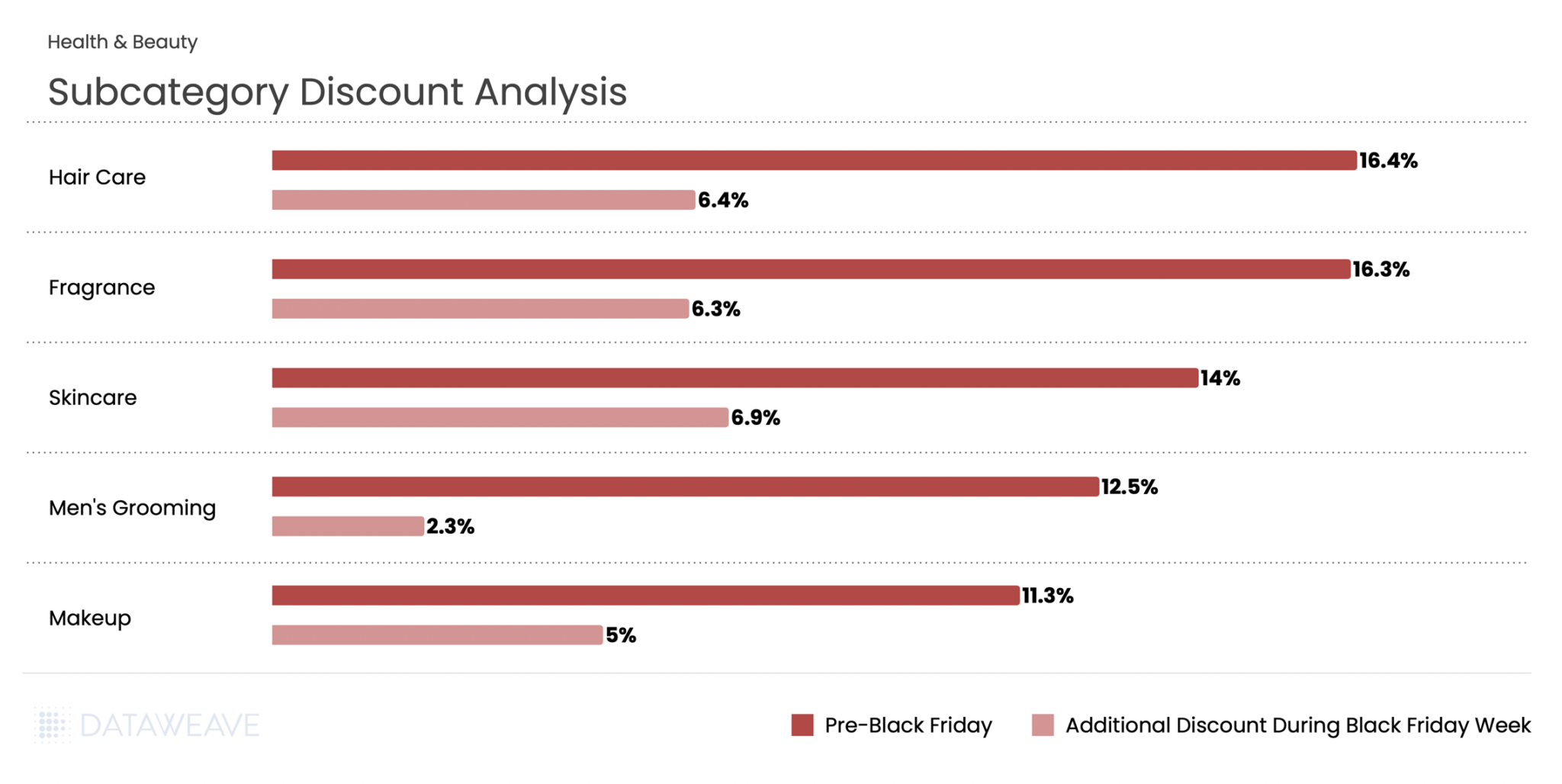
    Health & Beauty presented a unique discounting pattern compared to other categories. Pre-Black Friday discounts averaged 14.4%, the second-highest among all categories. But Black Friday Week discounts were also robust at 6.1%, the highest additional discount increase.

    Hair Care led both periods with 16.4% pre-sale discounts and an additional 6.4% during Black Friday Week. Skincare saw the highest Black Friday Week discount at 6.9%, suggesting retailers strategically saved their best skincare promotions for the main event when consumers are actively seeking holiday gift sets. Men’s Grooming stood apart with strong pre-sale discounts of 12.5% but more modest Black Friday Week additions of just 2.3%.

    Share of Search: Brand Visibility Trends

    The UK Beauty category saw some of the most dramatic Share of Search swings in our analysis.

    Brand visibility for health and beauty during Black Friday week in the UK

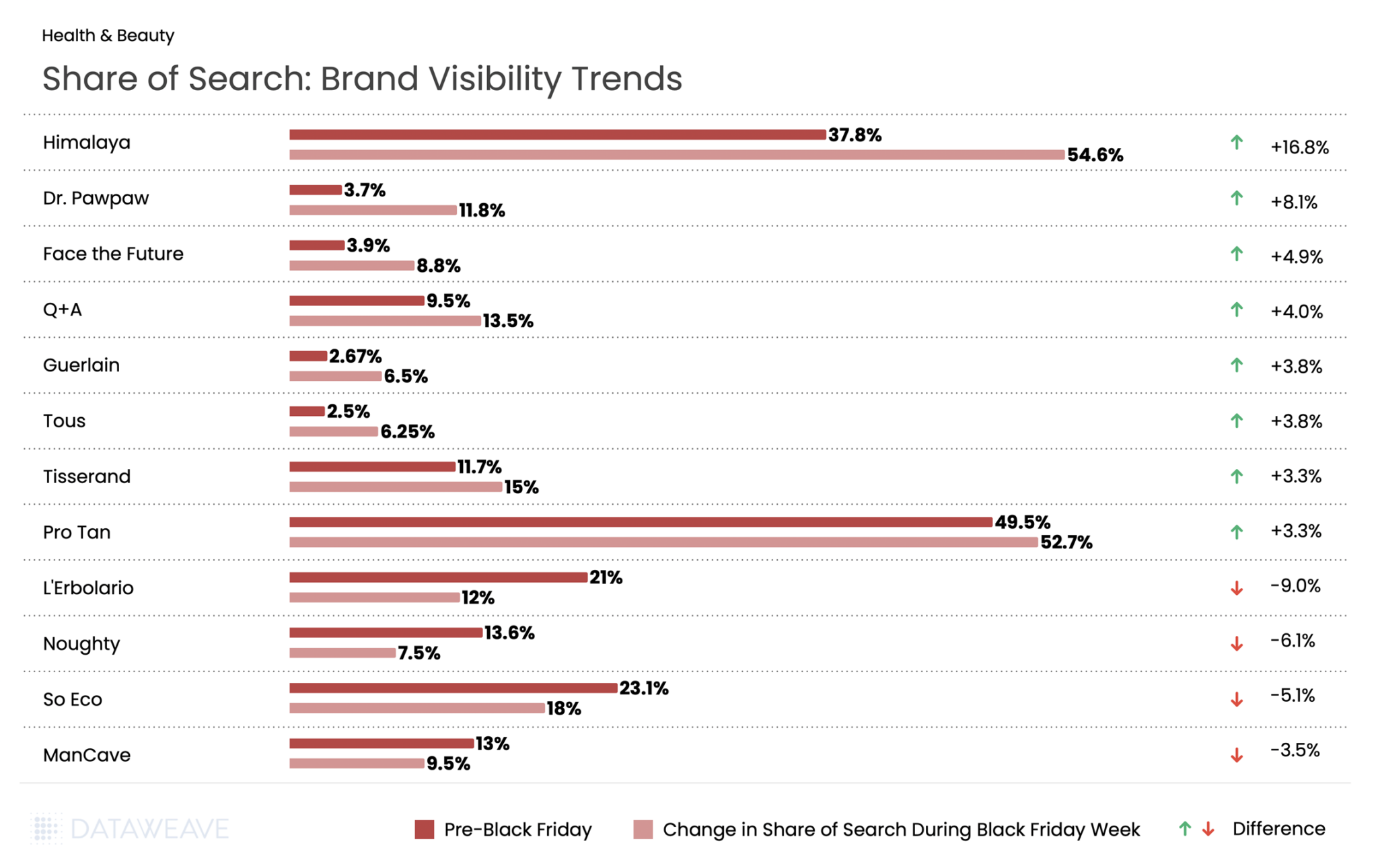
    Himalaya, the Ayurvedic skincare brand, dominated the category with a stunning 16.8% gain. British cult favorite Dr. Pawpaw exploded from 3.7% to 11.8%, a gain that reflects the brand’s growing mainstream appeal. Face the Future, the skincare specialist, also gained significant ground with a 4.9% increase.

    Budget-friendly British brand Q+A continued its momentum, rising 4%, while prestige names like Guerlain and Tous each gained 3.8%.

    Italian natural beauty brand L’Erbolario saw the steepest decline, with visibility dropping by 9%. Haircare brand Noughty fell 6.1%, and eco-beauty brand So Eco declined by 5.1%.

    Grocery

    While Grocery typically sees more modest discounts compared to discretionary categories, the sector remains a critical part of Black Friday shopping in the UK, particularly as consumers prepare for holiday entertaining and gifting. Our analysis of 11,979 SKUs shows how UK retailers approached promotions across essential and indulgent subcategories.

    Subcategory Discount Analysis

    Discount analysis for key FMCG subcategories this Black Friday in the UK

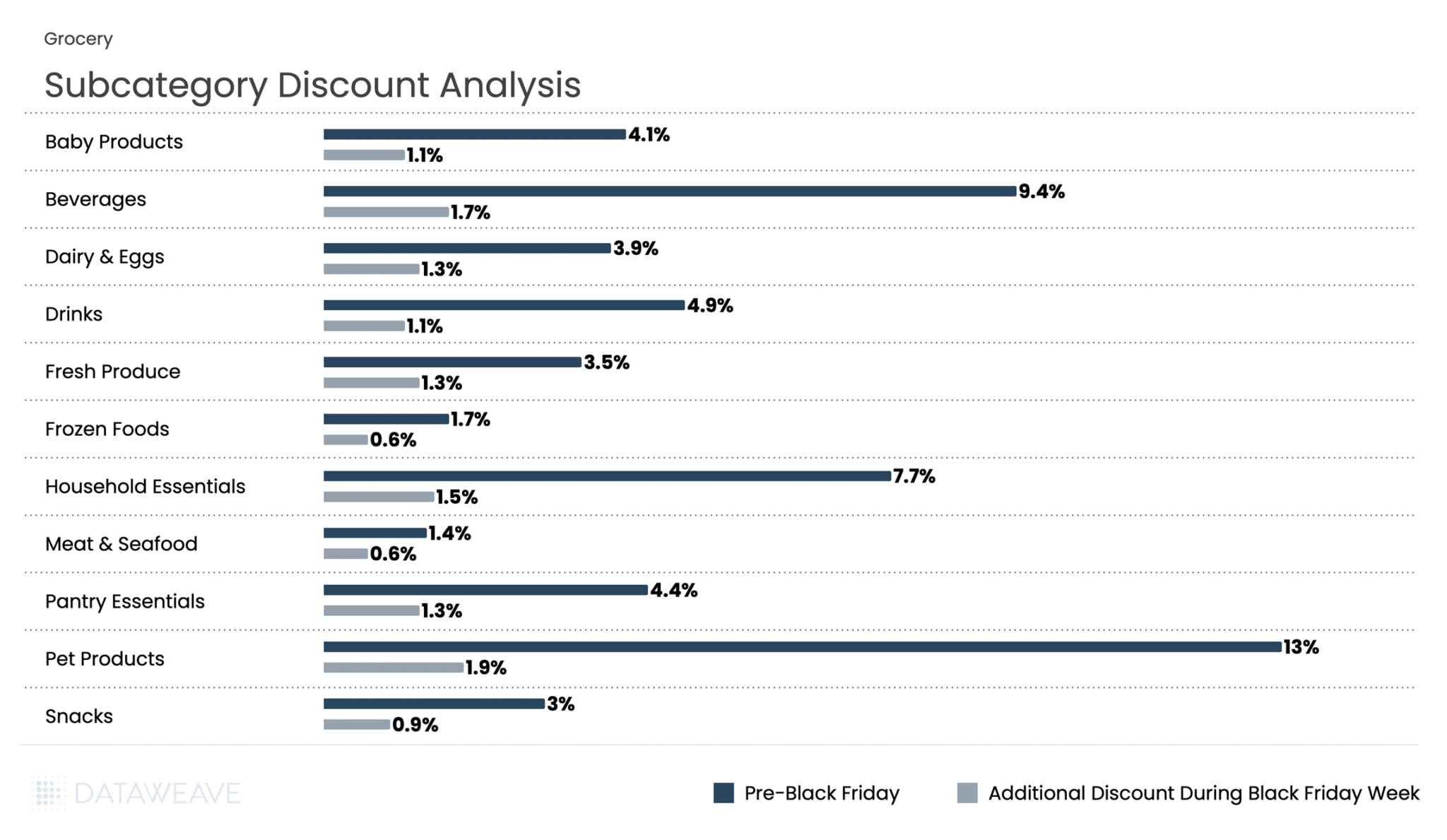
    Grocery had the lowest discounts across all categories, reflecting the already-thin margins in food retail. Pre-Black Friday discounts averaged just 5.7%, with Black Friday Week adding only 1.2%. Pet Products led pre-sale discounts at an impressive 13%, significantly outpacing other grocery subcategories.

    Beverages and Household Essentials followed with 9.4% and 7.7% pre-sale discounts respectively, and maintained their lead during Black Friday Week with 1.7% and 1.5% additional discounts each. Fresh categories like Meat & Seafood (1.4% pre-sale, 0.6% Black Friday Week) and Frozen Foods (1.7% pre sale, 0.6% additional discounts during Black Friday week) saw minimal promotional activity, consistent with perishable inventory constraints and tight margins.

    Share of Search: Brand Visibility Trends

    Brand visibility for FMCG during Black Friday week in the UK

    Doritos led with a 7.3% surge in visibility. Pepsi delivered an equally impressive performance, rising from 3.6% pre Black Friday to 10.7% during Black Friday week. Fanta too saw 5.2% gain in share of search.

    Conversely, Coca-Cola gained more modestly at 1.6%, while its Sprite brand actually declined 0.9%.

    Apparel

    Apparel remains a Black Friday staple in the UK and is projected to deliver the strongest year-on-year growth of any UK retail segment this festive season. With clothing accounting for 39% of planned Black Friday purchases, the category represents one of the most hotly contested battlegrounds during the sales period.

    Our analysis of 17,063 SKUs, the largest category in our study, reveals interesting patterns across fashion segments that demonstrate both the opportunities and competitive intensity in UK apparel retail.

    Subcategory Discount Analysis

    Discount analysis for key Fashion and apparel subcategories this Black Friday in the UK

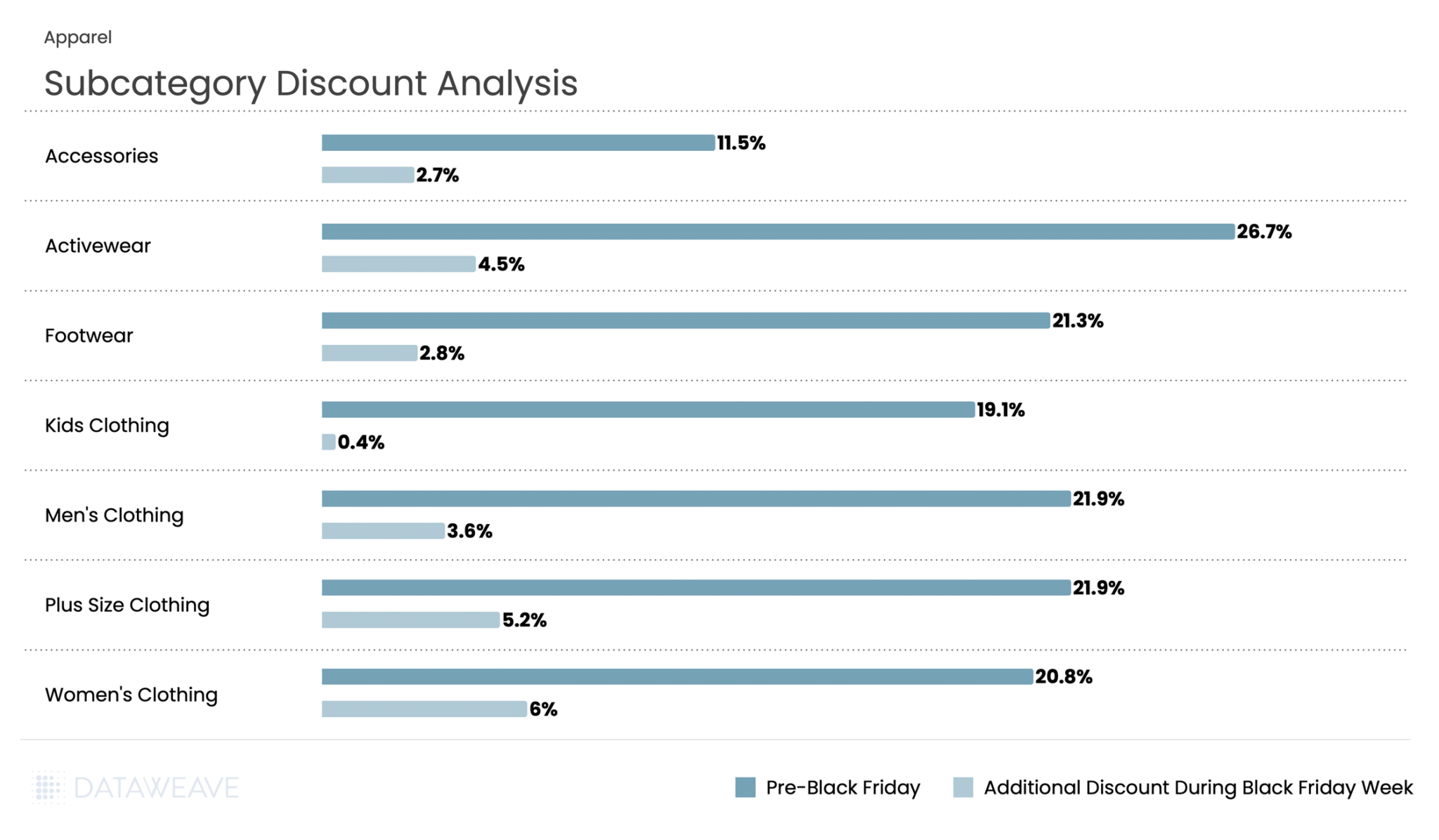
    Apparel showed the strongest discounting activity throughout the BFCM period among all categories. Pre-Black Friday discounts averaged 17.2%, with Black Friday Week adding 3.5%, making it one of the most heavily promoted categories.

    Activewear led pre-sale discounts at an impressive 26.7%, with an additional 4.5% discount during Black Friday week. Plus Size Clothing and Men’s Clothing tied for second place in pre-sale discounts at 21.9% each. Notably, Plus Size Clothing saw the highest Black Friday Week discount at 5.4%.

    Women’s Clothing saw robust discounts throughout, with 20.8% pre-sale and an additional 6% during Black Friday Week (the highest additional discount in the category).

    Share of Search: Brand Visibility Trends

    Brand visibility for apparel during Black Friday week in the UK

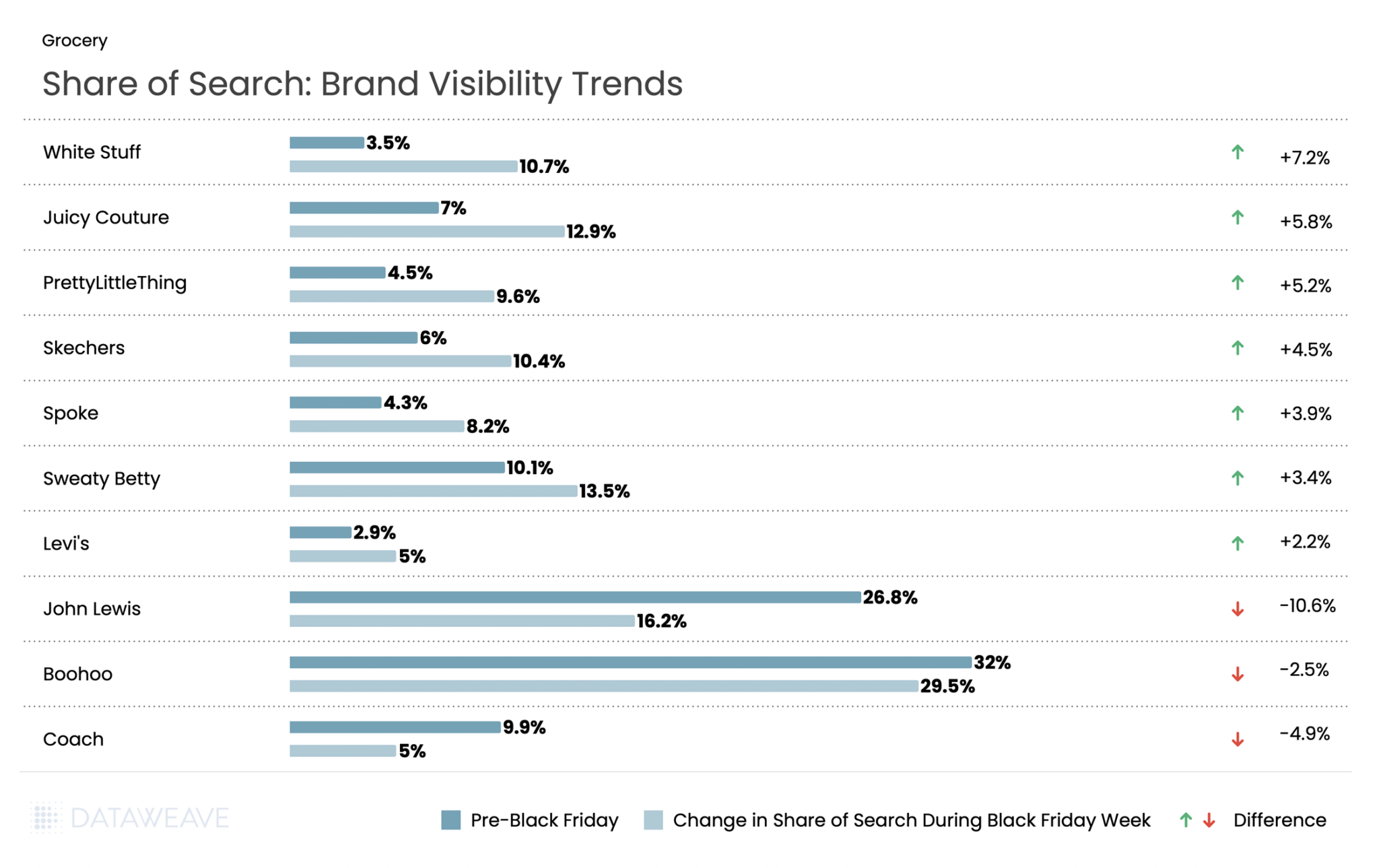
    White Stuff, the British lifestyle brand, saw a 7.2% surge in visibility during Black Friday. Y2K fashion made a statement as Juicy Couture jumped 5.8 %. Fast fashion player Pretty Little Thing gained in visibility by 5.2%. Comfort brands performed strongly, with Skechers gaining 4.5% and activewear specialist Sweaty Betty rising 3.4%. Even premium denim brand Levi’s gained ground, increasing share of search by 2.2%.

    However, retail giants faced significant visibility challenges. John Lewis saw the steepest decline in the Apparel category, with share of search dropping by 10.6% during Black Friday week. Fast fashion giant Boohoo declined 2.5%. Premium accessory brand Coach’s share fell 4.9%.

    The data suggests UK consumers gravitated toward distinctive brands with clear identities during Black Friday, whether heritage British labels, Y2K nostalgia, or comfort-focused specialists, rather than generalist retailers or fast fashion platforms.


    Want to understand how DataWeave’s pricing intelligence platform can help your business make data-driven decisions during peak sales events? Contact us to learn more about competitive insights, price intelligence, assortment analytics, content analytics, and digital shelf analytics.

    Check out our analysis on Black Friday 2025 Pricing and Discount trends in the USA.

    Follow our blog for more insights on retail pricing trends, brand visibility analysis, and data-driven commerce intelligence.
  • Black Friday U.S. 2025: Comprehensive Analysis of Deals, Pricing Trends, and Brand Visibility Across Key Categories

    Black Friday U.S. 2025: Comprehensive Analysis of Deals, Pricing Trends, and Brand Visibility Across Key Categories

    Black Friday 2025 shattered records once again. U.S. consumers spent a record $11.8 billion online on Black Friday, a 9.1% increase from 2024 and the first time online sales exceeded $11 billion. The National Retail Federation (NRF) projects holiday retail sales (November-December) to grow 3.7% to 4.2% over 2024, with total holiday spending expected to surpass $1 trillion for the first time ever. Against this backdrop of robust consumer spending, how did leading retailers and brands perform across key categories this Black Friday?

    At DataWeave, we conducted a detailed analysis of Black Friday 2025 pricing trends across five major categories: Consumer Electronics, Home & Furniture, Health & Beauty, Grocery, and Apparel. Our AI-powered pricing intelligence platform monitored nearly 80,000 SKUs across leading U.S. retailers like Amazon, Walmart, Target, Macy’s, Home Depot, Sephora, and more, revealing interesting patterns in how retailers and brands approached this year’s sale season.

    Our Methodology

    For this analysis, DataWeave monitored average discounts across leading U.S. retailers during two distinct periods:

    • Pre-Black Friday: Up to November 23, 2025 – capturing early holiday deals and baseline pricing
    • Additional Discounts During Black Friday Week: November 24 – December 1, 2025 – covering Thanksgiving week through Black Friday (November 28) and Cyber Monday (December 1)

    Our sample encompassed the top-ranked products across subcategories on major retail sites. We also analyzed Share of Search data, which measures brand visibility by monitoring which brand names appear in the top 20 search results for critical keywords.

    Black Friday 2025: The Big Picture

    Here’s the snapshot of average discounts during the Pre-Black Friday period compared to Black Friday Week:

    Black Friday snapshot of categories across US

    Key Insight: Pre-Black Friday discounts were significant across all categories. This suggests retailers front-loaded their promotions to capture early holiday shoppers, with additional discounts during Black Friday Week adding to the baseline discounts already in place.

    Consumer Electronics

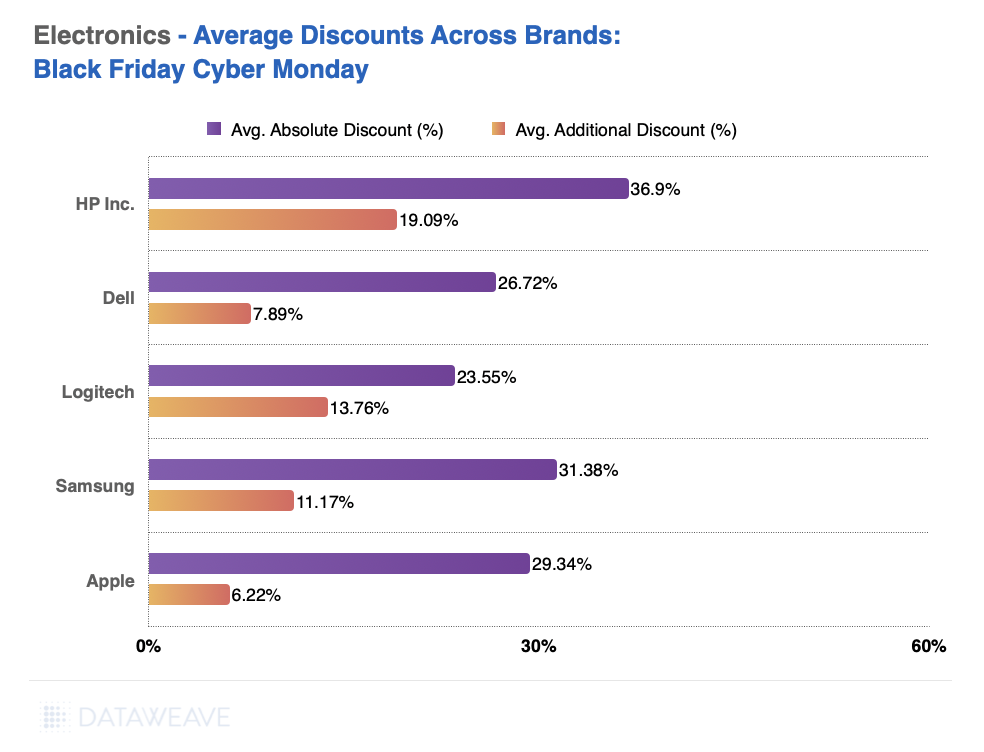
    Consumer electronics remain one of the most anticipated categories during Black Friday and Cyber Monday. Notably, AI traffic to retail websites grew 805% year-over-year, with consumers using AI tools most frequently for video games, appliances, and electronics categories. Our analysis of 10,356 SKUs reveals how discounts varied across subcategories.

    Subcategory Discount Analysis

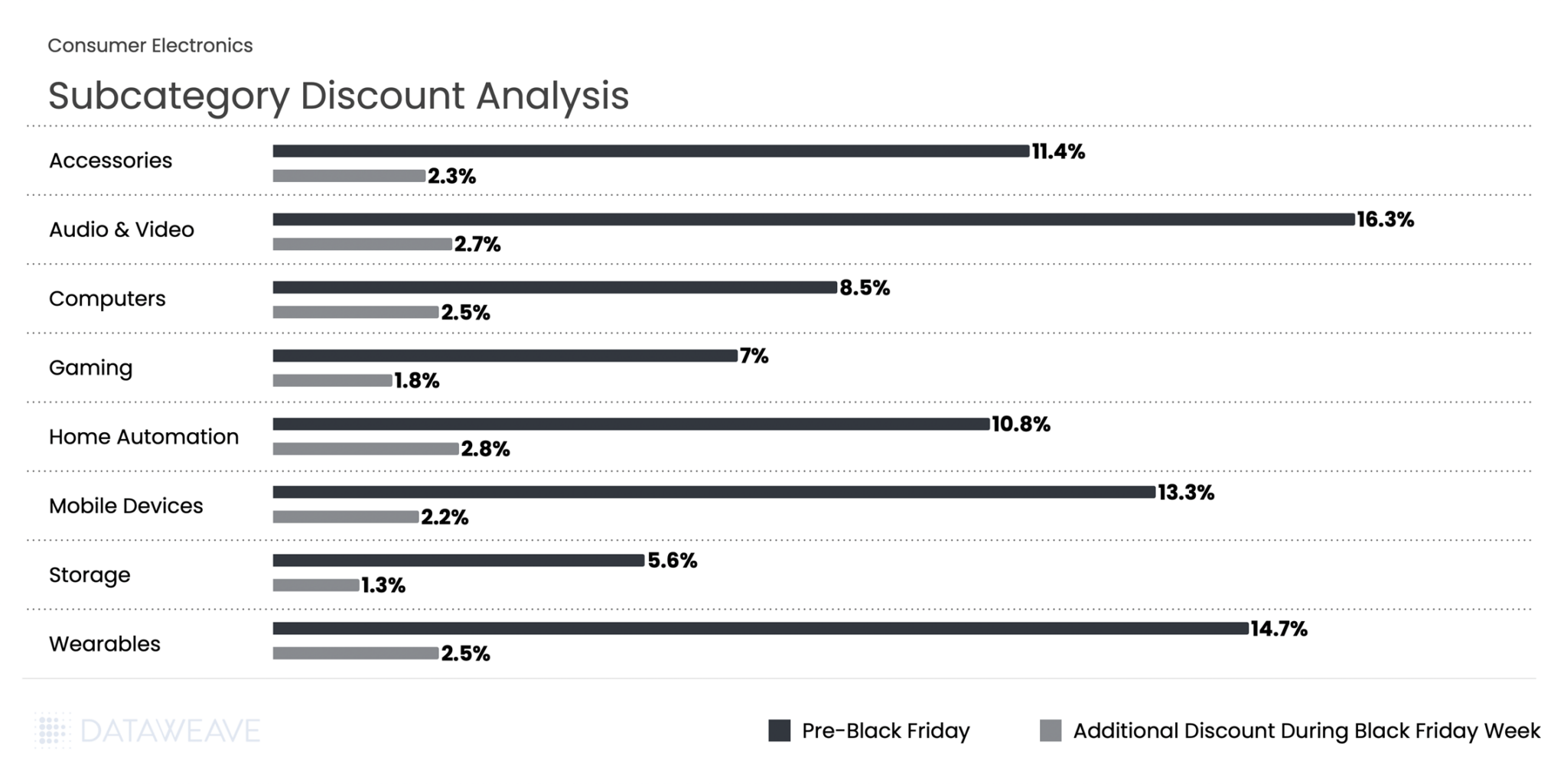
    Consumer Electronics discount trends across sub categories this Black Friday

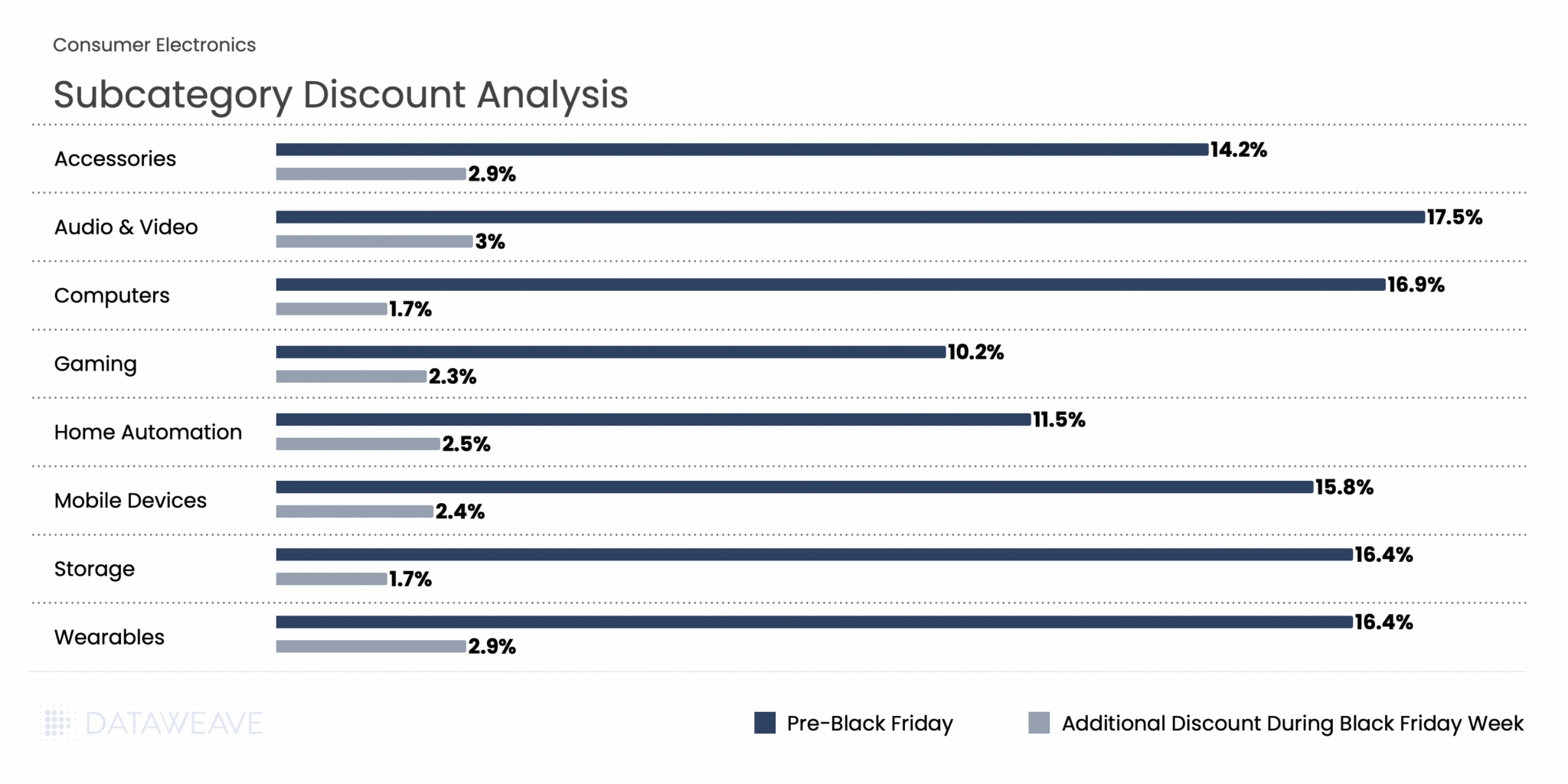
    In Consumer Electronics, Pre-Black Friday discounts averaged 14.6% across subcategories, while Black Friday Week saw an additional 2.6% discount on average. Audio & Video products led the pre-sale discounting at 17.5%, indicating retailers were eager to move inventory early. During Black Friday Week, Audio & Video, Accessories, and Wearables saw the highest additional discounts (2.9-3 %), while Computers and Storage had already been heavily discounted pre-sale, leaving minimal room for further reductions during the main event.

    Share of Search: Brand Visibility Trends

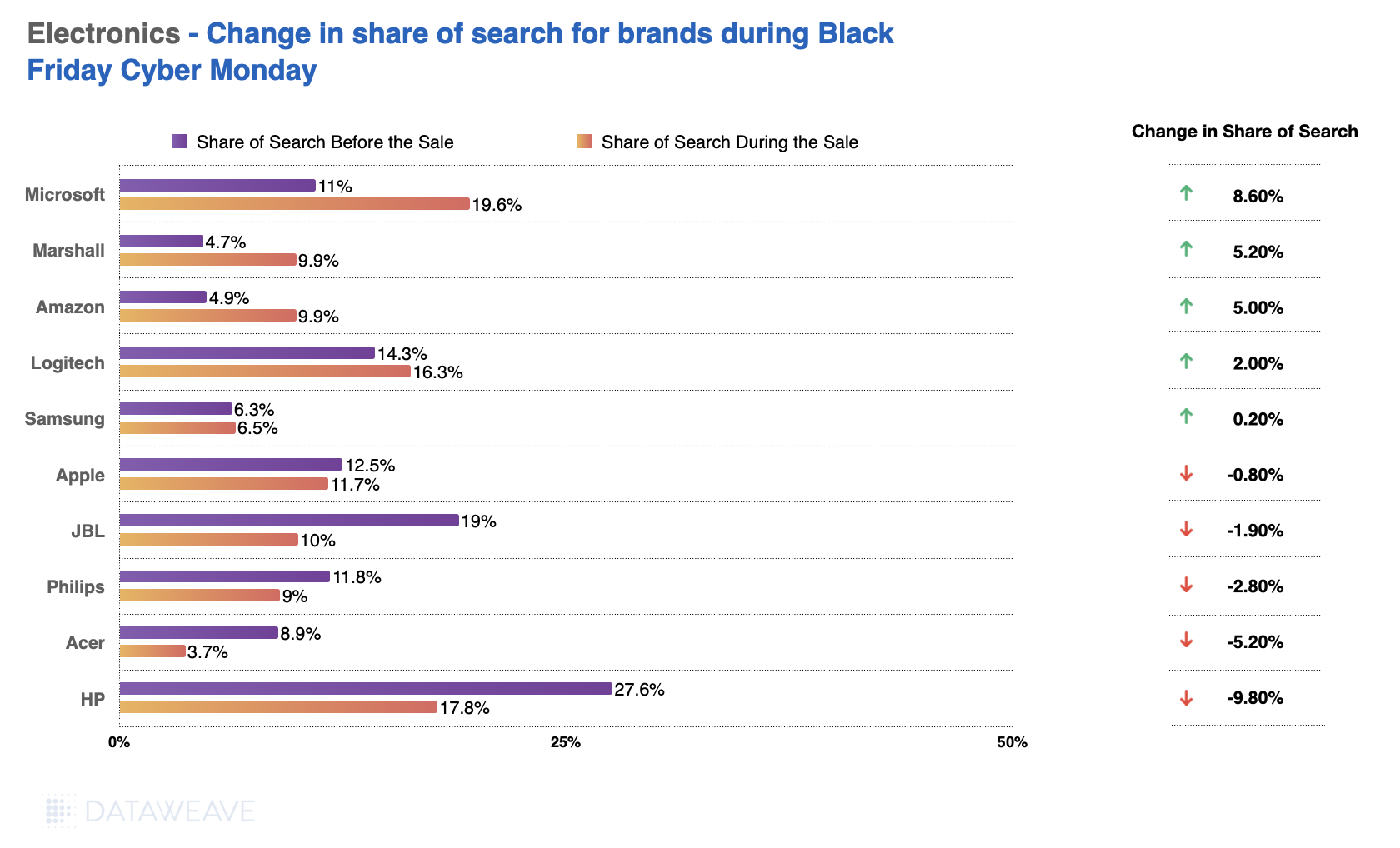
    Our Share of Search analysis reveals significant shifts in brand visibility during Black Friday Week:

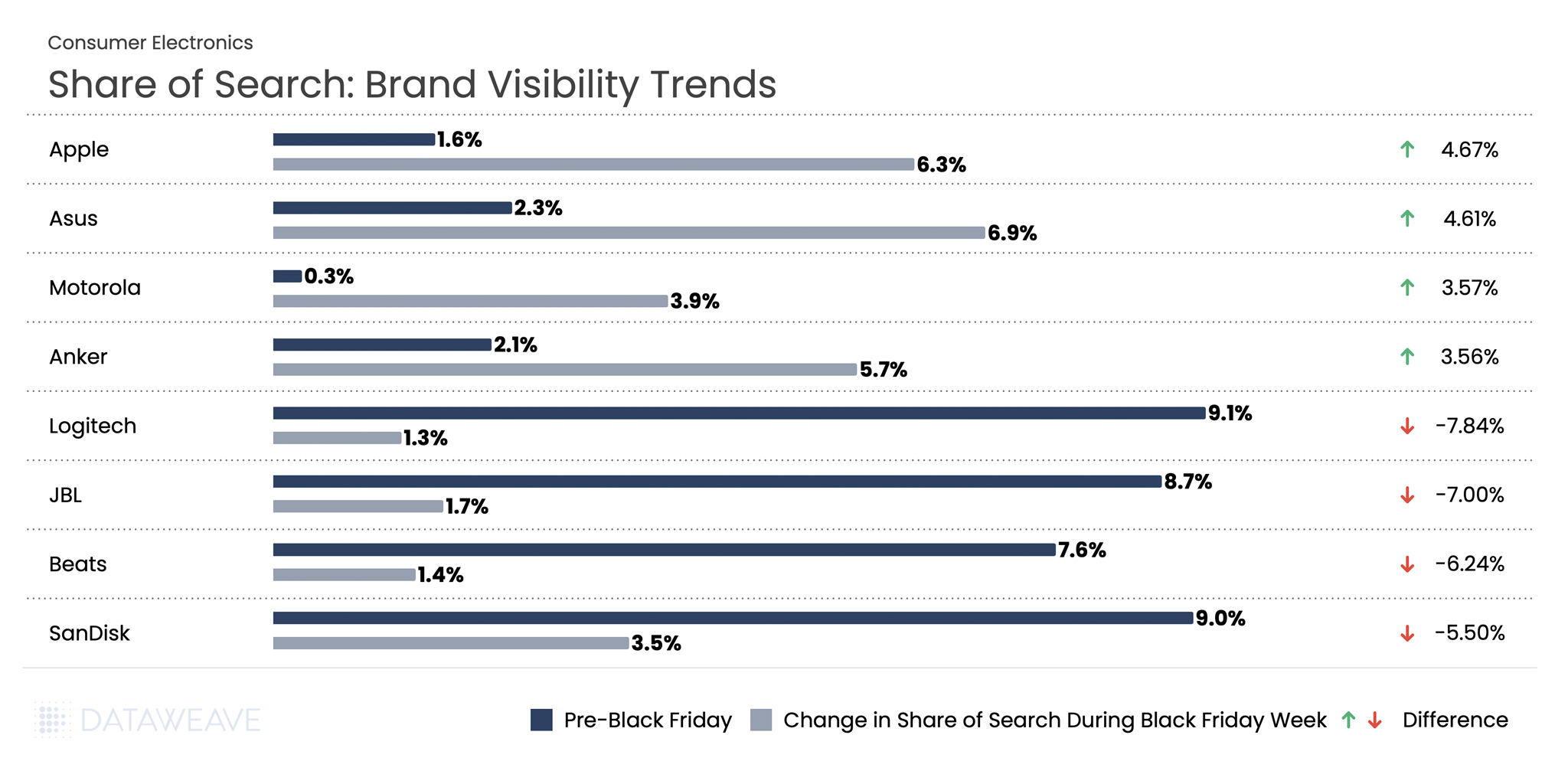
    Share of Search shows brand visibility trend across consumer electronics brands in the US

    The Takeaway: Our analysis reveals significant shifts in brand visibility during Black Friday Week compared to the pre-sale period. Computing and mobile-focused brands like Apple and Asus gained substantial ground, while audio brands like Logitech, JBL, and Beats saw their visibility plummet. Apple’s Share of Search jumped from 1.58% to 6.2%, a gain of 4.6%, suggesting strong promotional activity or heightened consumer interest. Meanwhile, Logitech dropped nearly 8%, from 9.9% to just 1.2%.

    Home & Furniture

    The Home & Furniture category continues to be a consumer favorite during Black Friday. Our analysis of 12,610 SKUs shows how discounts were distributed across subcategories.

    Subcategory Discount Analysis

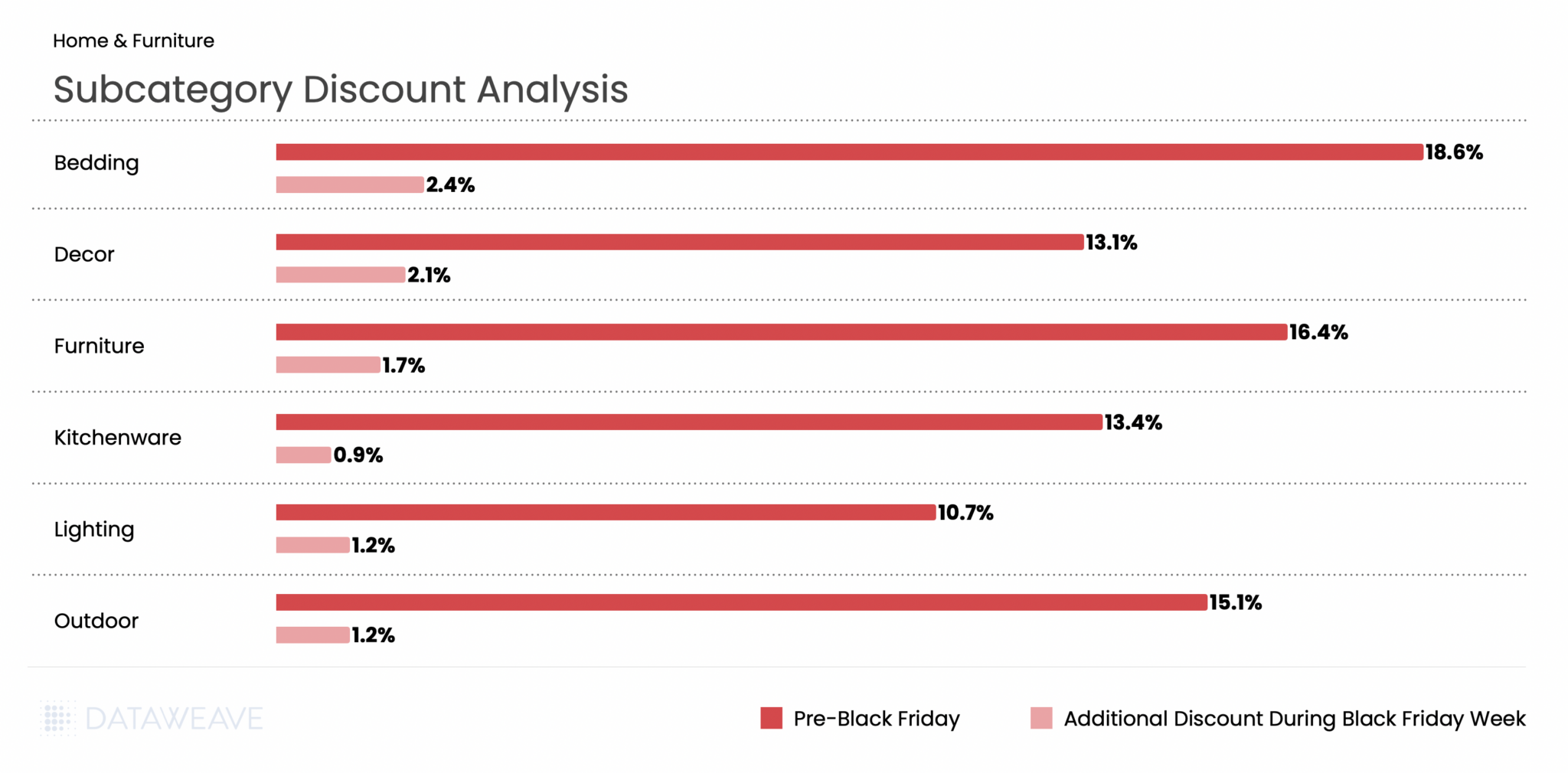
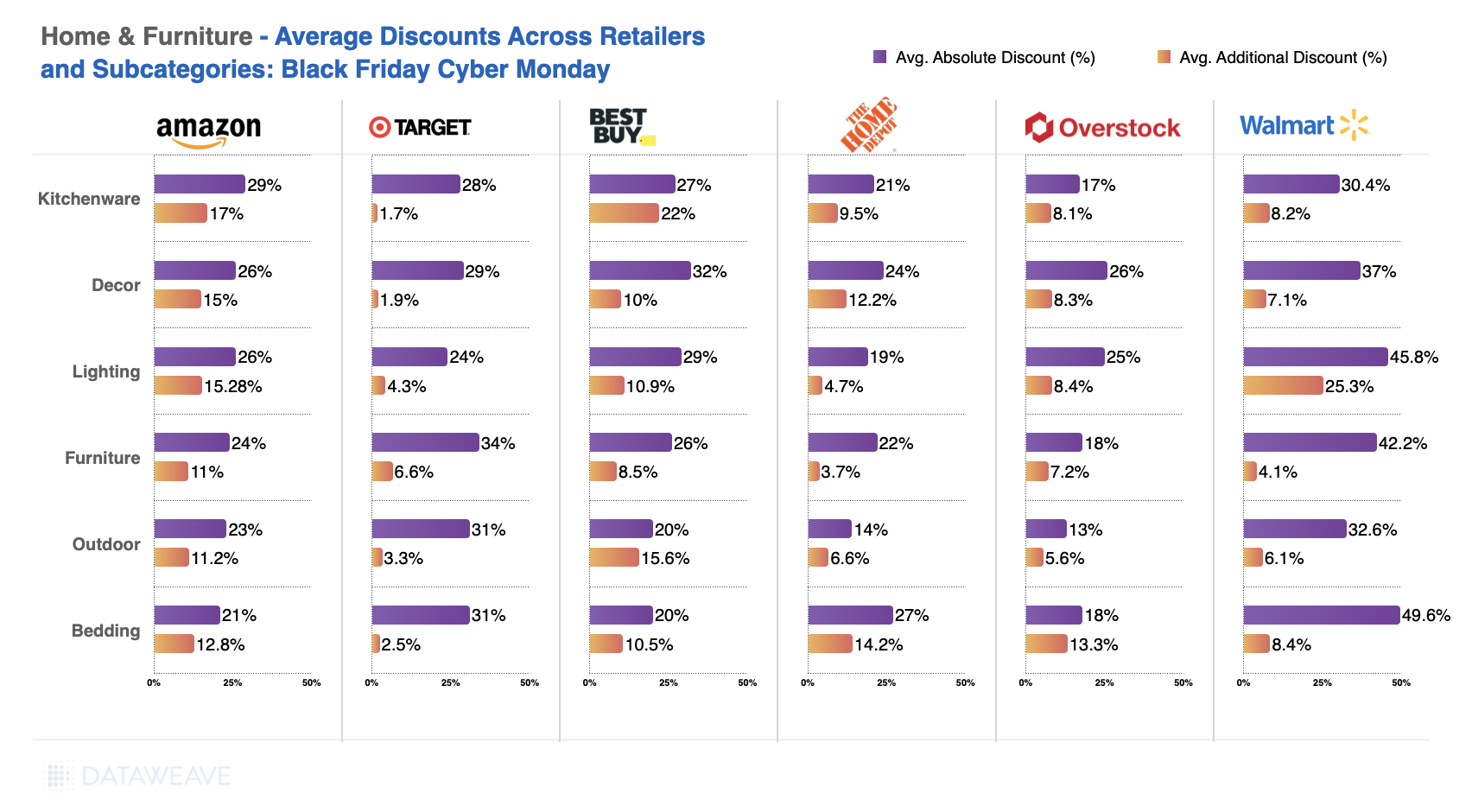
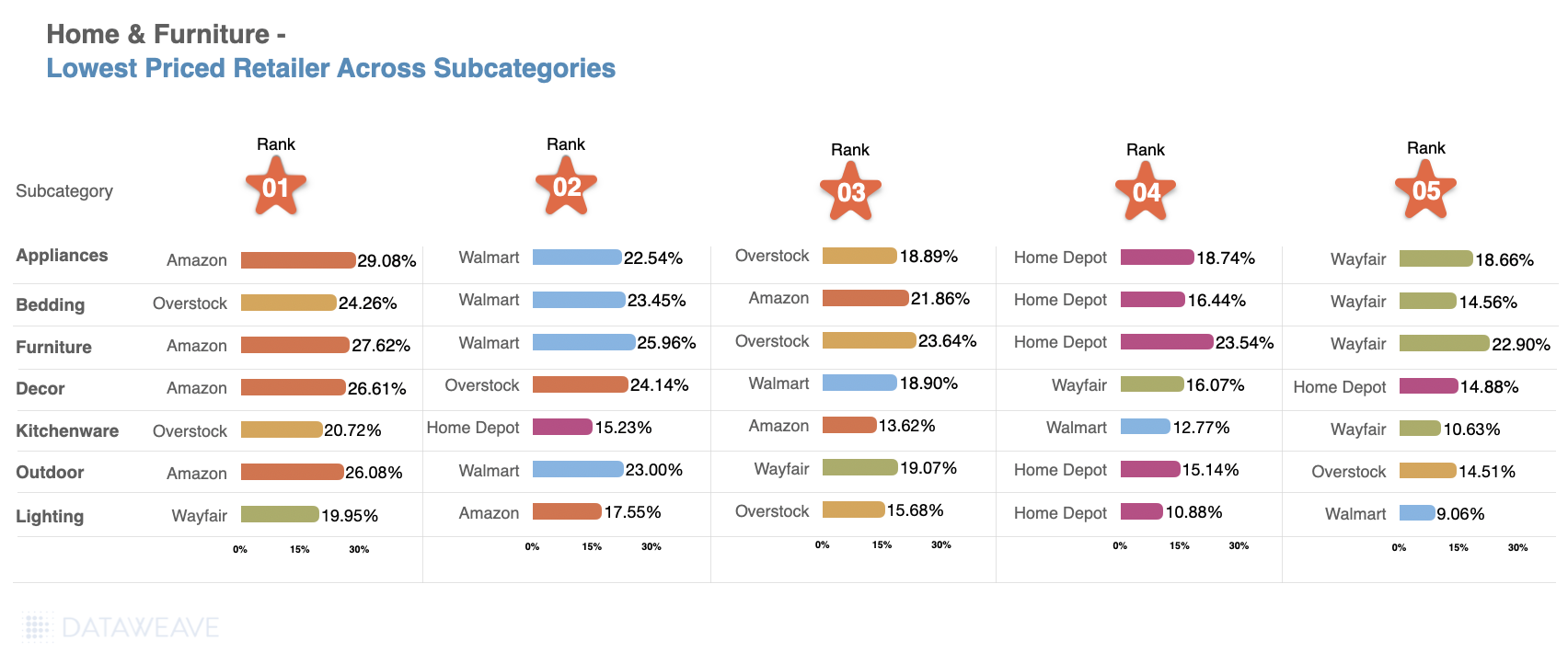
    Discount analysis for home and furniture subcategories this Black Friday

    Home & Furniture saw Pre-Black Friday discounts averaging 13.9%, with Black Friday Week adding just 1.7% on average, the second-lowest additional discount among all categories. Bedding led pre-sale discounts at an impressive 18.6%, followed by Furniture at 16.4% and Outdoor at 15.1%. This suggests retailers aggressively promoted home goods early in the season to capture deal-seekers.

    During Black Friday Week, Bedding maintained leadership with 2.4% additional discounts, while Kitchenware saw the smallest bump at just 0.9%, indicating early promotions had already captured most of the discount opportunity.

    Share of Search: Brand Visibility Trends

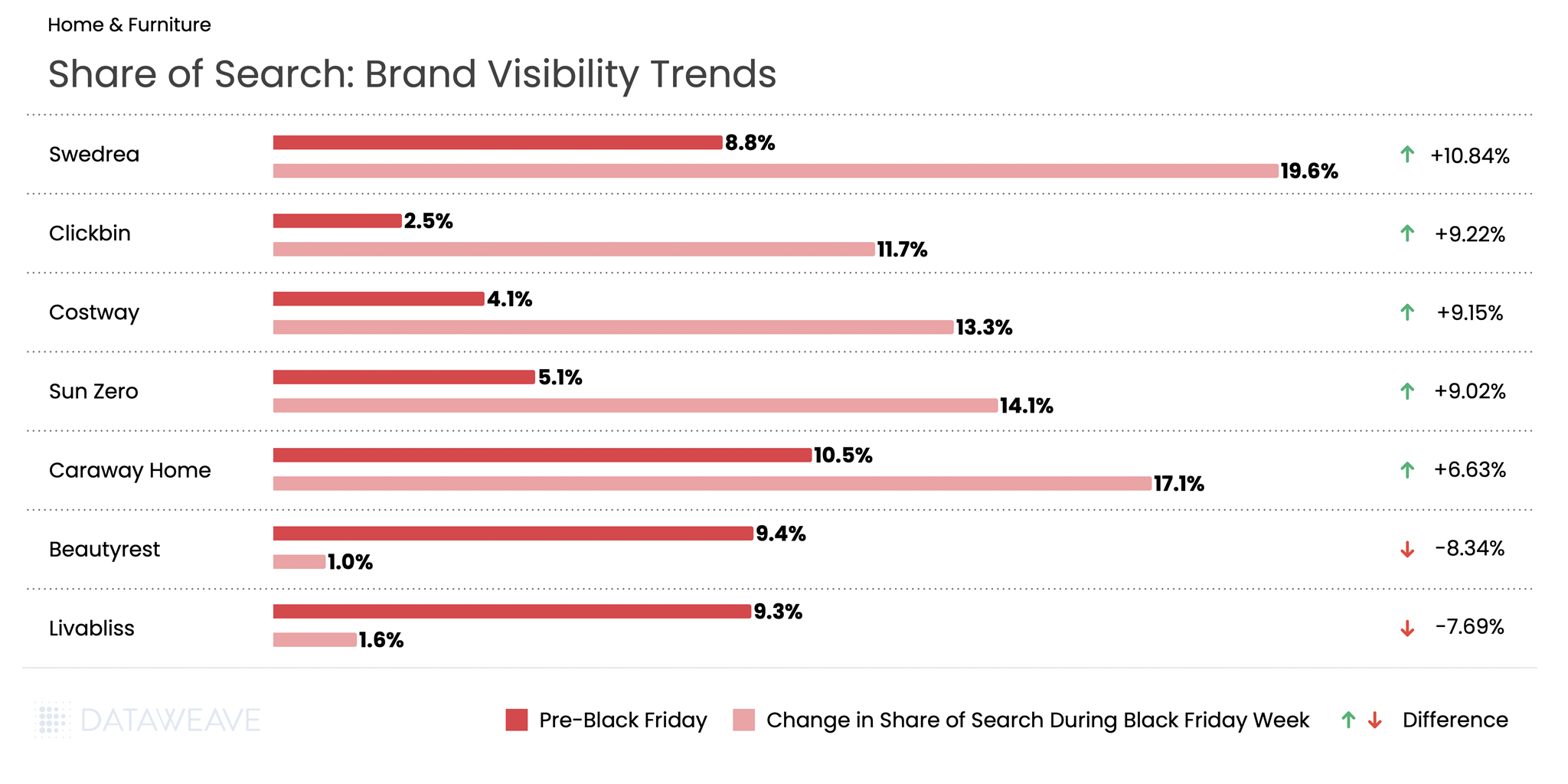
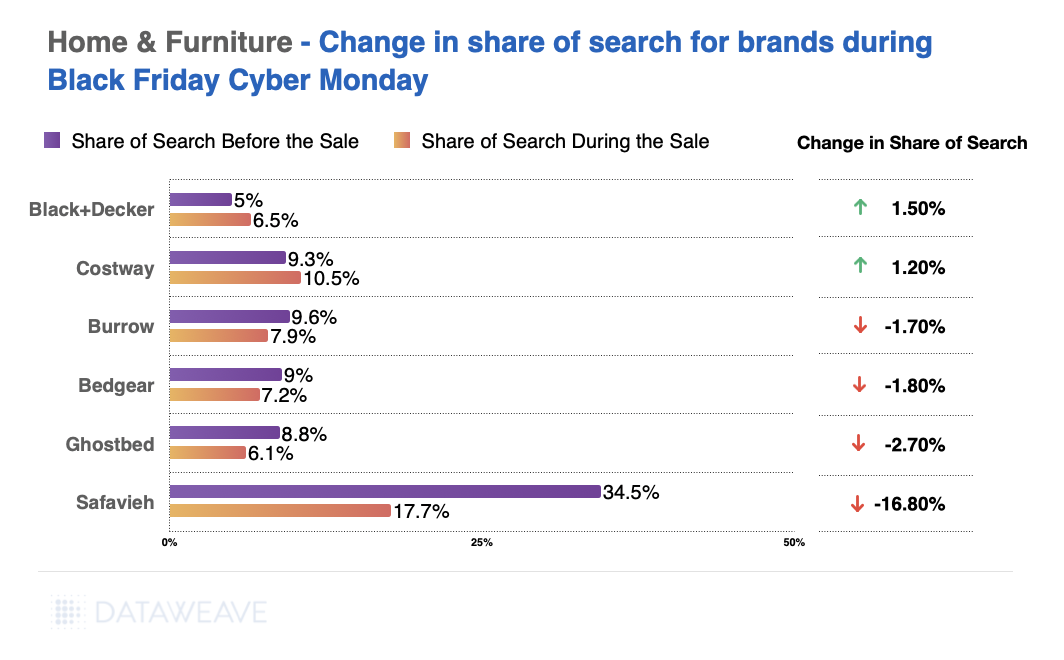
    Share of Search shows brand visibility trend across home and furniture brands in the US

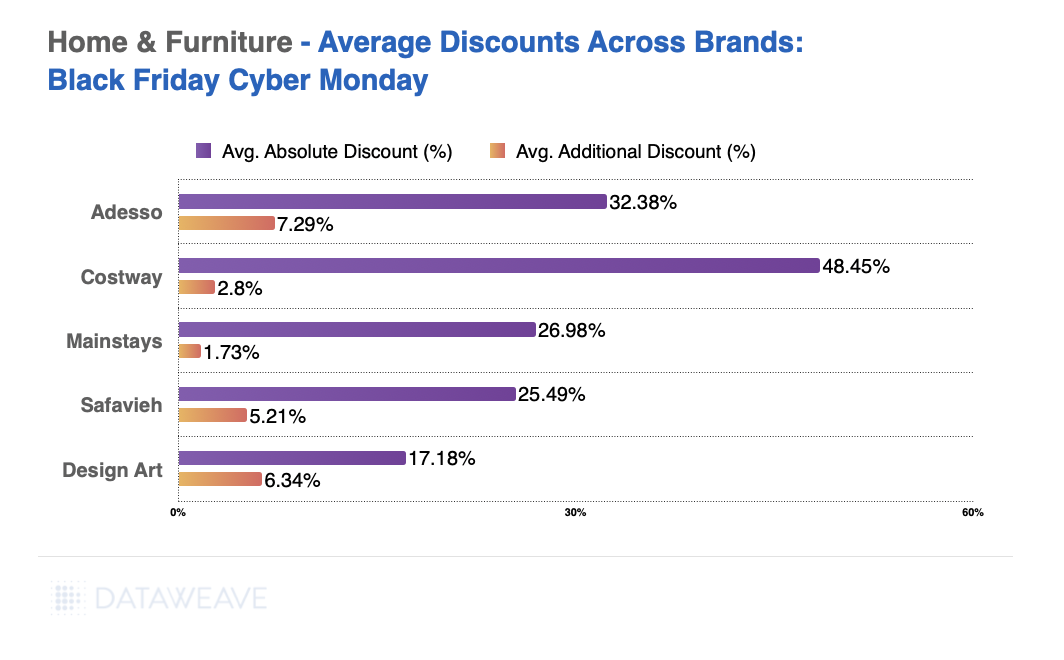
    The Takeaway: The Home & Furniture category saw some of the most dramatic Share of Search swings in our entire analysis. Emerging and value-oriented brands dominated the gains, with Swedrea surging from 8.7% to 19.6%, a remarkable 10.8% increase. Similarly, Clickbin and Costway each gained over 9%. On the flip side, established premium brands like Beautyrest and Livabliss saw sharp visibility declines, dropping over 7-8%.

    Health & Beauty

    Health & Beauty has emerged as a growth engine during Black Friday. The beauty industry is projected to grow 5% annually through 2030 according to a McKinsey survey. Our analysis of 16,141 SKUs reveals subcategory-level insights.

    Subcategory Discount Analysis

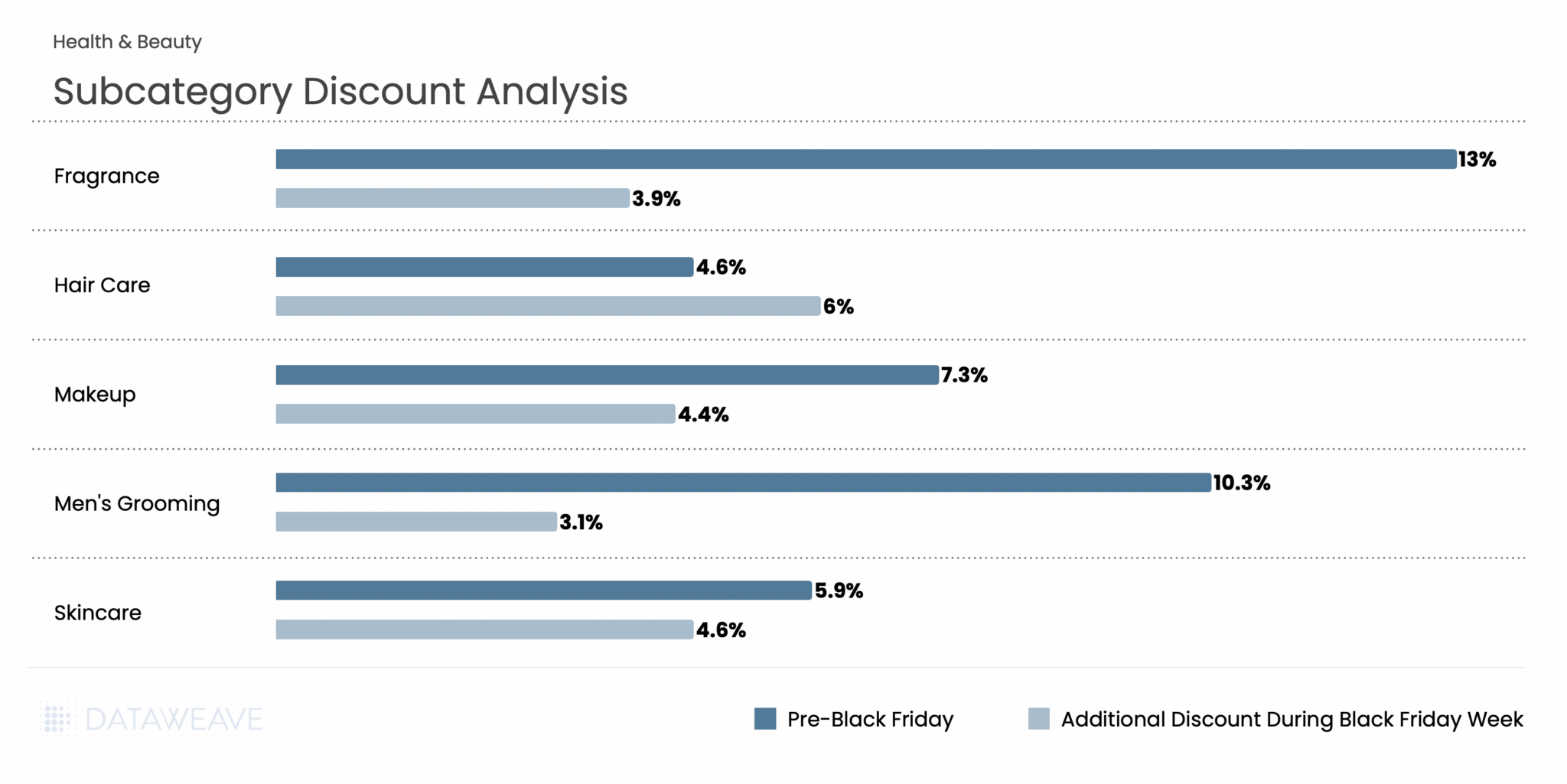
    Discount analysis for health and beauty subcategories this Black Friday

    Notable finding: Health & Beauty presented a unique discounting pattern compared to other categories. Pre-Black Friday discounts averaged just 7.1%, the second-lowest among all categories. But Black Friday Week discounts were relatively strong at 4.8%. This indicates the Beauty category held back more discounts for the main event.

    Notably, Hair Care was the only subcategory across our entire analysis where Black Friday Week discounts (6%) exceeded Pre-Black Friday discounts (4.6%), suggesting retailers strategically saved their best hair care promotions for the big weekend. Fragrance led pre-sale discounts at 13%, making it an attractive early shopping category.

    Share of Search: Brand Visibility Trends

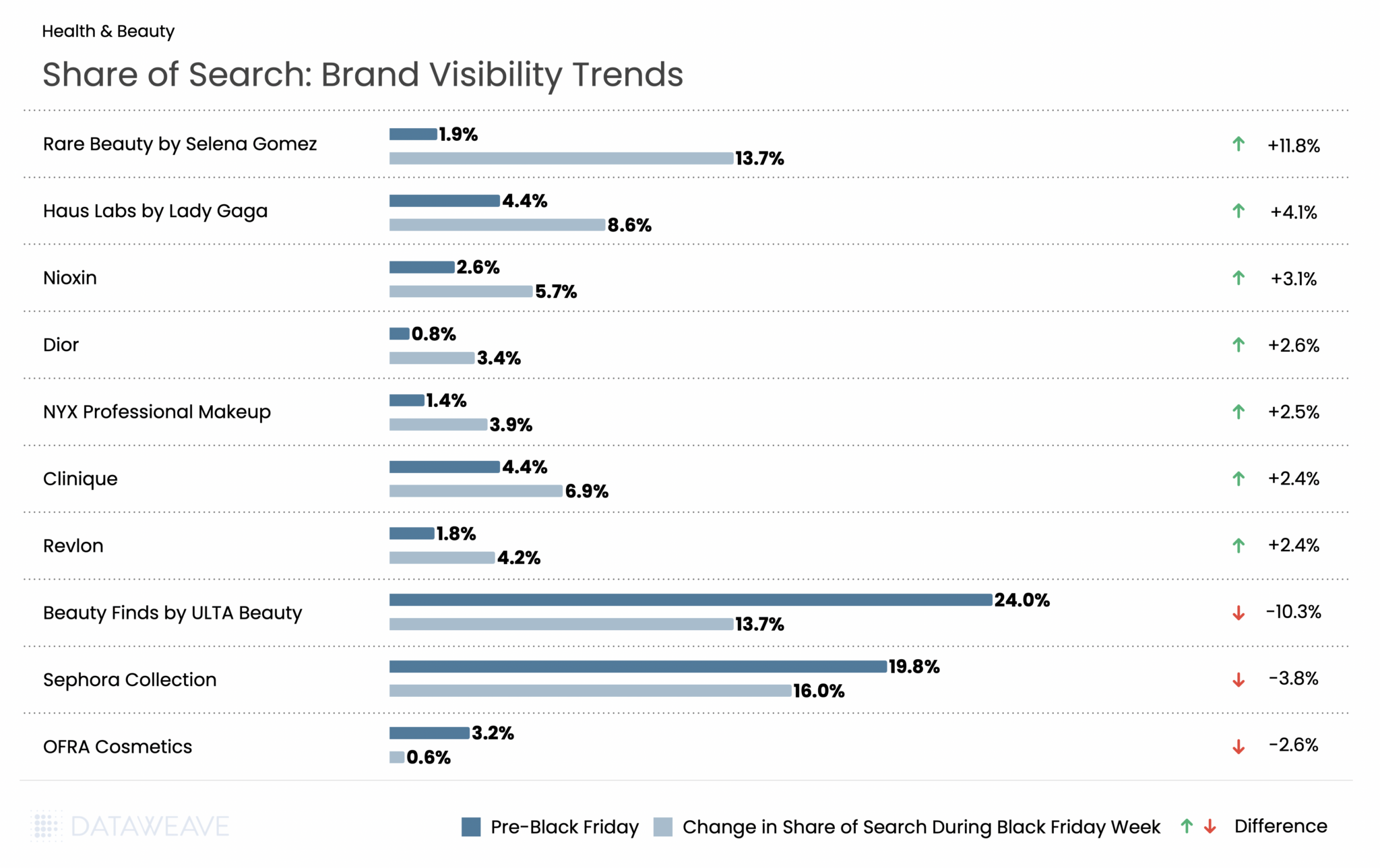
    Health & Beauty saw some of the most dramatic Share of Search swings in our analysis, driven largely by celebrity-backed brands. Rare Beauty by Selena Gomez exploded from just 1.9% to 13.7%, a whopping 11.8% gain that made it the biggest winner across all categories. Haus Labs by Lady Gaga also surged (+4.1%), while prestige brands like Dior (+2.6%) and Clinique (+2.4%) gained ground.

    The flip side? Retailer private labels took a hit: Beauty Finds by ULTA Beauty collapsed from 24% to 13.7% (-10.3%), and Sephora Collection dropped from 19.8% to 16.0% (-3.8%).

    Share of Search shows brand visibility trend across health and beauty brands in the US

    Key Takeaway: The Beauty category tells a compelling story about the power of celebrity brands during Black Friday. The Share of Search shifts appear to reflect how retailers and brands recalibrated their promotional focus for Black Friday. Celebrity-driven lines rose sharply in visibility, suggesting stronger placement, promotion, or search prioritization during the sale period. At the same time, private-label ranges from ULTA and Sephora lost ground, indicating a pivot away from house-brand visibility in favor of more spotlighted national and prestige brands throughout the event.

    Grocery

    While Grocery typically sees more modest discounts compared to discretionary categories, the sector remains a critical part of Thanksgiving weekend shopping. According to the National Retail Federation, grocery stores and supermarkets ranked as the third most popular shopping destination during Thanksgiving weekend, with 40% of consumers making purchases there. Our analysis of 18,823 SKUs shows how retailers approached promotions across essential and indulgent subcategories.

    Subcategory Discount Analysis

    Discount analysis for grocery subcategories this Black Friday

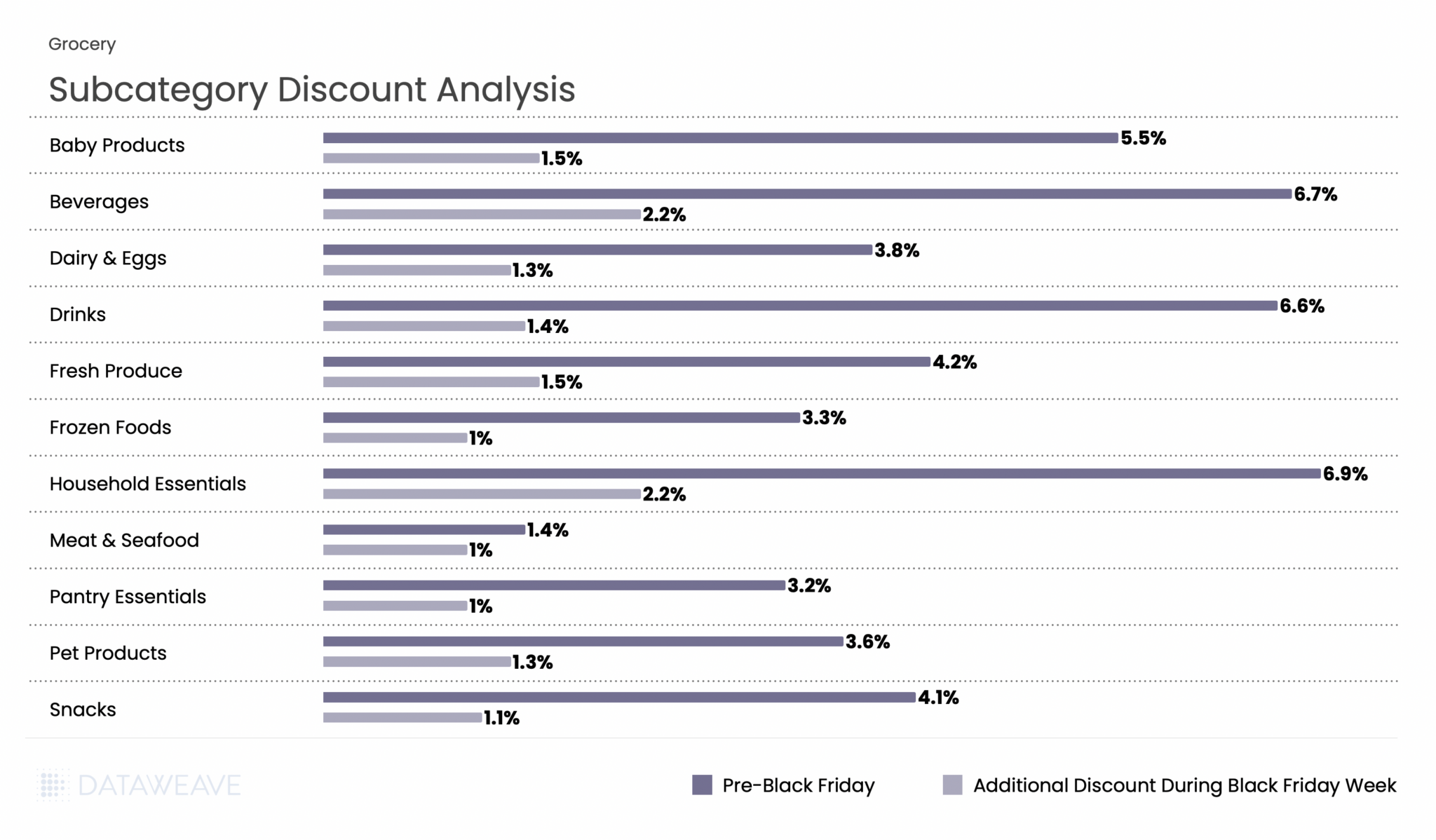
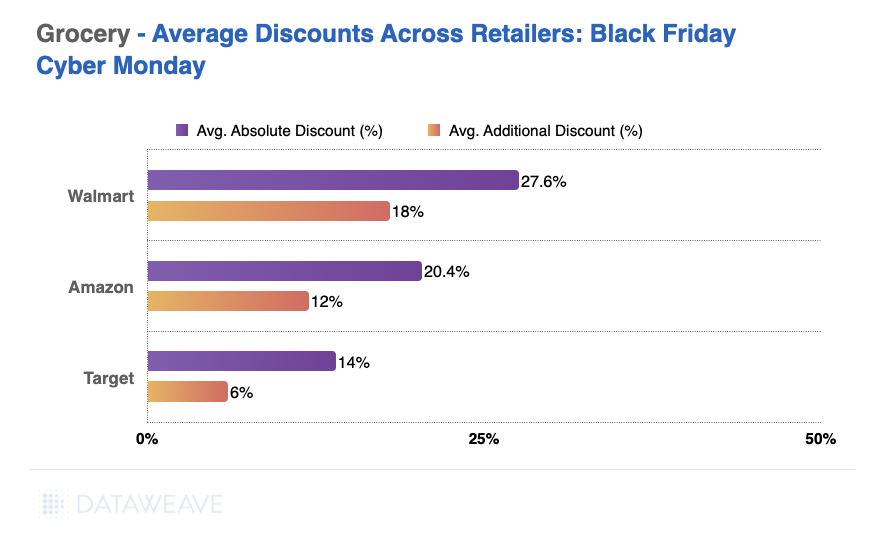
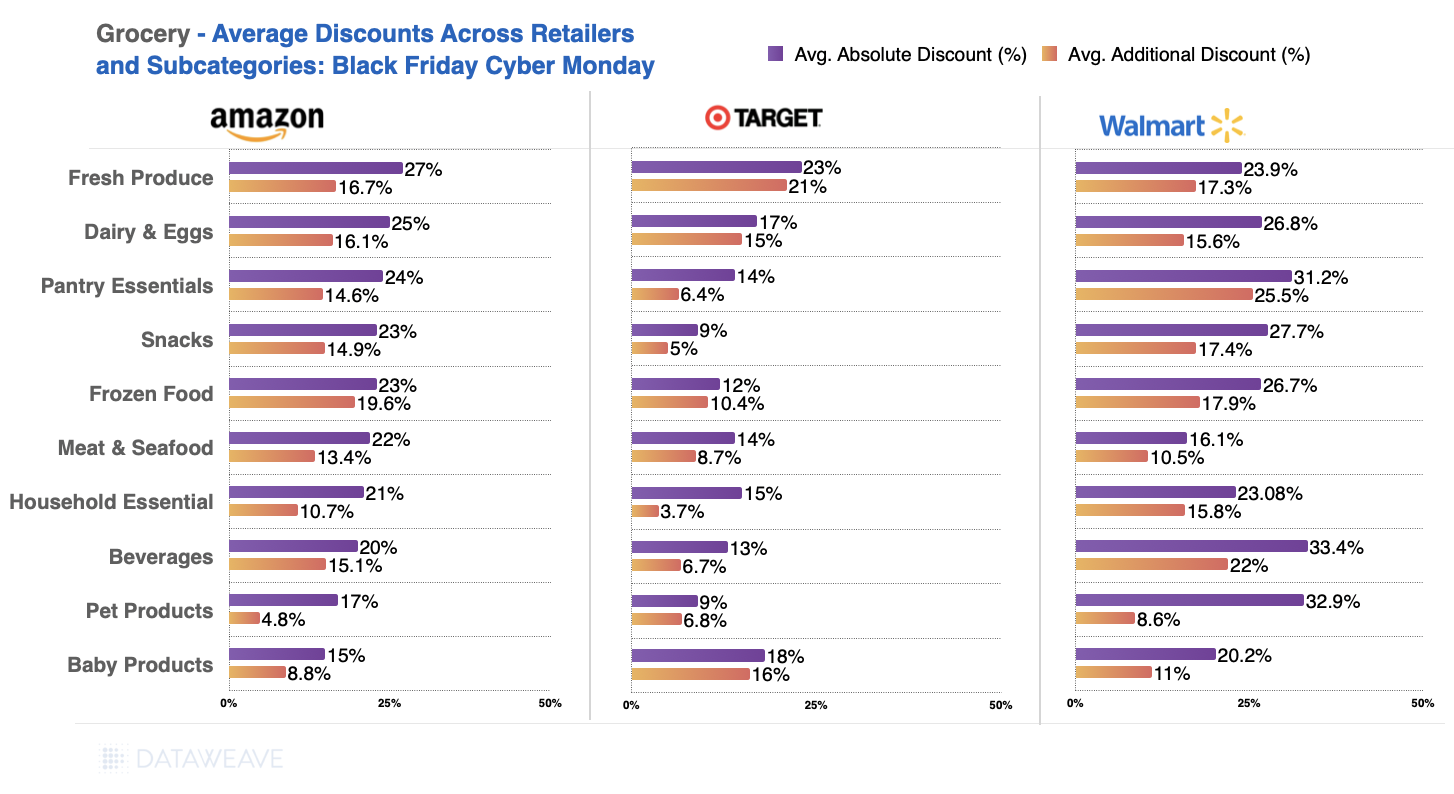
    Grocery had the lowest discounts across all categories, reflecting the already-thin margins in food retail. Pre-Black Friday discounts averaged just 5.2%, with Black Friday Week adding only 1.5%. Household Essentials and Beverages led pre-sale discounts at 6.9% and 6.7% respectively, and maintained their lead during Black Friday Week with 2.2% additional discounts each. Fresh categories like Meat & Seafood (1.4% pre-sale, 1% Black Friday Week) and Frozen Foods (3.3%, 1%) saw minimal promotional activity, consistent with perishable inventory constraints and tight margins.

    Key Takeaway: Grocery discounting remains conservative, with shelf-stable and household items seeing the most promotional activity. The Beverages and Household Essentials subcategories, which have longer shelf life and higher margins, were the primary battleground for grocery promotions during BFCM 2025.

    Share of Search: Brand Visibility Trends

    Share of Search shows brand visibility trend across CPG brands in the US

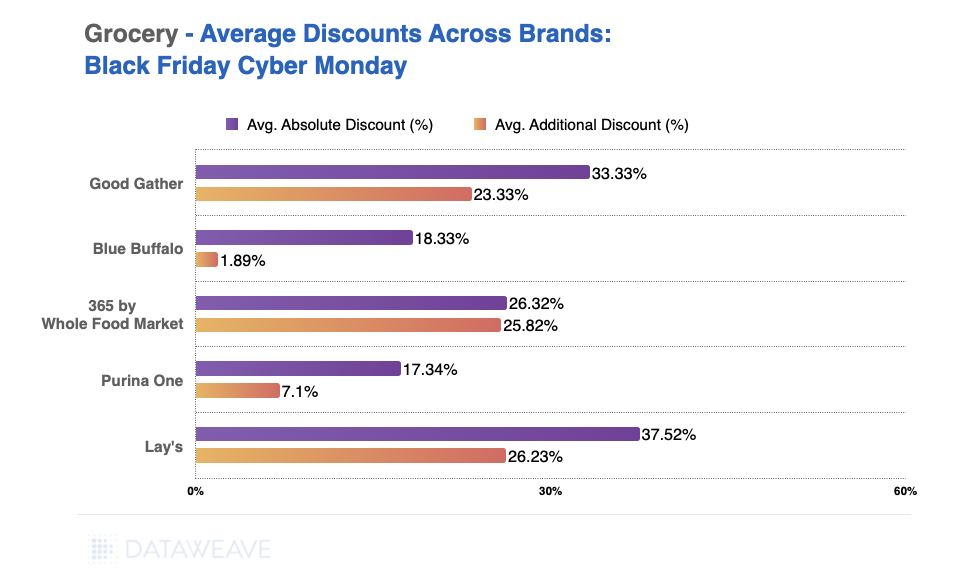
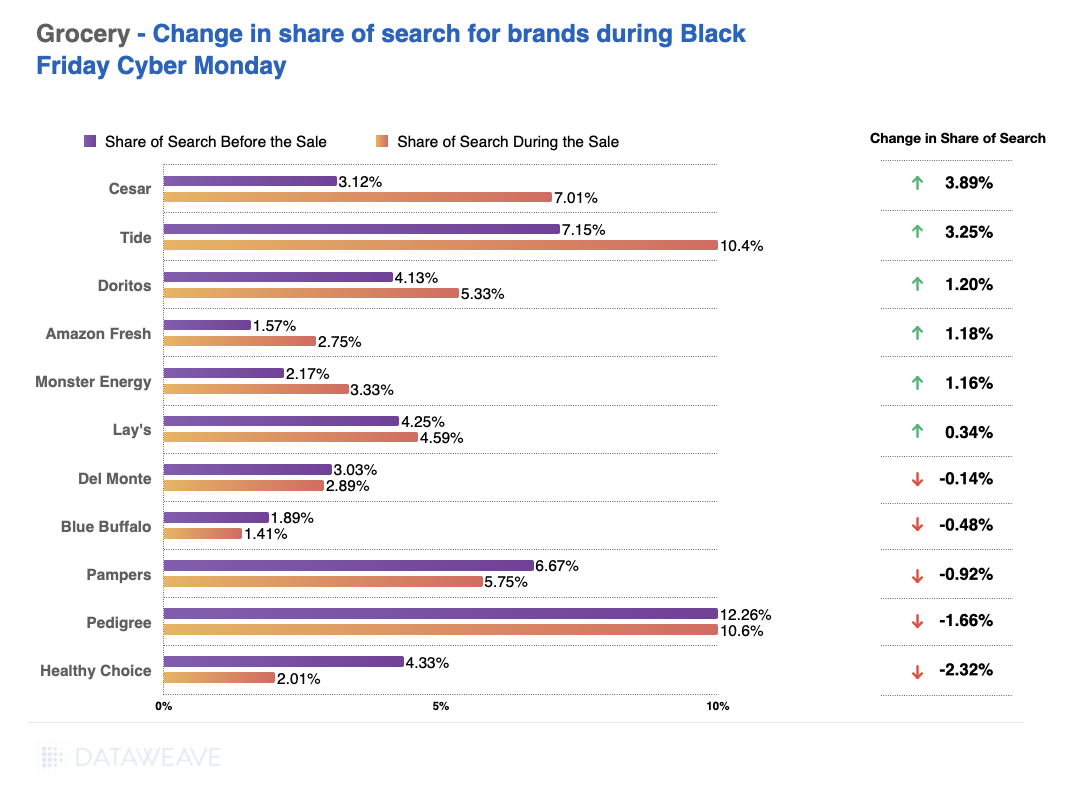
    The Grocery category saw some surprising Share of Search swings during Black Friday Week. Most notably, there was a dramatic divergence between beverage giants: Sprite surged from 1.7% to 6.8% (+5.1%), while Coca-Cola collapsed from 6% to just 0.1% (-5.9%). This stark contrast suggests vastly different promotional strategies or algorithmic visibility changes between the two brands. Private label 365 by Whole Foods Market continued its steady rise, gaining 3%, reflecting ongoing consumer interest in store brands as shoppers seek value.

    The Sprite vs. Coca-Cola divergence is one of the most striking findings in our analysis. Additionally, brands like Amy’s (organic/natural foods) and McCormick (spices/seasonings) gained significant visibility.

    Apparel

    Apparel remains a Black Friday staple and performed strongly this year. Our analysis of 21,749 SKUs (the largest category in our study) reveals interesting patterns.

    Subcategory Discount Analysis

    Discount analysis for apparel and fashion subcategories this Black Friday

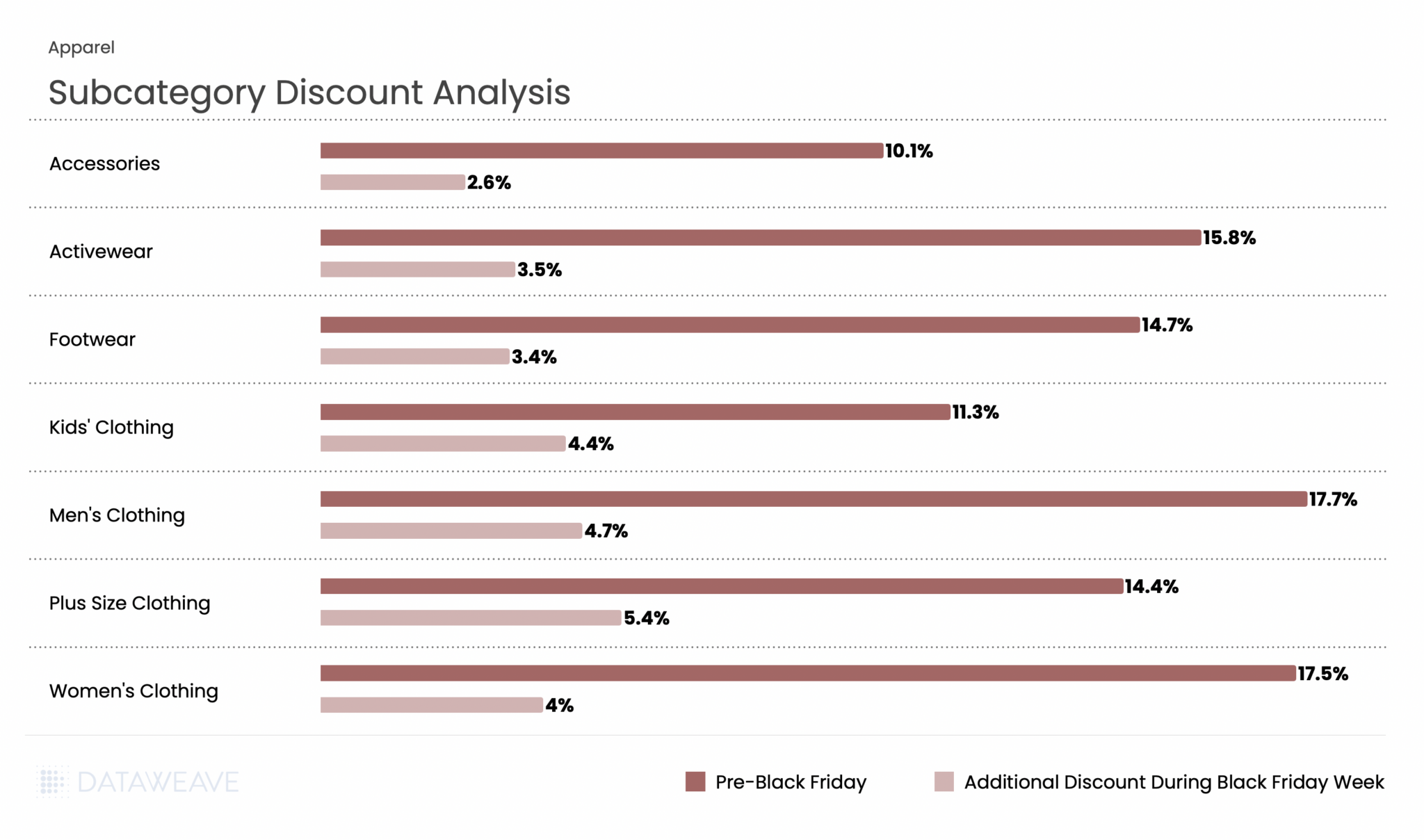
    Apparel showed strong discounting activity throughout the BFCM period. Pre-Black Friday discounts averaged 13.8%, with Black Friday Week adding 3.8%, the highest additional discount among all five categories. Men’s Clothing and Women’s Clothing led pre-sale discounts at 17.7% and 17.5% respectively, reflecting aggressive early promotions on core apparel. Interestingly, Plus Size Clothing saw the highest Black Friday Week discount at 5.4%, suggesting retailers pushed harder during the main event to drive conversions in this segment. Kids’ Clothing also saw strong Black Friday Week discounts at 4.4%.

    Share of Search: Brand Visibility Trends

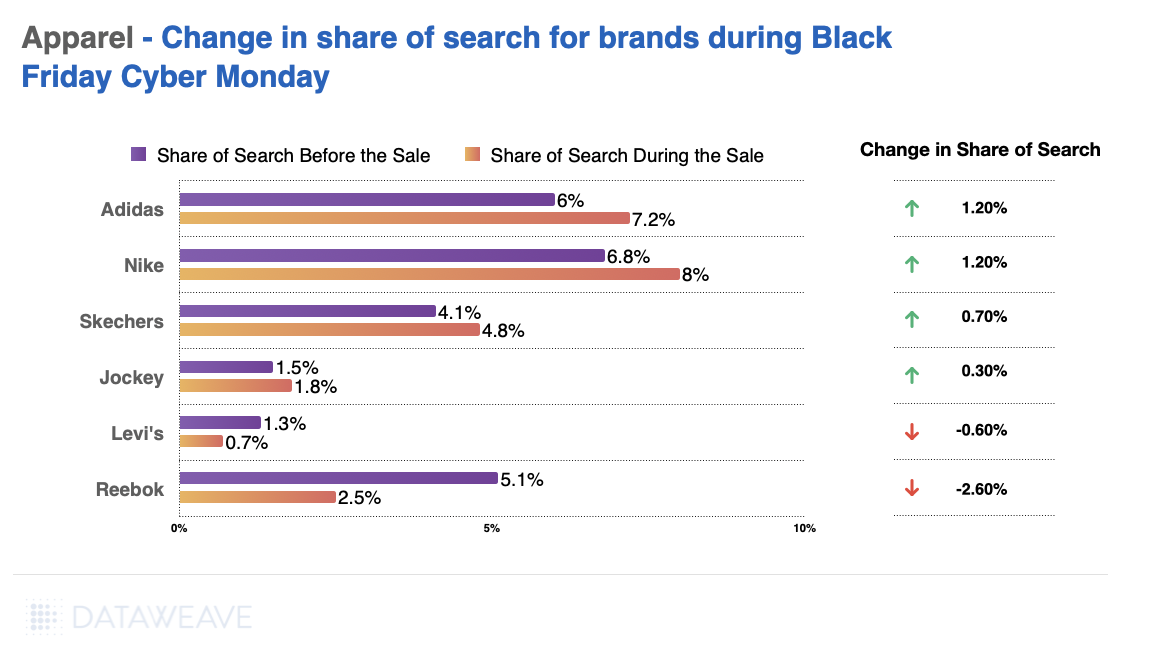
    Apparel saw dramatic Share of Search movements during Black Friday Week. Fashion-forward brands dominated the gains: Madewell surged from 6.9% to 16.1% (+9.2%), while Alice + Olivia jumped from 14.7% to 23.6% (+8.9%). Nike also performed strongly with a 7.1% gain. Conversely, outdoor and athletic brands faced steep declines: The North Face dropped from 18.4% to 5.9%, a massive 12.5% decline, the largest in our entire analysis. Adidas fell 7.7%, Beyond Yoga declined 5.3%, and luxury brand Coach by 5%.

    Share of Search shows brand visibility trend across apparel brands in the US

    Key Takeaway: The data suggests fashion-forward and lifestyle brands (Madewell, Alice + Olivia, Saint Laurent) gained visibility at the expense of outdoor/athletic brands (The North Face, Adidas, Beyond Yoga). This could indicate that fashion brands invested more heavily in promotional visibility during the sale period.


    Want to understand how DataWeave’s pricing intelligence platform can help your business make data-driven decisions during peak sales events? Contact us to learn more about competitive insights, price intelligence, assortment analytics, content analytics, and digital shelf analytics.

    Follow our blog for more insights on retail pricing trends, brand visibility analysis, and data-driven commerce intelligence.
  • Prime Day 2025: Shadow of Rising Prices Over Record Sales

    Prime Day 2025: Shadow of Rising Prices Over Record Sales

    Amazon Prime Day 2025 generated a record-breaking $24.1 billion in US online sales during its extended four-day run (July 8–11, 2025). While the expanded format helped broaden participation, it also diluted the urgency and daily peaks that typically define Prime Day.

    Beneath this record-setting performance lies a more complex reality. Persistent inflation, shifting consumer behavior, and rising pricing pressures created a retail environment very different from previous years, one where higher baseline prices often replaced the deep discounts shoppers expected.

    To understand these dynamics, DataWeave analyzed pricing and visibility trends across 11,495 products using our proprietary AI platform. The study focused on four major categories – Consumer Electronics, Apparel, Home & Furniture, and Health & Beauty – comparing identical SKUs from Prime Day 2024 and 2025, and tracking changes in both organic and sponsored share of search for leading brands.

    The results reveal clear year-over-year price increases: Apparel led with a 9.5% rise, followed by Health & Beauty (7.9%), Consumer Electronics (5.1%), and Home & Furniture (3.9%). In total, 47% of tracked products saw higher prices, indicating that this year’s record sales were achieved in an environment of elevated base pricing rather than deeper discounts.

    Category-wise year-on-year price surge 2024 Vs. 2025_Amazon Prime Day

    Multiple converging forces shaped the retail landscape leading into Prime Day 2025, pushing baseline prices higher even before promotions began.

    • Supply Chain Pressures: Ongoing disruptions and elevated shipping and production costs continue to shape the cost structure across categories.
    • Trade Policy Factors: Recent tariff measures and trade regulations may be contributing to upward pricing trends in certain categories, particularly those with high import dependence such as electronics and home goods.
    • Labor and Operating Costs: Rising wages, transportation expenses, and general operating overhead are placing additional pressure on retailer margins and influencing pricing decisions.
    • Currency Fluctuations: Shifts in exchange rates continue to add variability to the cost of imported goods, especially in globally sourced categories like electronics and apparel.

    These combined pressures created a pricing environment where brands had less room for deep discounting, shaping not just how products were priced, but also how aggressively they were promoted.

    To better understand the impact, we compared Prime Day 2025 prices to those from Prime Day 2024 for the same SKUs across major categories. This year-over-year view highlights how elevated baseline prices, driven by the factors outlined above, shaped the shopping experience and promotional strategies.

    Consumer Electronics

    • JBL prices increased 24% year-over-year, the highest among major electronics brands.
    • Amazon’s own brand saw prices increase by 22%.
    • Beats saw a significant 9% increase, while Sony and Samsung both experienced 8% price increases. Apple prices went up by 6%, and Google saw a 7% increase.
    • Meanwhile, other established brands like LG and Motorola maintained minimal increases at 1%, Lenovo at 2%, Soundcore at 3%, and Bose and Hisense both at 5%.
    Consumer Electronics Price Change_Share of Search_Prime Day 2025

    Apple dominated visibility gains, jumping to 17.2% share of search during Prime Day with a 10.7% growth, likely driven by promotional focus on premium devices. Soundcore also saw significant gains of 10.3%, reaching 15.8% share of search.

    LG and Amazon Basics both achieved strong 5.1% growth. Hisense gained 4.7% share with 5% price increases. Samsung and Amazon maintained strong positions with modest gains of 1.9% and 1.3% respectively.

    However, several brands lost ground, with Sony declining most significantly by 1.8% share despite its strong market position, followed by Google (-0.5%) and Motorola (-0.4%).

    Apparel

    • Party Pants showed the highest price increases at 18% year-over-year, followed by casual wear brand Dokotoo at 13%.
    • Athleisure brand CRZ Yoga saw prices increasing by 11%, while Under Armour saw prices rise by 10%.
    • While Reebok experienced a significant 12% increase, Adidas saw 5% price increase.
    • Meanwhile, innerwear brands like Hanes and Cupshe saw minimal price increases at 1%, while Coofandy also saw minimal increases of 1%.
    • Amazon’s own Amazon Essentials maintained minimal price increases of 2%, and Jockey saw modest increases of 4%.
    Apparel Price Change_Share of Search_Prime Day 2025

    T-shirt brand Gildan led share of search gains with 4.0% growth along with a 5% price increase. Party Pants achieved 3.3% growth with 18% price increases, while CRZ Yoga gained 2.8% share and 11% price increases.

    Amazon Essentials and Mens’ apparel brand Coofandy both improved share by 2.1%, with Amazon Essentials keeping price increases to just 2% and Coofandy at 1%. Under Armour gained 2.3% share with 10% price increase.

    However, several brands lost ground, with Hanes declining significantly by 4.4% while keeping price increases to just 1%, followed by Cupshe (-1.4%) and Blooming Jelly (-0.7%).

    Home & Furniture

    • Mattress brand Best Price Mattress increased prices 23% year-over-year, the highest in the category.
    • Amazon Basics showed 12% price increases, demonstrating strategic private label pricing.
    • Home Improvement and Appliances brand Black+Decker saw a pricing increase of 11%.
    • Better Homes saw an 8% increase, while most other brands saw price increases between 4-7%.
    Home & Furniture Price Change_Share of Search_Prime Day 2025

    Appliance brand Acekool led visibility gains with 3.7% growth along with a 5% price increase. Amazon Basics improved significantly with a 3.6% share growth alongside its 12% price increases. Better Homes achieved 3.1% gains with 8% price increases.

    Ironck gained 2.6% share with 7% price increases, and furniture brand Furinno improved by 1.5% with 5% price increases. However, several brands lost ground, with Samsonite declining most significantly by 4.4%, Best Price Mattress lost 2.1% share with its massive 23% price increase, and Allewie declined by 1.7% with 4% price increases.

    Home goods face elevated pressure from expanded steel and aluminium tariffs increased to 50%.

    Health & Beauty

    • Minimalist saw prices increase 25% year-over-year, the highest in the category, followed by Tresemme at 20% and Oral-B at 17%.
    • Neutrogena increased pricing by 14%, while Sun Bum rose 13% and Viking Revolution 12%.
    • Nyx Professional Makeup saw price increases of 10%, Dove and L’Oréal Paris both at 8%, and Maybelline at 7%.
    • Value-positioned brands saw modest price increases, with Philips Sonicare (6%), OGX and Banana Boat (both 5%), e.l.f. (4%), and Garnier (3%).
    • Notably, Cetaphil, Colgate, and Sensodyne all kept increases to just 1%.
    Health & Beauty Price Change_Share of Search_Prime Day 2025

    Dove led visibility gains with 9.3% growth along with 8% price increases. Minimalist achieved remarkable 8.1% growth even with the category’s highest 25% price increases, and Maybelline gained 4.9% share with 7% price increases.

    Cetaphil improved by 4.8% with minimal 1% price increases, while e.l.f. gained 4.1% share with 4% price increases. However, several established brands lost share, with Oral-B declining most significantly by 9.3% along with 17% price increases, followed by OGX (-7.9%) with 5% price increases, Viking Revolution (-6.5%) with 12% increases, and Philips Sonicare (-5.5%) with 6% price increases.

    In Conclusion

    Prime Day 2025 underscores the shifting realities of retail, where persistent pricing pressures, evolving consumer behavior, and complex market forces are redefining how promotions are planned and executed. In this environment, success hinges on having the right intelligence at the right time, empowering brands to target promotions strategically, protect margins, and maintain visibility in a crowded marketplace.

    As competition intensifies, the ability to anticipate trends and respond with precision will separate market leaders from the rest. At DataWeave, we equip retailers and brands with the insights needed to navigate these changes and make data-backed decisions that drive sustainable growth.

    Stay connected to our blog for ongoing analysis of pricing, promotion, and visibility trends or reach out to us today to learn more.

  • Standard Reporting vs. Competitive Intelligence: What Retail Leaders Need to Know

    Standard Reporting vs. Competitive Intelligence: What Retail Leaders Need to Know

    Back in the day, pricing strategies were a lot easier. These days, not only do teams need to have robust standard price reporting workflows, but they also need to have the know-how and tools to gain and act on competitive intelligence. Retail leaders should prioritize automation and strategic thinking and ensure their teams have the tools, processes, and methodologies required to monitor the competition at scale and over the long term.

    Retail leaders who recognize the distinction between standard reporting and competitive intelligence are more likely to gain team buy-in, especially when developing pricing strategies that drive results. You can’t be everywhere at once, but you can optimize pricing strategies to stay ahead of the competition.

    This article has everything you need to know about the differences between standard reporting and competitive intelligence and how to use both to make your teams more effective than ever!

    Understanding the Distinction

    Standard price reporting is much like checking the weather to see if it’s stormy before grabbing a raincoat or sunhat. You need to do it to make essential, everyday choices, but it will not help you predict when the next storm is coming. Standard price reporting deals more with the short-term and immediate actions needed as opposed to long-term strategy.

    Don’t get us wrong, standard price reporting is still an essential responsibility of a pricing team’s function—but there’s more to it. It is also lower-tech than a competitive intelligence strategy and can rely on route heuristics.

    Think of it as data-in, data-out. It deals with pricing operations like:

    • Weekly price movements: Seeing which competitors, product categories, and individual items had pricing shifts in the short-term
    • Basic price indices: Outlining benchmarks to watch how your own, and your competitors’, products are trending in the market
    • Price competitiveness metrics: Setting thresholds that show whether your products are priced below, above, or equal to your competition for general trend reporting

    Standard price reporting is fundamental for operational teams that manage price adjustments in the short term. It can also help teams remain agile and reactive to market condition changes.

    It’s likely that your team already has standard reporting strategies or tools to help them with tactical execution. But are they harnessing competitive intelligence correctly with your help?

    Characteristics of Competitive Intelligence

    While standard price reporting is like checking the weather, competitive intelligence is like being a meteorologist who measures atmospheric changes, predicts storms, and scientifically analyzes weather patterns to keep everyone informed and in the know.

    Competitive intelligence goes well beyond simply tracking price movements and benchmarking them against a single set of standards. Competitive intelligence helps steer teams in a strategic direction based on insights from the market. It can drive long-term business success and is one of your best tools to ‘steer the ship’ as a retail leader.

    Here are some of the essential elements of competitive intelligence:

    • Strategic insights: Including but not limited to understanding your competitors’ pricing strategy, promotions, and product positioning
    • Market-wide patterns: Identifying trends based on geography, product category, or individual SKU across retailers to inform broader strategies
    • Long-term trends: Taking historical market and competitor data and combining it with real-time retail data to predict future price movements as shifts in consumer behavior to inform pricing strategies

    The pricing team serves as a critical strategic partner to senior leadership, delivering the cross-functional insights and market analysis needed to inform C-suite decision-making. By equipping executives with a holistic view of the competitive landscape, pricing gaps, and emerging trends, the team empowers leadership to align pricing strategies with broader business objectives.

    This partnership enables senior leaders to guide day-to-day pricing operations with confidence—ensuring tactical execution aligns with corporate goals, monitoring strategy effectiveness, and maintaining competitive agility. Through ongoing market intelligence and scenario modeling, the pricing function helps leadership proactively position the brand, capitalize on untapped opportunities, and future-proof revenue streams.

    Different Audiences, Different Needs

    As mentioned, there is a place for both standard price reporting and competitive intelligence. They have different roles to play, and different teams find them valuable. Since standard reporting mainly focuses on day-to-day shifts and being able to react to real-time changes, operational teams find it most useful.

    On the other hand, competitive intelligence is a tool that leadership can use to shape overarching pricing strategies. The insights from competitive intelligence drive operational activities over months and quarters, whereas standard reporting drives actions daily.

    To succeed in pricing, you need to rely on a combination of tactical standard reporting and competitive intelligence for long-term planning. With both, you can successfully navigate the ever-fluctuating retail market.

    Price Reporting for Operational Teams

    Your operational team is responsible for making pricing adjustments that directly impact sales volume. Automated data aggregation and AI-powered analytics can make this process faster and more accurate by eliminating the need for manual intervention.

    Instead of spending hours identifying changes, standard reporting tools surface the most critical areas that need attention and recommend adjustments. This helps operational teams react fast to shifting market conditions.

    Key functions of standard price reporting include:

    • Daily/weekly pricing decisions: Frequent price adjustments based on market trends will help your company remain competitive across entire product categories. With automated, real-time dashboards, your pricing team can monitor broad category-level pricing shifts and make necessary adjustments accordingly.
    • Individual SKU management: Not all pricing changes happen at the category level. Standard reporting also allows teams to view price and promotion changes on individual SKUs down to the zip code. It’s important to have targeted, granular insights when a change occurs even on a single SKU, especially because these individual changes are easy to miss. Advanced product matching algorithms can tie together exact products across retailers to monitor items conjointly. By incorporating similar product matching technologies beyond standard reporting, your teams can monitor individual price changes on comparable products.
    • Immediate action items: The best standard reporting tools alert pricing teams when there has been a change in competitor pricing and give them recommendations for what to change. If a competitor launches a flash sale or an aggressive discount program, your team should know as fast as possible which product to adjust. Without this functionality, teams can miss important changes or experience a delay in action that results in lost sales or customer perception.

    Competitive Intelligence for Leadership

    For Senior Retail Executives, Category Directors, and Pricing Strategy Leaders, pricing cannot only be about reacting to individual competitor price changes. Instead, you must proactively think about your market positioning and brand perception. Doing this without a complete competitive intelligence strategy can feel like throwing darts while blindfolded. Sometimes, you’ll hit the target, but mostly, you’ll miss or only come close. Competitive intelligence tools can help you hit that target every time. They leverage big data, artificial intelligence (AI), and predictive modeling to help you derive holistic insights to understand your current positioning relative to the current and future pricing landscape.

    Core strategic functions of competitive intelligence include:

    • Strategic planning: Competitive intelligence tools can help you forecast competitor behavior, economic shifts, and category-specific patterns you’d otherwise overlook (ex, price drops before new releases, subscription or bundling trends, or seasonable price cycles). Instead of reacting to a change, your team can already have made changes or at least know what playbook to implement.
    • Market positioning: Geographic pricing intelligence built into competitive intelligence tools can help you understand variations across locations and optimize multiple channels simultaneously. This can be the foundation of regional pricing strategies that factor in local economies and consumer perception.
    • Long-term decision-making: You can use competitive intelligence technology to align your pricing strategy with upcoming seasonal trends isolated using historical data, predicted economic shifts, and changes in customer purchasing behavior. This aggregate view of the pricing landscape will help you step out of the weeds and make better company decisions.

    From Data to Strategy – Transforming Basic Price Data

    Shifting your focus from isolated, reactive data to broader market trends is the key to going from basic price reporting to real competitive intelligence. Never forget the importance of real-time data, but know it’s your responsibility as a leader to bring a broader viewpoint to operations.

    Transforming from basic price data to competitive intelligence involves:

    1. Harnessing the data
      • Pattern recognition: Your solution should help you identify repeat pricing behaviors and competitor strategies
    2. Figuring out what to do with the data
      • Strategic implications: It should help you understand how your pricing changes will affect customer perception of your brand
    3. Doing something with the insights from your data
      • Action planning: The solution should help you create proactive strategies that position you as a market leader, leaving your competition to try to keep up with you instead of vice versa

    Leveraging Technology for Competitive Intelligence

    Technology is at the heart of leveling up your standard price reporting game. If you want industry-leading competitive intelligence, you can leverage DataWeave’s comprehensive pricing intelligence solution with built-in competitive intelligence capabilities and features for your operational teams.

    You can also uncover gaps and stay competitive in the dynamic world of eCommerce. It provides brands with the competitive intelligence they need to promptly adapt to market demand and competitors’ pricing. Stay ahead of market shifts by configuring your own alerts for price fluctuations on important SKUs, categories, or brands, all time-stamped and down to the zip.

    And since our platform relies on human-backed AI technology, you can have complete confidence in your data’s accuracy at any scale. If you want to bring a new strategic mindset to your pricing team, consider adding competitive intelligence to your tech stack. If you want to learn more, connect with our team at DataWeave today.

  • Preparing for Tariff Impact: A Retailer’s Guide to Price Intelligence

    Preparing for Tariff Impact: A Retailer’s Guide to Price Intelligence

    The power to impose tariffs on foreign countries is one of the most impactful measures a government has at their disposal. The government can use this power for various reasons: to punish rivals, equalize trade, give domestic products a comparative advantage, or collect more funds for the federal government.

    Whatever the reason, tariffs have real-world impacts on brands and retailers selling in a global economy. They effectively make products more expensive for some and comparatively cheaper for others. Since tariffs can be added or removed at the drop of a hat, retail executives, category managers, and pricing teams trying to keep up have their work cut out for them.

    You’ve come to the right place if you’re wondering how to prepare for and respond to potential tariffs. The answer lies in technology that will make you flexible when you need to react to policy changes. Establishing workflows and processes embedded with pricing intelligence can help you stay competitive even when global politics intercepts your business.

    Understanding Tariff Impact

    Before diving into tariffs’ implications on pricing strategies, we need to understand how tariffs work and the current economic environment. Tariffs are a government’s tax on products a foreign country sells to domestic buyers. You might remember President Trump’s expanded tariff policy in September 2018. It placed a 10% tax on $200 billion worth of Chinese imports for three months before raising to a rate of 25% in January 2019. At that time, an American buyer would pay the original price of the goods plus the tax to the American government. Many additional tariffs and counter-tariffs by other countries were enacted during Trump’s first term in office, including the European Union, Canada, Mexico, Brazil, and Argentina, resulting in a trade war.

    Announcements of when, where, and on what new tariffs will be imposed are unpredictable. The only predictable thing is that this type of market volatility is here to stay. Pricing teams should adjust their mindsets to assume that volatility may always be on the horizon. This is because tariffs have many cost implications. Besides the flat rate imposed by the government on a certain product, tariffs have historically raised the price of all goods.

    In economic terms, tariffs create a multiplier effect. Consider a tariff placed on gasoline imported from Canada. This measure may encourage American drilling but will have immediate ripple effects throughout the economy. Everything that relies on ground transportation will increase in price, at least in the short term.

    This means that a fashion brand that sources and manufactures its entire line domestically will incur more costs since transportation will be more expensive. If fashion companies act like most companies, they will pass that added tax burden on to the consumer through higher prices. The company will make this decision based on how sensitive its consumers are to price increases, i.e., the elasticity of demand. These interwoven relationships extend across industries and products, affecting most retailers somehow.

    Of course, category exposure varies by industry and sector. Tariffs are known to impact specific industries more than others. For example, steel, electronics, and agriculture products are at risk of price fluctuations based on their reliance on imported components. These have high category exposure. Some industries reliant on domestic production with stable input costs are less prone to category exposure. These include domestic power grids, natural gas, real estate, and handmade goods. No matter which industry you’re in, however, expect some spill over.

    Preparation Strategies

    Strategies to battle disruption in retail

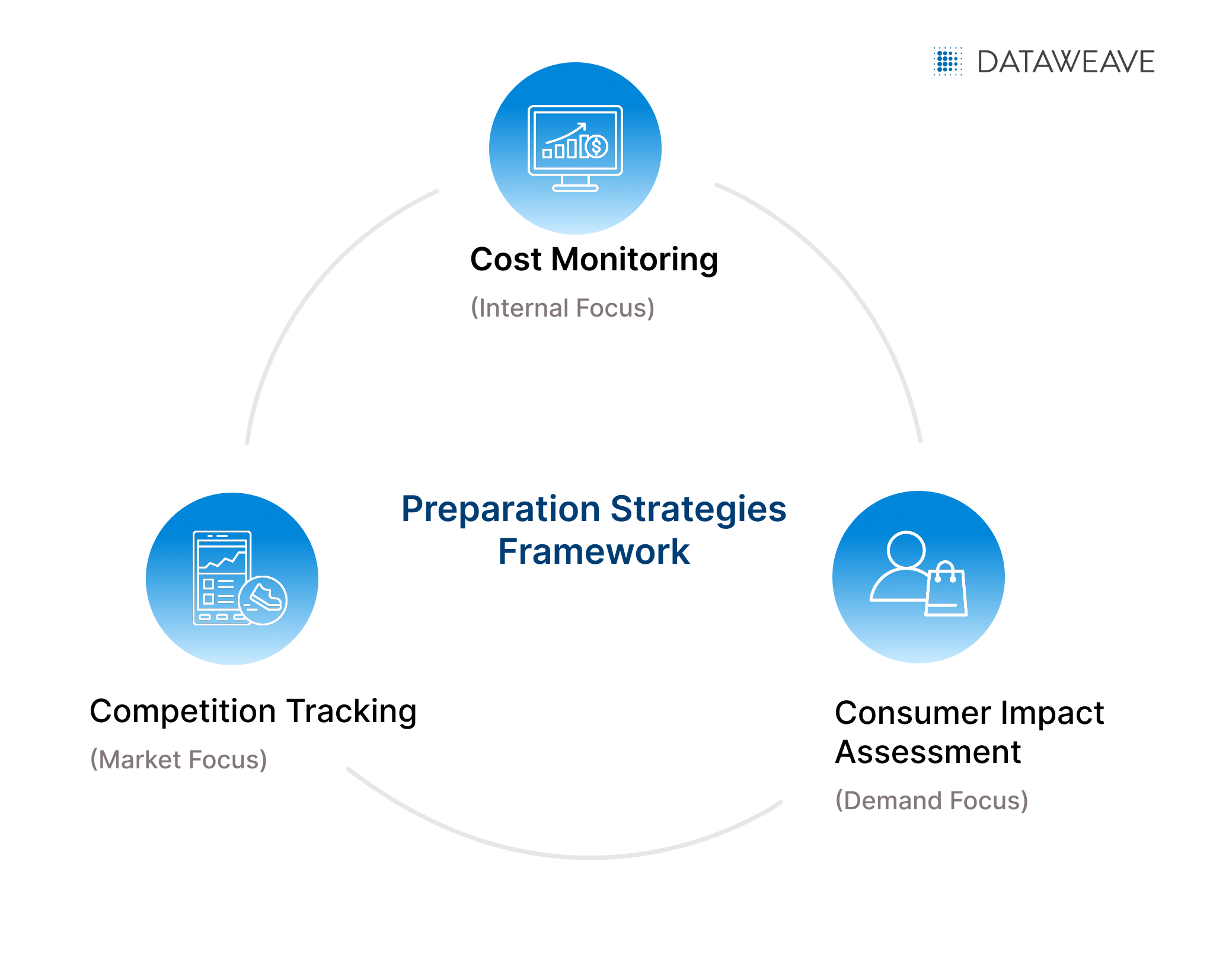
    Forward-thinking leaders can help position their teams for success in the face of pricing volatility brought on by tariffs. The key is to enable teams to sense disruptions quickly and provide a way to take corrective action that doesn’t diminish sales. Here are three strategies you can implement ahead of time that will help keep you competitive during tariff disruption.

    Cost Monitoring

    Start by getting a firm handle on internal and external costs. Understand and analyze fluctuations in the cost of raw materials, production, and supply chain for your business to operate. Make sure that your products are priced with pre-defined logic so changes in price on one SKU don’t create confusion with another. For example, faux leather costs rise while genuine leather stays the same. In that case, a leather version of a product should be raised to reflect the price increase in the pleather variation, not to devalue the perception of luxury.

    Next, you will want to understand historical pricing trends as well as pricing indexes across your categories. These insights can help your teams anticipate cost fluctuations before they even arise and mitigate the risk that economic shifts create, even unexpected tariffs.

    Competition Tracking

    Tracking your competition is likely already a strategy you have in mind. But how well are your teams executing this important task? If they’re trying to watch for market shifts and adjust pricing in real time without the help of technology, things are likely slipping through the cracks.

    Competitive intelligence solutions help retailers discover all competitive SKUs across the e-commerce market, monitor for real-time pricing shifts, and take action to mitigate risk. You need an “always-on” competitive pricing strategy now so that the second a tariff is announced, you can see how it’s affecting your market. This way, you can maintain price competitiveness and avoid margin erosion when competitors’ pricing changes in response to a tariff or other market shift.

    Consumer Impact Assessment

    The multiplier effect is felt throughout the supply chain when tariffs are implemented. The effect can affect consumers in a number of ways and cause them to become spending averse in certain areas. Often, during times of economic hardship, grocery items remain relatively inelastic. This is because consumers continue to purchase essentials regardless of price changes. Conversely, the price of eating out or home delivery becomes more elastic since consumers cut back on dining expenses when costs rise across their shopping basket.

    You need to establish clear visibility into the results of your pricing changes. The goal should be to monitor progress and measure the ROI on specific and broad pricing changes across your assortment. Conducting market share impact analysis will also help you determine if you are losing out on potential customers or whether a decline in sales is being felt across your competition. Impact analysis tools can help your company check actual deployed price changes in real time.

    Response Framework

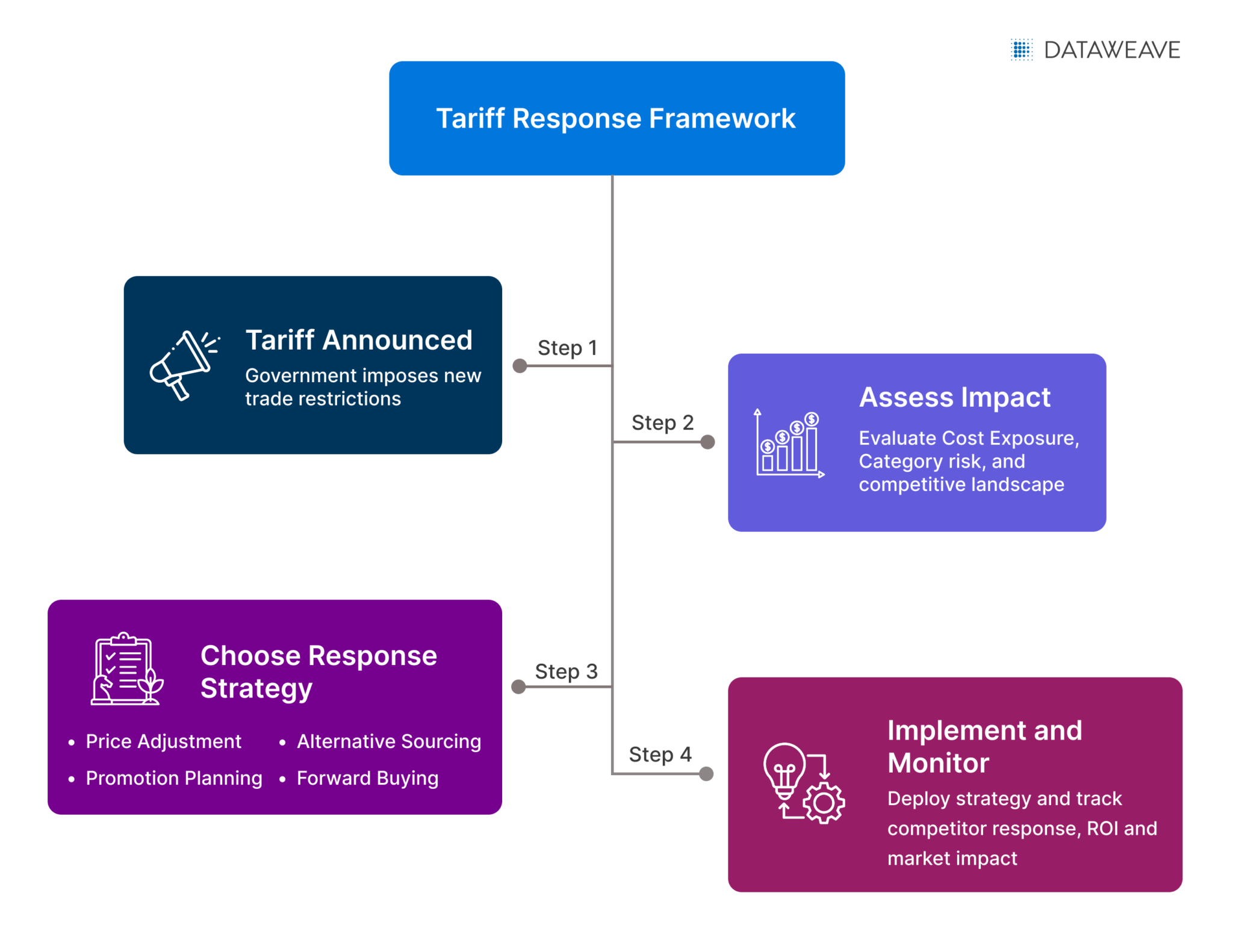
    Tariff response action plan for retailers

    Once you’ve prepared your team with strategies and technologies to set them up for success, it’s time to think about what to do once a tariff is announced or implemented. Here are three real-time decision-making strategies you should consider before your feet are to the fire. Having these in your back pocket will help you avoid financial disruption.

    Price Adjustment Strategies

    Think about how you strategically adjust prices. These could include percentage increases, flat rate increases, or absorbed via other strategies like bundling. You should also determine a cost increase threshold that you’re willing to absorb before raising prices. Think about the importance of remaining price attractive to consumers and weigh the risk of increasing prices past consumers’ ability or willingness to pay.

    Promotion Planning

    Folding increased costs into value-added offerings for consumers can be a good way to retain customer sentiment and sales volume without negatively affecting profit margins. You can leverage discounts, promotions, or bundling options to sell more of an item to a customer at a lower per-unit cost.

    What you don’t want to do is panic-adjust prices in response to tariffs of competitor moves. Instead, you can use a tool competitor intelligence solutions to watch if your competition is holding prices steady or adjusting. With full information about pricing at your disposal, you can make better decisions on your promotional strategy and not undercut yourself or lose customer loyalty.

    Alternative Sourcing

    Let’s face it: putting all your eggs in one basket is bad for business. Instead of relying solely on a single supplier for production, you should have a diverse set of suppliers ready and able to shift production when tariffs are announced. If a tariff impacts Chinese exports, having a backup supplier in Vietnam can prevent added costs entirely. You can also consider strategies like bulk pricing, set pricing, or shifting entirely to domestic suppliers.

    Forward Buying

    Proactively stockpile inventory by purchasing large quantities of at-risk products before tariffs take effect. This strategy locks in lower costs and ensures supply continuity during disruptions. However, balance this with careful demand forecasting to avoid overstocking, which ties up cash flow and incurs storage costs. Use historical sales data and tariff implementation timelines to optimize order volumes—this is especially effective for products with stable demand or long shelf lives.

    Market Intelligence Requirements

    Preparing your pricing teams and giving them a framework upon which to act when tariffs are announced doesn’t have to be complicated. You can get access to the right data on costs, competitors, and consumer behavior with DataWeave’s pricing intelligence capability.

    We provide retailers with insights on pricing trends, category exposure, and competitor adjustments. Our AI-powered competitor intelligence solutions allow you to get timely alerts whenever a significant change happens. This can include changes to competitor pricing and category-level shifts that you’d otherwise react to when it’s too late.

    These automated insights can also help you track historical pricing trends, elasticity, and margin impact to construct a clear response framework in an emergency. Additionally, our analytics capabilities can help you identify patterns to power pre-emptive pricing and promotional strategies.

    Getting the right pricing intelligence strategy in place now can prevent disaster later. Think through your preparedness strategy and how you want your teams to respond in the event of a new tariff, and consider how much easier reacting accurately would be with all the data needed at your fingertips. Reach out to us to know more.

  • Beyond MAP Pricing: Strategic Approaches for Brands and Retailers

    Beyond MAP Pricing: Strategic Approaches for Brands and Retailers

    Many retailers view minimum advertised pricing (MAP) policies as a necessary evil since they present several challenges for competitive positioning. In an idealistic free market, there wouldn’t be a need for MAP policies, and healthy competition would do the work of setting the final advertised price.

    However, MAP policies aren’t beneficial only for brands; they also greatly benefit retailers. This article will examine why MAP pricing can be a strategic advantage for both brands and retailers. We’ll also look at ways brand managers and retail pricing teams can navigate MAP requirements to maintain profitability and safeguard customer trust.

    Understanding MAP Fundamentals

    Minimum Advertised Price (MAP) is a policy set by brands that requires their sales channels to price the brand’s products at a minimum dollar value. Retailers are free to price the items higher, but the advertised price is never to exceed the minimum threshold.

    This agreement is established at the outset of a relationship or new product launch and can change at the brand’s discretion. Consumers typically see only the minimum advertised price when they search for a product across competing retailers. This means retailers need to find other ways to differentiate themselves beyond offering the lowest price.

    But a retailer can still effectively price the product at a lower cost to win sales away from the competition. This comes in the form of discounts applied at checkout, bundled deals, or other promotions that affect the final cart but not the advertised price. Only the advertised price must remain within MAP guidelines. This gives retailers a way to set themselves apart from the competition while still protecting the brand.

    A minimum advertised price has three central values: one for the brand, one for the retailer, and one for both.

    1. Brand or manufacturer: A MAP policy protects the brand’s value and prevents price erosion. If a retailer consistently undercuts a product’s price to make it more competitive, customers may begin to perceive the brand as lower in value over time. It can cause the brand to appear less premium than if prices hold steady. If a customer pays full price one day and then sees the same item advertised at a lower base price the next, it can weaken brand loyalty and cause dissatisfaction.
    2. Retailer: Minimum advertised pricing policies prevent retailers from engaging in a pricing war with one another, driving the price of an item down and hurting margins. This race to the bottom is bad for business. Apart from reducing profits, it discourages sellers from investing in marketing and other activities that drive sales. It also means that smaller retailers can compete with larger retailers, effectively leveling the playing field across the market.
    3. All parties: The issue of counterfeit and unauthorized sellers on the grey market plagues retailers and brands. One of the most straightforward ways to identify these sellers that undercut prices and damage brand perception is to track who is pricing products outside of agreements. Unauthorized or counterfeit sellers can be identified by establishing a MAP policy and monitoring who sells at the wrong price. Then, official legal action can be taken to prevent those merchants from selling the product.

    Brand Perspective

    Developing a clear and precise MAP policy is an important option for brands looking to stay competitive. Make sure you outline the minimum advertised price for each product for each sales channel and do so by geography. Write clear instructions on how discounts, promotions, and sales can be applied to the advertised price to avoid misunderstandings later. Ensure you work with your legal team to fill in any gaps before presenting them to retailers.

    If you find sellers acting outside the MAP policy, you must act swiftly to enforce your MAP policy. Cease and desist orders are the most common enforcement strategy a brand can use on unauthorized sellers and counterfeiters. But there are legal considerations for authorized sellers, too. You may need to fine the retailer for damages, restrict inventory replenishment until prices have been adjusted, remove seller authorization by terminating the relationship entirely, or escalate to your legal team.

    Open communication between the brand and retailer is in everyone’s best interest to ensure minimum pricing is being used. Have explanatory documents available for your retailers’ non-legal teams to reference while they set prices. These can take the form of checklists, video explainers, or even well-informed brand representatives working closely with retail pricing teams. It’s likely that some MAP violations will occur from time to time. The importance your retail partners place on fixing those errors will help you determine how much goodwill you will give them in the future.

    Brands can consider rewarding retailers that consistently adhere to minimum advertised price policies. Rewards often take the form of more lenient promotion policies, especially during major holidays like Christmas, Prime Day, or Black Friday. However, it’s never advisable to relax the actual MAP policy to allow one retailer to advertise a lower price year-round.

    Retailer Strategies

    A retailer can take several approaches to complying with a brand’s MAP policy while still maximizing sales. First, you need a dedicated compliance process spearheaded by compliance specialists or, better yet, enabled by technology. Embedding a process that checks for MAP violations into daily or weekly operations will prevent problems before brands become aware.

    Automated price tracking tools can help discover discrepancies so that you don’t accidentally violate a MAP agreement. Make sure MAP training extends beyond your pricing team and includes marketing. Anyone who participates in promotions or events should be made aware of the agreements made with specific brands. Determine if there are alternative promotion methods available to attract customers. You could offer free shipping on certain items, bundle giveaways, or apply cart-wide discounts at checkout.

    Monitoring your competition in real time will also help you stay ahead. If you discover a competitor undercutting your prices, bring this to the attention of your brand representative. This can build loyalty with the brand and help prevent lost sales due to market share loss.

    Digital Implementation for MAP Compliance

    Pricing teams at brands and retailers manually attempting to manage MAP pricing will lag behind the competition without help. They must discover, monitor, and enforce MAP compliance simply and effectively.

    Over the past several years, there has been a seemingly exponential proliferation of online sellers, complicating the industry and making it nearly impossible to find and discover all instances of every product you sell. It’s further complicated by marketplaces like Amazon, Walmart, and eBay, which are full of individual unauthorized sellers and resellers.

    Implementing a digital tool is the first step to effectively discovering and monitoring MAP compliance, even across these marketplaces. This tool should monitor all competition for you and discover imbalances in pricing parity.

    DataWeave’s MAP Violations Merchant Analytics solution has AI-backed software that scours the web for your products. It uses identifiers like UPCs and product titles and compares imagery to find where the product is sold. Our AI-powered image recognition capabilities are especially helpful in identifying inauthentic listings that may be counterfeit products or unauthorized sellers. It also has built-in geographic and channel-specific MAP monitoring capabilities to help with localized enforcement.

    The tool can aggregate all this data and present dashboard views of your own and competitors’ pricing that are easy to digest and act on. After all, retailers need to monitor their own MAP compliance as well as the competition’s. Brands can also track competitor sellers’ networks to explore potential new retail partnerships and grow their network reach.

    The MAP Violations Merchant Analytics solution has automated violation alerts and advanced reporting built into it. This means you can get real-time alerts instead of pouring through dashboards searching for exceptions each week. For deeper insights, the dashboards provide time-stamped proof of which sellers are undercutting MAP minimums, so you have all the information you need to make a case against them. Discovering repeat offenders is easy with historical trends dashboards that show which sellers have a history of violations.

    With all this information on who is violating what—and when—enforcement becomes much more manageable. Send cease and desist orders to unauthorized sellers and start having conversations with authorized sellers acting outside of your agreement. Acting quickly will help prevent hits to your brand’s reputation, price erosion, and lost sales.

    DataWeave’s MAP solution gives you the competitive edge to effectively discover MAP violations, monitor market activity, and act quickly when an issue is discovered.

    Make MAP Compliance a Strategic Advantage

    Basic MAP compliance and enforcement isn’t simply about setting pricing policies anymore. These policies are foundational to brand strategies, maintaining good relationships with retailers, and establishing long-term profitability for your business.

    When you let MAP violations go unchecked, it can erode your margins, damage how your customers perceive your brand, and create confusion across channels. Discovering, monitoring, and acting on MAP violations is much easier with the help of tools like DataWeave’s AI-enabled MAP Violations Merchant Analytics.

    Ready to take control of MAP pricing at your company? Request a MAP policy assessment from DataWeave today!

  • Portfolio Enhancement Through Price Relationship Management: Building Coherent Pricing Across Product Lines

    Portfolio Enhancement Through Price Relationship Management: Building Coherent Pricing Across Product Lines

    Do you remember when the movie Super Size Me came out? If you missed it, it was about the harmful effects of eating fast food too often. One aspect of the film that stands out is McDonald’s clever use of pricing to encourage consumers to buy bigger—and therefore more expensive—meals.

    Hungry patrons could upgrade their meal to a Super Size version for only a few cents more. In doing so, McDonald’s was able to capitalize on perceived value, i.e., getting more product for an apparent lower total price for the volume. It encouraged restaurant-goers to spend a little more while feeling like they got a great deal. It was a smart use of strategic pricing.

    There are hundreds of pricing relationship types like this one that pricing leaders need to be aware of and can use to their advantage when creating their team’s pricing strategy and workflows. You need to maintain profitable and logical price relationships across your entire product portfolio while keeping up with the competition. After all, the gimmick to Super Size would never have worked if the upgrade had been of less value than just buying another burger, for example.

    In this article, we’ll examine more real-world examples of pricing challenges so you can consider the best ways to manage complex price relationships. We’ll examine things like package sizes, brands, and product lines and how they’re intertwined in systematic price relationship management. Read on to learn how to prevent margin erosion, improve customer perception of your brand, and keep your pricing consistent and competitive.

    The Price Relationship Challenge

    Pricing is one of the most challenging aspects of managing a retail brand. This is especially true if you are dealing with a large assortment of products, including private label items, the same products of differing sizes, and hundreds, or even thousands, of competing products to link. Inconsistencies in your price relationship management can confuse customers, erode trust, and harm your bottom line.

    Let’s take a look at a few common pitfalls in portfolio pricing that you might run into in real life to better understand the impact on customer perception, trust, and sales.

    Pricing Relationship Challenges Retailers Need to Account For

    Private Label vs. Premium Product Pricing

    Let’s consider a nuanced scenario where price relationships between a retailer’s private label and premium branded products create an unexpected customer perception. Imagine you’re in a supermarket, comparing prices on peanut butter. You’ve always opted for the store’s private-label brand, “Best Choice,” because it’s typically the more affordable option. Here’s what you find:

    • Best Choice (Private Label) 16 oz – $3.50
    • Jif (National Brand) 16 oz – $3.25

    At first glance, this pricing feels off—shouldn’t the private label be the cheaper option? If a customer has been conditioned to expect savings with private-label products, seeing a national brand undercut that price could make them pause.
    This kind of pricing misalignment can erode trust in private-label value and even push customers toward the national brand. When price relationships don’t follow consumer expectations, they create friction in the shopping experience and may lead to lost sales for the retailer’s own brand.

    Value Size Relationships

    A strong value-size relationship ensures that customers receive logical pricing as they move between different sizes of the same product. When this relationship is misaligned, customers may feel confused or misled, which can lead to lost sales and eroded trust.

    Let’s look at a real-world example using a well-known branded product—salad dressing. Imagine you’re shopping for Hidden Valley Ranch (HVR) dressing and see the following pricing on the shelf:

    • HVR 16 oz – $3.99
    • HVR 24 oz – $6.49
    • HVR 36 oz – $8.99

    At first glance, you might assume that buying a larger size offers better value. However, a quick calculation shows that the price per ounce actually increases with size:

    • 16 oz = $0.25 per ounce
    • 24 oz = $0.27 per ounce
    • 36 oz = $0.25 per ounce

    Customers expecting a discount for buying in bulk may feel misled or frustrated when they realize the mid-size option (24 oz) is actually the most expensive per ounce. This mispricing could drive shoppers to purchase the smallest size instead of the intended larger, more profitable unit—or worse, lead them to a competitor with clearer pricing structures.

    Retailers must maintain logical price progression by ensuring that price per unit decreases as the product size increases. This not only improves customer trust but also encourages higher-volume purchases, driving profitability while maintaining a fair value perception.

    Price Link Relationships

    A well-structured price link relationship ensures customers can easily compare similar offerings of the same product and size. When the pricing across different versions or variations of the same item isn’t clear or consistent, it can confuse customers and damage trust, ultimately leading to missed sales and a negative brand perception.

    Let’s break this down with an example of a popular product—coffee. Imagine you’re shopping for a bag of Starbucks coffee and you see the following pricing on the shelf:

    • Starbucks Classic Coffee, 12 oz – $7.99
    • Starbucks Coffee, Mocha, 12 oz – $9.99
    • Starbucks Ground Coffee, Pumpkin Spice, 12 oz – $12.99

    At first glance, the product is the same size (12 oz) across all options, but the prices vary significantly. One might assume that the price difference is due to differences in quality or features, but what if there’s no clear indication of why the different flavors are priced higher than the standard?

    After investigating, you may realize that the only differences are related to different variants—like “Mocha” or “Pumpkin Spice” rather than any significant changes in the product’s core attributes. When customers realize they’re paying a premium for just different flavors, without any tangible difference in product quality, it can lead to feelings of confusion and frustration.

    Retailers must ensure that price links between similar offerings are justifiable by clearly communicating what differentiates each product. This avoids the perception that customers are being charged extra for little added value, building trust and encouraging repeat purchases. By maintaining transparent price link relationships, businesses can foster customer loyalty, increase sales, and drive better overall satisfaction.

    What is the Foundational Process to Tackle the Price Relationship Challenge?

    Now that we’ve reviewed several challenges brands face when pricing their products, what can be done about them?

    If you’re a pricing leader, you must create a robust pricing strategy that considers customer expectations, competitive data, sizing, and the overall value progressions of your product assortment. These are the three foundational steps to solve your price relationship challenges.

    1. First, you need to group products together accurately.
    2. Second, you need to establish price management rules around the group of related items.
    3. Third, you should set in place a process to review your assortment each week to see if anything is out of tolerance.

    This process is difficult, if not impossible, to manage manually. To effectively set up and execute these steps, you’ll need the help of an advanced pricing intelligence system.

    Implementation Strategy

    Want to know how to roll out a price relationship management strategy? Follow this implementation strategy for a practical way to get started.

    1. Set up price relationship rules: Determine which of your products go together, such as same products with different sizes or color options. Assign different product assortment groups and determine tolerances for scaling prices based on volume or unit counts.
    2. Monitoring and maintenance: Establish rules to alert the appropriate party when something is out of tolerance or a price change has been discovered with a competitive product.
    3. Exception management: Only spend time actioning the exceptions instead of pouring through clean data each week, looking for discrepancies. This will save your team time and help address the most significant opportunities first.
    4. Change management considerations: Think about the current processes you have in place. How will this affect the individuals on your team who have managed pricing operations? Establish a methodology for rolling this new strategy and technology out over select product assortments or brands one at a time to build trust with internal players.

    DataWeave offers features specifically built to help pricing teams manage pricing strategies. These applications can help you optimize profit margins and improve your overall market positioning for long-term success. A concerted effort to create brand hierarchies within your own product assortment from the get-go, followed by routine monitoring and real-time updates, can make all the difference in your pricing efforts.

    Within DataWeave, you can create price links between your products (value sizing) and those of the competition. These will alert you to exceptions when discrepancies are discovered outside your established tolerance levels. If a linked set of your products in different sizes shows inconsistent pricing based on scaled volumes, your team can quickly know how to make changes. If a competitor’s price drops significantly, you can react to that change before you lose sales.

    DataWeave even offers AI-driven similar product matching capabilities, which can help you manage pricing for private label products by finding and analyzing similar products across the market.

    If you want to learn more about price relationship management, connect with our team at DataWeave today.

  • Maximizing Competitive Match Rates: The Foundation of Effective Price Intelligence

    Maximizing Competitive Match Rates: The Foundation of Effective Price Intelligence

    Merchants make countless pricing decisions every day. Whether you’re a brand selling online, a traditional brick-and-mortar retailer, or another seller attempting to navigate the vast world of commerce, figuring out the most effective price intelligence strategy is essential. Having your plan in place will help you price your products in the sweet spot that enhances your price image and maximizes profits.

    For the best chance of success, your overall pricing strategy must include competitive intelligence.

    Many retailers focus their efforts on just collecting the data. But that’s only a portion of the puzzle. The real value lies in match accuracy and knowing exactly which competitor products to compare against. In this article, we will dive deeper into cutting-edge approaches that combine the traditional matching techniques you already leverage with AI to improve your match rates dramatically.

    If you’re a pricing director, category manager, commercial leader, or anyone else who deals with pricing intelligence, this article will help you understand why competitive match rates matter and how you can improve yours.

    Change your mindset from tactical to strategic and see the benefits in your bottom line.

    The Match Rate Challenge

    To the layman, tracking and comparing prices against the competition seems easy. Just match up two products and see which ones are the same! In reality, it’s much more challenging. There are thousands of products to discover, analyze, compare, and derive subjective comparisons from. Not only that, product catalogs across the market are constantly evolving and growing, so keeping up becomes a race of attrition with your competitors.

    Let’s put it into focus. Imagine you’re trying to price a 12-pack of Coca-Cola. This is a well-known product that, hypothetically, should be easy to identify across the web. However, every retailer uses their own description in their listing. Some examples include:

    How product names differ on websites - Amazon Example
    Why matching products is a challenge - Naming conventions on Target
    Match Rate Challenge - how product names differ on retailers - Wamlart
    • Retailer A lists it as “Coca-Cola 12 Fl. Oz 12 Pack”
    • Retailer B shows “Coca Cola Classic Soda Pop Fridge Pack, 12 Fl. Oz Cans, 12-Pack”
    • Retailer C has “Coca-Cola Soda – 12pk/12 fl oz Cans”

    While a human can easily deduce that these are the same product, the automated system you probably have in place right now is most likely struggling. It cannot tell the difference between the retailers’ unique naming conventions, including brand name, description, bundle, unit count, special characters, or sizing.

    This has real-world business impacts if your tools cannot accurately compare the price of a Coca-Cola 12-pack across the market.

    Why Match Rates Matter

    If your competitive match rates are poor, you aren’t seeing the whole picture and are either overcharging, undercharging, or reacting to market shifts too slowly.

    Overcharging can result in lost sales, while undercharging may result in out-of-stock due to spikes in demand you haven’t accounted for. Both are recipes to lose out on potential revenue, disappoint customers, and drive business to your competitors.

    What you need is a sophisticated matching capability that can handle the tracking of millions of competitive prices each week. It needs to be able to compare using hundreds of possible permutations, something that is impossible for pricing teams to do manually, especially at scale. With technology to make this connection, you aren’t missing out on essential competitive intelligence.

    The Business Impact

    Besides the bottom-line savings, accurately matching competitor products for pricing intelligence has other business impacts that can help your business. Adding technology to your workflow to improve match rates can help identify blind spots, improve decision quality, and improve operational efficiency.

    • Pricing Blind Spots
      • Missing competitor prices on key products
      • Inability to detect competitive threats
      • Delayed response to market changes
    • Decision Quality
      • Incomplete competitive coverage leads to suboptimal pricing
      • Risk of pricing decisions based on wrong product comparisons
    • Operational Efficiency
      • Manual verification costs
      • Time spent reconciling mismatched products
      • Resources needed to maintain price position

    Current Industry Challenges

    As mentioned, the #1 reason businesses like yours probably aren’t already finding the most accurate matches is that not all sites carry comparable product codes. If every listing had a consistent product code, it would be very easy to match that code to your code base. In fact, most retailers currently only achieve 60-70% match rates using their traditional methods.

    Different product naming conventions, constantly changing product catalogs, and regional product variations contribute to the industry challenges, not to mention the difficulty of finding brand equivalencies and private label comparisons across the competition. So, if you’re struggling, just know everyone else is as well. However, there is a significant opportunity to get ahead of your competition if you can improve your match rates with technology.

    The Matching Hierarchy

    • Direct Code Matching: There are a number of ways to start finding matches across the market. The base tier of the hierarchy of most accurate approaches is Direct Code matching. Most likely, your team already has a process in place that can compare UPC to UPC, for example. When no standard codes are listed, your team is left with a blind spot. This poses limitations in modern retail but is an essential first step to identifying the “low-hanging fruit” to start getting matches.
    • Non-Code-Based Matching: The next level of the hierarchy is implementing non-code-based matching strategies. This is when there are no UPCs, DPCIs, ASINs, or other known codes that make it easy to do one-to-one comparisons. These tools can analyze complex metrics like direct size comparisons, unique product descriptions, and features to find more accurate matches. They can look deep into the listing to extract data points beyond a code, even going as far as analyzing images and video content to help find matches. Advanced technologies for competitive matching can help pricing teams by adding different comparison metrics to their arsenal beyond code-based. 
    • Private Label Conversions: Up until this level of the hierarchy, comparisons relied on direct comparisons. Finding identical codes and features and naming similarities is excellent for figuring out one-to-one comparisons, but when there is no similar product to compare with for pricing intelligence, things get more complicated. This is the third tier of the matching hierarchy. It’s the ability to find similar product matches for ‘like’ products. This can be used for private label conversions and to create meaningful comparisons without direct matches.
    • Similar Size Mappings: This final rung on the matching hierarchy adds another layer of advanced calculations to the comparison capability. Often, retailers and merchants list a product with different sizing values. One may choose to bundle products, break apart packs to sell as single items or offer a special-sized product manufactured just for them. 
    Similar Size Mappings - product matching hierarchy - Walmart
    Similar Size Mappings - product matching hierarchy - Costco

    While at the end of the day, the actual product is the same, when there are unusual size permutations, it can be hard to identify the similarities. Technology can help with value size relationships, package variation handling, size equalization, and unit normalization.

    The AI Advantage

    AI is the natural solution for efficiently executing competitive product matching at scale. DataWeave offers solutions for pricing teams to help them reach over 95% product match accuracy. The tools leverage the most modern Natural Language Processing models for ingesting and analyzing product descriptions. Image recognition capabilities apply methods such as object detection, background removal, and image quality enhancement to focus on an individual product’s key features to improve match accuracy.

    Deep learning models have been trained on years of data to perform pattern recognition in product attributes and to learn from historical matches. All of these capabilities, and others, automate the attribute matching process, from code to image to feature description, to help pricing teams build the most accurate profile of products across the market for highly accurate pricing intelligence.

    Implementation Strategy

    We understand that moving away from manual product comparison methods can be challenging. Every organization is different, but some fundamental steps can be followed for success when leveling up your pricing teams’ workflow.

    1. First, conduct a baseline assessment. Figure out where you are on the Matching hierarchy. Are you still only doing direct code-based comparisons? Has your team branched out to compare other non-code-based identifiers?
    2. Next, establish clear match rate targets for yourself. If your current match rate is aligned with industry norms, strive to significantly improve it, aiming for a high alignment that supports maximizing the match rate. Break this down into achievable milestones across different stages of the implementation process.
    3. Work with your vendor on quality control processes. It may be worth running your current process in tandem to be able to calculate the improvements in real time. With a veteran technology provider like DataWeave, you can rely on the most cutting-edge technology combined with human-in-the-loop checks and balances and a team of knowledgeable support personnel. Additionally, for teams wanting direct control, DataWeave’s Approve/Disapprove Module lets your team review and validate match recommendations before they go live, maintaining full oversight of the matching process.
    4. The more data about your products it has, the better your match rates. DataWeave’s competitive intelligence tools also come with a built-in continuous improvement framework. Part of this is the human element that continually ensures high-quality matches, but another is the AI’s ‘learning’ capabilities. Every time the AI is exposed to a new scenario, it learns for the next time.
    5. The final step, ensure cross-functional alignment is achieved. Every one from the C-Suite down should be able to access the synthesized information useful for their role without complex data to sift through. Customized dashboards and reports can help with this process.

    Future-Proofing Match Rates

    The world of retail is constantly evolving. If you don’t keep up, you’re going to be left behind. There are emerging retail channels, like the TikTok shop, and new product identification methods to leverage, like image comparisons. As more products enter the market along with new retailers, figuring out how to scale needs to be taken into consideration. It’s impossible to keep up with manual processes. Instead, think about maximizing your match rates every week and not letting them degrade over time. A combination of scale, timely action, and highly accurate match rates will help you price your products the most competitively.

    Key Takeaways

    Match rates are the foundation of pricing intelligence. You can evaluate how advanced your match rate strategy is based on the matching hierarchy. If you’re still early in your journey, you’re likely still relying on code-to-code matches. However, using a mix of AI and traditional methods, you can achieve a 95% accuracy rate on product matching, leading to overall higher competitive match rates. As a result, with continuous improvement, you will stay ahead of the competition even as the goalposts change and new variables are introduced to the competitive landscape.

    Starting this process to add AI to your pricing strategy can be overwhelming. At DataWeave, we work with you to make the change easy. Talk to us today to know more.

  • Beyond Basic Price Monitoring: Advanced Applications of Competitive Intelligence

    Beyond Basic Price Monitoring: Advanced Applications of Competitive Intelligence

    It’s up to senior leadership, whether you’re a Chief Strategy Officer, Pricing Executive, or Commercial Director, to think big picture about your company’s competitive intelligence strategy. For more junior team members, it’s easy to get caught in the “this is how we’ve always done it” mindset and continue to go through the motions of price monitoring.

    You don’t have that luxury—it’s up to you to find and implement new ways to move beyond basic price monitoring and usher your company into an era of achieving actionable insights through competitive intelligence. There is much more to gain from competitive data than simple price monitoring.

    How can retailers leverage clean, competitive data to uncover strategic insights beyond basic price comparisons? This article will help you shift your mindset from tactical monitoring to strategic insight generation. We’ll see how sophisticated analysis of clean and refined competitive data can reveal competitor strategies, regional and geographic opportunities, and overall market trends.

    It’s time to shift away from standard reporting, which should be left for your pricing owners and end users, and towards gaining competitive intelligence to shape your holistic company pricing strategy. With the right tools, you can make this shift a reality.

    Regional Price Intelligence

    One significant opportunity you should take advantage of is a greater understanding of regional price intelligence. Understanding the nuances that shape how products, categories, and other retailers’ prices according to geographical differences can set your company up to win customer trust and dollars at checkout.
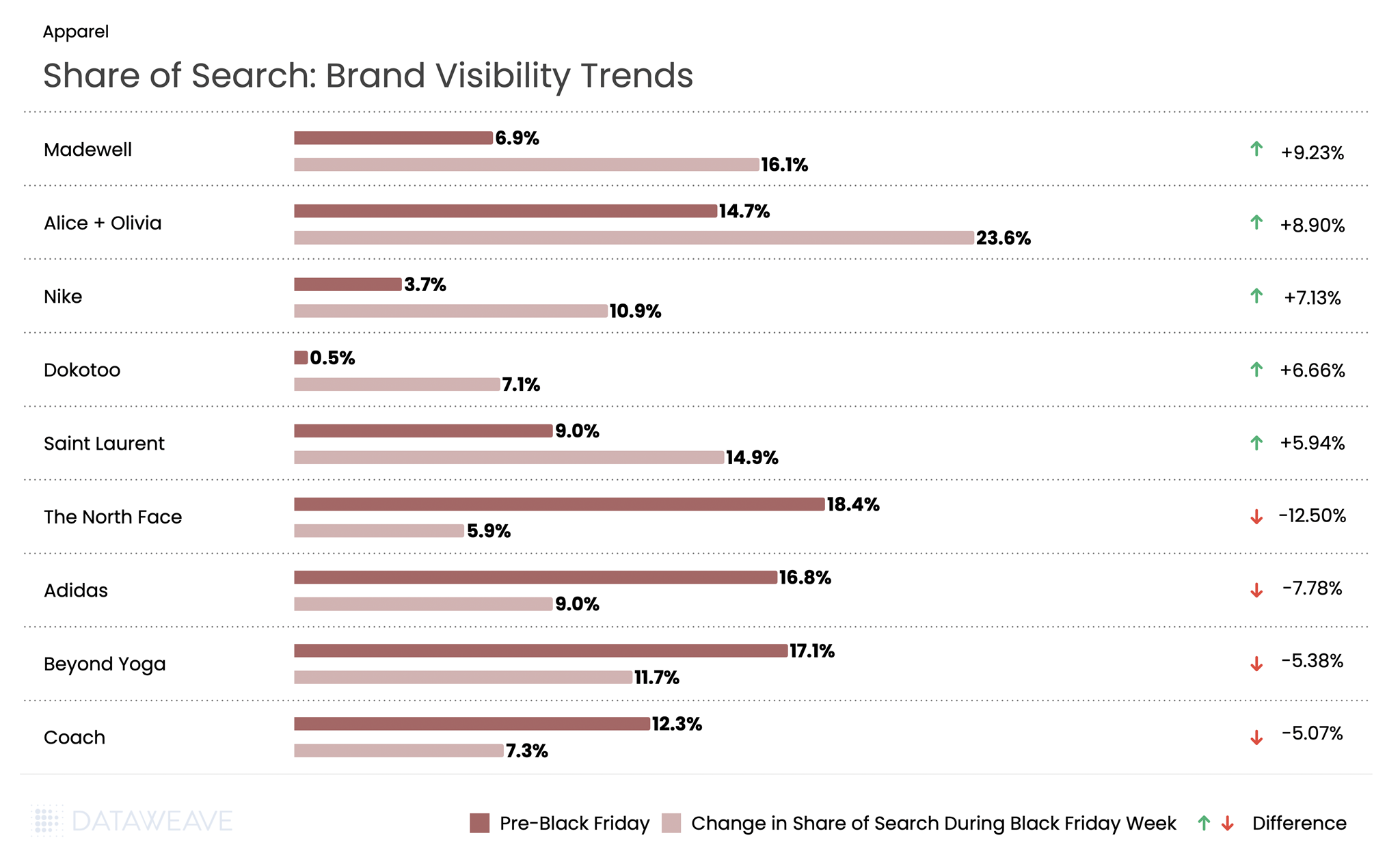
    Understanding geographic and regional pricing strategies

    Geographic price intelligence helps leaders leverage market opportunities based on where sales are happening. Variations in how products and categories are priced across regions often reflect competitor tactics, local demand, and cost structures.

    Let’s consider an example that impacts a broad geography, such as the entire continental United States – egg prices. Eggs are a staple grocery item and are frequently a loss leader in stores. This means they are products priced below their cost specifically to draw customers into stores.

    However, Avian Flu outbreaks affecting millions of birds have become more common recently. These outbreaks drive the cost of eggs higher as flocks must be culled to prevent the spread of the disease. This means that retailers must act to maintain acceptable margins or losses without frightening away customers or losing their trust.

    Avian Flu has been especially bad in Iowa and California. Retailers in these regions face tough decisions during outbreaks. They need to figure out how to balance the high prices required to cover the supply shortages with maintaining consumer trust that this staple product will not be perceived as ‘overpriced.’ Customers expect retailers to be fair even when supply chain issues make it challenging to keep prices stable.

    Another example impacting the broader USA is credit card defaults. Credit card defaults are reaching levels unseen since the financial crisis of 2008. $46 billion worth of credit card balances were written off in the first nine months of 2024 alone. This unprecedented figure highlights the fact that many Americans are struggling financially. Higher-income earners continue to do ok, but lower-income families are feeling the pressure more than ever.

    Understanding the differences between the geographies you sell in can help you construct your pricing strategies better. This is especially true as consumers brace themselves for more anticipated economic hardship.

    Retailers must set realistic financial targets without overpricing their catalogs. Otherwise, they risk losing customers who would otherwise have bought their products. Competitive intelligence can help retailers understand how economic disparities impact core consumer bases.

    Pricing leaders can leverage insights around geographic variations in supply, demand, and competitor pricing to help in situations like these. With how important eggs are, changes to their price can spill over into other categories. And with credit card defaults affecting hundreds of thousands of Americans, having a way to dive into these topics can help shape overarching strategies.

    Customer perception is a recurring theme in competitive intelligence. It’s not only about the actual value your brand offers but the perceived value based on historical context, current events, and competition.
    Leveraging Regional Price Differences for Strategic Advantage

    On the topic of customer perception, there are strategic ways to use customer perception to your advantage. One of these is detecting cross-market arbitrage opportunities using competitive intelligence and actioning them.

    But what is cross-market arbitrage? It’s the practice of exploiting the differences in price across different markets or regions. As a retailer, you can use cross-market arbitrage to your advantage by finding disparities in market conditions and strategically pricing your products to entice customers or offer more value. These opportunities can be in demand, supply, or competitive pricing. Acting quickly in markets where frequent disruptions happen can drive your business forward.

    DataWeave’s advanced competitive intelligence tools can analyze regional market trends to help you respond to real-time local demand fluctuations or cost pressures.

    Local Market Dynamics

    Pricing isn’t a one-size-fits-all operation. Where and what you’re pricing truly matters. Pricing teams should take price zones into account when constructing pricing strategies. This is because pricing isn’t equivalent across locations; it’s localized. Understanding this fact is critical for category-specific considerations at the macro and micro levels.

    This map shows a retailer’s regional price differentials on a breakfast basket. With the ability to access and refine your data, you can better construct maps like this one to track local market dynamics. Determine where you need to differentiate prices based on locality, understand the strategic stance of your competitors, and plan if you start to see changes in competitive price zones.

    Map shows a retailer's regional price differentials on a breakfast basket

    Competitor Strategy Detection

    As a retailer, you should continuously monitor your competitors, whether they’re succeeding or stagnating. One example of a major retailer that is seeing growth even during this challenging economic time is Costco. Costco is an interesting case because they do not have stores in every major city or even in every state.

    Costco has its brand strategy down, and it is tied to the pricing strategy. Costco has committed to its customers to provide quality items at competitive prices, and they’ve delivered even in a volatile economy. Costco has managed to maintain competitive prices on core merchandise and make strategic pricing adjustments on items that matter most to members. Their private label brand, Kirkland Signature, highlights their value-first approach. They continue to lead with price reductions like:

    • Organic Peanut Butter: $11.49 → $9.99
    • Chicken Stock: $9.99 → $8.99
    • Sauvignon Blanc: $7.49 → $6.99

    Costco has figured out how to balance premium offerings for cost-conscious consumers with standardly priced items filling the shopper’s basket. This demonstrates that they have a pricing strategy that relies on competitive intelligence and market trends.

    With the correct data and tools, any retailer can conduct research to discover more about their competitors and gain usable insights into their implemented pricing strategies. Once established, this can act as an early warning signal so you can take action.

    For example, understanding whether a retailer operates with a stable Everyday Low Price (EDLP) strategy or a more dynamic High/Low pricing approach is crucial when building and maintaining the integrity of your pricing strategy.

    Data should be able to show you things like:

    • When holiday price decreases start to accelerate
    • How quickly a retailer responds to cost increases (especially at the category or item level)
    • The cadence of seasonal campaigns and their impact on pricing behavior

    When we move beyond the numbers, these patterns tell a story about how to win in today’s competitive retail landscape. After all, pricing isn’t just a standard reporting tactic. In its truest form, it’s a strategy rooted in understanding the bigger picture of your consumers, competition, and the economy.

    Actionable Intelligence Framework

    With a practical system to turn insights into action, your company’s pricing strategy is much more likely to drive actual results. Merely collecting data and churning out out-of-date reports won’t cut it. Instead, begin to identify patterns and insights for accurate competitive intelligence. Use this simple framework to start setting up a comprehensive competitive intelligence process.
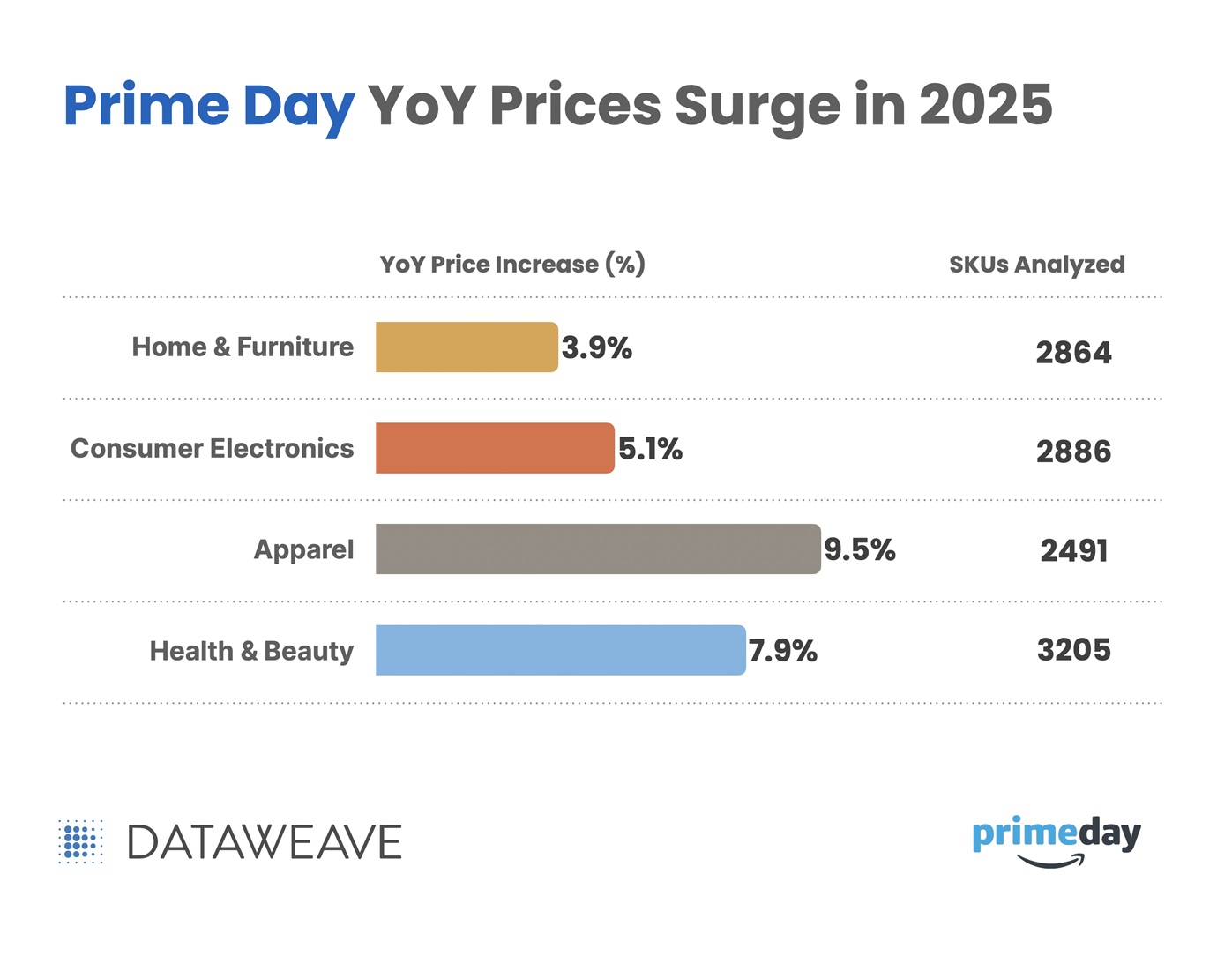
    • Setting up monitoring systems: Leverage technology to monitor and aggregate data on your competition, market trends, and consumer behavior. Ensure the system chosen can clean and refine the data along the way so it’s ready to be analyzed.
    • Creating action triggers: Define clear thresholds and triggers based on key insights. These can be things like price changes of a certain amount, competitor moves, assortment changes, or regional and geographic trends. These triggers should prompt specific, pre-planned actions for your team to capitalize on opportunities.
    • Response protocol development: Change management is easier with a plan. Work on building out and training your teams on protocols for specific triggers. When something arises, they know the protocol to take advantage of the opportunity or mitigate the challenge effectively.
    • Performance measurement: Measure the impact of your team’s protocol-based actions with the help of pre-determined KPIs and then hone your approach to competitive intelligence based on the results.

    Competitive Intelligence at Your Fingertips

    Shifting from a latent standard reporting and price monitoring mindset to a growth mindset centered around competitive intelligence doesn’t need to be a struggle. The key is to lean on the tools that will accelerate your company’s journey to finding the right insights and putting action behind them quickly.

    Start by conducting a competitive intelligence maturity assessment to evaluate your organization’s current state and identify areas for improvement. Then, create a capability development roadmap for your company to track efficacy and progress toward your goal.

    Want to talk to the experts in competitive pricing intelligence? Click here to speak with the DataWeave team!

  • Black Friday vs Boxing Day: Which Sale Event Offered Better Deals?

    Black Friday vs Boxing Day: Which Sale Event Offered Better Deals?

    When it comes to shopping events, Black Friday stands out as one of the most anticipated dates for scoring deals. Typically occurring the day after Thanksgiving, the weekend kicks off the holiday shopping season with a frenzy of discounts. But Boxing Day, celebrated on December 26, is also well-known for its post-Christmas clearance sales.

    This Black Friday, US eCommerce sales increased by a hefty 14.6% in 2024, according to Mastercard SpendingPulse. While Black Friday leads in overall revenue generation for retailers, Boxing Day presents unique opportunities for clearing post-holiday inventory.

    For a consumer, which sale event is likely to offer the most attractive deals?

    At DataWeave, we analyzed discounts across retailers and categories to uncover the answer.

    Our Methodology

    For this analysis, we tracked pricing data across major retailers for Black Friday and Boxing Day. To provide a comprehensive analysis of Black Friday pricing strategies, we explored a matched products dataset, comparing identical 14,000+ SKUs across retailers within key categories.

    • Categories included: Consumer Electronics, Home & Furniture, Apparel, Health & Beauty, Grocery
    • Retailers included: Amazon, Target, Walmart, Sephora, Ulta Beauty, Overstock, Home Depot, Best Buy, Saks Fifth Ave, Nordstrom, Macy’s, Bloomingdale’s, Neiman Marcus
    • Timeline: November 26 (Black Friday), December 26 (Boxing Day)

    Average Discounts: Black Friday vs Boxing Day

    Our analysis reveals that Black Friday generally offered steeper discounts across most categories, although Boxing Day wasn’t far behind. Here’s a breakdown:

    Boxing Day Vs. Black Friday - Discounts Across Categories

    While Black Friday led in most categories, Apparel saw a slight edge on Boxing Day, with discounts averaging 40.22% compared to 37.67% on Black Friday. Electronics, Beauty, and Home, however, remained more lucrative during Black Friday.

    Top 5 Products Higher Discounts on Black Friday

    Diving deeper into specific products, here are our top 5 picks offering better discounts during Black Friday.

    Top 5 Products With Higher Discounts on Black Friday
    • Appliances like an Immersion blender set offering a discount of 88.29%, significantly higher than its Boxing Day offer of 86.62%. 
    • High-end electronics like the Microsoft Surface Pro 4 also saw substantial markdowns at 84.60%. 
    • In beauty and fashion, both La Roche Posay’s retinol serum and Vera Bradley’s satchel offered discounts above 80%. 
    • Even everyday essentials like paper towels enjoyed generous discounts, with markdowns reaching 82.35% during Black Friday compared to 76.47% on Boxing Day.

    Top 5 Products With Higher Discounts on Boxing Day

    Boxing Day revealed some remarkable deals across diverse categories, with certain products offering significantly better value than their Black Friday counterparts.

    Top 5 Products With Higher Discounts on Boxing Day
    • The JBL Go 2 portable speaker emerged as the standout, with an extraordinary 82% Boxing Day discount compared to just 20% on Black Friday—a dramatic 62% difference.
    • Home furnishings showed strong Boxing Day performance, with the Costway accent armchair set reaching 80.30% off.

    In Conclusion

    Black Friday reigns supreme in driving early holiday sales, offering deeper discounts and drawing larger crowds. However, Boxing Day remains critical for retailers to offload surplus inventory and attract post-holiday shoppers.

    By combining insights from both events, retailers can refine their strategies to maximize revenue and enhance customer satisfaction. For shoppers, the decision comes down to timing—shop early for better deals or wait to capitalize on clearance markdowns. The products and categories with more attractive offers tend to vary between these two sale events. Hence, as a shopper, it’s a good idea to keep track of prices all through the holiday season to take advantage of the best deals.

    Check out our comprehensive coverage of Black Friday 2024 deals and discounts across categories.

    For a deeper dive into the world of competitive pricing intelligence and to explore how our solutions can benefit apparel retailers and brands, reach out to us today!

  • Black Friday 2024 in Canada: Insights on Consumer Electronics and Home & Furniture

    Black Friday 2024 in Canada: Insights on Consumer Electronics and Home & Furniture

    Black Friday and Cyber Monday are major retail events in Canada, with 43% and 29% of the population making purchases during these sales respectively, according to a YouGov report. Consumer electronics continue to lead the Canadian retail market during these events, with 55% of surveyed shoppers choosing to buy tech products on Black Friday. Household appliances come in second, with 25% of shoppers opting for these items, while 18% prefer to shop for furniture deals.

    These statistics highlight the importance of delivering value during the Thanksgiving sales week. Retailers must cater to shoppers’ expectations with competitive pricing, attractive deals, and a seamless shopping experience. So, what unique offerings did Canadian retailers present to shoppers this season?

    To understand the pricing and discount dynamics during BFCM 2024 in Canada, DataWeave analyzed discounts across leading consumer electronics and home & furniture retailers. Using our AI-powered pricing intelligence platform, we analyzed 37,108 SKUs across these categories for major retailers including Amazon, Walmart, Best Buy, Home Depot, and Canadian Tire from the 10th to 29th November. We focused on the top 500 products ranked for each search keyword on each retail site, using targeted terms aligned with categories like “sofa” and “wearables”.

    In the following insights, the Absolute Discount represents the reduction of the selling price compared to the Manufacturer’s Suggested Retail Price (MSRP). The Additional Discount reflects how much lower the selling price is during Black Friday compared to its price a week before the sale. This metric reveals the actual or effective value of the sale event, beyond the standard discounts typically offered.

    Also check out our detailed analysis of discounts and pricing for the consumer electronics, apparel, health & beauty, grocery, and home & furniture categories across major US retailers this Black Friday.

    Consumer Electronics

    Retailers in Focus

    Consumer electronics saw robust participation from major retailers, with Amazon, Best Buy, and Walmart leading the charge. Here’s how they stacked up in terms of discounts:

    Pricing Trends Across Leading Consumer Electronics Retailers in Canada - Black Friday Cyber Monday 2024
    • Best Buy emerged as the frontrunner in absolute discounts at 31.2%, while Amazon impressed with a notable 19.7% additional discount, indicating a strong Black Friday-specific markdown strategy.
    • Walmart offered steady competition, particularly in audio and video products, which reached an average absolute discount of 37.2%. However, it’s average additional discount was only 3.1%, indicating muted BFCM-specific price reductions in this category.

    Subcategory Insights

    Diving deeper into consumer electronics subcategories, we observed varied discounting strategies.

    Pricing Trends Across Leading Canadian Consumer Electronics Retailer Subcategories - Black Friday Cyber Monday 2024
    • Audio & Video stood out as the most discounted subcategory, with Walmart leading at 37.2%.
    • In Wearables, Walmart again took the top spot with 36.4%, while Amazon offered higher additional discounts (22.4%).
    • Discounting for computers and gaming was less aggressive, highlighting strategic pricing to maintain profitability in these high-demand segments.

    Brand Performance

    Brand-level data highlighted how key players used Black Friday to drive visibility and sales.

    Pricing Trends Across Leading Canadian Consumer Electronics Brands - Black Friday Cyber Monday 2024
    • Dell led in average absolute discounts (36.7%) followed by Samsung at 36.68%
    • Audio brand JBL offered significant absolute discounts at 35.9%.
    • Apple and Lenovo offered comparatively fewer discounts but maintained strong visibility, as seen in their increase in the Share of Search during the sale period.
    Visibility Trends Across Leading Canadian Consumer Electronics Brands - Share of Search - Black Friday Cyber Monday 2024
    • MSI (laptop brand) and Bose (audio and earphone brand) experienced significant increases in visibility, with Share of Search increases of 5% and 3.6%, respectively.
    • Notably, HP faced a decline (-3.2%) in the Share of Search, suggesting missed opportunities to align promotions with consumer interest.

    Home & Furniture

    Retailers in Focus

    The home and furniture category saw competitive discounting, with Walmart, Canadian Tire, and Home Depot vying for consumer attention.

    Black Friday - Cyber Monday Trends Across Leading Canadian Home & Furniture Retailers
    • Walmart took the lead with the highest absolute discounts at 36.8%. The retailer’s additional discounts were more conservative at 3.6%. This is similar to their discount levels in Consumer Electronics.
    • Canadian Tire offered stiff competition, providing 31.6% absolute discounts and 25% additional discounts.
    • Home Depot matched its absolute and additional discounts, maintaining consistency at 24.1%.

    Subcategory Insights

    Home and furniture subcategories revealed targeted discount strategies.

    Black Friday - Cyber Monday Trends Across Leading Home & Furniture Subcategories - Canada
    • Bedding emerged as the most discounted subcategory at Walmart (50.6%) and Canadian Tire (35.3%).
    • Kitchenware saw competitive pricing, with Walmart leading at 42.9%, followed by Canadian Tire at 33.9%.
    • Canadian Tire focused on lighting, offering the highest absolute discounts in this subcategory (38.2%)

    Brand Performance

    Brand-level analysis revealed stark contrasts in discounting approaches.

    Black Friday - Cyber Monday Trends Across Leading Home & Furniture Brands - Canada
    • Furniture brands Homcom led in absolute discounts (36.4%), while South Shore stood out with the highest additional discounts (30.2%).
    • Value-oriented brands like furnishings brand Mainstays and mattress and bedding brand Zinus offered more modest discounts, focusing on consistent affordability.
    Black Friday - Cyber Monday Trends Across Leading Canadian Home & Furniture Brands - Share of Search and Visibility
    • Zinus (mattresses and sofa brand) experienced a significant 7.9% increase in the Share of Search, driven by aggressive promotions.
    • Home furnishings brands like Costway and Safavieh faced declines, reflecting the importance of aligning promotional strategies with consumer expectations.

    Insights for Retailers and Brands

    This Black Friday, Canadian retailers effectively balanced deep discounts with category-specific strategies to maximize sales. However, the fluctuating Share of Search highlights the critical need for brands to align promotions with consumer interest.

    For brands and retailers looking to stay ahead of the competition, DataWeave’s pricing intelligence platform offers unparalleled insights to refine discounting strategies and boost visibility. Contact us to learn how we can help you stay competitive in this dynamic retail landscape.

  • A Deep Dive into Consumer Electronics Pricing During Black Friday 2024

    A Deep Dive into Consumer Electronics Pricing During Black Friday 2024

    Americans spent a whopping total of $10.8 billion online this Black Friday. As Thanksgiving Week 2024 wraps up, one thing is clear: the consumer electronics category continues to dominate seasonal shopping trends. Fueled by a blend of enticing deals and high consumer demand, the sector delivered competitive discounts across subcategories like wearables, gaming, and mobile devices.

    At DataWeave, we analyzed discounting trends in the U.S. consumer electronics market during this year’s sales events. Using our AI-powered pricing intelligence platform, we tracked pricing and promotions for 22383 SKUs across Amazon, Walmart, Target, and Best Buy from November 10 to 29. We focused on the top 500 products ranked for each search keyword on each retail site, using targeted terms aligned with categories like “gaming” and “apple.” Here’s what we uncovered.

    Also check out our insights on discounts and pricing for health & beauty, grocery, apparel, and home & furniture categories this Black Friday.

    Retailers Battle It Out with Competitive Discounts

    Discount trends reveal clear leaders in terms of markdowns:

    • Walmart offered the deepest average absolute discounts at 36.9%.
    • Amazon and Target followed closely, highlighting a diverse range of deals designed to appeal to budget-conscious shoppers
    • Best Buy, the specialist consumer electronics retailer, offers the lowest discounts this Black Friday at 26.2%.
    Pricing Trends Across Leading Consumer Electronics Retailers - Black Friday Cyber Monday 2024

    Note: The Absolute Discount represents the reduction of the selling price compared to the Manufacturer’s Suggested Retail Price (MSRP). The Additional Discount reflects how much lower the selling price is during Black Friday compared to its price a week before the sale. This metric reveals the actual or effective value of the sale event, beyond the standard discounts typically offered.

    Subcategory Spotlight: Where the Best Deals Happened

    From audio & video to wearables, each retailer carved out competitive advantages across subcategories.

    Pricing Trends Across Leading Consumer Electronics Retailer Subcategories - Black Friday Cyber Monday 2024
    • Both Amazon and Walmart offered high discounts in audio & video and wearables, but Walmart led, with discounts up to 46.3%.
    • Best Buy, meanwhile, offered high absolute discounts on Mobile Devices(34%) and Storage (31%), followed by high discounts on wearables and Audio & Video.
    • Amazon maintained a balanced approach, excelling in audio & video and mobile devices.

    Brand-Level Insights: HP and Samsung Dominate

    The biggest winners this year were brands that strategically leveraged Black Friday discounts to boost visibility and sales:

    • HP took the top spot with average discounts of 36.9%, followed by Samsung at 31.4%.
    • Despite its premium reputation, Apple offered an average discount of 29.3%, signaling a shift in strategy to attract deal hunters.
    Pricing Trends Across Leading Consumer Electronics Brands - Black Friday Cyber Monday 2024

    Share of Search: Shifting Consumer Attention

    Search trends reveal how discounts shaped brand visibility:

    • Microsoft saw the largest spike in share of search (+8.6%), thanks to aggressive pricing on gaming consoles and accessories.
    • Marshall and Amazon also saw significant gains in visibility.
    • Surprisingly, HP experienced a sharp decline (-9.8%), indicating missed opportunities despite steep discounts.
    Visibility Trends Across Leading Consumer Electronics Brands - Share of Search - Black Friday Cyber Monday 2024

    Consumer Electronics: Lowest-Priced Retailer Analysis

    In the previous analysis, we focused on the top 500 products within each subcategory for each retailer, showcasing the discount strategies for their highlighted or featured items. However, to identify which retailer offered the lowest or highest prices for the same set of products, it’s necessary to match items across retailers. For this, we analyzed a separate dataset of 340 matched products across retailers to compare their pricing during Black Friday. This approach provides a clearer picture of price leadership and competitiveness across categories.

    Here are the key takeaways from this analysis.

    Category-Level Highlights

    Retailers Offering Most Value - Lowest Priced - Consumer Electronics - Black Friday 2024
    • Amazon leads with the highest average discount (41.35%), offering the most value to consumers. It is followed by Target (39.37%) and Walmart (36.15%).
    • Best Buy, the specialist consumer electronics retailer, ranks last with an average discount of 31.53%, emphasizing a less aggressive pricing strategy compared to competitors.

    Subcategory Highlights

    Lowest Priced Retailer Across Major Subcategories- Consumer Electronics - Black Friday 2024
    • Wearables: Amazon offers the steepest discounts (55.40%), followed by Best Buy (50.60%) and Walmart (45.75%).
    • Mobile Devices: Amazon also leads (37.94%), with Walmart (29.30%) in second place and Target trailing at 19.48%.
    • Gaming: Target takes the lead (37.47%), with Amazon and Best Buy offering similar discounts around 30%.
    • Computers: Target again emerges as the leader (39.18%), narrowly surpassing Walmart (36.13%).

    Brand Highlights

    Lowest Priced Retailer Across Leading Brands- Consumer Electronics - Black Friday 2024
    • Apple: Amazon dominates with 53.06%, closely followed by Walmart (50.55%), while Target and Best Buy hover around 43%.
    • Nintendo: Target edges out Amazon (37.62% vs. 36.54%), with Best Buy (33.21%) and Walmart (25.92%) trailing.
    • Beats by Dr. Dre: Amazon leads (46.07%), with Target (37.14%) as the runner-up. Best Buy and Walmart offer comparatively modest discounts around 25%.
    • Bose: Walmart emerges as the value leader (23.90%), surpassing Target (16.09%) and Best Buy (15.29%).
    • Cricut: Amazon sets a high benchmark (54.13%), with Target far behind (36.43%) for this viral portable printer brand. Best Buy (12.32%) and Walmart (10.79%) offer significantly lower discounts.

    What This Means for Retailers and Brands

    Retailers looking to stay competitive should focus on strategic discounting and enhanced brand visibility. Brands must align with consumer expectations by:

    • Leveraging platforms like DataWeave to analyze discount trends.
    • Optimizing pricing and assortment strategies for seasonal demand.

    For more insights into consumer electronics pricing, contact DataWeave to discover how our AI-powered solutions can drive success in today’s fast-paced market. Stay tuned for more category-specific analyses in the coming weeks!

  • The Apparel Market: A Closer Look at Black Friday Discounts

    The Apparel Market: A Closer Look at Black Friday Discounts

    As the holiday shopping season kicked off, savvy shoppers embraced the spirit of the season, drawn by enticing deals. The apparel category is forecasted as the second highest earning category (Source: Statista), expected to generate revenues up to $43.9 billion, closely following consumer electronics. To understand the pricing strategies of top retailers amidst the sale season, DataWeave analyzed the pricing trends for the Apparel category this Black Friday.

    We leveraged our AI-powered data platform to analyze the discounting across key retailers. Our analysis focused on the Apparel category, examining how Amazon, Walmart, Target, Saks Fifth Avenue, Nordstrom, Bloomingdales, Neiman Marcus and Macy’s differentiated themselves through their discounts.

    Also check out our in-depth insights on discounts and pricing for health & beauty, grocery, and home & furniture categories this Black Friday.

    Our Methodology

    For this analysis, we tracked the average discounts of apparel products among leading US retailers during the Thanksgiving weekend sale, including Black Friday. Our sample was chosen to encompass the top 500 ranked products in each product subcategory across during the sale.

    • Sample size: 37,666 SKUs
    • Retailers tracked: Amazon, Walmart, Target, Nordstrom, Macy’s, Bloomingdale’s, Saks Fifth Avenue, Neiman Marcus
    • Subcategories reported on: Footwear, Kid’s Clothing, Men’s Clothing, Women’s Clothing, Activewear, Plus Size Clothing, Accessories
    • Timeline of analysis: 10 to 29 November 2024

    We focused on the top 500 products ranked for each search keyword on each retail site, using targeted terms aligned with categories like “athleisure” and “plus size clothing”. Our methodology distinguished between standard discounts and Black Friday-specific ‘additional discounts’ or price reductions during the sale compared to the week before, to reveal true consumer value.

    Key Findings

    This year’s fashion discounts were unprecedented. Let’s take a look.

    Retailer Level Insights

    Discounts Across Leading Apparel Retailers - Black Friday 2024
    • Nordstrom leads with the highest average absolute discount at 59%, followed by Saks Fifth Avenue at 35.5% and Bloomingdale’s at 41.5%. Macy’s shows the lowest average discount at 24.1%, while Amazon has an average discount of 30.4%.
    • Amazon ranks lower in both average absolute and additional discounts compared to competitors, indicating a more conservative discounting strategy.

    Subcategory Analysis

    Discounts Across Leading Apparel Retailers - Subcategories - Black Friday 2024
    • Kids’ Clothing saw the deep discounts (up to 55% at Nordstrom), reflecting growing pressure on family budgets and heightened competition to attract budget-conscious parents.
    • Plus-Size Clothing emerged as a major focus, with Nordstrom leading at 53.22% average absolute discounts, signaling that retailers are increasingly prioritizing size inclusivity and appealing to a broader consumer base.
    • Footwear experienced robust discounting, particularly at Bloomingdale’s with 37% average absolute discounts, showing a competitive approach to attract customers looking for seasonal footwear deals.
    • Activewear displayed substantial discounts, with Walmart offering up to 41% on average, aligning with the trend of consumers looking for practical and comfortable attire during the winter season.

    Brand Level Insights

    Apparel brands, meanwhile, also offer telling insights.

    Discounts Across Leading Apparel Brands - Black Friday 2024
    • Top Discounting Brands: Aqua leads with an average absolute discount of 44.58%, followed by Boss at 42.33% and Burberry at 37.84%.
    • Lowest Discounts: Athletic Works shows the lowest average absolute discount at 31.23%, with a minimal additional discount of 3.73%.
    • Competitive Advantage: Brands like Ralph Lauren and Boss show strong discounts, indicating aggressive marketing during the sale.

    Share of Search Insights

    Visibility - Share of Search Trend Across Leading Apparel Retailers - Black Friday 2024
    • Top Gainers: Adidas and Nike each saw an increase of 1.20% in their share of search during Black Friday/Cyber Monday, highlighting their strong brand presence and consumer interest.
    • Top Losers: Reebok experienced a sharp decline, losing 2.60% in its share of search, while Levi’s also dropped by 0.60%.
    • Search Trends: The data suggests a strong consumer preference for activewear brands like Nike and Adidas and a decline in interest for traditional apparel brands like Levi’s.

    Who Offered Most Value This Black Friday

    In the previous analysis, we focused on the top 500 products within each subcategory for each retailer, showcasing the discount strategies for their highlighted or featured items. However, to identify which retailer offered the lowest or highest prices for the same set of products, it’s necessary to match items across retailers. For this, we analyzed a separate dataset of 418 matched products across Apparel specific retailers to compare their pricing during Black Friday. This approach provides a clearer picture of price leadership and competitiveness across categories.

    Here are the key takeaways from this analysis.

    Category-Level Analysis

    At the overall category level, Macy’s emerged as the lowest-priced retailer, offering the highest average discount of 28.72%, followed closely by Nordstrom (26.06%). The steep decline in average discounts from Saks Fifth Avenue (14.42%) and Neiman Marcus (7.93%) highlights a clear gap in discounting strategies.

    • Macy’s and Nordstrom are aggressively competitive on pricing in the overall apparel category, likely capturing consumer attention with substantial discounts.
    • Saks Fifth Avenue and Neiman Marcus may rely more on brand perception and luxury positioning rather than heavy discounting.
    Retailers Offering Most Value - Lowest Priced - Apparel - Black Friday 2024

    Subcategory-Level Analysis

    Lowest Priced Retailer Across Major Subcategories- Apparel - Black Friday 2024
    • Neiman Marcus tops the ranking with an impressive 60.85% average discount, outperforming Macy’s (52.86%) and Nordstrom (43.04%) for Men’s Clothing. We see a similar trend with Neiman Marcus offering more value across Women’s Clothing as well, compared to other retailers.
    • The competition in footwear was intense, with Neiman Marcus narrowly securing the top spot at 31.03%, slightly ahead of Saks Fifth Avenue (30.28%) and Macy’s (30.07%).
    • Saks Fifth Avenue led by a significant margin in the Activewear category, offering 39.89% average discounts, indicating a strong push in this growing segment.
    • Macy’s followed at 32.16% in Activewear, while Neiman Marcus and Nordstrom had comparatively lower discounts of 26.40% and 19.52%, respectively.

    Brand-Level Analysis

    Lowest Priced Retailer Across Leading Brands- Apparel - Black Friday 2024
    • Kate Spade New York: Neiman Marcus leads with the highest discount of 55.23%, reflecting strong price leadership in premium fashion, closely followed by Saks Fifth Avenue at 51.66%.
    • Coach: Neiman Marcus dominates with a significant 75.85% discount, showcasing an aggressive promotional strategy for this luxury brand.
    • Spanx: While Neiman Marcus leads with 28.22%, discounts across other retailers like Saks Fifth Avenue, Macy’s, and Nordstrom are clustered within a competitive range of 17–19%.
    • Montblanc: Macy’s takes the lead with 20.32%, signaling its competitiveness even in high-end accessories, with Saks Fifth Avenue and Nordstrom closely behind.
    • Ugg: Saks Fifth Avenue leads with 31.42%, focusing on maintaining price leadership for this popular brand, while other retailers remain competitive with discounts around 25–30%.

    What’s Next

    To win over price-conscious shoppers, retailers need to stay competitive and consistently offer the lowest prices.

    For a deeper dive into the world of competitive pricing intelligence and to explore how our solutions can benefit apparel retailers and brands, reach out to us today!

    Stay tuned to our blog for more insights on different categories this Black Friday and Cyber Monday.


  • Breaking Down Grocery Discounts This Black Friday

    Breaking Down Grocery Discounts This Black Friday

    As shoppers flocked online and to stores during Black Friday and Cyber Monday, the grocery category stood out as a key battleground for retailers. With inflation affecting consumer spending, discounted groceries have become a critical driver for both shopper savings and retailer competitiveness.

    In fact, according to the NRF, one of the top shopping destinations during Thanksgiving weekend were department stores (42%), online (42%),and grocery stores and supermarkets (40%). Clearly, consumers are looking to stock up in bulk on their groceries to maximize their savings.

    To understand the pricing dynamics in the grocery category, DataWeave analyzed grocery discounts across leading grocers, uncovering significant trends that shaped consumer choices during this holiday shopping period.

    Our research encompassed retailers like Amazon, Target, and Walmart, examining their discounting strategies across subcategories, alongside trends in share of search for leading CPG companies.

    Also check out our detailed analysis of discounts and pricing for health & beauty and home & furniture this Black Friday.

    Key Grocery Market Stats for Black Friday-Cyber Monday 2024

    • Retailer Discounts: Walmart offered the highest average absolute discount at 27.6%, followed by Amazon at 20.4% and Target at 14.0%
    • Subcategory Insights: Beverages Category at Walmart saw the deepest discounts, with an average of 33.4%
    • Top Gaining Brands: Cesar experienced the largest increase in share of search during the sales period (+3.89%)

    This blog will dive deeper into grocery discount trends and brand-level strategies, offering insights for retailers looking to stay competitive in the grocery sector.

    Our Methodology

    For this analysis, we tracked the average discounts offered by major U.S. grocery retailers during the Thanksgiving weekend, including Black Friday and Cyber Monday. We focused on key subcategories within the grocery segment, capturing trends in discounting strategies.

    • Sample Size: 18,324 SKUs
    • Retailers Tracked: Amazon, Walmart, Target
    • Subcategories Reported On: Fresh Produce, Dairy & Eggs, Pantry Essentials, Snacks, Frozen Foods, Meat & Seafood, Household Essentials, Beverages, Pet Products, Baby Products
    • Timeline of Analysis: November 10 to 29, 2024

    In the following insights, the Absolute Discount represents the reduction of the selling price compared to the Manufacturer’s Suggested Retail Price (MSRP). The Additional Discount reflects how much lower the selling price is during Black Friday compared to its price a week before the sale. This metric reveals the actual or effective value of the sale event, beyond the standard discounts typically offered.

    Key Findings

    Retailer-Level Insights

    Average Discounts Across Leading Grocery Retailers - Black Friday Cyber Monday 2024
    • Walmart emerged as the leader in grocery discounting, offering the highest average absolute (27.6%) and additional (18%) discounts.
    • Amazon adopted a mid-tier discounting strategy, with average absolute discounts of 20.4%.
    • Target, while more conservative, maintained competitiveness in select subcategories like baby products.

    Subcategory Insights

    Average Discounts Across Leading Grocery Retailer Subcategories - Black Friday Cyber Monday 2024
    • Pantry Essentials saw Walmart leading with an average discount of 31.2%, appealing to budget-conscious consumers stocking up for the holidays.
    • Fresh Produce showed consistent discounting across retailers, with Amazon slightly ahead at 27%.
    • Beverages stood out for significant discounting at Walmart, with an impressive 33.4% average discount.

    Brand-Level Insights

    Average Discounts Across Leading Grocery Brands - Black Friday Cyber Monday 2024
    • Lay’s led in absolute discounts (37.52%) and additional discounts (26.23%) showcasing aggressive pricing in the snacks subcategory.
    • Good & Gather maintained its competitive edge with strong discounts, appealing to price-conscious consumers seeking value.
    • Brands like Blue Buffalo (pet food brand) offered significant absolute discounts, but with a low additional discount of just 2%, the overall impact of the sale event on effective value was limited.

    Share of Search Insights

    Gains and Losses in Share of Search Across Leading Grocery Brands - Black Friday Cyber Monday 2024
    • Cesar (dog food brand), Tide (laundry staple) and Doritos saw significant gains in share of search, reflecting successful promotional strategies.
    • Brands like Pampers (baby diapers brand), Healthy Choice, (frozen foods brand) and Pedigree (pet food brand) experienced a decline, indicating less effective engagement during the sale period.

    Who offered the lowest prices?

    In the previous analysis, we focused on the top 500 products within each subcategory for each retailer, showcasing the discount strategies for their highlighted or featured items. However, to identify which retailer offered the lowest or highest prices for the same set of products, it’s necessary to match items across retailers. For this, we analyzed a separate dataset of 1433 matched products across retailers to compare their pricing during Black Friday. This approach provides a clearer picture of price leadership and competitiveness across categories.

    Here are the key takeaways from this analysis.

    Category-Level Analysis

    Retailers Offering Most Value - Lowest Priced - Grocery - Black Friday 2024
    • Walmart is the lowest priced retailer overall for the grocery category, with an impressive average discount of 44.60%. This significant discount advantage makes Walmart a leading option for value-seeking consumers.
    • Target follows with strong discounts of 36.73%, indicating solid pricing in comparison but less aggressive than Walmart.
    • Interestingly, Amazon was the most expensive in Grocery, with an average discount of only 6.3%.

    Subcategory-Level Analysis

    Lowest Priced Retailer Across Major Subcategories- Grocery - Black Friday 2024
    • Walmart leads in various subcategories such as Pet Products (21.12%), Dairy & Eggs (13.79%), Household Essentials (13.05%), Frozen Foods (15.07%), and Meat & Seafood (17.60%), showcasing its extensive value across the board.
    • Target excels in Beverages (14.58%) and Baby Products (15.00%) with competitive discounts, standing out in these specific subcategories.
    • Kroger provides notable value in Pantry Essentials (20.04%) and Fresh Produce (15.85%), although its overall average discount is lower than Walmart’s.
    • Amazon consistently ranks lower in terms of average discounts across most subcategories, highlighting it as less competitive for consumers seeking the lowest prices.

    Brand-Level Analysis

    Lowest Priced Retailer Across Leading Brands- Grocery - Black Friday 2024
    • Walmart also holds the top position for several key brands like Cheetos (14.92%) and Dannon (8.81%), making it the best option for consumers looking for budget-friendly choices across popular brands.
    • Target takes the lead for brands like Betty Crocker (25.20%) and Chobani (11.37%), showing that it can offer value for specific products.
    • Kroger maintains strong discounts for brands such as Delmonte (9.19%), but it does not outpace Walmart in the overall grocery brand comparison.
    • Amazon generally lags behind in average discounts for most brands, with Dannon (1.12%) and Chobani (2.43%) showing significantly lower discounts.

    Walmart is the lowest priced retailer in the grocery category and provides substantial value across a wide range of subcategories and popular brands. This ties in with Walmart’s ELDP pricing strategy. The retailer leads in overall average discounts and maintains its position as the go-to for price-conscious consumers. Target offers strong value in certain subcategories and brands but falls short of Walmart’s broad value based pricing advantages.

    What’s Next

    For grocery retailers, competitive pricing and targeted promotions are critical to driving sales during key shopping events. As consumers continue to prioritize value, staying ahead in the discounting game can significantly impact market share.

    For detailed insights into grocery discounting strategies and to explore how DataWeave’s solutions can help retailers optimize their pricing, contact us today!

    Stay tuned to our blog for further analyses of other categories during Black Friday and Cyber Monday.

  • Black Friday 2024: Home & Furniture Pricing Trends Analyzed

    Black Friday 2024: Home & Furniture Pricing Trends Analyzed

    The Home & Furniture category continues to thrive, propelled by consumer interest in creating personalized and functional living spaces. In 2023, the U.S. furniture and home furnishings market was valued at approximately $641.7 billion in 2023 and is estimated to grow at a CAGR of 5.1% from 2024 to 2032. Black Friday and Cyber Monday play a crucial role in fueling this growth, offering consumers a mix of premium and affordable options across subcategories.

    To better understand market trends and discount strategies this Black Friday, at DataWeave we tracked over 18,149 SKUs across major home & furniture retailers, including Amazon, Walmart, Target, Best Buy, Home Depot, and Overstock, from November 10 to 29, 2024. Using our AI-powered pricing intelligence platform, we focused on the top 500 products in subcategories like kitchenware, furniture, decor, lighting, outdoor items, and bedding.

    In our analysis, the Absolute Discount represents the reduction of the selling price compared to the Manufacturer’s Suggested Retail Price (MSRP). The Additional Discount reflects how much lower the selling price is during Black Friday compared to its price a week before the Black Friday sale. This metric reveals the actual or effective value of the sale event, beyond the standard discounts typically offered.

    Also check out our insights on discounts and pricing for the health & beauty category this Black Friday.

    Retailer Performance: Who Led the Discount Race?

    Retailers showed varying discount strategies for Home & Furniture products. Walmart emerged as the leader in absolute discounts (37.5%) while Amazon offered the highest additional discount of 14%. Best Buy maintained competitive pricing across all subcategories, while Overstock and Home Depot offered relatively modest discounts.

    Black Friday - Cyber Monday Trends Across Leading Home & Furniture Retailers

    Subcategories in Focus

    Breaking down the discounts by subcategory provides deeper insights into consumer priorities and retailer strategies:

    Black Friday - Cyber Monday Trends Across Leading Home & Furniture Subcategories
    • Kitchenware saw strong competition, with Walmart (30.40% absolute discounts) and Amazon (29% absolute discounts) dominating.
    • Lighting became a discount hotspot, with Walmart offering up to 45.8% in absolute discounts and 25.3% additional markdowns.
    • Furniture remained a core focus for Target, delivering an impressive 34% average absolute discount.
    • Bedding stood out at Walmart, where discounts peaked at 49.6%.

    Brand Spotlight: Who Stood Out?

    Among top-performing brands, furniture brand Costway offered the highest discounts, with an average of 48.4%. Meanwhile, Adesso (lighting solutions), Mainstays and Safavieh (both home furnishings brands) balanced discounts and premium appeal.

    Black Friday - Cyber Monday Trends Across Leading Home & Furniture Brands

    Search Visibility: The Winners and Losers

    Share of search dynamics revealed significant shifts in brand visibility during Black Friday:

    Black Friday - Cyber Monday Trends Across Leading Home & Furniture Brands - Share of Search and Visbility
    • Furniture brand Costway (+1.2%) and home improvement player Black+Decker (+1.5%) gained visibility.
    • On the flip side, premium brands like Safavieh known for rugs and home furnishings (-16.8%) and furniture brand Burrow ( -1.7%) saw declines.

    Who Offers the Lowest Prices?

    In the previous analysis, we focused on the top 500 products within each subcategory for each retailer, showcasing the discount strategies for their highlighted or featured items. However, to identify which retailer offered the lowest or highest prices for the same set of products, it’s necessary to match items across retailers. For this, we analyzed a separate dataset of 735 matched products across Home & Furniture specific retailers to compare their pricing during Black Friday. This approach provides a clearer picture of price leadership and competitiveness across categories.

    Here are the key takeaways from this analysis.

    Category-Level Highlights

    Retailers Offering Most Value - Lowest Priced - Home & Furniture - Black Friday 2024
    • Amazon emerges as the lowest-priced retailer across Home & Furniture categories, with the highest average discount of 27.50%, closely followed by Walmart (26.09%).
    • Overstock and Wayfair trail with average discounts of 22.93% and 20.71%, respectively, while Home Depot offers the least aggressive pricing at 18.14%. This is notable, as all 3 players are known specialists in the category.

    Subcategory Highlights

    Lowest Priced Retailer Across Major Subcategories- Home & Furniture - Black Friday 2024
    • Amazon stands out as the leader in multiple subcategories, including Appliances, Furniture, Decor, and Outdoor, offering competitive average discounts of around 26-29%.
    • Overstock leads in Bedding and Kitchenware, with strong average discounts of 24.26% and 20.72%, respectively.
    • Wayfair is notable for Lighting, with an average discount of 19.95%, and is also competitive in Outdoor and Furniture categories.
    • Walmart consistently ranks high in several subcategories like Appliances and Bedding, providing solid discounts of around 22-23%.

    What’s Next

    For home & furniture retailers, driving maximum value during mega sale events like Black Friday involves offering bundles and sets to meet customer demands and trend expectations. Gaining insights into competitor discounts and pricing can help furniture retailers get an edge amid this environment.

    Want to know how DataWeave’s intelligence platform can empower your business during peak sales events? Contact us to discover more about competitive insights, price intelligence, and data-driven decision-making.
    Stay tuned to our blog to see more coverage on Black Friday 2024.

  • Early Black Friday Deals Analyzed: How Top Retailers Stack Up on Discounts

    Early Black Friday Deals Analyzed: How Top Retailers Stack Up on Discounts

    Black Friday, once confined to a single weekend, has evolved into a shopping season that now stretches well before Thanksgiving. With inflation hovering around 3% and consumer confidence showing signs of recovery, retailers are adapting their promotional calendars to capture early-bird shoppers and maintain a competitive edge.

    Major retailers, including Amazon, Walmart, Target, and Best Buy, have capitalized on this trend by launching promotions weeks in advance, signaling the traditional holiday rush is now a month-long event. At DataWeave, we put these deals under a microscope.

    Our Methodology

    Using DataWeave’s advanced, AI-powered pricing intelligence platform, we tracked early Black Friday deals across Consumer Electronics, Home & Furniture, Health & Beauty, and Apparel categories. We monitored dedicated Black Friday deal pages on Amazon, Walmart, Target, Best Buy, Nordstrom, Neiman Marcus, and Sephora to gather and analyze discount data a week prior to Black Friday weekend.

    Who’s Offering the Best Deals Across Categories?

    Our pre- Black Friday analysis reveals a clear pattern of premium brands offering deeper discounts across categories ahead of the holiday. Here are some key findings around retail players:

    • Walmart emerges as the most aggressive discounter across categories, leading in Health & Beauty (57.07%), Apparel (48.97%), and Consumer Electronics (43.35%).
    • Amazon maintains consistent but lower discounts (28-29%) across categories, suggesting potential deeper cuts ahead.
    • Best Buy and Sephora, both category specialists, play it conservative compared to mass retail players.

    Let’s look at each category more closely to get a detailed snapshot of the deals this Thanksgiving week:

    Health & Beauty

    Our analysis reveals that it’s not electronics, but the health & beauty category that leads with the widest discount range pre Black Friday, making it the category to watch out for.

    • Walmart takes the lead with an aggressive 57.1% average discount in this category, capitalizing on its value-oriented reputation.
    • Beauty specialist Sephora holds modest beauty discounts (32.81%) compared to other retailers.
    • Amazon offers the broadest range of SKUs (571) in the category.
    Avg. Discounts Across Retailers Pre Black Friday 2024 - Health & Beauty

    Among the health & beauty brands we analyzed, cosmetics brand Tarte and viral K-Beauty skincare brand COSRX stand out with discounts above 40%, appealing to cost-conscious beauty enthusiasts.

    Brands with Highest Avg. Discounts Before Black Friday 2024 - Health & Beauty

    Consumer Electronics

    Our pre- Black Friday analysis reveals interesting insights about consumer electronics deals this season.

    • Walmart, once again, emerges as the frontrunner in the category with 43.4% average discounts.
    • Best Buy plays it conservative in electronics (30.75%), despite being a category specialist, but offers the most extensive SKU coverage (3030).
    • Amazon’s consistent 29.7% discount across 1,749 SKUs suggests they’re probably holding back their best deals for Prime members during Black Friday.
    Avg. Discounts Across Retailers Pre Black Friday 2024 - Consumer Electronics

    Brand-specific data for the category reveals significant deals on Speck (48.07%) and smart TV brand Insignia (39.22%), making accessories and mid-tier electronics attractive for early shoppers. Core computing (HP at 32.14%) and electronics brands maintain more conservative discounts. It remains to be seen if this changes on Black Friday or Cyber Monday.

    Brands with Highest Avg. Discounts Before Black Friday 2024 - Consumer Electronics

    Apparel

    Our analysis of the apparel category reveals several highlights:

    • In the apparel category too, Walmart dominates with an impressive 49% average discount, effectively targeting price-sensitive shoppers in the fashion segment.
    • Nordstrom and Neiman Marcus, both known for apparel, offer significant discounts at 43.2% and 37.8% respectively.
    • Amazon’s expansive SKU coverage (1344) is countered by a modest 29.5% discount, showing its focus on variety over depth of discounts.
    Avg. Discounts Across Retailers Pre Black Friday 2024 - Apparel

    Premium fashion brands dominate the highest discounts this Black Friday in the apparel category. Vince Camuto leads with over 45.1% average discount. Notably, Levi and Nike’s aggressive 44.43% and 43.50% discounts suggests significant inventory positions or intent to capture market share.

    Brands with Highest Avg. Discounts Before Black Friday 2024 - Apparel

    Home & Furniture

    Our analysis reveals an interesting trend across the category.

    • In the home & furniture category too, Walmart leads at 41.8% average discounts. Target follows closely, but with significantly lesser SKUs on offer.
    • Amazon’s 28.1% discount, though the lowest among major players, spans a substantial 1,982 SKUs, reinforcing its position as a marketplace for diverse needs.
    Avg. Discounts Across Retailers Pre Black Friday 2024 - Home & Furniture

    Top 3 Products With the Highest Discounts Across Retailers

    To provide a clearer picture of the early Black Friday landscape, we analyzed the top 3 products with the most substantial discounts in consumer electronics and health & beauty categories. These insights highlight how retailers are leveraging strategic discounts on high-value items to attract early shoppers.

    Top Discounted Products in Consumer Electronics

    Premium TVs dominate the discount scene, with LG’s 83″ OLED offering up to 44.5% off on Amazon, closely followed by a 44.4% discount on Best Buy, showcasing aggressive competition. The same product has much lower discounting on Walmart, but notably, the product is retailed at $3999.9, at least $1000 less than other retailers, highlighting Walmart’s commitment to offering lowest prices.

    Products With Highest Discounts Pre Black Friday 2024 - Consumer Electronics - TVs
    Products With Highest Discounts Pre Black Friday 2024 - Consumer Electronics - Playstation
    Products With Highest Discounts Pre Black Friday 2024 - Consumer Electronics - Digital Cameras

    Gaming consoles, like the PlayStation 5 Slim Bundle, show moderate discounts (ranging from 15% on Walmart and Target to 25% at Best Buy), appealing to tech-savvy shoppers.

    Notable competition is evident in price matching across major retailers, particularly in TVs and high-value electronics like the Nikon Z 8 camera, where Walmart offers the deepest discount at 13.75%, edging past Amazon and Best Buy.

    Top Discounted Products in Health & Beauty

    Viral skincare staples like Tatcha’s Water Cream show tight discounting consistency, with Walmart offering 19.47% off compared to Amazon’s 20% and Sephora’s 20.83%.

    Products With Highest Discounts Pre Black Friday 2024 - Health & Beauty - Tatcha Water Cream
    Products With Highest Discounts Pre Black Friday 2024 - Health & Beauty - Olaplex Hair Oil
    Products With Highest Discounts Pre Black Friday 2024 - Health & Beauty - Yves Saint Laurent Satin Lipstick

    Trending haircare brand Olaplex displays greater disparity, with Walmart leading with a 33.33% discount, surpassing Amazon and Sephora. Luxury brand, Yves Saint Laurent’s Satin Lipstick is one of the highest discounted items across retailers.

    Looking Ahead

    Our analysis suggests that while some early deals offer genuine value, particularly in premium beauty and high-end electronics, many retailers might be holding their best discounts for Black Friday.

    For shoppers, the key is being selective: jump on premium brand discounts now (since they’re likely to remain the same though the weekend), but wait on mid-range electronics and home goods where better deals are likely to emerge on Black Friday or Cyber Monday.

    For retailers, the imperative is clear: dynamic pricing intelligence is crucial for maintaining a competitive edge while protecting margins. Competitive insights will be critical as the holiday season progresses to balance market share against profitability.

    Stay tuned for our Black Friday Cyber Monday analysis next week, where we’ll track how these early discounts compare to the main event’s deals!

  • Mastering Grocery Pricing Intelligence: A Strategic Approach for Modern Retailers

    Mastering Grocery Pricing Intelligence: A Strategic Approach for Modern Retailers

    When egg prices surged 70% during the 2023 avian flu outbreak, grocery retailers faced a critical dilemma: maintain margins and risk losing customers, or absorb costs and watch profits evaporate. Similarly, rising olive oil and chocolate prices also had domino effects, cascading down from retailers to consumers. In each of these scenarios, those with sophisticated pricing intelligence systems adapted swiftly, finding the sweet spot between competitiveness and profitability. Others weren’t so fortunate.

    This scenario continues to play out daily across thousands of products in the grocery sector. From breakfast cereals to fresh produce to bottled water, retailers must orchestrate pricing across a variety of categories – each with its own competitive dynamics, margin requirements, and price sensitivity patterns.

    The Evolution of Grocery Pricing Intelligence

    Imagine these scenarios in the grocery industry:

    • Milk prices spike during a supply shortage.
    • Your competitor drops egg prices by 20%.
    • Fresh produce costs fluctuate with an unseasonable frost.

    For grocery retailers, these aren’t occasional challenges—they’re Tuesday. Reacting to each pricing crisis as it comes isn’t just exhausting—it’s a recipe for shrinking margins and missed opportunities.

    Think of it this way: If you’re constantly playing defense with your pricing strategy, you’re already two steps behind. Commoditized items like milk and eggs face intense price competition, while seasonal products and fresh produce demand constant attention. Simply matching competitor prices or adjusting for cost changes isn’t enough anymore. What’s needed is a proactive approach that anticipates market shifts before they happen and turns pricing challenges into competitive advantages. This is where price management comes in.

    Price management has transformed from simple competitor checks into a strategic power play that can make or break a retailer’s market position. Weekly manual adjustments have given way to a long-term strategic view, driven by data analytics and market intelligence. Here are the basics of how price management in grocery retail works today.
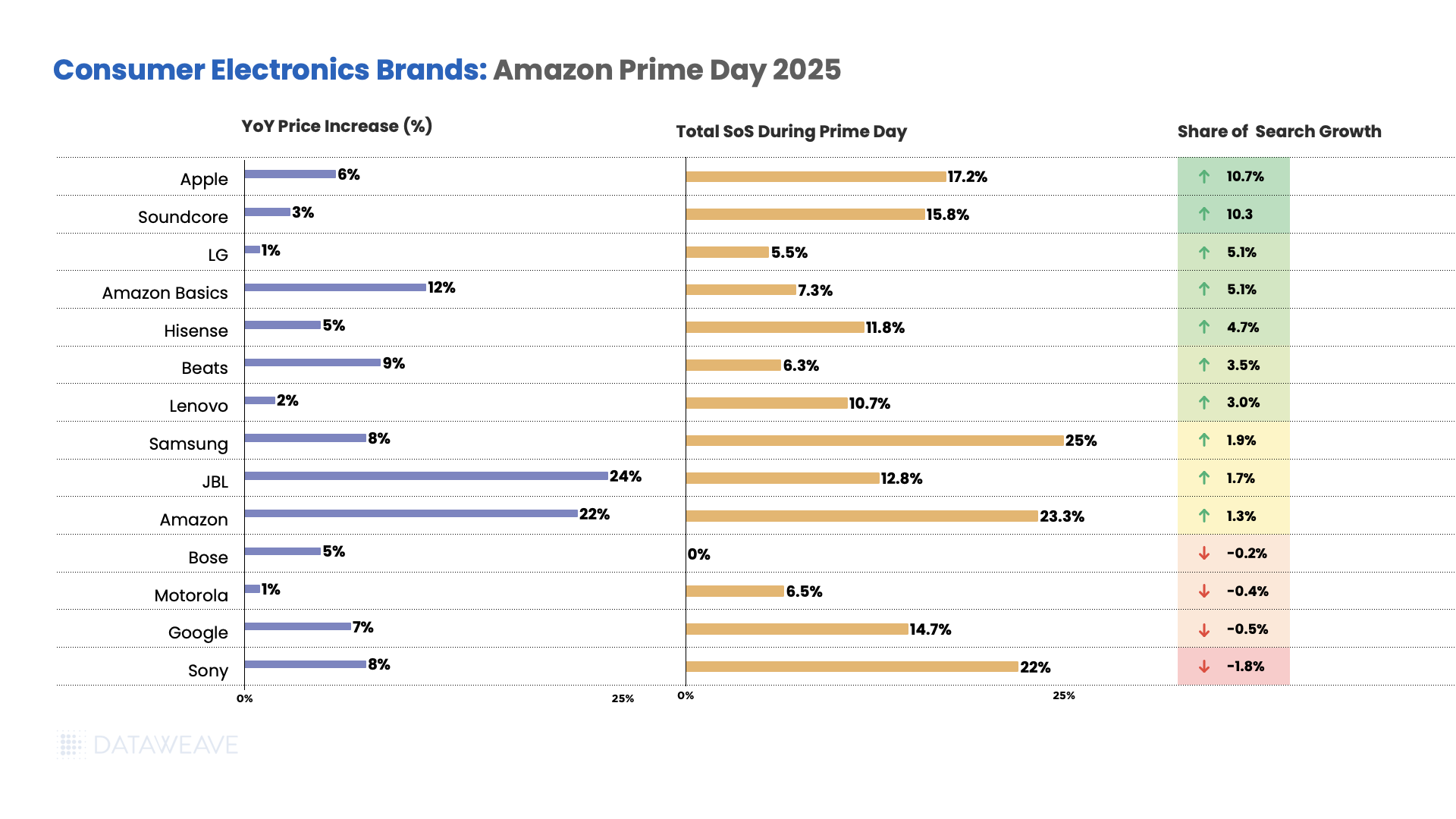
    Three Pillars of Grocery Price Management

    1. Smart Data Collection: Building Your Foundation

    The journey begins with comprehensive data collection and storage across your entire product ecosystem. This means:

    • Complete Coverage Of All SKUs Across All Stores: Tracking prices for all SKUs across all stores, with particular attention to high-velocity items and volatile categories.
    • Dynamic Monitoring: Tracking prices across different time frequencies as grocery prices are highly volatile for different categories. So daily tracking for volatile items like dairy and produce, and weekly for more stable categories may be needed.
    • Competitive Intelligence: Gathering data not just on prices, but on promotions, pack sizes, and private label alternatives.
    • Infrastructure to Support Large Volumes of Data: Partnering with external data and analytics providers to bridge the gap when retailers struggle with the scale of digital infrastructure these data sets require.

    2. Intelligent Data Refinement: Making Sense of the Numbers

    Raw data alone isn’t enough—it needs context and structure to become actionable intelligence. This is called Data Refinement—the process of establishing meaningful relationships within the data to facilitate the extraction of valuable insights. This refinement stage is closely tied to the data collection strategy, as the quality and depth of the insights derived depend on the accuracy and coverage of the collected data.
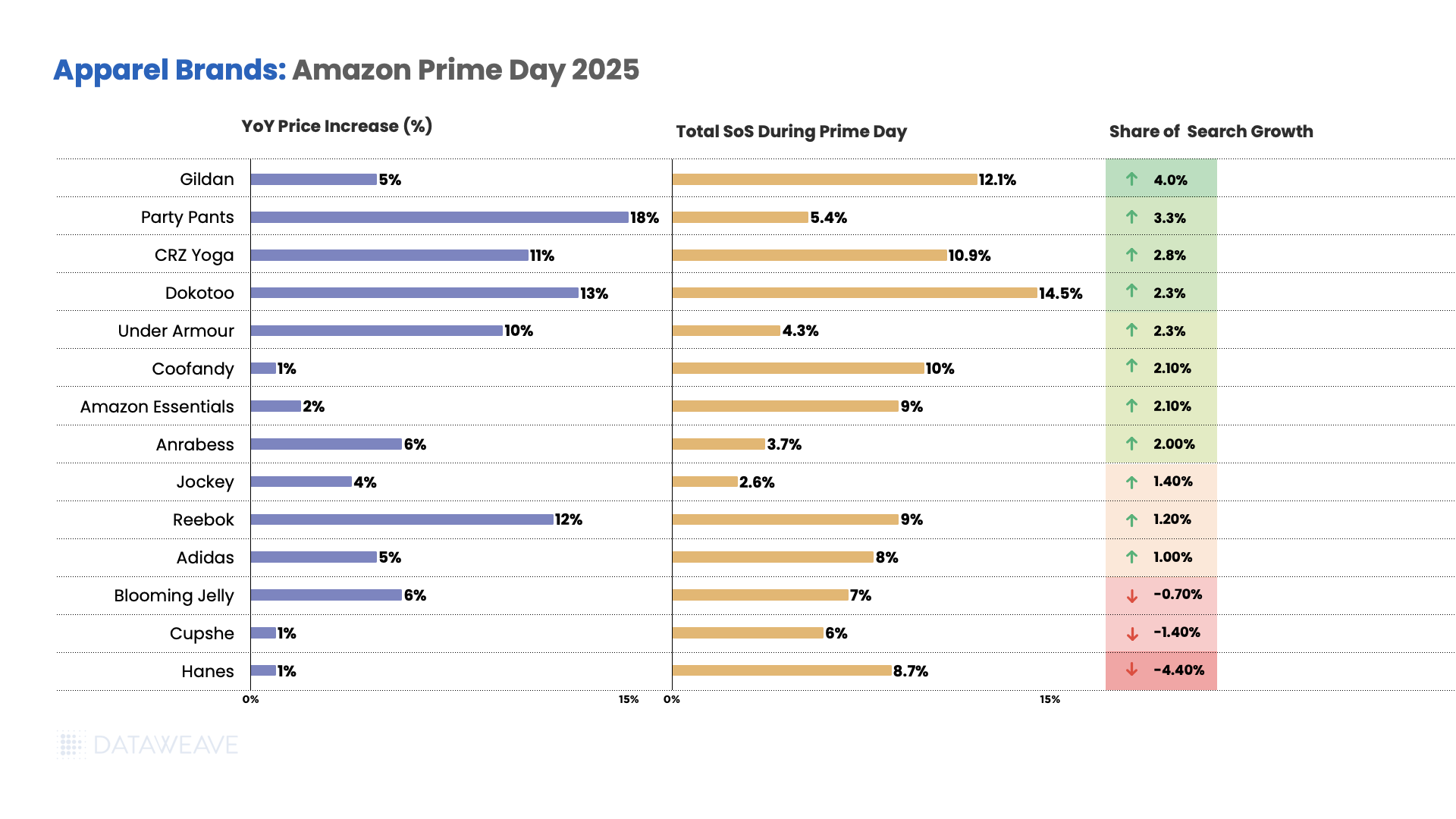
    Data refinement includes several key processes:

    Advanced Product Matching

    Picture this: You’re tracking a competitor’s pricing on organic apples. Simple, right? Not quite. Yes, Universal Product Codes (UPCs) and Price Lookup Codes (PLUs) are present in Grocery to standardize product identification across different retailers—unlike the fashion industry’s endless style variations. Still, product matching isn’t as straightforward as scanning barcodes.

    Grocery Pricing Intelligence data faces a challenge when product names, weights, and details differ

    Here’s the catch: many retailer websites don’t display them. Then there’s the private label puzzle—your “Store’s Best” organic apples need to match against competitors’ house brands, each with their own unique UPC. Throw in different sizes (4 Apples vs. 1Kg of Apples), regional product names (fancy naming for plain old arugula), and international brand variations (like the name for Sprite in the USA and China), and you’ve got yourself a complex matching challenge that would make conventional pricing intelligence providers sweat.

    Grocery Pricing Intelligence data faces a challenge when different naming conventions and languages are used in different geographies

    Custom Product Relationships for Consistent Pricing and Competitive Positioning

    Think like a shopper browsing the dairy aisle. You regularly buy your family’s favorite organic yogurt, the 24oz tub. But today, you notice the larger 32oz size is on sale – except the 24oz isn’t. As you stand there, confused, you wonder: Is the sale only for the bigger size? Did I miss a promotion? Should I buy the 32oz even though it’s more than I need?

    For shoppers, this inconsistent pricing across product variations creates a frustrating experience. Establishing clear relationships between related items in your catalog is essential for maintaining consistent pricing and a coherent competitive strategy.

    Grocery Pricing Intelligence data refinement involves Custom Product Relationships for Consistent Pricing and Competitive Positioning

    Start by linking products based on attributes like size, brand, and packaging. That way, when you adjust the price of the 32oz yogurt, the 24oz version automatically updates too – no more scrambling to ensure uniform pricing across your assortment. Similarly, products of the same brand but with flavor variations should be connected to keep pricing consistent.

    Taking this one step further, mapping your competitors’ exact and similar products is crucial for comprehensive competitive intelligence. Distinguishing between premium and private label tiers, national brands, and regional players gives you a holistic view of the landscape. With this understanding, you can hone your pricing strategies to maintain a clear, compelling position across your entire category lineup.
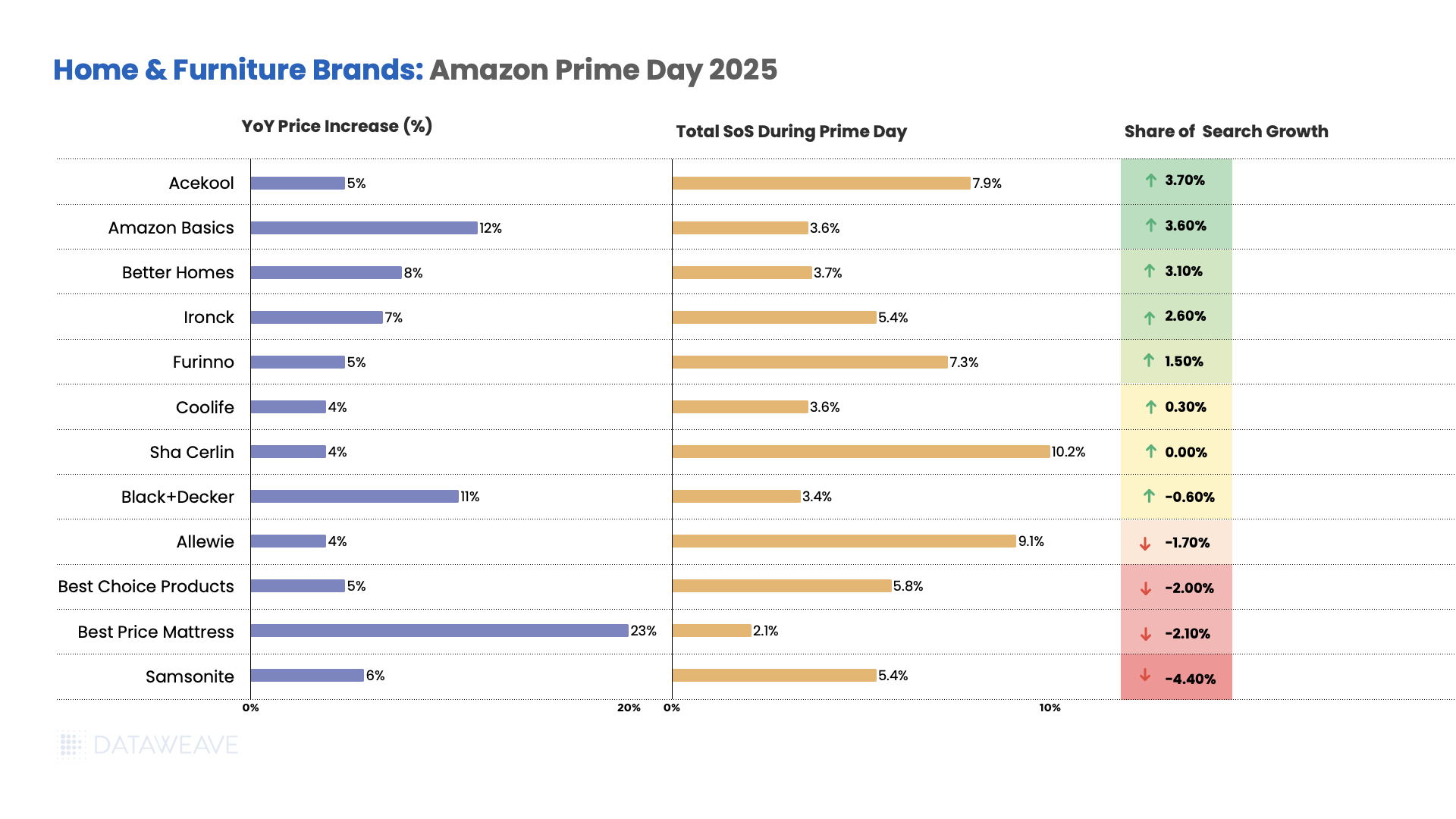
    Consistent pricing, whether across your own product variations or against competitors, provides clarity and accuracy in your overall competitive positioning. By establishing these logical connections, you avoid the customer confusion of seemingly random, inconsistent discounts – and ensure your pricing strategies work in harmony, not disarray.

    The Role of AI and Data Sciences in Data Refinement

    On the surface, linking products based on attributes like size, brand, and packaging seems like a no-brainer. But developing and maintaining the systems to accurately and automatically identify these connections? That’s a whole different animal.

    Think about it – you’re not just dealing with text-based product titles and UPCs. There are images, videos, regional variations, private labels, and a whole host of other data types and industry nuances to account for.

    Luckily, DataWeave is one of the few companies that’s truly cracked the code. Our multimodal AI models are trained to process all those diverse data formats – from granular product specs to zany regional produce names. And it’s not just about technology; we also harness the power of human intelligence.
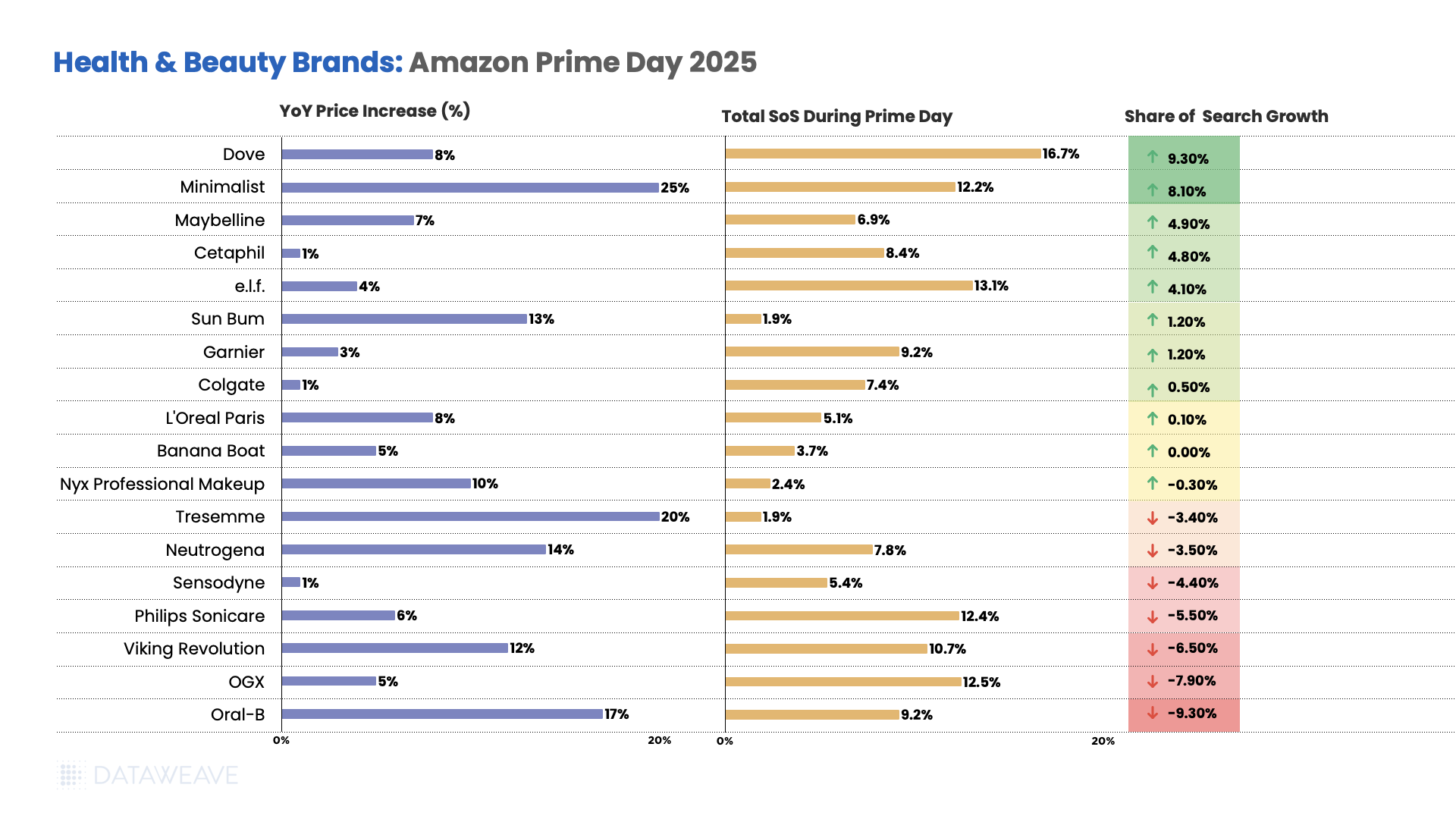
    See, in the grocery world, category managers are the real decision makers. They know their shelves inside and out and can spot those tricky connections in product matching, especially when they are not UPC-based. That’s why DataWeave built in a Human-in-the-Loop (HITL) process, where their AI systems continuously learn from expert feedback. It’s a feedback loop that allows our customers to pitch in and keep product relationships accurate, reliable, and always adapting to new market realities.

    So while product mapping may seem straightforward on the surface, the reality is it takes some serious horsepower to do it right. Thankfully, DataWeave has both the technical chops and the grocery industry know-how to make it happen. Because when it comes to pricing intelligence, getting those product connections right is half the battle.

    3. Strategic Implementation: Turning Insights into Action

    The true value of pricing intelligence (PI) is realized through its strategic application. Although many view PI as a technical function, its strategic significance is increasing, particularly in the context of recent economic pressures like inflation. Here’s why:

    Tactical vs Strategic Use of Data: From Standard Reporting to Competitive Analysis

    Pricing intelligence has come a long way from the days of simply reacting to daily price changes. These days, it’s not just about firefighting—it’s about driving long-term strategy.

    You can use pricing data to make quick, tactical adjustments, like matching a competitor’s sudden price drop on milk. Or, you can leverage that same data to predict market trends, optimize your product lineup, and shape your overall pricing strategy. Retailers who take that strategic view can get out ahead of the curve, anticipating shifts instead of just chasing them.

    DataWeave supports both of these approaches. Our Standard Reporting tools give pricing managers the nitty-gritty details they need—current practices, historical patterns, and operational KPIs. It’s all the insights you’d expect for making those tactical, day-to-day tweaks.

    In addition, DataWeave offers something more powerful: Competitive analysis. This is where pricing intelligence becomes a true strategic weapon. By providing a high-level view of market positioning, competitor moves, and untapped opportunities, competitive analysis empowers leadership to make proactive, big-picture decisions.

    Armed with this broader perspective, retailers can start taking a more surgical approach. Maybe you need to adjust pricing zones to better meet customer demands. Or rethink your overall strategies to stay ahead of the competition, not just keep pace. It’s the difference between constantly putting out fires and systematically fortifying your entire pricing fortress.

    Beyond Pricing: Comprehensive Data for Broader Insights

    Pricing intelligence is just the tip of the iceberg. When you really start to refine and harness your data, the possibilities for grocery retailers expand far beyond simple price comparisons. Think about it – all that information you’re collecting on products, markets, and consumer behavior? That’s a goldmine waiting to be tapped. Sure, you can use it to keep a pulse on competitor pricing. But why stop there?

    What if you could leverage that data to optimize your product assortment, making sure you’re stocking the right mix to meet customer demands? Or tap into predictive analytics to get a glimpse of future market shifts, so you can get out ahead of the curve? How about using it to streamline your supply chain, identify availability inefficiencies, and get products to shelves faster?

    Sure, pricing intelligence will always be mission-critical. But when you couple it with these other data-driven insights, that’s when grocery retailing gets really interesting. It’s about evolving from a price-matching robot to a true strategic visionary, armed with the intelligence to take your business to new heights.

    Looking Ahead: The Future of Grocery Pricing Intelligence

    The grocery pricing landscape continues to evolve, driven by:

    • Integration of AI and machine learning for predictive pricing
    • Enhanced focus on omnichannel pricing consistency
    • Growing importance of personalization in pricing strategies

    Pricing intelligence isn’t just about having data—it’s about having the right data and knowing how to use it strategically. Success requires a comprehensive approach that combines robust data collection, sophisticated analysis, and strategic implementation.

    By embracing modern pricing intelligence tools and strategies, grocery retailers can navigate market volatility, maintain competitive positioning, and drive sustainable growth. The key lies in building a pricing ecosystem that’s both sophisticated enough to handle complex data and flexible enough to adapt to changing market conditions.

    Ready to transform your pricing strategy? Check out our grocery price tracker to get month-on-month updates on grocery prices in the real world. Contact us to learn how our advanced pricing intelligence solutions can help your business stay ahead in the competitive grocery market.

  • Mastering Fuel Price Competitiveness: How First-Party Data Outperforms Third-Party in Pricing Accuracy

    Mastering Fuel Price Competitiveness: How First-Party Data Outperforms Third-Party in Pricing Accuracy

    Fuel retailers today operate in a highly competitive and volatile market. Consumer behavior is increasingly driven by price sensitivity, particularly in industries like fuel where small changes in price can significantly influence where consumers choose to fill up. The stakes are even higher when you consider the razor-thin margins many fuel retailers work with, making every cent count.

    For years, retailers have relied on third-party apps and services to provide them with location-based competitive fuel price data. These services collect pricing data based on customer transactions. While these platforms offer a convenient way for consumers to find cheaper fuel prices, their value to retailers is limited. The data they provide is often riddled with inaccuracies, lags, and incomplete coverage, leaving retailers vulnerable to missed pricing opportunities.

    In this rapidly shifting landscape, retailers need data that is not only accurate but also real-time. Solving this involves directly tapping into retailers’ own data sources (first-party or 1P data) —such as websites and apps. This is believed to be the most comprehensive and reliable source of fuel price data in the market.

    To validate this hypothesis, we conducted a comprehensive analysis comparing first-party and third-party (3P) fuel price data. Our analysis compared pricing (at the same time of the day) across more than 40 gas stations—including major players like Circle K, Costco, Speedway, and Wawa. The data was captured several times a day for over a week.

    Accurate Pricing Matters More Than Ever

    Our analysis revealed that nearly a quarter (24.4%) of the fuel pricing data provided by third-party sources was inaccurate when compared to first-party data. On average, these inaccuracies amounted to a price difference of 10.9%.

    Such discrepancies, though seemingly minor, can significantly affect consumer behavior. Inaccurate prices could drive customers to competitors who are listed with lower prices—even if the real difference is negligible. For fuel retailers, this leads to lost revenue, missed opportunities, and reduced market share.

    First-party vs Third-party Fuel Price Comparison

    The implications are clear: relying on third-party competitive data alone puts retailers at risk. With inaccurate data, retailers may fail to adjust their prices in time to respond to market changes, losing customers to competitors.

    The Core Challenges of Third-Party Data

    Third-party data comes with inherent limitations. The way this data is collected presents significant challenges for fuel retailers looking to optimize pricing strategies. Here are the main issues:

    • Inconsistent Data Frequency: Third-party pricing data is often gathered through customer card transactions. As a result, pricing data updates only when and where transactions occur. This can lead to irregular data availability, particularly in stations with lower transaction volumes. For instance, in rural areas or during off-peak hours, fewer transactions lead to fewer updates. Retailers are left with outdated data, making it difficult to keep pace with real-time price fluctuations.
    • Limited Geographic Coverage: Regions with lower transaction volumes are particularly affected by data gaps. While urban centers may enjoy more frequent updates, rural and less-frequented stations often suffer from a lack of data. This limited geographic coverage creates blind spots, making it impossible for retailers in these regions to stay competitive.
    • Potential Data Inaccuracies Across Fuel Types: Our analysis showed that inaccuracies in third-party pricing data were most pronounced for Unleaded fuel, with errors occurring nearly 80% of the time. While Diesel prices fared slightly better, inaccuracies were still frequent. This inconsistency across fuel types further complicates the challenge for retailers relying on third-party data.
    First-party vs Third-party Fuel Price Comparison by Fuel Type

    Leveraging First-Party Data

    At DataWeave, our Fuel Pricing Intelligence solution leverages real-time 1P data directly from fuel retailers’ websites and mobile apps, ensuring that retailers always have access to the most up-to-the-minute and accurate pricing information.

    Here’s why first-party data stands out:

    • Real-Time Updates: Our solution provides near-instantaneous updates across more than 30,000 ZIP codes, ensuring that retailers always have the most up-to-date pricing information. This real-time accuracy is essential for making dynamic pricing adjustments in a highly competitive market.
    • Wide Geographic Coverage: DataWeave’s first-party solution captures data across a broad geographic range, ensuring no blind spots in coverage. Retailers in rural or less-frequented areas benefit from the same level of insight as their urban counterparts, giving them the ability to optimize pricing in real-time.
    • Complementary to Existing Solutions: For retailers already using third-party data, DataWeave’s first-party solution can complement and enhance their current systems. By filling in data gaps and providing more frequent updates, our solution ensures that retailers are never left in the dark when it comes to competitive pricing.

    Retailer-Wise Variances

    Among the retailers analyzed, we found that some were more affected by third-party data inaccuracies than others. Speedway and Wawa, for instance, experienced inaccuracies in up to 28% of third-party price data. In contrast, Circle K exhibited fewer discrepancies, but even they were not immune to the challenges posed by third-party data.

    For their competition, relying on third-party data alone presents a significant risk. By switching to first-party data sources, or complementing their existing third-party data with DataWeave’s first-party solution, retailers can ensure they stay competitive in the eyes of price-sensitive consumers.

    First-party vs Third-party Fuel Price Comparison by Retailer

    In an industry as price-sensitive as fuel retail, accurate data is a strategic asset. Leveraging first-party data allows fuel retailers to:

    • Maximize Revenue: By using real-time, accurate data, retailers can avoid under- or over-pricing their fuel, ensuring they capitalize on high-demand periods while minimizing losses during low-demand times.
    • Enhance Margins: First-party data provides the precision needed to fine-tune margins, ensuring profitability even in fiercely competitive markets.
    • Boost Customer Retention: Competitive pricing fosters customer loyalty. With better data, retailers can maintain customer trust and retention, even during volatile market shifts.

    Shift into High Gear with DataWeave

    As the fuel retail industry becomes increasingly competitive, the need for accurate, real-time pricing data has never been more important. DataWeave’s Fuel Pricing Intelligence solution empowers retailers with the insights they need to stay ahead of the competition, optimize pricing strategies, and boost profitability.


    With first-party data, fuel retailers can eliminate the blind spots and inaccuracies associated with third-party sources. This shift toward data-driven pricing strategies ensures that every price adjustment is backed by real-time insights, giving retailers the edge they need to succeed.

    To learn more, talk to us today!

  • The Complete Guide to Competitive Pricing Strategies in Retail and E-commerce

    The Complete Guide to Competitive Pricing Strategies in Retail and E-commerce

    Your budget-conscious customers are hunting for value and won’t hesitate to switch brands or shop at other retailers.

    In saturated and fiercely competitive markets, how can you retain customers? And better yet, how can you attract more customers and grow your market share? One thing you can do as a brand or retailer is to set the right prices for your products.

    Competitive or competition-based pricing can help you get there.

    So what exactly is competitive pricing? Let’s dive into this strategy, its advantages and disadvantages, and how it can be used to stay ahead of the competition.

    What is Competitive Pricing?

    Competitive or competition-based pricing is a strategy where brands and retailers set product prices based on what their competitors charge. This method focuses entirely on the market landscape and sets aside the cost of production or consumer demand.

    It is a good pricing model for businesses operating in saturated markets, such as consumer packaged goods (CPGs) or retail.

    Competitive Pricing Models

    Competitive pricing isn’t a one-size-fits-all strategy. The approach includes various pricing models that can be customized to fit your business goals and market positioning.

    Here’s a closer look at five of the most common competition-based pricing models:

    Price Skimming

    If you have a new product entering the market, you can initially set a high price. Price skimming allows you to maximize margins when competition is minimal.

    This strategy taps into early adopters’ willingness to pay a premium for new project categories. As competitors enter the market, you can gradually reduce the price to maintain competitiveness.

    Premium Pricing

    Premium pricing lets you position your product as high-quality or luxurious goods.

    When you charge more than your competitors, you’re not just selling a product—you’re selling status and an experience. This strategy is effective when your offering is of superior quality or has unique features that justify a higher price point.

    Price Matching

    Price matching—also known as parity pricing—is a defensive pricing tactic.

    By consistently matching your competitors’ prices, you can retain customers who might otherwise, be tempted to switch to an alternative.

    This approach signals your customers that they don’t need to look elsewhere for what they need and can feel comfortable remaining loyal to your brand.

    Penetration Pricing

    Penetration pricing is when you set a low price for a new product to gain market share quickly. The opposite of price skimming, this strategy can be particularly effective in price-sensitive or highly competitive industries.

    By attracting customers early, you can also deter some competitors from entering the market. This bold move can establish your product as a market leader from the get-go.

    Loss Leader Pricing

    Loss leader pricing is a strategic sacrifice that can lead to greater gains in the long run.

    By offering a product at a low price—sometimes even below cost—you can attract new customers to your brand and strengthen your current customers’ loyalty.

    Eventually, you can cross-sell other higher-margin products to your loyal customer base to cover the loss from your loss leader pricing and increase sales of other more profitable products.

    Key Advantages of Competitive Pricing

    Although it’s not the only pricing strategy available, competitive pricing has some significant advantages.

    It is Responsive

    Agility is synonymous with profit in industries where consumer preferences and market conditions shift rapidly.

    Competitive pricing allows you to adapt quickly—if a competitor lowers their prices, you can respond promptly to maintain your positioning.

    It is Simple to Execute and Manage

    Competitive pricing is straightforward, unlike cost-based pricing, which requires complex calculations and spans various factors and facets.

    By closely monitoring competitors’ prices and adjusting your prices accordingly, you can implement this pricing strategy with relative ease and speed.

    It Can Be Combined with Other Pricing Strategies

    Competitive pricing is not a standalone strategy—it’s a versatile approach that can easily be combined with other pricing strategies. For example, say you want to use competitive pricing without losing money on a product. In this case, you could use cost-plus pricing to determine a base price that you won’t go below, then use competitive pricing as long as the price stays above your base price.

    Key Disadvantages of Competitive Pricing

    While competition-based pricing has its advantages, it’s not without its pitfalls. Here are some potential disadvantages of competitive pricing.

    It De-emphasizes Consumer Demand

    If you focus solely on what competitors are charging, you could overlook consumer demand.

    For example, you could underprice items that consumers could be willing to purchase for more. Or, you might overprice items that consumers perceive as low-value, which can reduce sales.

    You Risk Price Wars

    If you and your competition undercut each other for customer acquisition and loyalty, you will eventually erode profit margins and harm the industry’s overall profitability. It’s a slippery slope where everyone loses in the end.

    There’s Potential for Complacency

    When you base your prices on beating those of competitors, you might neglect to differentiate your offerings through innovation and product improvements. Over time, this can weaken your brand’s position and lead to a loss of market share. Staying competitive means more than just matching prices—it means continuously evolving and adding value for the consumer.

    4 Tips for a Successful Competitive Pricing Strategy in Retail

    Here are four competition-based pricing tips for retailers:

    Retailer Tip #1. Know Where to Position Your Products in the Market

    For competitive pricing to work, you must understand your optimal product positioning in the overall market. To gain this understanding, you must regularly compare your offerings and prices with those of your key competitors, especially for high-demand products.

    Then, you can decide which competition-based pricing model is suitable for you.

    Retailer Tip #2. Price Dynamically

    Dynamic pricing is a tactic with which you automatically adjust prices on your chosen variables, such as market conditions, competitor actions, or consumer demand.

    When it comes to competitive pricing, a dynamic pricing system can track your competitors’ price changes and update yours in lockstep.

    Price-monitoring tools like DataWeave allow you to stay ahead of the game with seasonal and historical pricing trend data.

    Retailer Tip #3. Combine Competitive Pricing with Other Pricing Strategies

    Competitive pricing can be powerful, but it doesn’t have to stand alone. You can enhance its benefits with complementary marketing tactics.

    To illustrate, you can bundle products to offer greater value than what your competitors are offering. You can also leverage loyalty programs to offer exclusive discounts or rewards so customers keep returning, even when your competitors offer them lower prices.

    Retailer Tip #4. Stay in Tune with Consumer Demand

    Competition-based pricing aligns you with your competitor, but don’t lose sight of what your customers want. Routinely test your pricing strategy against consumer behavior to ensure that your prices reflect the actual value of your offerings.

    5 Tips for a Successful Competitive Pricing Strategy for Consumer Brands

    If you’re thinking about how to create a competitive pricing strategy for your brand, consider these five tips:

    Brand Tip #1. Identify Competing Products for Accurate Comparisons

    The first step in competitive pricing is to know the value of what you’re selling and how it compares to that of your competitors’ products. This extends to private-label products, similar but not identical products, and use-case products.

    Product matching ensures your pricing decisions are based on accurate like-for-like comparisons, allowing you to compete effectively.

    Brand Tip #2. Understand Your Product’s Relative Value

    Knowing how your product competes on value is key to setting the right price. If your product offers higher value, price it higher; if it offers less, price it accordingly. This ensures your pricing strategy reflects your product’s market placement.

    Brand Tip #3. Consider Brand Perception

    Even if your product is virtually the same as a competitor’s, your brand’s perceived value may be different, which plays a crucial role in pricing.

    If your brand is perceived as premium, you can justify higher prices. Conversely, if customers perceive you as a value brand, your pricing should reflect affordability.

    Brand Tip #4. Leverage Value-Based Differentiation

    When your prices are similar to competitors’, you must differentiate your products by expressing your product value through branding, packaging, quality, or something else entirely.

    This differentiation will compel consumers to choose your product over other similarly priced options.

    Brand Tip #5. Stay Vigilant with Price Monitoring

    Your competitors will update their pricing repeatedly, and you will, too.

    It can be difficult and time-consuming to monitor your competitive pricing, so you’ll need a system like DataWeave to monitor competitors’ pricing and manage dynamic pricing changes.

    This vigilance ensures your brand remains competitive and relevant in real time.

    4 Essential Capabilities You Need to Implement Successful Competition-Based Pricing

    You’ll need four key capabilities to implement a competitive pricing strategy effectively.

    AI-Driven Product Matching

    Product matching means you’ll compare many products (sometimes tens or hundreds) with varying details across multiple platforms. Accurate product matching at that scale requires AI.

    For instance, AI can identify similar smartphones to yours by analyzing features like screen size and processor type. DataWeave’s AI product matches start with 80–90% matching accuracy, and then human oversight can fine-tune the data for near-perfect matches.

    You can make informed pricing decisions once you know which competing products to base your prices on.

    Accurate and Comprehensive Data

    A successful competition-based pricing strategy depends on high-quality, comprehensive product and pricing data from many retailers and eCommerce marketplaces.

    By tracking prices on large online platforms and niche eCommerce sites across certain regions, you’ll gain a more comprehensive market view, which enables you to make quick and confident price changes.

    Normalized Measurement Units

    Accurate price comparisons are dependent on normalized unit measurements.

    For example, comparing laundry detergent sold in liters to laundry detergent sold in ounces requires converting either or both products to a common base like price-per-liter or price-per-ounce.

    This normalization ensures accurate pricing analysis.
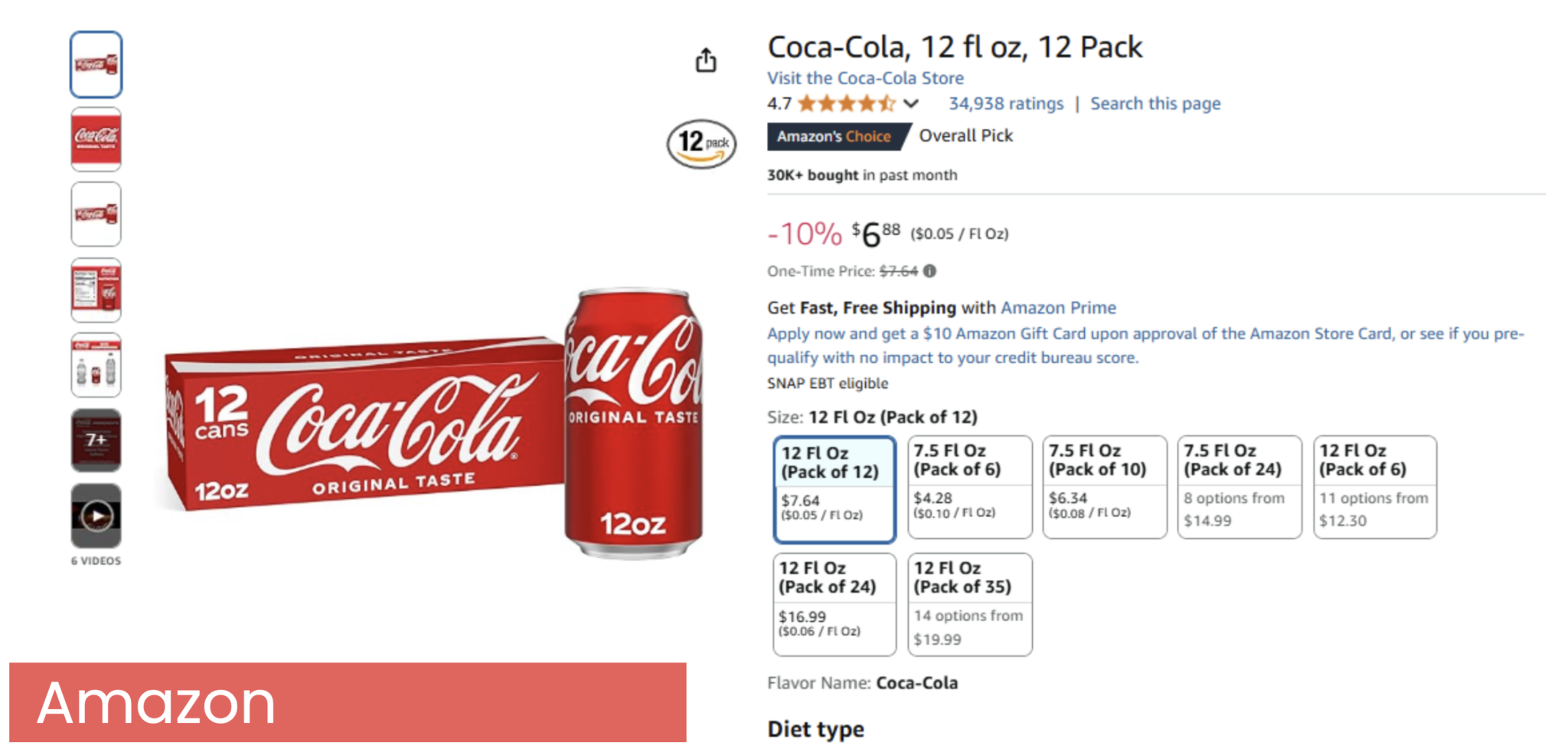
    Timely Actionable Insights

    Timely and actionable pricing insights empower you to make informed pricing decisions.
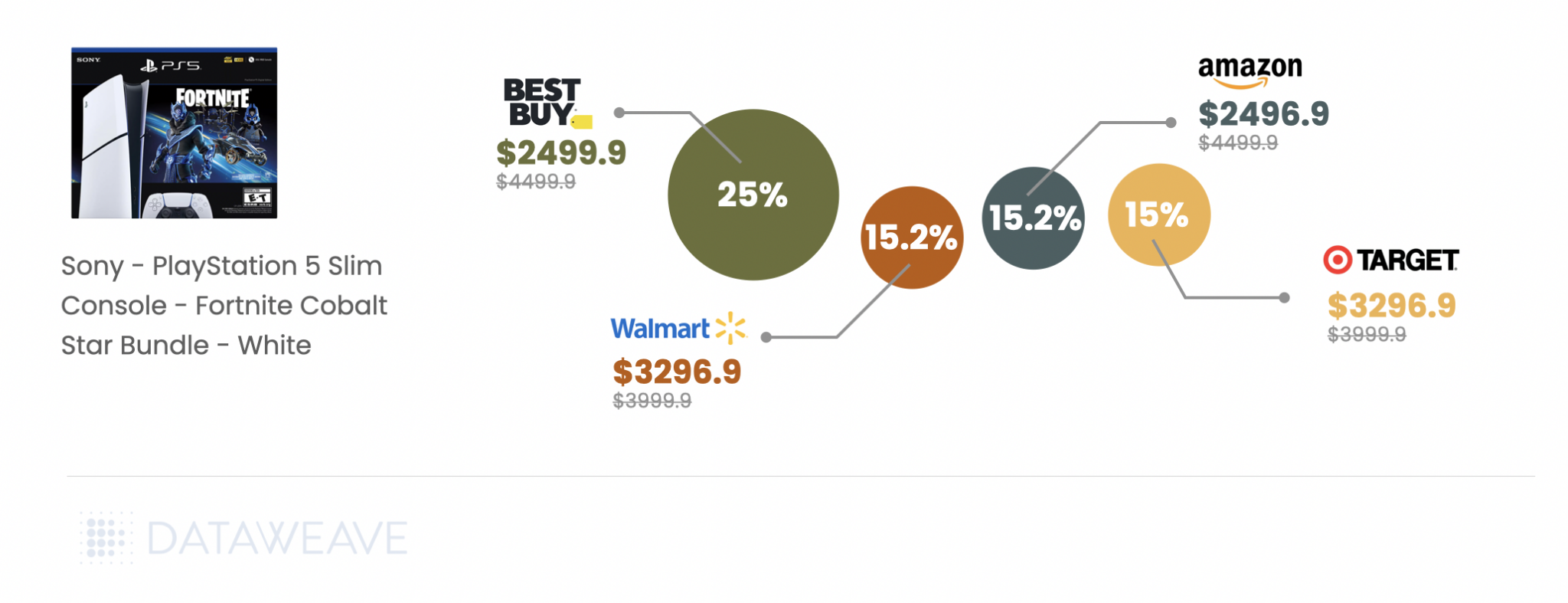
    With top-tier competitive pricing intelligence systems, you get customized alerts, intuitive dashboards, and detailed reports to help your team quickly act on insights.

    In Conclusion

    Competitive pricing or competition-based pricing is a powerful strategy for businesses navigating crowded markets, but you must balance competitive pricing with your brand’s unique value proposition.

    Competitive pricing should complement innovation and customer-centric strategies, not replace them. To learn more, talk to us today!