Category: Online sales

  • U.S. Prime Day Deals 2022: Promotion Intelligence First Look

    U.S. Prime Day Deals 2022: Promotion Intelligence First Look

    As inflation hits another 40-year high at 9.1 percent, U.S. consumers geared up for their first sign of hope and relief in the form of anticipated discount buys – 2022 Amazon Prime Days, or so we thought. While Prime Days have grown to become a promotional period almost as important as Black Friday to digital shoppers, the combination of economic uncertainty, inflationary pressures, and supply chain challenges seemed to alter the discount strategy expected given activity seen during 2021 Prime Days.

    Our analyst team has been hard at work aiming to provide a ‘first look’ at 2022 Prime Day Promotional Insights, tracking discounts offered across 46,000+ SKUs within key categories like Electronics, Clothing, Health & Beauty and Home, on seven major retailer websites – Amazon, Target, Best Buy, Sephora, Ulta, Lowe’s and Home Depot. Our analysis compares prices seen during Amazon Prime Day 2022 on July 12th, to pre-Prime Day maximum value prices seen in the ten days leading up to Prime Days, to determine the average change in discounts offered during the promotional period. Below is a summary of our findings.

    Competitive Promotions Give Amazon a Run for their Money

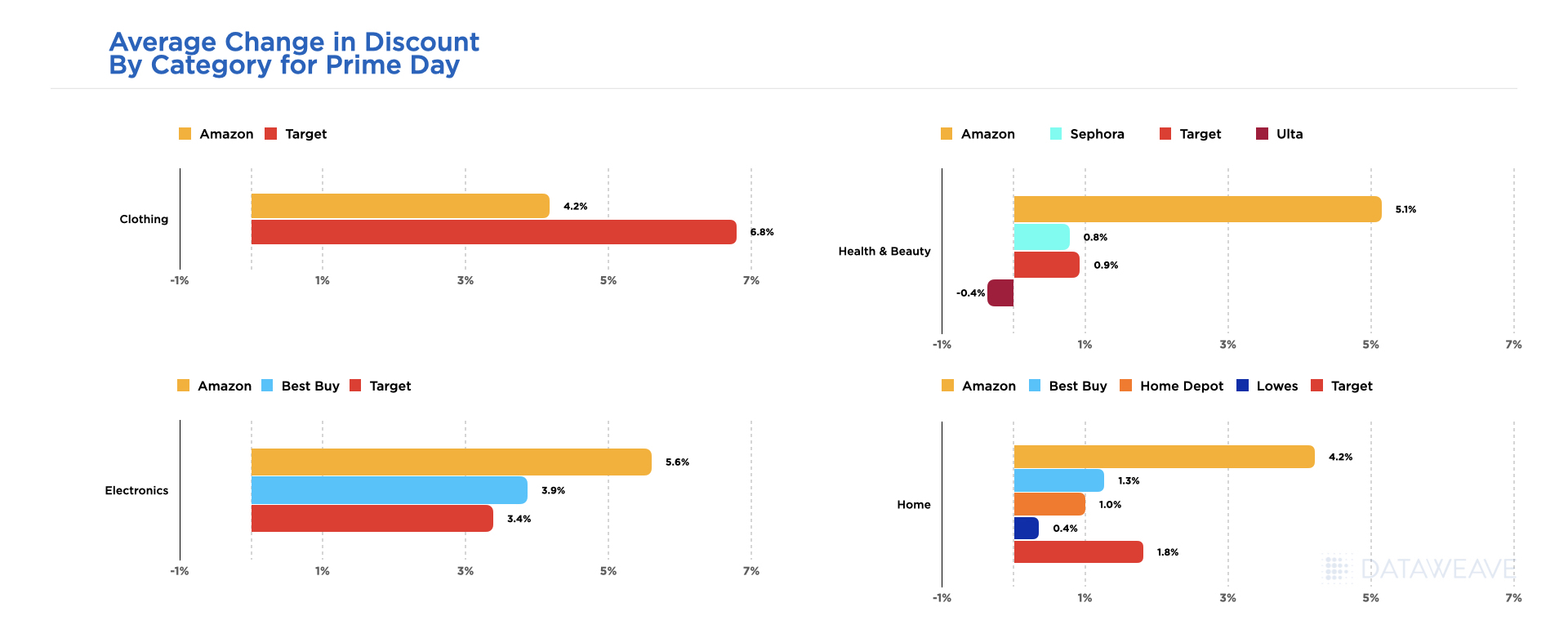
    Amazon offered the greatest average discount enhancements for Electronics at 5.6 percent followed by Health & Beauty items at 5.1 percent, and Home products at 4.2 percent versus pre-Prime Day discounts seen across the categories considered within our analysis. The only category reviewed where average discounts were greater on a competitor’s website was on Target.com within the Clothing category. As seen below, Clothing on Target.com average discounts were 6.8 percent greater than pre-Prime Day offers, which was 2.6 percent higher than the average discounts offered for Clothing on Amazon.
    Target Capitalizes on Growth Opportunity in Clothing Category

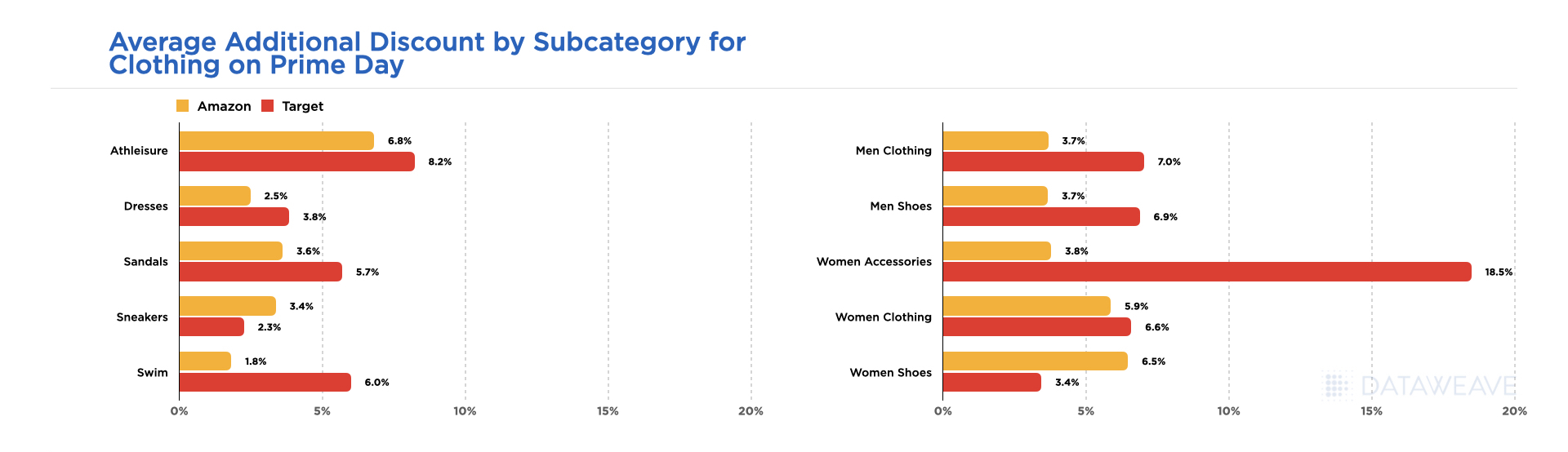
    Diving deeper into the details of where Target won within the Clothing category, you can see a majority of their promotional activity took place within Women’s Accessories where discounts offered were 18.5 percent greater than those seen pre-Prime Day 2022, which was almost 15 percent greater than the discount enhancements seen on Amazon for Women’s Accessories. In fact, Women’s Shoes and Sneakers were the only two categories where the average discounts offered were greater on Amazon than on Target.com.
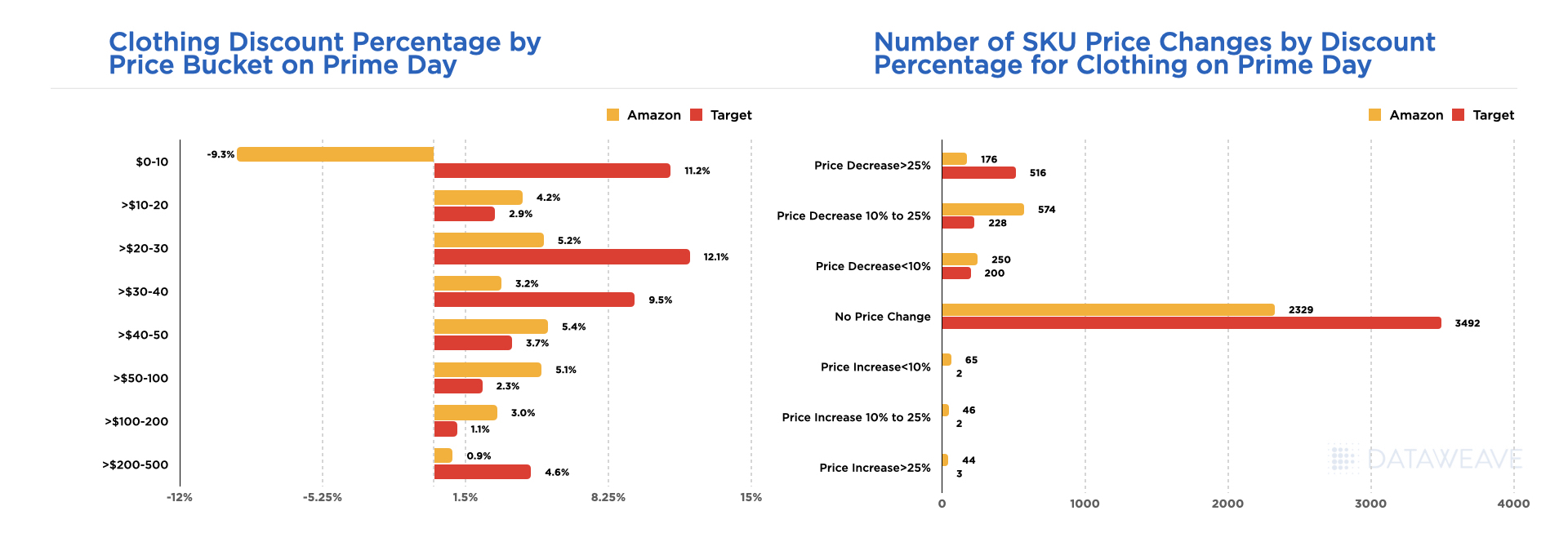
    Overall, the discounts offered on Target.com within the Clothing category were primarily concentrated within items priced $40 and lower, but what was most interesting is that within the $10 and under price bucket, Target offered average discounts of over 11 percent whereas Amazon increased prices for these items on average by over 9 percent.

    While most of the Clothing available on both Amazon and Target.com during Prime Days 2022 were offered without a price change, the greatest discount percentages tracked were within the range of 10-25 percent off on Amazon whereas Target chose to offer the bulk of their promotions at 25 percent off an up.
    Strategic Promotional Strategies Defined at the Electronics Subcategory Level

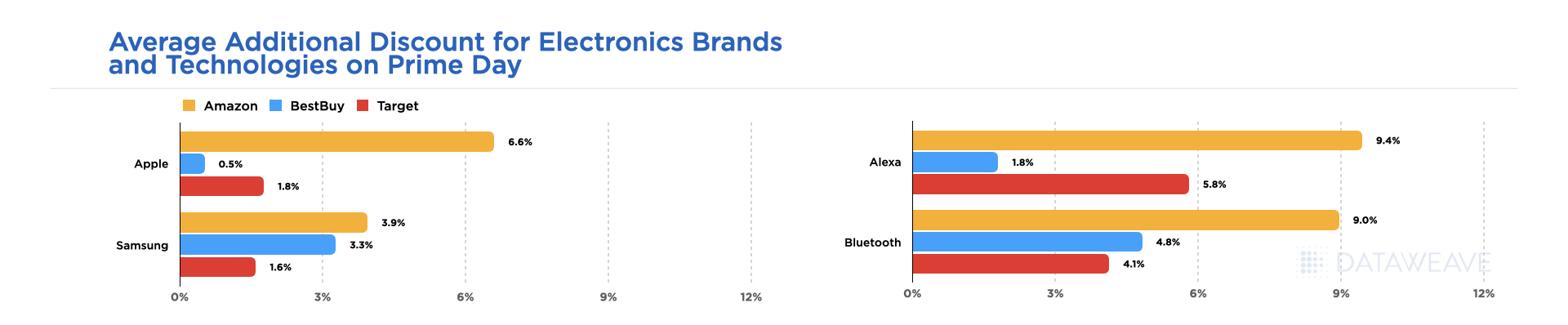
    When it comes to the Electronics category on Prime Day, the big question is always who will win the battle of the brands. Below shows the difference in average pricing and promotions discounts offered between products manufactured by Samsung versus Apple across each retailer platform, noting discounts were almost 3 percent greater on average for Apple versus Samsung products on Amazon, and Apple discounts were almost 5 percent greater on Amazon versus than those seen on Target.com.

    Amazon wasn’t going all in on Apple however, as we saw ‘Alexa’ devices (Amazon products) available on Best Buy and Target websites also, but the discounts were almost 4 percent greater on Amazon versus Target and over 7 percent greater than the discounts seen on BestBuy.com.
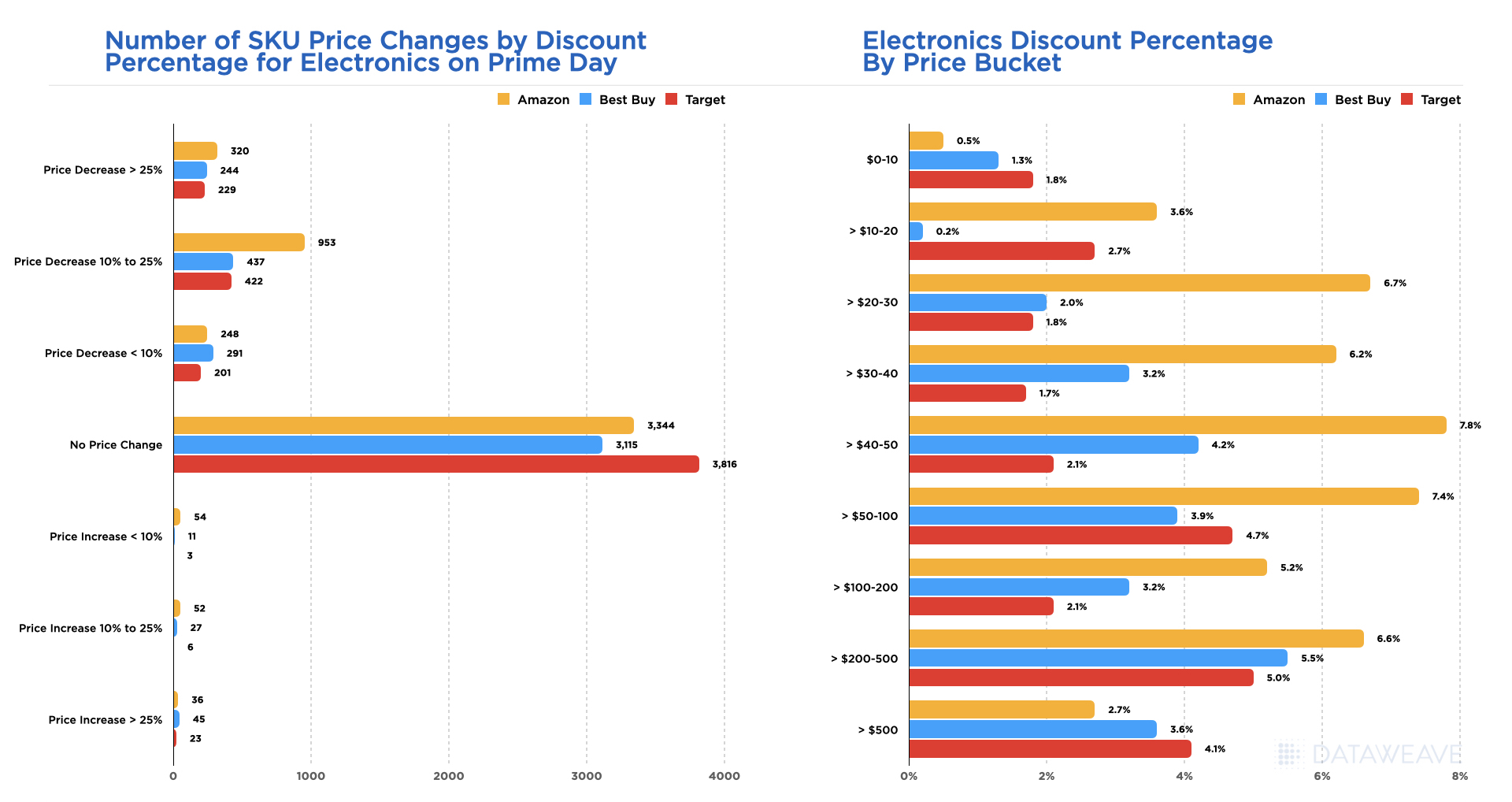
    While the average discounts offered within the Electronics category were greatest on Amazon (5.6 percent) versus Best Buy (3.9 percent) and Target (3.4 percent) as noted within the first chart of this blog and across brands and technologies considered above, the discounts offered on Amazon were strategically focused between 10-25 percent as seen below.

    Amazon’s Electronics promotions were also targeted at smaller price points, items priced between $20-500, whereas Best Buy and Target offered greater promotions for electronics priced $500 and up than Amazon.
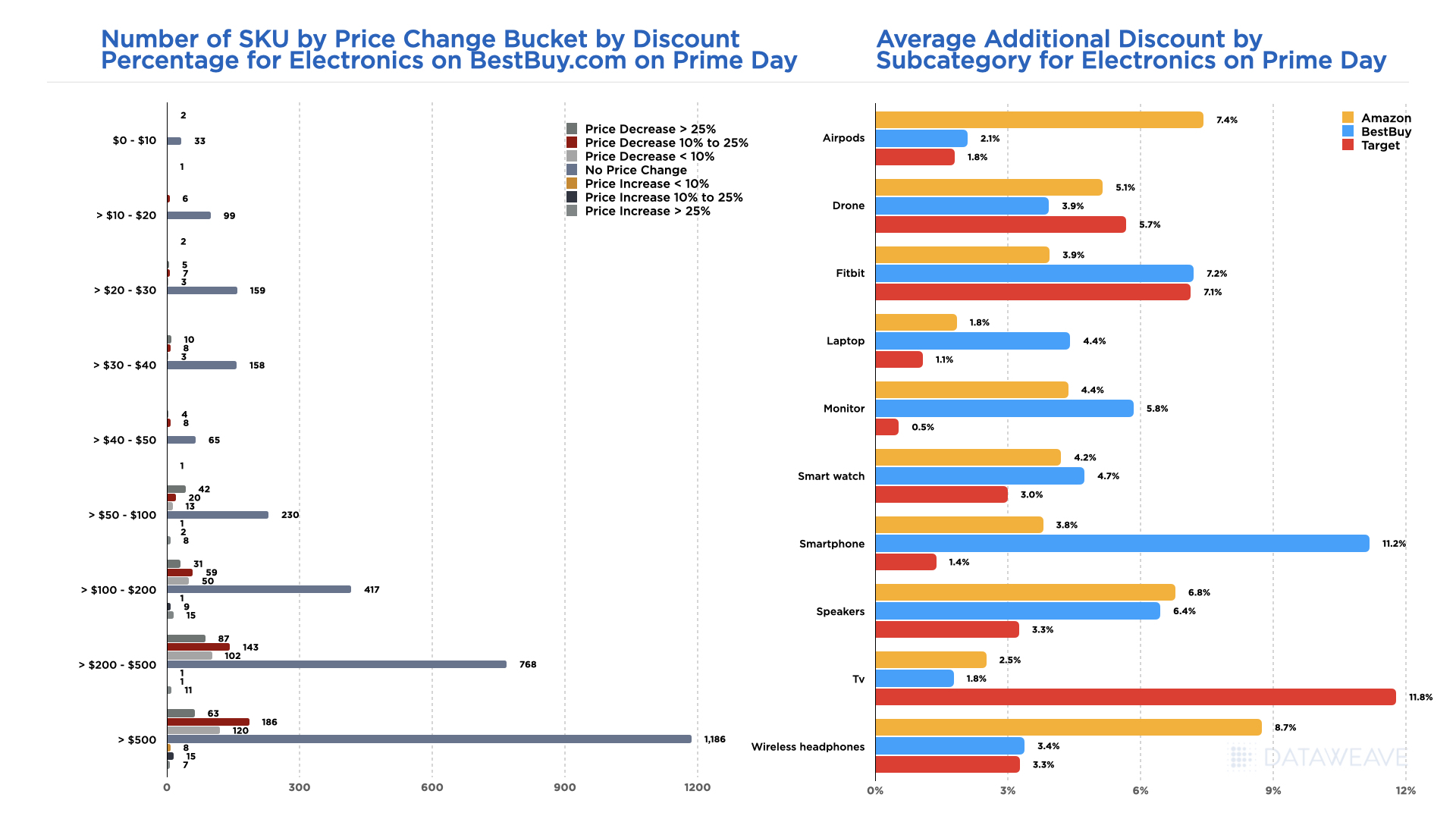
    Below is a snapshot of price buckets tracked for Electronics available on BestBuy.com, highlighting where most of the promotional activity was targeted at products priced $50 and up during Prime Days 2022, with discounts ranging from 10 percent up to greater than 25 percent greater than pre-Prime day prices.

    The standout categories were TVs on Target.com with discounts averaging nearly 12 percent greater than those seen pre-Prime day, and smartphones on BestBuy.com with discounts averaging just over 11 percent greater than those seen pre-Prime Day. The category with the greatest average discount enhancements seen on Amazon during Prime Days 2022 was for Wireless Headphones with an average discount of 8.7 percent.
    Home is Where Amazon’s Heart Was on Prime Day

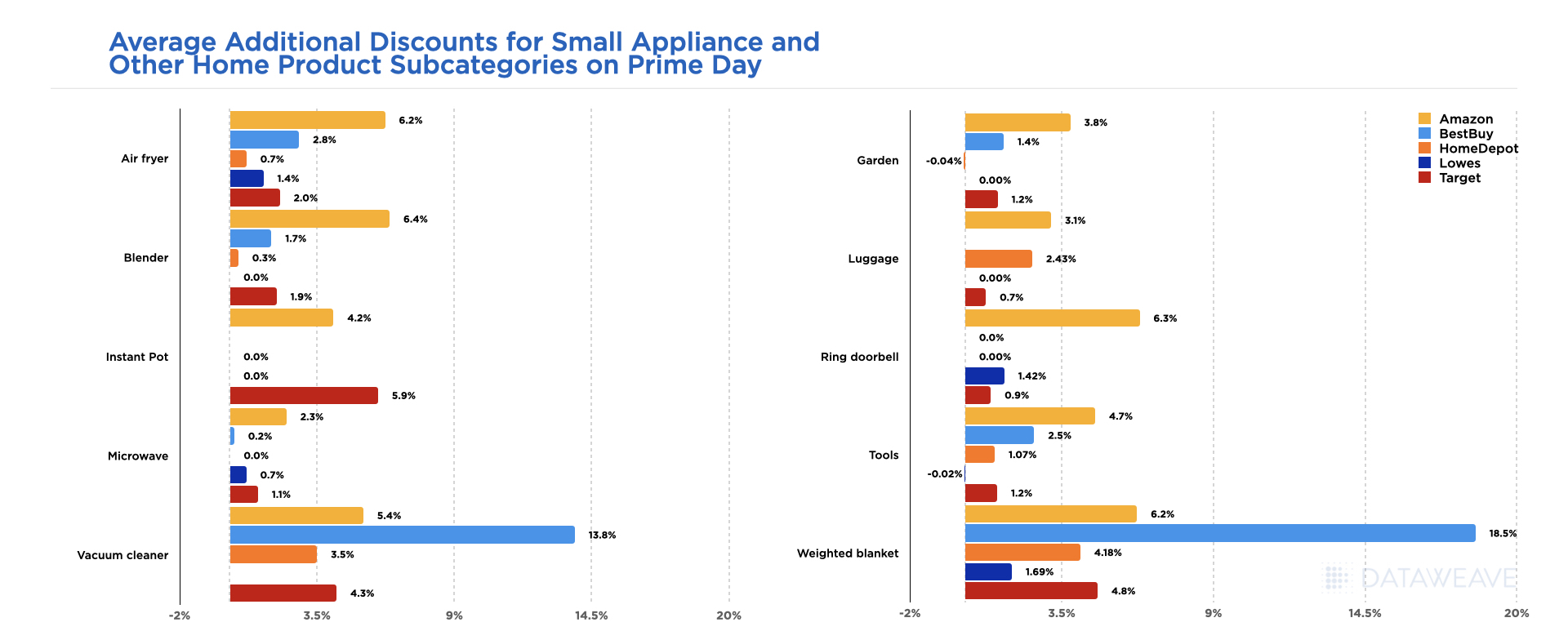
    Amazon dominated offers within the Home categories, especially for products within mid ($40-100) and higher price ranges (items priced $200-500), with the bulk of the discounts offered between 10-25 percent. There was little to no promotional activity seen across all price points on Lowe’s or Home Depot’s websites within the categories we tracked, and most other competitive offers on Home products were seen on BestBuy.com for products priced from $50-500. Even a subcategory like Tools offered deeper average discounts on Amazon (4.7 percent) than discounts seen on HomeDepot.com (1.1 percent) or Lowes.com (0 percent).
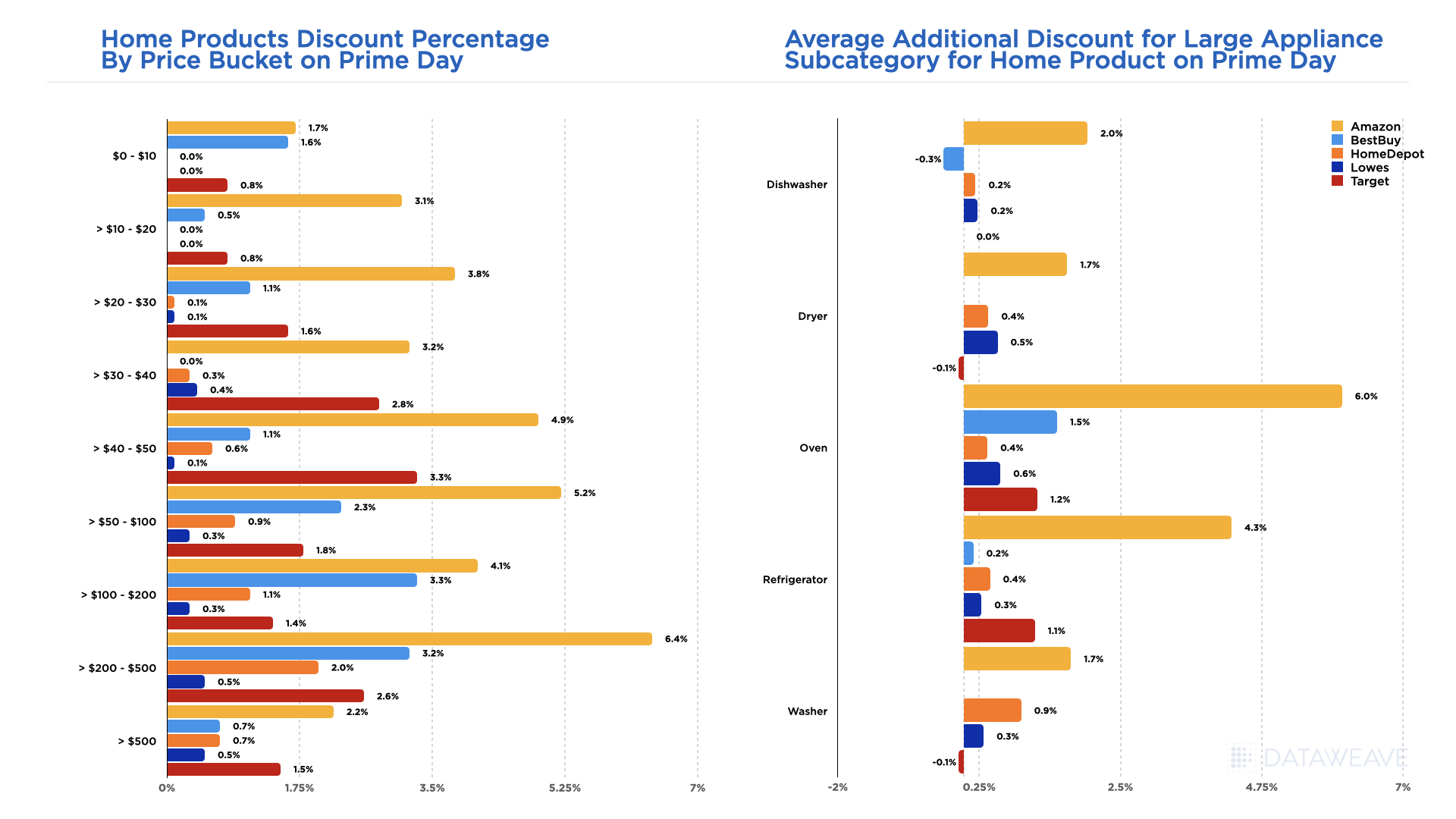
    For Large Appliances, Amazon was the only retailer to off any significant discount across each major subcategory with the greatest average discount being on Ovens at 6 percent, followed by Refrigerators at 4 percent. One caveat with this category, when we reviewed Large Appliance prices two weeks prior to Prime Days, we saw average price increases around 16.7 percent occurring on Amazon.

    During Prime Days 2022 however, Amazon also offered top average discounts for small appliances, except for on Instant Pots which appeared to have greater average discounts on Target.com (5.9 percent versus 4.2 percent on Amazon), and Vacuum Cleaners which appeared to have the best promotion of appliances small and large at 13.8 percent average discount on BestBuy.com. Another subcategory deeply discounted on BestBuy.com was weighted blankets, which averaged discounts around 18.5 percent versus Amazon’s average discount at only 6.2 percent.
    Health & Beauty Retailer Pricing Strategies Revealed

    Given the importance Health & Beauty Brands placed on Prime Day sales last year, we had anticipated to see more offers, especially within pure-play beauty retail channels, than we did for this booming category.
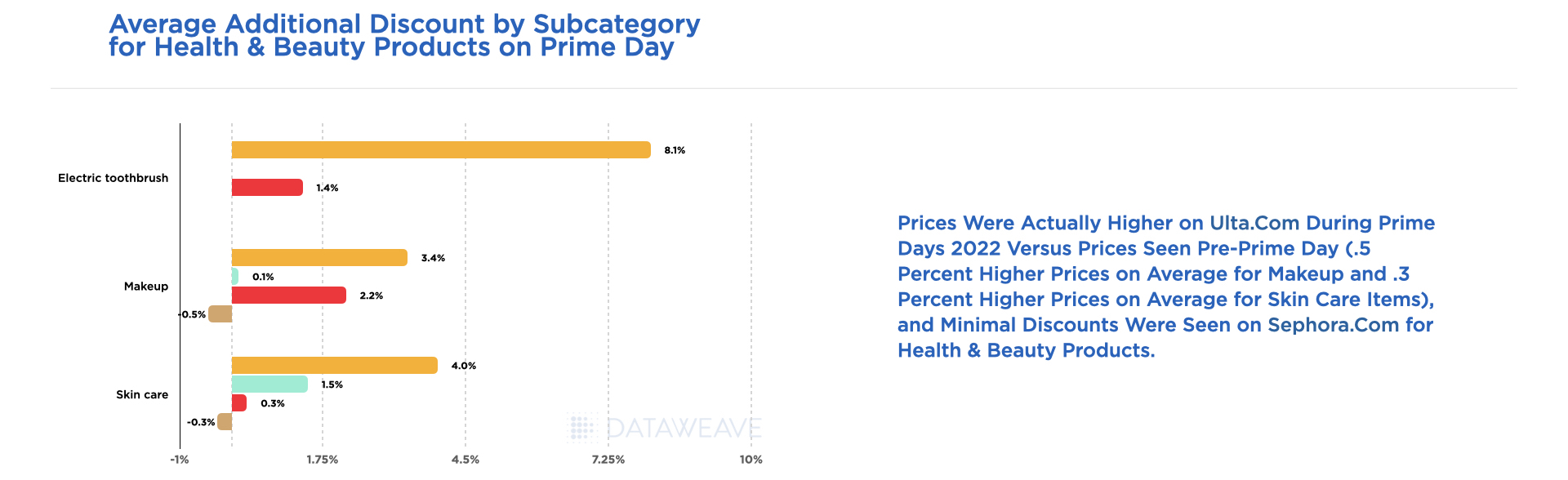
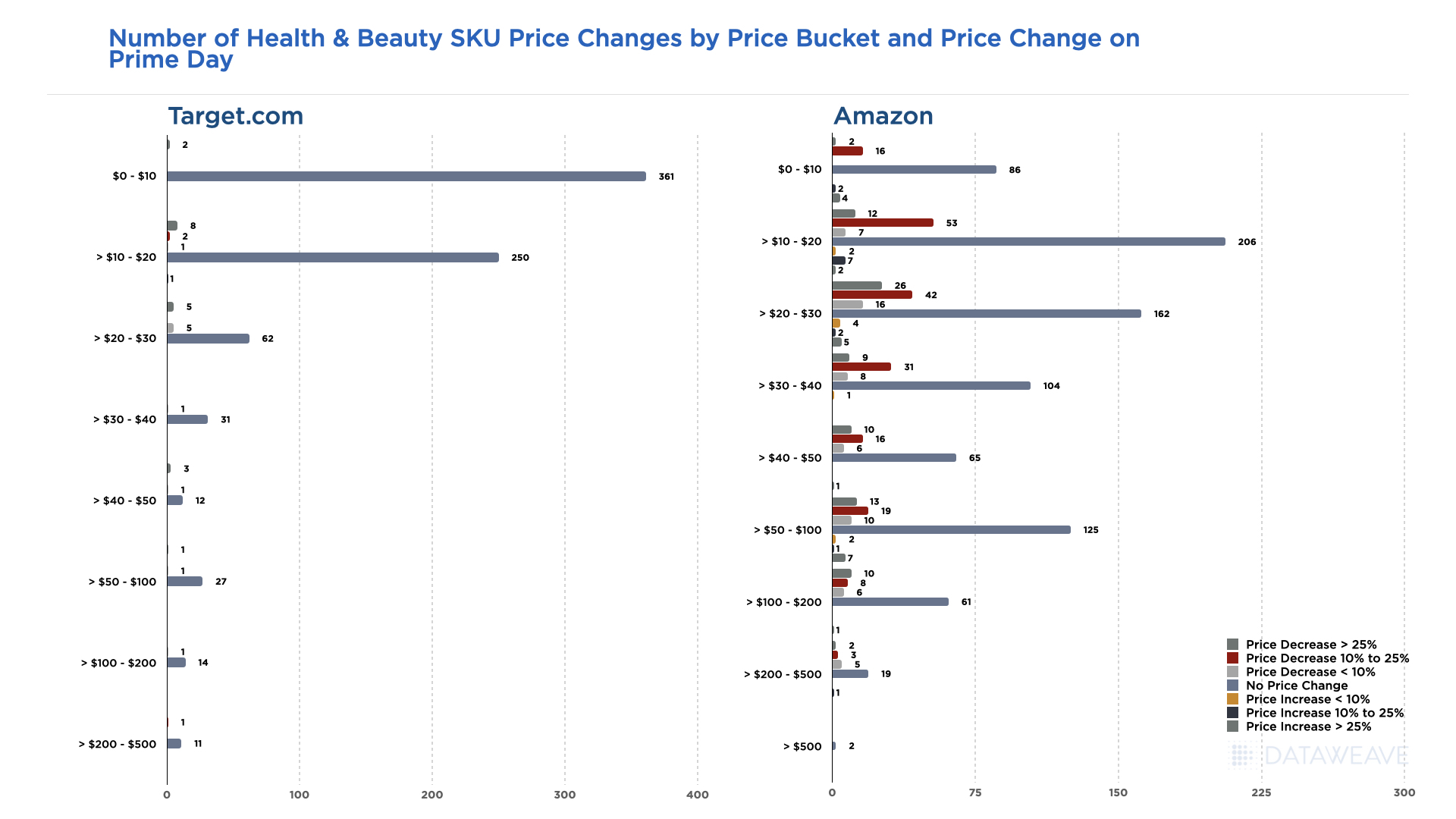
    Amazon drove most of the Health & Beauty offers seen averaging 5.1% discounts versus other retailers only offering less than 1% on average, but discounts were aimed at a targeted group of SKUs on Amazon, bringing the average discount lower overall. Most of the promotions offered on Amazon fell within mid-range price points ($20-50) and were discounted between 10-25 percent versus pre-Prime Day prices.
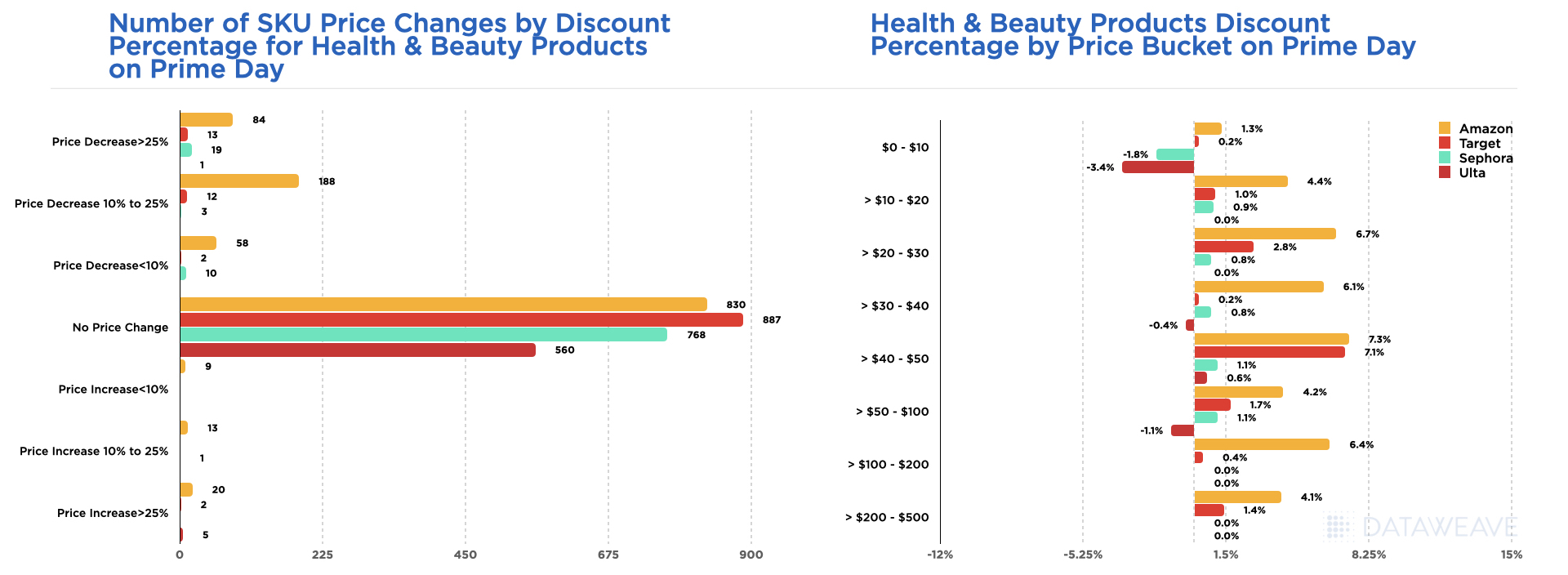
    Target.com offered the most comparable discounts to Amazon for Health & Beauty products on average, but their strategy primarily focused on items within the $20 and lower price range with discounts ranging primarily between 10-25 percent.
    More 2022 Prime Day Insights Coming Soon

    We know the significance visibility to critical pricing and promotional insights play in enabling retailers and brands to offer the right discounts to stay competitive, especially during promotional periods like Prime Days. While this blog is intended to provide a ‘sneak peek’ into 2022 Prime Day insights for the U.S. market, we will be providing more extensive, global coverage and will proactively share new insights with the marketplace as they become available throughout the month of July.

    Be sure to also check out our Press page for access to the latest media coverage on Prime Day insights and more. Don’t hesitate to reach out to our team if there is any particular category you are interested in seeing in more detail, or for access to more information on our Commerce Intelligence and Digital Shelf solutions.
  • eCommerce in South Africa: Data-Driven approach to getting ahead

    eCommerce in South Africa: Data-Driven approach to getting ahead

    What an exciting month we’ve had at DataWeave! Our team flew down to gorgeous Cape Town, South Africa to attend the 8th edition of #EcomAfrica! After months of Zoom calls and virtual events, it was a refreshing change to see our customers in person and meet some of the movers and shakers in eCommerce and some of the top South African brands. 

    Top eCommerce Companies in South Africa
    Top eCommerce Companies in South Africa

    My last visit to South Africa was before the pandemic. Things have changed since then, & the difference was stark! The eCommerce landscape had a paradigm shift during Covid-19 and grew exponentially. My customers spoke to me about the new opportunities, growth potential as well as challenges that came in because of this boom. For one, eCommerce in South Africa has become more competitive than ever – from online retail to grocery and food delivery to even alcohol delivery! All retail businesses seem to have jumped onto the eCommerce bandwagon.

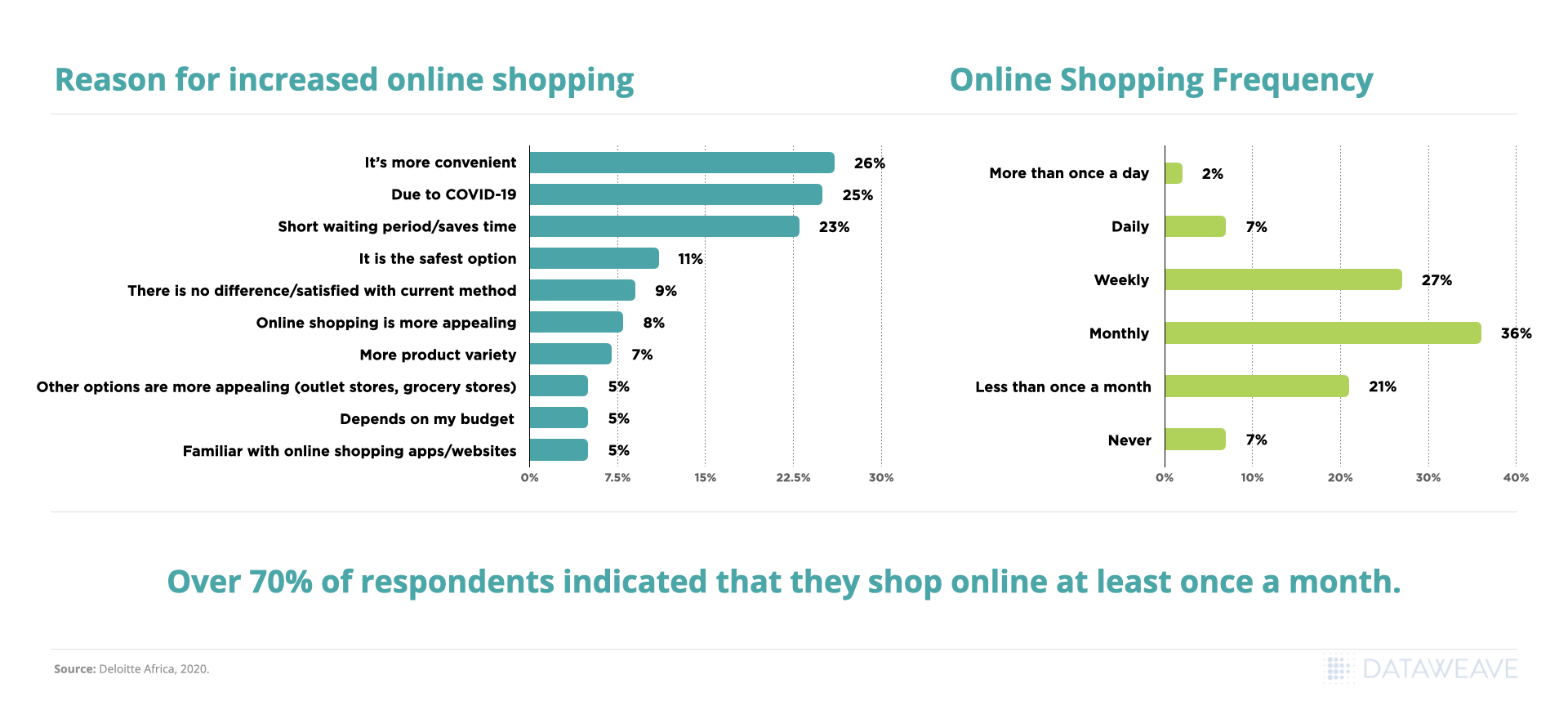
    A recent Deloitte report found that over 70% of South Africans shop online at least once a month & 2 out of 3 respondents said they plan to increase their frequency of online shopping. 65% said they know what they want, search online & check all stores that stock the product to compare prices. Price is one of the key factors that influence consumer purchase decisions. Other critical factors include delivery fee, delivery time, promotions & discounts & product assortment to name a few. In order to stay ahead in this highly competitive arena, both retailers and brands need to make data-driven decisions about critical KPIs like pricing to stay ahead of the competition.

    Increased Online Shopping & Online Shopping Frequency
    Increased Online Shopping & Online Shopping Frequency

    We’ve been working with customers in South Africa for over 4 years now, even before the pandemic. So on Day 2 of the event – S.Krishnan Thyagarajan “Krish”, President & COO, Dataweave had a chance to share our learnings and experience from all these years and how user data is critical to getting ahead & winning the eCommerce race in South Africa.

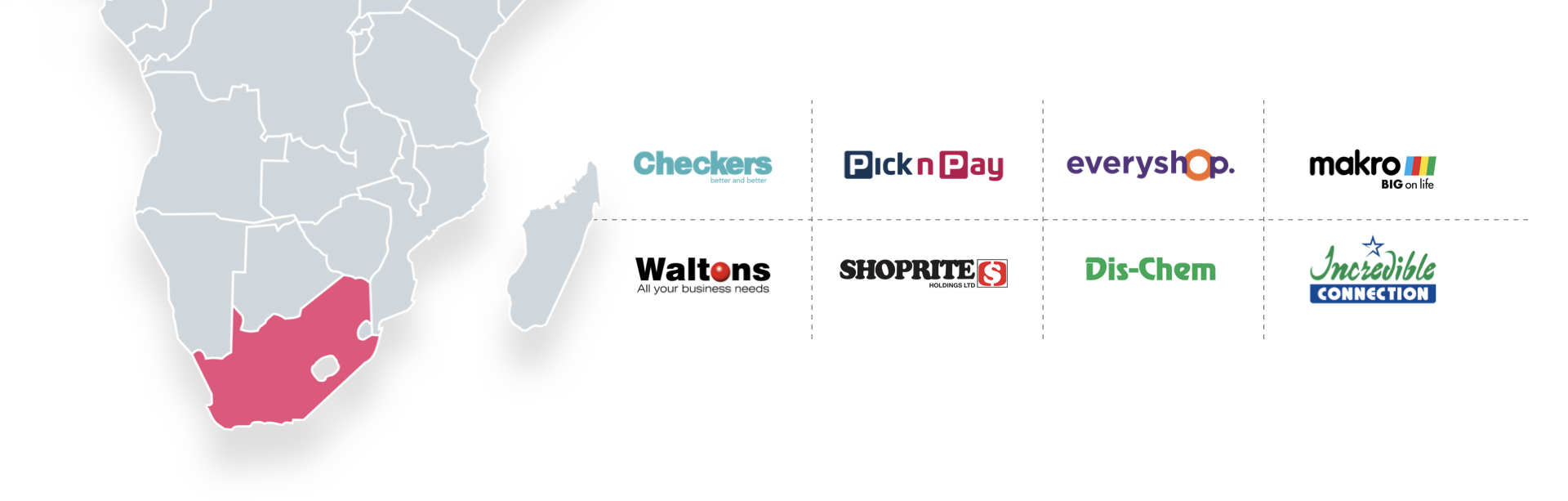
    For the purpose of Krish’s keynote address, we tracked pricing insights for a finite set of categories across key South African retailers like Checkers, Pick n Pay, EveryShop, Incredible, Makro, Waltons, Shoprite & Dis-Chem to name a few over a period of 16 months from Dec 2020 to April 2022. We highlighted price increase and decrease opportunities and how each retailer reacted in order to stay competitive, increase sales and protect margins. 

    BATTLE of the eCommerce GIANTS!

    Key Highlights from the Keynote

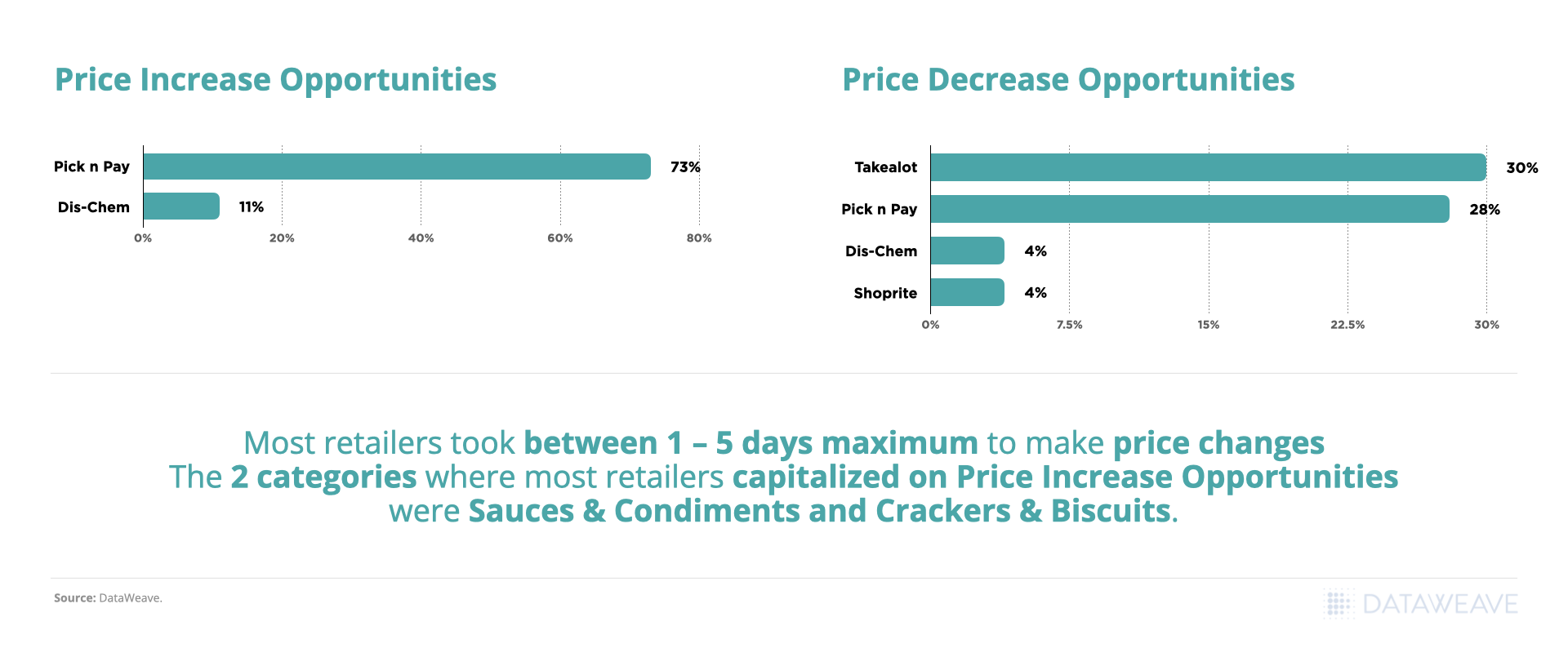
    • Increasing prices where an opportunity exists helps retailers increase their margins exponentially. Pick n Pay had the highest action rate (73%) when it came to capitalizing on price increase opportunities v/s Dis-Chem at 11%. 
    • When it came to price decrease opportunities (in order to stay competitive with rival brands) Takealot was the most responsive retailer – they capitalized on 30% of the opportunities, followed by Pick n Pay at a close second (28%) and Shoprite & Dis-Chem at just 4%.
    • Most retailers took between 1 – 5 days maximum to make price changes which means responsiveness to the market among all retailers is high making it more important for online retailers to always be on their toes.  
    • The 2 categories where most retailers capitalized on Price Increase Opportunities were Sauces & Condiments and Crackers & Biscuits.

    Want to watch the Keynote video on Demand? Click here to register & watch.

    Price Increase & Decrease Opportunities
    Price Increase & Decrease Opportunities

    Bonus video content! 

    • Watch the Impact of price increase & decrease opportunities on Private Label brands! 
    • See how product stock availability impacts price changes over a 16-month period. 
    • Find out which brands are in the lead in the Skin Care, Pet, Baby, Laundry & Cleaning Aid categories 

    If you’re an online retailer in South Africa & need insights on staying competitive with the right pricing, product assortment, delivery time, delivery rates, and the other key influencers that affect customers’ choice of online retailers, sign up for a demo with our team at DataWeave to know how we can help!  

  • The Rise of South African eCommerce : The Growth, & the Future

    The Rise of South African eCommerce : The Growth, & the Future

    2020 onwards, the South African economy was crippled due to the pandemic and lockdowns. However, according to StatsSA, South Africa’s online retail market share grew to 2.8% in 2020, double that in 2018. After the pandemic, South Africa’s eCommerce industry grew by 66% in 2020 compared to the year before. This increase was primarily because of restrictions on traditional stores that led to a 30% reduction in in-store purchases. 
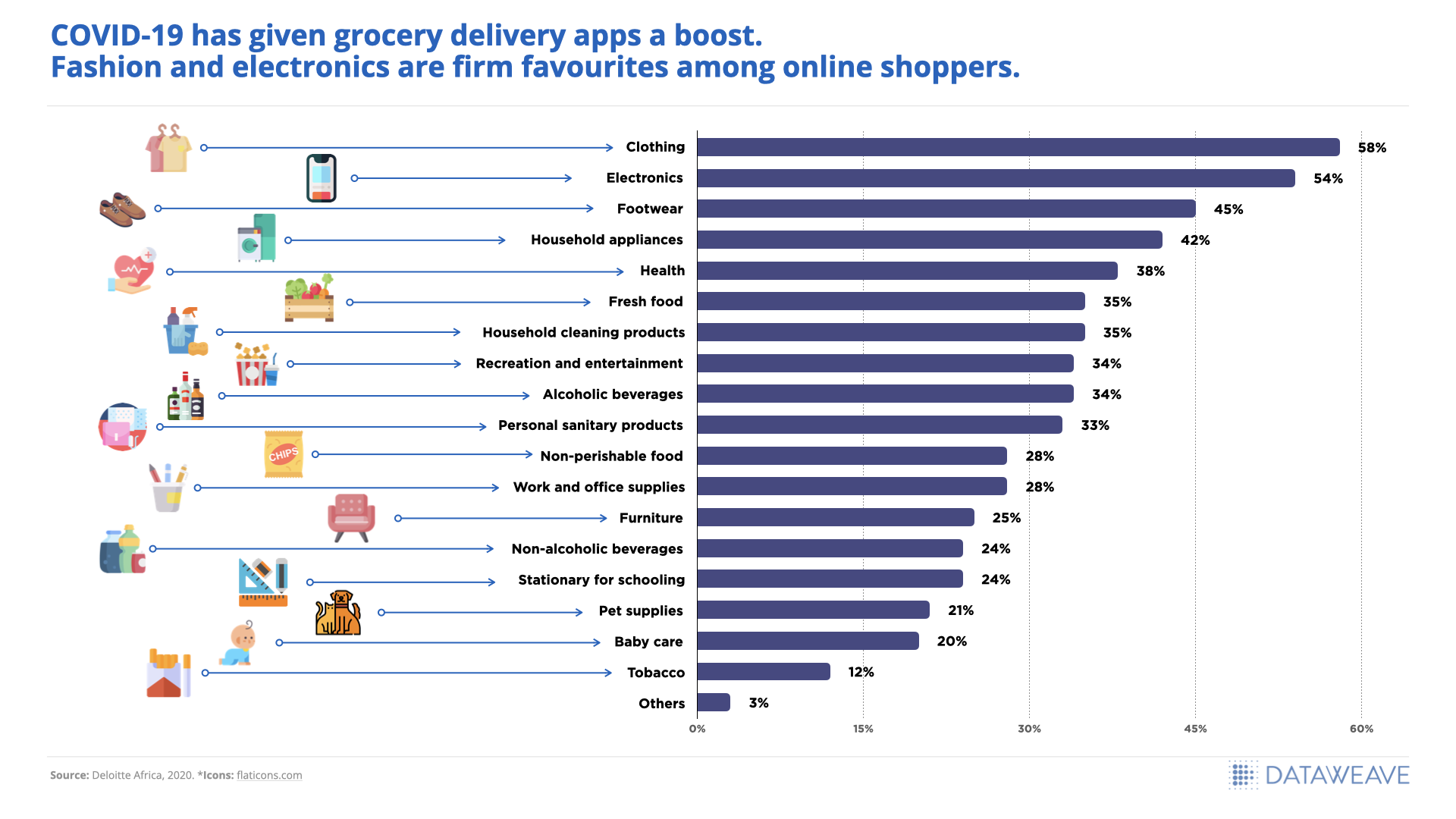
    According to a Deloitte study, over 70% of South Africans shop online at least once a month because of convenience. Household appliances, footwear, clothing, electronics, and health products are the most popular categories among South African online customers.

    Top Categories
    South African Ecommerce
    South African Ecommerce


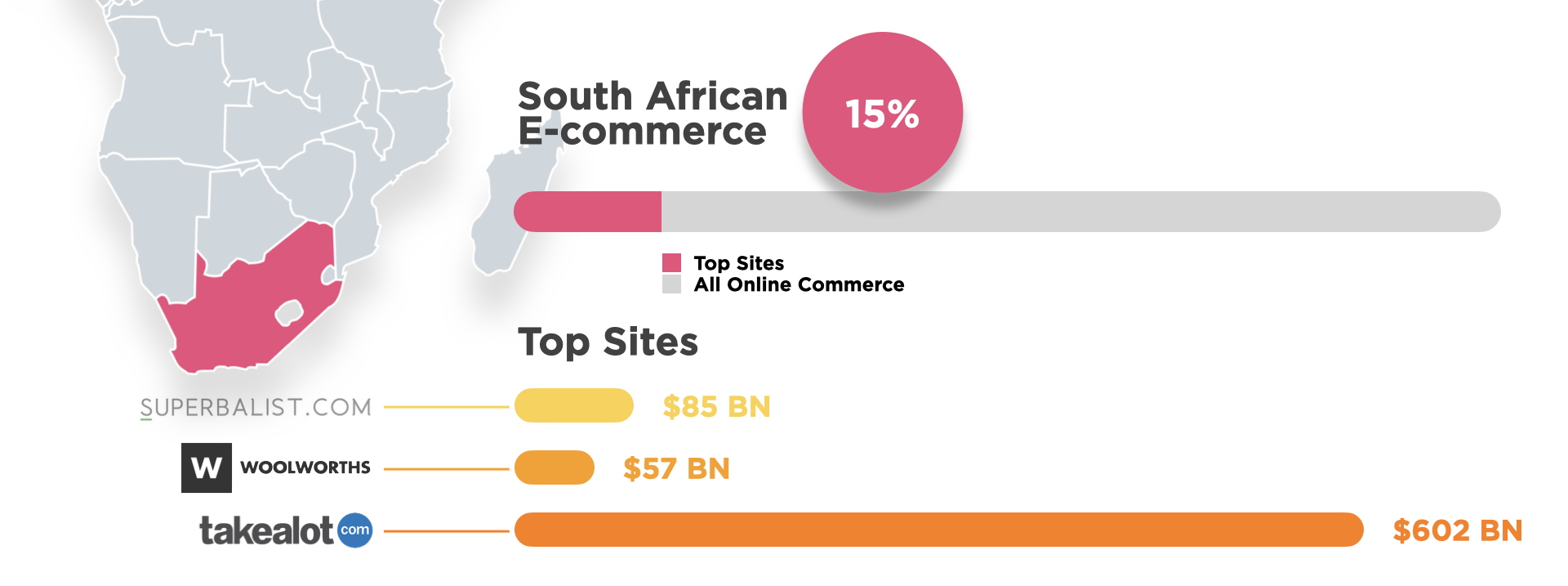
    These eCommerce stores account for 15% of online revenue in South Africa

    1. Takealot.com: Revenue US$602 million 
    2. Superbalist.com: Revenue US$85 million 
    3. Woolworths.co.za: Revenye US$57 million

    In this blog, we will discuss emerging eCommerce trends in South Africa and their impact on the various retail segments. 

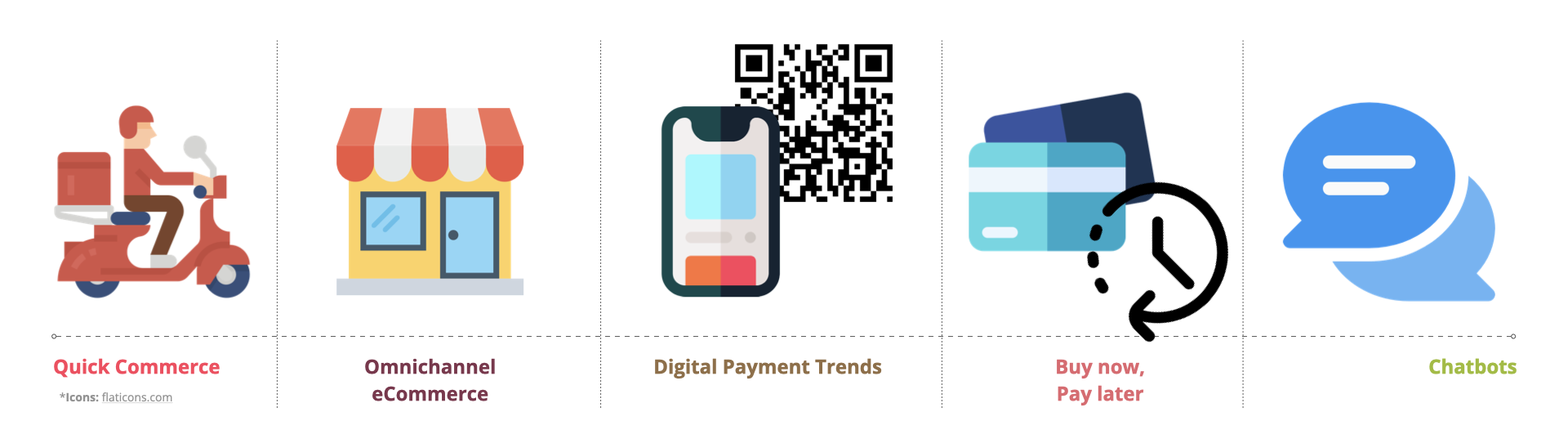
    Trends to watch in 2022

    Trends to watch
    Trends to watch

    1. Quick commerce

    Quick delivery, especially when it comes to groceries, medicines, and food has become a customer expectation now. Q-commerce, a trend that capitalizes on optimizing delivery time, has become common in food tech companies and is now gaining traction in grocery delivery too, especially after the pandemic. UberEats, Checkers, Pick ‘n Pay, and Jumia is some of the country’s biggest Q-commerce players.

    2. Omnichannel eCommerce

    Omnichannel experience has taken center stage for retailers in South Africa after the pandemic. According to Nielseniq’s study, 30% of South African consumers indicated they had shifted their shopping habits to online shopping from in-person grocery store visits between March 2021 and 2022. 

    3. Digital Payment Trends

    The digital payment ecosystem in South Africa has seen a massive growth trajectory after the pandemic. Customers seamlessly use digital payments across shopping, entertainment, groceries, food, health, and wellness – a trend we suspect is here to stay.

    4. Buy Now Pay Later

    Buy now pay later is an interest-free mode of payment that is popular worldwide for helping customers who cannot make high-value purchases. Consumers don’t have to pay any price upfront and pay off the amount in interest-free installments over a predefined period. The BNPL is forecasted to account for 13.6% of global eCommerce payments by 2024.

    5. Chatbots

    Quick response to customer queries and problems is instrumental in increasing conversion rate and sales. However, it can be difficult to respond to emails and instant chat 24/7 for small businesses. This is where automated chatbots are helping South African retailers answer customer questions promptly and correctly.

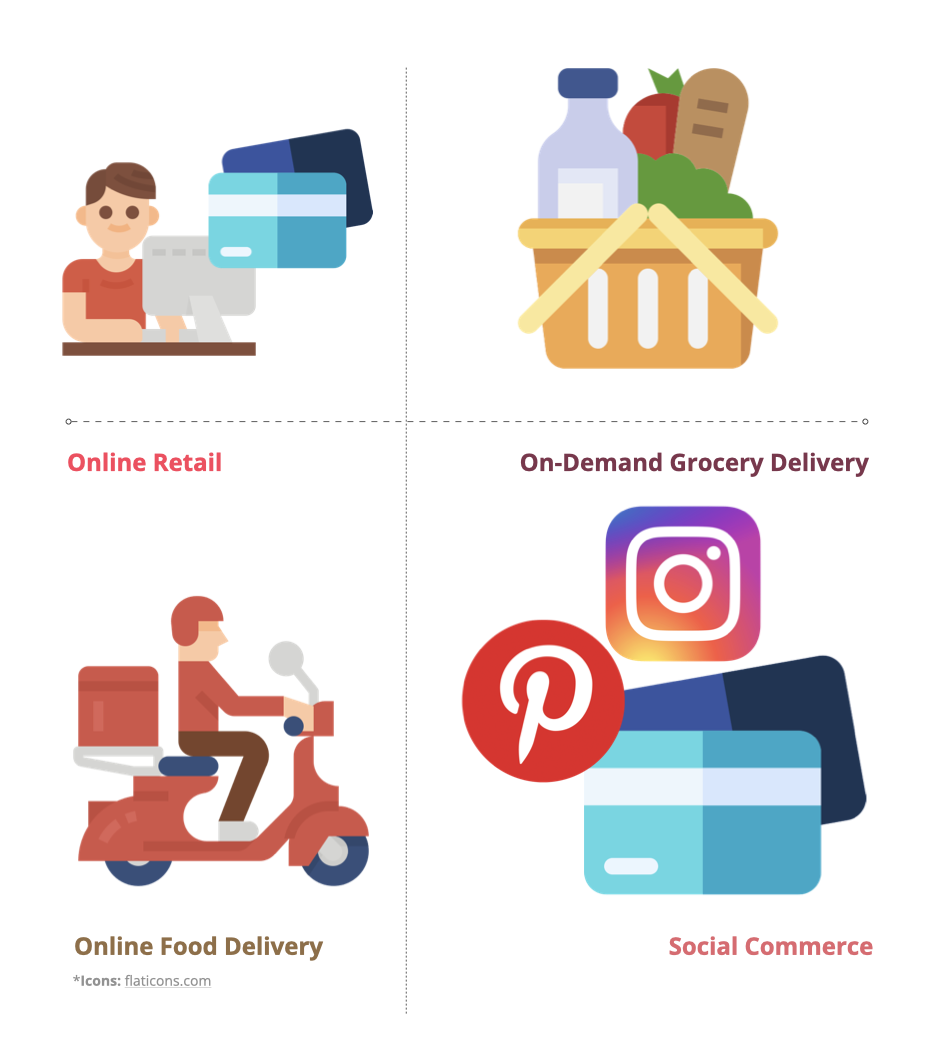
    The 4 Fastest-Growing Retail Segments

    4 Fastest-Growing Retail Segments
    4 Fastest-Growing Retail Segments

    1. Online Retail

    eCommerce & online retail grew 20% YOY after the pandemic. Retailers saw a huge increase in the adoption of online shopping by consumers. Traditional brick-and-mortar stores looked for omnichannel opportunities to keep up with online retailers. Mr. Price, a clothing retailer in South Africa, saw a surge in online sales by a massive 90% between April and June 2020. There is a similar success story where OneDayOnly, another South African online retailer, saw 40% growth during the same period.

    … but this growth surge brought in some challenges for retailers too. With more and more customers shopping online, competition increased. Price-sensitive customers would constantly compare prices across online retailers before making a purchase. It became critical for retailers to price their products right to beat the competition & win the sale, without hurting their margins! 

    2. On-Demand Grocery Delivery

    Groceries saw an increase of 54% from 2019 driven by the pandemic & lockdown restrictions.
    South African eCommerce companies offer a wide range of on-demand services, from taxi rides and grocery orders to liquor delivery. Retailers fulfill orders from stores to offer affordable rates and quick delivery across South Africa. It replicates the instant gratification of purchasing products from brick and mortar stores and the added benefits of the hyper convenience of shopping from a mobile or a computer. 

    Read quotes from our customers at Talabat, Glovo & Grab Food – we worked closely with them & helped them in their efforts to scale through this global Q-Commerce boom.

    3. Online Food Delivery

    According to Statista, revenue in the online food delivery segment in South Africa is projected to reach US$0.87bn in 2022. As competition heats up and more and more players enter the market, staying competitive is becoming increasingly challenging for food delivery businesses.

    Bolt Foods SA said they grew 50% month on month in mid-2021 and said they had to bet on making sure they were offering competitive prices in order to get ahead. Additionally, in their quest to have a stronger competitive advantage, Bolt Food says it is also offering customers a very low delivery fee, lower than Uber Eats & Mr. D since delivery costs are a major consideration for customers when using food delivery apps.

    The right price, product assortment, delivery fee, and delivery eta are critical to scaling a Food Delivery business. If you’re in the food-tech business, reach out and we can tell you how DataWeave’s Food Delivery Intelligence can help you scale quickly and profitably! 

    4. Social Commerce

    With approximately 41.19 million South African customers engaging in online activity, there is a huge shift in user behavior as customers get comfortable purchasing directly via social platforms instead of online retailers or physical stores. Social commerce uses networking websites such as Facebook, Instagram, and Twitter as vehicles to promote and sell products and services.

    What matters to South African online shoppers?

    Between June and November 2020, South African consumers mostly used online retailers monthly (42%), food delivery services weekly (36%), and online classifieds less than once a month (34%). 

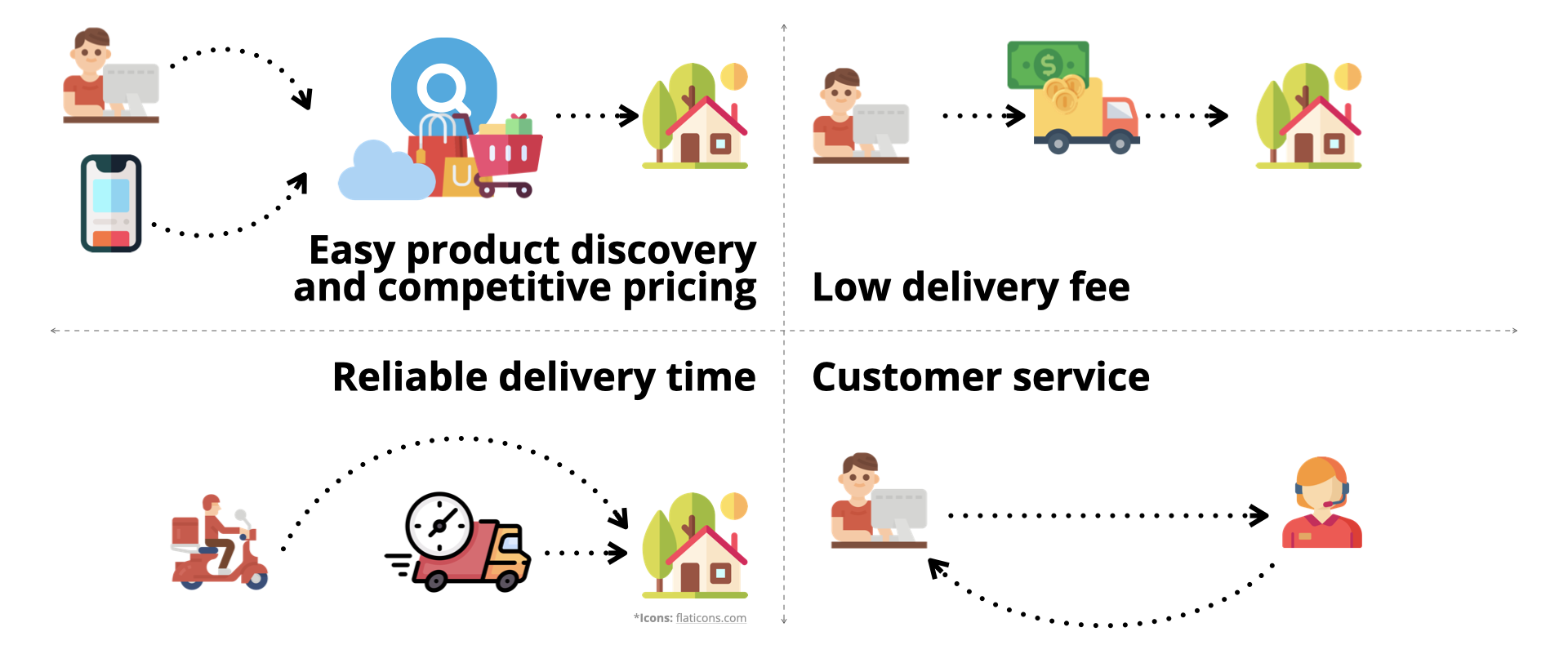
    Here is a summary of things that matter to South African shoppers when they shop online:

    1. Easy product discovery and competitive pricing

    Most customers start their online shopping with a product in mind and look for discounts and sales across retailers. More than 67% of respondents of a survey have said that they go to a specific online store and search for the product they want. Almost the same share of consumers said they compare online stores to find offers for products they want. Price plays an important part in product selection. 

    In order to offer the most competitive pricing, retailers in South Africa need to keep a keen eye on competitor pricing. They need to identify gaps and opportunities to make price changes to not only offer the most attractive price to customers but also drive more revenue and margins by pricing products right.

    2. Reliable Delivery time

    81% of South African consumers say that unreliable delivery time is one of the reasons that affect their choice of an online store. Quick delivery time has become a differentiator in the eCommerce space, where ‘next day delivery or even ‘same-day delivery’ have become the norm. South African online shoppers want reliable delivery times that suit their busy schedules. 

    Read more here, about how DataWeave helped an America QSR understand the correlation between their delivery time & sales volumes! 

    3. Low delivery fee

    86% of South African customers believe that high delivery fees impact their online stores’ choices. The high delivery cost is a problem for low-income customers and customers who shop daily.
    If you want to track how your delivery fee compares to your competition and how it’s impacting your sales, our Food Delivery Intelligence solutions are for you!

    4. Customer Service

    Your company’s customer service should be responsive, smooth, omnichannel, and hassle-free. 78% of South African customers are frustrated with delays in customer support from online retailers. Slow response times and lack of communication in case of delays, delivery, and refunds hamper the customer experience drastically.

    Customer Service
    Customer Service

    Conclusion

    eCommerce in South Africa is growing at unprecedented rates. There has been a surge in the appetite of South Africans for online shopping and online retailers across the board are gearing up to meet this demand. 

    If you’re an online retailer in South Africa & need insights on staying competitive with the right pricing, product assortment, delivery time, delivery rates, and the other key influencers that affect customers’ choice of online retailers, sign up for a demo with our team at DataWeave to know how can help!  

  • Share of Keyword Search Cinco de Mayo 2022

    Share of Keyword Search Cinco de Mayo 2022

    As inflation continues to hike costs for consumers and supply chains challenge them to maintain loyalty, there is still an active audience willing to pay the ultimate price for the convenience of food and alcohol delivery. That being said, we analyzed 8 popular Retail and Delivery Intermediary websites and 11 popular ‘Cinco de Mayo’ keywords to see which Brands are predicted to win the battle of Digital Shelf Share of Search this holiday.

    2022 Cinco de Mayo Share of Search Insights - Top Brands for 'Cinco de Mayo'
    2022 Cinco de Mayo Share of Search Insights – Top Brands for ‘Cinco de Mayo’

    Opportunities for Food & Bev on Cinco de Mayo

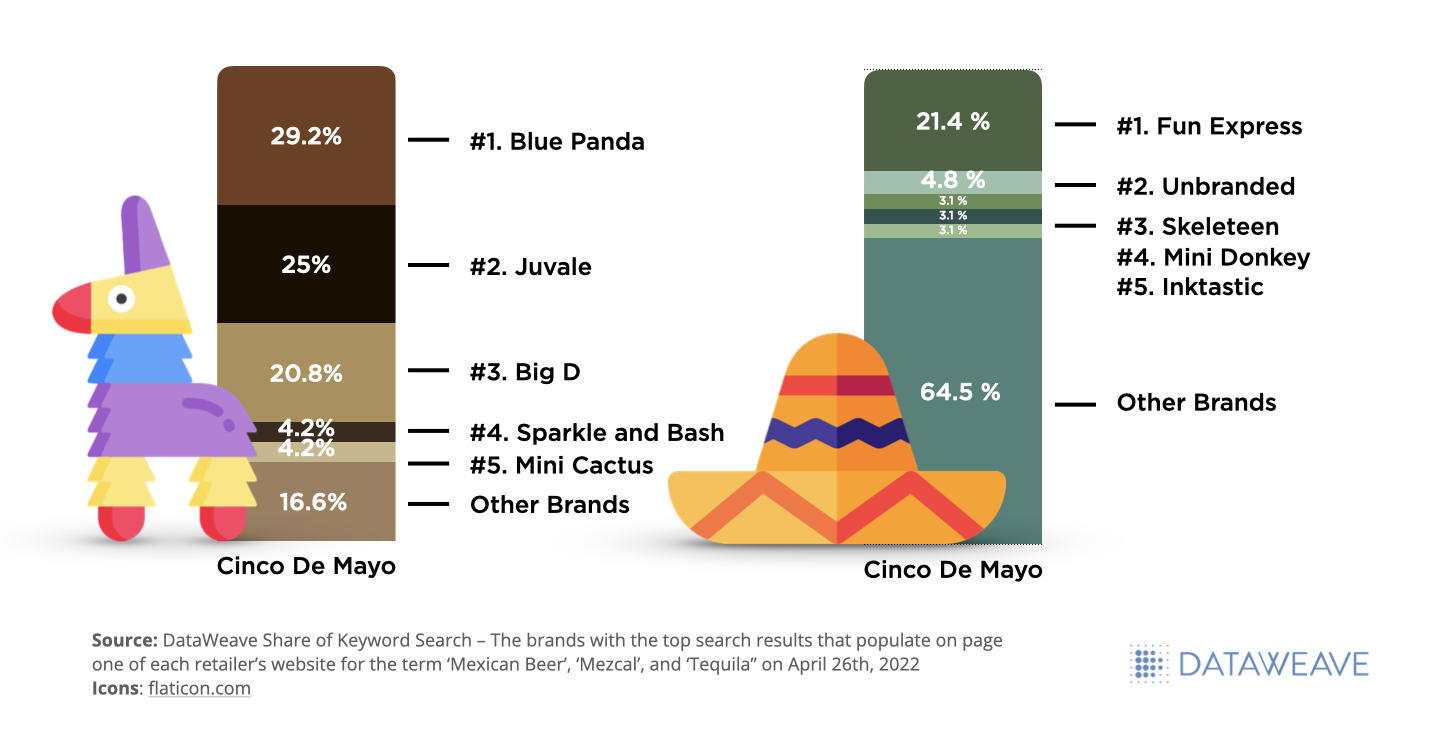
    While most of our analysis focused on popular Cinco de Mayo food and beverage products, none of these brands populated on either Target (pictured on left below) or Walmart (pictured on right below) page 1 search results for the term ‘Cinco de Mayo’. Keyword search results for this term are dominated primarily by décor brands as indicated below.

    Brands Achieving Top Share of Search for Food and Beverage Categories on Cinco de Mayo 2022
    Brands Achieving Top Share of Search for Food and Beverage Categories on Cinco de Mayo 2022

    Share of Keyword Search Results – Alcohol Category

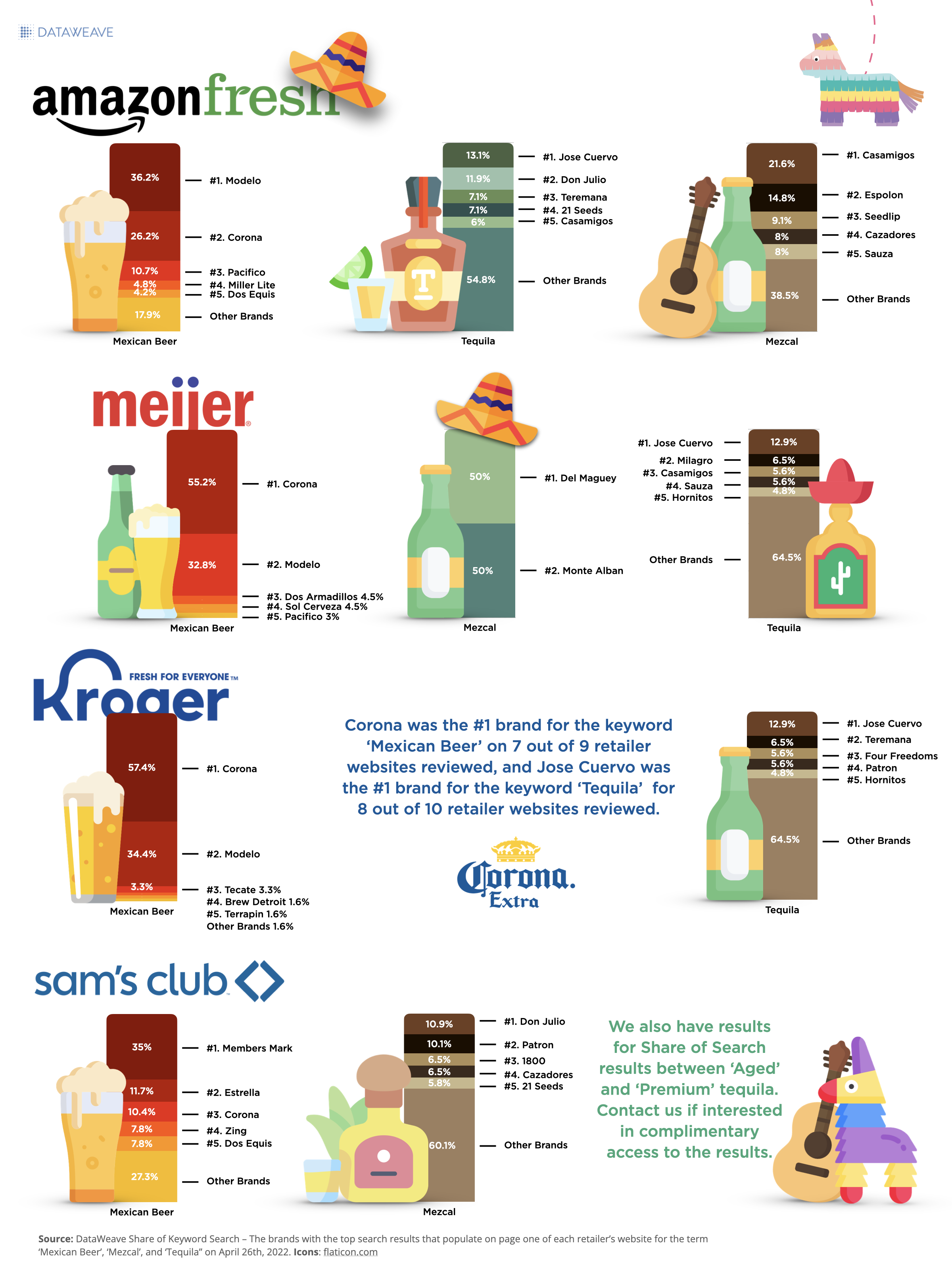
    Three of the most popular alcohol types sought out during Cinco de Mayo are ‘Mexican Beer’, ‘Mezcal’, and ‘Tequila’. Below are the brands dominating Share of Keyword Search results on each of the major retail websites we researched.

    AmazonFresh, Meijer, Kroger, and Sam's Club Share of Search - Beer, Mezcal, and Tequila Keywords on Cinco de Mayo 2022
    AmazonFresh, Meijer, Kroger, and Sam’s Club Share of Search – Beer, Mezcal, and Tequila Keywords on Cinco de Mayo 2022

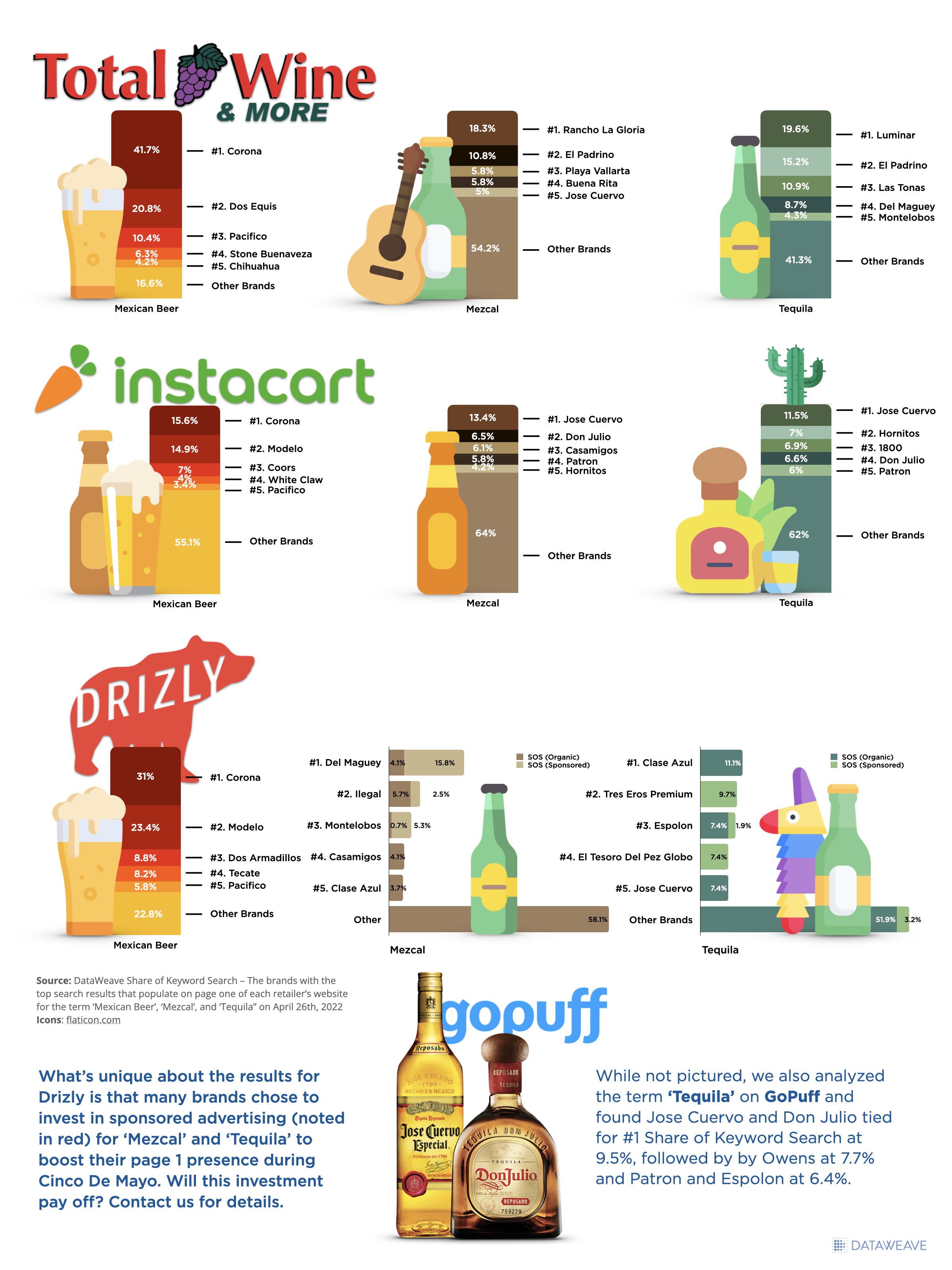
    We also reviewed the same keyword performance across popular delivery intermediaries to see how Share of Keyword Search altered for ‘Mexican Beer’, ‘Mezcal’, and ‘Tequila’. The results are below for TotalWine, Instacart, Drizly and GoPuff:

    TotalWine, Instacart, Drizly, and GoPuff of Search - Beer, Mezcal, and Tequila Keywords on Cinco de Mayo 2022
    TotalWine, Instacart, Drizly, and GoPuff of Search – Beer, Mezcal, and Tequila Keywords on Cinco de Mayo 2022

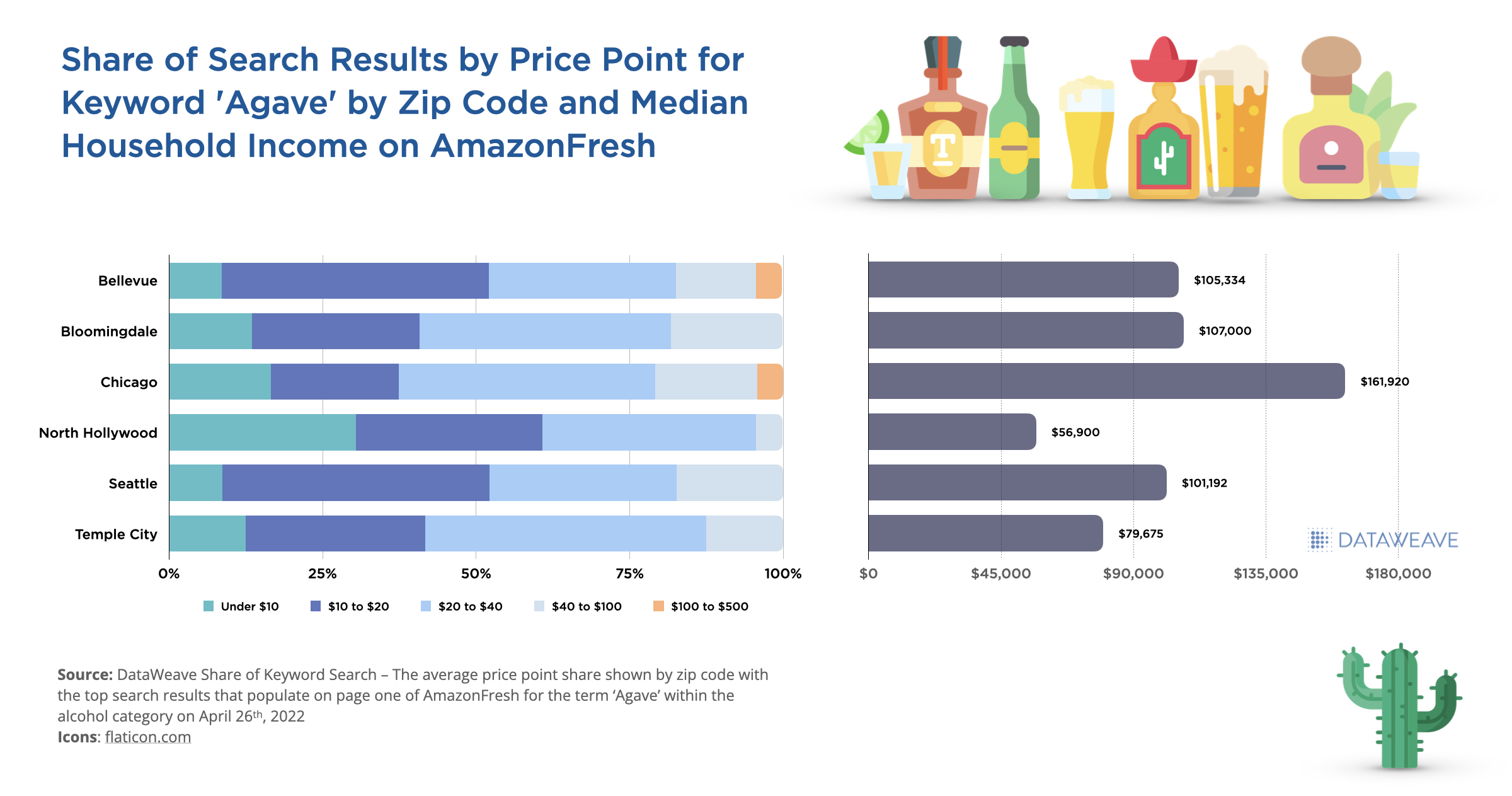
    The keyword ‘Agave’ is also a popular search term within the alcohol category during the time leading up to Cinco de Mayo. We reviewed keyword search performance at various zip codes to see how price points that populated on page 1 search results varied given the change in median income. Below are the results:

    Share of Search for Alcohol by Price Point and Zip Code on AmazonFresh
    Share of Search for Alcohol by Price Point and Zip Code on AmazonFresh

    Share of Keyword Search Results – Grocery Categories

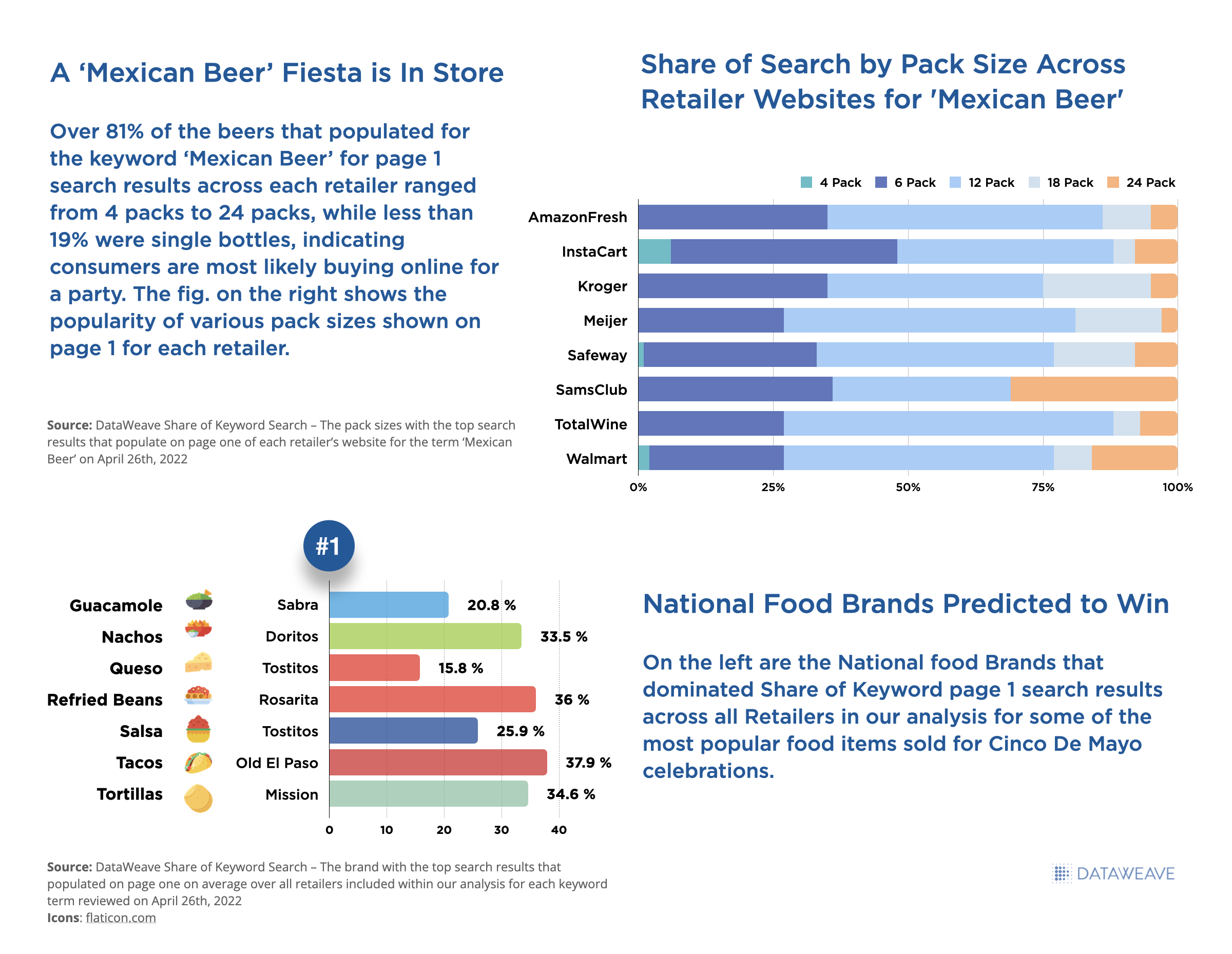
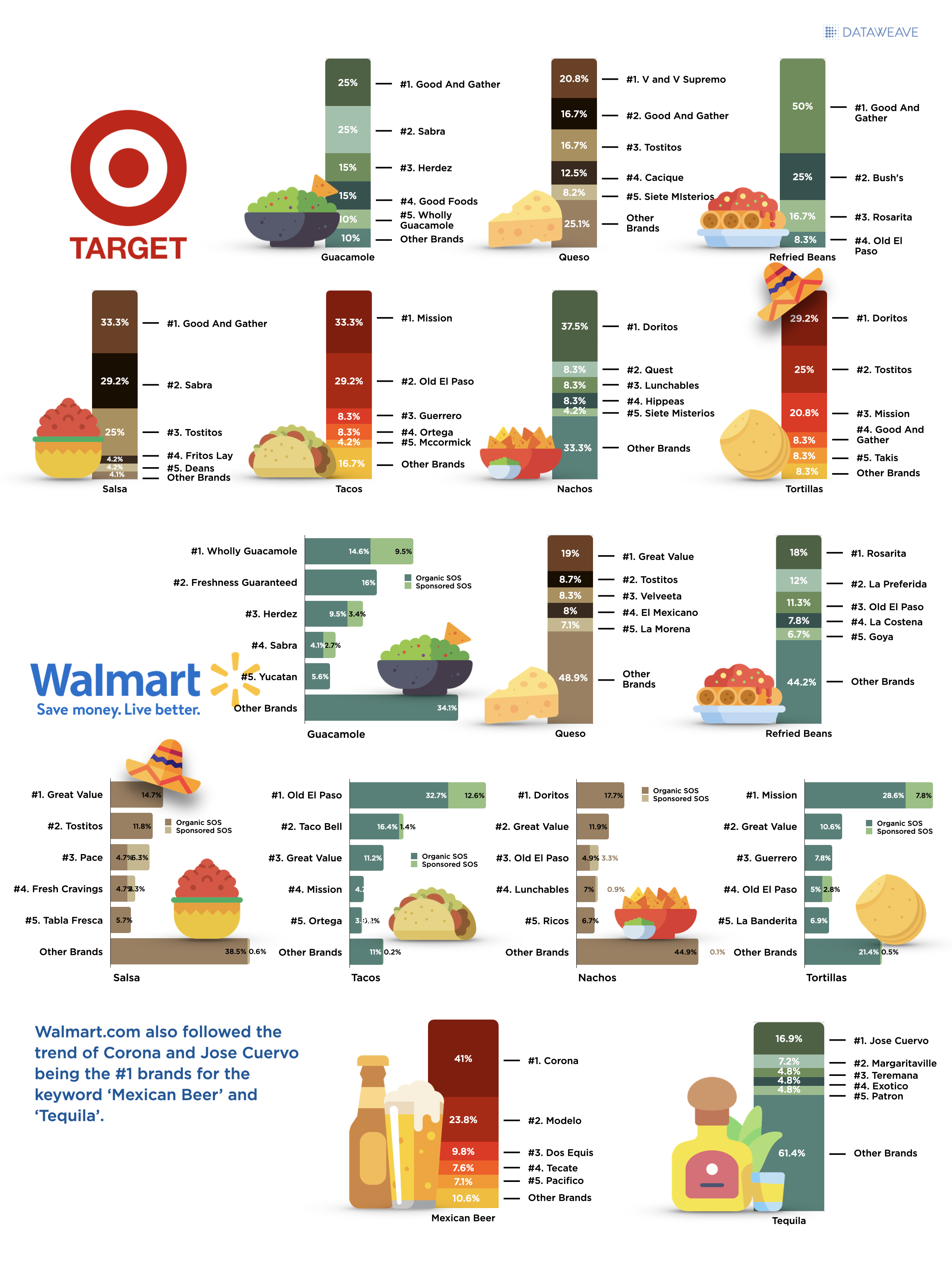
    We also reviewed some of the most popular grocery items purchased during Cinco de Mayo by Keyword Share of Search results to see which brands are primed to win the Digital Shelf this year. Below are the results for Target.com and Walmart.com.

    Walmart and Target Share of Search - Food and Beverage Keywords on Cinco de Mayo 2022
    Walmart and Target Share of Search – Food and Beverage Keywords on Cinco de Mayo 2022

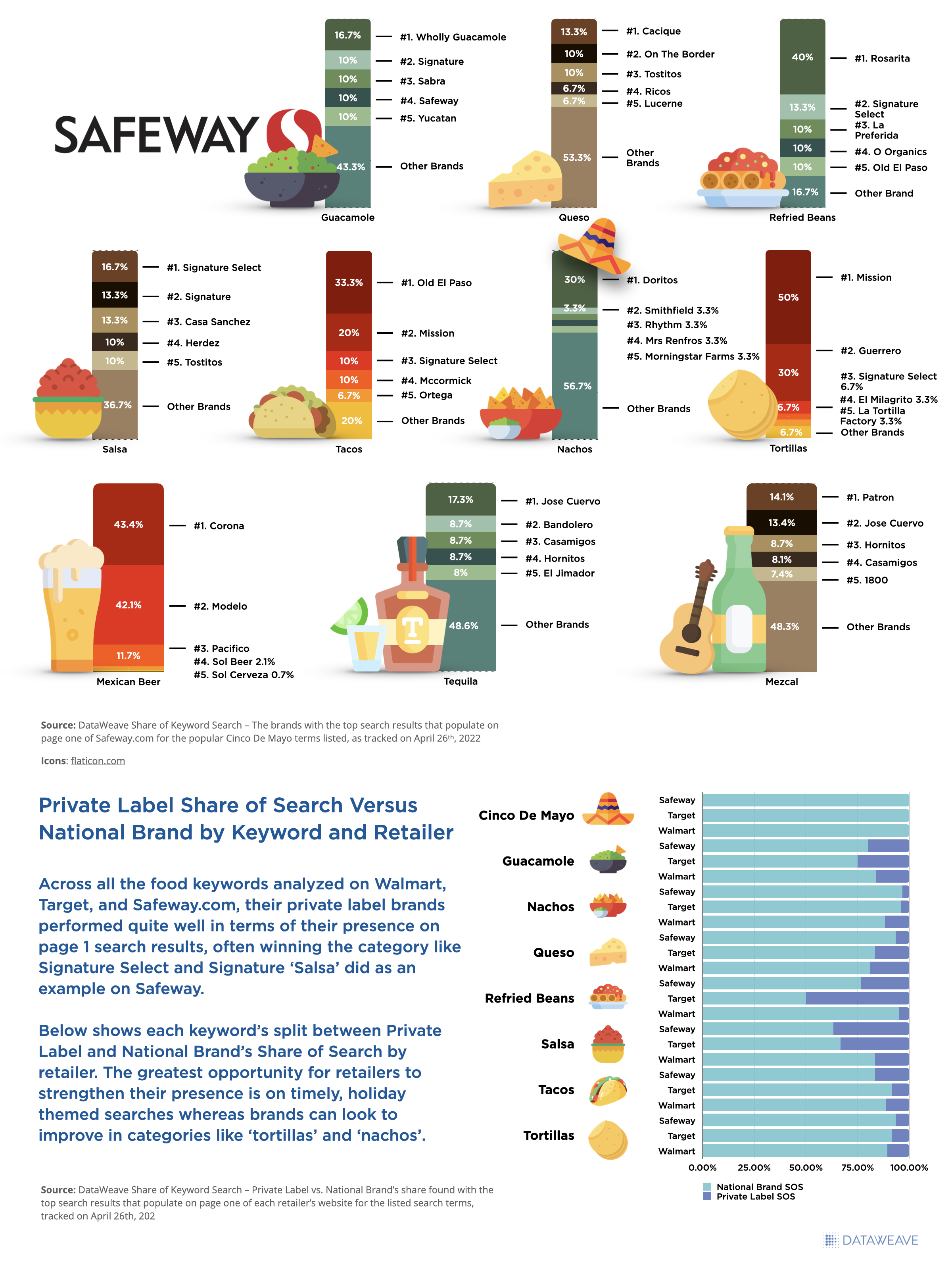
    Below are the results for the same popular grocery items and alcohol keywords related to Cinco de Mayo and the page 1 results seen for Brand Share of Search on Safeway.com.

    Safeway Share of Search - Food and Beverage Keywords on Cinco de Mayo 2022
    Safeway Share of Search – Food and Beverage Keywords on Cinco de Mayo 2022

    Access to these types of real-time digital marketplace insights can enable retailers and brands to make strategic decisions and help drive profitable growth in an intensifying competitive environment. Be sure to reach out to our Retail Analytics experts for access to more details regarding the above analysis, and let us know what other holiday insights you’d be interested in seeing this year. Happy Cinco de Mayo!

  • eCommerce Performance Analytics for CPG Private Label

    eCommerce Performance Analytics for CPG Private Label

    The combination of economic uncertainty, inflation, and perceived affordability has increased consumer’s willingness to buy and try more private label products, challenging National brands to differentiate their eCommerce strategies, especially those related to price positioning, in other ways.

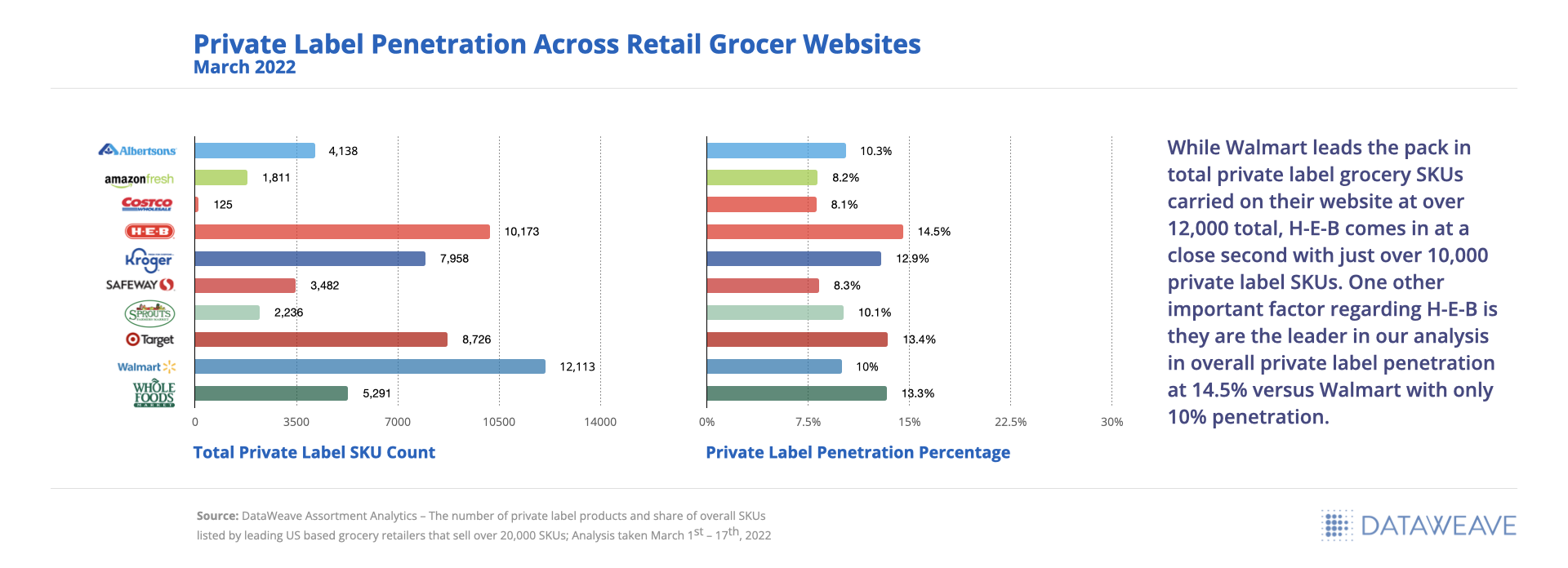
    Our previously released report, Inflation Accelerates Private Label Share and Penetration, confirmed 8 out of 10 brands with the highest SKU count carried across all grocery retailer websites to be private label, signaling the strength of their digital Share of Voice. Given the growing shift in consumer preference toward private label brands, we are providing access to the latest trends seen from September 2021 through March 2022. Below you will find a summary of what the data revealed about the growing presence of private label brands on the Digital Shelf.

    Private Label Account and Category Penetration

    We analyzed private label penetration at an account level to understand which private label brands have the greatest presence on retailer digital shelves, and to see which retailers may be leaving product assortment opportunities on the table.

    Private Label Penetration Across Retail Grocer Websites

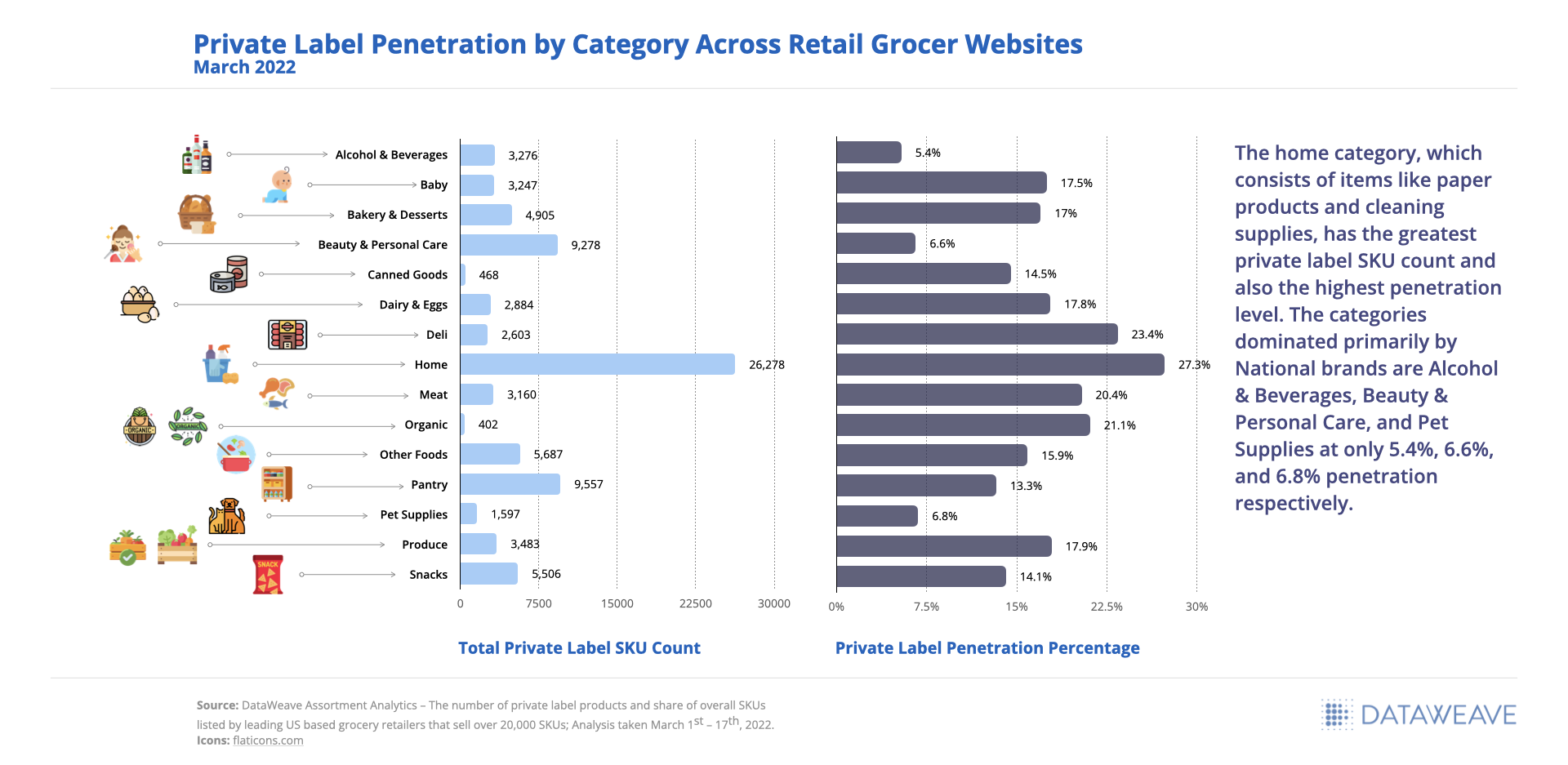
    As a retailer, it is important to understand how your private label penetration stacks up against the industry average at a category level, especially given the performance tracked for retailers included within our analysis and the vast number of SKUs they offer online (over 20,000).

    Private Label Penetration by Category Across Retail Grocer Websites

    The Private Label and National Brand Price Gap Widens

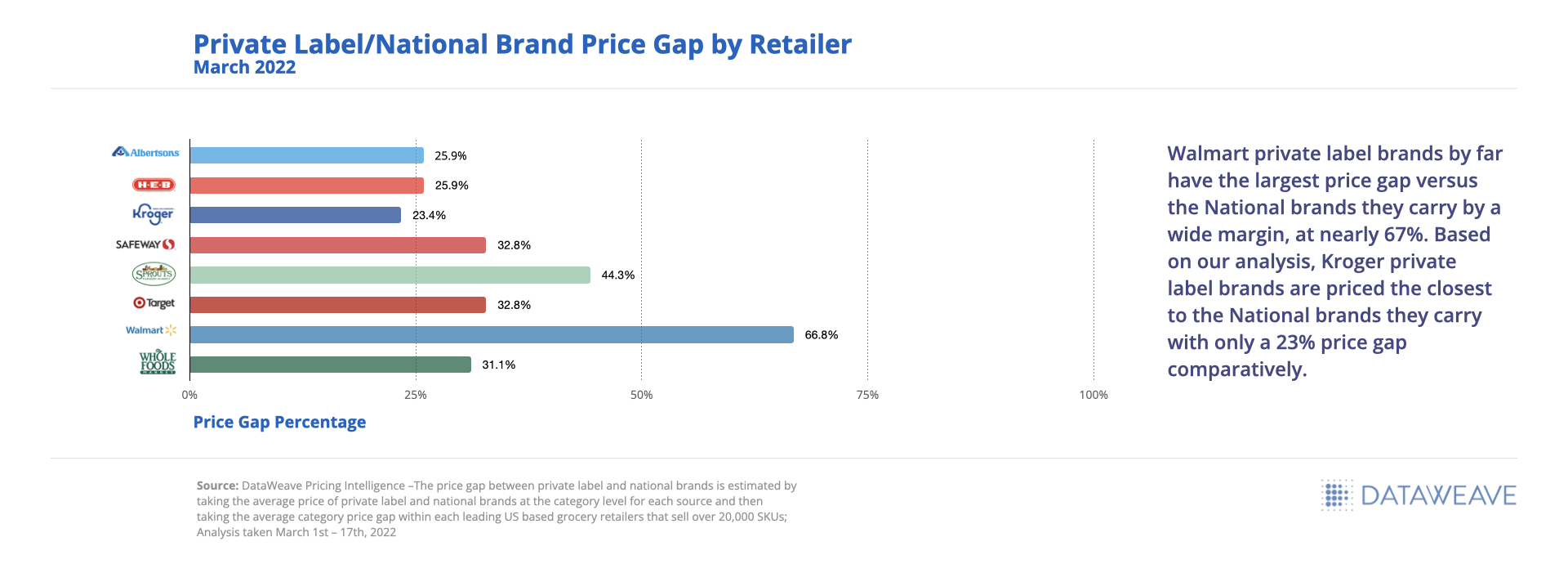
    Private label brands tried out of necessity mid-pandemic increased in popularity as grocery prices continued to rise, providing an opportunity for retailers to increase brand affinity and loyalty for their online shoppers. Retailers alike were able to keep affordability at the forefront of their strategies and maintain a price gap of 23% or more, despite inflationary pressures to increase prices.

    Private Label / National Brand Price Gap by Retailer

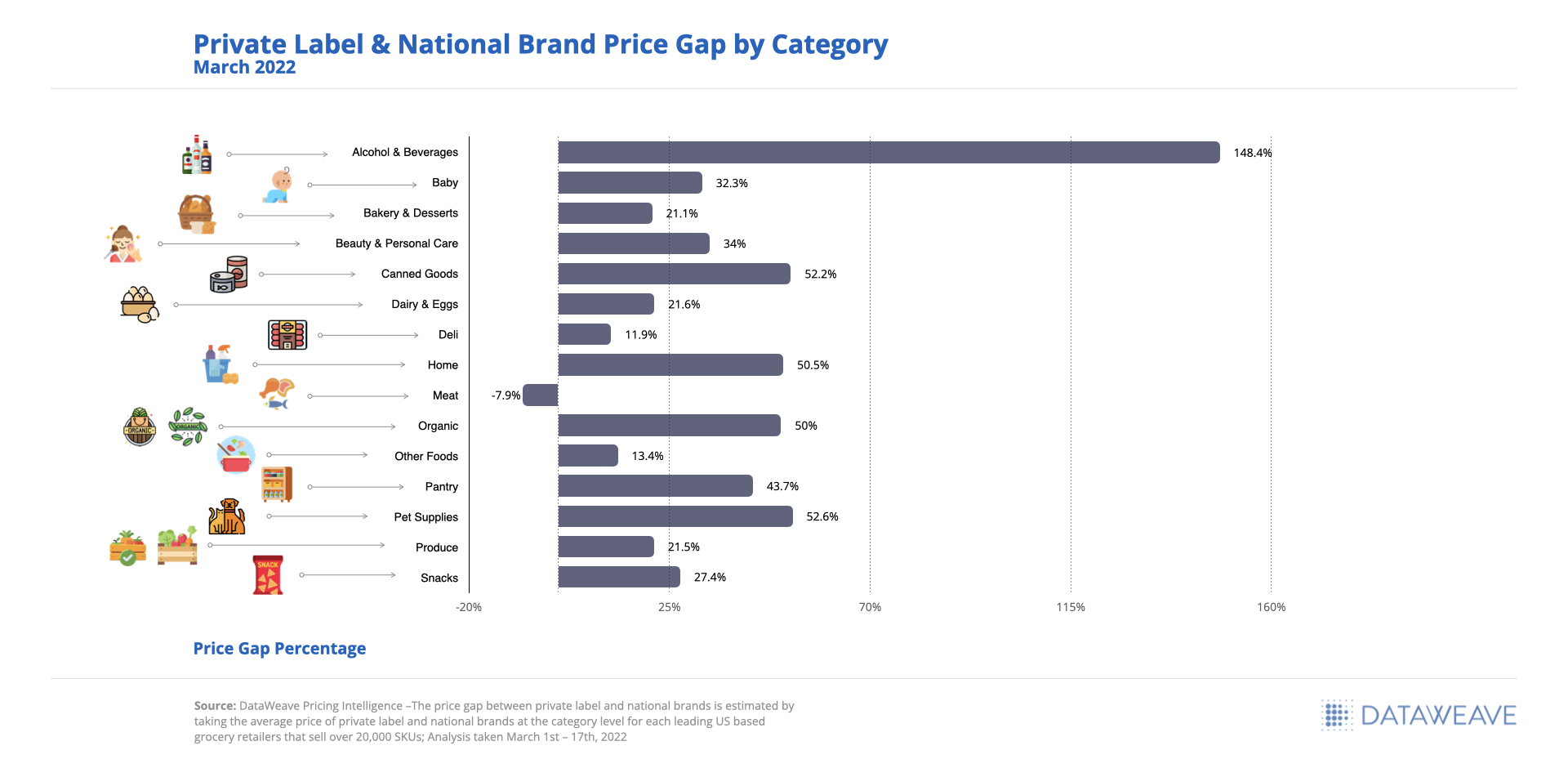
    Looking at the results at a category level, we can see that Meat is the only category found within our analysis where private label brands are priced higher than National brands at an average of 8% greater. The Alcohol & Beverages category tends to always see the greatest price gap between private label and National brands given the price variances by unit (ranging from under $10 to over $100), in this case averaging a 148% price gap.

    Private Label & National Brand Price Gap by Category

    Private Label Total Basket Value Comparison Across Retailers

    While SKU-level pricing is extremely important to product strategy, for a retailer, it is equally as important to be as mindful of the total basket value even more so now as consumers further their private label loyalty across various categories. A few SKU-level missteps in pricing decisions can exacerbate cart abandonment and negatively impact shopper loyalty in a world where prices can be compared instantly in the palm of your hand.

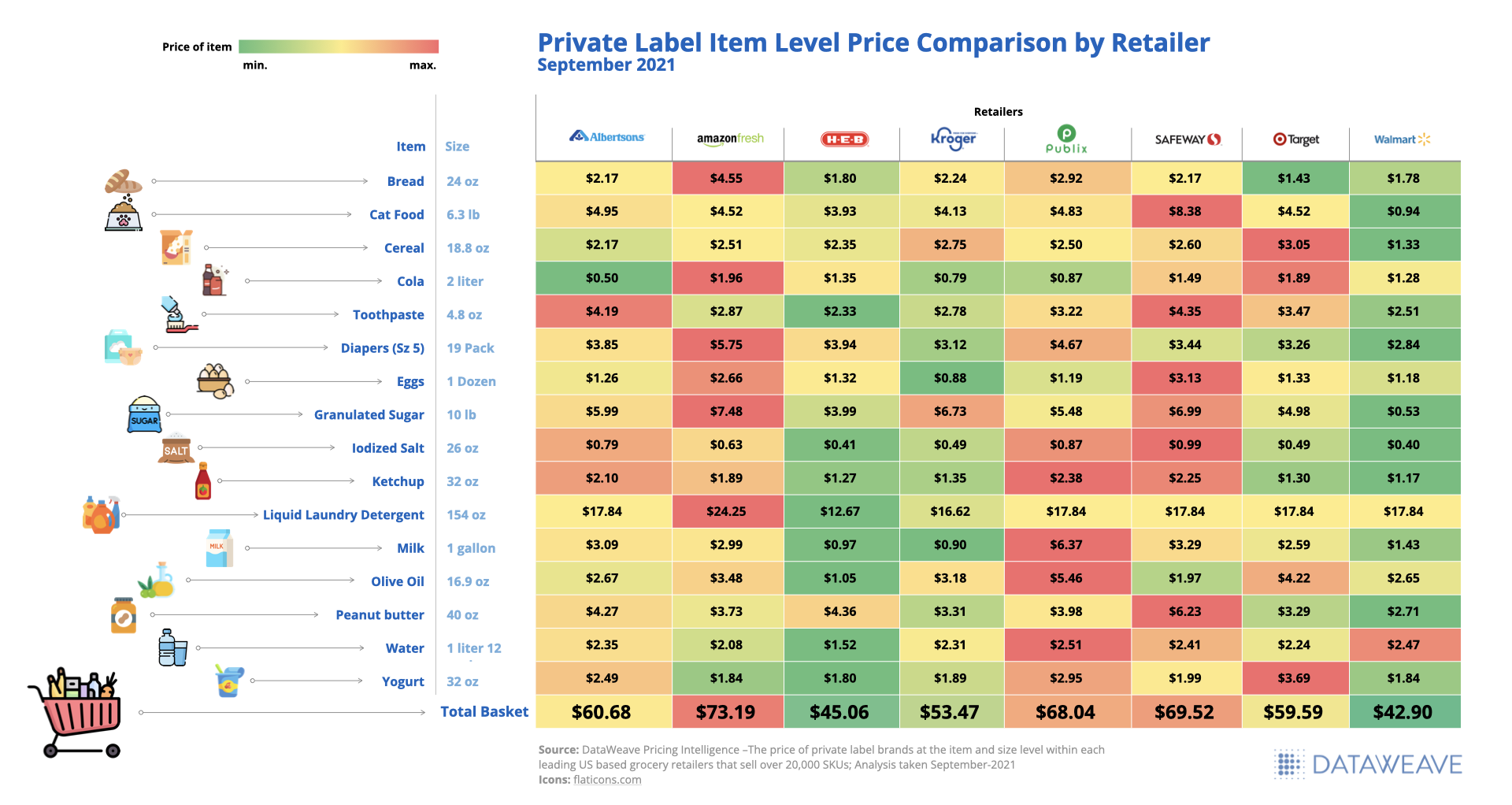
    Based on our analysis, Walmart and H-E-B private label products offered the lowest priced total basket of goods at $42.90 and $45.06 respectively, whereas AmazonFresh and Safeway offered the highest total at $73.19 and $69.52 respectively.

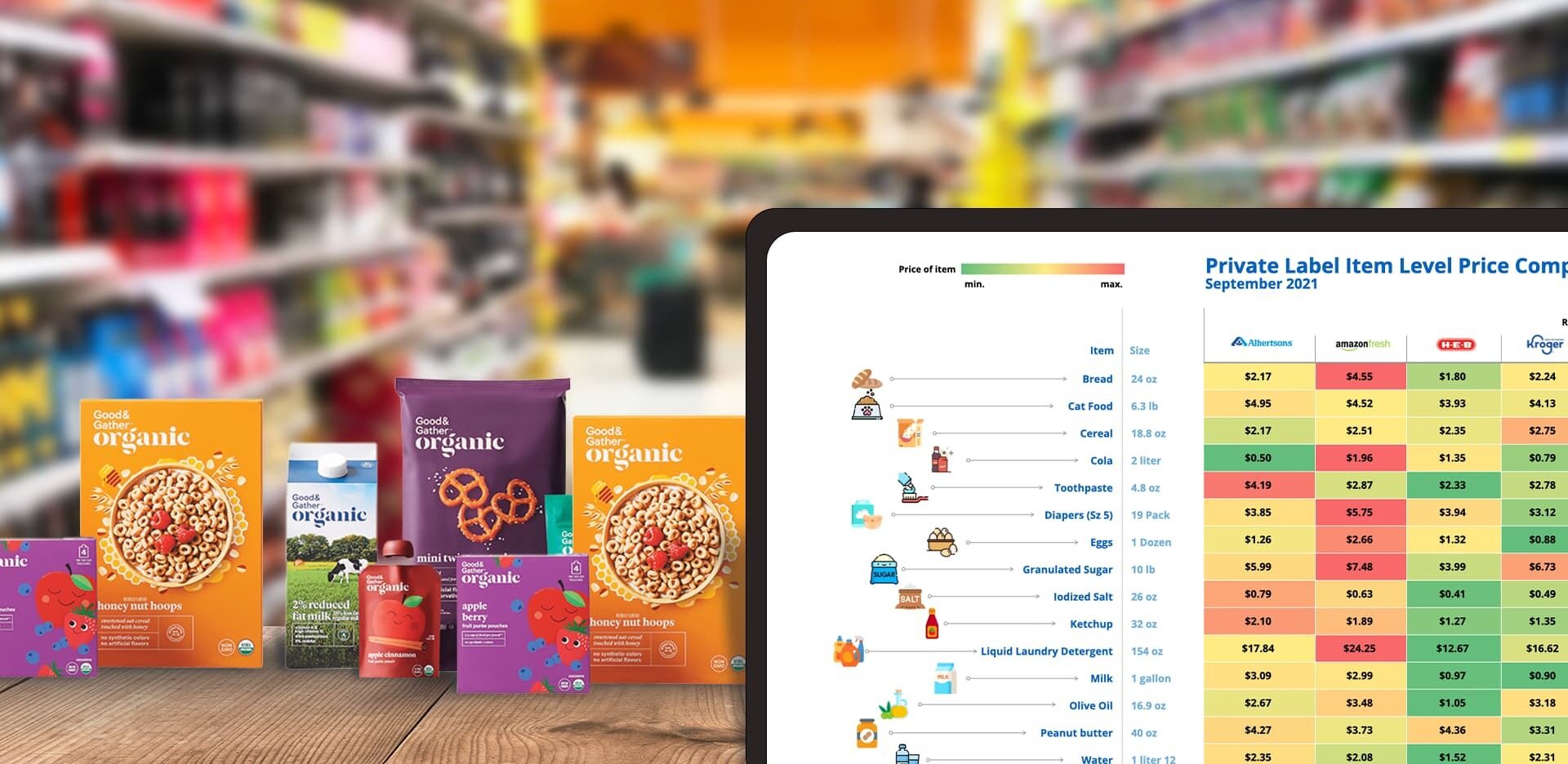
    Private Label Item Level Price Comparison by Retailer

    Inflation-driven Price Changes are on the Rise with Room to Grow

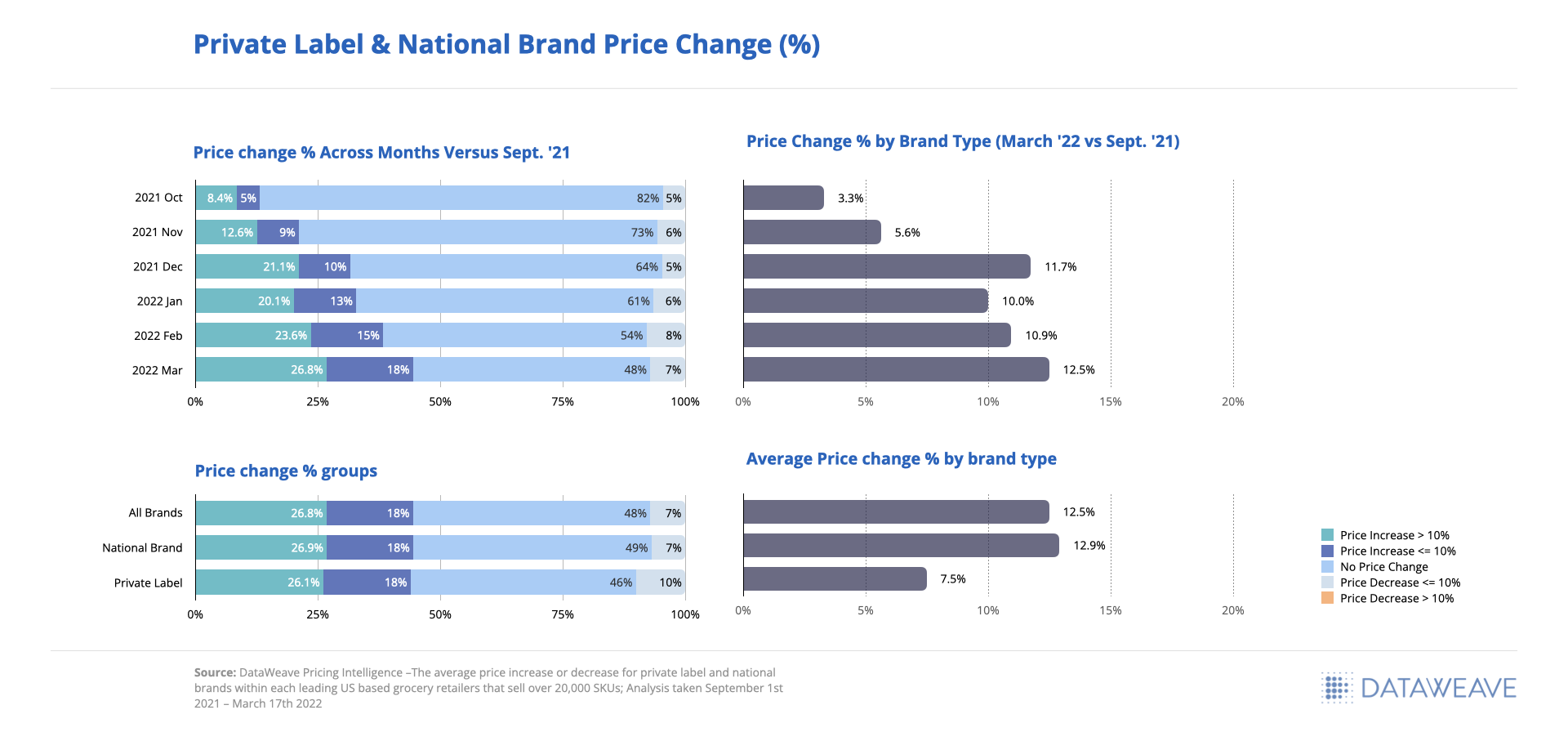
    Based on the 20,000+ SKUs analyzed, we saw a continual price increase every month since September 2021 when comparing future monthly prices to those we tracked in September. The greatest price increase happened in March 2022 at 12.5% on average, however, there are still 48% of SKUs that have yet to see a price increase even as inflationary pressures rise.

    When viewing the split between National and private label brand price increases in March 2022 versus September 2021, we saw National brands increased prices on average by 13% where private label brand prices only increased an average of 7%.

    Private Label & National Brand Price Change
    Private Label & National Brand Price Change (%)

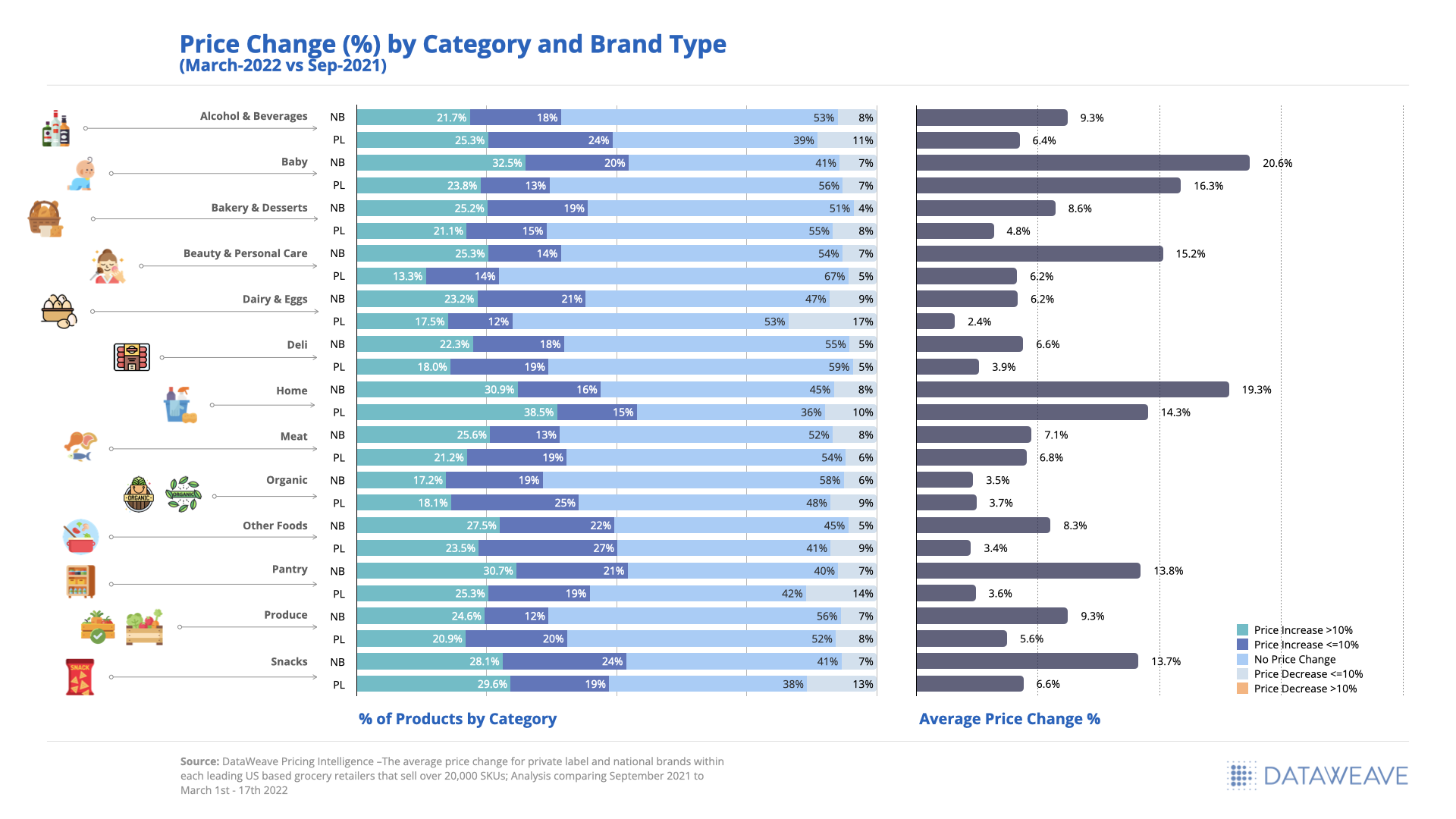
    Price decreases are still occurring across all categories, despite inflation, but to varying degrees ranging from 5% for Deli items to 17% for Dairy & Eggs. Within the Dairy & Eggs and Pantry categories, private label brands reduced prices for an additional 10% of total SKUs compared to National brands.

    The greatest category of opportunity for price increases within private label were found within Beauty & Personal Care with 67% of private label products yet to see a price change since September 2021.

    Price Change (%) by Category and Brand Type

    Private Label Price Change Correlation to Product Availability

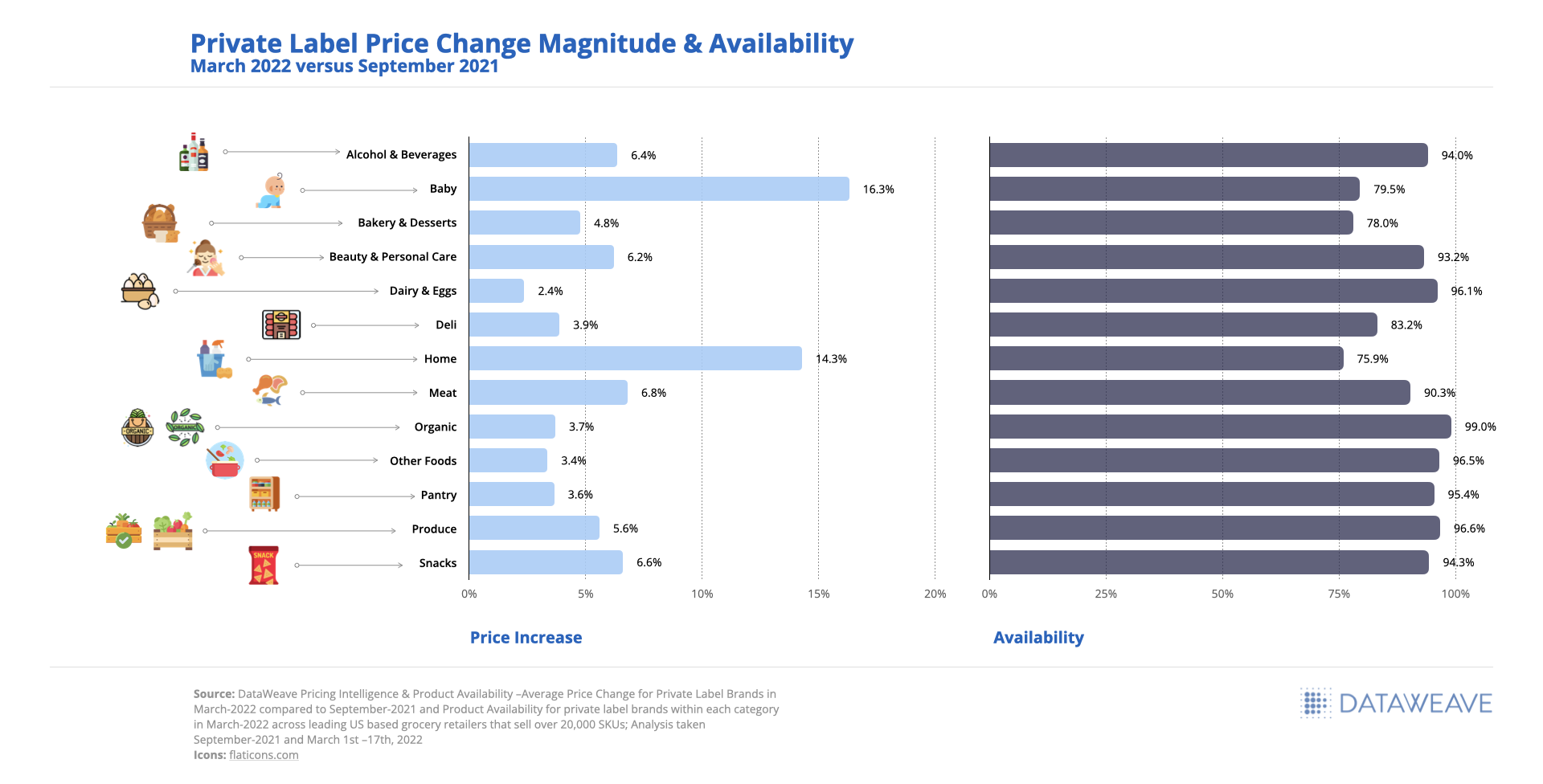
    The category with the greatest magnitude of price increase seen within private label brands occurred within Baby at 16.3% followed by Home at 14.3% on average. Private label products within Home and Baby categories were also showing the lowest availability rates, 75.9% and 79.5% respectively, indicating a high demand for these items even as prices increased.

    The private label categories with the smallest price increase on average were Dairy & Eggs at 2.4% and Other Foods and Pantry at 3.4% and 3.6%, respectively.

    Private Label Price Change Magnitude & Availability
    Private Label Price Change Magnitude & Availability

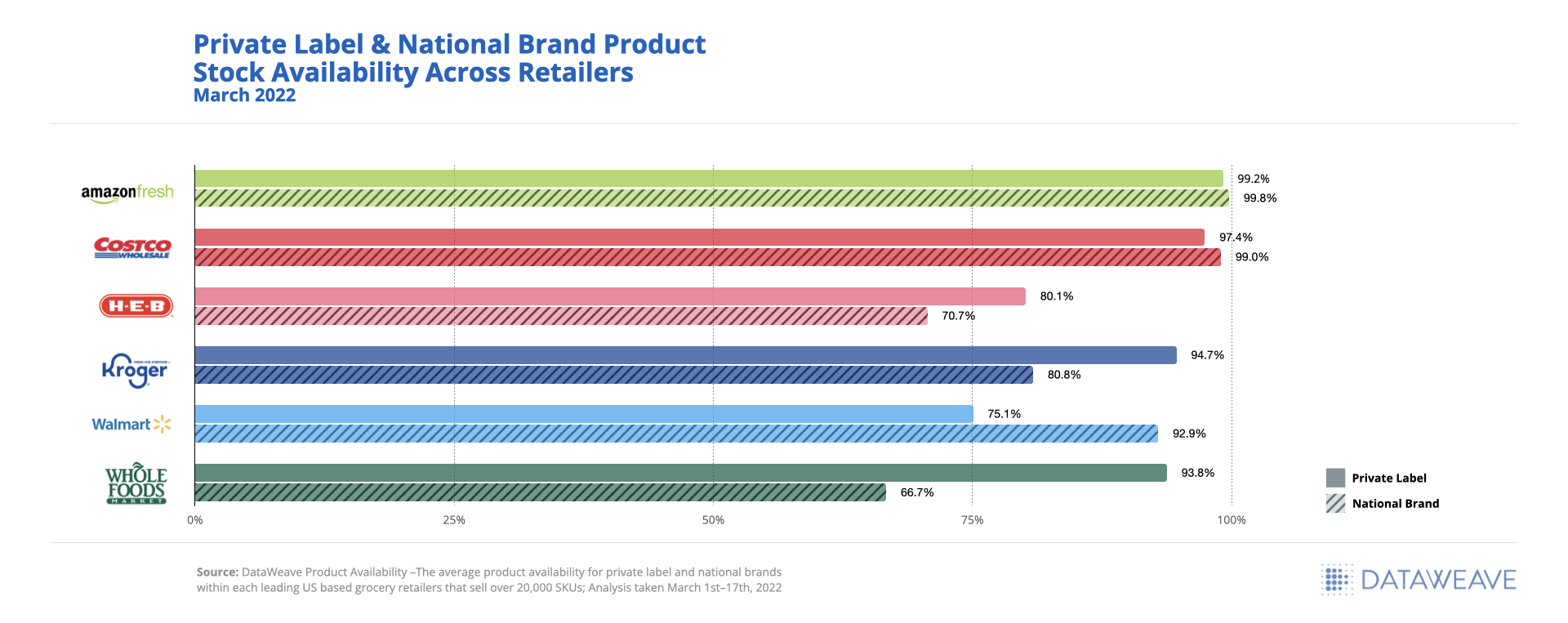
    While in many accounts both private label and National brands struggled with stock availability in March 2022, National brand availability is much lower (around 10% on average) than private label availability.

    H-E-B had the lowest overall product availability at 76% across both private label and National brands on average. Only Walmart had lower availability for Private Label at 75% compared to 93% for National brands, but they also had the greatest price gap between private label and National brands.

    Private Label & National Brand Product Stock Availability

    The Future of eCommerce Growth for Private Label

    Our greatest learning from this analysis is that it’s time for retailers to start thinking and planning more like the National brands they carry when it comes to positioning their private label brands for success. Successful retailers are taking this time to reset their private-label strategies and transfer short-term switching behavior into long-term customer loyalty.

    Retailers playing catch up have the opportunity to address some of the gaps highlighted throughout this analysis, for example, relative to pricing and assortment changes. Below are some of the highlighted opportunities:

    • Though inflation is driving price hikes, more than 50% of products analyzed have yet to see a price increase indicating an opportunity to protect margin
    • Narrowing the price gap between a store’s brand and National brands should not be the only focus as competitive private label brands are becoming a greater threat at a category and basket level
    • Modifying and expanding assortments as demand increases for private label can improve customer retention and loyalty, especially for cross-shopping consumers

    According to The Food Industry Association (FMI), only 20% of food retailers currently promote private brands on their homepages, and only 48% include detailed product descriptions indicating even more opportunities left on the table for retailers to optimize private label digital performance.

    Many leading retailers are leveraging real-time digital marketplace insights and eCommerce analytics solutions like ours to further their online brand presence and optimize sales performance. This report highlights only a small sample of the types of near real-time insights we provide our clients to effectively build competing strategies, make smarter pricing and merchandising decisions, and accomplish eCommerce growth goals. Be sure to reach out to our Retail Analytics experts for access to more details regarding the above analysis.

    For access to a previously recorded webinar presented in partnership with the Private Label Manufacturers Association and conducted by DataWeave’s President and COO, Krish Thyagarajan, click here.

  • The Rise of On-Demand Grocery Delivery after the Pandemic

    The Rise of On-Demand Grocery Delivery after the Pandemic

    Before the pandemic, the grocery industry was set around brick-and-mortar stores, and there was a slow movement towards on-demand grocery. Online grocery delivery was still considered a peripheral channel. However, grocery shoppers started turning to on-demand platforms since the onset of COVID-19. According to Acosta’s report, since the pandemic, 45% of customers prefer online grocery shopping over physical stores. 

    COVID-19 drastically accelerated the online grocery delivery trend, increasing 10% and 15% of total grocery sales during the peak COVID-19 time. In the U.S., online grocery shopping reached nearly $90 billion in sales in 2020, increasing by more than $30 billion. 

    In this article, you’ll learn about the early pioneers of online grocery delivery in the U.S., the modern players, and the impact of COVID-19 on grocery trends.

    Early pioneers of online grocery delivery

    Early pioneers of online grocery delivery
    Early pioneers of online grocery delivery

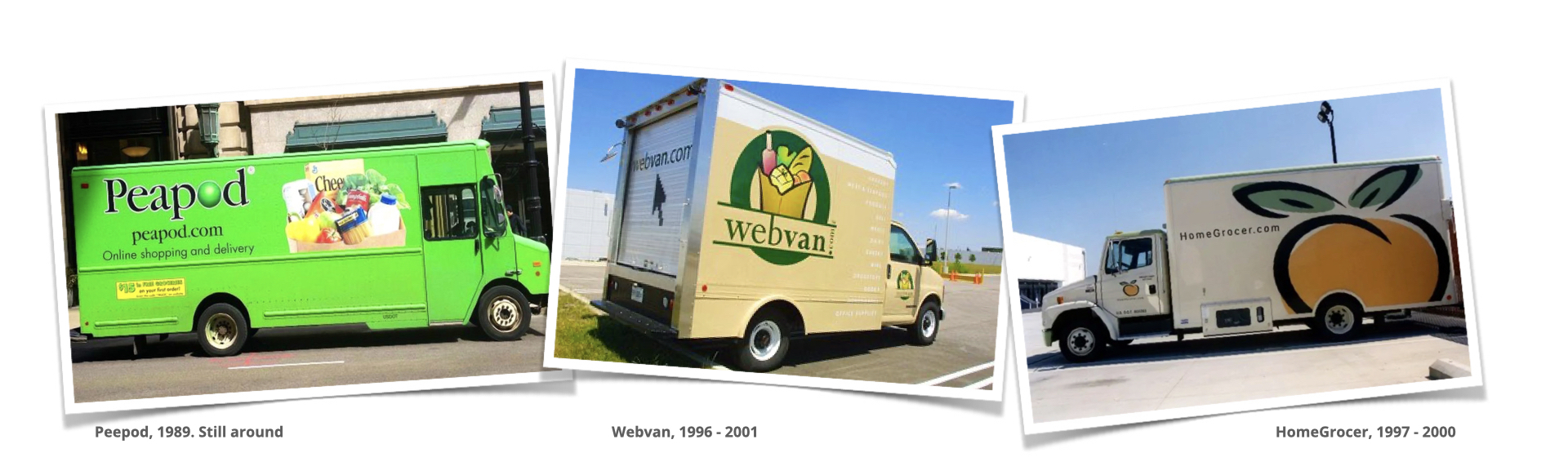
    In the late 1990s, consumers had just started ordering products online. Online grocery shopping was an early area of focus. It offered lucrative rewards to high-spending consumers, increased convenience, and saved them time. Peapod, founded in 1989 by brothers Andrew and Thomas Parkinson, was the first online grocery delivery service. Back when they started, users had to install software from CD-ROMs and then place orders. Though it took years to become a well-known name in the industry, Peapod is still in business.

    Webvan and HomeGrocer.com were two other early pioneers of online grocery delivery that started in 1996 in California and 1997 in Washington respectively. Webvan had a successful launch in California, and they had aggressive expansion plans to operate in 26 major cities around the United States. However, the company filed for bankruptcy less than two years later. HomeGrocer.com quickly created the infrastructure needed to support the business, including a fleet of vans and a huge warehouse. They had impressive early growth, and sales reached over $1 million a day by mid-2000. They expanded into other markets, including California, Georgia, Oregon, Texas, and Illinois.

    Modern players of the on-demand grocery delivery

    Modern players of the on-demand grocery delivery
    Modern players of the on-demand grocery delivery

    Online Grocery Trends Post-Pandemic

    When COVID-19 first began to engulf the world, supermarkets and grocery delivery platforms like Amazon Fresh and Instamart became overwhelmed with huge demands. To handle the surge of online orders, stores had to make drastic changes to accommodate the switch to on-demand delivery requests. Popular grocery delivery brands had to introduce waitlists and online queues for new customers. According to a poll, 53% of shoppers would continue online grocery shopping because they had a good experience, indicating that the on-demand grocery trend will continue post-pandemic. 

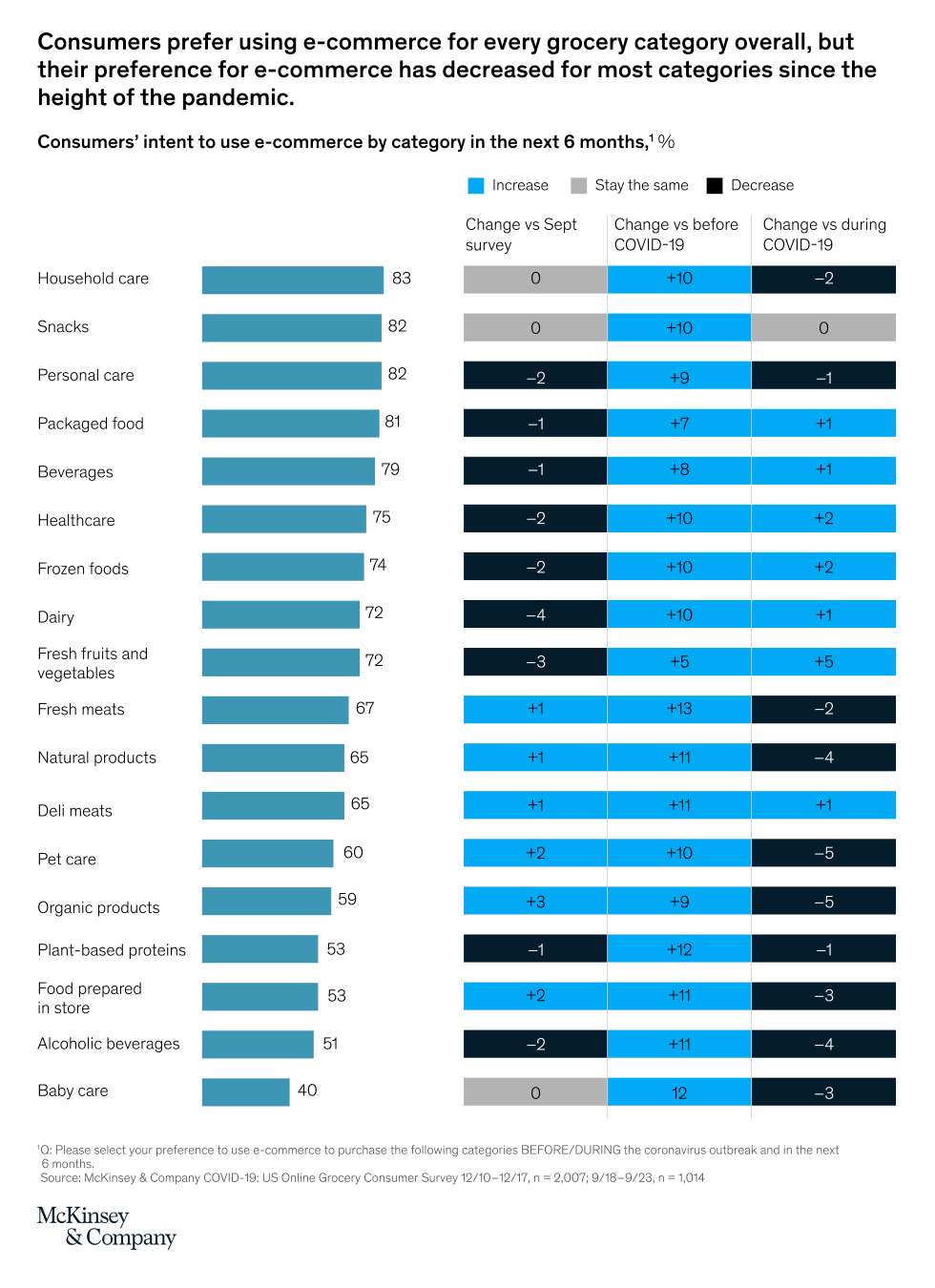
    mckinsey grocery report
    Mckinsey Grocery Report

    As shoppers prefer more digital channels in their path to purchase, the on-demand grocery trend is becoming much more significant for both consumers and brands. According to a McKinsey and company survey, frozen fruits, health care items, fresh fruits and vegetables, packaged foods, household care items, beverages, and deli meats categories are likely to remain popular among U.S. consumers post-pandemic. Meanwhile, CoreSight Research found that fresh fruits and vegetables were the biggest bestsellers from 2020-to 2021 followed by fresh dairy, meat, eggs, frozen food, and bread and baked goods. 

    Why Grocery Shoppers are going digital

    Online ordering offers a more personalized experience to shoppers as they get recommendations for products that are often bought together. When paired with data analysis and AI-powered algorithms, grocery stores could work on targeted marketing and offer quick delivery services. 

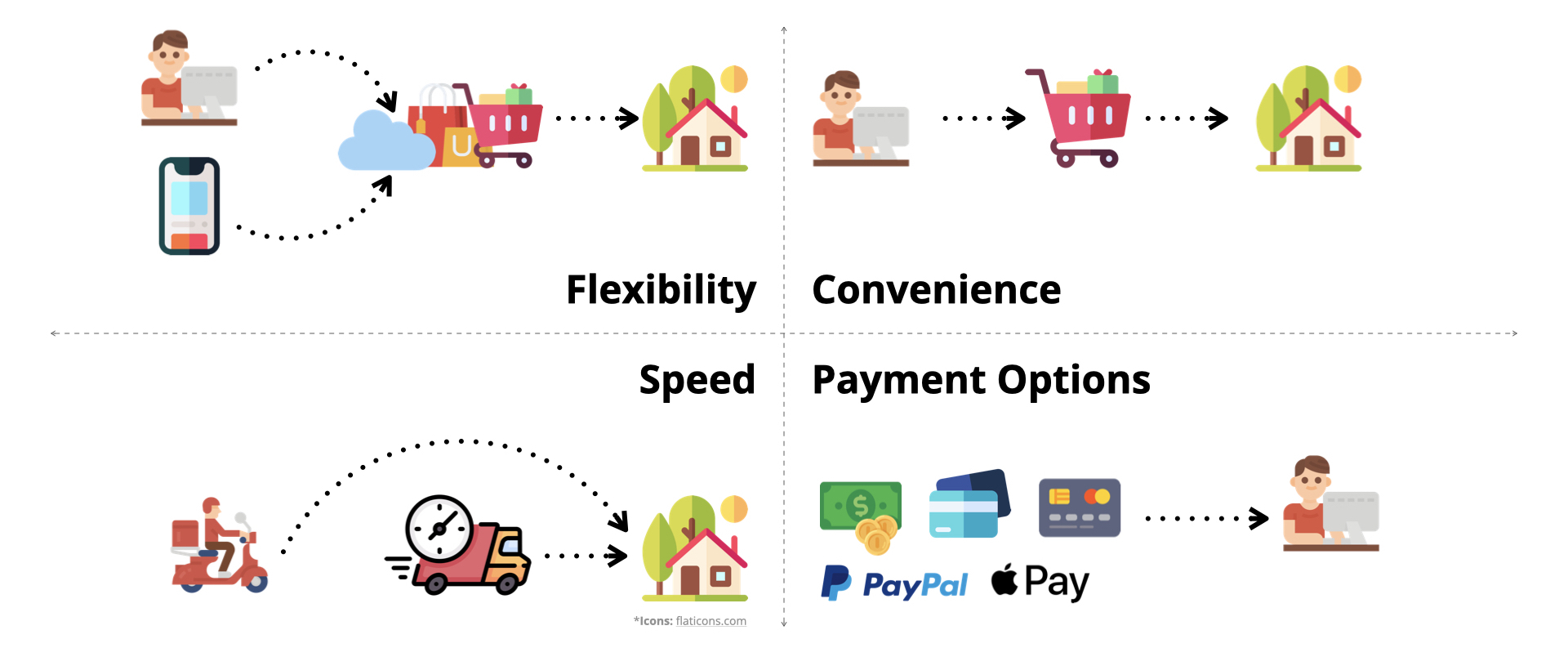
    1. Flexibility

    On-demand grocery shopping offers customers a wide range of delivery options, including subscription services, buy online pick up in-store, click and collect, option-based pricing, and much more. This offers choice and accessibility to modern customers looking for speed and convenience.

    2. Convenience

    With the increasing focus on social distancing and safety, shoppers started to rely on delivery services rather than waiting in long queues and risking exposure. The focus and priority of grocery shoppers shifted from discounts and pricing to convenience, speed, and safety. Online grocery shopping order methods also differ by generation. 40% of millennials prefer to shop groceries on mobile, and 52% prefer computers. Similarly, 66% of Gen X prefer to shop on computers, and only 27% prefer to shop on smartphones. 

    Grocery Shoppers are going digital
    Grocery Shoppers are going digital

    3. Speed

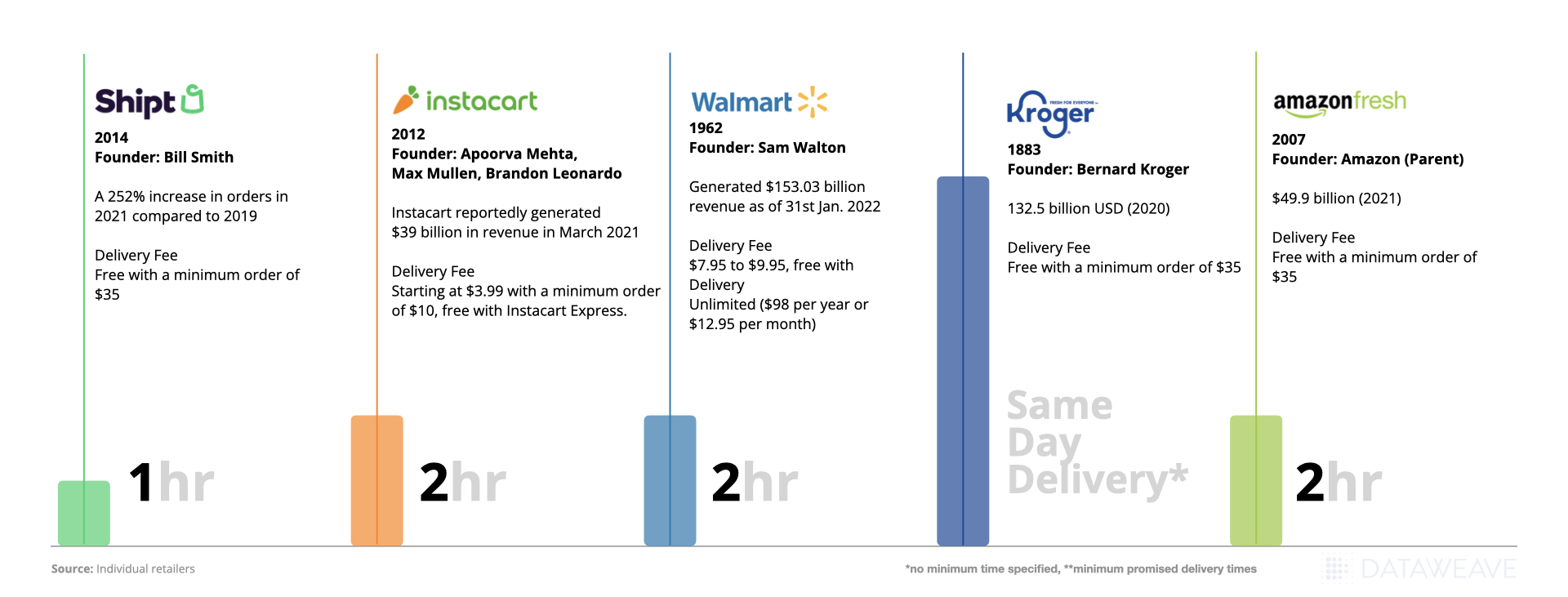
    The fierce competition in the on-demand grocery delivery space has led to small delivery times. Startups like GoPuff (30 minutes), and Jiffy (15 minutes) are competing with the big boys like Walmart and Amazon Fresh to deliver groceries in under an hour. Quick delivery options like two-hour delivery and same-day delivery have made it easier for customers to shop for fresh produce. Customers can quickly order a few items for a specific recipe and get it delivered within a few hours

    4. Multiple payment methods

    At store checkouts, cash and card are the only two acceptable options. Customers prefer to have more options in today’s modern world. Online grocery shopping makes buying easier by offering multiple payment options like PayPal, credit/debit cards, and monthly payment plans that negate the delivery fees for each delivery.
    How to successfully run a Grocery Delivery Business?

    The increasing demand for speed and convenience puts pressure on the grocery industry that faces inventory issues like fresh produce and product availability. However, the benefit of online grocery delivery services is that it provides insight into the end-to-end view of the customer journey. Grocery delivery brands can use the data to design services and models that meet customer demand and minimize costs across the supply and distribution chain. 

    If you’re a Grocery Delivery company and want to track your delivery time, or product catalogue so you can boost sales with an in-demand product assortment, or you want to drive more revenue & margin by making sure your products are priced right v/s your competition, reach out to us at DataWeave! Sign up for a demo with our team to know how we can help you optimize your online sales.
  • How VCs and Brand Rollups are using Data for faster Acquisitions

    How VCs and Brand Rollups are using Data for faster Acquisitions

    When it comes to brands – the biggest story of 2021 was the astronomical growth of Brand Roll-ups. For the uninitiated, Brand Roll-ups are companies that acquire multiple digital consumer brands and then scale these brands 100x by leveraging their own operational expertise across eCommerce platforms, Supply Chain, Warehousing, Marketing, and so on.
    Thrasio is the poster boy for the Brand roll-ups and is valued at over 10 Bn USD.

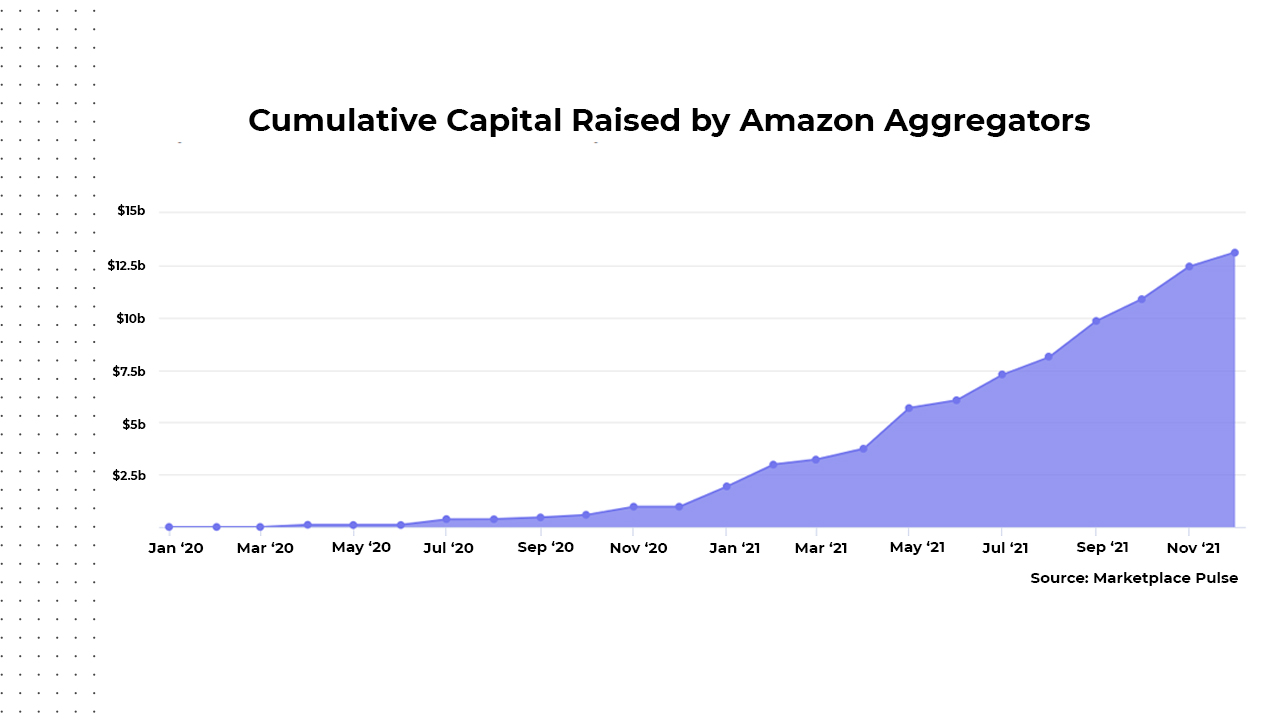
    Brand rollups have raised over $12 billion in 2021 and the trend only seems to be accelerating in 2022. Not only Brand Roll ups, but VCs too have been pouring money into digital brands. In India, 77+ brands have raised more than 2B USD in 2021. In the US this number is estimated to be north of $10 billion.

    Cumulative capital raised by Amazon Aggregators
    Cumulative capital raised by Amazon Aggregators

    Scaling fast doesn’t come easy. It comes with its own set of challenges. So even with ample experience in running and scaling brands, Brand roll-ups are posed with unique challenges.

    Challenge of Scouting the right brand

    There are 1000s of online consumer brands and new ones are launching every day. Every Brand roll-up wants to be the first one to scout a brand – but this is not easy.

    The challenge here is to identify & pick the right brands without having access to any sales or financial data. Every Brand Rollup has a wishlist with regards to the number of SKUs, price points, reviews, and ratings as well – but don’t have tools in place to scout brands with these criteria in mind. And across multiple platforms and categories, the problem gets more complicated.

    This is an ongoing problem since a brand that was not selling well yesterday may start hitting higher sales numbers a week down the line – and that is why Brand scouting has to be a continuous process.

    One way these aggregators have solved this challenge is by offering mouth-watering referral fees for referring a brand. But this is not a sustainable long-term solution.

    Data Comes to the Rescue

    What Brand Roll-ups need is a continuous and automated data first Brand Scouting solution to enable them to scout the right brands.

    • What are all the brands in a category of interest?
    • Which of these brands is within the filters of Number of SKUs, Price Range, etc.?
    • Which brands have shown an exceptional rise in search rankings?
    • Which brands have shown the most increase in the number of ratings and reviews?
    • Which brands have the highest gain in the customer ratings?
    • What are the estimated sales and market share of the brands?

    DataWeave’s Brand Scouting solution solves exactly this.

    DataWeave’s Brand Scouting Solution

    DataWeave’s Brand Scouting Solution is a comprehensive solution to help Brand Rollups and VCs scout for the ideal brand that fits their acquisition profile. We leverage public data collected from multiple eCommerce platforms to get them the desired information on brands they’re looking for.

    For all the focused categories (Typically 30-40) – we collect data of all the SKUs (Typically 15,000-20,000) and aggregate that at a Brand level:

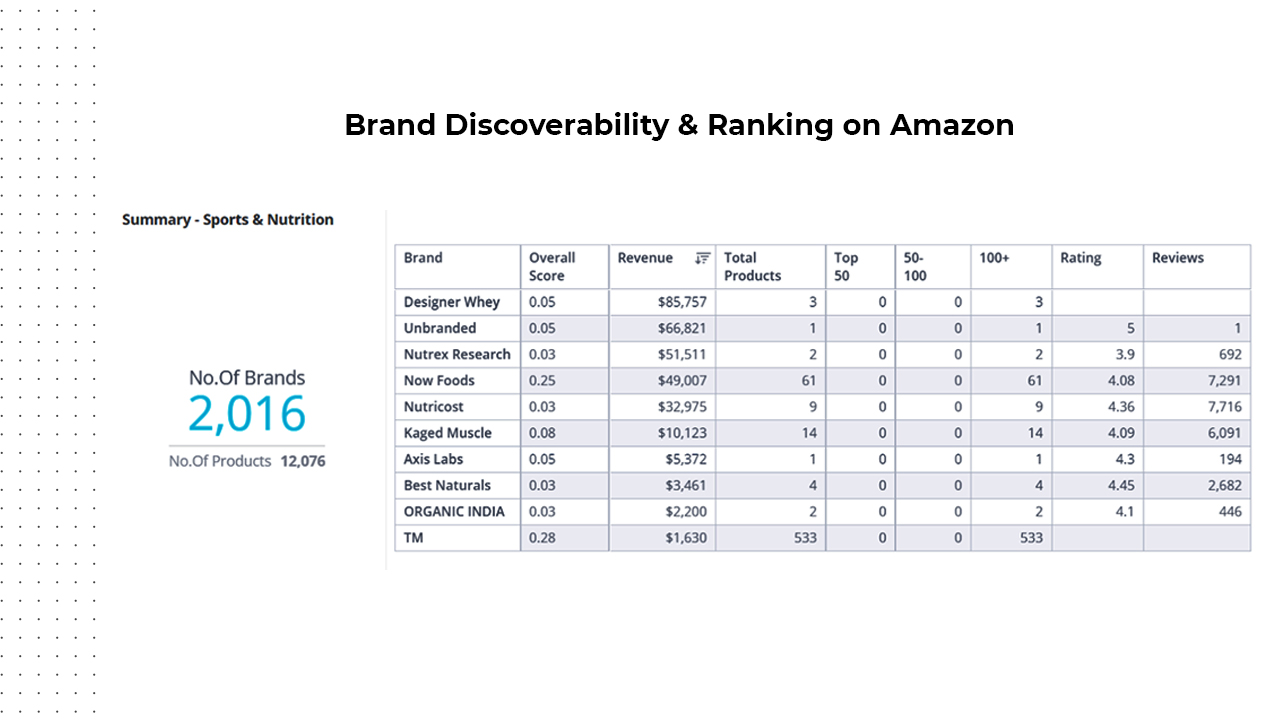
    • Ranking – Usually Brand Rollups are not interested in the Brands which are on the first page. But, they are interested in the brands which might be b/w 500 to 10,000 ranks but are showing an exceptional gain in ranking week on week.
    Brand Discoverability & Ranking on Amazon
    Brand Discoverability & Ranking on Amazon
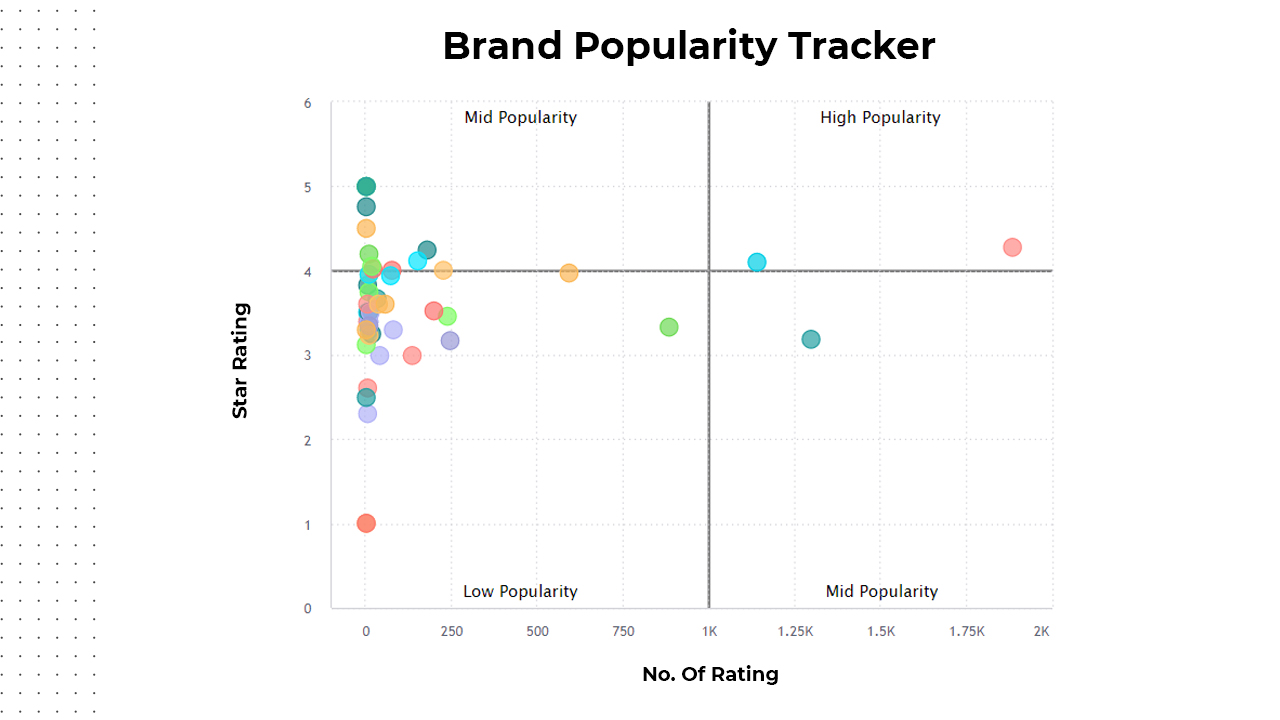
    • Ratings – It’s important to look at brands that are showing high improvement in ratings or have consistently shown high ratings. The proportion of 5 stars vs. 1 star is an important metric here.
    • Number of Reviews and Ratings We enable you to find brands that have both high ratings as well as a high number of reviews. This is a very good metric to find the brands in a category that are getting exceptional customer love.
    Brand Popularity Tracker
    Brand Popularity Tracker
    • Filters – We enable filtering in terms of – No. of SKUs, Price Range, Rating and Reviews and even can eliminate established brands so that you only see the brands which qualify your criteria. We also enable you to separately analyze brands that are buying sponsored ads in a category, so you have a clear distinction between organic and sponsored growth of these brands.
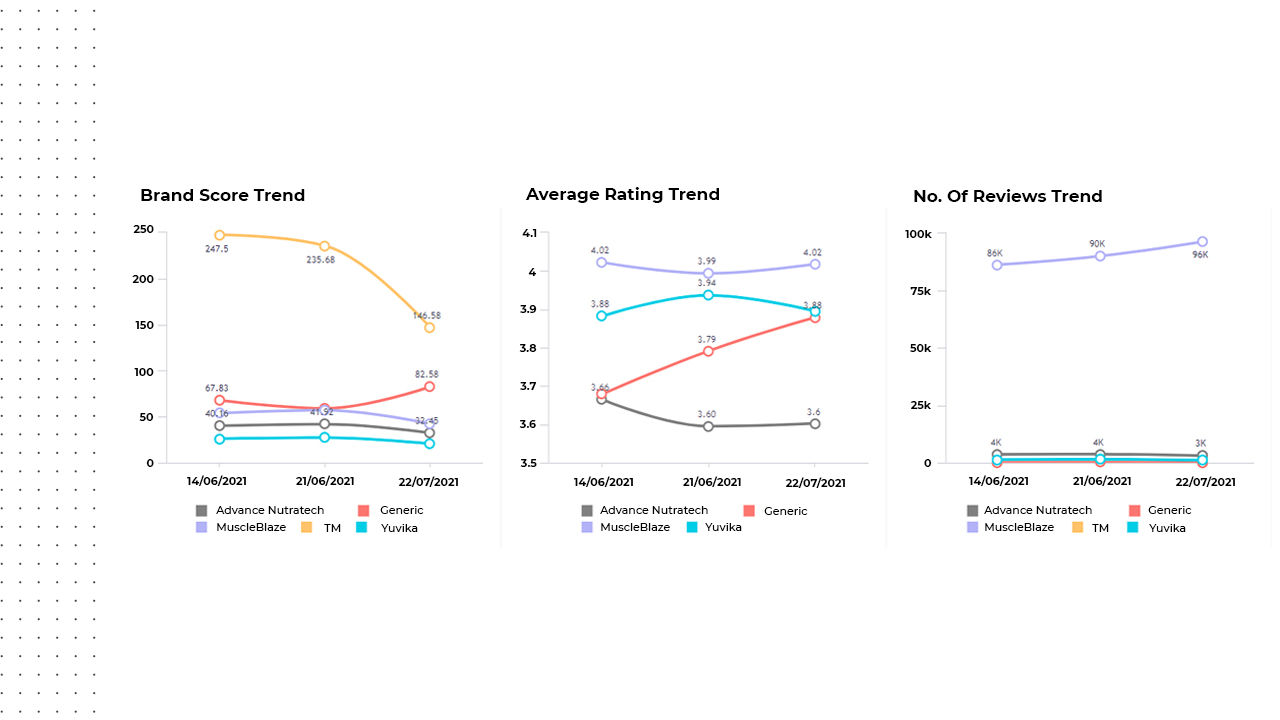
    • Trends – What is important is not just the static performance on the day of analysis – but a trend analysis over a period of time to find the brands which are growing exceptionally.
    Brand Score Trend, Average Rating trend & No of Reviews Trend
    Brand Score Trend, Average Rating trend & No of Reviews Trend

    … but, wait there’s more.

    We compliment Brand Scouting with three more solutions to provide the right context and further analysis needed to provide comprehensive insights into the category and platforms where you are scouting for brands:

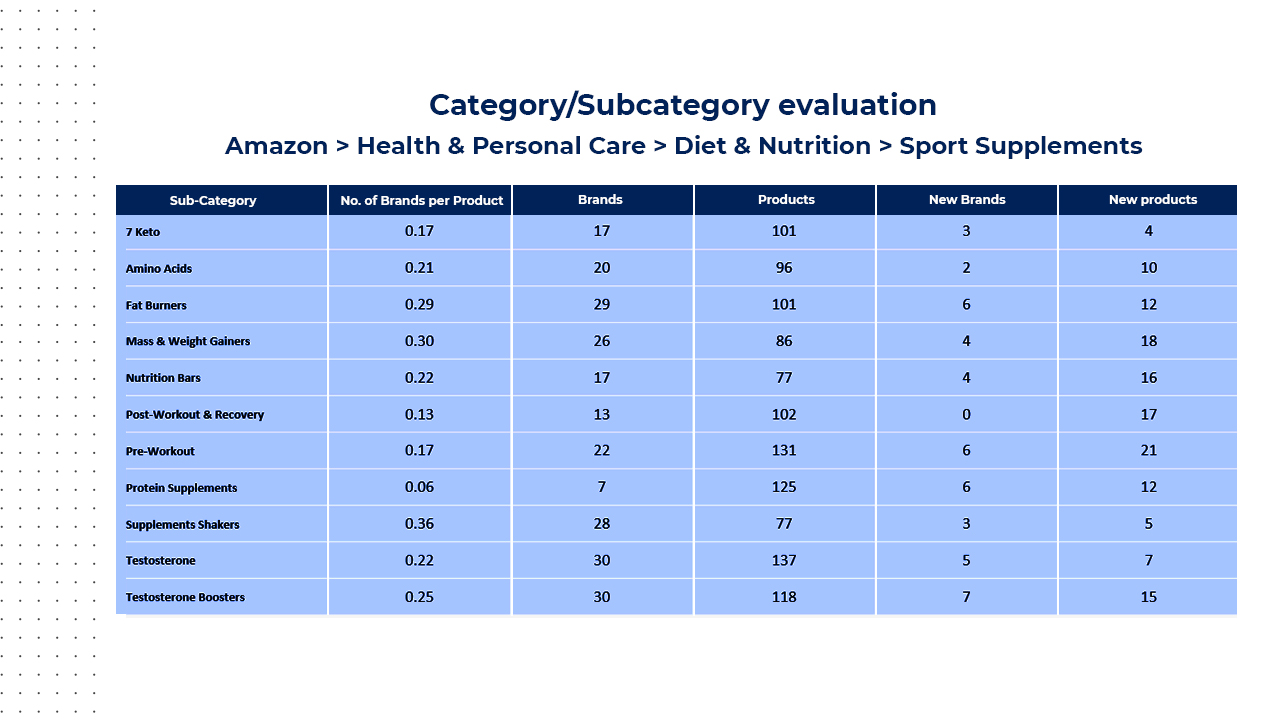
    Category Analytics: When you are looking at a category and the brands in that category, it is often important to understand how dynamic that category is. We can help analyze:

    • If the category is crowded with more brands per product.
    • Does it have space for new brands?
    • What is the number of new brands entering that category?
    • What is the number of new SKUs entering that category?
    Category & Subcategory Evaluation
    Category & Subcategory Evaluation

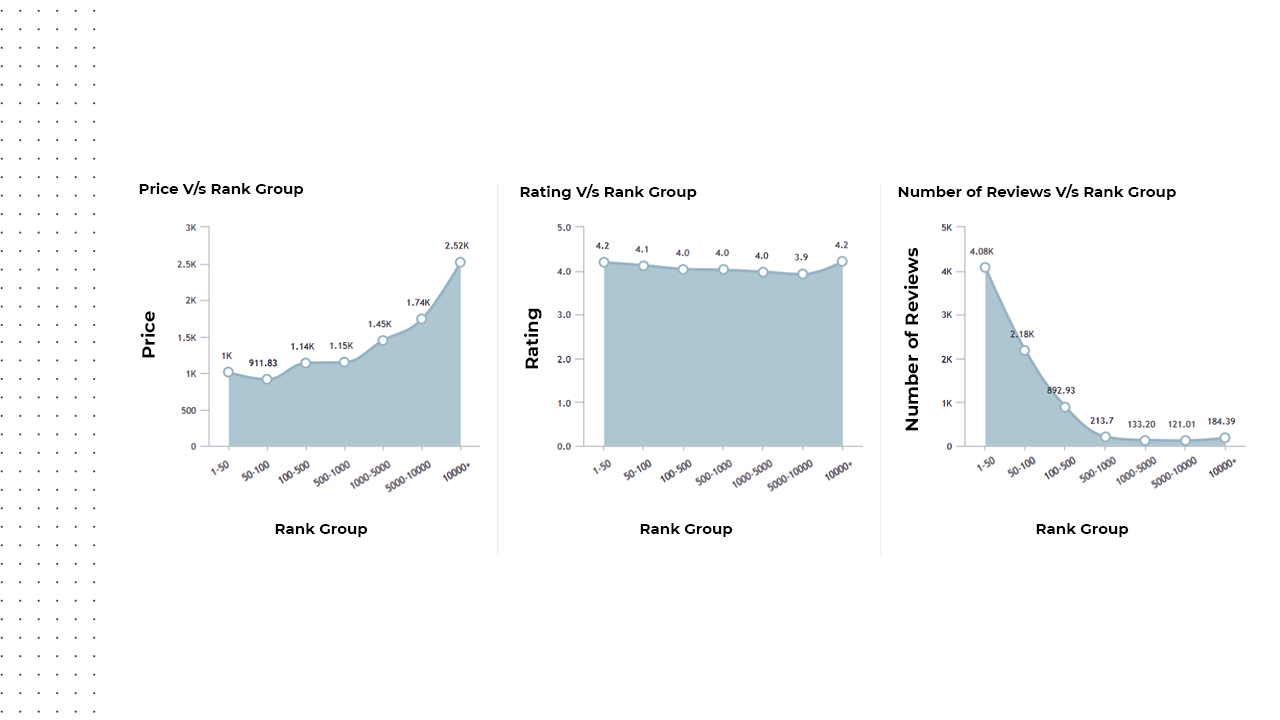
    We can also help with benchmarking the category – to help understand how the brand that you are scouting is doing when compared to its category peers.

    Rank Group versus Price, Rating & No of Reviews
    Rank Group versus Price, Rating & No of Reviews

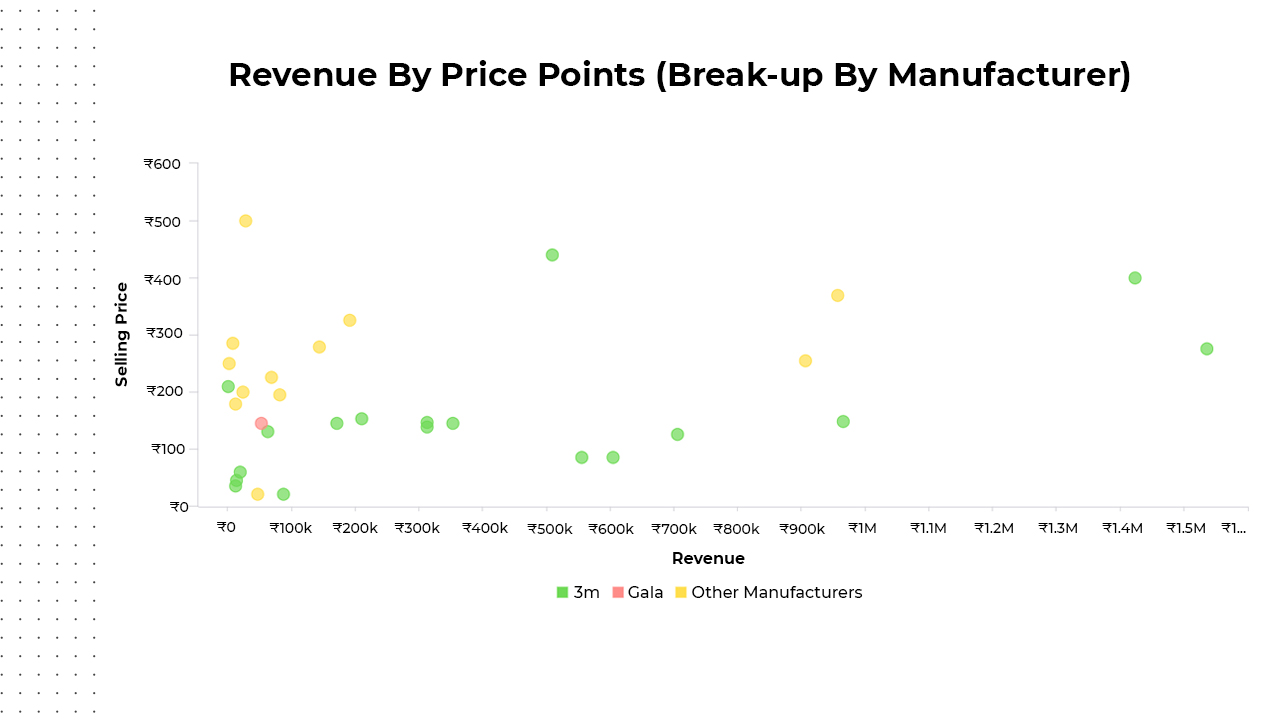
    Sales & Share: We can also provide a good directional estimate of the sales and market share of all the SKUs in the category wherein you are scouting for brands. These are estimates powered by our proprietary machine learning algorithms and can help you solidify your hypothesis around a blog or a category.

    Revenue by Price Points
    Revenue by Price Points

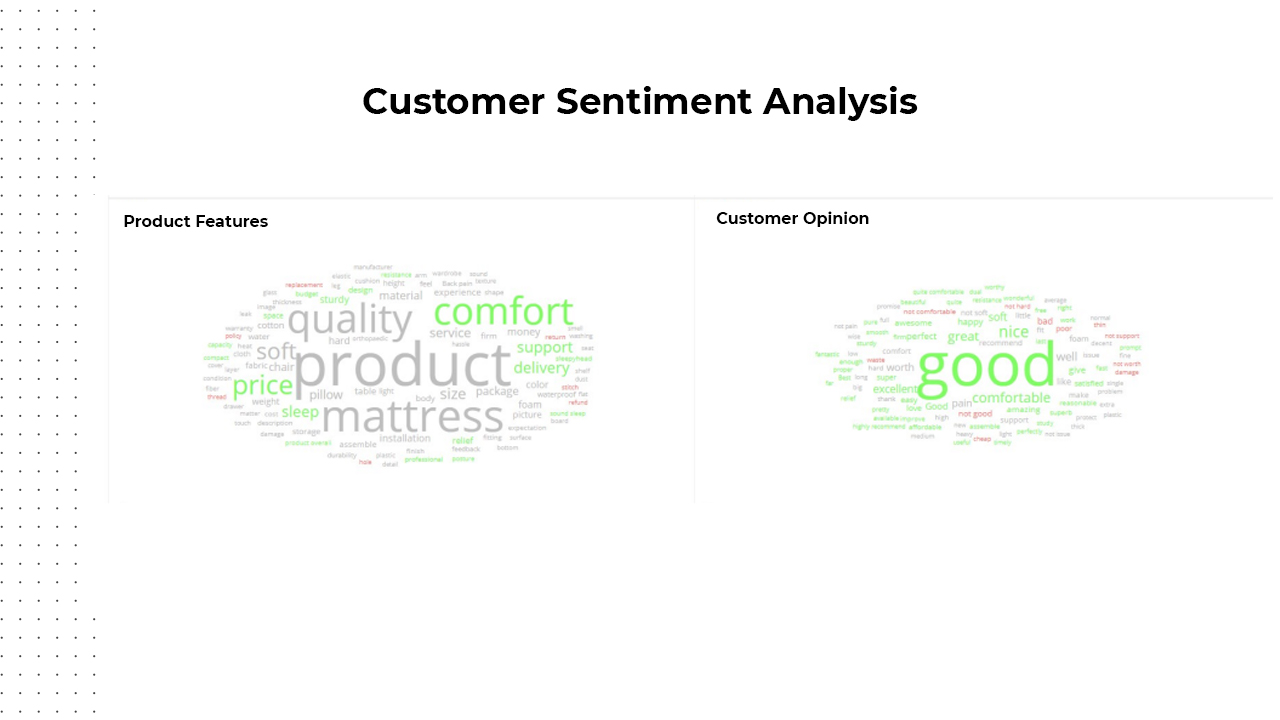
    Sentiment Analysis of Reviews: Customer reviews tell more about the qualitative aspects of the SKU and the brand itself. Our algorithms can help understand what features of a brand or a product do customers really care about. We can answer questions such as:

    • Which features are mentioned most commonly?
    • Which features are mentioned positively or negatively?
    • What adjective is used to describe that particular feature?
    Customer Sentiment Analysis
    Customer Sentiment Analysis

    The suite of Brand Scouting and complementary solutions is evolving rapidly as the space is evolving rapidly. We are supporting several VCs and Brand Roll-ups globally to scout for brands.

    The best aspect about DataWeave is our ability to scout brands across 2,000+ eCommerce platforms globally across geographies. We are super stoked to be playing an enabler in the Brand Rollup revolution.

    Beyond Brand Scouting – Digital Shelf Analytics

    The challenge for Brand roll-ups is not over by just scouting and acquiring a brand. The journey is just about starting – the next challenge that the Brand Rollup faces now is to scale up these brands.

    The challenge the Brand Rollup face is unique and very different from a single brand operator or even traditional CPG conglomerates.

    DataWeave’s flexible product philosophy enables Brand Roll-ups to diagnose and measure the performance of multiple brands across multiple platforms in one dashboard.

  • UK’s Biggest Sale Days: What we saw in 2021 and trends for 2022

    UK’s Biggest Sale Days: What we saw in 2021 and trends for 2022

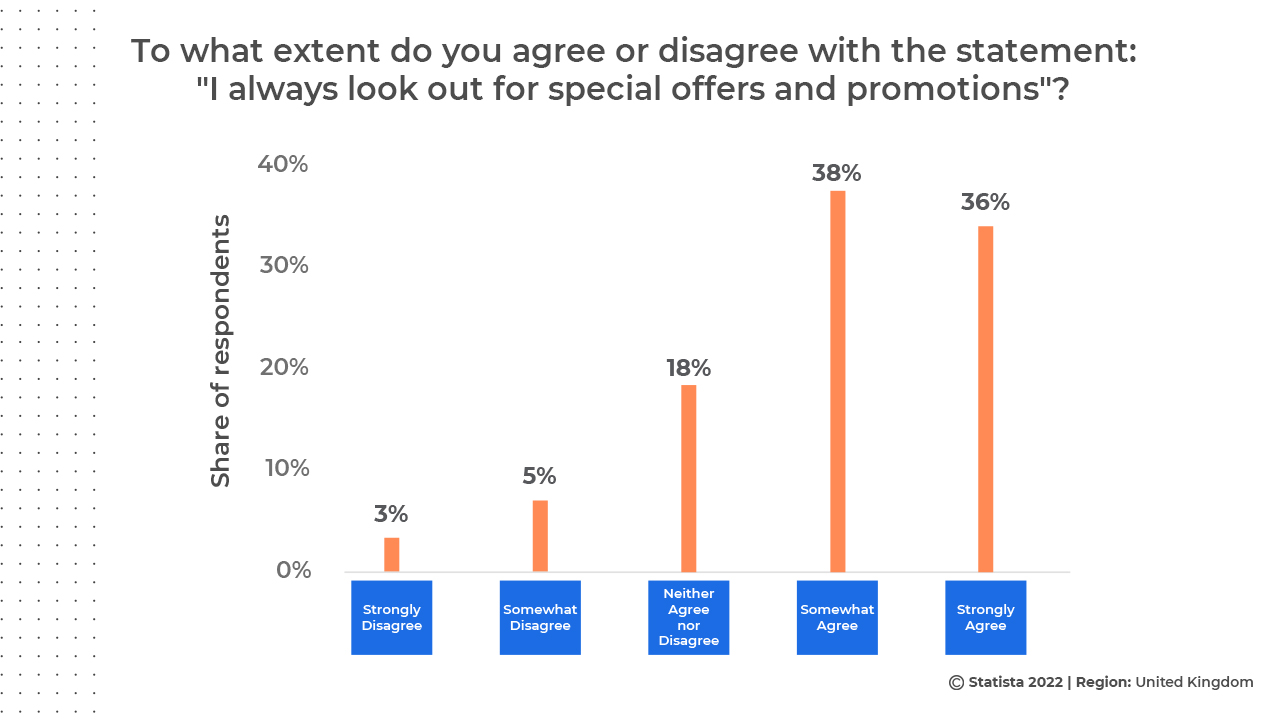
    Customers love discounts, and promotions are the most effective tool to attract shoppers and increase sales during the holiday season and clearance sales. According to a survey, 76% of UK customers look for discounts before purchasing a product. Promotional discounts encourage customers to try new brands. And this is why brands often have a special coupon for first-time users. 

    According to Software Advice, discounting tops the pricing strategy for retailers across all industries. It is preferred by 97% of survey respondents over other promotional strategies

    Share of Respondents
    Share of Respondents

    Retail Trends in the UK for 2022

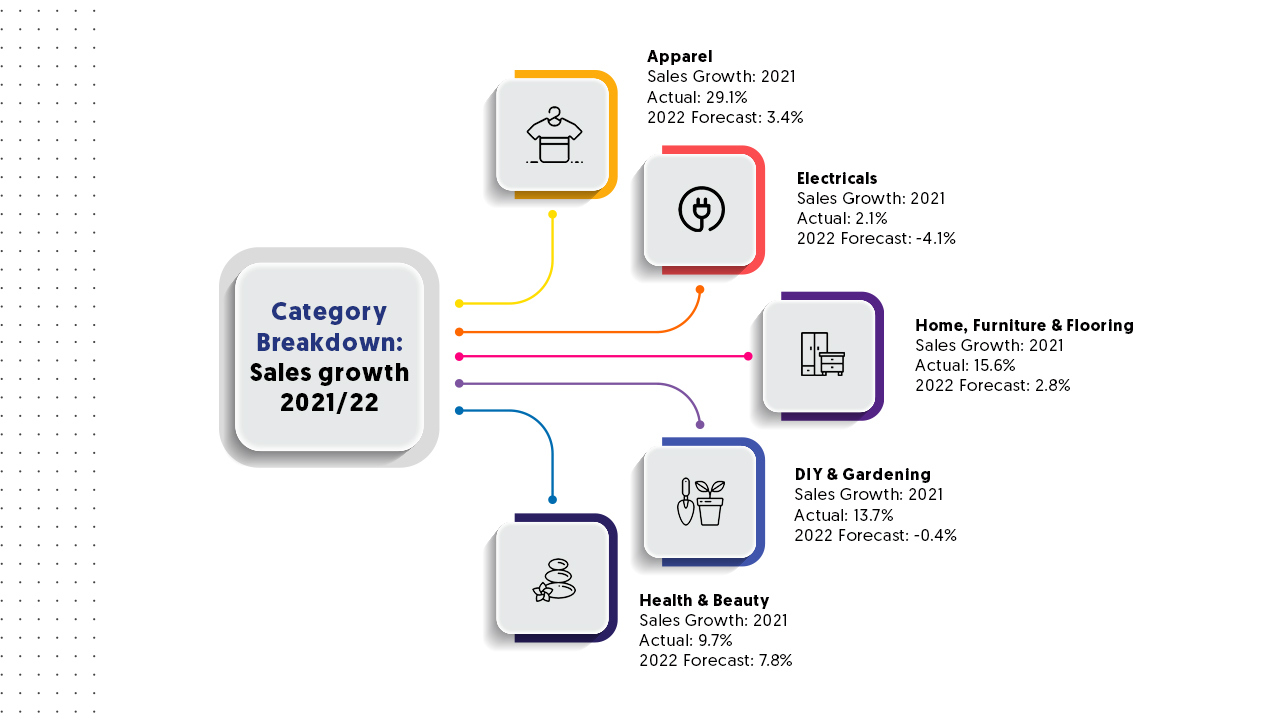
    The arrival of the Omicron variant in December 2021 slashed the shopping mood of UK customers and led to a 3.7% monthly drop in retail sales, but sales were still higher than February 2020 levels when Covid-19 first hit worldwide. Sales during the holiday season in 2021 took a hit due to a consistent decline in product availability and an increase in prices.  Inflation too started to rise in 2021 and is expected to increase by 7% by spring 2022. However, despite inflation, retail sales jumped back in January 2022. In fact, it is predicted that inflation will be a key driver of sales growth, with underlying demand across categories being uneven. Keeping that in mind, let’s look at sales growth across categories in 2021 and projected growth in 2022.

    Category Breakdown: Sales growth 2021/22
    Category Breakdown: Sales growth 2021/22

    Discounting Trends we saw in the UK in 2021

    Methodology

    • We tracked prices on the three biggest Sales Days in the UK
      – Amazon Prime Day, June 21st & 22nd 2021
      – Black Friday, Nov 26th, 2021
      – Cyber Monday, Nov 29th, 2021
    • Categories tracked: Beauty, Fashion, Electronics, Home Improvement, Furniture 
    • Websites tracked: Amazon UK, OnBuy, eBay UK, Etsy, Wayfair, Selfridges, John Lewis

    Prime Day, Black Friday, and Cyber Monday are three of the biggest sales days with comparable discounts. However, according to new research, in 54% of cases, it depends on the category of product you’re after that determines the volume of discount you get. For example, tech items such as smartphones, laptops, games consoles, smartwatches, and wireless speakers were cheaper on Black Friday but may not necessarily have been cheaper on the other sale days. 

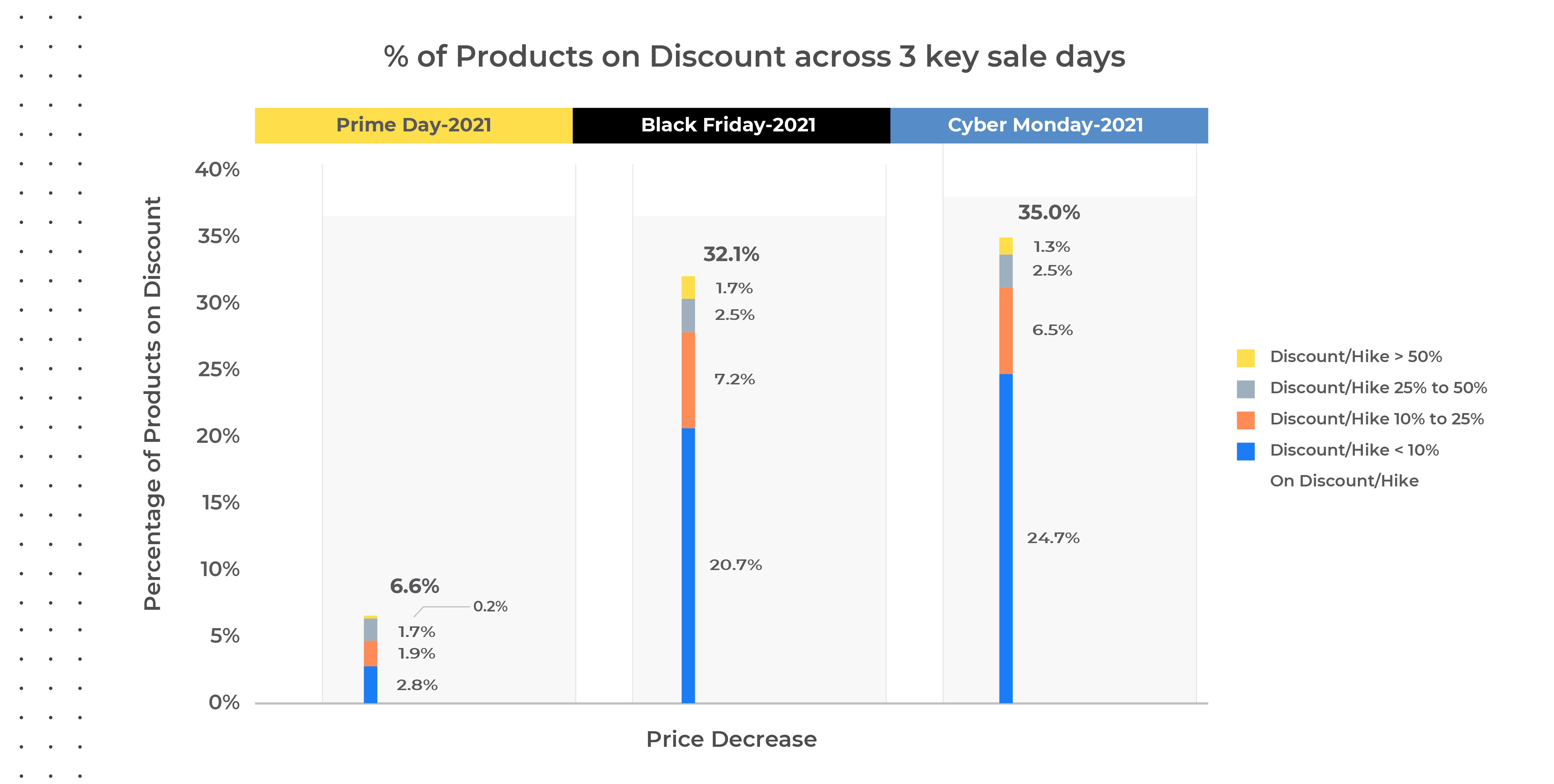
    We wanted to see which sale period had the most number of products on discount during the three big sale events. We also wanted to see which of those three sales would’ve been the best for consumers to get a higher section of products at a discount. 

    How Big were the Discounts?

    Discount across 3 key Sale Days
    Discount across 3 key Sale Days

    32% of products went on discount during Black Friday, 35% on Cyber Monday, and only 6.6% on Prime Day. One factor contributing to the low Prime Day percentage is the fact that not all retailers participate in discounting wars during Prime Day since it’s an exclusive Amazon-only sale. Customers looking for the best deals would’ve gotten them during the holiday season with a combination of the Black Friday & Cyber Monday sales. 

    Another interesting thing to note is the percentage discount – on Prime Day, only 0.2% of products had a discount of over 50% of all the discounted products. While on Black Friday & Cyber Monday that number was 1.7% & 1.3% respectively. 

    In conclusion, more products were offered at a discount on Black Friday & Cyber Monday; and the total percentage discount on those products was also higher.

    Which Categories had the Maximum Discount?

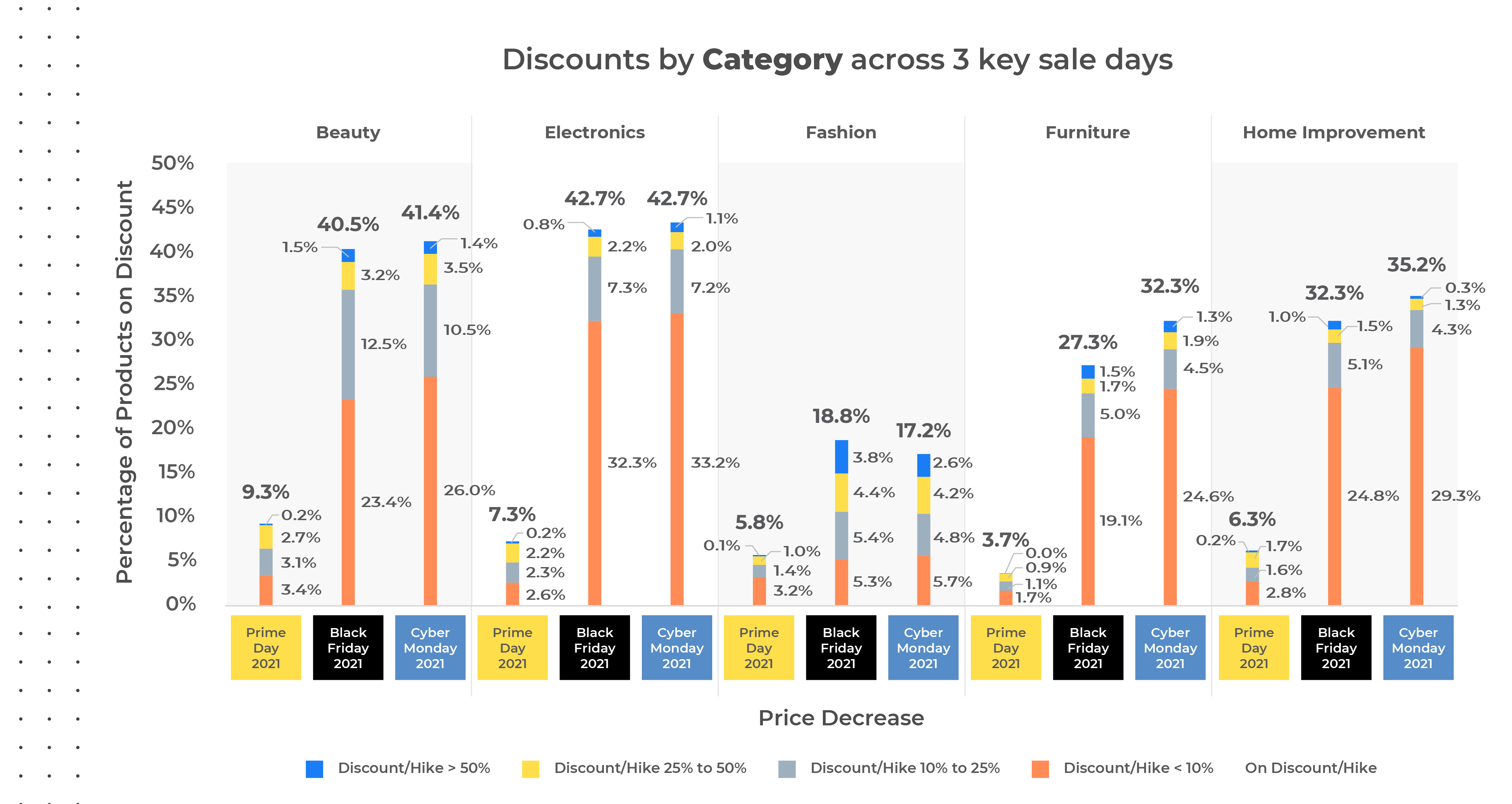
    Discounts by category
    Discounts by category

    On Black Friday, an estimated 47% of consumers in the UK planned to shop for electronics, whereas 40% of customers planned to shop for clothing and footwear during Black Friday to Cyber Monday.  The top-selling categories across the 48 hours of Amazon UK’s Black Friday 2021 sale included Home, Toys, Beauty, Books, and Health & Personal Care.

    Our data shows that Categories with the highest discounts were Beauty and Electronics with the highest discount on all 3 sale events. These 2 categories had discounts on over 40% products on Black Friday & Cyber Monday while categories like Home Improvement were in the 30 – 35% range, Furniture in the 27 – 32% range and Fashion has the least products on discounts at a little over 15%

    In the fashion category in the UK, Amazon UK offered the highest percentage of items with a price decrease (31.6%), whereas eBay offered the most significant magnitude of price decrease (14.3%). 

    Which UK Retailers gave the most discounts?

    OnBuy is an emerging marketplace in the UK that offers impressive discounted prices and is taking on top UK marketplaces like Amazon. It’s ranked Britain’s fastest-growing eCommerce platform in 2020 and also the fastest grower by traffic. The low listing fees starting at 5% allow sellers to competitively price their products, making them more accessible to a greater number of buyers with huge discounts. The most prominent deals and discounts are highlighted on the landing page and featured across OnBuy’s social pages to grab the audience’s attention. 

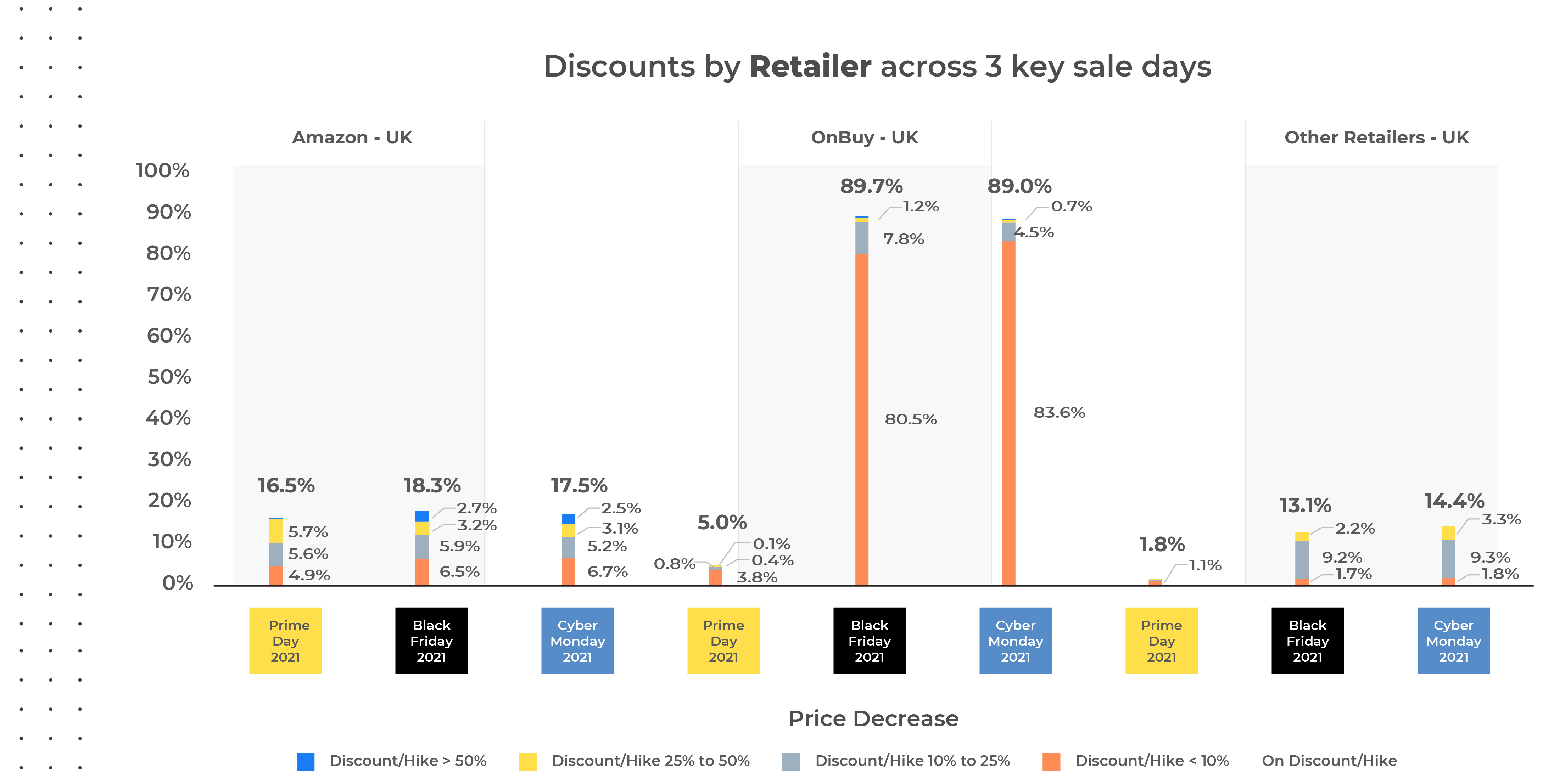
    Discounts by Retailer
    Discounts by Retailer

    This was clearly reflective in the data we gathered from the 3 big sales in 2021. Most retailers in the UK, including Amazon offered at best 20% of their products, in the categories we tracked, at discount. The only outlier was OnBuy – OnBuy offered close to 90% of their products at discount! 

    OnBuy was able to offer a comparatively high number of discounted products than their competition because the magnitude of the discount was much much lower. The platform offered minimal discounts; out of the 90% of discounted products, 80% of those products had discounts that were less than 10%. As opposed to other retailers who had under 7% of their products on discounts of less than 10%.

    OnBuy’s discounting strategy built a perception that they were the biggest discounters, even when the discounts were not as deep.

    Black Friday v/s Cyber Monday – which one was better for holiday shoppers?

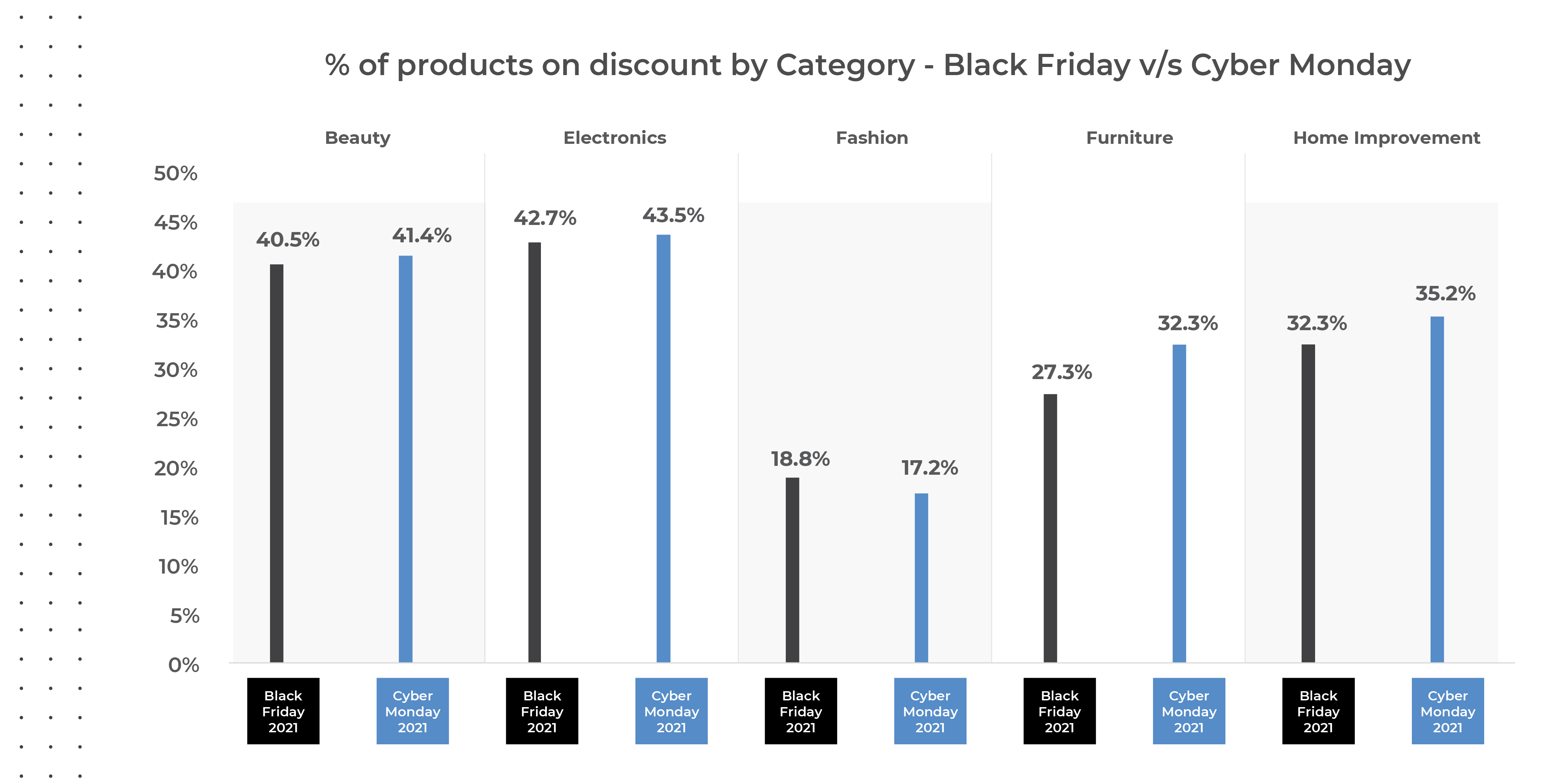
    Discount by category- Black Friday VS Cyber Monday
    Discount by category- Black Friday VS Cyber Monday

    Black Friday kicks off the holiday shopping season and is synonymous with some of the most significant sales after Thanksgiving. But until recently, Cyber Monday has become a great way for eCommerce retailers to capitalize on holiday discounts and expand their most beneficial sales events of the year.

    In 2021, retailers pulled in $8.9 billion in Black Friday online sales and a total sales of $10.7 billion on Cyber Monday. In the YOY review, Black Friday saw a decline of 1.3% from 2020’s record of $9.03 billion, and Cyber Monday saw a drop of 1.4%, only $100 million shy of $10.8 billion in 2020. 

    Across Beauty, Home Improvement, Electronics & Furniture categories, we saw that more products were on discount on Cyber Monday v/s Black Friday. However, the opposite was true for the Fashion Category. In the Fashion Category, we saw a marginally higher number of products on Discount during Black Friday than Cyber Monday.

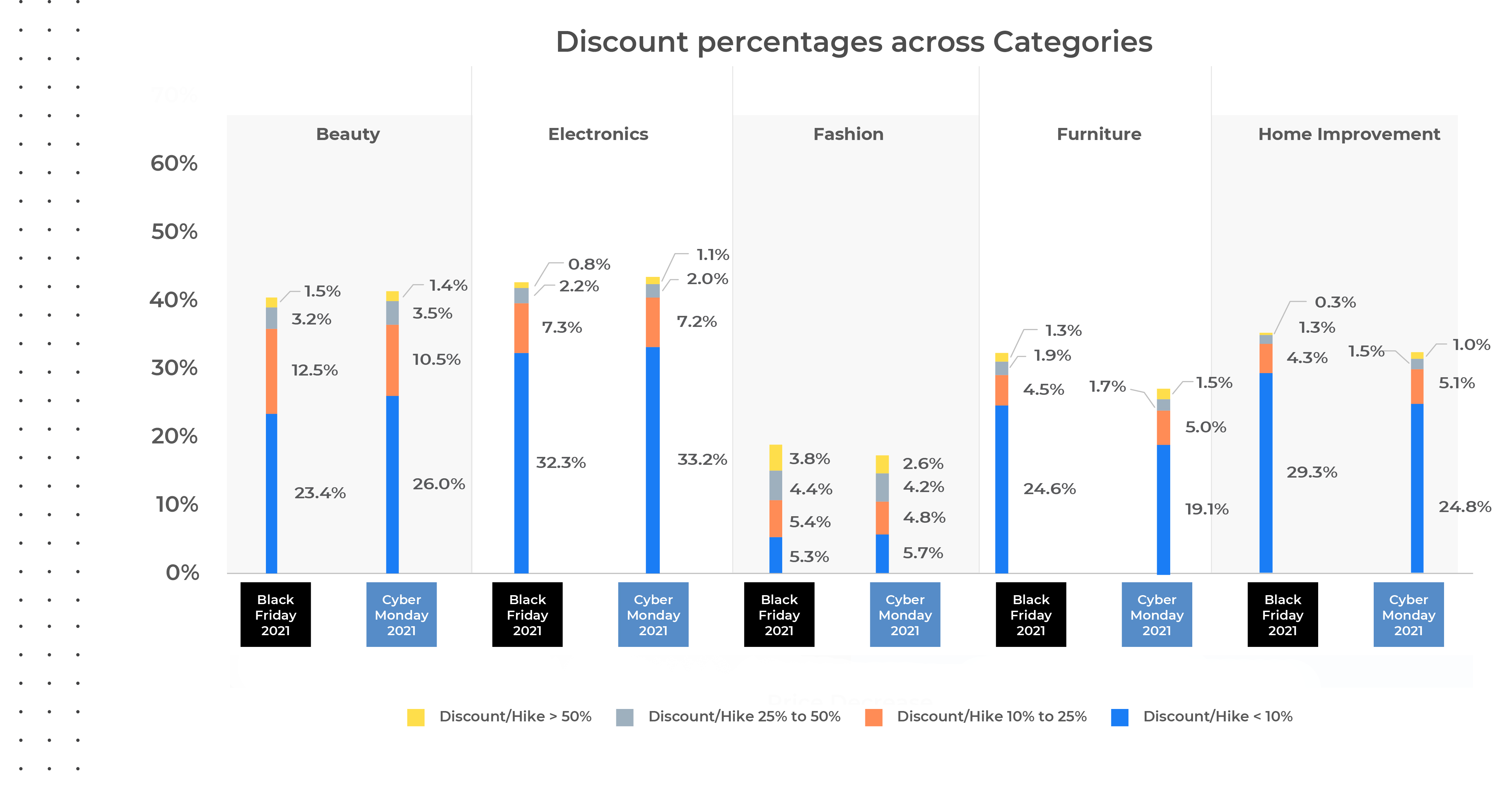
    Discount percentages across categories
    Discount percentages across categories

    Across both sales, the Electronics category offered the highest discounts at over 40% of products discounted compared to other categories on both Black Friday & Cyber Monday. However, a very small fraction of the products had a discount of over 50%, indicating the lack of ‘BIG blockbuster deals’ in this category. At the same time, the Fashion category offered the least number of deals with less than 20% products on discount, but the highest magnitude of discount across the board! On Black Friday, 3.8% of products had discounts higher than 50%, and 2.6% of products on Cyber Monday. In most other categories, between 1 – 1.5% of products had over 50% discount. However, Fashion brands offered more than 50% discount on 2x the average number of products on both sale days.

    Why did the Fashion Category offer such high discounts? Brands are now capitalizing on customers’ need for instant gratification in the age of see-now, buy-now fashion trends by offering their products at high discounts. It also allows them to quickly eliminate overstock. However, this has given rise to fast fashion, a trend that focuses on rapidly producing low-quality clothes in huge volume. Fast fashion focuses on replicating trendy pieces like streetwear and fashion week designs, not four times a year but every week, if not daily. Fast fashion promotes brands to manufacture and sell low-quality merchandise that goes out of trend as soon as buyers wear it once. There is little to no time for quality control, and pieces are thrown away after a few wears. In the UK alone, 300,000 tonnes of used clothes are buried or burned in landfills each year. However, every element of fast fashion from rapid production, competitive pricing, to trend replication has a detrimental impact on the planet.

    Conclusion  

    The effects of COVID-19 can be seen far and wide in the UK retail industry, especially with a steep rise in inflation. Fortunately, even though retail sales in the UK declined during the 2021 holiday season due to the Omicron variant, they increased during Black Friday and Cyber Monday. Sales also jumped back in January 2022 and are further projected to grow by 5% in 2022. Additionally, brands can sustain the impact of disruptive factors throughout 2022 by ensuring their Digital Shelf is updated and flexible enough to react swiftly to both threats and opportunities in order to maximize the chances of success. 

    Reach out to the team at DataWeave if you’d like to make smarter pricing & discounting decisions with up-to-date competitive insights.