Author: DataWeave Marketing

  • Health & Beauty on Black Friday: Analyzing Pricing Strategies of Top U.S. Retailers

    Health & Beauty on Black Friday: Analyzing Pricing Strategies of Top U.S. Retailers

    We’ve come a long way from face paint and medicinal herbs to multi-billion dollar industries revolving around health and beauty. Customers are getting increasingly bombarded with variety that promises something for everyone. In fact, a recent DataWeave study identified Health & Beauty as one of the most popular CPG categories in the U.S., both in terms of assortment strength and brand concentration. As with most other categories, pricing activity around Health & Beauty is especially abuzz when Thanksgiving weekend comes around.

    As part of our series of articles analyzing the pricing of leading retailers across categories on Black Friday, the DataWeave team performed an analysis on a sample of 14,000+ products across six top retailers – Amazon, JC Penney, Macy’s, Nordstrom, Target and Walmart. Seven product types were covered across the category, such as Fragrance, Hair Care, Makeup, etc. and the analysis focused on the top 500 ranked products of each product type.

    Additional markdowns

    For this analysis, we considered the mode of the prices for the week before and compared it with that during the sale. This painted a picture of the additional markdowns for the duration of the sale.
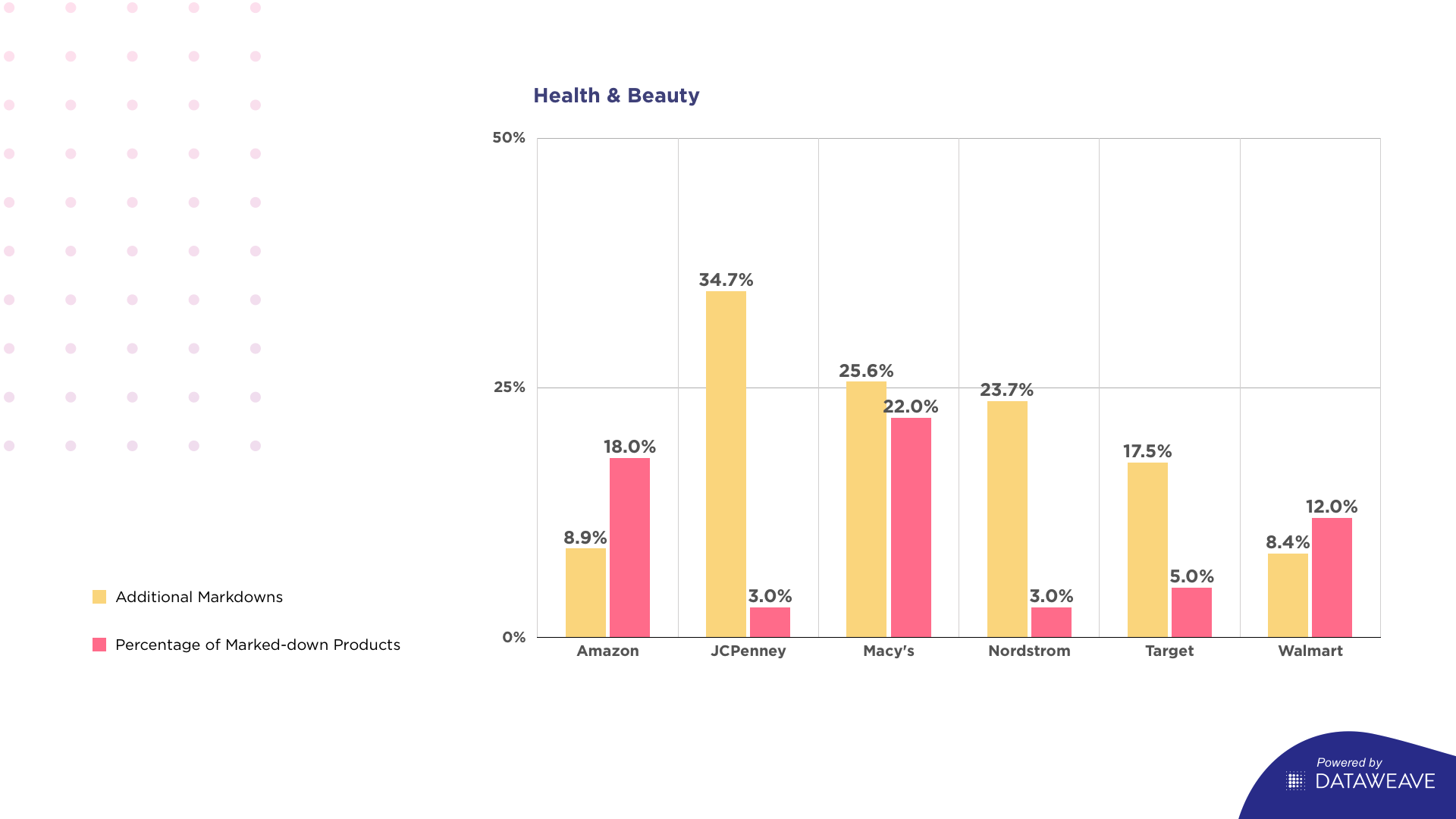
    Similar to our prior coverage of the Fashion category during Black Friday, Macy’s had the broadest reach in terms of the marked down products at 25.6%. The average percentage of the markdowns was 22% and was only eclipsed by JC Penney with an average of 34.7%, though this was only offered on 3% of its range. At the other end of the spectrum, Amazon and Walmart had the lowest markdowns at 8.9% and 8.4% respectively but were among the top three in products covered (18% & 12%). Target and Nordstrom offered mid-range markdowns across the board but on a rather conservative selection of products of 5% and 3%, respectively.

    Additional markdowns by product types

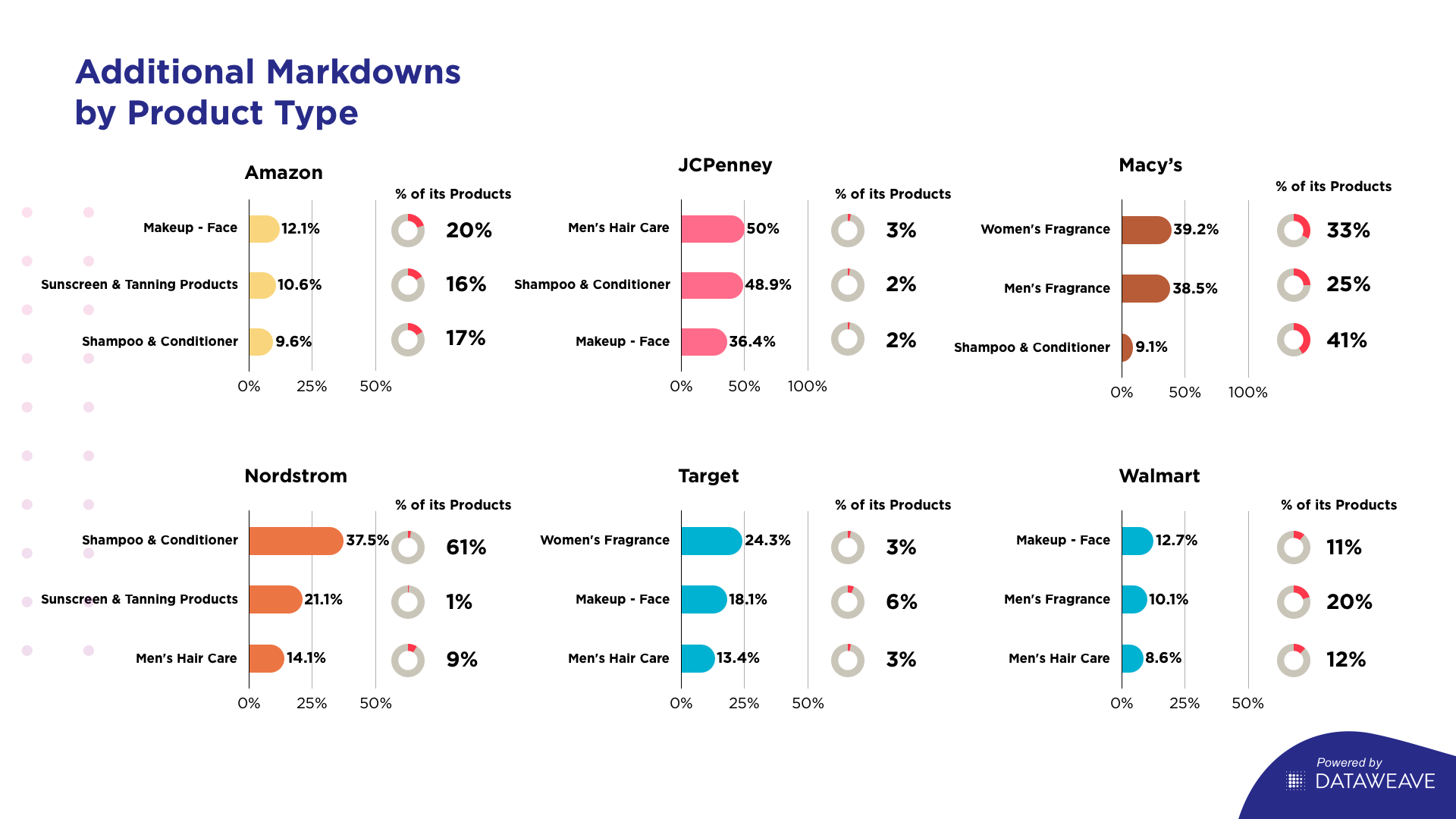
    When we delved further into the product types, we noticed that a majority of the retailers heavily marked down makeup, shampoo & conditioner and men’s hair care products. The table illustrates the top three discounted categories for each retailer we analyzed.
    Premiumness

    We categorized the products across retailers into buckets of how expensive or cheap a product is, relative to the rest of the products hosted by the retailer in the respective product type. Where the MRP was not displayed, the most expensive price of the product during the holiday period prior to Black Friday was considered for this categorization. We then tagged products as High, Medium and Low in terms of product premiumness, with High referring to the more expensive products.
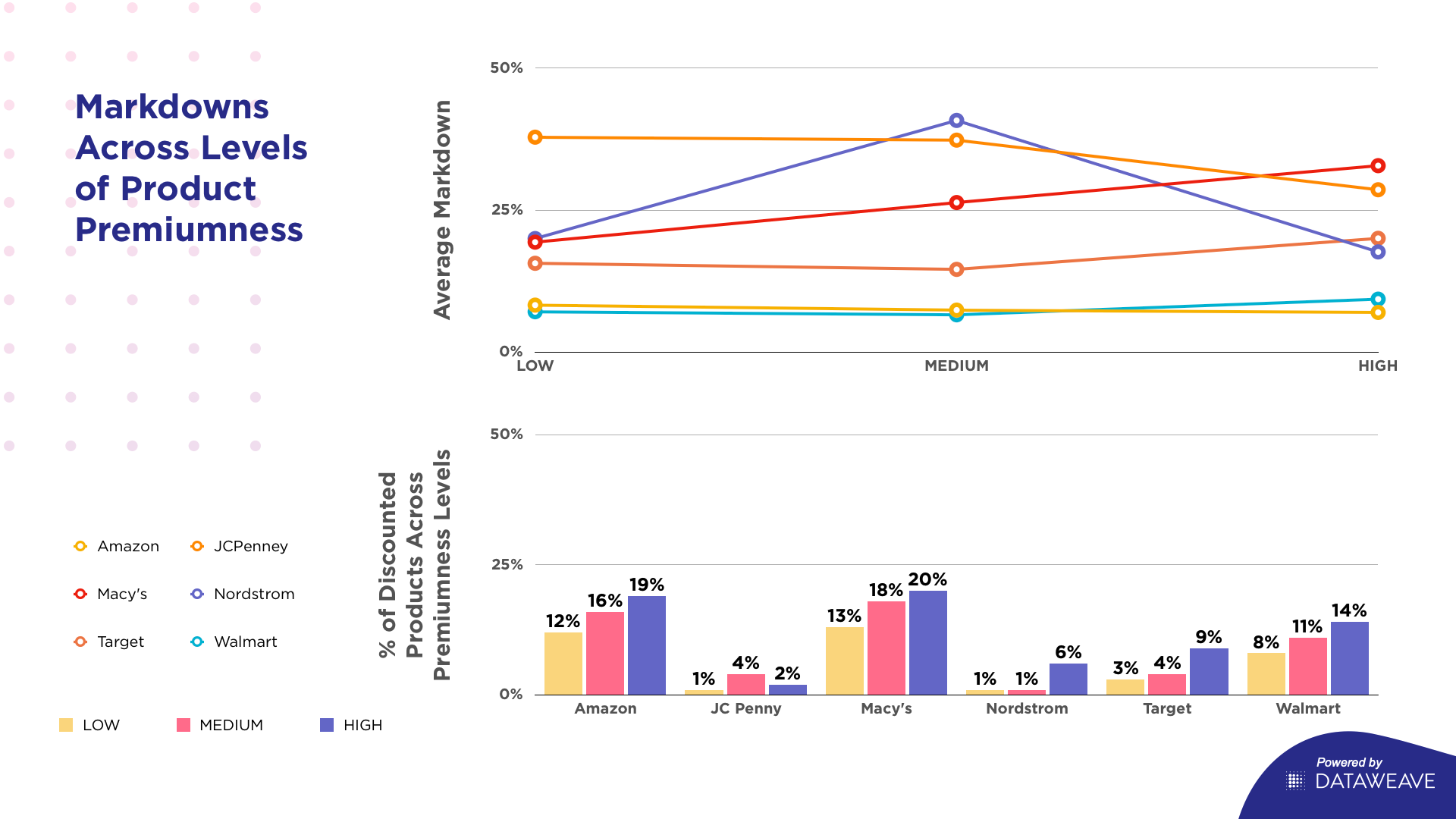
    In line with previous trends, Macy’s had the highest markdown on its high level products at 32.8%. It also had the widest coverage for the category at 20%. Amazon, Macy’s, Target, Walmart followed the expected approach of providing higher markdowns on the more premium products, and also on a higher portion of these products. This would be consistent with their goal of providing attractive offers on premium goods while also protecting their margins.

    JC Penney and Nordstrom were exceptions here, with JC Penney providing higher markdowns on its cheaper goods, while Nordstrom focused its markdowns on the medium bucket.  That being said, it should be reiterated that the portion of products with markdowns for both thee retailers was relatively small.

    Popularity

    Similar to categorizing the products at levels of product premiumness, we categorized them into levels of popularity as well. Here, popularity is defined using a combination of the average review rating and number of reviews obtained for each product.
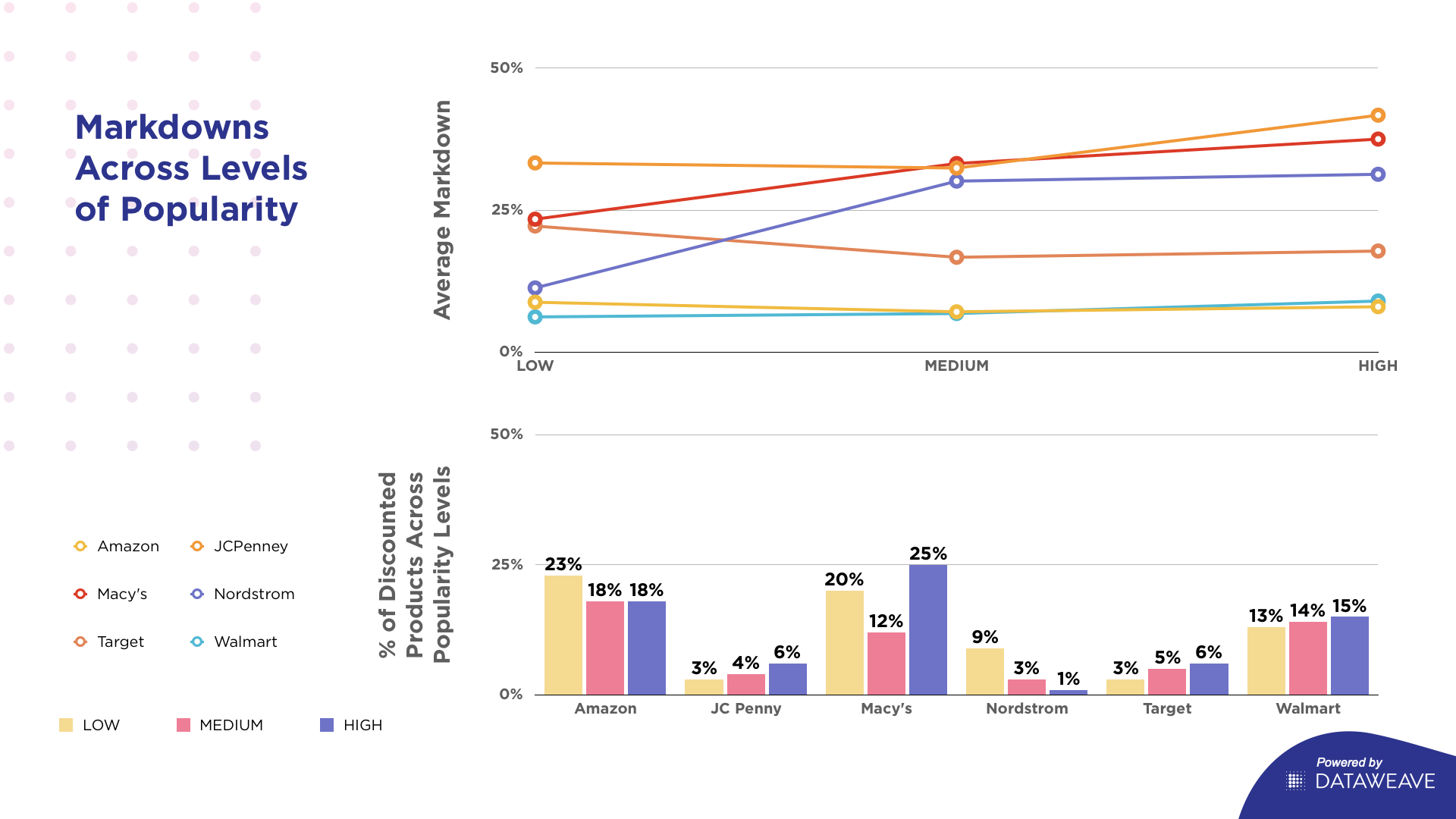
    Interestingly, no consistent pattern has emerged that indicates a strategic focus on factoring product popularity into their pricing strategies for Black Friday.

    Macy’s, JC Penney, and Nordstrom chose to provide higher markdowns on their highly popular products, of which only JC Penney and Macy’s chose to also markdown a higher portion of their highly popular products. It was just as common though to see retailers (including Amazon) marking down the prices of their least popular products. This is likely an attempt by the retailers to liquidate their excessive stock of less popular products during the sale.

    Price Change Activity

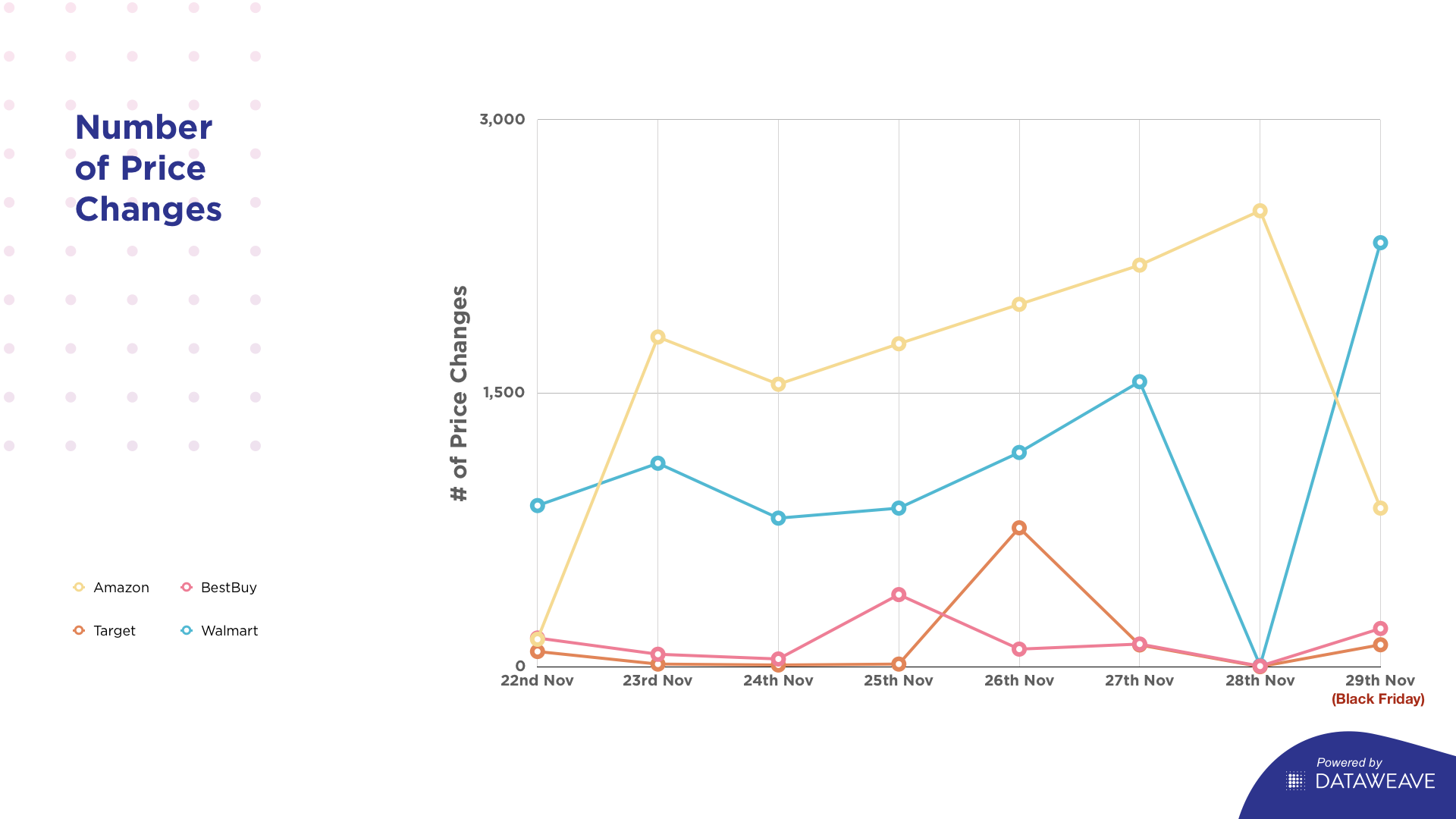
    As documented quite often in recent years, the Black Friday sale is no longer limited only to a single day, but attractive offers are often seen right through November, especially over the last week of the month. We tracked the level of pricing activity across retailers over the last week of November, in terms of number of price changes as well as the average price variation for each retailer.
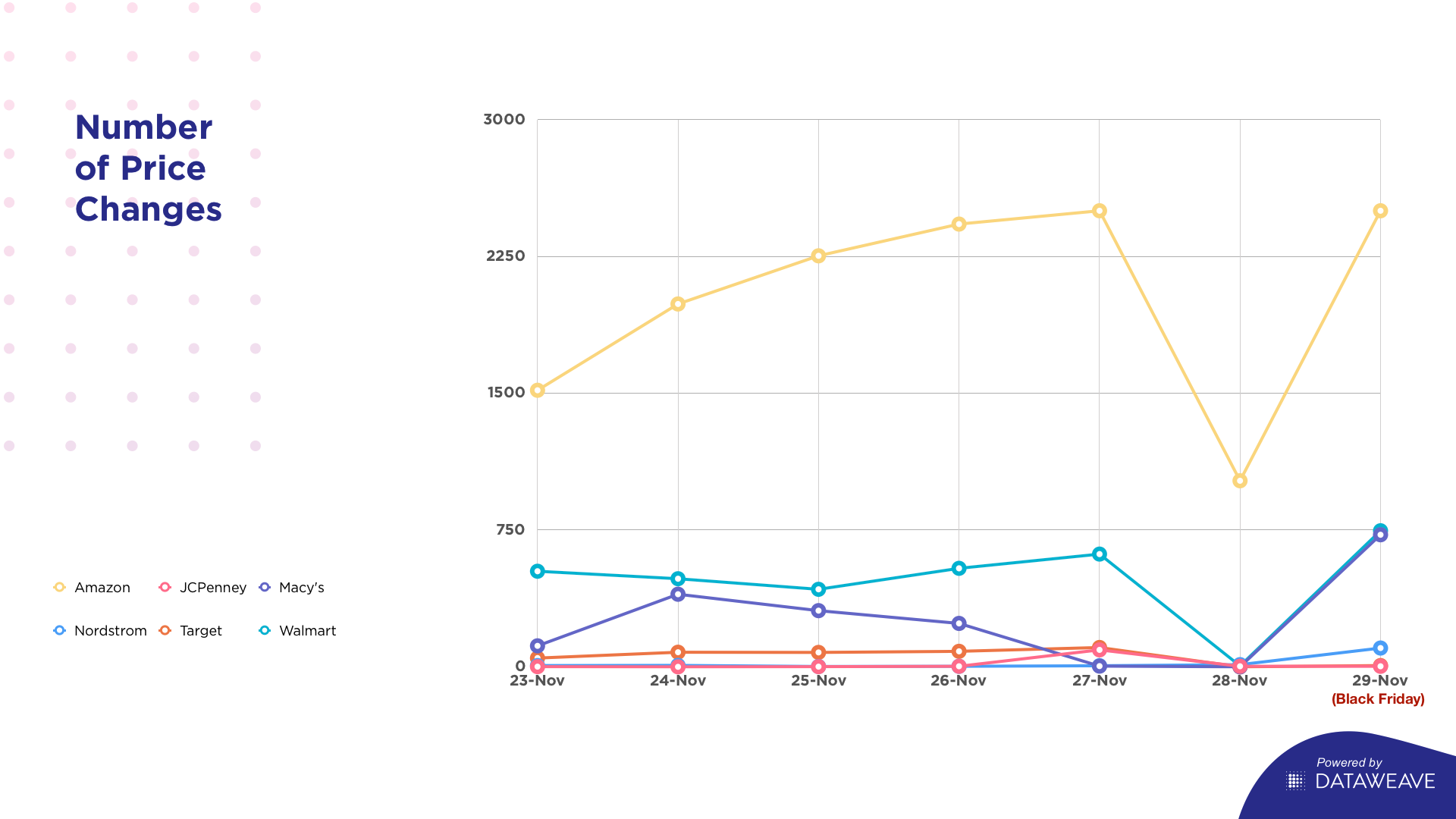
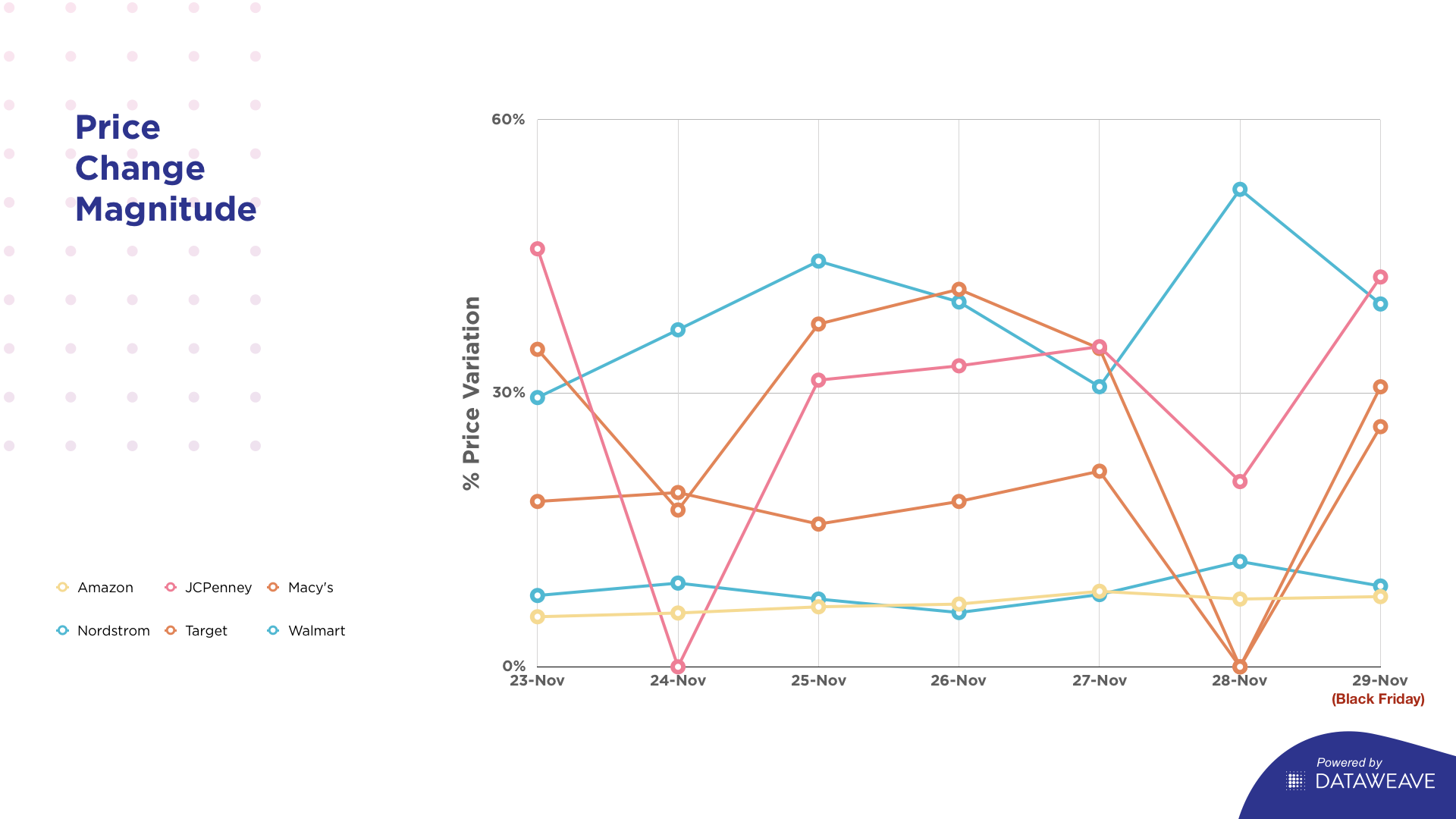
     

    In typical fashion, we observed that Amazon had the most number of pricing changes by a large margin, peaking at 2500 for the set of products tracked. The next in line was Walmart a long way down at 618 changes on the 27th. Even after the multiple changes, their average price change variation remained at the lower end of the scale – in and around 10%.

    The rest of the retailers exercised fewer price changes, with the slight exception of Macy’s in the days leading up to Black Friday. However, the changes almost ceased from the day before only to marginally rise on the 29th.

    While all the retailers tended to follow a predictable pattern of decreasing variation on the 28th and sharply increasing it the next day, Nordstrom and Walmart did the exact opposite, having likely chosen to jump the gun in offering discounts during Black Friday.

    Conclusion

    To conclude, we deduced that Macy’s had relatively higher markdowns on more of its products than the rest. JC Penney, Nordstrom and Target offered high markdowns on the face of it but on a very small section of products. Unsurprisingly, Amazon and Walmart stayed true to their past patterns and remained conservative in their additional markdowns during the sale but generous in their reach.

    Have a look here at our other observations regarding the Black Friday sale and stay tuned for more insights from our analysis of other product categories!
  • Black Friday Sale: Breaking Down Pricing Strategies in Consumer Electronics

    Black Friday Sale: Breaking Down Pricing Strategies in Consumer Electronics

    Online holiday shopping (Nov-Dec) in the US for 2019 is projected to be $143.7B, a 14.1% increase from 2018. This sets a rather exciting stage for retail giants in the battle to claim market share. Interesting patterns emerge as each one tries to out-smart the other. Black Friday, in particular, is when most of the activity was expected to be concentrated.

    Inevitably, consumer electronics had strong representation, according to research by Coresight. As traffic steers more towards online shopping, there’s an increased sense of comfort in purchasing big ticket items on an ecommerce platform. There are multiple reasons why electronics lead the race during the holiday season – easy to gift, personal indulgence, comparatively shorter shelf life and well, because who among us can really resist a gadget on sale.

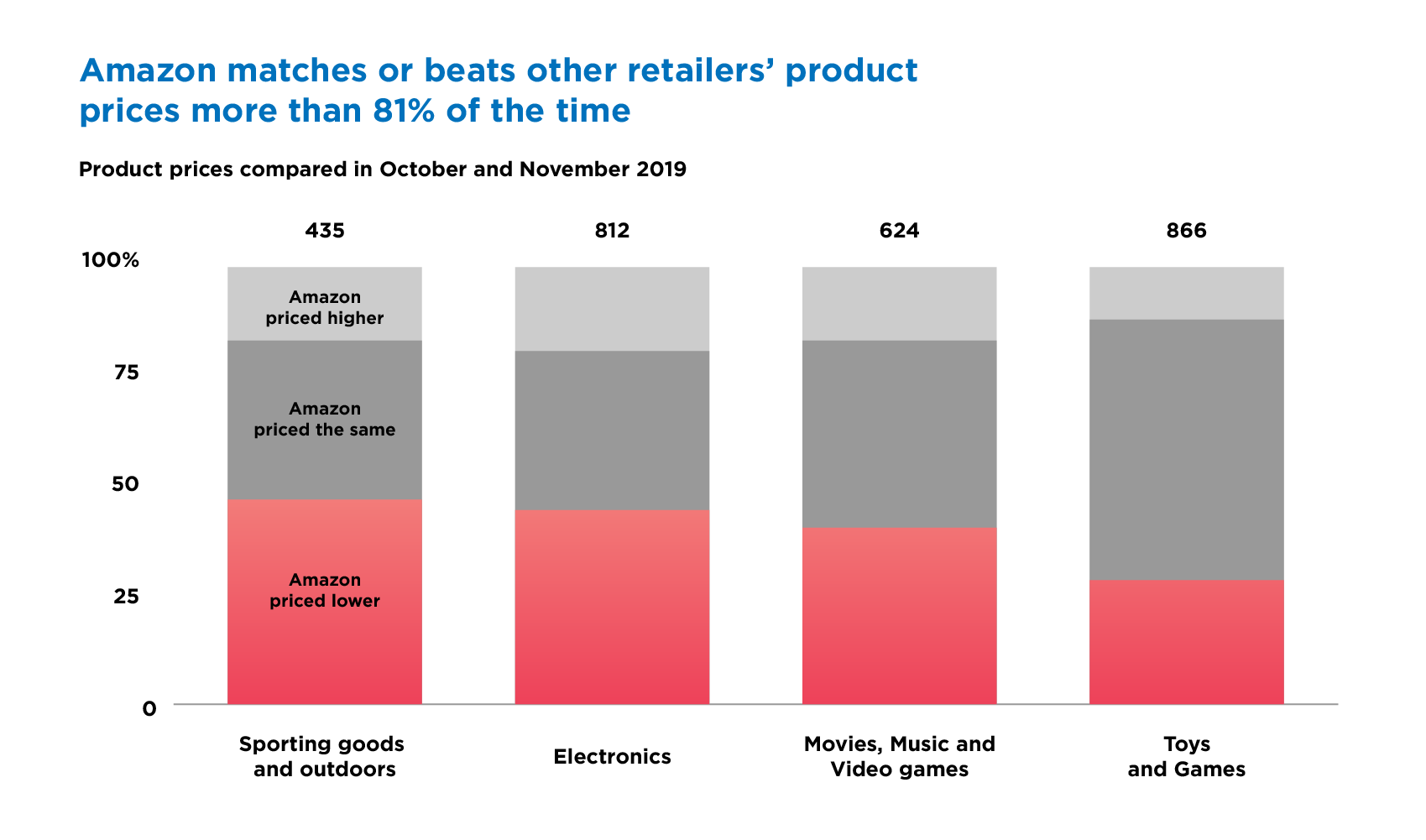
    In line with expectations during the season, there’s been a slew of generous discounts across the board. According to prior trends, Amazon was on course to be the lowest priced. In order to assess this, we decided to study a sample of 1000 products on Amazon and match them against its competitors like Walmart, Target, Best Buy and New Egg. Doing this gave us an accurate picture of the comparative pricing across retailers during this season, right up to Black Friday.

    Competitive Pricing Analysis

    There is a commonly held assumption that Amazon is the lowest priced retailer in most cases. How true is that? Here are our findings:

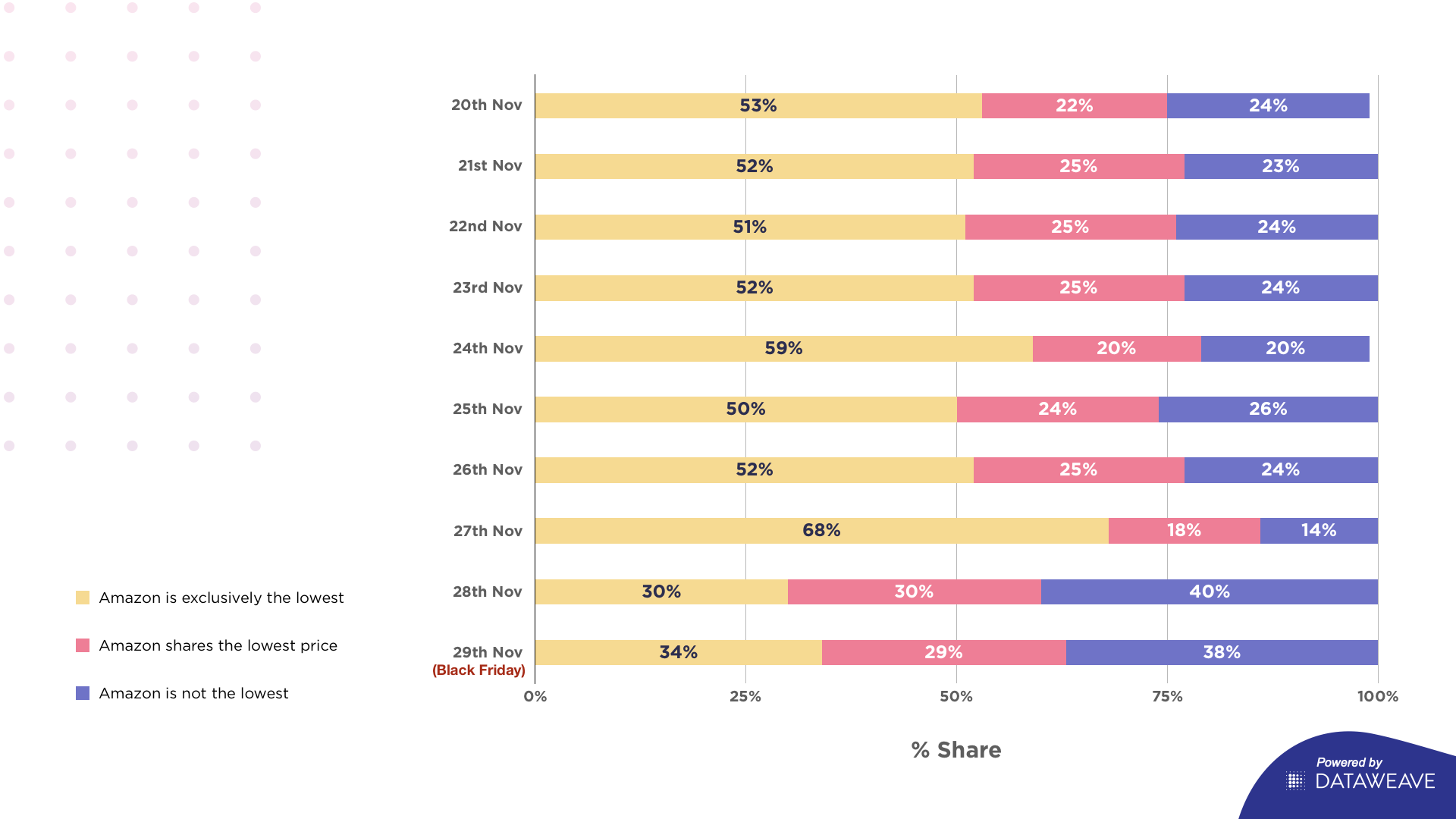
    We tracked the split across three scenarios during the holiday period – Amazon being exclusively the lowest priced, Amazon sharing the lowest priced spot and Amazon not being the lowest priced.

    Clearly, Amazon monopolized the share of lowest priced products during the entire period – with its share of lowest priced products ranging between 86% and 60%. The dip from 86% to 60% was immediate on the 27th, as Amazon’s competitors caught up. In general, Amazon’s share of lowest priced products fell from 76% to 62% on Black Friday, as its competitors launched their most aggressive promotional campaigns for the holiday season. As shown in the next chart below, a large portion of this can be attributed to Target’s pricing activity.

    Relative Price Index

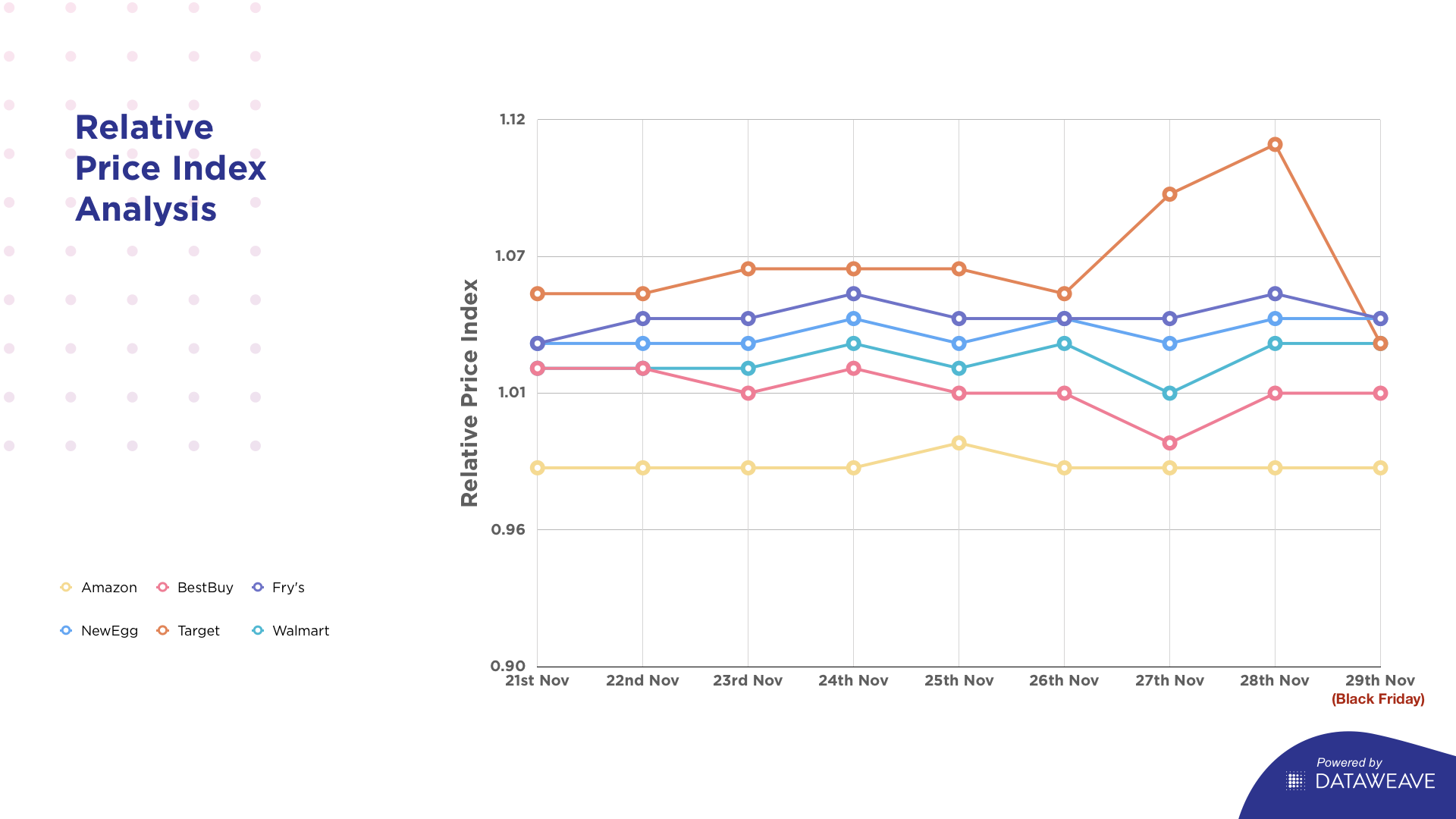
    From 21 November until Black Friday, we calculated the price index across retailers, which indicates the relative pricing levels each day for the set of matched products – the lower the price index, the lower the average relative price.

    Unsurprisingly, Amazon has been consistently the lowest priced by a fair margin. A few rungs down, New Egg and Fry’s have been going head-to-head with their price positions. Target on the other hand, underwent a spike in relative pricing from 26-28 November. To sum up, in order of lowest pricing, it’s Amazon, Best Buy, Walmart, New Egg, Fry’s and Target.

    Additional Markdowns

    While the insights above were unearthed by comparing the products of retailers against a sample of 1000 Amazon products, we went further and performed a separate analysis on a different sample of 15,000+ products across retailers, which focussed on the top 500 ranked products of each product type for Amazon, Best Buy, Target and Walmart. The product types considered include Digital Cameras, DSLRs, Headphones, Laptops, Mobile Phones, Refrigerators, Tablets, Televisions, USB Flash Drives and Wearables.

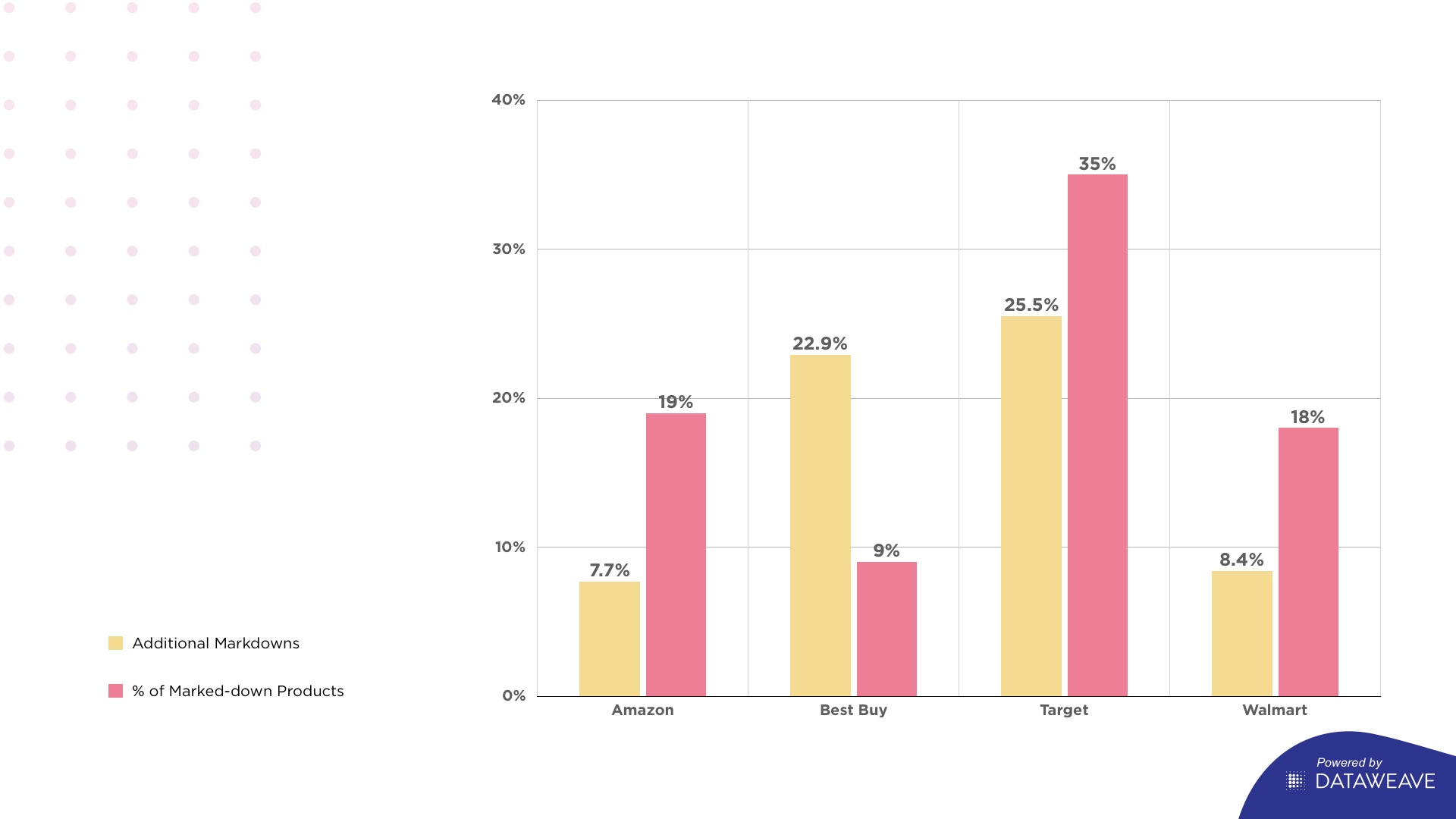
    Here, we compared the prices during the sale with the mode of the prices of the same retailer the week before. This put into perspective the level of additional markdowns during the sale period, enabling us to better understand the additional value to shoppers during the sale period (since discounts are often offered during non-sale periods too).

    Looking at opposite ends of the spectrum, we find Amazon with the least drastic markdowns during the sale as it tends to consistently have lower prices across the board. At the other end, there’s Best Buy and Target with the most aggressive markdowns; Target taking the lead, 25.5% on 35% of its products, which is also consistent with the activity we observed in the previous sample of matched products.

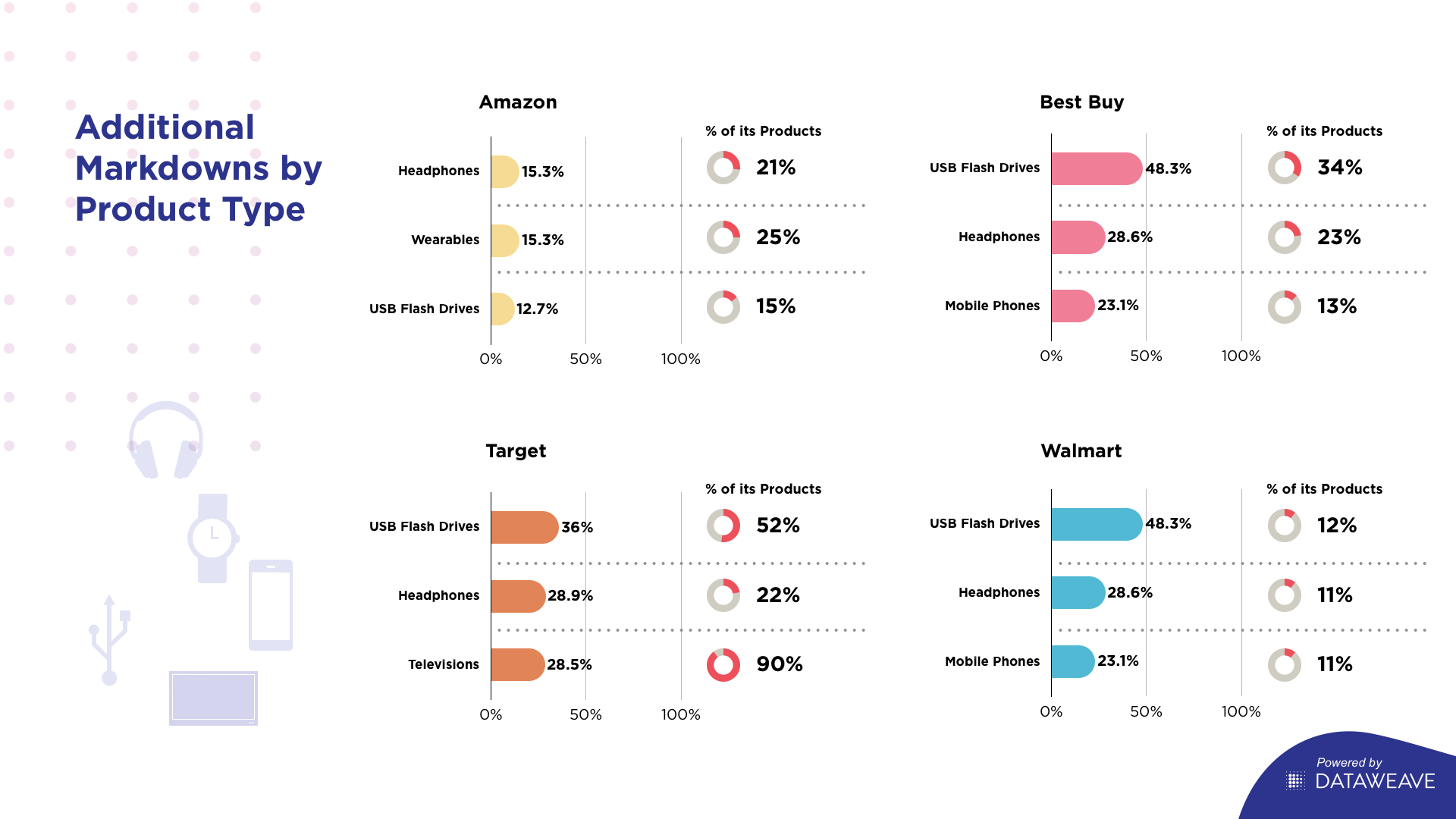
    Going further, we’ve broken down the markdown activity by the top product types for each retailer. Across the board, we observe attractive discounts on Headphones, USB Flash Drives and Mobile Phones.

    Price Change Activity

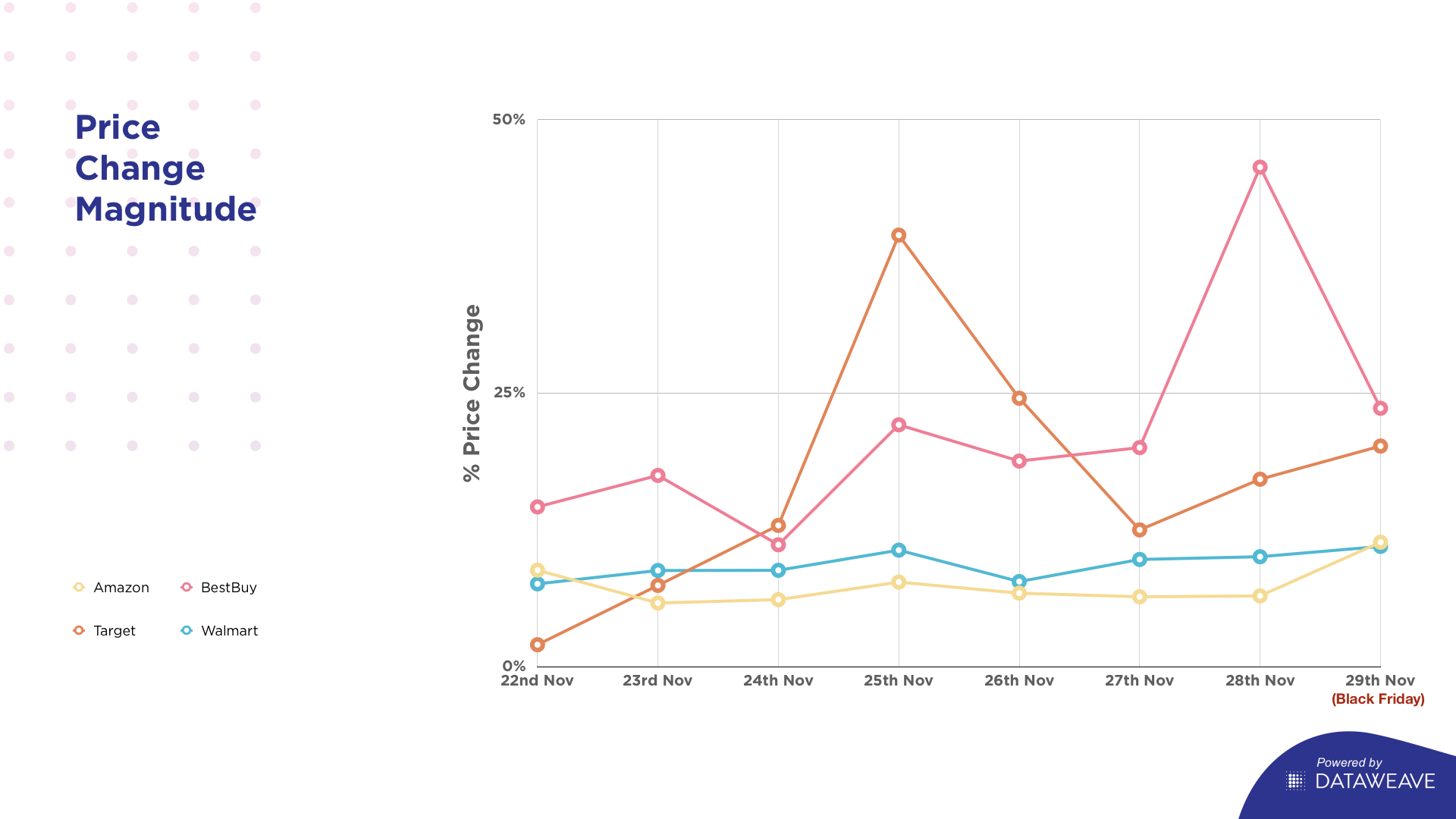
    With the proliferation of pricing intelligence tools (often driven by algorithms), dynamic pricing is a commonly observed behavior among retailers. We analyzed this trend during the holiday period to identify the retailers that are most aggressive in their price change activity. The following charts reveal the number of price changes performed by retailers in our sample as well as the average price variation during this holiday period.

    Amazon made several price changes during the week but with a relatively low magnitude, since it was the lowest priced anyway through the week. The only other player with similar activity was Walmart. Target and Best Buy had significantly fewer price changes but when they did make the changes, the magnitude was much larger. Their focus was solely on a smaller, select set of products where they went all in.

    In conclusion

    As the years advance, the duration of holiday sales is no longer restricted to the actual holiday, but the days preceding and following them as well. With more and more people getting increasingly comfortable with online shopping (14.1% increase from 2018), buying habits are evolving too. Big retailers are cashing in on this and driving their pricing strategies to keep up with the evolution.

    One of the clear cut findings from our research is that there are two primary paths they take: smaller additional markdowns over a longer period and larger additional markdowns over a shorter period. Whichever path they choose, retailers need to be on top of the game with valuable insights, that give them a competitive edge. For accurate and large scale competitive intelligence, reach out to us.

  • Amazon on course for an aggressive Black Friday

    Amazon on course for an aggressive Black Friday

    The holidays are around the corner and that much awaited holiday cheer, has now become directly proportional to the arrival of an Amazon package. According to a new report, in partnership with Bain & Company, DataWeave has observed that early in November, Amazon had the lowest price 30%-50% of the time and matched the lowest price 35%-60% of the remaining cases, based on an analysis performed on a sample of over 16,000 products across 10 websites and 5 product categories.

    Aggressive pricing strategies have been Amazon’s modus operandi for a while now and it’s not about to change this season. In the build up to the Black Friday promotions this year, they even slashed their prices of the rarely discounted Apple products, such as the iPad Pro. This sets the tone for what shoppers can expect as the holiday season comes upon us.

    Results of a recent survey, published as part of the Bain report, revealed that ‘value for money’ was the primary concern that influence purchasing decisions, across categories. In the same breath, the respondents went on to say that they perceive Amazon as a ‘value leader’, sans womens’ clothing and pet supplies.

    Although this season might continue to see Amazon rake in the most market share, competitors are not far behind. There’s heavy investment from the likes of Walmart and others in order to negate the effects of the undercut. If these competitive responses become louder, the dent on customer perception could begin to tilt to more neutral ground.

    Stay tuned as we follow this pattern during the season and release our findings over the next few weeks.

    For access to the full article that was published in the Retail Holiday Newsletter by Bain & Company and powered by DataWeave, click here.

  • Prime Day 2019 Fashion: Were the Deals as Attractive as the Merchandise?

    Prime Day 2019 Fashion: Were the Deals as Attractive as the Merchandise?

    Target and Walmart offered more appealing discounts than Amazon during Prime Day 2019.

    Statista estimates that e-commerce fashion accounted for approximately 20.4% of overall fashion retail sales in the United States in 2018, which amounted to about $103 billion in absolute terms. According to Internet Retailer, apparel is the largest and among the most competitive retail categories in e-commerce. Moreover, as a share of total apparel and accessories sales, online apparel sales is growing at a faster rate than US e-commerce as a whole.

    Given the high-growth and competitive nature of the category, we at DataWeave were interested to find out how high the stakes got during the fifth annual Prime Day earlier this month.

    Our Methodology

    Since Prime Day is no longer necessarily an Amazon event (since competing websites often offer attractive discounts as well), we tracked the pricing of several leading retailers selling fashion apparel, footwear, and accessories to assess their pricing and product strategies during the sale event. Our analysis was focused on additional discounts offered during the sale to estimate the true value that the sale represented to its customers. We calculated this by comparing product prices on Prime Day versus the same prices prior to the sale.

    Our sample consisted of 20 product types across women’s as well as men’s fashion categories. While we did monitor exclusive fashion retailers Macy’s, Bloomingdales, Nordstrom, and Neiman Marcus, we did not find them offering any additional discounts – an interesting insight all on its own since they’ve clearly chosen not to compete with Amazon during the two days of the Prime Day sale. We therefore restricted the rest of our study to Amazon, Target, and Walmart – the latter two of which interestingly offered immensely aggressive discounts in their apparel categories.

    The Verdict

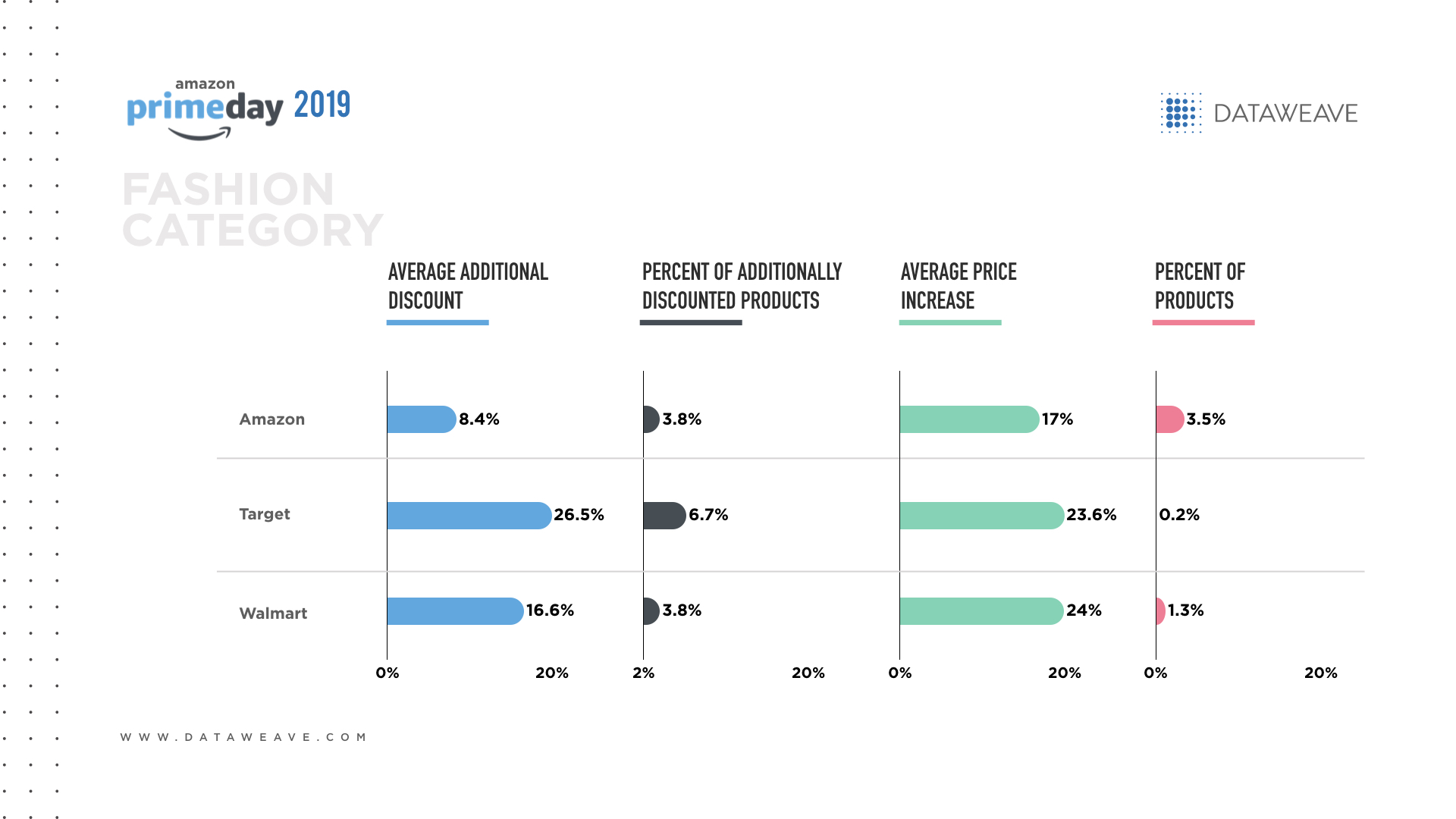
    Despite owning the day at least in name, Amazon was found to offer the lowest additional discounts among the retailers studied. Target and Walmart, on the other hand, ensured that they didn’t lose out on market share this Prime Day by offering substantially high discounts of their own. While Target was the most aggressive with a steep average markdown of 26.5%, Amazon closed out the bottom at 8.4%.

    Walmart and Target didn’t seem particularly focused on compensating their sharp discounts with price increases in other products – their focus seems to have been solely only on offering timely discounts during the sale. Amazon, on the other hand, marked up just about as many products as it marked down, with the markup margin being close to double that of the markdown in an effort to protect margins during the sale.

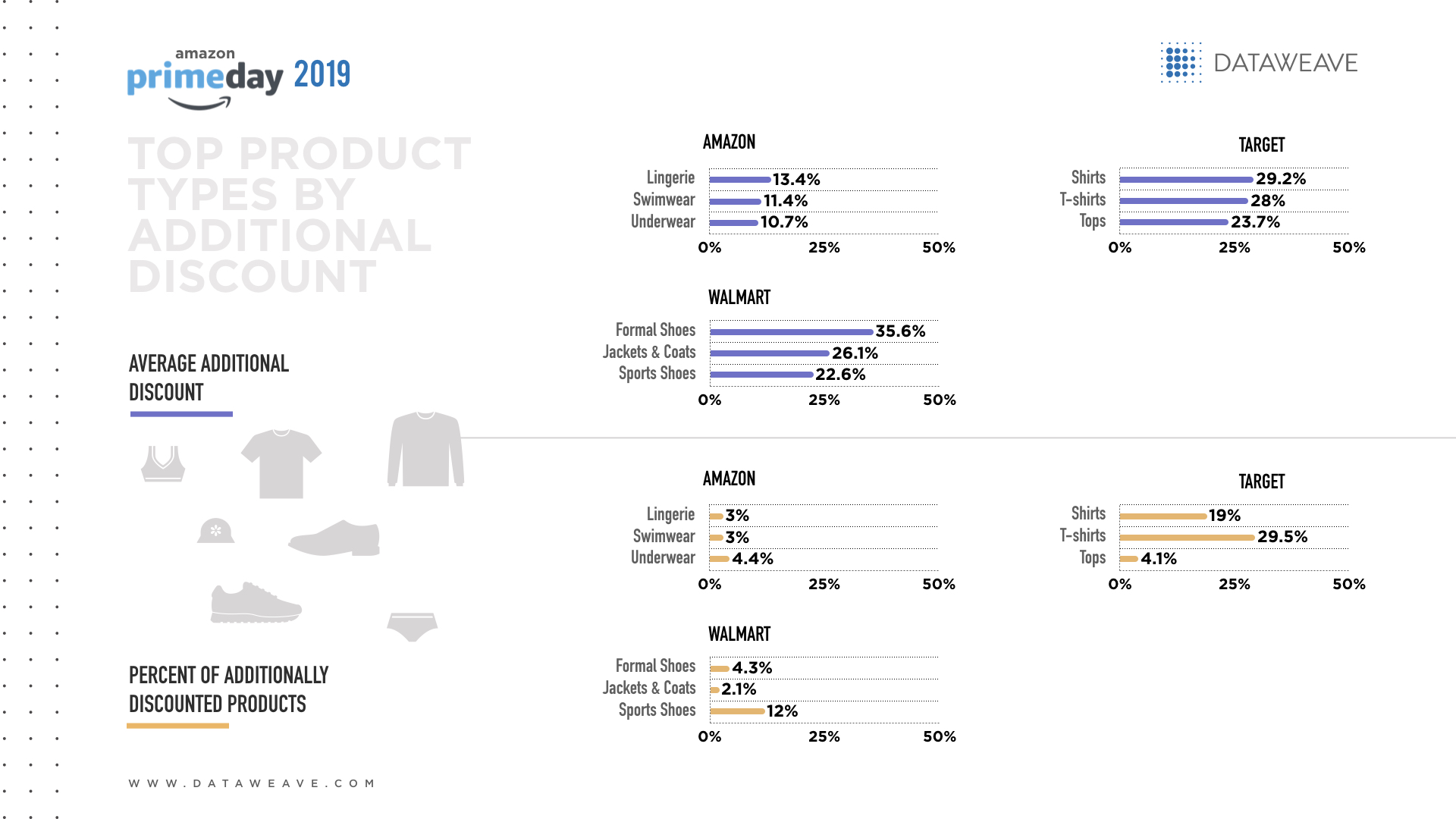
    Top product types by additional discount

    Target and Walmart both offered aggressive discounts across their top product categories. Walmart ended up with a marginally higher overall average additional discounts on product types like Shirts, T-shirts, and Tops.

    Interestingly, though Amazon offered moderate discounts across its top categories (Lingerie, Swimwear, and Underwear), the volume of marked down products was very limited.

    Additional discounts across popularity levels

    We determined popularity using a combination of average review rating and number of reviews, and the resulting scores were categorized as low, moderate, and high.

    When it came to discounting popular products, there were clear differences in strategy among all the three retailers. Amazon, which interestingly had close to 60% of its products in the low popularity bucket, chose to offer the highest discounts in the same category – indicating an effort to clear its stock of unpopular products. Target and Walmart, on the other hand, focused their discounts on moderate rated products.

    Additional discounts across product “premiumness” levels

    Premiumness was calculated as the average selling price before the sale event. This was divided into four percentile blocks, with higher percentile blocks indicating higher selling prices.

    As found in the electronics and furniture categories that were analyzed previously, most of the discounting activity was focused on the lower end of the premium spectrum with a view to protect margin – despite a largely equitable distribution of discounted products across percentile ranges (with the exception of Target, which had a discounted assortment heavily dominated by its least premium products).

    This indicates a clear strategy to protect margins, while still maintaining the perception of promoting attractive offers to draw traffic. Target and Walmart both offered substantial additional discounts of close to 30% on their least premium products, while at 12%, Amazon offered less than half that discount.

    Additional discounts across visibility levels

    Given the fairly large number of SKUs across the fashion category in general, the discounts across visibility levels understandably didn’t vary much when compared to the more pronounced fluctuations observed in the electronics and furniture categories. This is also largely because consumers tend to explore lower ranked products more so in the fashion category than in other categories.

    Across product categories, we’re seeing lower-than-expected additional discounts on Amazon this Prime Day, coupled with more aggressive pricing activity by Amazon’s competitors. While this puts more pressure on Amazon, this also is a strong validation of Prime Day as a key annual sale event on the US shopper’s calendar.

    Curious to know how Amazon and its competitors performed in other product categories this Prime Day? Watch this space for more!

  • Online Furniture Pricing Strategies on 2019 Prime Day

    Online Furniture Pricing Strategies on 2019 Prime Day

    Just as with electronics, other retailers actually offered far better discounts than Amazon during Prime Day 2019.

    Online furniture sales have risen significantly since the 2000s, driven largely by a growing array of products, and even more so by the convenience of avoiding travel and crowded stores. According to Statista, online furniture and homeware sales were estimated to reach approximately $190 billion in 2018, with China and the United States accounting for over $60 billion in revenue each.

    Thus, furniture has quickly become a key product category during sale events globally – and Prime Day was no different. At DataWeave, we got down to figuring out exactly how plum those deals were this year.

    Our Methodology

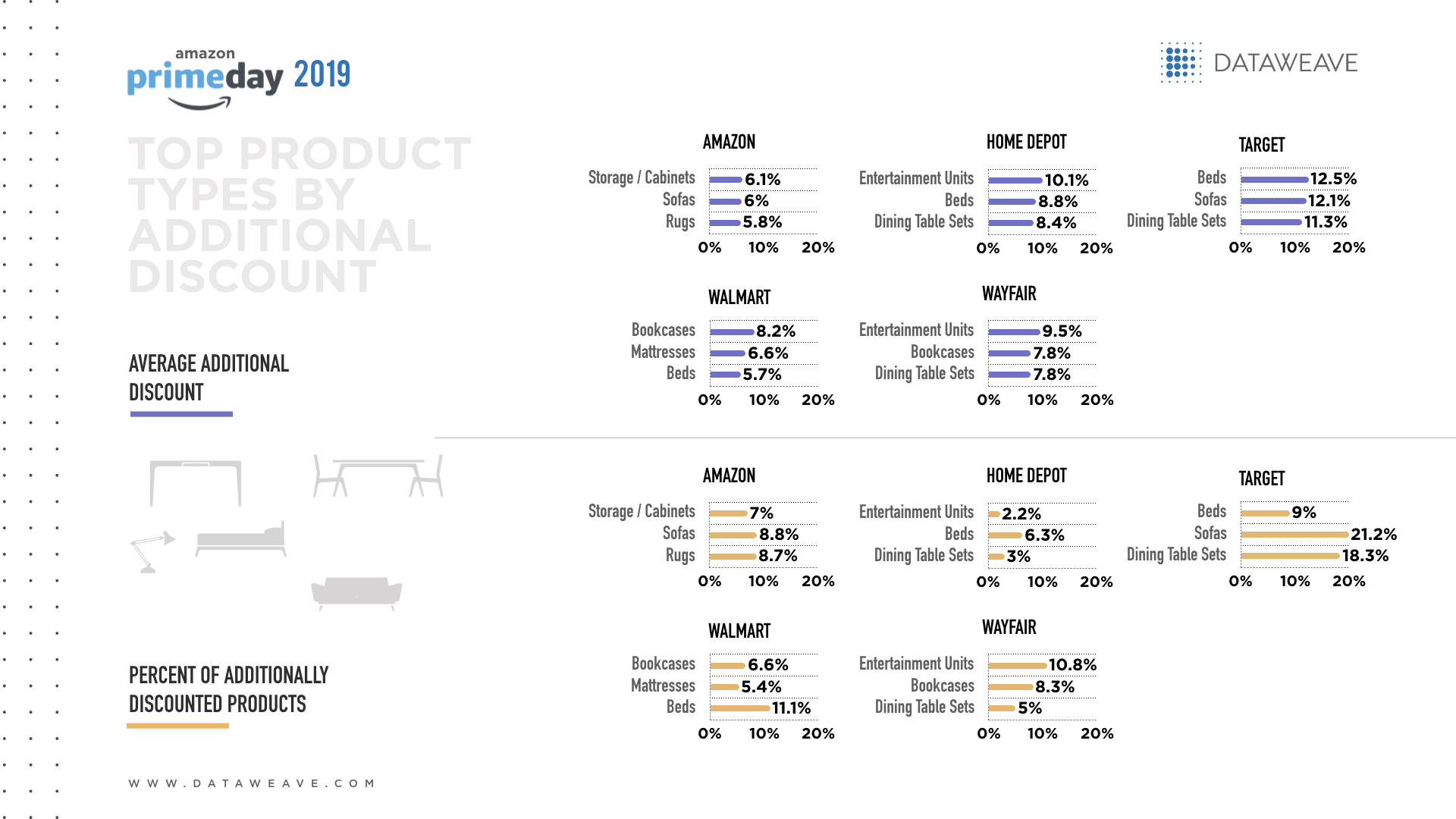
    We tracked the pricing of several leading retailers selling home and furniture products to assess their pricing and product strategies during the sale events. Our analysis was focused on additional discounts offered during the sale to estimate the true value that the sale represented to its customers. We calculated this by comparing product prices on Prime Day versus the same prices prior to the sale. Our sample consisted of the top 1,000 ranked products across 10 popular product types, including beds, dining table sets, sofas, entertainment units, and coffee tables – analyzed for five retailers (Amazon, Home Depot, Target, Walmart, and Wayfair).

    The Verdict

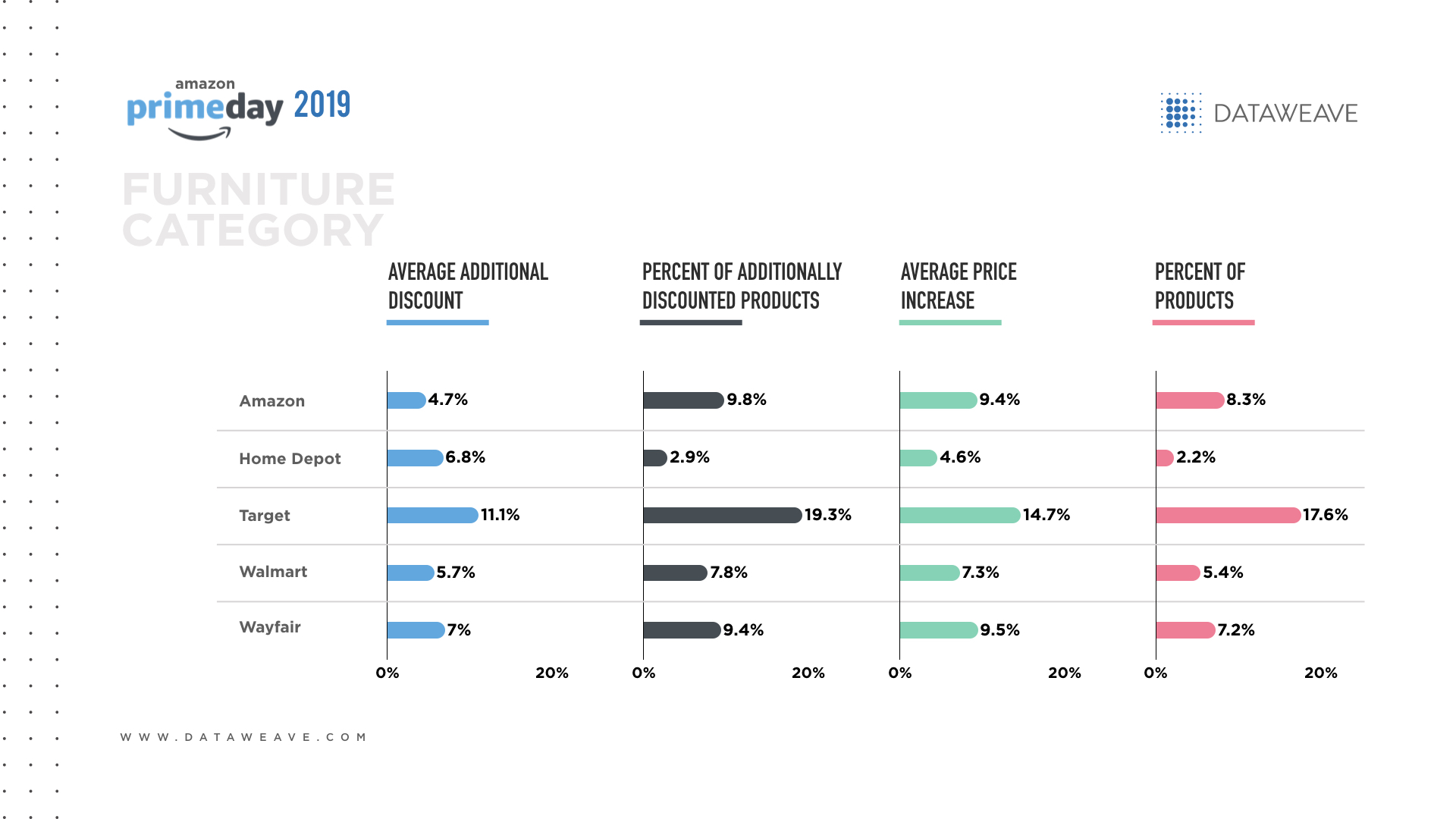
    As we found in the electronics category, there were surprising price spikes in this category too – with Target reporting an average increase as high as 14.7%, and Amazon clocking a still moderately high 9.4%. Target also reported the highest distribution of products with price markups. Home Depot indicated the lowest price increase at 4.6%.

    When it came to additional discounts, Amazon fell short of expectations – at 4.7%, it offered the lowest average among its competitors. Target, on the other hand, was extremely aggressive both in terms of additional discounts and volume of discounted products.

    To conclude, all the retailers observed seemed to be keeping a close watch on their margins by countering price reductions with nearly equivalent surges elsewhere in their assortment.

    While there was no single product type that was found to be popular across all five retailers, it was clear that Target was again the most aggressive at offering discounts. It also had among the largest product ranges on discount.

    Amazon chose to follow a very moderate route both in terms of average discount and discounted product volume.

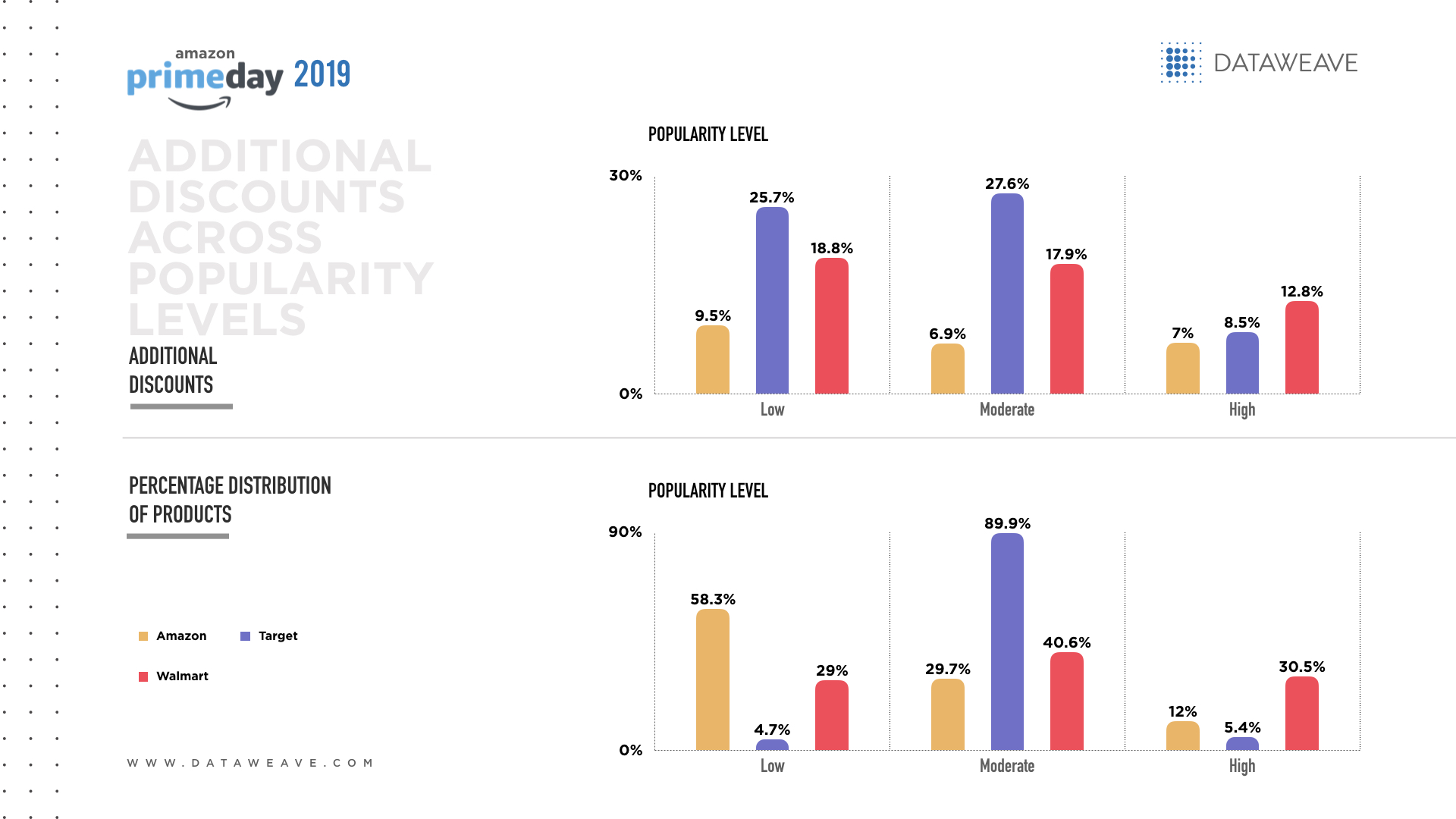
    Additional discounts across popularity levels

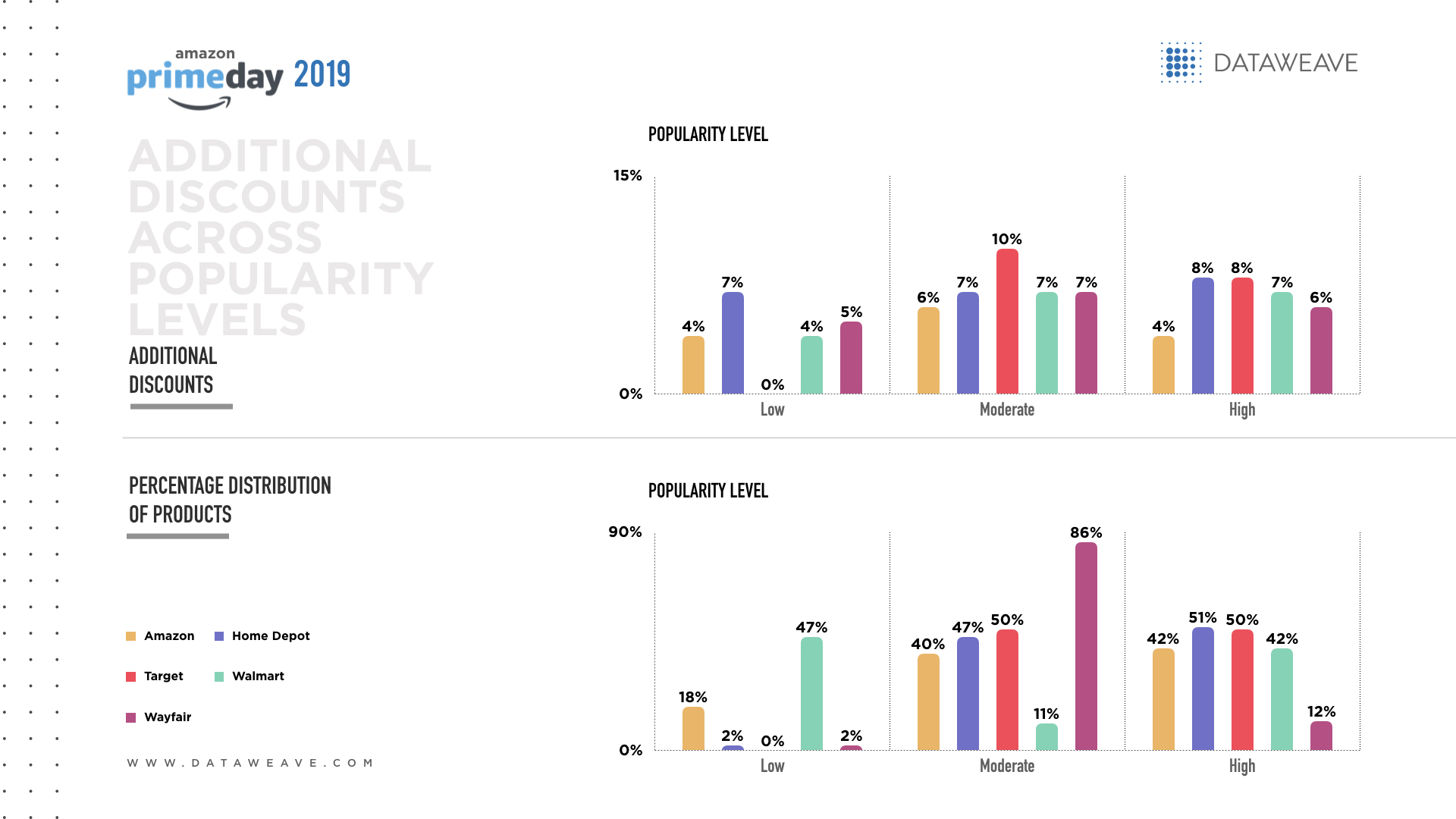
    We determined popularity using a combination of average review rating and number of reviews, and the resulting scores were categorized as low, moderate, and high.

    There doesn’t seem to have been much of a focus on low-popularity products in terms of additional discounts. Most of the attention was focused on products with moderate popularity, since there isn’t much of a need to be aggressive on price for highly popular products, and products with lower popularity aren’t really worth promoting.

    The only retailer that offered a higher discount on its most popular products was Home Depot. Walmart, too, seemed reluctant to let go of the opportunity to capitalize on popularity – it chose to offer the same discount on moderately as well as highly popular products.

    Interestingly, Walmart seems to have a disproportionately large share of products in its low popularity category – something it should possibly evaluate in the future in terms of brand quality, products, and service.

    The percentage distribution of products mostly indicated a linear relationship, with the highest distribution usually being offered for highly popular products. The exception was Wayfair, which offered a much larger array in its moderately popular category.

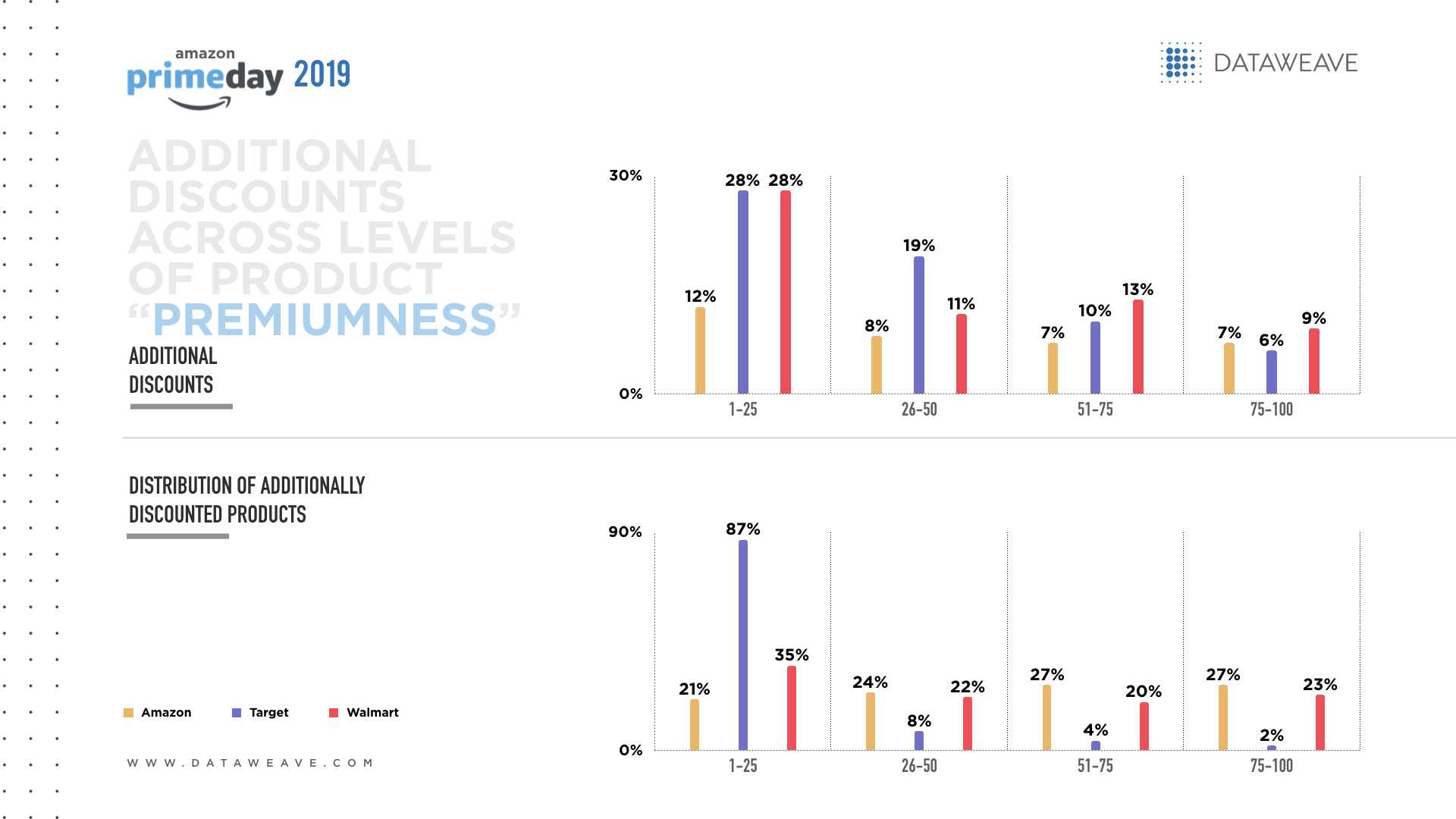
    Additional discounts across product “premiumness” levels

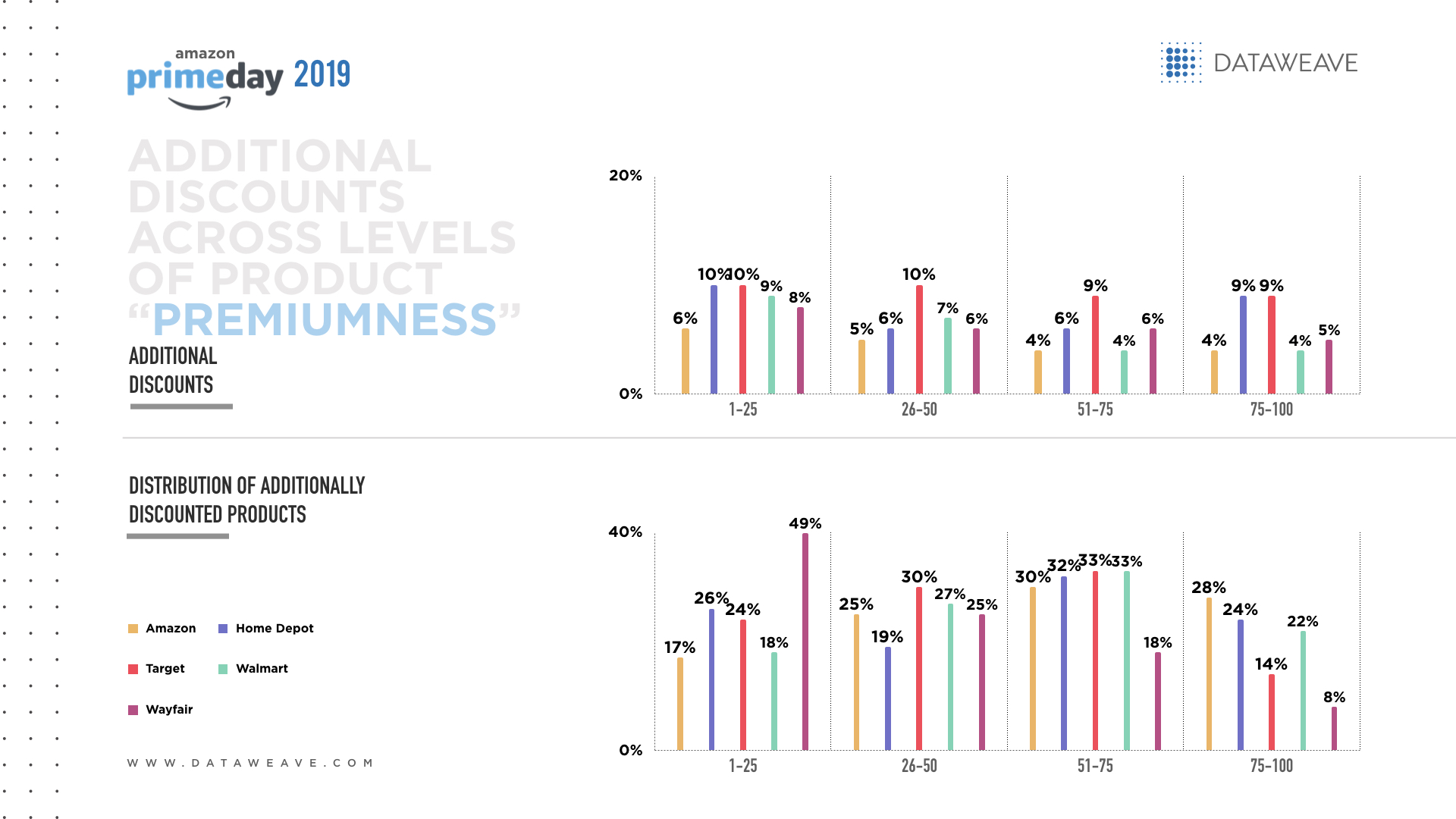
    Premiumness was calculated as the average selling price before the sale event. This was divided into four percentile blocks, with higher percentile blocks indicating higher selling prices.

    Most of the discounting activity seems to have occurred in the lower end of the premium spectrum, with a view to protect margin – despite a largely healthy distribution of products across percentile ranges. This indicates a clear strategy to protect margins, while also promoting attractive offers to draw traffic.

    However, there are a couple of exceptions – Target was consistent throughout the “premiumness” spectrum, resulting in the highest overall discounting activity. Home Depot too was aggressive, but selectively so – it chose attractive pricing for the lower and higher ends of its assortment.

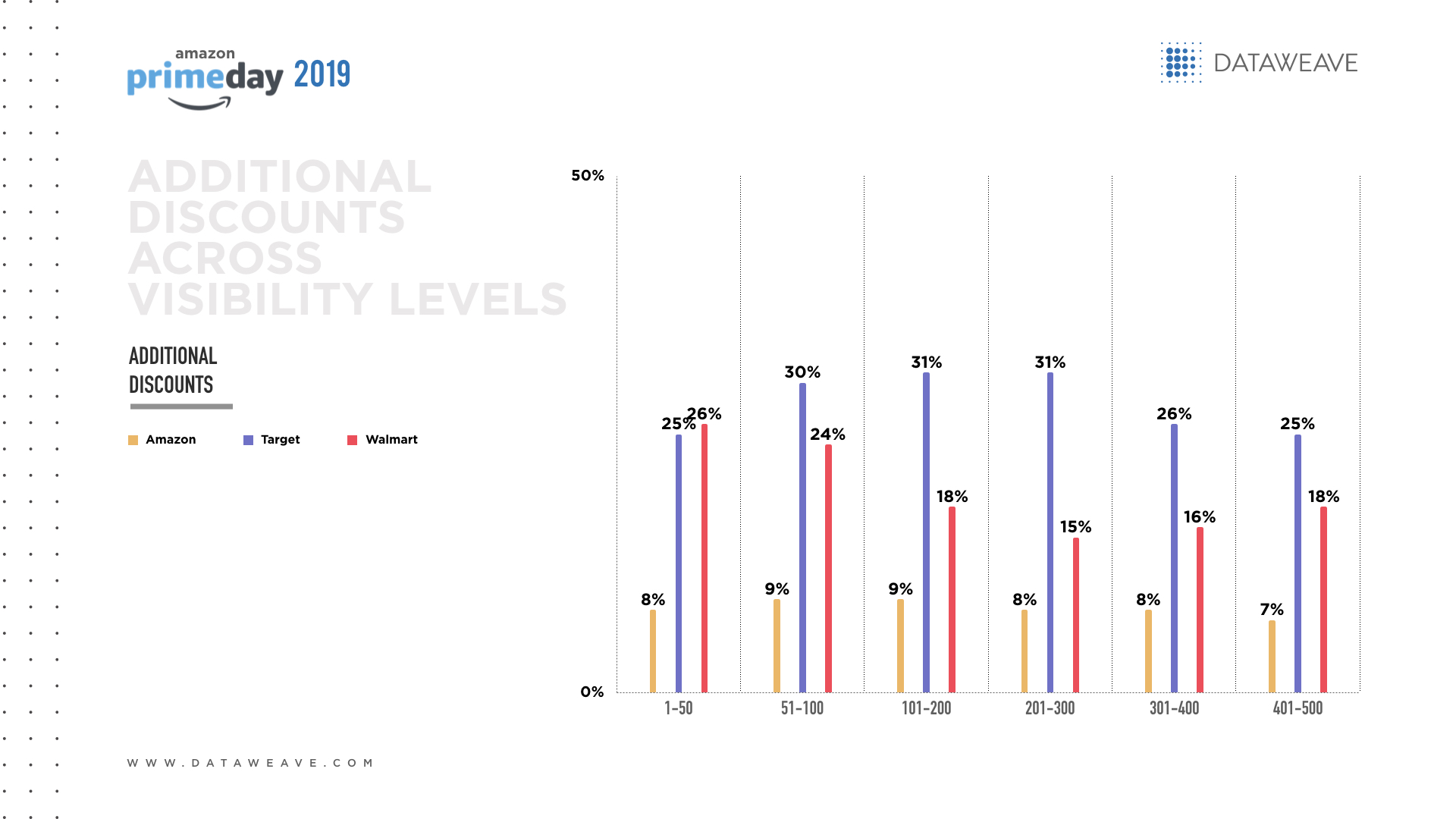
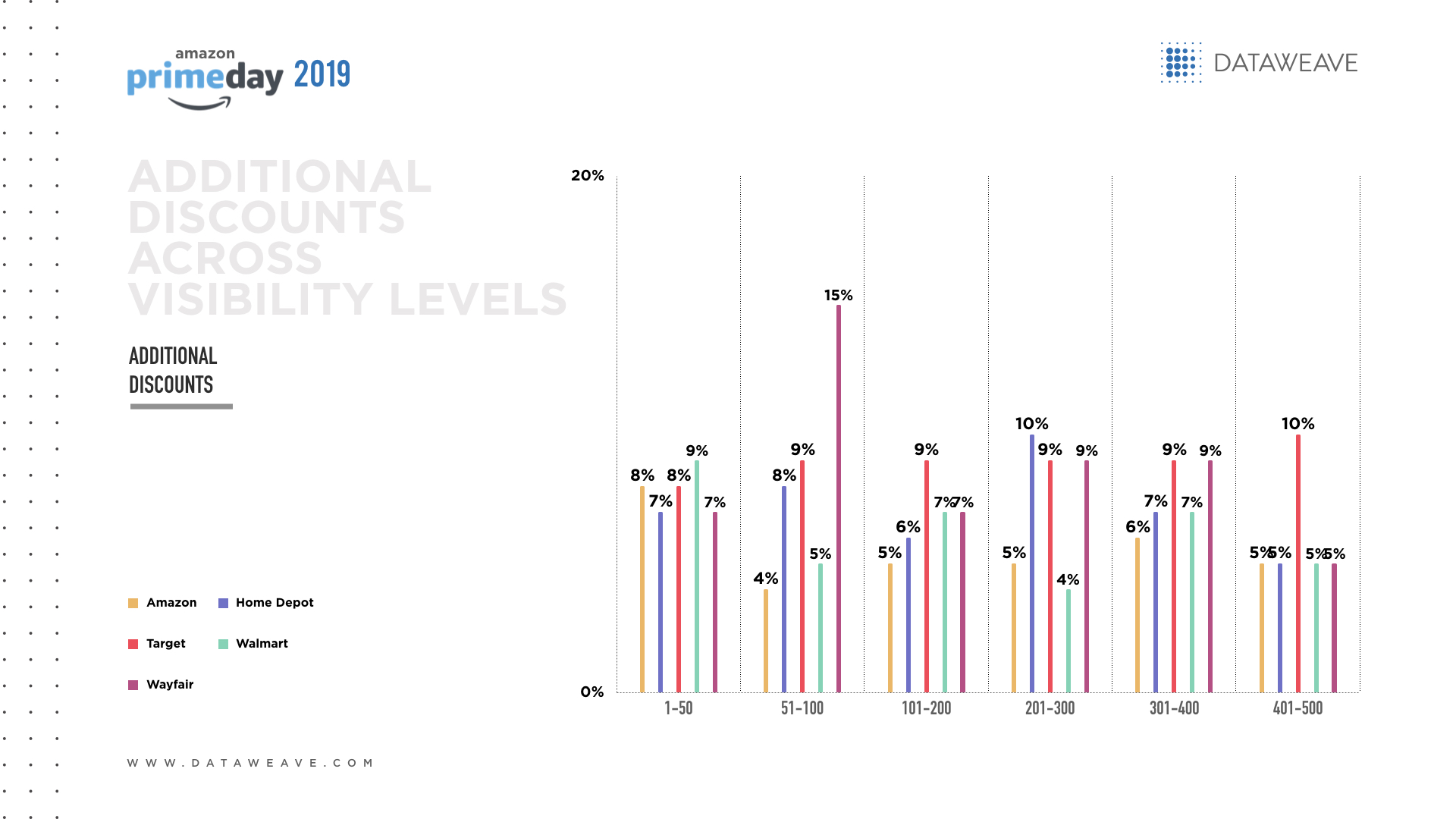
    As expected, many retailers showed higher discounting activity in the higher ranks of their listing pages. As usual, though, there are a few exceptions here too. Home Depot and Wayfair indicated unusual patterns – perhaps relying on search results as opposed to organic listing page results. On the other hand, Target again indicated a consistent pattern, with mostly similar discounts across visibility levels.

    Overall, across all parameters analyzed, both the Electronics and Furniture categories have been treated quite similarly in terms of pricing activity by most retailers. Is Prime Day really all about its marketing hype, or will it live up to its promise in at least one segment? Stay with us to find out as we follow through with our series of articles analyzing various product categories on this year’s Prime Day.

  • A Study of Deals on Amazon Prime Day 2019 | DataWeave

    A Study of Deals on Amazon Prime Day 2019 | DataWeave

    Our preliminary analysis reveals that Prime Day 2019 had other retailers offering better deals than Amazon in many cases.

    As Prime Day extended into an additional day this year, Amazon seems to be hitting the right note with its customers, going by the revenue it’s raking in. This year, the longest Prime Day event ever witnessed a sales increase of 72%overtaking Black Friday and Cyber Monday combined.

    At DataWeave, we were curious to find out how prime these deals were, and if in fact other retailers were offering better discounts. We started with the electronics category, which remains among the most popular categories year on year.

    Our Methodology

    We tracked the pricing of several leading retailers selling consumer electronics to assess their pricing and product strategies during the sale event. Our analysis was focused on additional discounts offered during the sale to estimate the true value that the sale represented to its customers. We calculated this by comparing product prices on Prime Day versus the prices prior to the sale. Our sample consisted of up to the top 1,000 ranked products across 10 popular product types in consumer electronics on Amazon, Best Buy, Target, and Walmart.

    The Verdict


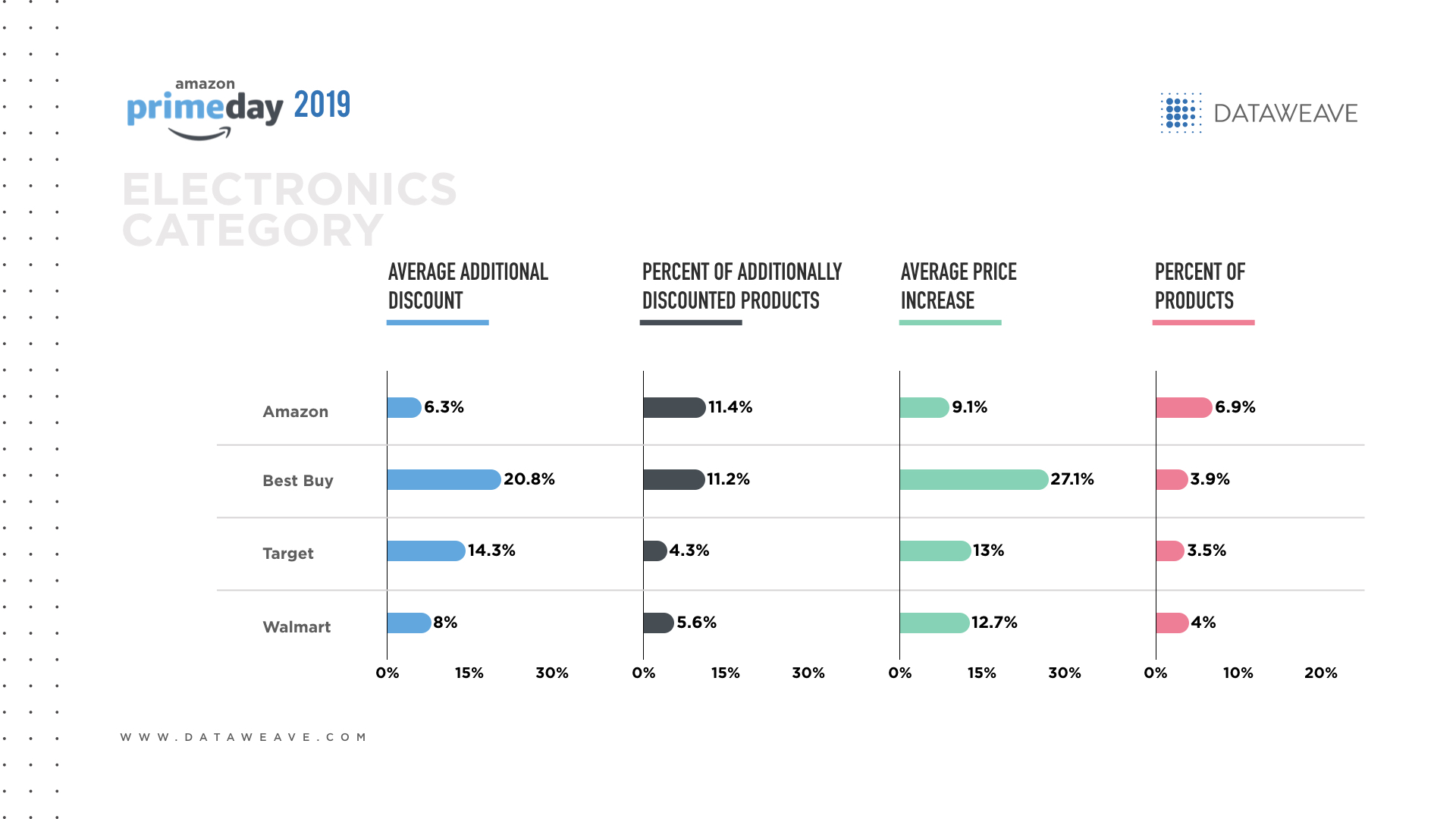
    What we found most surprising was that across retailers, some portions of the assortment underwent price increases as well. While Amazon indicated the lowest increase at 9.1%, Best Buy indicated an increase as high as 27.1%. However, Amazon reported the highest percentage of products (6.9%) that showed a price increase.

    Equally surprising was that Amazon reported the lowest price reduction at 6.3% – Walmart, Target, and Best Buy in fact reduced their prices by much larger margins than Amazon did. A point to note here, however, is that Amazon did report the highest percentage of additionally discounted products – with Best Buy coming in at a close second.

    This goes to show that Prime Day, for all its hype, does not in truth offer the best deals to Amazon shoppers. This, of course, is expected based on the competitors’ perspective of wanting to avoid losing market share. As a result, shoppers would be well advised to compare prices across websites to find the best deal.

    Top product types by additional discount


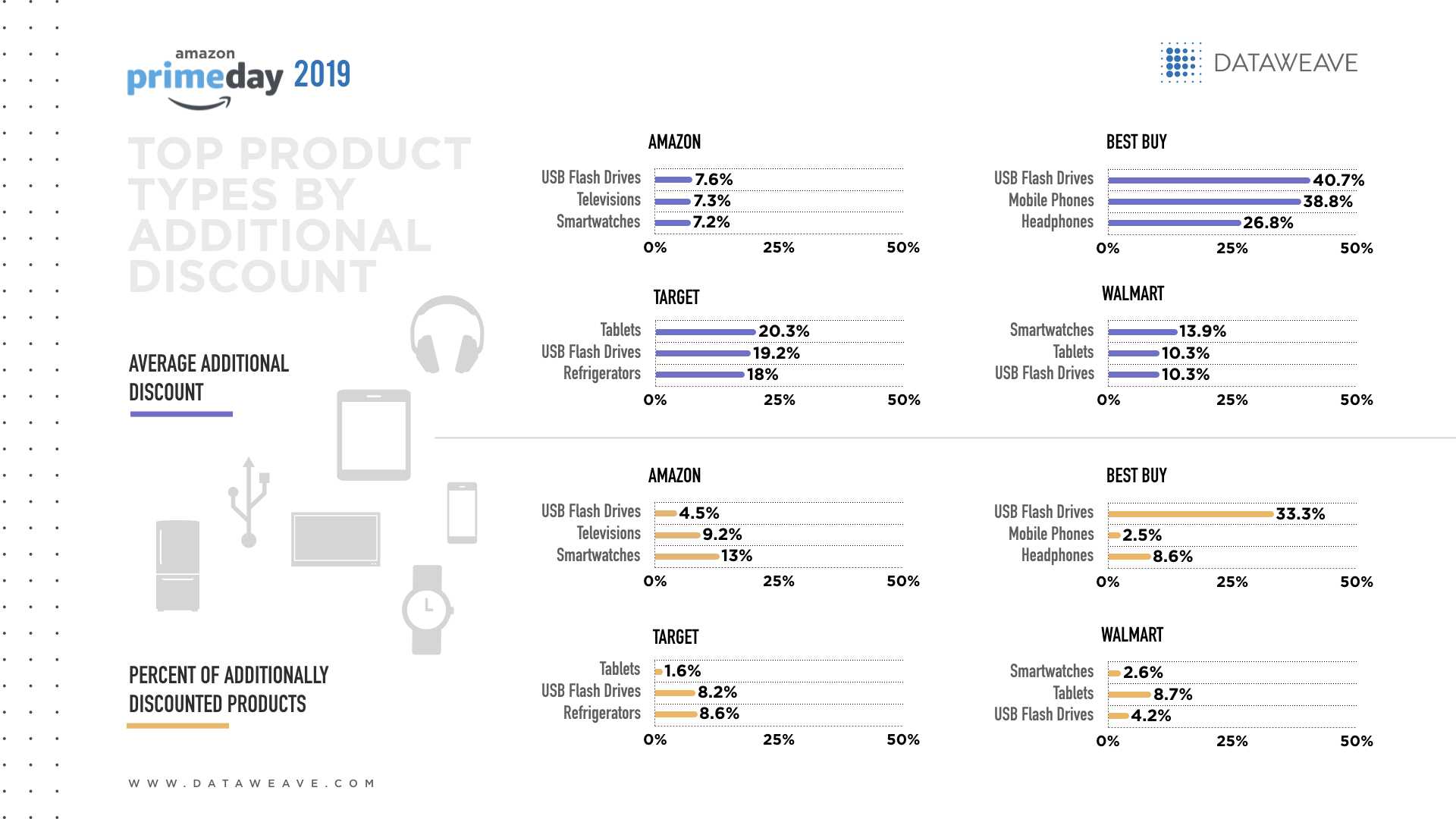
    USB flash drives were a popular product category across all four retailers analyzed, with Best Buy offering the best average additional discount at 40.7%. Other popular product types ranged from the usual personal devices such as mobile phones, tablets, and smartwatches to home appliances such as refrigerators and TVs.

    Additional discounts across popularity levels

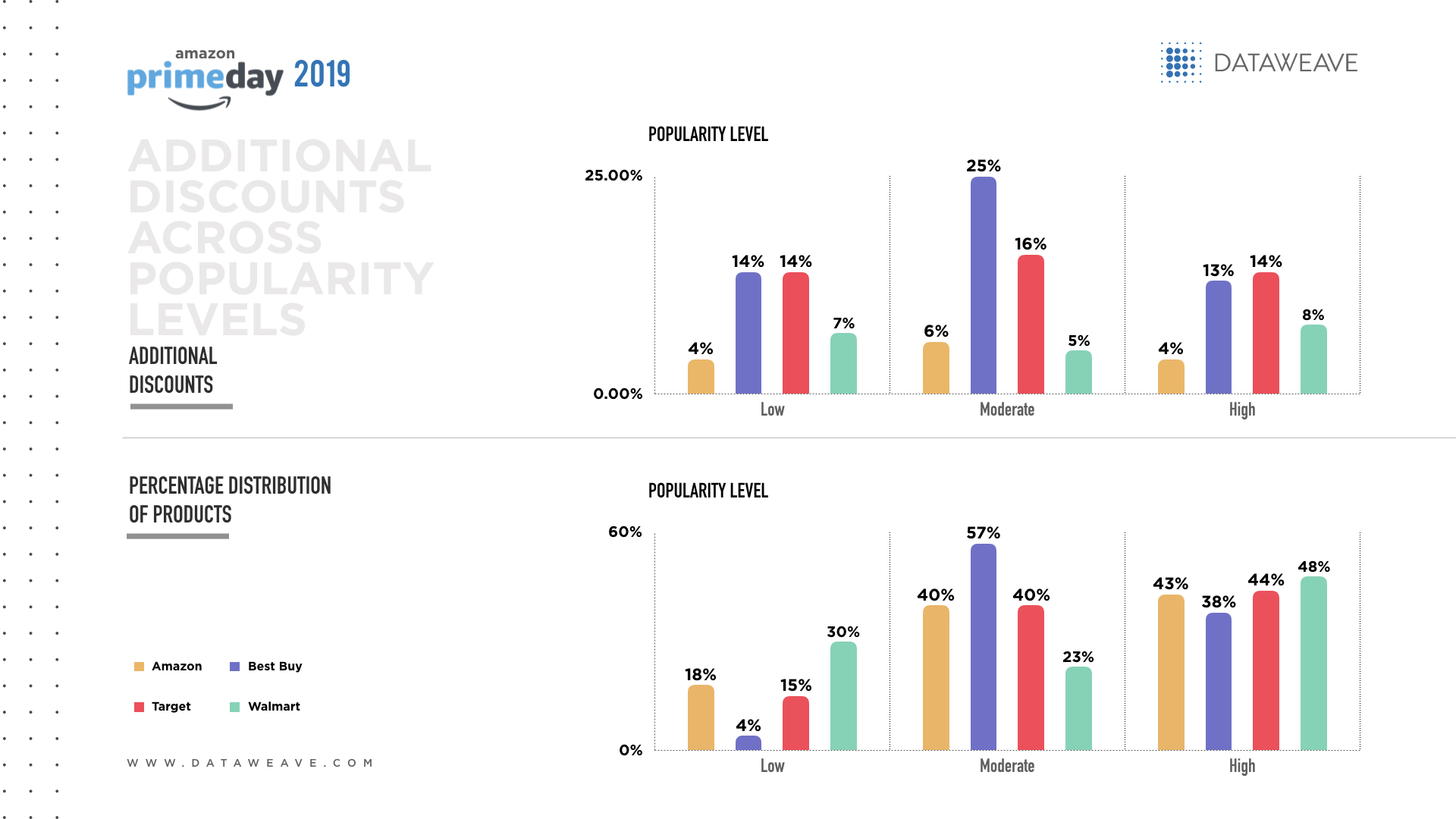
    We determined popularity using a combination of average review rating and number of reviews, and the resulting scores were categorized as low, moderate, and high.

    Interestingly, discounts were not found to be directly proportional to popularity. Except Walmart, all the retailers tended to offer the best discounts on products that enjoyed moderate popularity. This makes sense, since there isn’t a strong need to be aggressive on price for highly popular products in any case. On the other hand, products with lower popularity aren’t really worth promoting. Walmart, which was the exception, reported a higher discount on low- and high-popularity products than it did on moderately popular products.

    The percentage distribution of products did mostly show a directly proportional relationship, with the highest distribution usually being offered for highly popular products. The exception in this case was Best Buy, which evidenced a much higher distribution in its moderately popular goods.

    Additional discounts across product “premiumness” levels

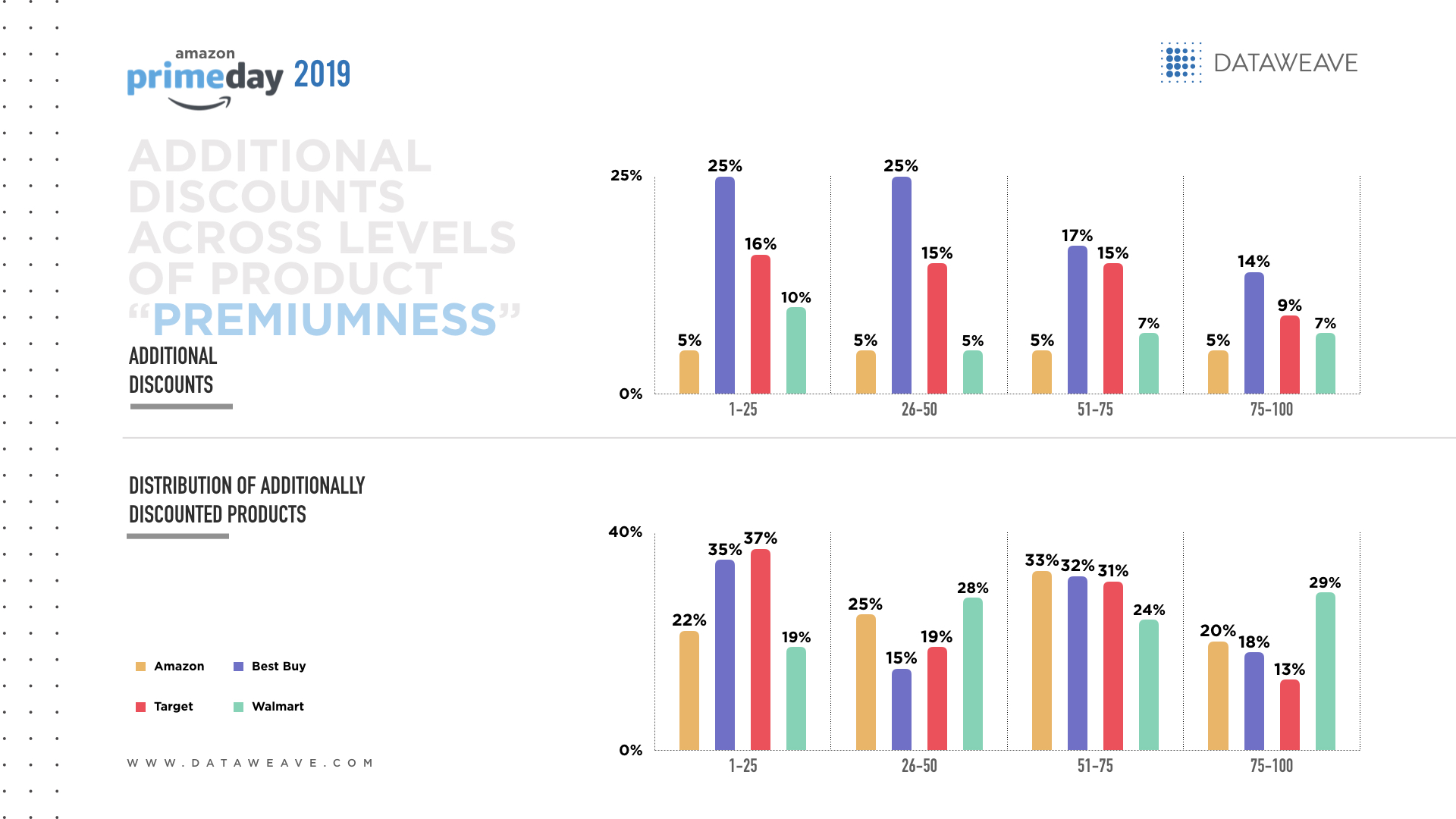
    Premiumness was calculated as the average selling price before the sale event. This was divided into four percentile blocks, with higher percentile blocks indicating higher selling prices.

    In general, all retailers were found to have slightly higher additional discounts in the lower end of the “premiumness” spectrum. This is still a smart move, as it enables sellers to save on margin while still promoting attractive discount percentages. Interestingly, Amazon offered the lowest additional discount – a flat 5% – across all categories, despite offering more or less competitive product distributions compared to other retailers.

    Additional discounts across visibility levels

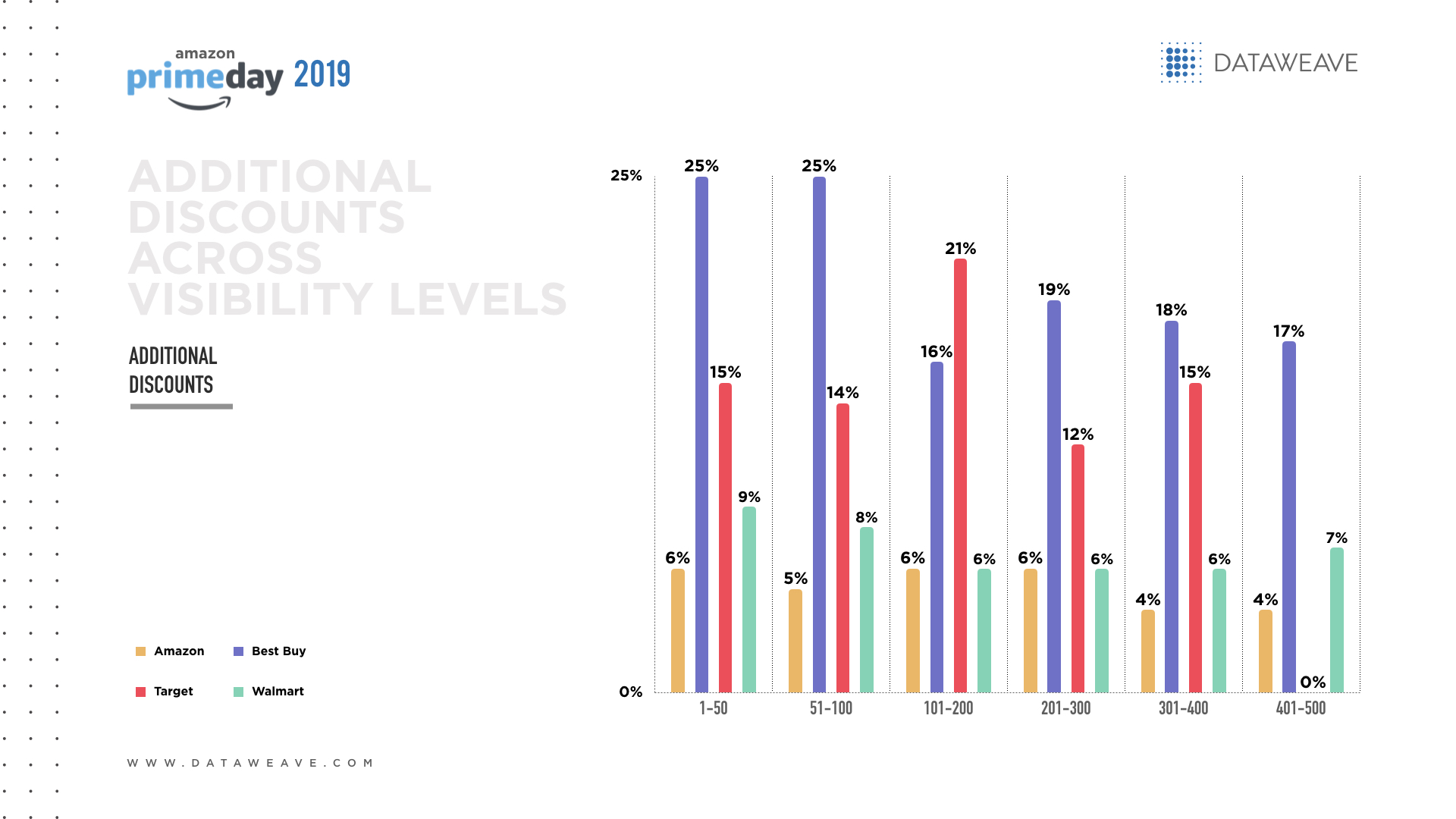
    Here, too, the lower end of the spectrum mostly witnessed higher additional discounts. This tactic actually offers double benefits – one, the most attractive discounts are offered in the higher realms of visibility, thus effectively enticing consumers to buy these products, and two, it helps build a low price perception (despite this not holding good as one delves deeper into the higher ranks). Again, it’s interesting to note that Amazon didn’t offer the highest discounts here either – in fact, it mostly offered the lowest additional discounts.

    All in all, it seems that Prime Day isn’t all it’s hyped up to be, at least not in the Electronics segment. How about other categories? Watch this space for more insights!

  • Retailers Adopt Aggressive Private Label Pricing Strategies in CPG

    Retailers Adopt Aggressive Private Label Pricing Strategies in CPG

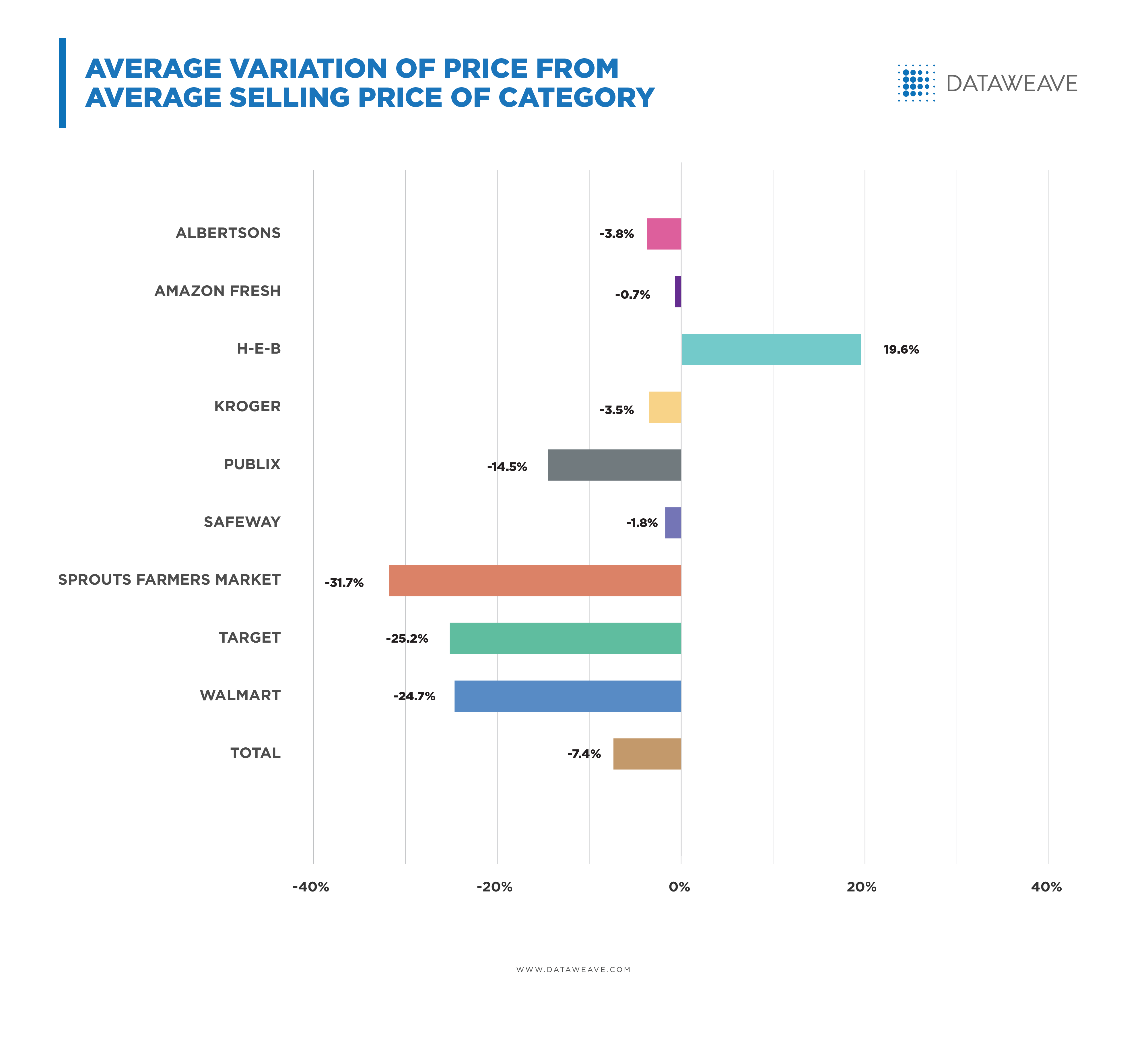
    Nine out of 10 leading retailers price their private label products lower than the average prices of their respective categories, reveals the latest DataWeave study, drafted in collaboration with SunTrust Robinson Humphrey The study reveals that an increasing number of retailers are viewing private label brands as a way to ensure sustained profitability.

    “As the CPG space reels under intense competition, a number of retailers are doubling down on private labels to capture valuable additional margin. For instance, Kroger, Walmart, and Amazon Fresh have a higher degree of private label penetration than the other retailers we analyzed,” said Karthik Bettadapura, Co-founder & CEO at DataWeave. “Our study unveils several such key insights covering product assortment & distribution patterns, price perception, and private label dynamics, revealing a clear snapshot of the disruptive transformations sweeping across the US CPG landscape.”

    Other key findings from the report, which tracked and analyzed 450,000 products across 10 leading retailers and 10 ZIP codes each, include the following:

    • Product assortment is emerging as a driver that’s as critical as pricing when it comes to customer retention. Target, H-E-B, and Kroger have a head start here, offering the largest product assortments among the retailers analyzed.
    • A sharp assortment strategy customized to local tastes and preferences is key to sustaining and enhancing customer satisfaction. Albertsons, Walmart, and Amazon Fresh lead here, revealing a higher focus on localized assortments.
    • “Home” and “Beauty & Personal Care” categories lead the distribution of private label products across retailers. The focus on these categories echoes a similar focus among national brands as well. These categories have the highest overall brand concentration, with around 4,000 brands each.

    To download the entire report, click here.

  • Thanksgiving Weekend Sale: How Top US Consumer Brands Fared

    Thanksgiving Weekend Sale: How Top US Consumer Brands Fared

    Online retailers in the US have enjoyed an impressive turnover during 2018’s Thanksgiving weekend sale. Over the last few weeks, DataWeave has published deep-dive reports on the performance of top US retailers in fashion and consumer electronics during this period, detailing their discounting and product strategies across several product types.

    In continuation of our series of articles on the Thanksgiving weekend sale, this article focuses specifically on the top brands across all retailers analyzed.

    Read Also:

    A Study of Fashion Retail Pricing Across Thanksgiving, Black Friday and Cyber Monday 2018

    How Consumer Electronics Was Priced Across Thanksgiving, Black Friday and Cyber Monday 2018

    While a lot of attention from the media and analysts during these sale events is often focused on the strategies and performance of retailers, the festive sale period is equally vital for consumer brands. Both established brands and new entrants across all categories compete aggressively to gain market share during a period that accounts for a substantial portion of annual sales turnover.

    For brands, the two primary drivers of conversion specific to sale events are competitive pricing and prominent brand visibility. At DataWeave, we went about analyzing which brands came out on top across retailers and categories during the Thanksgiving weekend sale, based on these two factors.

    Our Methodology

    We tracked the pricing of 6 leading fashion retailers and 5 major consumer electronics retailers to study the pricing strategies of brands during the sale events. Our analysis focused on additional discounts offered during the sale period to evaluate the true value of the sale event to customers. To calculate this effect, we compared the pricing of products on Thanksgiving Day, Black Friday and Cyber Monday to the pricing of products prior to the sale commencing. We considered the Top 500 ranked products on 11 product types across Men’s and Women’s Fashion and 11 popular consumer electronics products for this analysis.

    Consumer Electronics Brands

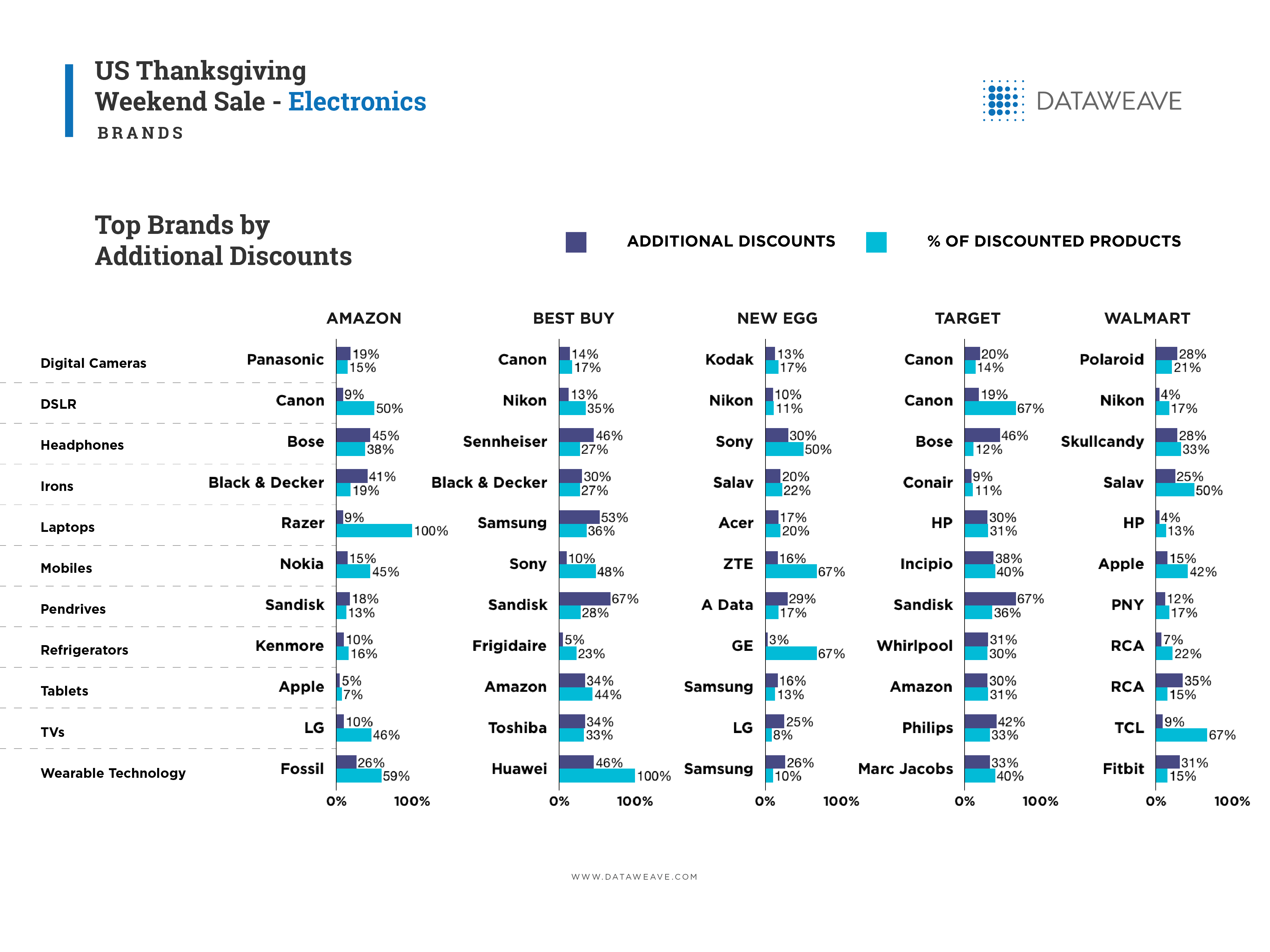
    In digital cameras, Canon’s traditional role as a discount leader was on show, featuring on both Best Buy (14%) and Target (20%), the two most aggressive price discounters in consumer electronics. Nikon took Canon’s place in DSLR cameras, for Best Buy (13%), New Egg (10%) and Walmart (4%), albeit at a comparatively low additional discount point.

    Razor benefited from Amazon’s strategy of promoting its lower-priced products, promoting a modest 9% additional discount but across its entire range of laptop products. The competitiveness of this category between brands is shown by Samsung’s decision to give an additional 53% discount across 36% of its product line at Best Buy.

    The strategic approach brands take with different retailers was illustrated by HP’s 30% additional discount on 31% of its products at Target while over at Walmart, HP had a dire a 4% additional discount on a mere 13% of its products. A similar strategy was employed by LG with its televisions. On Amazon, its TVs had a 10% additional discount applied to 46% of its products, while at New Egg that translated to 25% and 8% respectively.

    Among the fast emerging wearables category, under-pressure Chinese firm Huawei dropped an aggressive 46% additional discount on 100% of its product range at Best Buy. By comparison, the next highest in this category was Marc Jacobs at Target with 33% and 40% respectively.

    Most Visible Brands Across Product Types

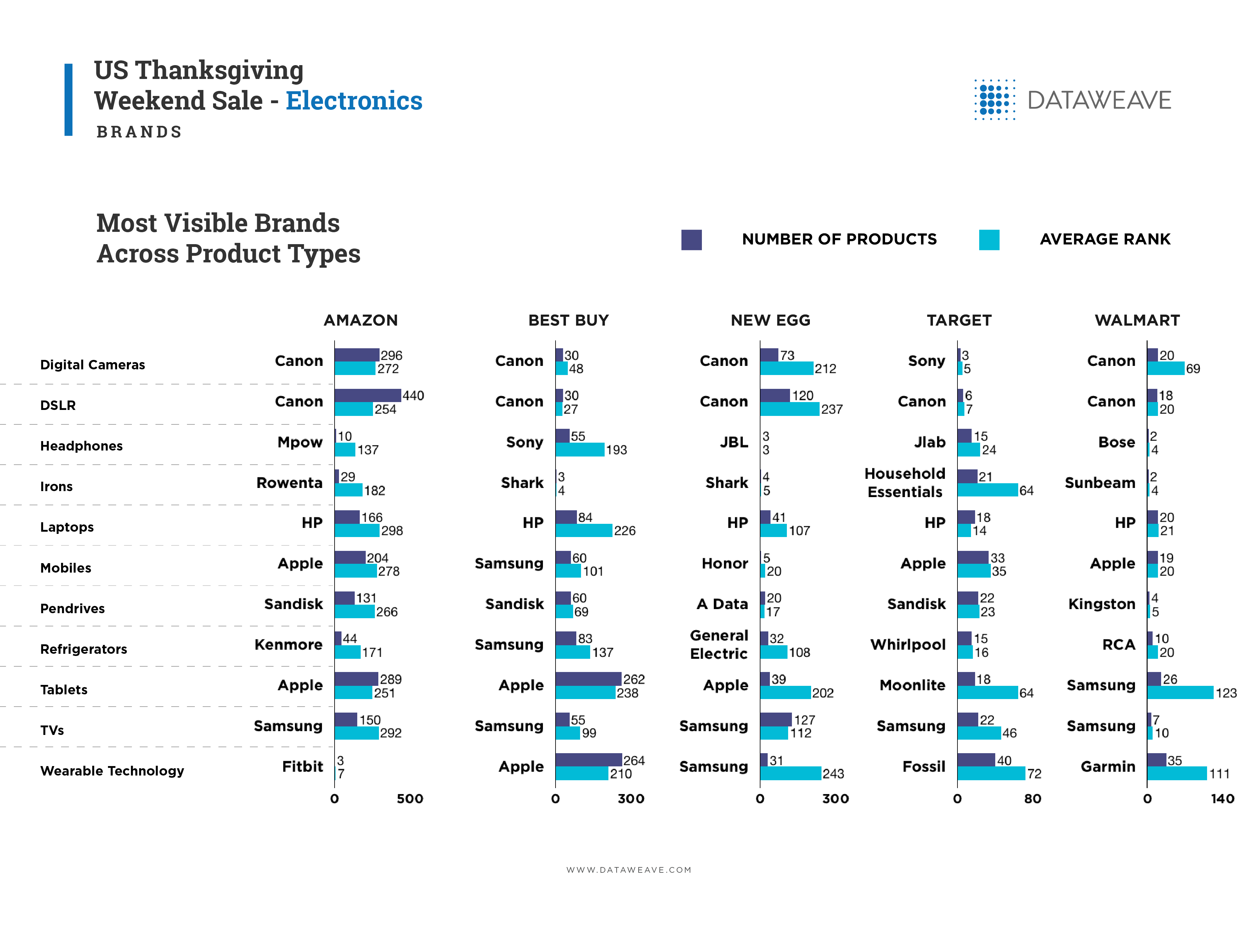
    In our analysis, brand visibility is represented in terms of both the number of products for each brand, as well as the average rank of all its products (“lower” the rank value, higher is the visibility).

    The influence an online retailer exerted on a brand’s average ranking is illustrated by Canon’s digital cameras. On Amazon, its 296 products had an average ranking of 272, while on Best Buy it was 30 and 48, 73 and 212 on New Egg and 20 and 69 on Walmart. For all these retailers, Canon was the most visible brand in digital cameras, despite such variation.

    It was a similar story on laptops, with HP’s Amazon ranking of 298 based on 166 products, contrasting with a Target ranking of 14 on 18 products and Walmart ranking of 21 on 20 products.

    These patterns appear to play out in TVs too, with Samsung’s Amazon average ranking of 292 based on 150 products contrasting with Walmart average ranking of 10 across 7 products.

    Unsurprisingly, across our analysis of additional discounts and brand visibility, the top brands are well known and recognizable brands in each product type, with very few new entrants breaking out from the pack. This story, though, takes a turn in the following analysis on visibility growth.

    Brands With Highest Growth in Visibility

    To perform this analysis, we developed an index for the visibility of a brand based on the number of products available per brand as well as the average rank of those products. We then compared this score for each brand between before and during the sale period, and subsequently calculated the percentage growth.

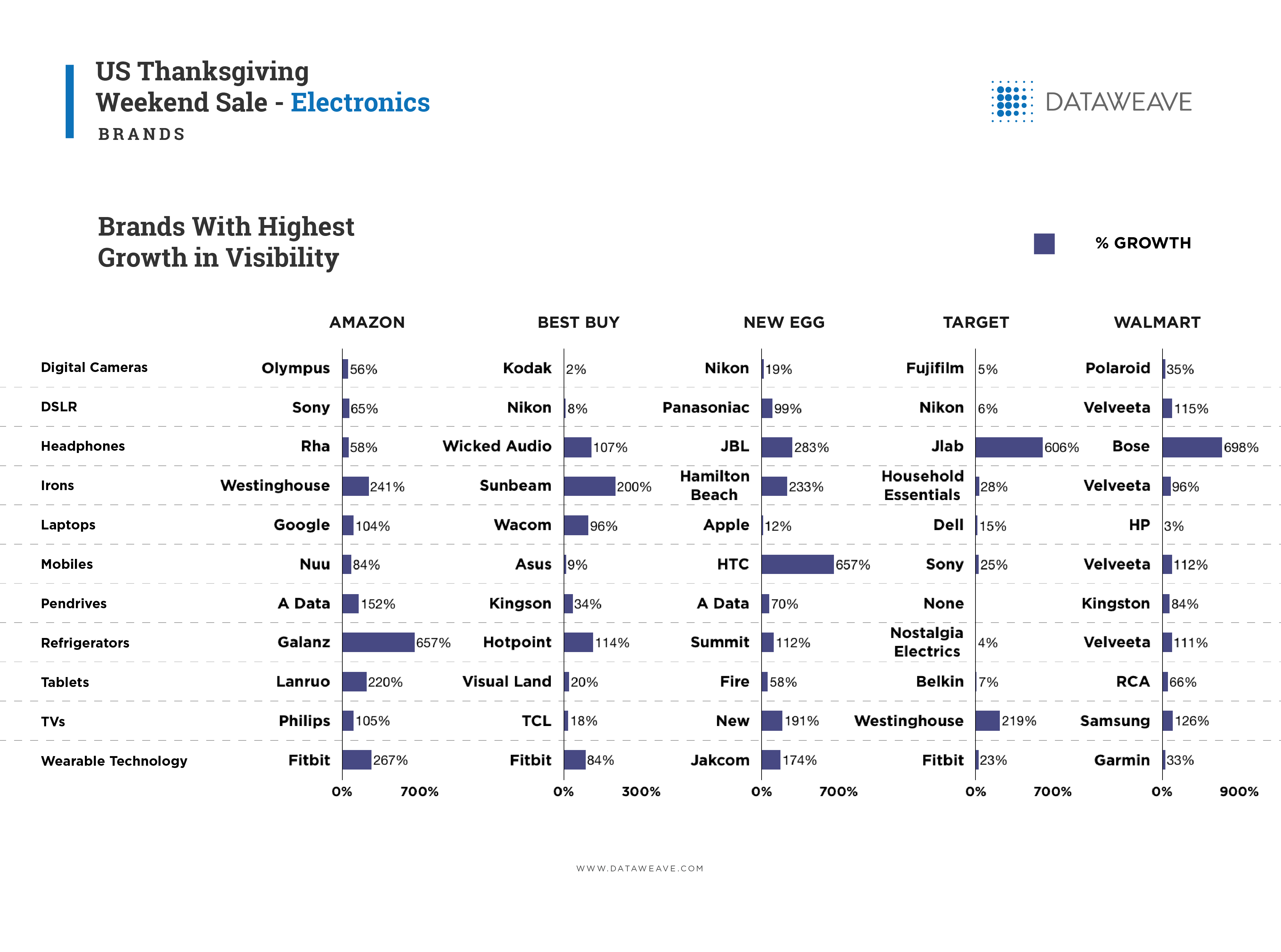
    The list of brands that showed the highest growth in visibility for each product type is an interesting mix of well established and newer brands. The usual suspects included the likes of Philips, Fitbit, Sony, Kodak, Nikon, etc. The presence of brands like Apple, Google, and Bose is surprising as they would be expected to command strong visibility even before the sale. Some of the newer brands include Rha, Westinghouse, Garmin, Lanruo, and more.

    Some brands showed a dramatic increase in visibility. Examples include Bose on Walmart (698%), HTC on New Egg (657%), Galanz on Amazon (657%), and Jlab on Target (608%).

    Kodak’s digital cameras (2% growth) on Best Buy took the honors for the lowest increase in visibility, just ahead of HP laptops (3%) on Walmart, Nostalgia Electrics refrigerators (4%) and Belkin Tablets (7%) both on sale at Target. These numbers indicate a relatively static assortment for the respective retailers and product types.

    Fashion Brands

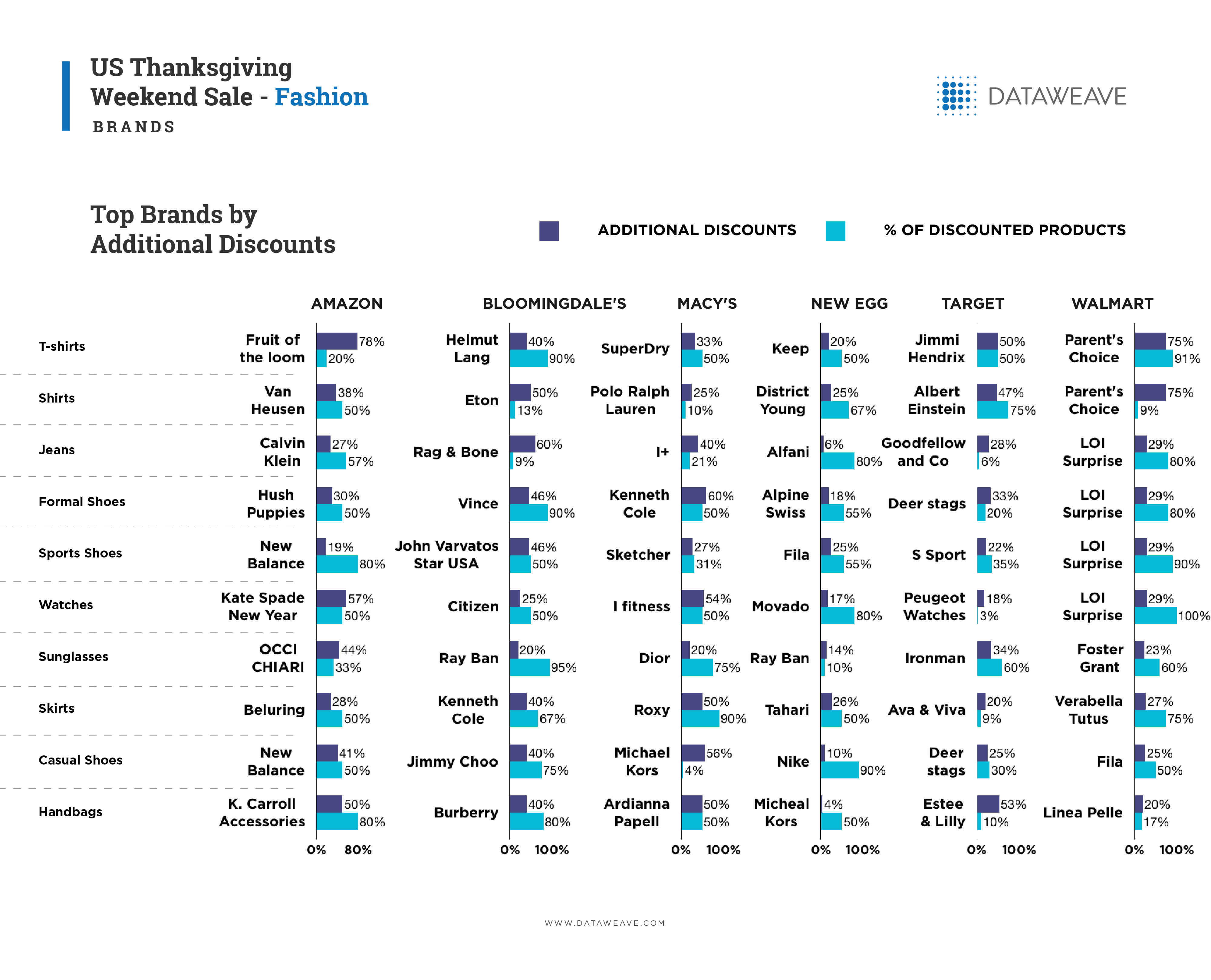
    Moving over to the Fashion category, we observed significantly more aggressive discounting activity, as expected. Parent’s Choice T-shirts recorded the highest additional discount (80%) applied to the widest product range (Walmart 91%). Similarly, Fruit of the Loom saw Amazon promote a 78% additional discount applied across 20% of its products.

    In shoes, Macy’s promoted a 60% additional discount on 50% of Kenneth Cole’s product range. In watches, Amazon featured a 57% additional discount on 50% of Kate Spade New Year branded products. Meanwhile, in sunglasses, Ray Ban in Bloomingdale’s enjoyed a 20% additional discount spread across a whopping 95% of its products, compared to just a 14% additional discount applied to a mere 10% of Ray Ban products in New Egg.

    In stark contrast to what was observed in Electronics, the Fashion category saw fewer large brands dominate the discounting landscape across categories. This isn’t surprising given how the Fashion category tends to be cluttered with a plethora of brands, while the Electronics category usually consists of a leaner set of popular brands in each product type.

    Most Visible Brands Across Product Types

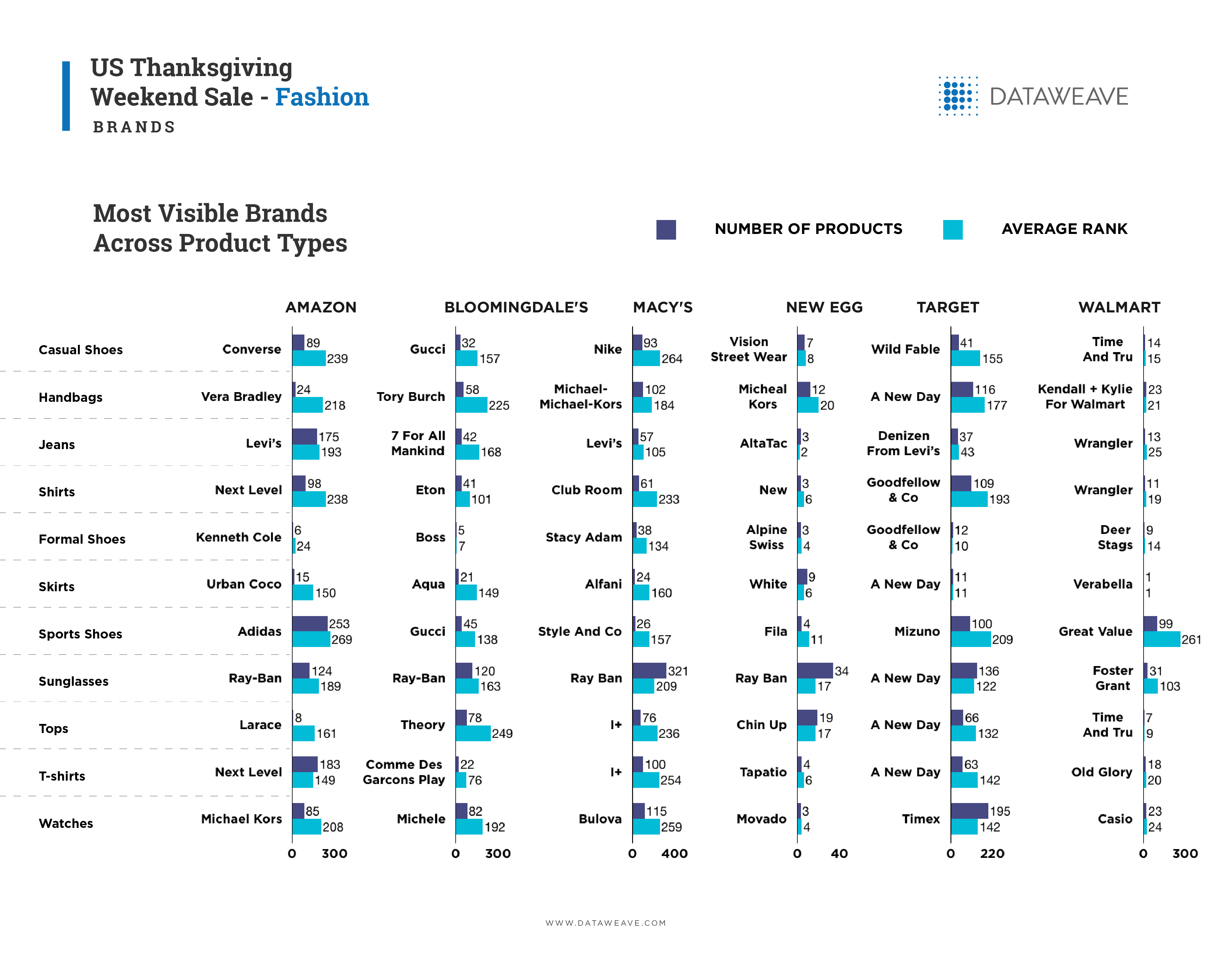
    In casual shoes, Nike’s ranking of 264 on 93 and Converse’s ranking of 239 on 89 products contrasted with Vision Street Wear’s ranking of 8 on 9 products and Time And Tru’s 15 ranking on 14 products.

    Another point of contrast was Micheal Kors (Handbags) cross-retailer platform performance - its average ranking of 184 on 102 products on Macy’s while its average ranking on New Egg was 20 across 12 products. Still, it appears the brand discounted heavily in New Egg to compensate for its relatively low visibility on the website.

    Ray Ban recorded a category high ranking of 209 based on 321 products on Macy’s. By comparison, Ray Ban had a ranking of 17 on 34 products at New Egg. Over at Amazon, Ray Ban managed a creditable 189 ranking on 124 products and a 163 ranking on 120 products at Bloomingdale’s.

    Brands With Highest Growth in Visibility

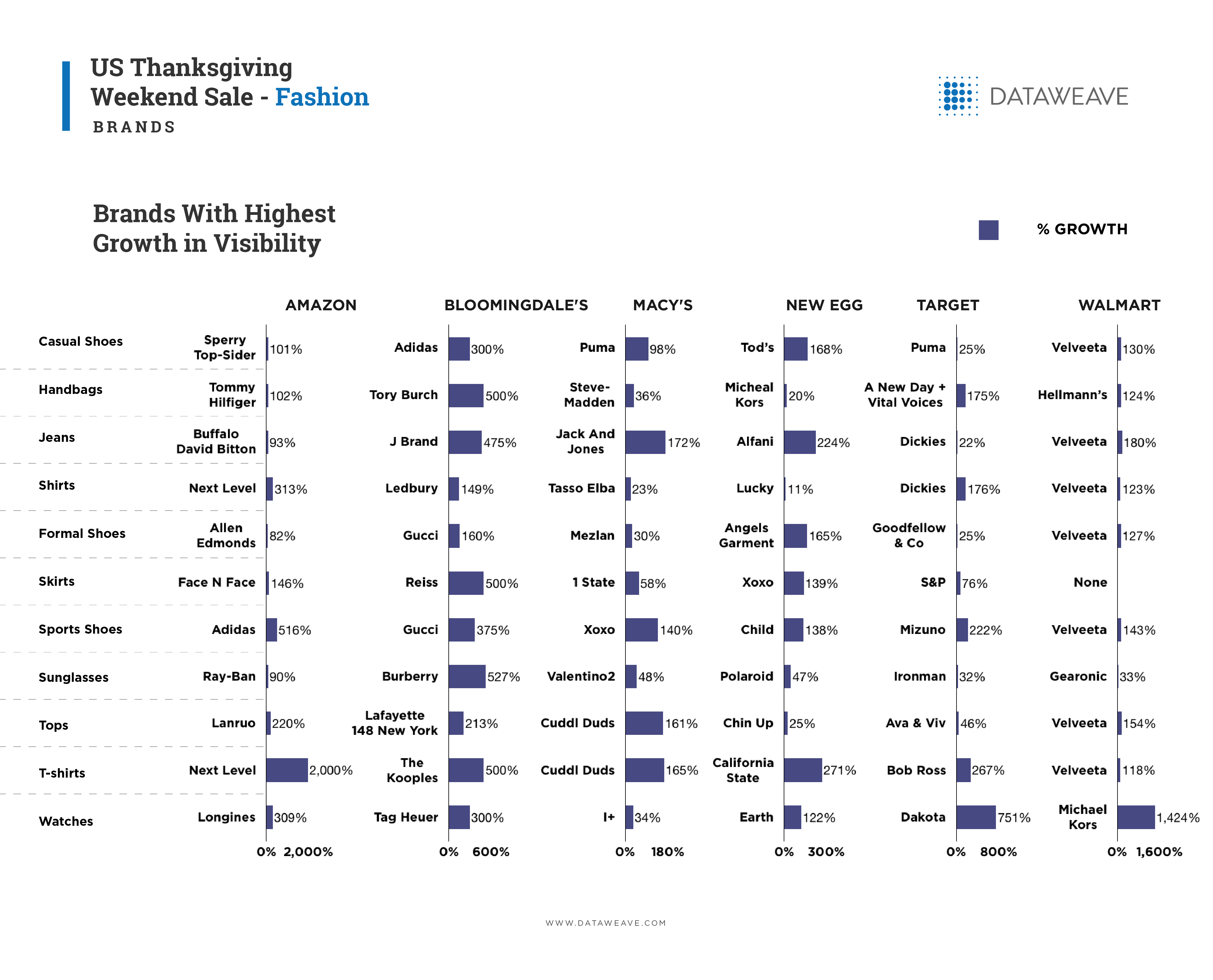
    Compared to the Electronics category, Fashion consists of certain brands that skyrocketed in their visibility. Examples include Next Level T-shirts (Amazon 2,000%), Michael Kors Watches (Walmart 1,424%), Dakota Watches (Target 751%) and Adidas sports shoes (Amazon 516%).

    Bloomingdale’s delivered amazing visibility growth for key brands, with Burberry (527%), Reiss (500%), The Kooples (%00%), Tory Burch (500%), J Brand (475%), and Adidas (300%) all enjoying strong visibility growth.

    At the other end of the visibility growth spectrum, the growth rates of Lucky shirts (New Egg, 11%), Micheal Kors (New Egg, 20%) Dickies jeans (Target, 22%), Tasso Elba shirts (Macy’s, 23%), and Puma Casual Shoes (Target, 25%) indicate a relatively more static assortment in their respective product types.

    Depth Of Product Range And Discounting Strategy Matters

    Across the three sales, DataWeave identified several different additional discounting and product assortment strategies by both the retailers and the brands.

    While retailers are increasingly discounting the lower priced products to shape price perceptions among shoppers (take a bow Amazon), what are the implications for brands? Firstly, a thin product range is going to make achieving visibility more challenging. Secondly, brand strategies across online retailing platforms will need to be more clearly defined and executed. Thirdly, those brands that treated Thanksgiving, Black Friday and Cyber Monday as discrete events are going to have to rethink their approach as these lines increasingly blur with time.

    If you’re interested to learn more about how DataWeave aggregates and analyzes data from online sources as massive scale, as well as how we provide competitive intelligence to retailers and consumer brands, visit our website!

  • Consumer Electronics Prices During the Holidays

    Consumer Electronics Prices During the Holidays

    Consumer electronics has always been one of the most popular product categories for consumers during the Thanksgiving weekend sale each year.

    Shoppers often hold off on making expensive purchases in electronics in anticipation of great discounts during these sale events. While Cyber Monday is traditionally the key day for offers in electronics, recent trends, triggered by the growth of eCommerce, lean toward offering attractive prices across the entire sale weekend.

    Studies indicate that in 2018, the average value of an online transaction hit $97. This compares with $91 in 2017 and $87 in 2016, continuing the trend of a steadily increasing transaction value over the past two years. This year, the scene was set for a massive Cyber Monday as Black Friday purchases of electronics reached $6.22 billion, up 23.6 percent from last year according to Adobe Analytics.

    At DataWeave, we recently analyzed and published a blog post on the Thanksgiving weekend sale for the Fashion vertical.

    (Read here: A Study of Fashion Retail Pricing Across Thanksgiving, Black Friday and Cyber Monday 2018)

    As part of the same project, we scrutinized the consumer electronics vertical just as keenly across top electronics retailers in the US by monitoring prices across the weekend.

    Our Methodology

    We tracked the pricing of the 5 leading retailers selling consumer electronics to assess their pricing and product strategies during the sale events. Our analysis focused on additional discounts offered during the sale to evaluate the true value the sale event represented to customers. To calculate this effect, we compared the pricing of products on Thanksgiving Day, Black Friday and Cyber Monday to the pricing of products prior to the sale commencing. We considered the Top 500 ranked products on 11 popular product types in carrying out this analysis.

    Key Findings

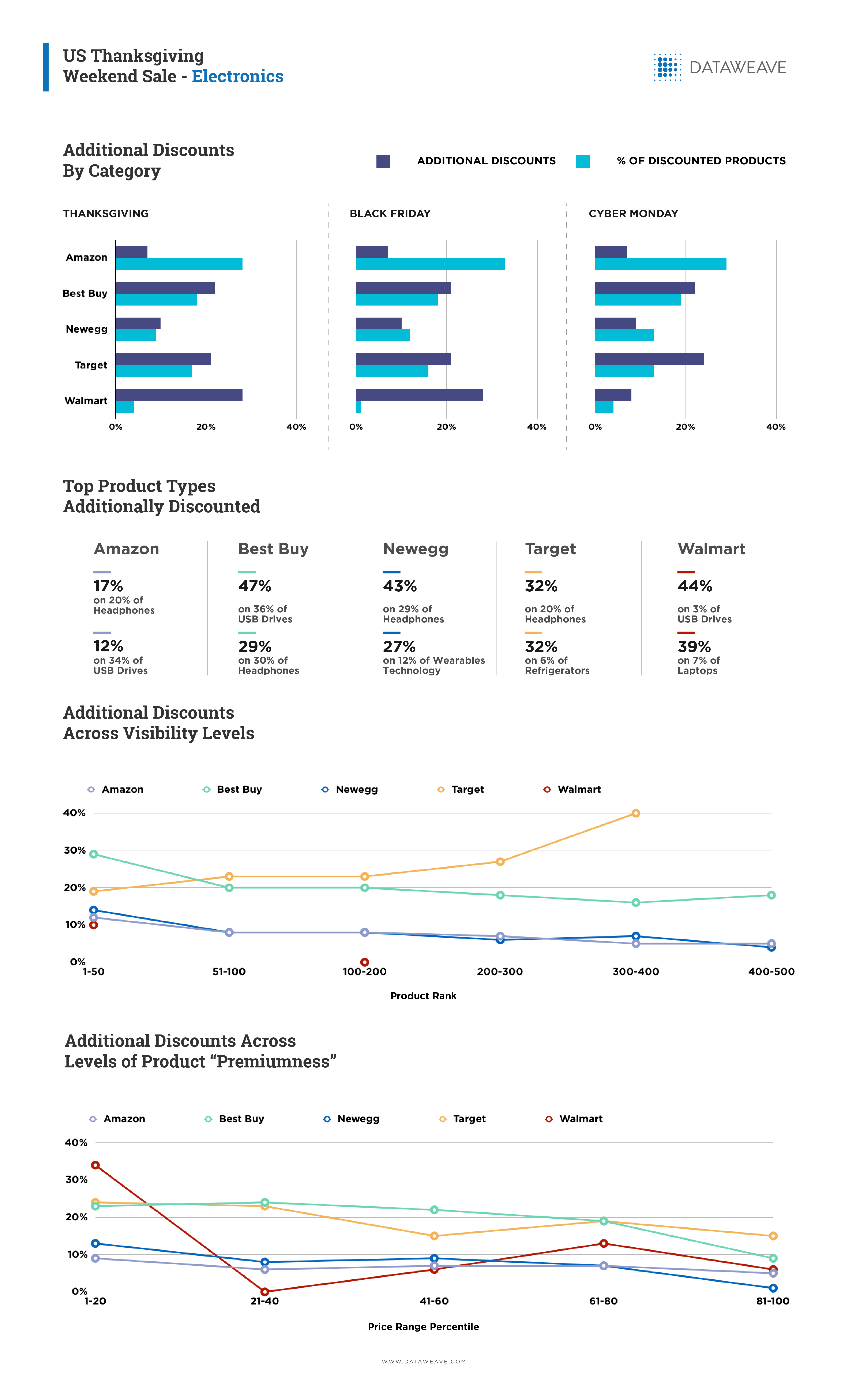
    In contrast to the Fashion category, the consistency in the discounting strategy for all retailers across the three sale days in the Consumer Electronics category was striking. The only exception was Walmart, which opted somewhat curiously to roll back its discounts on Cyber Monday. All other retailers held similar additional discounts levels on a fairly similar set of products through the sale weekend.

    Target and Best Buy led the electronics discount charge at 22% and 21% for 18% and 17% of their assortment, respectively.

    While Amazon discounted the highest number of products at 29% of its range, it continued its recent strategy of not discounting steeply. In fact, Amazon was among the lowest in terms of additional discounts. The other end of the spectrum, Walmart provided a 28% additional discount on the first two sale days, offered only on a modest range of products (4% and 1%).

    Headphones and USB Drives proved popular lead product types for discounting by all retailers. Other product types making the cut included Refrigerators (Target), Laptops (Walmart), and Wearable Technology (Newegg).

    Amazon’s discounting strategy appears to be informed significantly by product visibility. The highest ranked products were far more aggressively discounted, and the discounts reduced progressively as we move to less visible products. This supports previous evidence illuminating Amazon’s strategy to develop a low price perception. We saw a similar trend emerging from Best Buy and Newegg as well.

    This discounting approach is in stark contrast to the behavior we witnessed in our earlier analysis of the Fashion category, where we found little correlation between visibility and discounts. However, given the higher price points and greater price elasticity in the Electronics category, we were not surprised to see this level of strategic clarity. Interestingly, our analysis of Target’s discounting behavior showed an opposite trend as Target opted to load up discounts on its less visible products.

    Walmart was excluded from this part of our study due to the very low number of common products before and during the sale that we could analyze.

    Another stable trend which emerged during our analysis of the sale weekend is the consistency with which lower priced products are offered at higher additional discounts relative to the more premium, higher priced products in the retailers’ product type. This trend largely held across retailers. Customer perceptions of low prices can be built by heavily discounting products at the lower end of the premium spectrum, while retailers can harvest their critical margin on their higher value goods.

    Diving Deeper Into Amazon

    Amazon announced a few days ago that it had its biggest shopping day in the company’s history on Cyber Monday. In its announcement, the company also stated the five shopping days starting with Thanksgiving and continuing through to Cyber Monday shattered records as US consumers bought millions of more products over the five-day sales compared with the same sales period last year.

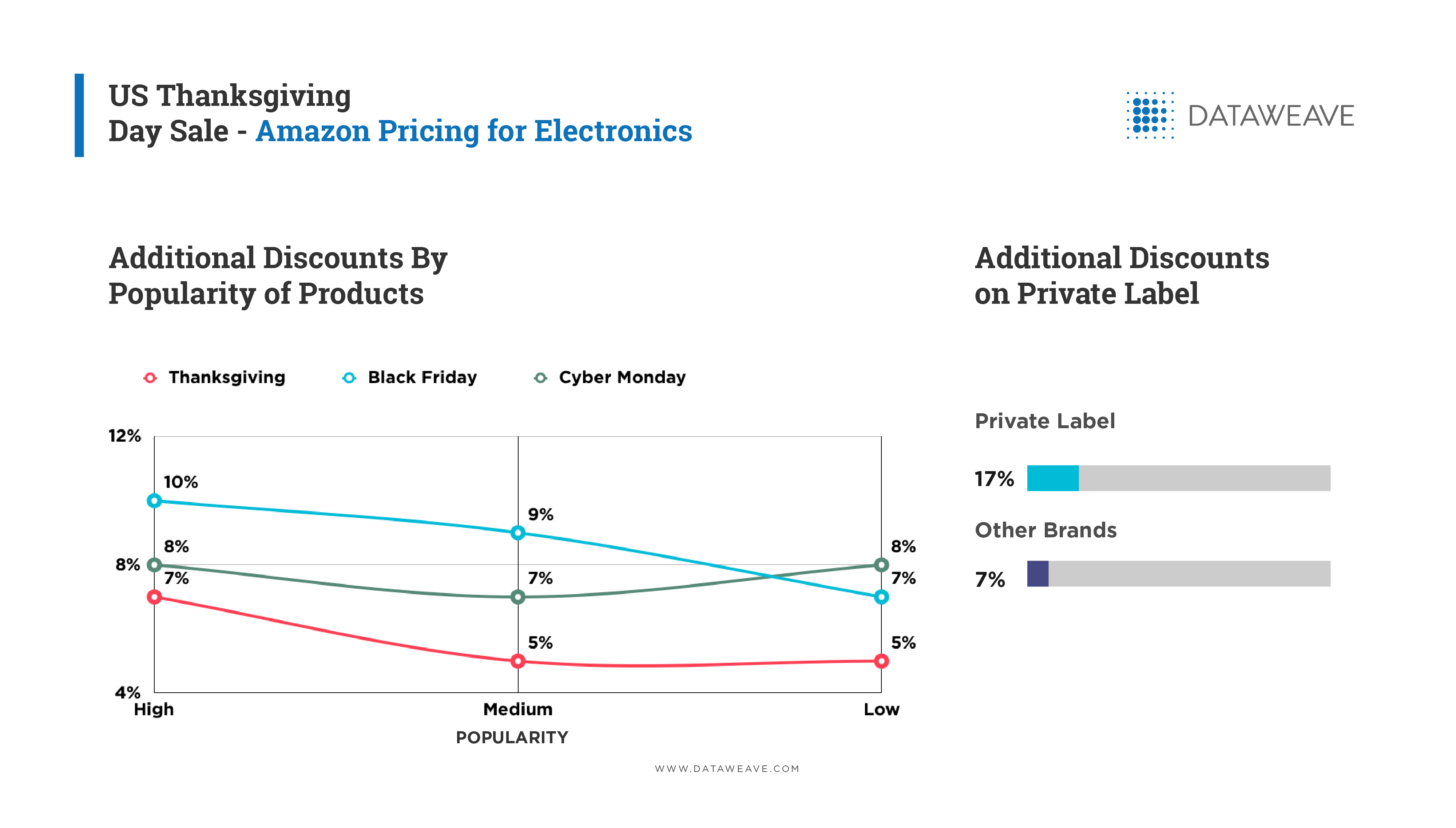
    When the product popularity was evaluated and compared with additional discounts, we see higher discounts for better-reviewed products on Thanksgiving and Black Friday. Cyber Monday was an exception where discounts were distributed more smoothly across the three popularity bands.

    As with what we witnessed in the Fashion category, we detected higher additional discounts in Amazon’s Electronics private label brands (17%) relative to the average discount for other brands (7%).

    Profitability is back in the spotlight

    Electronics continued to be a key focus eCommerce retailers during their pivotal sales events in 2018. We are seeing signs of a shift to eCommerce and an accelerating emergence of a “Black November” and a “Cyber Post-Thanksgiving Weekend” impacting on sales results for the beginning of the holiday season.

    This year, there was a more concerted and strategic approach by retailers to maximize margin in the high-value end of the Electronics Category while still discounting the more popular and lower priced products. As expected, both Target and Best Buy featured prominently with their heavy discounting, while both Amazon and Newegg appeared to be executing a more nuanced discounting strategy. This rather reserved approach to the sale and careful focus on profitability is backed up by recent reports of Amazon’s shift in approach to housing low margin products.

    As was the case with the Fashion category, we saw the importance of Cyber Monday for Electronics sales being eroded and spread across the entire weekend, on the backdrop of a larger trend of attractive offers encompassing much of November and December.

    If you would like to know more about how DataWeave aggregates data from online sources to deliver actionable insights to retailers and consumer brands, check out our website!

  • A Study of Fashion Retail Pricing Across Thanksgiving, Black Friday and Cyber Monday 2018

    A Study of Fashion Retail Pricing Across Thanksgiving, Black Friday and Cyber Monday 2018

    The biggest holiday sale event of the western retail calendar — the Thanksgiving weekend sale, which includes Thanksgiving Day, Black Friday, and Cyber Monday — came and went a few weeks ago and made a huge splash along the way. While the sale event, especially Black Friday, is traditionally an offline sale event, modern online retailers too step up to offer products at attractive prices through this period.

    Online retail sales numbers grew at an impressive clip based on stats reported by Adobe Analytics. Thanksgiving Day sale itself generated $3.7 billion in sales, up 28 percent from a year ago. Black Friday delivered a record $6.22 billion in online sales — a substantial leap of 23.6 percent year on year. Cyber Monday sales online generated a new record of $7.9 billion, up nearly 18 percent from last year.

    Spending on fashion specifically was up 5.4 percent over the 2018 Black Friday weekend, the best growth seen since 2011, according to consulting firm Customer Growth Partners. Apparel retailers now book nearly a quarter of their annual sales during these holiday sales — a measure of just how important these annual sales have become to the online retailer’s commercial performance.

    As a provider of Competitive Intelligence as a Service to retailers and consumer brands, DataWeave consistently monitors and captures pricing and assortment information from leading retailer websites during sale events to study their product and pricing strategies — and we’ve done the same for this year’s Thanksgiving weekend sale as well.

    Our Methodology

    We tracked the pricing of 6 leading fashion retailers to study their pricing and product strategies during the sale events. Our analysis focused on additional discounts offered during the sale to evaluate the true value of the sale event to customers. To calculate this effect, we compared the pricing of products on Thanksgiving Day, Black Friday and Cyber Monday to the pricing of products prior to the sale commencing. We considered the Top 500 ranked products on 15 product types across Men’s and Women’s Fashion for this analysis.

    Key Findings in Men’s Fashion

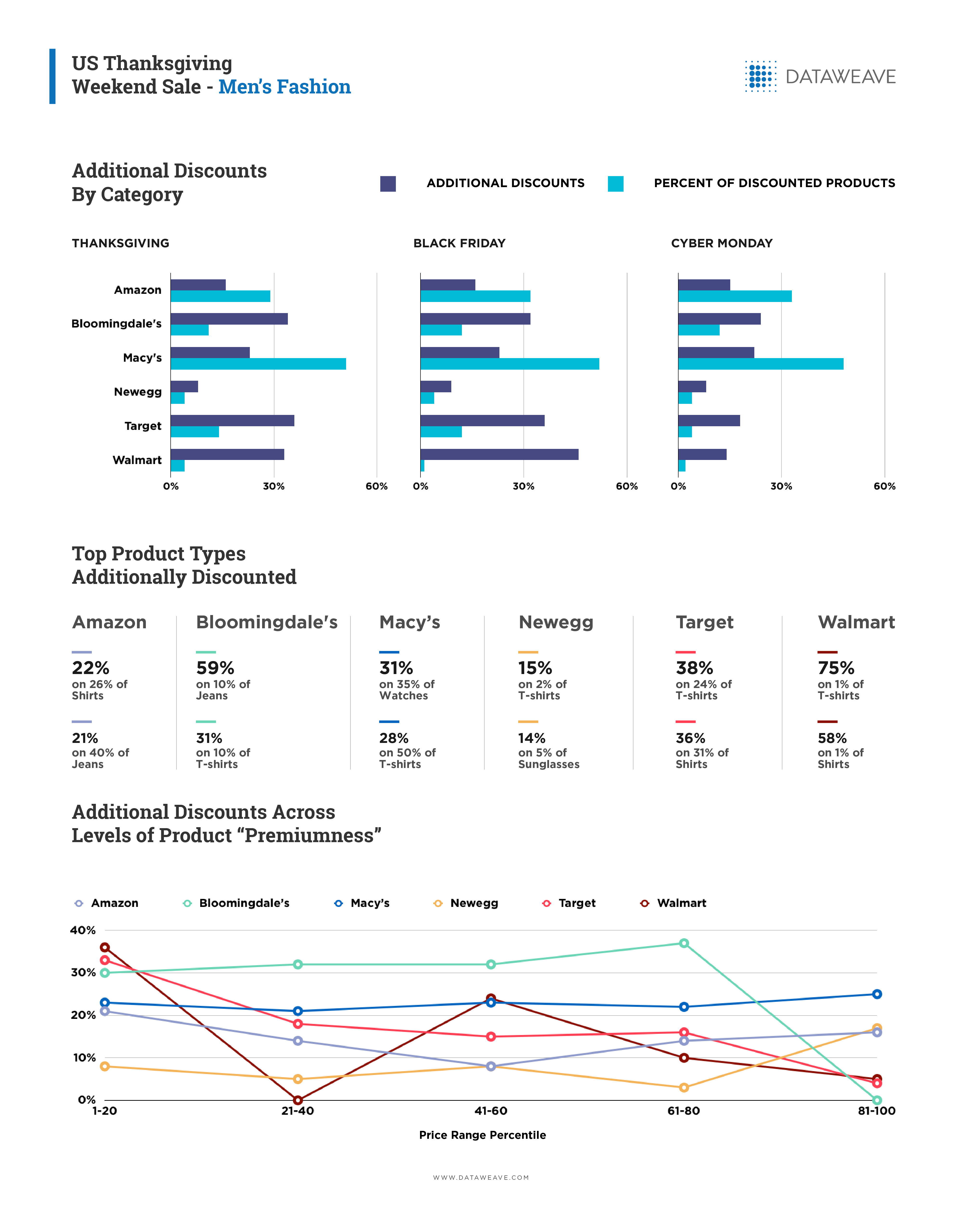
    Macy’s and Bloomingdale’s featured prominently among the top discounting retailers. This is unsurprising, given their focus on Fashion. Macy’s, in particular, additionally discounted just over half its fashion assortment over the three days. This was an order of magnitude greater than its nearest competitor Amazon at 29 percent.

    Target and Walmart too discounted aggressively on Thanksgiving and Black Friday. Target exceeded Macy’s by 2 percentage points. However, Target and Walmart rolled back their discounts on Cyber Monday effectively halving them.

    Walmart’s discount strategy displayed significant variation across the 3 days of sale. On Black Friday, Walmart led the retailing pack with its 46 percent discount only to roll back to 15% on Cyber Monday. The fluctuations in these discounts reflect significant variation and churn in Walmart’s Top 500 ranked products across the three days of sales.

    As we have seen in previous sales, Amazon was a model of consistency in its discount strategy across the three days, maintaining a healthy 15% — 16% on roughly a third of its assortment. Strikingly, Newegg elected not to compete too aggressively in Fashion this year, adopting high single digit discounts on a similar percentage of its products.

    Across all six retailers, Shirts, Jeans, and T-shirts proved to be the most popular product types in terms of additional discounts although accessories such as sunglasses (Newegg) and watches (Macy’s) broke up apparel’s dominance.

    Did additional discounts vary by price range?

    We also studied the variation of discounts across ranges of product “premiumness”. We generated a percentile scale based on price ranges of products from before the sale, and studied the additional discounts offered for products in these price range buckets during the sale. A percentile score or 1 is the cheapest product and 100 is the most expensive product. All of these metrics were calculated first at a product type level and then aggregated at an overall level for each retailer.

    Amazon and Target display a clear strategy to additionally discount their more affordable range of products – those in the 1–20 cluster.

    Bloomingdale’s showed a less structured strategic approach. Its additional discounts were largely spread evenly across levels. Its product churn among the Top 500 items during the sale focused on its more expensive products as indicated by its score of 0 for the 81–100 percentile bracket.

    Macy’s opted to discount even more evenly across the board than Bloomingdale’s. It’s likely Macy’s relied on a different lever to drive discounts strategically. Walmart’s pricing approach was markedly uneven and all over the board from a strategic perspective.

    Key Findings in Women’s Fashion

    One of the most interesting patterns to emerge from these sale events was the marked difference in discounting strategy adopted for Women’s Fashion compared to Men’s Fashion. Both Amazon and Macy’s discounted their Women’s Fashion line up far less aggressively than their Men’s Fashion products. Their discounts also applied to a smaller set of products.

    Bloomingdale’s Women’s Fashion discounting was similarly marginally less aggressive than its approach to its Men’s Fashion. Only Target’s pricing remained consistent across its Men’s and Women’s Fashion products. However, Newegg’s strategy of not engaging too aggressively in Men’s Fashion this year carried over to its treatment of Women’s Fashion.

    The top product types additionally discounted were also not unexpectedly different between the Men’s and Women’s Fashion products. Skirts, Shoes, and Tops emerged as the favorite product types to discount, although no two retailers had the same discounting emphasis.

    As with Women’s Fashion, Amazon and Target discounted their less expensive products more consistently. However, in Women’s Fashion, they were joined by Walmart and to a lesser degree, Newegg.

    This showed evidence of a strategy to retail the less expensive products at more attractive price points to generate the price perception of being low-priced. Meanwhile, they continued to harvest comparatively more margin through their more expensive products. This was a more nuanced approach to margin management than what we saw in Men’s Fashion.

    Does product visibility correlate with discounts?

    One working hypothesis is that products discounted heavily tend to have higher visibility to drive the perception of lower price. However, the results of our analysis appear counter-intuitive.

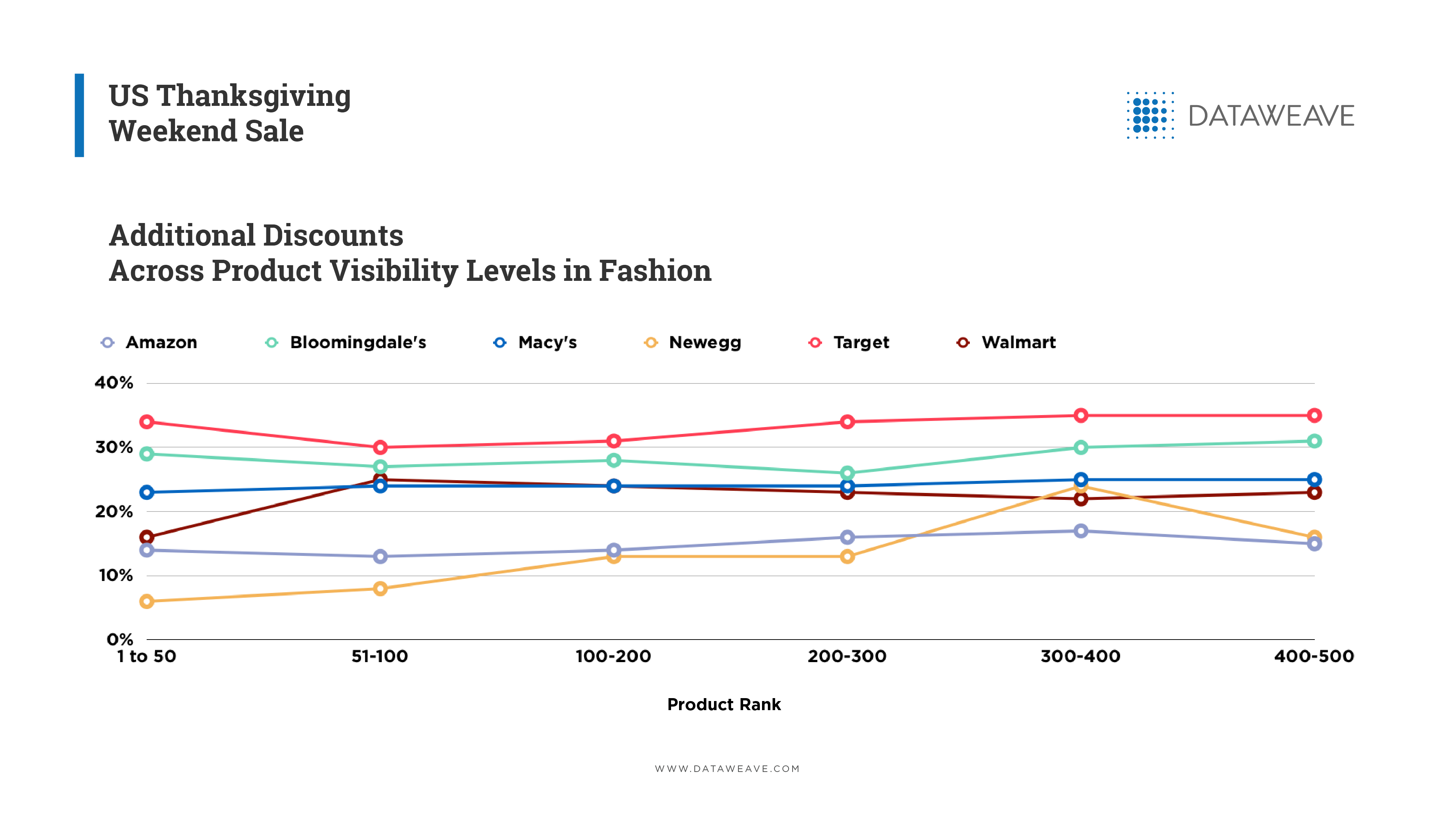
    Amazon’s additional discounts in Men’s Fashion appear relatively uniform across all product cohorts. In fact, Amazon’s peaked additional discounts with the 200–400 cohort.

    Similar trends surfaced with other retailers. Newegg additionally discounted its longer tail products, while Walmart additionally discounted its Top 50 products at only 16% compared to an average of around 23% for other cohorts in its Top 500.

    A closer look at Amazon.com

    (Read Also: Amazon’s US Fashion and Apparel Product Assortment Evolves)

    We extracted data on Amazon’s reviews and ratings to investigate its discounting strategy across ranges of product popularity — a measure that’s defined using a combination of average review rating and number of reviews. We compiled a measure of all products that were rated as High, Medium, and Low cohorts and evaluated Amazon’s discounting strategy in each cohort.

    In Men’s Fashion, Amazon aggressively discounted its Medium and Low rated products on Thanksgiving, only to switch its strategy the next day on Black Friday. This tactical switch was presumably intended to showcase Amazon’s well-reviewed products at attractive prices on Black Friday — a larger sale event.

    By Cyber Monday, Amazon’s Medium reviewed products were back enjoying more aggressive discount levels, albeit the discount variance across all three cohorts was minor.

    Amazon’s discounting strategy for its Men’s Fashion products was in stark contrast to its strategy in Women’s Fashion. Here, Amazon additionally discounted its High and Medium reviewed products on Thanksgiving. While there was no specific discernible pattern on Black Friday, Amazon’s discounting was most consistent across its three popularity cohorts on Cyber Monday.

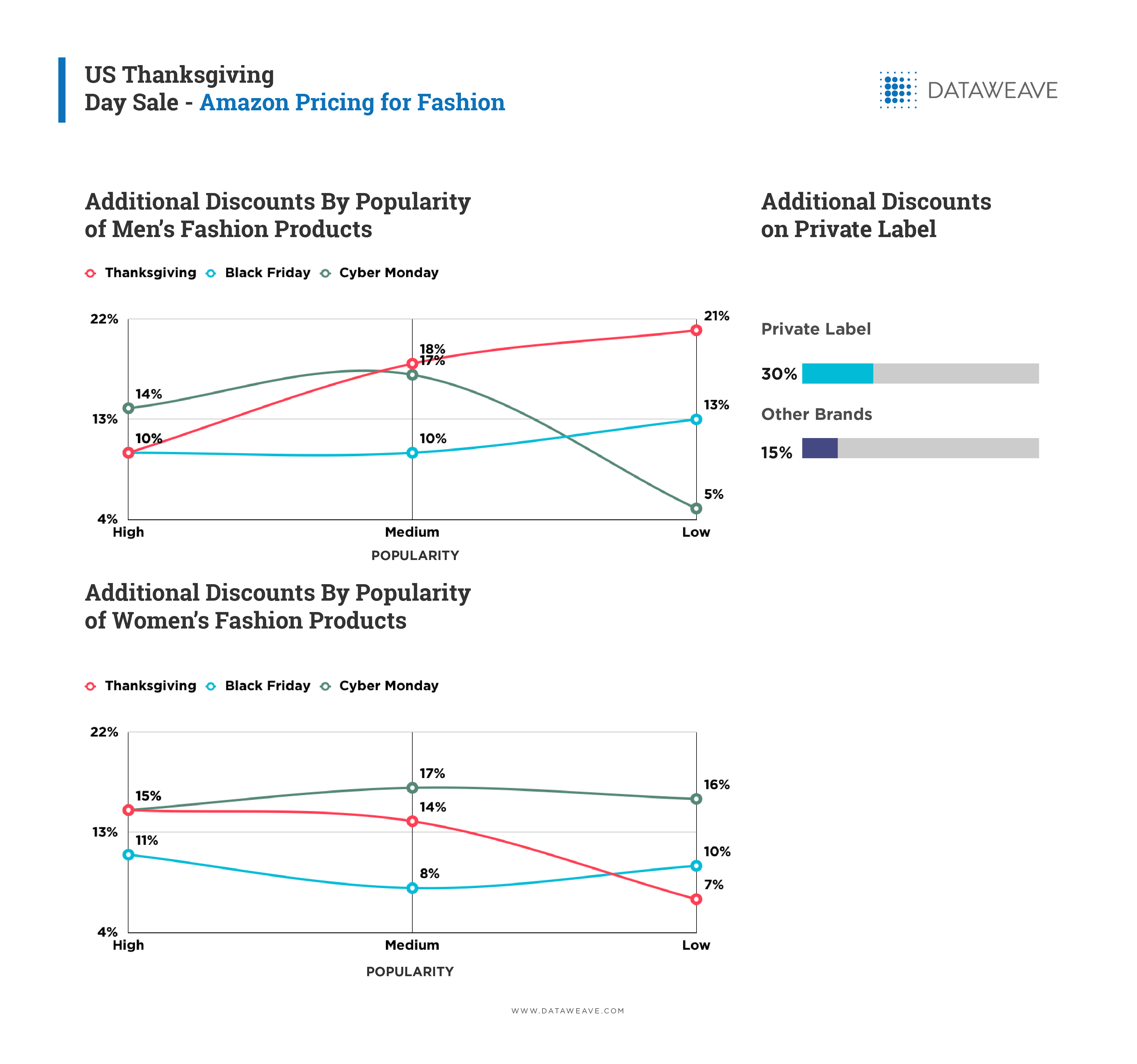
    We also looked at Amazon’s discounting activity across its private label products relative to other brands. Unsurprisingly, Amazon discounted its private label fashion products at an aggressive 30%, while the other brands benefited from, on average across all days and all categories, an additional 15% discount.

    Online drives shifting tides in holiday sale events

    While traditionally the holiday shopping season sees a peak around Black Friday and Christmas, retailers are increasingly seeing the demand spread across the entirety of the sale season of November and December. As a result, retailers need to stay on their toes to drive increased sales and gain market share over an extended period of time.

    Certainly, in 2018, we witnessed a more focused approach to mine margins in Women’s Fashion while still discounting aggressively. As expected, both Macy’s and Bloomingdale’s featured prominently in the discounting stakes while both Amazon and Target appeared to implement a more nuanced approach to juggling a reputation for low prices and driving increased margin.

    If you’re curious about how DataWeave aggregates data from eCommerce data at massive to deliver actionable insights to retailers and consumer brands, check us out on our website!

  • Decoding Alibaba’s Singles Day Sales

    Decoding Alibaba’s Singles Day Sales

    An average of $11.7 million per second was the rate at which Alibaba clocked $1 billion in sales during the first 85 seconds of Singles’ Day. As Alibaba’s annual sale event continues to grow in scale, referring to it as a global retail phenomenon is an understatement. Alibaba closed the day having shipped 1.04 billion express packages based on sales of merchandize worth 213.5 billion yuan ($30.67 billion).

    This performance shredded any lingering concerns analysts may have harbored about the prospects of this year’s sale, given the international backdrop of the ongoing trade skirmish between the US and China.

    Along with attractive discounts across a range of product categories, Singles’ Day also promised an integrated experience fusing entertainment, digital and shopping, in stark contrast to other large global sale events like Black Friday, which focus predominantly on discounts.

    At DataWeave, we set out to investigate if all the hype resulted in actual price benefits to the shoppers and how the various categories and brands performed in terms of sales during the event. To do this, we leveraged our proprietary data aggregation and analysis platform to capture a range of diverse data points on Tmall Global, covering unit sales (reported by the website) and pricing associated with Tmall Global’s major categories over the Singles’ Day period.

    Our Methodology

    We captured 5 separate snapshots of data from Tmall.com during the period between October 25 and November 14, encompassing over 15,000 unique products each time, across 15 product categories.

    To calculate the average discount rate, we considered the percentage difference between the maximum retail price and the available price of each product. We also looked at the additional discount rate, for which we compared the available price during Singles’ Day to the available price from before the sale. This metric reflects the truest value to the shopper during Singles’ Day in terms of price.

    Our AI-powered technology platform is also capable of capturing prices embedded in an image. For example, the offer price of ¥4198 was extracted accurately from the accompanying image by our algorithms and attributed as the available price while ¥100 from the same image was ignored.

    This technology was employed across hundreds of products using DataWeave’s proprietary Computer Vision technology.

    Domestic Appliances and Digital/Computer Categories Powered Turnover

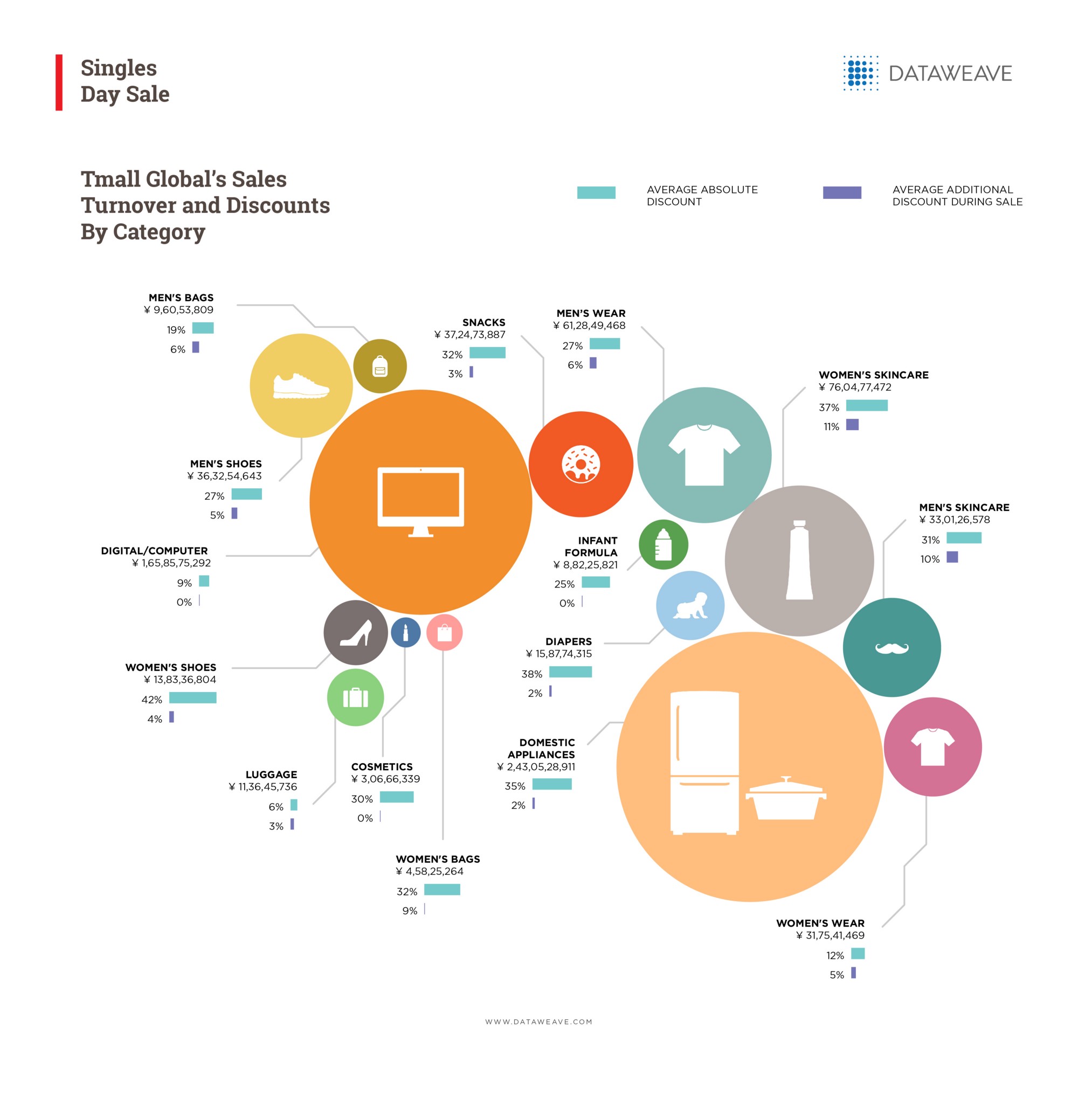
    The Domestic Appliances and Digital/Computer categories dominated the Singles Day Sale in terms of absolute sales turnover. This isn’t surprising, since the average order value for these categories are typically much higher compared to the other categories analyzed.

    What clearly stands out in the above infographic is that the two largest categories in terms of sales turnover had average additional discounts of only 2 per cent and 0 per cent — a rather surprising insight. In general, with the exceptions of Women’s skincare, Men’s skincare, and Women’s bags (11 per cent, 10 per cent, and 9 per cent respectively), all other categories saw low additional discounts during Singles’ Day.

    However, the absolute discounts across the board were consistently high, with only Luggage (6 per cent), Digital/Computer (9 per cent) and Women’s wear (12 per cent) staying significantly below the 20 per cent mark. In fact, eight categories enjoyed absolute discounts greater than 30 per cent.

    Among common categories between Men and Women, the Men clocked more sales in Men’s wear, shoes, and bags. Only skincare proved to be an exception, where Women’s skincare generated twice the turnover of their Men’s equivalent.

    The Infants category was another intriguing sector to emerge during the sale. Both Diapers (38 per cent) and Infant’s Formula (25 per cent) were substantially discounted, despite only receiving low additional discounts of 2 per cent and 0 per cent respectively – indicating aggressive pricing strategies in this category even during non-sale time periods.

    The biggest takeaway from our analysis is the lack of any correlation between sales turnover and additional discounts, or even the absolute discounts.

    International Brands Make Gains

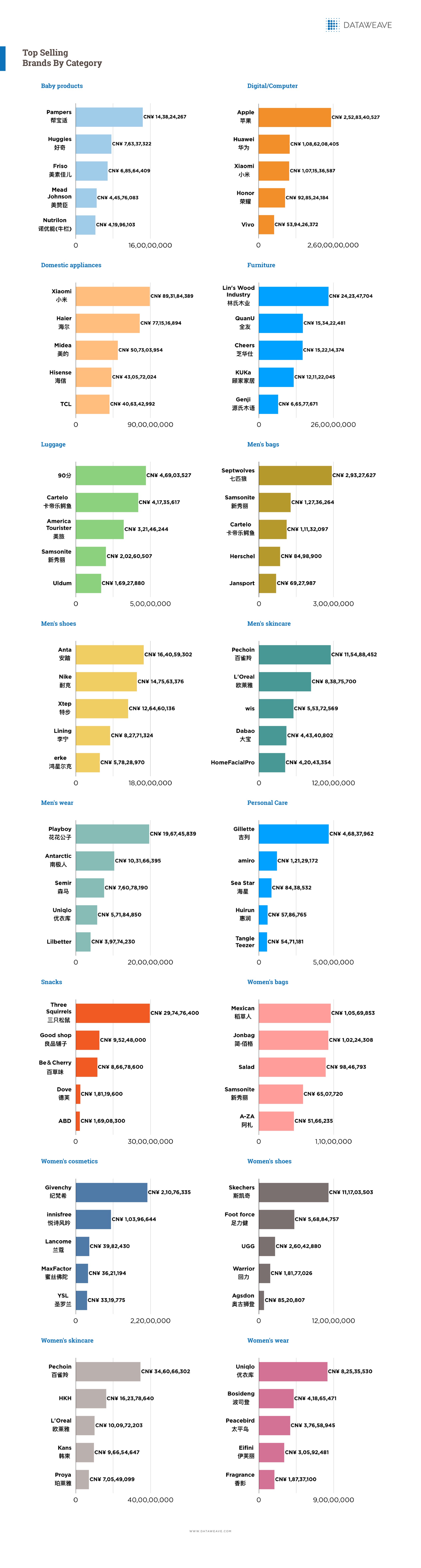
    International brands continue to penetrate the Chinese market showing up amongst the Top 5 brands of 13 of the 16 categories on sale.

    In the Diaper category, Pampers delivered nearly twice the sales turnover of its next biggest competitor. As expected, Apple and Huawei battled it out for honors in the Digital/Computer category although Xiaomi enjoyed pleasing results, nearly matching Huawei’s sales to go with its sales leadership of the Domestic Appliances category. Local brands, though, swept the Domestic Appliances, Furniture and Women’s Wear categories.

    The challenge posed by Chinese brands was illustrated by Nike’s spot in the second place in the highly competitive Men’s Shoes category after Anta.

    International brands topped only five of the 16 categories and Top 3 positions in ten categories. Still, there’s a growing presence of international brands in China’s eCommerce.

    Gillette won handsomely over its competition in the Personal Care category while Skechers enjoyed a similar result in Women’s Shoes, racking up nearly twice the retail sales of its nearest competitor. Another category dominated by international brands was the Women’s Cosmetics category where international brands accounted for 4 of the Top 5 brands.

    Similarly, Samsonite’s acquisition of American Tourister gave it two top 5 brands in the Luggage category. Other global brands to make the cut during the Singles’ Day sale included L’Oréal, Canada’s Hershel, Playboy, South Korea’s Innisfree and Japan’s Uniqlo.

    It’s Not All About Price On Singles’ Day

    The dramatic rise in shopping during Singles’ Day is not driven solely by price reductions. Alibaba’s commitment to its “New Retail” strategic model has led the Chinese giant to channel its impressive resources to focus on bringing together the online elements of its business with the more traditional offline aspects of its retail distribution. This is combined with entertainment to create a larger story based around the shopper’s overall “experience” rather than just driving “attractive prices” as a short-term retail hook.

    Alibaba is betting big on erasing the line between online and offline and its futuristic vision of structuring retail around the way people actually want to shop. Based on the consistently impressive results of Singles’ Day year after year, “New Retail” has a promising future.

    If you wish to know more about how DataWeave aggregates data from online sources to provide actionable insights to retailers and consumer brands, check out our website!

  • CEO Speak: Serving the US Market, Hiring the Right Talent, And More

    CEO Speak: Serving the US Market, Hiring the Right Talent, And More

    Recently, Karthik Bettadapura, Co-founder & CEO at DataWeave, was interviewed by Vishal Krishna, Business Editor at YourStory, in the Bay Area, California. They discussed DataWeave’s focus on the US market, challenges that retailers face today, DataWeave’s technology platform and hiring practices, and more.

    The following is a transcript of the interview.

    (The transcript has been edited for clarity and brevity)

    Vishal Krishna (VK)You left India to come and conquer America, why is that?

    Karthik Bettadapura (KB) : Just a bit of history — we started in 2011 and product development and research was based in Bangalore, and still is. At the end of the first 5 years, we realized that we built great technology, but we were not able to scale beyond a certain point [in India]. If we had to build a growing business, we had to look at other markets as well.

    VK: Quickly, can you tell me what DataWeave does?

    KB: We provide Competitive Intelligence to retailers and customer brands. We work with some of the largest brands and retailers out there and we provide them with analyses to compete profitably.

    VK: You said you had marque clients in India, yet you didn’t want to stay there because you wouldn’t have scaled beyond a particular point. Why is that?

    KB :The ticket size in India is still on the lower side. If you must build a sustainable business, you need access to a much larger customer base and we found that in the US.

    VK: Let’s start from the basics. What are a few things that a startup should decide to do when coming to America?

    KB: A few things:

    • A good understanding of the market
    • Learn fast about the market
    • Build a team here, or a have a team here already doing some work initially
    • Consider how your team back in India will go about doing things in your absence
    • The last one is about your own personal journey. I was so used to walking into an office and interacting with people. You come here, and you are all alone!

    VK: It’s a lonely journey. Doors don’t open all that easily and you’ve got to hustle. Why?

    KB: For people here, you are an unknown entity. Why should they be trusting someone who does not have enough customers here or has not raised money here? We had two US-based customers when we came in. It’s an uphill task to ensure that customers trust you.

    VK: Who was the first customer you personally met here and why was that meeting so important?

    KB: The first customer I met here was a large, big box retailer, and the meeting was primarily focused around why they should trust us — how can they know that we would survive and serve them, as well as how we are better than some of the other guys out there.

    VKCan you tell us what DataWeave does for US retailers?

    KB: For retailers, we provide competitive intelligence, primarily around pricing optimization and assortment analytics. In the US, a lot of retailers are shutting shop and filing for bankruptcy.

    VK: Yeah, we saw Sears go through something like that.

    KB: The reasons fall broadly into 3 categories:

    • They failed to compete profitably with a lot of these new age businesses.
    • The new age retailers offer superior customer experience. They have figured out a better assortment/product strategy.
    • The third one is ‘Price’ — price is such an important feature.
      What we do is help these retailers optimize their strategies around pricing, assortment and promotions, eventually enabling them to compete profitably.

    VK: Typically, customers pay you on the outcome, pricing, license or subscription?

    KB: It’s a subscription-based model. There is a one-time setup fee and an ongoing subscription fee.

    VK: So you plug into their data management system?

    KB: Yes, but we can also have our product sit independently. Sitting out of their internal systems is a benefit for us as we don’t have to get into the entire loop of integrations into their internal systems right from Day 1. We prove our product works and then we integrate with their systems.

    VK: How do you integrate? Is the CIO your target?

    KB: No, we don’t sell to the CIO world. We sell to analytics, pricing, and merchandising teams.

    VK: Can pricing alone give retailers a competitive edge?

    KB: Yes, pricing is a big lever that retailers use. For example, last holiday season’s sale, Amazon and Walmart made 120 million price changes in just 2–3 days.

    VKSo they change the prices so dynamically to compete with each other. Is this price war coming to India?

    KB: It is happening in India already.

    VK: How much data can DataWeave’s infrastructure ingest?

    KB: We are a global platform — we have customers across the globe, not just the US or India. So, on a daily basis, we process data on around 120 million products.

    VKTalk a little bit on R&D quickly. Do you have your marketing team in the US?

    KB: We have marketing teams in the US and India.

    VK: And the engineering team?

    KB: The engineering team is in Bangalore.

    VK: For people who want to work in your company, what kind of talent are you looking for?

    KB: We look at 4 broad talent areas:

    • One is in the world of data acquisition, which addresses issues like how data can be aggregated from thousands of websites and millions of pages on an ongoing basis, and how this data can be stored.
    • The second area is on what kind of insights can be generated using this data. This could be done using text analytics, image analytics, and other technologies. This includes process optimization, in terms of building efficient and scalable systems.
    • The third area is on how well the data can be represented if we have a customer who wants 60–70 million data points to be consumed on a weekly basis.
    • And the last area is on data modeling — what kind of insights can we eventually give to the customer? And, when I say insights, I mean specific actions.

    VK: You want people who can handle massive scale and for that they should be good at linear regression.

    KB: We value people who write good code. We primarily work in Python, and we use a lot of optimization techniques in the middle of the stack to help us scale.

    VK: Would you do something for supermarkets?

    KB: Absolutely. The largest offline supermarket in India is our customer.

    VKSo what can you do for supermarkets?

    KB: Offline retailers across the world are facing something that’s called showrooming. This is when a shopper walks up to a store, looks at and feels a product, then searches online to see it’s available at a better price. So we have retailers who are wary of this phenomenon. We also have retailers who are wary of diminishing customer loyalty. So they have to constantly ensure that they are priced better in the market and are not losing customers because of [online] pricing.

    VK: How powerful are your algorithms?

    KB: There is a dedicated team that works on our algorithms. These fall into several buckets. One is pure data scale algorithms — how do you build systems which ensure that you are able to efficiently query them in real time and get the desired output. The second one is — how do you keep improving your machine learning algorithms. For example, computer vision algorithms, text analytics algorithm, etc. The third — how do you keep experimenting effectively.

    VK: What role can an MBA degree holder play in DataWeave?

    KB: We have people who hold MBA degrees and are working in customer success, delivery management, marketing, and sales.

    VK: Do you spend time in training?

    KB: You do have some lead time if you are a fresher, but if you are a lateral hire, its expected that you keep the ball rolling. They should be able to learn and learn fast — learning is more important than knowing. So, we give a lot of importance to people who can learn and pick up things quickly – about our product, handling customer objections, etc.

    *

    Watch the whole video here or check out DataWeave’s website to know more about how we use data engineering and artificial intelligence to enable retailers and brands to compete profitably in the age of eCommerce.

  • Evolution of Amazon’s US Product Assortment

    Evolution of Amazon’s US Product Assortment

    As with many other product categories, Amazon has made a significant incursion in Apparel — a key battleground category in retail today. Recently, DataWeave once more collaborated with Coresight Research, a retail-focused research firm to publish an in-depth report revealing insights on Amazon’s approach to its US fashion offerings.

    Since our initial collaborative report in February this year, we have witnessed some seismic shifts in the category at both the brand and the product-type level.

    Research Methodology

    We aggregated our analytical data on more than 1 million women’s and men’s clothing products listed on Amazon.com in two stages:

    Firstly, we identified all brands included in the Top 500 featured product listings for each product subcategory in both the Women’s Clothing and Men’s Clothing sections featured on Amazon Fashion (e.g., the top 500 product listings for women’s tops and tees, the top 500 product listings for men’s activewear, etc.). We believe these Top 500 products reflect around 95 percent of all Amazon.com’s clothing sales. This represents 2,782 unique brands.

    We then aggregated the data on all product listings within the Women’s Clothing and Men’s Clothing sections for each of those 2,782 brands. This generated a total of 1.12 million individually listed products. This expansive list forms the basis for our highlights of the report.

    Third-Party Seller Listings Are Rising Sharply

    We identified a total of 1.12 million products across men’s and women’s clothing — a significant increase of 27.3 percent in the seven months between February and September 2018. The drivers of this sharp spike are third-party seller listings. In contrast, the report indicates only a 2.2 percent rise in first-party listings over the same period, compared to a 30.5 percent jump in third-party listings.

    In addition, Amazon has listed just 11.1 percent of all clothing products for sale, with third-party sellers offering the remaining 88.9 percent — an indication of the strength of Amazon’s open marketplace platform.

    A Major Brand Shift On Amazon Fashion Is Underway

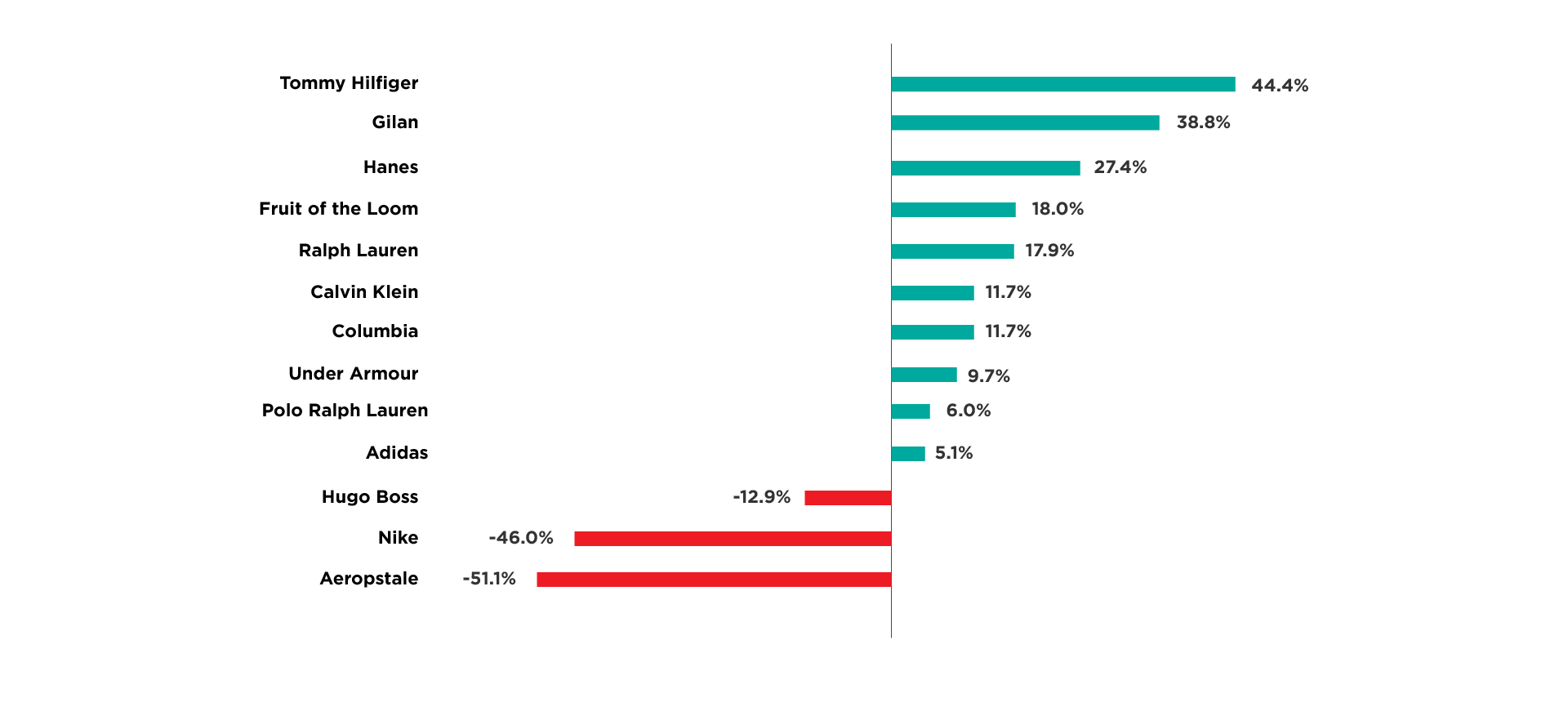
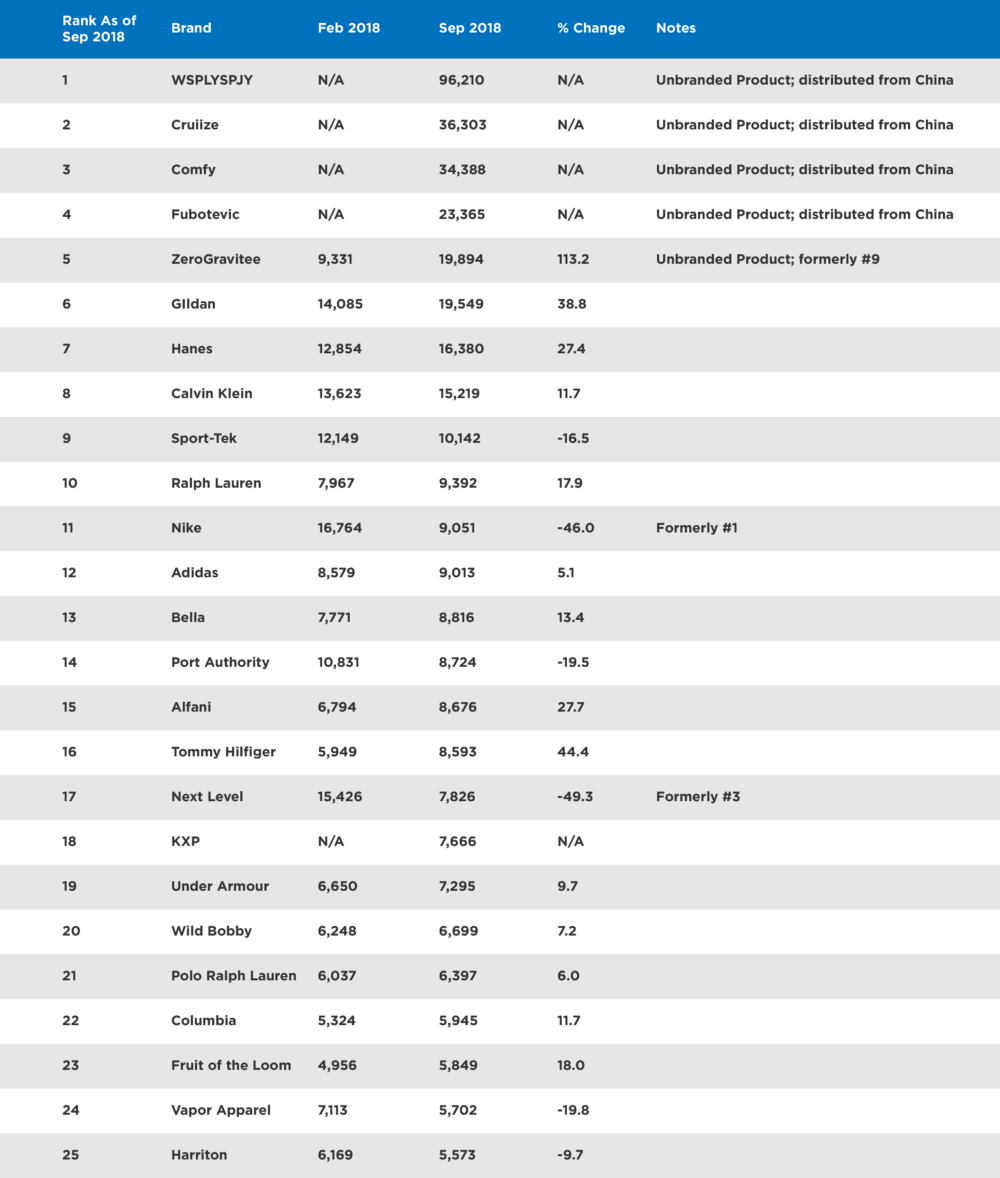
    In just over six short months, major brand shifts on Amazon Fashion have taken place. The number of Nike listings has plummeted by 46 percent, driven by a slump in third-party listings following Amazon’s new partnership with Nike — a story recently covered by Quartz. Limited growth in Nike clothing first-party listings failed to compensate for this decline.

    Gildan’s spike in total product listings appears to be fueled by increased first-party listings off a low base. Calvin Klein’s 2017 agreement to supply Amazon with products appears to be driving the Calvin Klein brand’s double-digit uptick in first-party listings on Amazon Fashion.

    Aéropostale’s decline appears to be entirely driven by a drop in its third-party listings. The brand itself is not listed as a seller on Amazon.com.

    Amazon Is Rebalancing Its Apparel Portfolio and Switching Its Focus from Sportswear To Suits

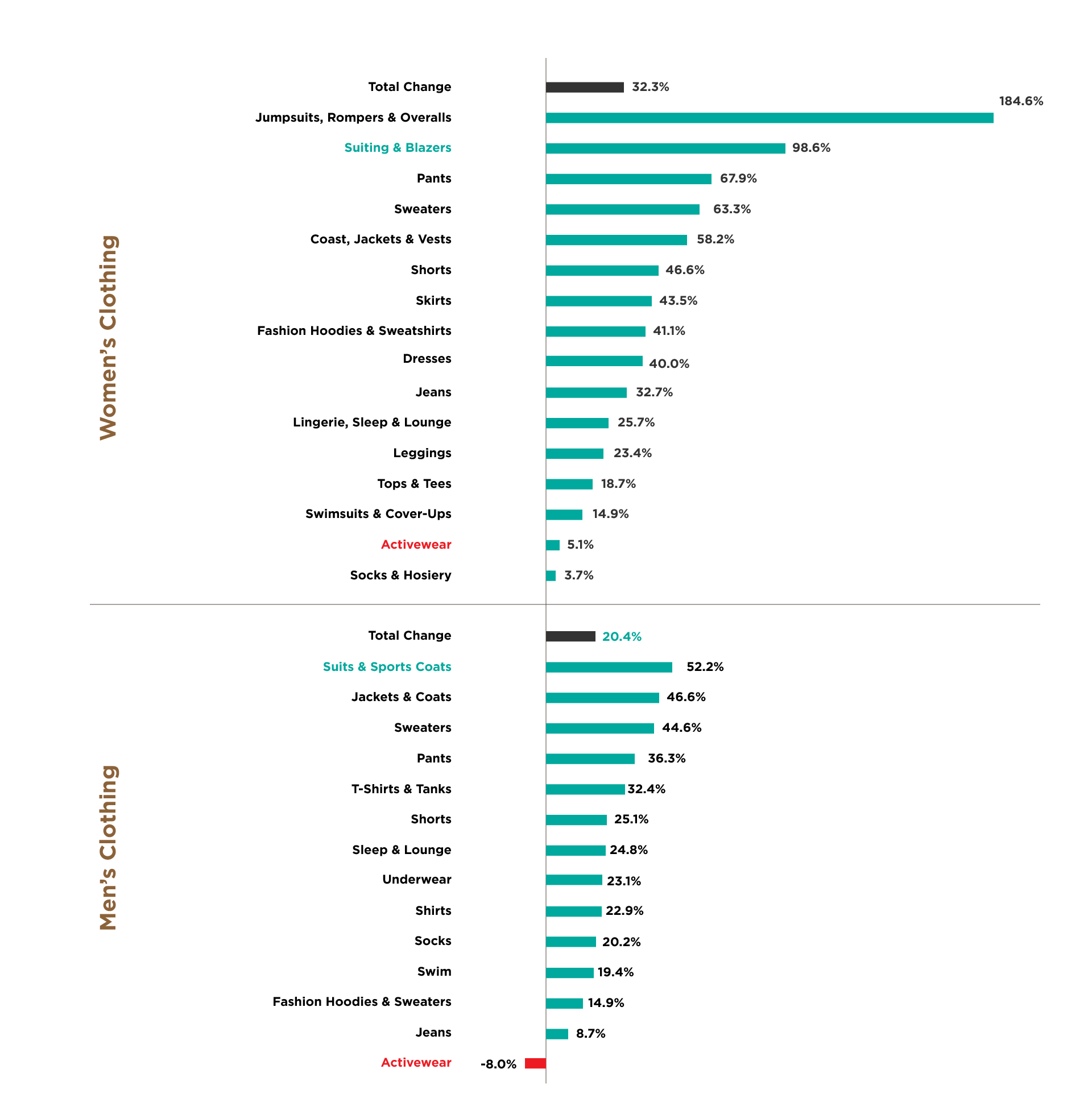
    As its Fashion footprint rapidly matures, Amazon now appears to be rebalancing its portfolio with strong growth being shown in listings for formal categories such as suits and away from sportswear. We recorded a 98.6 percent increase in listings of women’s suits and blazers complemented by a 52.2 percent rise in men’s suit and sports coat listings between February and September 2018.

    Generic “Non-Brands” Are Surging On Top 25 Brands List

    Over the past six months, low-price generic brands have made major inroads into Amazon’s listings. Four unknown “brands” captured the top positions on the list of brands offered on Amazon Fashion. The WSPLYSPJY, Cruiize and Comfy brands appear to be shipped directly to customers from China.

    Source: Coresight/DataWeave (Amazon Fashion: Top 25 Brands’ Number of Listings, February 2018 vs. September 2018)


    Source: Coresight/DataWeave (Amazon Fashion: Top 25 Brands’ Number of Listings, February 2018 vs. September 2018)

    WSPLYSPJY alone accounts for fully 8.6 percent of Amazon men’s and women’s clothing listings. Cruiize accounts for a further 3.2 percent of listings while Comfy chips in another 3.1 percent.

    Amazon Appears To be Executing A Strategic Pivot

    Amazon’s fashion offering is fast maturing. We saw substantial growth in the number of listings for more formal categories. The realignment in third-party listings by Nike together with increased first-party listings for Calvin Klein and Gildan appear to be driven by alliances with Amazon.

    Simultaneously, ultralow-price generic clothing items delivered on order from China have inundated the “Most-Listed Products” rankings. Third parties now represent nearly 90 percent of Amazon Fashion’s offering.

    While Amazon Fashion shoppers enjoy a wider choice than they did even six months ago, we believe a stronger emphasis on first-party listings would grow the products eligible for Prime delivery. This tactic could strengthen Amazon Fashion’s long-term appeal as a shopping destination.

    If you’re interested in DataWeave’s technology, and how we aggregate data from online sources to provide unique and comprehensive insights on eCommerce products and pricing, check us out on our website!

  • Inside India’s eCommerce Battle: Attractive Offers Usher In The Festive Season

    Inside India’s eCommerce Battle: Attractive Offers Usher In The Festive Season

    It’s festival season in India again and shoppers took advantage of aggressive cutthroat competition between Indian online retailers to drive sales to unprecedented highs.

    All the major Indian eCommerce websites including, Amazon, Flipkart, Myntra, and Shopclues opted to go head to head by holding their first sale event this season over 4 to 5 days starting on the 10th of October. Still, as industry reports indicate, one retailer came out on top during this event — an insight supported by our analysis as well.

    A New Battleground

    The highlight this year was seeing how the announcement of global retail colossus Walmart’s acquisition of Flipkart would impact the sale events. The acquisition was the most influential development in India’s eCommerce sector, and it has transported a decades-long U.S. rivalry between Amazon and Walmart to Indian soil. As a result, this year’s sale event held out the promise of more attractive pricing and vast product selection for India’s consumers than ever before.

    Industry analysts estimate that the sale generated a cumulative Rs 15,000 crore in sales over the spread of the five sale days, a whopping outcome. In 2018, this translated into around a 64 per cent year-on-year growth outcome compared to the USD 1.4 billion (around Rs 10,325 crore) generated by the 2017 sales.

    The DataWeave Analysis

    At DataWeave, we analyzed the performance of each of the major eCommerce platforms including Amazon, Flipkart, Myntra, Paytm, and Shopclues. For each eCommerce website, we aggregated data on the Top 500 ranked products for over 40 product types spread across 6 product categories (Electronics, Men’s & Women’s Fashion, Furniture, Haircare, Skincare).

    We focused our analysis on only the additional discounts offered during the sale and compared them to prices prior to the sale, to reflect the true value of the sale to India’s shoppers.


    The battle of the discounts was led primarily by Flipkart and Amazon. Flipkart’s average additional discounts by category actually exceeded Amazon’s in three out of six categories, and it discounted more products that Amazon across all categories.

    Clearly, the focus for all e-tailers was skewed towards the main battlegrounds of Electronics and Fashion, compared to mainstream FMCG categories such as Hair and Skin Care. However, this is not surprising given FMCG functions on rather skinny margins.

    Across retailers, the Men’s and Women’s Fashion categories were the most aggressively discounted, attracting both the highest additional discounts and the highest percentage of products with additional discounts.

    The Furniture category too was an interesting battleground between Amazon and Flipkart, attracting attractive discounts on a wide range of products, particularly in Flipkart’s case.

    Prospective shoppers in search of relatively more expensive clothing products on discount during the sale would have established Myntra as their ideal destination, as it carried more premium products on discount during the sale, relative to all its competitors. For shoppers in search of an electronics bargain though, they would have done well to opt for Flipkart.

    Shoppers may have found some interesting deals on Paytm Mall too, especially in Men’s Fashion, while Shopclues largely held itself back from any dramatic price reductions.

    While Myntra capitalized on its niche though aggressive discounting in the Fashion category, most of the discounting action revolved unsurprisingly around Amazon and Flipkart. To drill down for a more complete understanding of just how the Amazon and Flipkart discounted their products, we conducted a more detailed follow-on analysis.

    We normalized additional discounts and popularity using a scale of 1 to 10 and plotted each product on a chart to analyze its distribution characteristics. Popularity was calculated as a combination of the average review rating and the number of reviews posted. Products with a popularity score of zero, as well as zero additional discounts were excluded from this analysis.


    The most obvious insight yield through this analysis is how Flipkart elected to distribute its additional discounts across a larger range of discount percentages. By contrast, Amazon went all in on the more limited range of products it decided to provide additional discounts on. This is a strategy we have seen Amazon adopt previously.

    One other intriguing insight is Flipkart’s decision to go for a much higher distribution of products falling below a popularity score of 0.5 compared to Amazon. Amazon’s strategy resulted in more of its discounted products having a higher popularity score, relative to Flipkart, albeit only by a comparatively minor amount. However, a shopper’s chances of buying a popular, positively reviewed product at a lower price were higher on Amazon than Flipkart during this sale.

    Achieving a Consistent Competitive Edge

    Flipkart claims to have recorded a 70 per cent plus share of entire Indian e-commerce market in the 4 day-BBD’18 sales. Flipkart further claimed to have cornered an 85 per cent share in the online Fashion category together with a 75 per cent share in the Electrical category’s large appliances during the sale. This includes a contribution by Flipkart’s subsidiary Myntra.

    As these numbers reflect, Amazon still has some way to go to entrench itself in the Fashion category of the Indian market. However, Amazon appears content to continue its surgical discounting philosophy.

    Overall, this year witnessed an impressive participation by Tier II and Tier III Indian city consumers — a sign of things to come in Indian online retail.

    With increasing competitive pressure, retailers simply cannot adopt discounting and product selection strategies in isolation and be successful. Having access to up to date insights on competitors’ products dynamically during the day is emerging as key to ensuring they’re able to sustain their lowest priced strategy for appropriate products. These insights are also proving critical in identifying gaps in their product assortment, which can hamper customer conversion and retention.

    During sale events, modern retailers need to rely on highly granular competitive insights on an hourly basis (or even more frequently) to inform their pricing and product strategies to ensure they consistently maintain a competitive edge for the consumer’s wallet. And while access to reliable competitive intelligence is critical, true value can only be derived when it gets integrated with a retailer’s core business and decision-making processes, such as assortment management, promotions planning, pricing strategies, etc.

    DataWeave’s Competitive Intelligence as a Service helps global retailers do just this by providing timely, accurate, and actionable competitive pricing and product insights, at massive scale. Check out our website to find out more!

  • Evaluating the Influence of Learning Models

    Evaluating the Influence of Learning Models

    Natt Fry, a renowned thought leader in the world of retail and analytics, published recently an article expounding the value and potential of learning models influencing business decision-making across industries over the next few years.

    He quotes a Wall Street Journal article (paywall) published by Steven A. Cohen and Matthew W. Granade who claim that, “while software ate the world the past 7 years, learning models will ‘eat the world’ in the next 7 years.”

    The article defines a learning model as a “decision framework in which the logic is derived by algorithm from data. Once created, a model can learn from its successes and failures with speed and sophistication that humans usually cannot match.”

    Narrowing this down to the world of retail, Natt states, “if we believe that learning models are the future, then retailers will need to rapidly transform from human-learning models to automated-learning models.”

    This, of course, comes with several challenges, one of which is the scarcity of easily consumable data for supervised learning algorithms to get trained on. This scarcity often results in a garbage-in-garbage-out situation and limits the ability of AI systems to improve in accuracy over time, or to generate meaningful output on a consistent basis.

    Enabling Retailers Become More Model-Driven
    As a provider of Competitive Intelligence as a Service to retailers and consumer brands, DataWeave uses highly trained AI models to harness and analyze massive volumes of Web data consistently.

    Far too often, we’ve seen traditional retailers rely disproportionately on internal data (such as POS data, inventory data, traffic data, etc.) to inform their decision-making process. This isn’t a surprise, as internal data is readily accessible and likely to be well structured.

    However, if retailers can harness external data at scale (from the Web — the largest and richest source of information, ever), and use it to generate model-driven insights, they can achieve a uniquely holistic perspective to business decision-making. Also, due simply to the sheer vastness of Web data, it serves as a never-ending source of training data for existing models.

    DataWeave’s AI-based model to leverage Web data


    Web data is typically massive, noisy, unstructured, and constantly changing. Therefore, at DataWeave, we’ve designed a proprietary data aggregation platform that is capable of capturing millions of data points from complex Web and mobile app environments each day.

    We then apply AI/ML techniques to process the data into a form that can be easily interpreted and acted on. The human-in-the-loop is an additional layer to this stack which ensures a minimum threshold of output accuracy. Simultaneously, this approach feeds information on human-driven decisions back to the algorithm, thereby rendering it more and more accurate with time.

    Businesses derive the greatest value when external model-based competitive and market insights are blended with internal data and systems to generate optimized recommendations. For example, our retail customers combine competitor pricing insights provided by our platform with their internal sales and inventory data to develop algorithmic price optimization systems that maximize revenue and margin for millions of products.

    This way, DataWeave enables retailers and consumer brands to utilize a unique model-based decision framework, something that will soon be fundamental (if not already) to business decision-making across industry verticals and global regions.

    As AI-based technologies become more pervasive in retail, it’s only a matter of time before they’re considered merely table stakes. As summarized by Natt, “going forward, retailers will be valued on the completeness of the data they create and have access to.”

    If you would like to learn more about how we use AI to empower retailers and consumer brands to compete profitably, check out our website!

    Read Natt’s article in full below:

    Steven A. Cohen and Matthew W. Granade published a very interesting article in the Wall Street Journal on August 19, 2018 — https://www.wsj.com/articles/models-will-run-the-world-1534716720

    Their premise is that while software ate the world (Mark Andreessen essay in 2011, “Why Software is Eating the World”) the past 7 years, learning models will “eat the world” in the next 7 years.

    A learning model is a decision framework in which the logic is derived by algorithm from data. Once created, a model can learn from its successes and failures with speed and sophistication that humans usually cannot match.

    The authors believe a new, more powerful, business opportunity has evolved from software. It is where companies structure their business processes to put continuously learning models at their center.

    Amazon, Alibaba, and Tencent are great examples of companies that widely use learning models to outperform their competitors.

    The implications of a model-driven world are significant for retailers.

    Incumbents can have an advantage in a model-driven world as they already have troves of data.

    Going forward retailers will be valued on the completeness of the data they create and have access to.

    Retailers currently rely on the experience and expertise of their people to make good decisions (what to buy, how much to buy, where to put it, etc.).

    If we believe that learning models are the future then retailers will need to rapidly transform from human-learning models to automated-learning models, creating two significant challenges.

    First, retailers have difficulty in finding and retaining top learning-model talent (data scientists).

    Second, migrating from human-based learning models to machine-based learning models will create significant cultural and change management issues.

    Overcoming these issues is possible, just as many retailers have overcome the issues presented by the digital age. The difference is, that while the digital age has developed over a 20 year period, the learning-model age will develop over the next 7 years. The effort and pace of change will need to be much greater.

  • Prime Day Sale: Unraveling the Highs and Lows of Amazon’s Flagship Event

    Prime Day Sale: Unraveling the Highs and Lows of Amazon’s Flagship Event

    Another year, another round of media frenzy, and another set of records broken.

    In only three years, Amazon’s Prime Day has evolved into one of the landmark sale events of the shopper’s calendar. Reports indicate that this year’s sale made a major splash, raking in over $4.2 billion in sales — a 33% increase compared to last year. Also, the retail behemoth shipped over 100 million products during the 36-hour sale. Amazon stated that they “welcomed more new Prime members on July 16 than on any other previous day in Prime history.”

    The much talked about website outage added some spice and drama to the proceedings during the first hour. However, this was fixed quickly.

    This year is also the first Prime Day with Whole Foods, Amazon’s most expensive acquisition, giving US shoppers unprecedented incentives to shop at the physical stores of the grocery retailer.

    However, Prime Day is not just about the US, but a truly global event. In India, as part of its promotions for Prime Day, Amazon leveraged VR to have people experience the products in their true form factor at select malls.

    At DataWeave, our proprietary data aggregation and analysis platform enabled us to keep an eye on the pricing and discounts of products during the sale. We tracked Amazon.com, Amazon.co.uk, and Amazon.in before (14th July) and during the sale (16th July) and monitored several product types in Electronics, Men’s Fashion, Women’s Fashion and Furniture categories. We captured information on the price, brand, rank on the category page, whether Prime was offered or not, etc. and analyzed the top 200 ranks in each product type listing page. To best indicate the additional value to shoppers during the sale, we focused our analysis only on additional discounts on products between the 14th and 16th of July.

    Scrutinizing the data yielded some rather interesting insights:

    Amazon UK was more aggressive with its discounts than the US and India across most categories, with Furniture being the only exception (highest discounts in the US).

    In the US, Women’s Fashion observed the steepest discounts (12%), though there were discounts available on a larger number of Men’s Fashion products (5% additional discount on 20% of products).

    While disparity between discounts on Prime products vs non-Prime was quite evident, it was surprisingly low for many categories. In fact, the Electronics category in the UK and the Furniture category in India witnessed sharper discounts for non-Prime products than Prime.

    Top categories by additional discount include Women’s Handbags, Sports Shoes, and Pendrives in the US, Sunglasses and Tablets in the UK, and Women’s Tops, Men’s Jeans, Women’s Sunglasses, and Refrigerators in India. Top brands include Nike, Amazon Essentials, Sandisk, and 1home in the US, Oakley, Toshiba, Belledorm, and rfiver in the UK, and Adidas, Sony, UCB, and Red Tape in India.

    As indicated in the following infographic, some of the most discoverable brands during the sale include Canon, Apple, Nike and Casio in the US, Sandisk, Amazon, Levi’s, and Ray Ban in the UK, and Nikon, UCB, Whirlpool, and HP in India. Discoverability here is measured as a combination of the number of the brand’s products in the top 100 ranks and the average rank of all products of the brand. Also in the infographic, is a set of products with high additional discounts during the sale.


    Amazon’s competitors though aren’t ones that simply roll with the punches.

    Flipkart, Amazon’s largest competitor in India (recently acquired by Walmart), announced its own Big Shopping Days sale between July 16 and July 19. On Prime Day, the company joined in with some attractive offers:

    • 8%, 10%, and 7% additional discounts on 11%, 29%, and 16% of Electronics, Men’s Fashion, and Women’s Fashion categories, respectively.
    • 35% off on Perfect Homes 3-seater Sofa
    • 27% additional discount on Acer Predator Helios Gaming Laptop
    • 25% additional discount on Sandisk 16GB Pen Drive

    Propelling the Amazon Flywheel

    While Amazon clearly benefits in the short-term with this sale, the long-term effect of feeding its famous flywheel is evident as well.

    Amazon’s flywheel is a framework through which the company looks to build a self-feeding platform that accelerates growth over time. Attractive discounts and a broad selection of products improves customer experience, which increases traffic to the website, which attracts more merchants on its platform, who in turn broaden the selection of available products.

    Sale events like Prime Day create the sort of hype needed to draw a lot of traffic to Amazon’s website, generating momentum that has a compounding effect on Amazon’s growth. Not surprisingly, more than half of the people surveyed in the US by Cowen last December said they lived in a household with at least one Prime subscription.

    As Amazon’s stock traded at an all time high following Prime Day, it’s only a matter of time before the company becomes the world’s first trillion dollar company.

    Check us out, if you’re interested in learning more about our technology and how we provide Competitive Intelligence as a Service to retailers and consumer brands.

  • Clearance Sale Analysis: Retailing Woes Stagger H&M and Toys “R” Us

    Clearance Sale Analysis: Retailing Woes Stagger H&M and Toys “R” Us

    Confidence amongst retailing analysts was rocked last month by two successive announcements.

    H&M’s most recent quarterly report, which revealed it had accumulated over $4.3 billion in unsold inventory, shocked retail analysts. In an era of on-the-fly inventory replenishment where stocks are closely matched to sales, a spike in unsold inventory is a strong indicator of trouble ahead. The news left analysts questioning H&M’s competitiveness in the fiercely contested global apparel category, where ever-changing consumer preferences demand agility in managing inventory levels.

    In the other major announcement, Toys “R” Us officially closed its doors to shoppers. The retailer’s losses continued to pile up and the chain groaned under a mountain of debt, leaving it little choice but to close down. “The stark reality is that the (chain is) projected to run out of cash in the U.S. in May,” it said in its bankruptcy filing.

    While the emergence of the online shopping phenomenon hasn’t helped Toys “R” Us, its ongoing afflictions largely reflect strategic missteps that predated the online shopping boom. In a category where the shopping experience is all, the retailer failed to adapt to changing consumer expectations. The warehouse context which shaped the retailing did little to promote toys sales or communicate the sheer breadth of inventory carried by Toys “R” Us.

    So, as Toys “R” Us begins to wind down its operations, the company has shuttered its online store and is channeling customers to its remaining physical retail outlets. However, prior to the closure, shoppers enjoyed some amazing bargains during their clearance sale.

    H&M’s problems appear less terminal. Its management claim to have implemented a strategy to slash its accumulated inventory and reign in its aggressive store expansion strategy.

    At DataWeave, we leveraged our proprietary data aggregation and analysis platform to analyze the clearance sales of both H&M and Toys “R” Us. We tracked the pricing, product categories, discounts, review ratings, stock status and more between 29-Mar and 3-Apr.

    The Toys “R” Us Sale


    Although the dolls and stuffed animals category carried the most products, its average discount was along the mid-range point for the sale at 28 percent. Games & Puzzles and Action Figures and NERF were the most heavily discounted categories at 40 percent and 36 percent respectively.

    As anticipated, products with lower review ratings were sold at slightly higher discounts. However, even exclusive products were sold at comparatively high discounts. Not surprising, given this was effectively a clearance sale.

    Hasbro, Mattel, and Spin Master were the highest represented brands during the sale, while for their part, Kid’s Furniture and Outdoor Play had fewer products participating in the sale. Other popular brands such as Fisher-Price and LEGO had a presence during the sale but offered fewer products.

    Zuru was the most aggressive in offering discounts with Spin Master the least aggressive. The remaining brands offered discounts of between 30 and 36 percent.

    Reports suggest that last year, toymakers Mattel and Hasbro each sold around $1 billion worth of their toys at Walmart, more than the volume they achieved selling through Toys “R” Us. Strategically, these leading brands seem to have their bases covered even though Toys “R” Us is closing down.

    Interestingly, some products were seen to go out of stock during the sale week, only to be replenished a day later, as illustrated in the above infographic.

    The H&M Sale

    Overall, H&M’s clearance sale was more aggressive in Women’s Apparel with three times more products on offer than for Men’s Apparel. However, there wasn’t much difference between the two in terms of the discounts on offer which hovered around the 45 percent range. Women’s Tops, Cardigan’s and Sweaters offered discounts on the most products during the sale period.

    Little difference was observed tactically, between how the different product categories, were handled.

    We saw a significant movement of products in Women’s apparel during the week, with over 330 newly added products and close to 200 products that were effectively churned. This pattern indicates H&M achieved a faster shelf velocity for this category than for Men’s, possibly due to a more aggressive approach to the selection of items on sale.

    Customer focus is key

    Reports indicate that despite a series of widespread and aggressive markdowns as shown in the analysis above, H&M is struggling to sell off its mountain of accumulated merchandise. Changing consumer tastes and increasing competition seem to have taken their toll on the once agile Swedish retailer. If it is going to weather this storm, H&M needs to revisit its fast fashion approach to assortment and inventory management. The retailer would also appear to need to improve its demand forecasting expertise.

    The bankruptcy filing by Toys “R” Us presents yet another lesson for eCommerce and bricks-and-mortar retailers alike, to address evolving consumer expectations and focus closely on the customer experience aspect of their business, which are supported by appropriate pricing and product assortment strategies.

    At DataWeave, our technology platform enables retailers to do just that, through comprehensive and timely insights on competitive pricing, promotions, and product assortment. Check out our website to find out more!


  • Study of Brand Inconsistency in Furniture eCommerce

    Study of Brand Inconsistency in Furniture eCommerce

    From initially lagging well behind early high-penetration categories such as consumer electronics, books, and apparel, furniture is now emerging as a key growth category.

    Online furniture purchases are growing at a rapid clip, estimated to currently be around 14 percent rate annually and is anticipated to reach 7.6 percent of total category sales in 2018.

    Savvy furniture brands are becoming increasingly aware of this shift in consumer shopping patterns and are taking steps to embrace the importance of creating a seamless online customer experience consistent across all eCommerce websites.

    Selling furniture online remains logistically complex. It requires the disciplined coordination across an ecosystem teeming with bricks and mortar stores, salespeople, warehouses merchants, and a network of delivery systems.

    All this complexity poses challenges for brands looking to deliver a consistent brand experience for consumers across multiple eCommerce websites.

    One frequent outcome of this complex ecosystem is the emergence of white labeling.

    The Invasion of White Labeling in the Furniture Category

    A white label product is one that is manufactured by one company only to be bundled and sold by other online merchants using different brand names. The end product is positioned as having been manufactured by the brand marketer.

    These white label products are frequently sold at a significant discount, compared to more mainstream name brands in the category.

    Electronics brands have often been victims of this phenomenon. Typical electronic white label products now commonplace range from radios and DVD players to computer mice and keyboards, through to TV remote controls.

    Increasingly, the furniture vertical is no longer a stranger to white label packaging and marketing as well.

    At DataWeave, using our proprietary data aggregation and analysis platform, we analyzed a range of factors of the furniture vertical, specifically the emerging phenomenon of white labeling.

    Our analysis spanned a sample set of over 20,000 products that we tracked across the websites of two of our eCommerce customers (whom we don’t wish to name) that have a large assortment of furniture products. Let’s call these eCommerce companies Retailer A and Retailer B.

    We identified white labeled products as being those that featured the exact same image between the two retailers but were sold under different brand names. Here, our AI-powered advanced image analytics platform matched the images of various products at an accuracy of more than 95%.

    The following infographic summarizes our analysis.

    Clearly, not only is white labeling quite prevalent here, but in almost every instance, we identified price variation. Some of the white labeled products were sold by lesser-known brands with significantly lower price points. This pricing strategy could potentially damage the customer experience for well-established consumer brand franchises in several ways.

    The shopper sees through the branding exercise where the same product is repackaged and presented as having been “produced” by a different brand, potentially eroding brand loyalty.

    As some 71 percent of the products studied were identified as white labeled products, this exposes the category as a whole to this risk.

    The shopper may be confused by the price difference as well, undermining the brand’s carefully constructed pricing perception. The average spread of 21 percent between competing white labeled products is potentially a major source of consumer dissonance and confusion.

    A Closer Look at Pricing

    While the inconsistent experience potentially created by widespread white labeling is almost characteristic of the furniture vertical, other eCommerce areas such as pricing and promotion have also been demonstrated as being key influencers of the shopping experience.

    Today, brands have little control over how their products are priced on eCommerce websites and are susceptible to pricing decisions taken by either the merchant selling the product or retailers themselves. Here, price change decisions have little to do with providing a consistent brand experience, as it’s not really a priority for merchants and retailers.

    In a hyper-competitive retail environment, retailers often discount heavily or change prices frequently to drive sales and margins. The following infographic summarizes the differences in pricing approaches between the two retailers we analyzed.

    Both retailers demonstrated quite divergent approaches in their pricing strategies. The key point of difference appeared to be Retailer B’s discount execution, which proved more aggressive than Retailer A’s, routinely exceeding the latter by five percent or more.

    This discounting strategy is focused on the 40+ percentile (by price, with 100 percentile being the most expensive product), and above price bands, while both retailers displaying similar strategies to their Top 20 and Top 20 to 40 percentile ranges.

    We also observe how Retailer B is more inclined to offer higher discounts on products with higher review ratings, compared to Retailer B’s strategy — a play on developing a “low price” perception among shopper.

    The Consumer Experience Matters

    Today, consumers expect a truly seamless shopping experience right across a brand’s entire integrated retail community, regardless of whether it is physical or digital. Consumers have evolved beyond being merely time poor and have emerged as a group of impatient shoppers, unforgiving of inconsistencies in their experience.

    With retail evolving to embrace multiple consumer touch points with a brand, the practice of white labelling represents a dangerous source of potential confusion and disillusionment. This raises the degree of difficulty involved in converting website visitors into buyers. Further, inconsistent pricing between eCommerce websites, due to dissimilar pricing strategies adopted by each website, only compounds the problem for furniture brands.

    Technologies like DataWeave’s Competitive Intelligence as a Service, that can provide furniture brands with timely insights on white labelled products, unauthorized merchants, and price disparity between ecommerce websites, can assist furniture brands in their efforts to better manage their online channel.

    Visit our website to find out more on how we help consumer brands protect their brand equity and optimize the experience delivered to their customers on eCommerce websites!
     

  • Amazon’s Fashion & Apparel Product Assortment | DataWeave

    Amazon’s Fashion & Apparel Product Assortment | DataWeave

    Apparel remains one of the key battleground categories in retail today, and like in most other product categories, Amazon has made significant in-roads here. Beyond expanding the range of product offerings and brands in its marketplace, Amazon has also launched several private label brands in this vertical and looked to drive more sales as a first-party seller.

    Recently, DataWeave collaborated with Coresight Research, formerly known as Fung Global Retail & Technology, a retail-focused research arm of Li & Fung Group, to publish an in-depth report revealing Amazon’s strategic approach to product assortment in its fashion and apparel category.

    In this blog post, we’ll summarize some interesting insights into Amazon’s strategy from the report. For an in-depth and detailed view, check out the original article at — “Amazon Apparel: Who Is Selling What? An Exclusive Analysis of Nearly 1 Million Clothing Listings on Amazon Fashion

    Research Methodology

    Our analysis focused on several critical areas, including the presence of Amazon’s private label, the demarcation between Amazon as a seller and its third-party sellers and the top brands and categories in women and men’s apparel.

    We aggregated data from Amazon.com in two stages:

    Firstly, we identified brands with a meaningful presence in Amazon’s clothing offering by identifying all brands included in the top 500 ranks of featured product listings for each product type in the Women’s Clothing and Men’s Clothing sections on Amazon (e.g., the Top 500 product listings for women’s tops and tees, the Top 500 product listings for men’s activewear, and so on.). This generated a total of 2,798 unique brands.

    Secondly, we aggregated our data on all product listings within the Women’s Clothing and Men’s Clothing sections for each of the 2,798 brands identified previously. This returned a total of 881,269 individually listed products. This extensive list forms the basis for the highlights in Coresight’s report.

    Coresight’s Analysis — Some Interesting Insights

    Strategically, Amazon remains heavily reliant on its third-party sellers in the clothing category. In total, just 13.7 percent of women’s and men’s clothing products featured on Amazon Fashion are listed for sale by Amazon itself (first-party sales), while third-party sellers account for 86.3 percent of listings.

    In womenswear, third-party sellers account for 85.7 percent of listings, while in menswear, they account for 87.1 percent of listings. Moreover, Amazon appears to be focusing its first-party clothing inventory on the higher-value categories. Clearly, the retailer’s reliance on third-party sellers underscores its opportunity to grow its sales of apparel volumes by bringing more of its current inventory in-house.

    The analysis found 834 Amazon private-label products on Amazon website, equivalent to 0.1 percent of all clothing available through Amazon Fashion. The company’s private labels appear to be clustered tightly in specific clothing categories.

    Womenswear brand Lark & Ro is by far the biggest of Amazon’s apparel private labels, as measured by the number of items.

    Nike is the most-listed brand on Amazon Fashion, with 16,764 listed products spanning womenswear and menswear. Lower-price brands such as Gildan and Hanes also rank very highly in terms of the number of products listed.

    Value-positioned brands that have traditionally focused on wholesaling to retailers, such as Gildan and Hanes, also rank very highly in terms of the number of products listed.

    What is clear is that currently, Amazon’s clothing listings are highly diluted, with no one major brand dominating the listings.

    Interestingly, casualwear and activewear clearly lead Amazon’s category rankings. Women’s tops and tees are the most heavily listed clothing category on Amazon Fashion, with 138,001 products listed.

    Men’s shirts, which includes a large number of casual shirts together with polo shirts and some T-shirts, comes in second, with 109,043 products listed. Echoing the prominence of the global Nike and Adidas brands on the Amazon website, activewear has achieved a centre of gravity status as a category, accounting for 76,930 men’s activewear products and 51,992 women’s activewear products listed on the site.

    Several Opportunities for Growth

    Amazon Fashion remains heavily dependent on third-party sellers. It’s a fair assumption that more first-party listings would attract greater numbers of shoppers, especially Amazon Prime members. Amazon’s private-label ranges represent another potential lever for growth.

    Also, the 30 most-listed brands on Amazon Fashion comprise 30 percent of all clothing products listed on the website, while just 189 brands have more than 1,000 products each listed on the website.

    This data indicates the presence of major growth opportunities across the board, be it Amazon private label brands, Amazon as a seller, and for several mid-range clothing brands.

    If you’re interested in DataWeave’s technology, and how we aggregate data from the Web to provide unique and comprehensive insights on eCommerce products and pricing, check us out on our website!
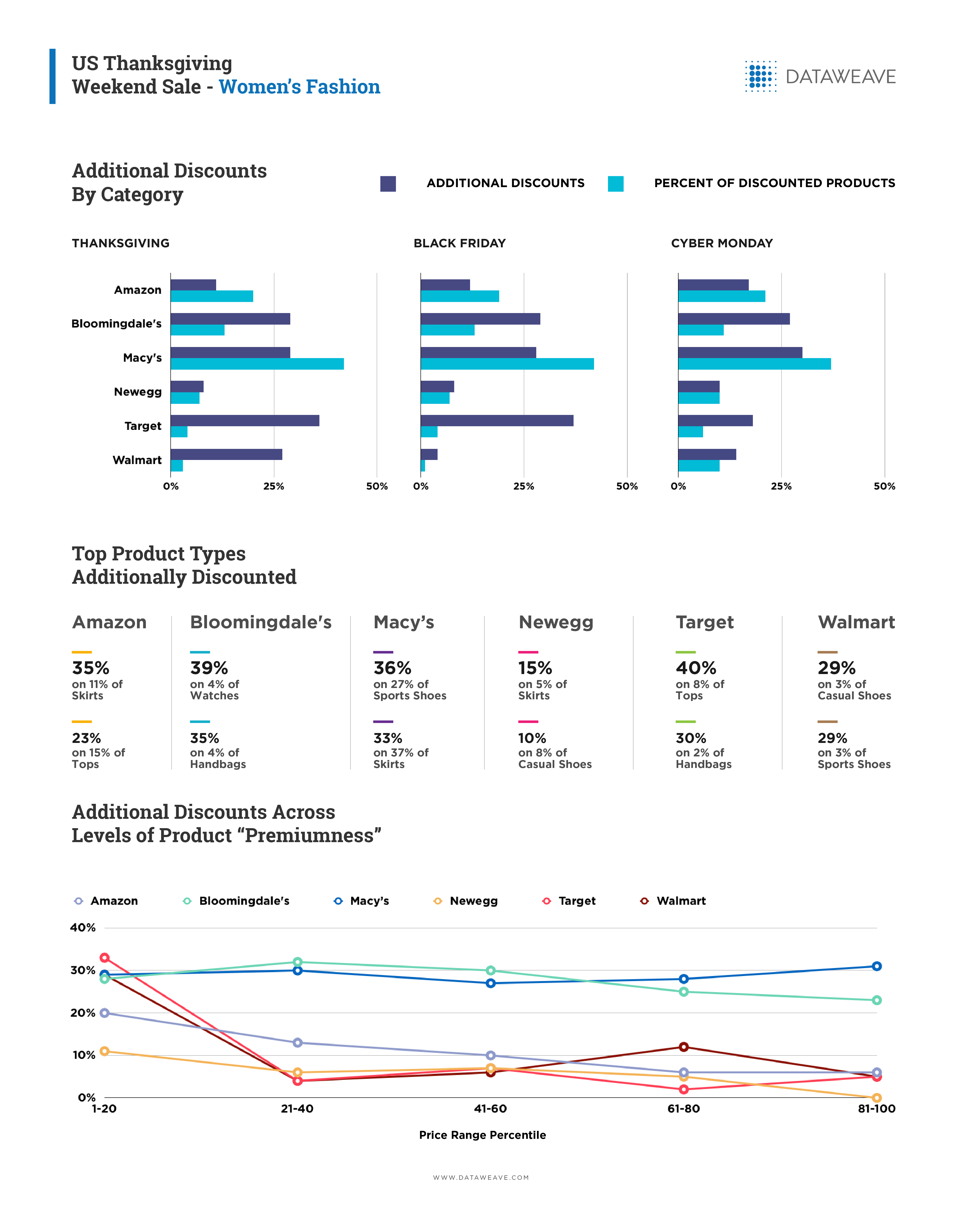
  • Boxing Day Sale: How UK’s Top Retailers and Brands Fared

    Boxing Day Sale: How UK’s Top Retailers and Brands Fared

    Following a successful Black Friday in November, the United Kingdom geared up for the 2017 Christmas season in December. Analysts estimate the total splurge in December at about £45 billion, beating last December’s record of £43 billion.

    Online sales hit £1.03billion, passing the £1billion threshold for the first time and up 7.9 percent on 2016’s £954million, according to the Centre for Retail Research. The rise of online shopping together with the timing of Christmas in 2017 meant shopper footfall in physical stores was lower than in previous years as people increasingly moved to shopping online.

    Total shopper numbers were 4.5 percent down on the previous year, according to research group Springboard, which may reflect the growing strength and reliability of online’s product range and delivery responsiveness.

    Major online retailers though continued to pull out the big discount guns across categories in an effort to attract online shoppers on Boxing Day, the biggest sale event in December.

    At DataWeave, we focused our proprietary data aggregation and analysis platform to analyze the top 500 ranked products in over 20 product categories across electronics and fashion retailers in the UK. Our analysis included several top UK retailers, which include Amazon, Argos, Currys, Tesco, Asos, Marks & Spencer, and Topshop.

    The discounts in the infographic below indicate the magnitude of reduction in prices during the sale (26th Dec), compared to before the sale (19th Dec), in order to best represent the additional value derived from the sale for shoppers.


    Boxing Day Sale Highlights

    In electronics, while Amazon offered discounts on the most number of products, Argos was aggressive in the average size of its additional discounts.

    Surprisingly, Amazon appeared to be much more conservative in the Men’s Fashion category with an average additional discount of 13.8 percent, spanning 341 products. Here, Asos deployed the most aggressive combination of high average additional discounts (36.9 percent) on a large number of products (165).

    Marks & Spencer focused their targeted discounts (43.1 percent) on a tight set of Men’s Fashion products (45), while interestingly, the story almost reverses in Women’s Fashion, where both M&S (43.1 percent, 281 products) and Topshop (40.5 percent, 226 products) were aggressive in what turned out to be a critical battleground category.

    Leading brands weren’t left out of the discounting action either, with the largest discount on offer going to Ruche (48.9 percent on 33.3 percent) women’s tops, closely followed by M S Collection (41.9 percent on 32.3 percent) handbags and Asos’ (37.5 percent on 21.2 percent) men’s jeans.

    Most Discoverable Brands

    We also analysed the most discoverable brands in each product type. This was measured as a combination of the number of the brand’s products present in the Top 500 ranks of a product type, as well as the average rank (lower the number, higher is the discoverability).

    It was no surprise that Canon DSLR cameras were highly discoverable on Amazon with 90 products, along with an average ranking of 93.2, while 34 Asus laptops recorded an average ranking of 85.2. At Argos, 57 Acer laptops recorded an average ranking of 73.4 while 50 LG televisions delivered an average ranking of 124.1.

    Other highly discoverable brands included MS Collection in Marks & Spencer, Apple iPhones and Tablets on Curry’s and Tesco.

    The Online Retail March Continues

    If we look at sales results across the world, from the United Kingdom to the United States, to Asia in countries such as India, Singapore and Indonesia through to Australia, online retail is aggressively cannibalizing traditional bricks and mortar in-store retail sales. Online retail’s demonstrated superiority in exploiting competitive intelligence and a sophisticated suite of analytics that accompany digital transactions, is surfacing in its agile discounting strategies, and its ability to continuously refresh product lines during key sales periods.

    This Boxing Day in the UK, fashion proved to reveal divergent discounting strategies between retailers, while only marginal differences in approach were visible in electronics — both high volume categories around Christmas season.

    Overall, December 2017 in UK marked a strong validation of online retail’s influence and we can expect a continuation of it’s ability to harness discounting with extensive product offerings, in order to lure shoppers away from in-store.

    If you’re interested in DataWeave technology, and how we deliver Competitive Intelligence as a Service to retailers and consumer brands, check out our website!